You may qualify for PIP if you need extra help with everyday tasks due to an illness, disability or mental health condition
Levi Winchester Money Editor
03:00, 05 Mar 2026
The duration of awards for individuals making a new claim for Personal Independence Payment (PIP) will be extended from April to help reduce the backlog. PIP is the main disability benefit for people of working age in the UK.
You may qualify for PIP if you need extra help with everyday tasks due to an illness, disability or mental health condition. However, your eligibility to PIP isn’t based on your condition – it is based on how it affects your life. PIP is normally awarded for a set period of time and currently, this can be as short as nine months.
Advertisement
But under changes due to come into effect from April 2026, this is to be extended to a minimum of three years for the majority of new PIP claimants aged 25 and over, rising to five years at their next review if they remain entitled.
The Department for Work and Pensions (DWP) said the measure aims to free up health professionals to carry out more face-to-face assessments and deliver more reassessments, reports the Mirror.
These operational changes are separate to the Timms Review, which will examine the role of PIP, eligibility for the daily living and mobility components and assessment process.
PIP comprises two elements – the daily living component, and the mobility component. The daily living rate is £73.90 a week if you’re awarded the standard rate, whilst the higher rate is £110.40 a week.
Advertisement
The mobility component is £29.20 per week for the standard rate, and £77.05 per week for the enhanced rate. You must inform the DWP if your health or condition has changed.
If you’re terminally ill, you typically receive PIP automatically without undergoing an assessment. If you are granted PIP under the special rules for terminal illness, your award will last for three years before being reviewed.
PIP is accessible if you are aged over 16 but below state pension age. If you claim PIP and reach state pension age, your claim will usually continue.
You may be able to submit a new claim at state pension age if you were eligible for PIP in the previous 12 months.
Malcolm Morrison from Paisley was visiting family in Dubai when Iranian counter-attacks erupted, forcing hundreds of British tourists to evacuate on suspended Emirates flights
A Scottish holidaymaker visiting relatives in Dubai has described the frightening moment drones headed in their direction whilst they were at a brunch gathering on Saturday afternoon.
Advertisement
The initial Emirates service returned from the upmarket destination on Wednesday evening as relieved Scots expressed their gratitude at touching down on British soil once more. The passenger jet landed at Edinburgh Airport following its journey from the Middle East.
Onboard were hundreds of travellers who found themselves embroiled in the conflict after hostilities spread to the affluent cities of Dubai and Abu Dhabi.
Ensure our latest headlines always appear at the top of your Google Search by making us a Preferred Source. Click here to activate or add us as your Preferred Source in your Google search settings.
Iranian retaliatory strikes commenced over the weekend following a joint US and Israeli missile offensive against Iran, prompting numerous regional airspace shutdowns, reports the Daily Record.
Malcolm Morrison and his partner, hailing from Paisley, were visiting family when missiles and blasts struck the nation. The family subsequently received an alarming notification on their mobile devices instructing them to immediately find shelter.
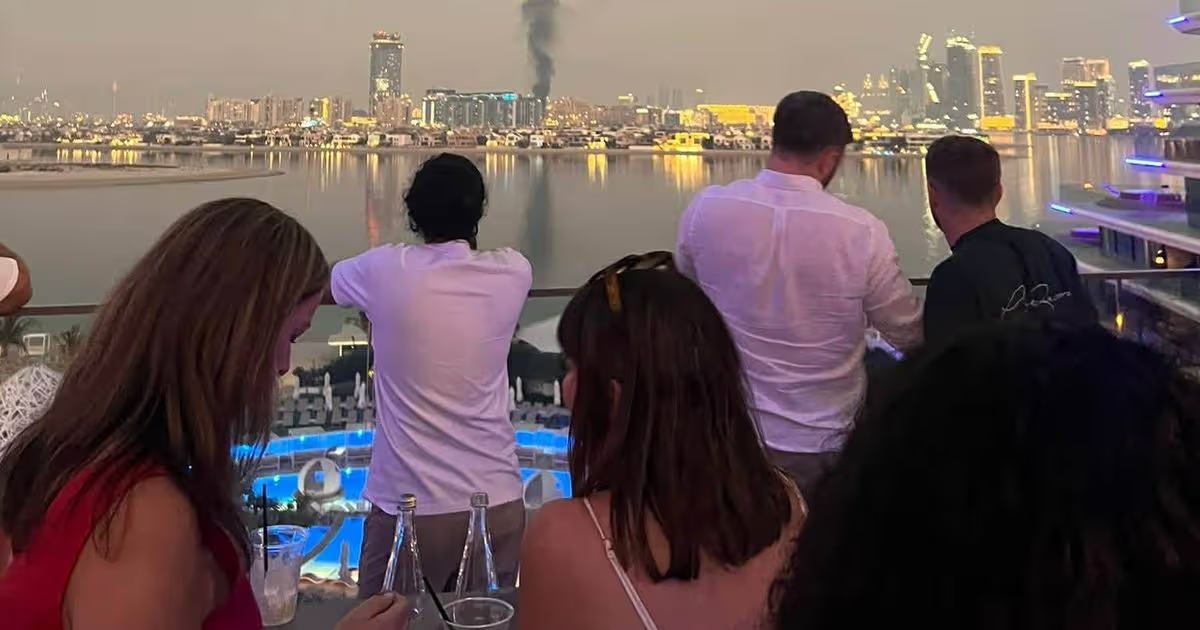
Malcolm, 40, told the Record: “It feels great to be home but it was very worrying. We only got there on the Wednesday. We were at a brunch at the W on the Palm when the missiles flew towards us. At first they told us it was fireworks, but you could feel the vibrations.
Advertisement
“It was half 4 at this point, but once it got dark we started seeing multiple missiles in the sky. Then we started seeing the black plumes of smoke. There wasn’t much news getting out but we knew it was bad. We got a notification to see they had stopped flights. Then we heard a bang, then we saw the smoke.
“Whilst we were still at the party we were told to stay inside. The Fairmont Hotel beside us actually got hit so we went and stayed with my sister. On the Sunday we heard three or four bangs above my sister’s place. It’s terrifying. I’m still so scared for her.”
Carriers operating Middle Eastern routes scrapped or rerouted numerous flights following the strikes, with Emirates Airlines, Qatar Airways and British Airways amongst those scaling back operations due to safety fears. The Edinburgh-bound service was one of just a handful resuming today after thousands of routes were grounded.
Advertisement
Malcolm went on: “Emirates said that flights were suspended but on the app it said our flight was still scheduled. We arrived at the airport today with no idea if we’d get home. We weren’t feeling confident.
“When we boarded the plane it was quite a strange atmosphere. I’m not one of these people who clap on planes but everyone was clapping when it landed. Everyone was tracking the flight path as we travelled. The first hour it was flying over countries that had been hit. That was not a good feeling.
“I’m 40-years-old but my mum has not stopped messaging me. Everyone was so worried about us. I still don’t think it’s sunk in – but we are home.”
The Emirates flight EK23 departed at 3.10pm local time and touched down at approximately 8pm GMT. Long-distance travel across the region continues to face significant disruption as the conflict persists, with airline passengers strongly advised to verify their flight status before making their way to the airport.
Services to London Heathrow, London Gatwick, London LHR, and Manchester also operated on Wednesday, having resumed earlier in the week. An Emirates spokesperson said: “All scheduled Emirates flights to and from Dubai remain suspended until 2359hrs UAE time on March 4, due to airspace closures across the region.
“Emirates continues to operate a limited number of passenger repatriation and freighter flights on 3 and 4 March. We are accommodating customers with earlier bookings as a priority on these limited flights.
“Do not go to the airport unless you have been notified directly by Emirates or hold a confirmed booking for these flights. Emirates continues to monitor the situation, and we will develop our operational schedule accordingly.”
Advertisement
Passengers are urged to visit the airline’s website for the latest updates.
When you tune into Guy Ritchie’s Young Sherlock, you’ll be treated to some onscreen magic from not one but two of the Fiennes family.
Advertisement
The Amazon Prime Video mystery thriller, which doubles as an origin story for the widely-loved Arthur Conan Doyle detective, Sherlock Holmes, is helmed by Hero Fiennes Tiffin, who some may recognise from the After movie quintet.
But that’s not all, he’ll be joined by his uncle Joseph Fiennes, who is stepping into an adjacent role for the show as Sherlock’s father, Silas Holmes, where fans will be able to see the real-life familial chemistry come to roaring life.
‘It’s a luxury that we have the relationship we do and that we are playing the characters that have the relationship they do, because if there is any familiarity that creeps in, it works quite well,’ Hero, 29, told Metro about making the leap from reality to fiction.
His uncle Joseph, famed for his roles in Shakespeare in Love and the Merchant of Venice, among countless others, is quick to agree.
Advertisement
He shared: ‘What we have is what actors are really reaching for all the time through quite hard work and research.
It’s a Fiennes’ family reunion – this time onscreen (Picture: Prime)
‘We get it for free, which is lovely, this familiarity, and so you want to lean into that; if anything, you want to embrace that.’
Joking that, naturally, great British actor Joseph is ‘obviously uncle Joe to me’, Hero acknowledged the impact growing up under his tutelage has been (bolstered, no doubt, by brother Ralph).
‘He’s also an incredible actor whom I’ve watched and, I guess, aspired to be like, so working opposite [him] in multiple capacities was inspiring, but also you make it fun as well,’ he said to a grinning Joseph, who was quick to add that he hoped he isn’t ‘the stodgy old uncle’.
Advertisement
The American Horror Story actor, 55, had similarly glowing words for his nephew, calling him ‘just sublime’, hugely talented’ and ‘having a great sense of leaving no stone unturned.’
Both had nothing but praise for one another after seeing each other in action (Picture: LounisPhotography/ABACA/Shutterstock)
He continued: ‘Off camera, he is such a graceful gentleman with the crew. That’s one thing I observed, which I just thought: “Wow, he’s got it in spades.”
‘He’s got a really, great understanding of caring and how the machine works, and also putting in the work ethic as an actor. It’s wonderful to behold.’
As an origin tale, this certainly goes off the beaten track, with the most notable shift being the unexpected friendship between Sherlock and his arch-rival, Moriarty.
But part of the process is embracing the radical changes.
Advertisement
‘Sometimes, you have a knee-jerk reaction and go: “They haven’t explored Sherlock and Moriarty [as] friends“. But you very quickly start to completely flip it on its head and go: “This actually justifies so much more of what I read in Conan Doyle’s works with this being the case.”‘
The show offers a radically different take on the Holmes tale (Picture: Daniel Smith/Prime)
When it comes to the complicated father-son dynamic specifically, Joseph was compelled by the way creator Matthew used both the source material and Conan Doyle’s real life to fuel his interpretation.
Joseph pointed out: ‘Conan Doyle, I think, had a pretty unstable but brilliant childhood where his father was an illustrator, and also, sadly, an alcoholic.
‘That sense of a relationship, which is fractured and beautiful at the same time, is something that plays out within the family dynamics of the character he invented, Sherlock Holmes, and Matthew Parkhill picked up on it, so it’s really, really rich, and it’s good fun.’
All in all, Hero echoed a boatload of ‘fun’ for anyone who tunes into the show, as well as plenty of ambition to pull something like this off.
Advertisement
Meanwhile, paraphrasing the great crime author himself, Joseph quipped: ‘ Conan Doyle once said: “If you’re feeling low, jump on a bicycle, go for a ride” and Hero, Matthew and Guy have delivered the best exhilarating ride for [eight] episodes. It is one to pick up the spirits.’
Young Sherlock is available to stream on Amazon Prime Video now.
Got a story?
If you’ve got a celebrity story, video or pictures get in touch with the Metro.co.uk entertainment team by emailing us celebtips@metro.co.uk, calling 020 3615 2145 or by visiting our Submit Stuff page – we’d love to hear from you.
North Wales expat Poppy Owen says she fears debris from defensive missiles more than the explosions as Iranian attacks hit UAE
Brit living in Dubai discusses threat posed by debris
Approximately 250,000 British citizens reside in Dubai – a varied population of business professionals, social media influencers, and pensioners. So far, many seem fairly calm despite fierce aerial bombardment from Iranian drones and missiles, which has witnessed tonnes of high explosive fired at locations throughout the Gulf following US and Israeli military actions.
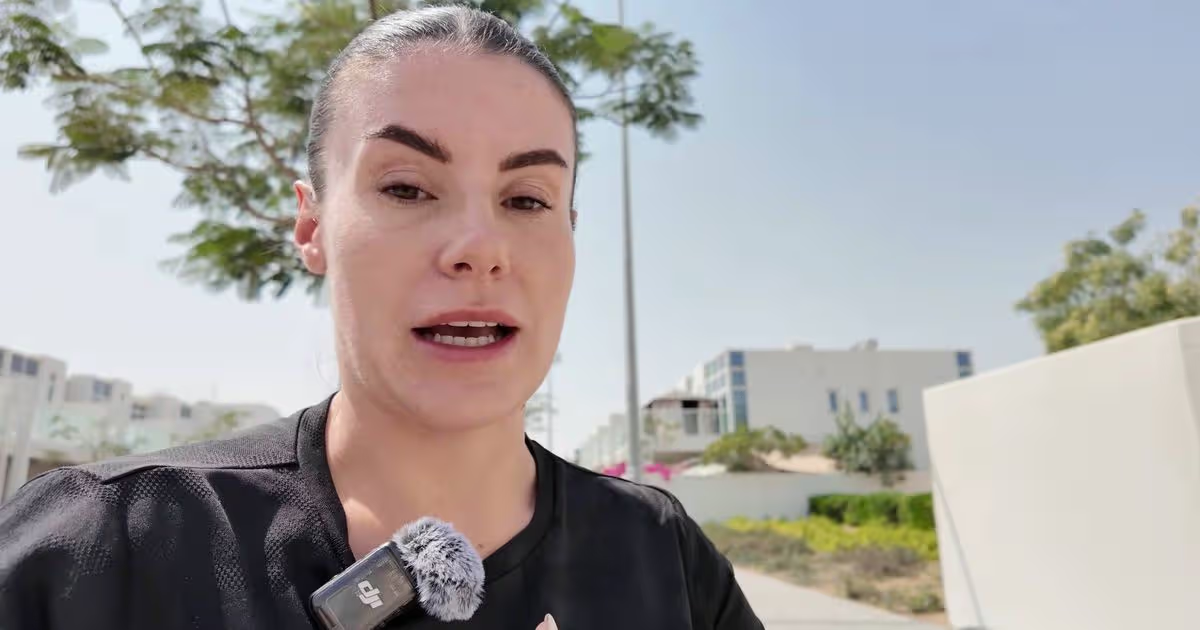
Welsh-born expat Poppy Owen, who for the past three years has lived in the upmarket Damac Hills neighbourhood , situated close to the UAE’s Minhad Airbase, confesses that her body “just went into pure fear and anxiety” during the peak of the weekend’s strikes. In a recent video recorded near her Dubai residence, Poppy reveals that the near-continuous explosions she heard were “too close for comfort.”
Originally hailing from North Wales, Poppy maintains her faith in the wealthy emirate’s extensive missile defence capabilities. A considerable amount of the protective weaponry safeguarding Dubai from approaching drones and missiles is deployed from Minhad Airbase – and it’s this close distance that troubles her most.
“It’s not the explosions that were something to be worried about,” she explains. “It was more the debris that when the explosions happened, it was the debris falling down onto buildings and things and places, that was the thing that we should be scared of most.”
Advertisement
She recounts how she has frequently guided her two young children into their bathroom, a place where they would be safe from shattered glass.
To keep her daughters calm, Poppy has attempted to convince them that the regular explosions and flashes in the sky are part of an extraordinary fireworks display.
Advertisement
Poppy shares: “They were reassured that it was just fireworks and nothing to worry about whereas my body just went into pure fear and anxiety because this is too close for comfort. It’s like ‘How can it be that loud? It must be somewhere quite close.’”.
“It was probably happening every 10 minutes or so. We live next to an airbase in Damac Hills – that’s no secret – and what’s happening is that they are firing missiles from the air base next to us, out towards the attacks coming in.”
Thus far, Dubai’s defensive measures seem to be effective. Whilst most incoming drones and missiles have reportedly been intercepted, some of the UAE’s most iconic structures have suffered damage – including the Fairmont The Palm hotel in the upscale Palm Jumeirah development and the Burj Al Arab.
Advertisement
Dubai International Airport has also allegedly been hit by a drone, as well as Abu Dhabi’s Zayed International Airport, where one fatality has been reported.
Yasser Elsheshtawy, a professor of architecture at Columbia University who resided in Dubai for two decades, expressed to the BBC that despite only a handful of Iranian strikes being successful, the city’s meticulously crafted image has sustained lasting damage.
He stated: “When you begin to see plumes of smoke rising in the city and sounds of explosion in some of the most exclusive places, that shatters that image of Dubai as this haven of security and safety.”
The scholar further noted that even minor structural harm to iconic buildings could lead to broader reputational implications.
Advertisement
“It will suffer for years to come,” he declared.
Poppy says that aside from an urgent grocery run, she and her family have been living under circumstances akin to the Covid-19 lockdown.
“We were just indoors because that’s what we got told to do. We got told by the government to stay indoors and close our windows, and then all day really it was just hearing the missiles and stuff like that being shot out.
Advertisement
“We were just waiting for the bang, and then any bangs that were happening and shaking the villa doors, at that point we were like, ‘Right, we need to get into the bathroom and just protect the children.’”.
She mentions that information has been scarce, limited to official government announcements and the sound of defensive missiles being launched.
While she and her husband have discussed the idea of leaving the country, they have chosen to stay put for the time being.
“To be honest, the best thing you can do is just stay indoors in the comfort of your own home with all your essentials and ride it out.”
Over Labour’s 18-month tenure, its set-piece fiscal announcements have featured headline-grabbing housing policy – the pending mansion tax, the two per cent hike on property income tax, the abolition of non-dom status, the increase in social housing funding and the relaxing of planning law.
Other measures such as VAT on private school fees have made an impact on certain localised housing markets too.
However, this week’s Spring Statement will be remembered for the things the Chancellor did not say and the relevance of her silence to homes sales, house price movement, and mortgage deals this year.
‘If you have a fixed mortgage rate offer on the table – take it’
Advertisement
Mortgage advisor Alexander Hall reported in February that mortgage approvals had climbed continually over the last three years while estate agents operating in high-demand areas such as Walthamstow are seeing multiple offers and sealed bids.
The anticipation of an uptick in sales had been fuelled by the expectation that interest rates are going to continue to fall over the next 12 months.
Considering Rachel Reeves announced yesterday that inflation has fallen faster than predicted, this very much looked on the cards. How quickly things can change.
Since the US strikes on Iran, and the Islamic Republic’s response, oil prices have soared.
Advertisement
Importers such as Asia, Europe and the UK will be hit by higher prices and the longer the conflict goes on, and the more disruption to passage and supply, the higher energy prices will go.
This would mean interest rate rises too as the Bank of England battle to get inflation back under control.
“The conflict in the Middle East has lifted energy prices and shrunk central bank rate cut expectations. Market expectations of a near-term base rate cut, perhaps as early as this month, have now reduced and we could see lenders increase mortgage rates depending on how long this goes on,” says Mark Harris, chief executive of mortgage broker SPF Private Clients.
“Borrowers who need the certainty of a fixed-rate mortgage to help with budgeting and are planning on taking one out in the next few weeks or months may wish to secure a product now.
Advertisement
“Mortgage rates can usually be booked up to six months before you need one,” he adds.
London housing market in a holding pattern, again
Interest rate movement is only the latest in a stream of reasons making potential buyers pause.
Many stalled last year to get through the November Budget. This year many buyers are waiting for more stock to be launched in the spring market and for more favourable mortgage repayment rates.
Advertisement
News of global instability and the impact that may have on energy prices, inflation and therefore the cost of living may well put the London housing market into a holding pattern once again, explains Jeremy Leaf, former chairman of the Royal Institution of Chartered Surveyors.
“Much will depend on the length of any disruption and the potentially negative impact on energy prices and inflation. In those circumstances, any delay in the level and pace of anticipated base-rate reductions is likely to prompt buyers and sellers to press the pause button at least until a closer direction of travel becomes apparent,” Leaf says.
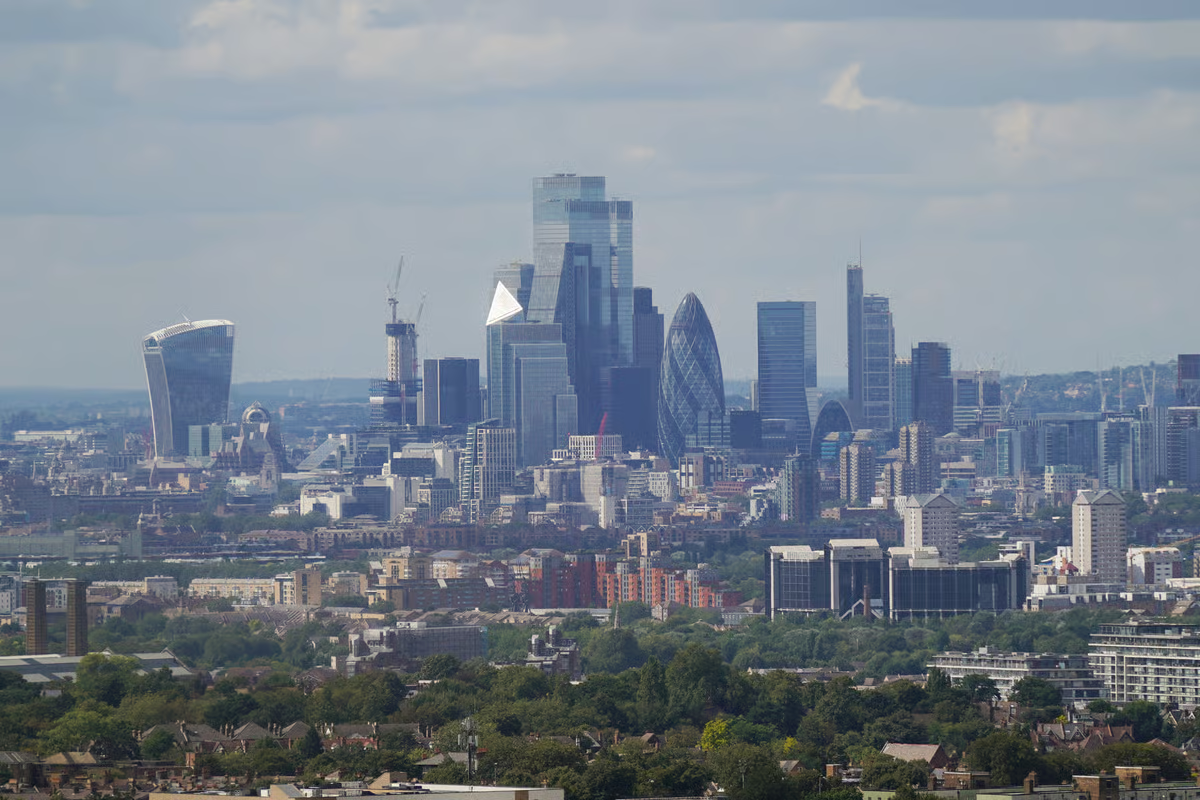
Rob Anderson, research director at Centre for London, adds: “London is the most globalised city in the UK and one of the most globalised cities in the world. So international macro forces do impact London’s housing market.”
UK unemployment its highest in a decade
Advertisement
As well as skirting around the potential impact of the Middle East conflict on UK inflation, there were other worrying references dropped into what was described by the Shadow Chancellor as a “surrender statement”.
Reeves said gross domestic product (GDP) will now grow “slightly slower in 2026” than forecast at the November budget but will increase by more than was expected in 2027 and 2028.
Of course, escalating and open-ended conflict in the Middle East could mean the downgrading of this longer-term forecast too.
The Chancellor also said unemployment is set to peak later this year, after already rising, but will fall from 2027-2030, ending 4.1 per cent lower than it was in 2024.
Advertisement
Anderson says unemployment is at its highest for a decade and that unemployment in London – due to its reliance on struggling sectors such as hospitality, tourism and retail – could be higher than the rest of the UK.
This, along with general concern about the lack of economic growth and the jobs market, feeds into inertia in the housing market with buyers hesitant to commit to such an enormous, life-altering purchase.
Are the Dubai boomerang buyers back?
Price drops in prime central London (PCL) have been one of the factors dragging on London’s property market recovery.
Advertisement
Savills data released in January revealed a 25 per cent fall in agreed deals on homes worth more than £1 million in the 12 months to November 2025.
Prices in central London fell 4.8 per cent across 2025 as a whole.
Muted activity was explained by missing international buyers who have left the country due to the hostile tax stance by the Labour government.
Over the weekend many of London’s high-end property agents and advisers spoke out, flogging the message that high net worth individuals are fleeing Dubai and Abu Dhabi and heading back to the luxury core of the UK capital.
Advertisement
Becky Fatemi of Sothebys International Realty in central London is more measured.
She says Middle Eastern buyers were already back in town. “Last year we saw a pause in activity with international buyers fearful of more anti wealth policy in the [November] Budget. This did not happen and from then we saw more Middle Eastern buyers return. In fact, the time to buy, for reduced pricing, was then,” she says.
“I am not seeing buyers pulling out of their Dubai deals but they are questioning being there full time, and many have decided to keep their base in London instead of selling it.
“London is still seen as a safe space and compared to the likes of Singapore and the US it is easy to get in and out,” she adds.
Advertisement
It’s not all doom and gloom
This Spring Statement was not trailed as a major fiscal event and there is a stability created by a lack of change.
“It is positive that we didn’t see a repeat of the damaging uncertainty that preceded last year’s Autumn Budget. And the Chancellor was right to reiterate the positive steps the Government has taken.
“These include abolishing the two-child benefit limit, which will help tens of thousands of children in the capital, and reforms to the planning system, which should help build more homes for Londoners,” says Anderson.
Advertisement
Reeves also made the right noises – if you are a housebuilder or a first-time buyer.
She referenced “more affordable housing” and helping “the builders not the blockers” although did not put any detail behind these sentiments.
As Anderson puts it: “The [housebuilding and homebuying] system in London is locked because we cannot build homes cheaply enough to sell at prices that people can afford.”
But there are indications that the Government realises this and is forming a plan behind the scenes.
Advertisement
Only last week the Chancellor met with the leaders of 13 building societies to discuss how lenders can help wannabe first-time buyers become homeowners, while one medium-sized developer in the southeast met with a representative in Number 10 to discuss a replacement Help to Buy product.
On the flipside, the void of activity that was the Spring Statement is creating quite the wishlist ahead of the Autumn Budget.
“Looking ahead to the Autumn Budget, which is the Government’s big opportunity for policy change this year, we would like to see stamp duty properly looked at.
“The current bandings have not kept pace with house prices and as a result less than half of homes in England are now stamp-duty free for first-time buyers,” says Colleen Babcock, property expert at Rightmove.
Advertisement
While lack of reform in the Spring Statement compounds the housing affordability crisis in London, expectations are certainly building that the Autumn Budget may finally bring some solutions.
In response, the school has allocated part of its budget towards further staff training and equipment for allergies. “It’s a small amount to have them there and make sure everyone is safe,” said Houghton, who meets in-person with parents of children with allergies to ensure a personalised medical plan is in place.
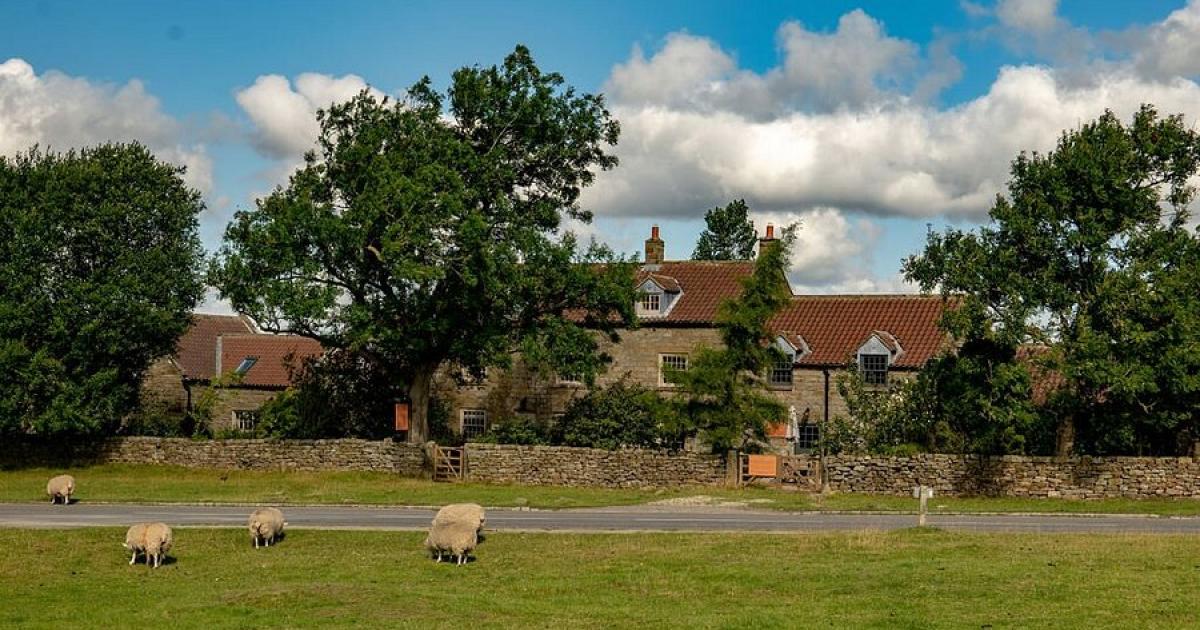
The Homestead Kitchen, set in an 18th-century stone-built farmhouse at Prudom House, has quickly established itself as a destination restaurant in its own right.
The Homestead Kitchen (Image: TRIPADVISOR)
Opened in November 2021 by chef-owner Peter Neville and his partner Cecily Fearnley, the couple have transformed the rural property into a relaxed fine-dining restaurant, family home and self-contained holiday cottage.
The Homestead Kitchen holds an impressive 4.8-star rating from 157 reviews.
Diners frequently describe the experience as “first class”, “just fabulous from start to end” and “one of the best” meals they have had in North Yorkshire.
Advertisement
Nestled against the rolling backdrop of the North York Moors National Park, the restaurant draws inspiration directly from its surroundings.
The North York Moors and their produce sit at the heart of the menu.
Moorland roe deer, Whitby crab and ingredients harvested from the flourishing on-site kitchen garden feature prominently in dishes that diners say are hearty and packed with flavour.
Advertisement
“We pride ourselves on having built a flourishing kitchen garden, growing organic vegetables, fruits and herbs,” says Peter Neville.
The Homestead Kitchen (Image: TRIPADVISOR)
“In our small orchard, we are encouraging the meadow to re-wild, using the flowers in the restaurant. Our sustainability mission is always changing and developing.”
The menu follows the seasons, shaped by what is growing in the garden, sourced from trusted local suppliers, or even donated by residents with a surplus of homegrown produce.
Diners can choose from a fixed-price lunch menu, an à la carte selection or, for special occasions, a tasting menu.
Advertisement
Recent reviews mention squid ink doughnuts, homemade bread with kipper butter, beautifully cooked meat dishes, vegetarian options and what one guest described as “the best fish pie ever”, followed by strawberries and sorbet.
The restaurant’s décor and views across the moors add to the sense of occasion.
On sunny days, guests can sit outside, while in winter the farmhouse setting offers a cosy retreat from frosty moorland walks.
Advertisement
Service is another recurring highlight in reviews, with staff described as friendly, knowledgeable and attentive.
One visitor who said they had spent decades dining in London’s top restaurants said the end-to-end experience was among the best they had enjoyed in years.
The Homestead Kitchen caters for a range of dietary requirements, including vegetarian, vegan and gluten-free options, and offers free off-street parking for visitors.
Open for lunch and dinner from Wednesday to Sunday (with Sunday lunch served from noon), it has also earned recognition from the Michelin Guide for its “good cooking”, further cementing its reputation as a “must-visit for food lovers exploring the North York Moors”.
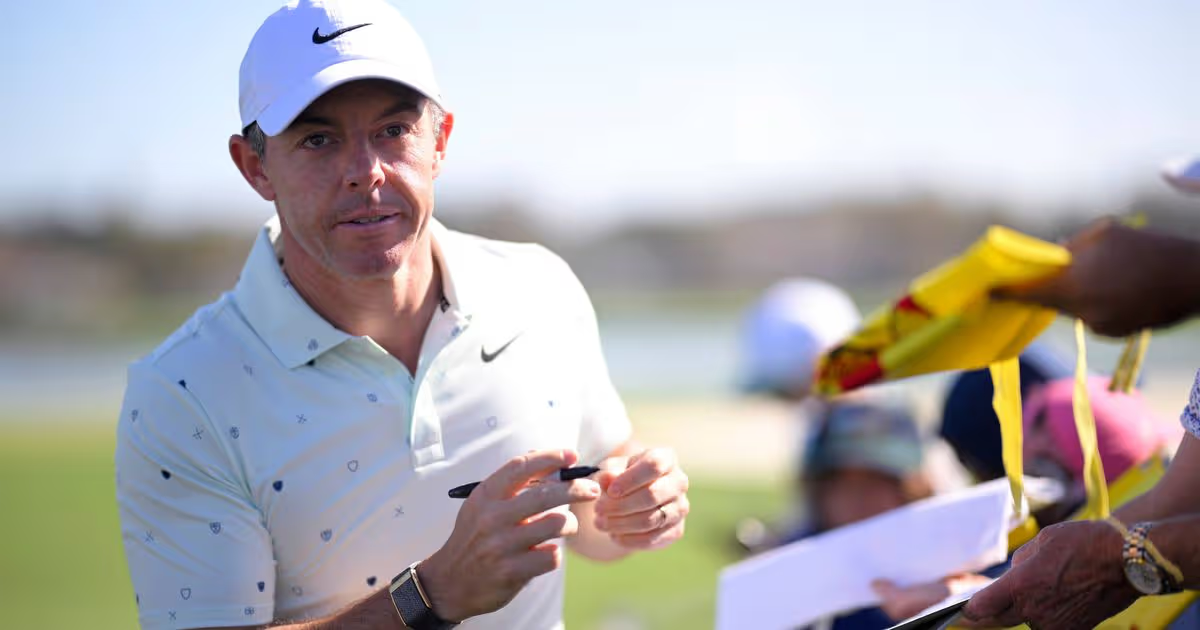
Rory McIlroy said that a “generous” offer to LIV players should not be dismissed, adding that the DP World Tour can only do “so much to accommodate these guys”
Rory McIlroy believes it was unfortunate that Jon Rahm declined the “generous” offer put forward by the DP World Tour, which would have cleared any obstacle to the Spaniard’s Ryder Cup eligibility.
Advertisement
Eight LIV players, including Tyrrell Hatton – a champion alongside McIlroy and Rahm in Rome and New York – accepted the conditions which required them to settle all outstanding fines, withdraw their appeals and pledge to participate in additional tour events.
Rahm turned down the proposal, alleging the DP World Tour was “extorting” players, and will persist with his appeal against the reported £2million-plus penalties he has accumulated from competing in rival tournaments.
“If you asked any DP World Tour member about the deal that they have cut with the LIV guys, I think they would all say that it was pretty generous,” said McIlroy.
“It’s a much softer deal than what Brooks (Koepka) took to come back and play on the PGA Tour.
Advertisement
“There’s a reason that eight of the nine took it because they probably think the same thing and one guy thinks a little differently and that’s a shame. He’s obviously well within his rights to think that way.
“The European (DP World) Tour can only do so much to accommodate these guys.”
Should Rahm’s appeal prove unsuccessful, he would remain liable for the fines, plus additional penalties accumulated as he continues to compete in LIV events without official authorisation. However, if he continues to resist payment, his DP World Tour membership could be jeopardised, potentially affecting his ability to participate in next year’s Ryder Cup at Adare Manor.
Advertisement
Here, Luke Donald will attempt to become the first captain to secure three consecutive victories.
“If you want to play on the Ryder Cup you have to be a member of the DP World Tour. You have to abide by the rules and regulations,” McIlroy further explained, stating that being asked to play two events in addition to the four required for membership “isn’t a heavy lift”.
“Look, the Ryder Cup is bigger than any one person. It’s bigger than all of us. We come and go. Players pass through the system.
“I think we should all be grateful that we have a platform like the Ryder Cup that we can play on and that we can showcase our skills and be a part of something that’s obviously way bigger than ourselves.
Advertisement
“At the end of the day it’s about the team and no one player is bigger than the team.”
Want to see more of the stories you love from Belfast Live?Making us your preferred source on Googlemeans you’ll get more of our exclusives, top stories and must-read content straight away. To add Belfast Live as a preferred source, simplyclick here.
Zoja Skubis, who is the youngest Polish woman to summit Manaslu (8,163 m) and Mount Everest (8,849 m) at just 19 years old, also gets her own Barbie doll, as does Stephanie Gilmore, an Australian professional surfer who is the first woman to achieve eight World Surf League (WSL) World Championship Titles.
More than 130,000 Brits have registered their presence in the Middle East, trapped overseas as the war between Iran and the US and Israel continues to escalate.
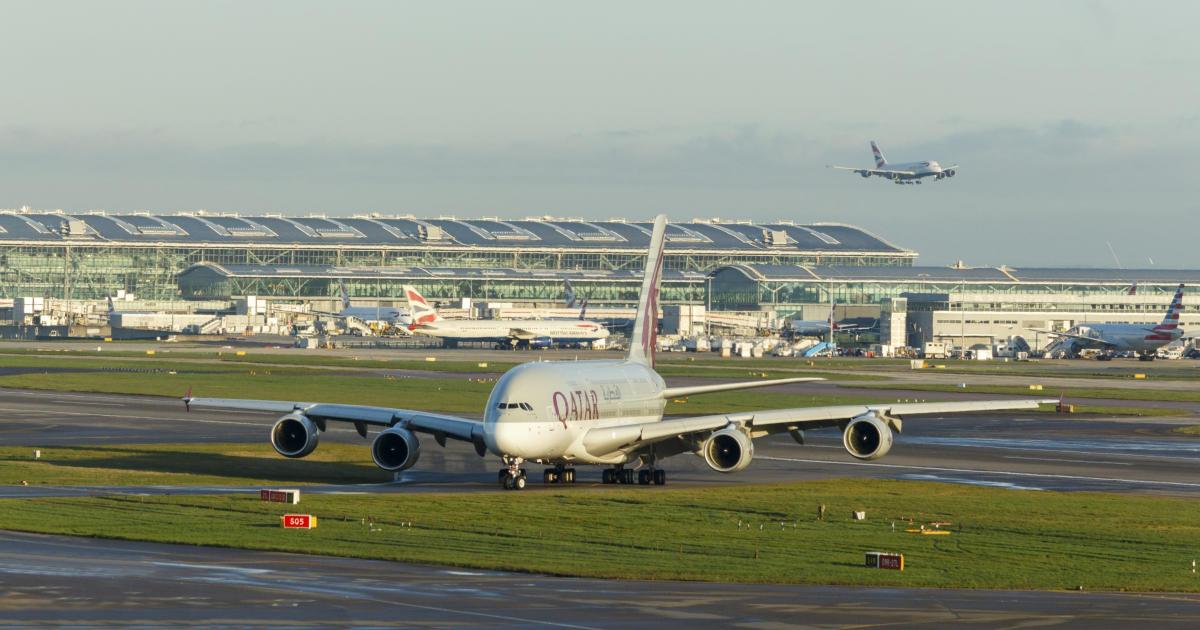
Airspace over nine countries in the Middle East remains closed (or partially closed), affecting some of the busiest airports in the world, including Dubai International Airport and Hamad International Airport (Doha, Qatar).
More than 20 major airlines have been forced to cancel hundreds of flights worldwide as a result, impacting Brits travelling abroad.
Advertisement
Airspace closures in place in the Middle East
The Airspace closures currently in place across the Middle East (at the time of writing), according to Flightradar24 , are:
Total closure
Iran
Iraq
Qatar
Bahrain
Kuwait
Syria
Israel
Partial closure
Saudi Arabia (area bordering Iraq and the Persian Gulf)
United Arab Emirates
Airlines affected by the Middle East conflict
Direct
The main airlines offering direct flights between the UK and the Middle East, affected by the ongoing conflict, are:
British Airways
Virgin Atlantic
Emirates
Etihad Airways
Qatar Airways
Turkish Airlines
Pegasus Airlines
Wizz Air / Wizz Air UK
Lufthansa Group (Lufthansa, Swiss, Austrian Airlines)
Air France
KLM
Norwegian
ITA Airways
Update: Qatar Airways flight operations remain temporarily suspended due to the closure of Qatari airspace.
Qatar Airways will resume operations once the Qatar Civil Aviation Authority announces the safe reopening of Qatari airspace. A further update will be provided on 06…
The airlines affected that are more likely to impact Brits who have connecting flights travelling from the Middle East include:
Air India
IndiGo
Air Arabia
LOT Polish Airlines
Cathay Pacific
Air Astana
Aegean Airlines
Azerbaijan Airlines
Other regional airlines carrying Brits around the Middle East have also been impacted.
When will flights resume in the Middle East?
All flights with the following major airlines remain suspended (at the time of writing):
Qatar Airways (update on March 6)
Wizz Air (update on March 7)
Pegasus Airlines
Lufthansa (update on March 6 and 8)
KLM (update on March 5)
Air France (update March 5)
Other airlines have resumed “some” flights from the Middle East:
Virgin Atlantic
Virgin Atlantic said it has begun operating some flights in the Middle East “following our latest assessments and in line with guidance from international aviation authorities”.
Advertisement
Its website adds: “Any decision to resume services is made only after thorough risk reviews and careful consideration of the latest intelligence available to us.
“While we intend to operate some flights as planned, the situation remains dynamic.
“We continue to monitor developments closely and will make further changes at short notice if required to ensure the ongoing safety and security of our customers and crew.
“We have also rerouted some of our flights. As a result, some of our services are operating on adjusted routings and may experience slightly longer flight times.”
Advertisement
British Airways
British Airways (BA) is currently unable to operate flights from several destinations, including Abu Dhabi, Amman, Bahrain, Doha, Dubai and Tel Aviv.
However, airspace over Oman is now open, and BA said it is working with the relevant authorities to schedule a flight from Muscat to London, departing at 02:30 local time on March 5.
Anyone currently in Oman wishing to travel on this flight is urged to contact BA +44 203 467 3854.
Advertisement
Emirates
All scheduled Emirates flights to and from Dubai remain suspended until 11.59pm on March 4 (UAE time), due to airspace closures across the region.
However, Emirates said it continues to operate a “limited number” of passenger repatriation and freighter flights (on March 3 and 4).
Emirates said: “We are accommodating customers with earlier bookings as a priority on these limited flights.
“Please do not go to the airport unless you have been notified directly by Emirates or hold a confirmed booking for these flights.”
Advertisement
It added: “Emirates continues to monitor the situation, and we will develop our operational schedule accordingly.
Etihad
All Etihad Airways’ scheduled commercial flights to and from Abu Dhabi remain suspended until Thursday, March 5.
However, the airline may run some repositioning, cargo, and repatriation flights in coordination with UAE authorities, and “subject to strict operational and safety approvals”.
Advertisement
The Etihad website adds: “Guests should not travel to the airport unless they have been contacted directly by Etihad and advised to do so.”
RECOMMENDED READING:
Which airlines are offering refunds?
Most of the major airlines are offering refunds for passengers affected by cancelled flights or for those who are set to travel on an upcoming date:
British Airways – customers travelling up to and including March 8 can request a refund
Emirates – up to and including March 10
Etihad Airways – up to and including March 10
Qatar Airways – up to and including March 10
Pegasus Airlines – up to and including March 12
Lufthansa Group (Lufthansa, Swiss, Austrian Airlines) – up to and including March 15
KLM – up to and including March 9
Passengers with these affected airlines are also able to re-book flights for a later date.
More information can be found on the relevant airlines website.
Up to a million people in the UK are already diagnosed with heart disease with a futher 200,000 being added every year
Experts have outlined several warning signs that mean you should seek medical attention, as they could point to a potentially severe health issue. They warn that one particular symptom – feeling lightheaded or faint – suggests a vital organ isn’t functioning properly.
Advertisement
The British Heart Foundation states this sensation can indicate heart failure – a condition currently affecting up to a million people across the UK. NHS data reveals a further 200,000 people receive this diagnosis annually, with many cases only identified following an emergency hospital admission.
Whilst heart failure cannot be cured, various treatments exist to help control symptoms and enhance quality of life. Since certain lifestyle alterations can significantly improve your well-being, it means it is important to be diagnosed as quickly as possible, reports the Mirror.
The British Heart Foundation has outlined several key warning signs to monitor – and explained when to consult your GP. Its website states: “When your heart is not pumping blood as well as it should, it means you’re not getting enough oxygen.
“This affects how your body works, including your breathing and muscles. This causes some of the main symptoms of heart failure.”
Advertisement
It said signs included:
fainting or feeling lightheaded
feeling very tired (fatigued) or weak at rest which gets worse with movement
shortness of breath when you’re active or resting
swelling in your feet and ankles which can spread to your lower body
It continued: “You should see your GP as soon as you can if you experience any of these symptoms. If you are struggling to breathe or have chest pain, call 999 for immediate medical assistance.”
Causes of heart failure
Heart failure develops due to various factors, most frequently following a heart attack, cardiomyopathy – a condition affecting the heart muscle – or high blood pressure, which places excessive strain on the heart. The condition may emerge suddenly or progress gradually over months or years.
Less frequent triggers include irregular heart rhythms, anaemia, congenital cardiac conditions and heart valve disease. Consuming alcohol beyond the recommended limit – currently 14 units or fewer weekly – can also contribute to the condition.
Stages of heart failure
According to the British Heart Foundation there are 4 stages or classes of heart failure. It said: “These stages describe how serious your heart failure is.” The stages are:
Advertisement
Stage 1 – you do not have symptoms during everyday activity
Stage 2 – you feel normal when resting but physical activity causes symptoms
Stage 3 – you feel normal when resting but a little physical activity causes symptoms
Stage 4 – you cannot do any physical activity without symptoms and may feel uncomfortable while resting
What treatments are available
The charity said: “There is not a cure for heart failure but available treatments can help manage symptoms and improve your quality of life. Your doctor will discuss treatments with you depending on what stage they’ve diagnosed you with.”
Treatments for heart failure include:
A medical device such as a pacemaker or ICD – a pacemaker helps control your heart rate to reduce the demand on your heart. An ICD detects and treats dangerous, irregular heartbeats
Heart surgery – done to improve blood flow to your heart or to repair/replace a faulty valve that is putting strain on your heart
Medicine – to protect and improve your heart function, improve your symptoms and reduce fluid build-up
Managing heart failure
The British Heart Foundation said: “Making changes to your lifestyle is another way to improve your health.” It says changes to try include:
Keeping active
Keeping to a healthy weight and diet
Limiting how much alcohol you drink (less than the recommended 14 units per week)
Stopping smoking and using other tobacco products
It adds: “Living a healthier lifestyle can be hard at first, but it’s important for your overall quality of life.” It advises reading its Eat Better booklet for tips on eating healthier.
The charity added: “There is no cure for heart failure. This can be upsetting and raise concerns about your life expectancy. If this is something you’re worried about, talk to your GP or a specialist heart failure team. They will explain what to expect during your treatment and give you the information and support you need.
“Conversations about life expectancy and death are difficult. You may need to discuss things like care, finances and Wills. Sorting these things out when you feel well enough to do so can help give you and your loved ones peace of mind.”