

Crypto World
The Last 24 Hours in Crypto


A closer look at some of the most important stories you might have missed in the past 24 hours.
A lot happened in the world of cryptocurrencies over the last 24 hours. We have handpicked a few of the more important titles you may have missed, so let’s have a quick look.
Google Warns of New iPhone Exploit Targeting Crypto Users
Google researchers have flagged a relatively powerful exploit kit that they call “Coruna.” It is capable of infecting iPhone devices and potentially jeopardizing sensitive information, including seed phrases of cryptocurrency wallets. The toolkit contains a total of 23 vulnerabilities across five exploit chains that target devices running older versions of iOS, ranging from iOS 13 to 17.2.1.
Multiple security analysts say that attackers have managed to deploy the exploit through compromised websites and fake crypto-oriented platforms. Once a vulnerable device visits the website, malware can scan messages and apps like MetaMask to locate wallet credentials or financial information.
The exploit has originally been linked to espionage campaigns before spreading to cybercriminal groups with financial motives. This highlights how advanced surveillance tools can leak into the broader criminal ecosystem, as well as the critical importance of maintaining technological hygiene, updating your phone’s software, and following mandatory security tips when interacting with crypto platforms.
Morgan Stanley Taps Coinbase and BNY Mellon for Bitcoin Infrastructure
Morgan Stanley is preparing to deepen its involvement in crypto infrastructure. The banking behemoth is supposedly considering launching a Bitcoin investment product. The bank intends to rely on Coinbase for cryptocurrency custody services, as well as on BNY Mellon for additional asset custody related to the proposed Morgan Stanley Bitcoin Trust.
The ETF itself will hold Bitcoin directly, and the custody structure will primarily rely on offline cold storage to reduce hacking risks, according to the filing.
The move signals growing institutional demand for regulated access to crypto products. Major financial institutions have undoubtedly increased their involvement and partnered with well-known crypto firms rather than building their own infrastructure in a bid to accelerate Wall Street’s venture into the digital asset industry.
You may also like:
Zerohash Applies for U.S. National Trust Bank Charter
Popular crypto infrastructure firm Zerohash has formally applied for a National Trust Bank Charter with the U.S. Office of the Comptroller of the Currency (OCC). This step could enable the company to operate as a federally regulated trust bank.
If the application is approved and the charter granted, this would allow Zerohash to further expand its services to niches such as digital asset custody, stablecoin management, and tokenized asset infrastructure under a unified federal regulatory framework.
The company is already powering crypto integrations for institutions, which include Morgan Stanley, Stripe, and Interactive Brokers. The move comes a day after Kraken became the first crypto company to obtain a Fed Master Account.
Venture Giant a16z Targets $2 Billion for a New Crypto Fund
Silicon Valley venture capital powerhouse Andreessen Horowitz (a16z) is raising around $2 billion for a fund focused on investing in the cryptocurrency industry. According to the reports, the round can close as early as the first half of this year.
Historically, a16z has been one of the most prominent VCs in the Web3 ecosystem, backing major projects and startups across blockchain infrastructure, crypto apps, DeFi, and related areas.
Despite the ongoing crypto winter, a new fund of this size suggests that venture investors still see long-term opportunity, highlighting that periods of pressure can also be times of opportunity. Recall that Dragonfly – another crypto-oriented VC – recently launched their fourth fund worth $650 million.
Tether Makes $1.5 Billion Bet on AI Sleep Tracking
Last but not least, we have the stablecoin giant Tether making a strategic investment in the AI-powered mattress and sleep-oriented technology company Eight Sleep at a $1.5 billion valuation.
The investment seems to be part of the firm’s broader strategy to diversify and expand well beyond crypto and stablecoins into emerging sectors such as health technology and artificial intelligence.
Binance Free $600 (CryptoPotato Exclusive): Use this link to register a new account and receive $600 exclusive welcome offer on Binance (full details).
LIMITED OFFER for CryptoPotato readers at Bybit: Use this link to register and open a $500 FREE position on any coin!

Crypto World
Exclusive: Yuliya Barabash Says the Biggest Winners of Crypto’ Next Cycle May Be the Most Regulated

If you have been in crypto for a while, you have probably noticed how quickly the industry has been maturing in terms of regulation.
Not long ago, the market lived in a gray zone. Exchanges launched overnight. Startups issued tokens across borders. Regulation struggled to keep up with how fast the space was moving.
Then came FTX and everything changed.
“The game completely changed after FTX and Celsius collapsed, exposing just how badly customer funds were being mismanaged,” said Yuliya Barabash.
Since those failures, regulators across the world have started moving much faster. New rules are appearing, oversight is tightening, and crypto companies are being pushed toward stronger compliance.
But this shift raises a question. Is regulation helping the industry grow up, or could it end up slowing the innovation that made crypto possible in the first place?
In an exclusive interview with Cryptonews, Barabash, Yulia Barabash, founder of consulting company SBSB Fintech Lawyers, shares her views on how regulation is reshaping crypto, why institutions now care more about compliance, and what the next phase of the industry could look like.
The Post-FTX Crypto Regulatory Era
According to Barabash, the collapse of several major crypto firms forced regulators to act more aggressively.
High-profile failures revealed serious problems in how some platforms handled customer funds and risk management. Once those issues became impossible to ignore, regulators began accelerating new frameworks.
“After FTX and Celsius, regulators could not just sit back anymore,” Barabash explained.

Authorities began focusing much more on transparency, investor protection, and anti-money-laundering rules.
For crypto companies, this meant the environment started changing quickly. Operating in regulatory gray zones became much harder.
Institutions Now Want Regulated Platforms
Another big shift is how institutional investors approach crypto.
Large investors are becoming far more selective about where they put their money. This is very different from how things were back in 2021.
Many now prefer licensed exchanges, regulated infrastructure, and platforms that operate within clear legal frameworks.
They want to know exactly how a platform operates before committing capital to reduce risks.
As Barabash points out, this is creating a clear divide in the industry. Companies that invest in compliance and licensing are increasingly attracting institutional attention, while loosely regulated platforms are becoming less appealing.
MiCA and Europe’s Regulatory Push
One of the biggest regulatory developments in recent years is Europe’s Markets in Crypto-Assets regulation, known as MiCA.
The framework aims to introduce consistent rules for crypto companies operating across the European Union.

Barabash believes this could play an important role in building trust around the industry.
Clear regulations can make it easier for institutions and traditional financial firms to participate in crypto markets.
At the same time, some companies worry that stricter requirements could increase costs and make it harder for smaller startups to compete.
But Really, Does Crypto Regulation Slow Innovation?
The idea that regulation might slow innovation is a common concern in the crypto community.
Barabash sees it a bit differently.
“Regulation does not necessarily kill innovation,” she said. “Sometimes it actually creates the structure needed for new technologies to grow safely.”
Without clear rules, many institutional investors and banks remain cautious about entering the space.
In that sense, stronger regulation can help unlock larger pools of capital and push the industry toward long-term growth.
Why Banking Relationships Still Matter
One area that often gets overlooked is the role of traditional banking infrastructure.
Crypto companies still rely heavily on banks for payment processing, fiat on-ramps, and financial services. Without those partnerships, even large platforms can run into serious operational challenges.
That is why compliance and anti-money-laundering programs have become so important.
For many crypto businesses, maintaining stable banking relationships can be just as critical as launching new products.
Political Leadership Still Shapes Crypto Policy
Regulation does not move in a vacuum. Politics often plays a bigger role than many people expect.
Barabash pointed out that regulatory priorities can shift depending on who is in charge. Changes in political leadership or institutional direction can influence how aggressively governments push crypto policies.
The digital euro is a good example.
The project has been discussed for years, but its timeline and direction have shifted several times as policymakers debated privacy concerns, financial stability, and the role of central bank digital currencies.
According to Barabash, leadership changes inside institutions like the European Central Bank could still influence how quickly the digital euro moves forward and what form it eventually takes.
For the crypto industry, that uncertainty means regulation will likely continue evolving alongside political priorities.
In other words, the rules of the game may keep changing as governments figure out how digital assets fit into the broader financial system.
The Industry Is Growing Up
The crypto industry is clearly entering a new phase.
The early days of rapid experimentation and limited oversight are slowly giving way to a more structured environment.
While regulation may introduce new challenges, it could also help build the trust needed for broader adoption.
According to Barabash, the companies that succeed in the next cycle will likely be those that adapt to this new reality.
“The industry is maturing,” she said. “And that maturity will shape where crypto goes next.”
The post Exclusive: Yuliya Barabash Says the Biggest Winners of Crypto’ Next Cycle May Be the Most Regulated appeared first on Cryptonews.

The launch of X Money has moved into a high-profile limited external beta, sparked by recent social media activity from Elon Musk and William Shatner.
Summary
- X Money has entered a high-profile external beta, highlighted by posts from Elon Musk and William Shatner promoting early access.
- The initial version focuses on peer-to-peer fiat payments, a debit card, and cash deposits with up to 6% APY, despite speculation about future crypto integration.
- Musk continues pushing X toward becoming a single hub for financial services, with the platform already holding money transmitter licenses across 40+ U.S. states.
While speculation regarding cryptocurrency integration is high, current reports indicate the initial rollout focuses primarily on fiat services.
Shatner tapped for X Money beta rollout
Actor William Shatner recently confirmed his involvement in the beta, posting about the “42nd X Money opportunity”. With X’s permission, Shatner has been auctioning invites to the payment service for charity. His posts revealed key features of the service, including:
- 6% Annual Percentage Yield (APY) on cash deposits.
- A $25 welcome gift for new beta users.
- An all-black X debit card offering cashback on eligible purchases.
Musk’s “Everything App” vision
Elon Musk reinforced the significance of the launch by retweeting screenshots of the new interface and debit card.

He also share a post from Teslaconomics on X Money stating, “This will be big”.
Musk has described X Money as the “central source of all monetary transactions,” aiming to eliminate the need for traditional bank accounts. This move returns Musk to his roots at X.com, the online bank he founded in 1999 that eventually became PayPal.
X Money is currently in closed internal testing, with a broader, limited external beta expected to expand in March and April 2026. The platform has already secured money transmitter licenses in over 40 U.S. states and is registered with FinCEN.
Regarding crypto, although Musk has hinted at future support for assets like Dogecoin, the current beta focuses on peer-to-peer fiat transfers and Visa-partnered payments.
However, the inclusion of “Smart Cashtags”—intended for seamless in-app trading—suggests that official crypto and stock integration may follow shortly after the initial launch.
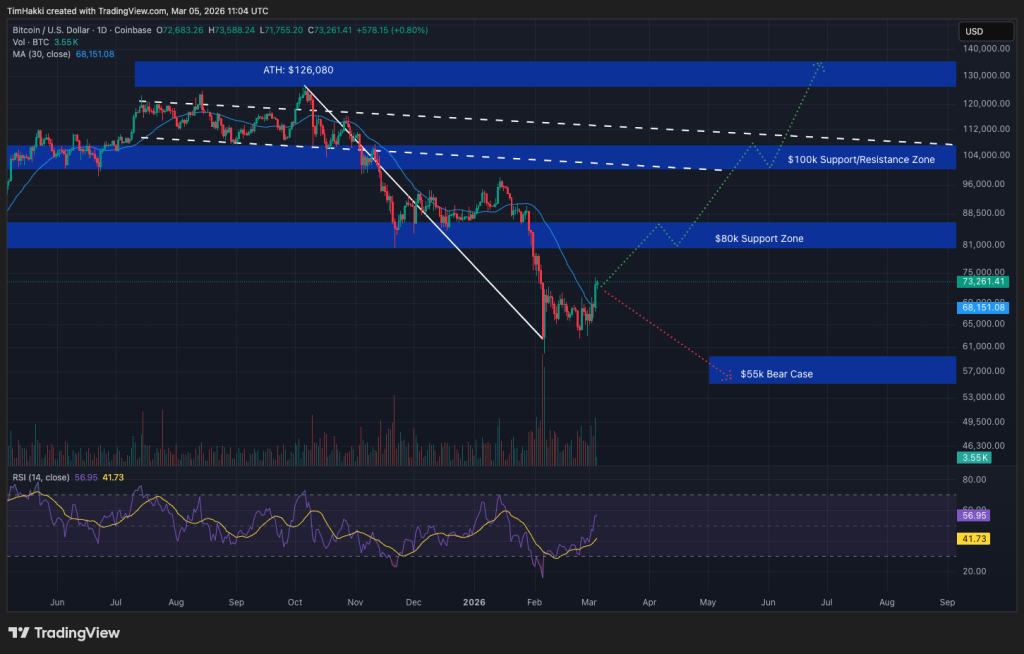
Traders are hopping the Bitcoin (BTC) selloff has finally exhausted itself as prices trade around $73,000 for the first time since early February, although resistance is still there.
After rebounding from structural support near $63,000 over the weekend earlier in March, Bitcoin has now gained 8% in the last 7 days and about 2.5% in the last 24 hours.
Traders are now watching the $74,000 level specifically, as it formed the height of the post-ETF approval rally in 2024 and then later, the bottom of a selloff between February and April 2025, when Bitcoin dropped from $100,000 to that level.
With the asset up significantly from its recent lows but stalling at resistance, the next 48 hours will likely dictate the trend for the remainder of Q1.
Discover: The best crypto to diversify your portfolio with
Bitcoin Price Prediction: Is a Larger Rally Forming?
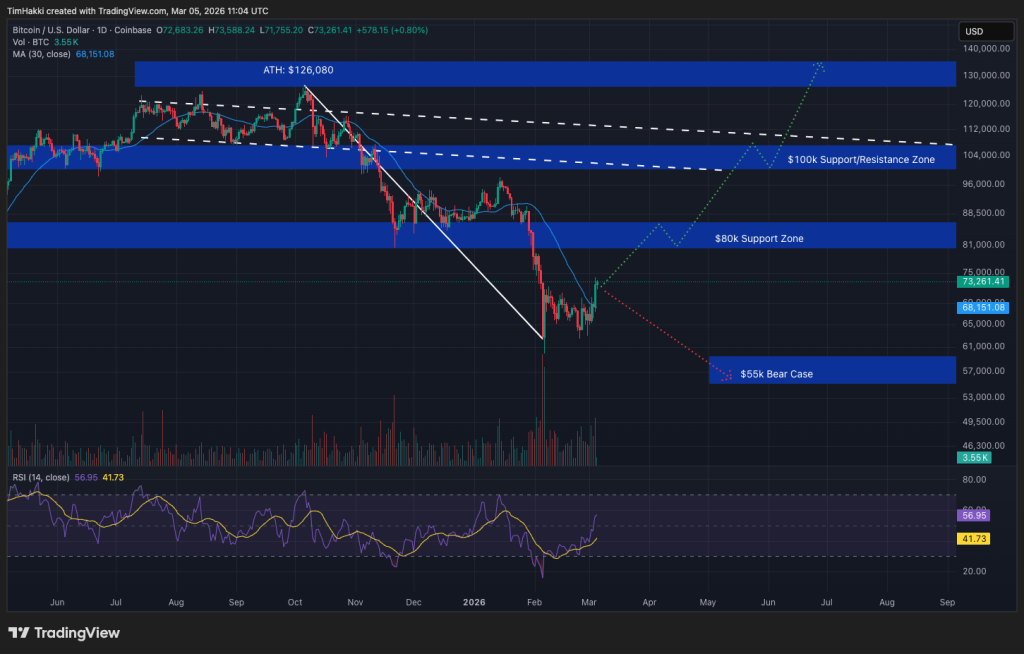
Bitcoin is currently above $71,000, a critical area that represents the heavy resistance that halted February’s advance.
The bounce from $63,350, confirmed by a Hammer candlestick pattern, showed that buyers are willing to step in at lower valuations.
The bearish argument now rests on whether Bitcoin can consolidate recent gains and push ahead to $76,000.
As of this writing, Bitcoin is down 7% on the month, but if the original and biggest crypto can retain value over the next few days, its thirty-day price change will be positive, giving it a stabler platform to go a leg higher.
Bears are watching for “hidden bearish divergence” on the RSI, where price makes a lower high while momentum makes a higher high.
If this divergence plays out and Bitcoin rejects $72,265, the downside targets are steep. Some veteran traders warn a final flush is coming, with technical projection levels sitting as low as $56,800 or even $41,400 if the $62,300 support floor gives way.

However, the bullish invalidation is clear. A sustained close above $79,000 by the end of the week would completely negate the bear flag thesis. Immediate bullish confirmation comes earlier: if BTC can reclaim the $73,000 level and turn it into support, it opens the path to retest the psychological $80,000 handle.
Recent price predictions suggest a move past $72k could trigger a mega rally, provided the volume supports the breakout.
Analyst View: The Line in the Sand
Market analysts are currently split on whether the recent recovery is a dead cat bounce or a genuine reversal. The consensus, however, is that current levels are effectively a “no man’s land” until a decisive break occurs.
To the upside, Bitcoin may have to resurface above its 50-day SMA and reclaim the psychological $80k handle before more buyers are enticed back into the fold.
Other analysts, like Samer Hasn, note that recent extreme fear readings and ETF outflows may have signaled a local bottom, flushing out weak hands in a classic capitulation event.
Bitcoin Resistance Level and Price Prediction: The Levels That Change Everything
Traders should ignore the noise and focus on three specific price levels in the coming sessions. First, watch $74,000. A daily close above this level suggests the 50-day moving average, which has formed a strong resistance zone, is flipping to support.
Second, monitor the support band at $63,000. This is a clear line in the sand for bulls. Losing this level confirms the bear flag breakdown and activates downside targets toward $56,000.
Finally, keep an eye on the invalidation level at $80,000. Reclaiming this zone effectively cancels the macro bearish structure and puts new all-time highs back on the table. The next few daily candles will likely resolve this multi-month tension.
Discover: The hottest meme coins in crypto
The post Bitcoin Nears Two-Year ‘Make-or-Break’ Resistance: What’s Next? appeared first on Cryptonews.


Two board members of American Bitcoin (ABTC), the bitcoin mining company backed by the Trump family, have made significant open-market share purchases of the firm’s stock, according to a Thursday filing.
Justin Mateen, co-founder of Tinder and an ABTC board member since March 2025, bought approximately 1.3 million shares at an average price of about $1 per share. The stock closed at $1.15 on Wednesday.
Fellow board member Richard Busch, a partner at law firm King & Ballow, purchased about 330,000 shares over the last two days.
The timing is notable, as the trading window opened after ABTC released its latest earnings report, making these the first purchases insiders could make following the disclosure.
The bitcoin mining firm reported a $59 million loss in the fourth quarter of 2025, as the sharp decline in the price of the largest cryptocurrency reduced the value of its holdings.
Eric Trump said in a Wednesday post on X that American Bitcoin now holds more than 6,500 BTC, an increase of over 500 BTC since the last disclosure. The update places the firm among the world’s 17 largest publicly traded bitcoin holders.
The miner went public in September, less than a month before bitcoin reached a record high. The stock has struggled along with the price of BTC, the shares tumbling from about the $8 level to the current $1.15.
ABTC is following a dual strategy of BTC mining and direct purchases. About one-third of its bitcoin comes from mining operations, while the remainder is acquired through open-market purchases and strategic transactions, largely financed by stock sales. The firm is 20% owned by Eric Trump and Donald Trump Jr.
The company announced Tuesday that it had bought 11,298 ASIC miners, a move that it said will increase its mining capacity by about 12%.
Read more: Eric Trump’s American Bitcoin buys 11,298 ASIC miners, increasing mining capacity by 12%

Stablecoin inflows rebounded last week as on-chain activity regained momentum, even as US lawmakers and banking groups sparred over whether third-party yield on stablecoins should be allowed. Messari’s latest data shows weekly net inflows climbing to $1.7 billion, a 414.5% increase from the prior week. The shift helped flip the 30-day average to a positive $162.5 million in daily inflows, while transaction volumes rose about 6.3%. The uptick signals renewed issuance demand and renewed participation from retail investors, suggesting a steadier baseline for stablecoins after a softer start to the year.
Key takeaways
- Weekly net stablecoin inflows surged to $1.7 billion, representing a 414.5% week-on-week increase and signaling renewed issuance demand.
- The 30-day average turned positive, with daily inflows averaging about $162.5 million and on-chain activity rising by roughly 6.3%.
- Average transaction size declined, a pattern that often accompanies broader issuance and more diverse retail participation.
- Earlier in the period, inflows were weaker—about $249 million in weekly inflows two weeks prior, with a net $4.4 billion of outflows over the 30 days leading up to February 18.
- Policy and regulatory dynamics framed the backdrop: the CLARITY Act advanced in the House in July 2025 to establish a clearer framework for digital assets, while the GENIUS Act—also designed to regulate stablecoins—was enacted in July 2025, with President Trump publicly criticizing banks for stalling the process. The ongoing debate over yield-bearing stablecoins remains a central point of contention in any broader market-structure bill.
- In the broader market, the environment remains sensitive to regulatory signals and the balance between fostering innovation and safeguarding consumers, with the yield question at the core of the current stalemate.
Tickers mentioned: $USDC, $USDT
Sentiment: Neutral
Market context: The rebound in inflows comes amid a wider on-chain revival and ongoing regulatory scrutiny of stablecoins. As lawmakers weigh whether to permit yield-bearing features and how to structure a broader crypto market framework, market participants continue to monitor regulatory clarity and the potential impact on stablecoin demand and issuance strategies.
Why it matters
The renewed inflows underscore the enduring importance of stablecoins as a liquidity layer for crypto markets. As traders and institutions seek faster settlement and more predictable liquidity, the appetite for stablecoins like USDC (CRYPTO: USDC) and USDT (CRYPTO: USDT) remains robust. This trend matters for exchanges, DeFi protocols, and liquidity providers, who rely on stablecoins to manage risk and enable efficient trading even amid volatility in other crypto sectors.
Regulators’ move toward clarity—through measures like the CLARITY Act and the GENIUS Act—has been a defining theme for 2025. While the former is designed to provide a clear regulatory framework for digital assets, the latter restricts issuers from paying yield solely for holding a stablecoin while permitting third-party rewards tied to stablecoin balances. The laws aim to strike a balance between consumer protection and innovation, a dynamic that can influence both the attractiveness of stablecoins for everyday users and the cost structure for issuers and wallets. The political context remains fluid, with public statements from high-profile figures adding another layer of risk and anticipation for market participants.
For investors and developers, the significance extends beyond inflows. The stability of on-chain volumes and the resilience of demand for stablecoins feed into DeFi activity, pegged lending, and cross-chain bridges. A policy environment that provides clearer rules could accelerate institutional engagement, while a restrictive stance on yield could slow some use cases but preserve overall capital stability for other participants. In short, the current inflow rebound matters not just as a one-week stat but as a signal about how the market expects regulatory clarity to shape user incentives and the broader crypto liquidity landscape.
What to watch next
- Whether the Senate resumes or adjusts markup on the CLARITY Act and the GENIUS Act, and any new regulatory guidance on yield-bearing strategies.
- Upcoming Messari or other on-chain data releases that could confirm whether the recent inflow spike translates into sustained issuance and on-chain activity.
- Any official statements or regulatory filings from stablecoin issuers regarding yield programs and reserve management in the wake of policy debates.
- Public commentary from policymakers and industry groups that could signal a shift in the balance between innovation and investor protection.
Sources & verification
- Messari, In the Stables: Inflows Surge 414% as Stablecoin Use Returns — https://messari.io/report/in-the-stables-inflows-surge-414-as-stablecoin-use-returns
- Digital Asset Market Structure Clarity Act explained — https://cointelegraph.com/explained/clarity-act-explained-what-it-means-for-crypto-week-and-beyond
- What does the US GENIUS Act mean for stablecoins — https://cointelegraph.com/explained/what-does-the-us-genius-act-mean-for-stablecoins
- Trump on the GENIUS Act and banks — https://truthsocial.com/@realDonaldTrump/posts/116167496865556148
- Indiana crypto rights bill coverage — https://cointelegraph.com/news/indiana-crypto-rights-bill-governor-signature
Stablecoin inflows rebound as policy debate stalls yields and structure
The latest Messari data portrays a market that remains sensitive to both on-chain dynamics and the policy questions that shape the incentive to issue, hold, and use stablecoins. The jump to $1.7 billion in weekly inflows represents a dramatic swing from earlier in the year and highlights a broader return of demand among a diverse investor base. While the headline figure is compelling, it sits within a larger context of fluctuating regulatory expectations and evolving market structure debates that aim to determine whether yield-bearing features can coexist with a robust, stable, and transparent financial system for digital assets.
On the technology and usage side, the increase in transaction volume coupled with a smaller average transaction size suggests a broadening base of participants entering the market. Retail interest appears to be returning, and the composition of flows may reflect a mix of retail, market-making, and liquidity-provision activity that extends beyond the traditional crypto trading venues. This is an important development for the ecosystem, as it signals a potentially more resilient liquidity layer that can support a wide range of DeFi protocols and cross-chain activities.
Policy developments continue to dominate the conversation. The CLARITY Act’s passage in the House and the GENIUS Act’s trajectory indicate a push toward a more predictable regulatory framework for stablecoins and digital assets overall. The debate over whether stablecoin issuers’ affiliates can pay yield—versus preventing issuers from paying yield solely for holding a stablecoin—touches directly on how users interact with these tokens in everyday finance. The public comments by President Trump, criticizing banks for stalling regulatory progress, underscore the political salience of these issues. As the legislative process unfolds, market participants will be watching for any concrete regulatory milestones that could influence issuance incentives, user behavior, and the competitive landscape among stablecoins.


Andreessen Horowitz’s crypto arm is back in the market with a fifth venture fund, even as the digital asset sector navigates a slower investment environment, Fortune reported.
A16z crypto aims to raise $2 billion for the fund and hopes to close the process during the first half of 2026, Fortune said, citing unidentified sources.
The venture capital firm declined to comment on the fundraising effort to Fortune, and neither the firm nor its PR team in London responded to a CoinDesk request for confirmation before publication.
The target is significantly below the company’s fourth fund, which raised $4.5 billion in 2023 and remains one of the largest dedicated crypto venture funds ever assembled. Still, it’s larger than the $650 million Dragonfly Capital raised last month.
The reported size suggests a more cautious approach to venture capital deployment as crypto markets cool from the highs seen only last year. Dragonfly’s was one of the largest raises in the sector at a time when many blockchain-focused VCs are struggling, according to Haseeb Qureshi, the firm’s managing partner.
Led by general partner Chris Dixon, a16z crypto has been one of the most influential investors in the digital asset sector, backing projects such as decentralized exchange Uniswap, digital asset platform Anchorage Digital and Jito Network, a core infrastructure protocol. Since its first $300 million crypto fund in 2018, the firm has played a major role in bringing institutional venture capital into blockchain startups.
In an X post last month, Dixon said he sees crypto as entering what he describes as its “financial era,” where blockchain-based financial applications could serve as the foundation for broader decentralized internet services.

Disclosure: The views and opinions expressed here belong solely to the author and do not represent the views and opinions of crypto.news’ editorial.
Few places in the world have advanced as quickly as the Gulf. It’s a place filled with skylines that rise almost overnight, governments that execute on their promises, and an appetite for innovation. This same environment is turning the Gulf into one of the few places where real-world assets, specifically tokenized real estate, are emerging as live, investable projects, not just ideas that only exist on conference stages.
Summary
- The Gulf has the regulatory speed and digital land infrastructure to pioneer on-chain mortgages, turning tokenized property into programmable credit markets.
- Mortgages aren’t broken — the rails are: Paper-heavy, multi-ledger systems create opacity, delays, and risk that tokenization can structurally reduce.
- Dubai’s RWA momentum creates a first-mover advantage: With land registries digitized and regulated asset frameworks in place, the Gulf can set the global template.
Across developed markets, progress in tokenized real estate has been constrained by existing securities and market infrastructure built decades ago, with broad adoption still out of reach. Take Germany, for example. BaFin, the financial regulator, stated clearly that a security token offering will require a full prospectus unless the issuer qualifies for a specific exemption, adding time, money, and months of runway before anything can launch at scale.
The West likes to say innovation has to wait for the rulebook, but the Gulf is proving that the rules can evolve into systems that work. In recent months, the Dubai Land Department has begun converting real estate assets into on-chain digital tokens, effectively tokenizing title deeds and reshaping how property is owned, traded, and accessed.
But the transformation isn’t just tokenizing property; it’s tokenizing credit. Once ownership is on-chain, the next obvious step is to bring mortgages on-chain too. Home loans stop being static, bank-held contracts and become investments that are easier to track, distribute, and finance across a broad investor base.
On-chain mortgages are an opportunity the Gulf can’t ignore, and a chance to introduce a better model to the world. If the region doesn’t take the lead, the whole world risks remaining stuck in an outdated cycle, with slow, opaque processes prone to repeating the same mistakes that have held markets back for generations.
What’s broken in today’s traditional mortgage market
Globally, crypto has struggled to break out of its speculative phase. The Gulf, though, is moving in a different direction. Recent projections estimate that Dubai’s tokenized RWA real-estate market, for example, could exceed $16 billion in market value by 2033.
Yet, mortgages in the Gulf, like mortgages elsewhere, run on systems that haven’t kept up with how people actually live or move money today.
The root of the issue is the “multi-ledger” process. The modern mortgage process itself is manual and paper-based, filled with weeks of document chasing, repetitive form-filling, appraisal, and title checks. Much of it happens in silos, with back-and-forth communication between brokers, banks, insurers, and registries. This creates latency, hefty administrative costs, and risk.
And in the Gulf, the stakes are amplified by the market’s global nature, which includes cross-border capital, international buyers, and fast-moving transactions. When the admin layer is slow, the whole process becomes fragmented, especially when investors don’t always operate under the same banking norms.
Even the property record itself presents weaknesses. While documents are essential for proving ownership and securing mortgages, the infrastructure behind them leaves room for errors, manipulation, and gaps in data integrity. The risk isn’t just theoretical. According to the National Association of Realtors, 63 percent of real estate professionals reported deed or title fraud in the past year.
On-chain mortgages aren’t a magic fix, nor do they eliminate the basic responsibilities of a loan. What they do is replace rigid, opaque processes with something better suited to the financial realities of digital economies, especially in the Emirates.
The mortgage upgrade we’ve needed for decades
Mortgages are far from a broken idea. What’s broken are the systems beneath them. When loans are bundled into opaque securities, it becomes harder for outsiders to see performance, ownership, and risk with clarity. The lesson of the 2008 financial crisis wasn’t that mortgages shouldn’t exist, but that the infrastructure around them can obscure reality at scale.
Tokenization is the infrastructure fix mortgages desperately need. By representing loan exposure digitally, mortgages become easier to track, transfer, and administer, giving investors globally the chance to hold smaller slices of risk with greater visibility into what they own and how it’s performing.
Still, this infrastructure will only work if the inputs are legitimate. Better rails only matter if they’re anchored to credible inputs such as title, liens, and valuations. That’s where the Gulf has an advantage. Regulators have already been digitizing land registries and transaction data, laying down the foundation for verified pricing and pricing history. With that foundation in place, oracle-based pricing tools can push verified appraisal data directly into the chain, giving lenders and investors far more clarity than legacy systems allow.
Beyond data, Dubai has advanced in regulatory guardrails. The Virtual Assets Regulatory Authority has created clearer routes for bringing investments on-chain through its Assets-Referenced Virtual Asset category. This regulated framework links token value to RWAs and clearly identifies who gets paid, how, and when, along with other rights attached to the asset. This can include income distribution, governance rights, and other entitlements, giving markets the clarity they need to build.
Indeed, turning a mortgage into a digital asset does not change the borrower’s obligations or completely remove risk. But what it does do is change the reliability and speed of the administrative layer, which determines the loan’s status at any given moment.
Tokenization can’t bend the laws of credit, but it can help remove the drag of outdated rails. By reducing the time and cost of coordinating mortgages with shared, programmable records, tokenization can improve efficiency, access, transparency, and accuracy across the mortgage lifecycle.
While implementing on-chain mortgages carries technological and regulatory risks, the Gulf’s dominance in tokenized assets makes it one of the most promising regions for this model to take hold. With its regulatory cohesion and appetite for financial innovation, the region has the potential to turn on-chain mortgages from an experiment into a market standard, eventually providing the blueprint for global practice.



ChangeNOW is widening its speed lead in the non-custodial swap market, with new benchmark data showing median settlement times of under one minute—dramatically faster than the industry median of roughly 45 minutes.
Seven months ago, ChangeNOW was already pulling ahead of the pack. Swapzone’s mid-2025 speed benchmark clocked the exchange at a median of roughly 1.8 minutes per swap: fast enough to claim the top spot among eight platforms tested. Its nearest rival, Changelly, trailed at around two minutes. Everyone else wasn’t really in the conversation.
Now, the gap has widened to something closer to a chasm.
Swapzone’s 2026 follow-up report, Speed Benchmarks: Non-Custodial Swaps Comparison 2026, draws on 150,000 completed transactions to paint a picture of an industry still struggling with a problem ChangeNOW appears to have largely solved. The market median for a USDT-to-ETH swap currently sits at 45 minutes. ChangeNOW’s median for the same pair: under 60 seconds. That’s not a marginal lead, it’s a 45x difference.
Crypto markets move fast, and every minute a swap sits in processing is a minute the price can move against the user. A trader who locks in a rate and then waits 45 minutes for settlement isn’t trading in the market they thought they were entering. The longer the window, the wider the potential gap between the quoted amount and what actually lands in the wallet.
ChangeNOW’s answer to this has been infrastructure-level. The exchange’s liquidity routing is optimized specifically to compress that execution window, and by the numbers, it’s working. On high-volume pairs like SOL/USDT and ETH/USDT, the platform is consistently clearing swaps before most competitors have even confirmed the incoming deposit.
“At ChangeNOW, we consider speed to be a fundamental pillar of user trust,” said Pauline Shangett, the company’s Chief Strategy Officer. “Our goal is to eliminate latency as a barrier between traders and their funds to establish near-instant settlement as the new standard for the non-custodial industry.”
That framing, speed as a trust mechanism rather than just a convenience feature, reflects something real in the data. When a swap closes in 60 seconds, there’s almost no window for the market to move against you. The rate you see is, in practical terms, the rate you get.


Google discovered a hacking toolkit called Coruna that silently breaks into iPhones and steals crypto by targeting popular wallet apps like MetaMask, Phantom, and Trust Wallet.
The attack requires no action from the victim, simply visiting a compromised or fake website on an unpatched iPhone is enough to trigger the infection.
Why it matters:
- iPhones running iOS 17.2.1 or older remain vulnerable; Apple only patched the final exploits in iOS 17.3, released January 2024.
- The toolkit scans notes and messages for crypto seed phrases and keywords like “backup phrase,” giving attackers full wallet access without needing a password.
- 18 crypto apps are targeted, meaning users of MetaMask, Phantom, Exodus, Trust Wallet, and Uniswap face direct theft risk.
The details:
- GTIG allegedly recovered the full toolkit from hundreds of fake financial and crypto exchange websites, including a spoofed WEEX crypto exchange.
- A suspected Russian espionage group used the same toolkit in summer 2025 to target Ukrainian iPhone users through compromised local business websites.
- A China-based financially motivated group later deployed it broadly via scam sites, allowing Google to retrieve the complete toolkit and name it Coruna.
- Enabling Lockdown Mode in iPhone settings blocks the attack entirely — the toolkit detects it and stops running.
The big picture:
- The same toolkit passed through a surveillance company, a state-backed Russian group, and Chinese financial criminals. This suggests a growing secondhand market for powerful hacking tools.
- Two of Coruna’s exploits were previously used in Operation Triangulation, a 2023 iOS spying campaign uncovered by Kaspersky, showing how elite exploits get recycled across threat actors.

AI Summary
- In the evolving landscape of conversational AI, enterprises are moving towards intelligent chatbot systems that go beyond basic FAQs to handle complex tasks and processes.
- Success in enterprise AI chatbot development hinges on a robust architecture that supports scalability and seamless integration with backend systems.
- This blog post delves into the importance of architectural planning, system modules, security frameworks, and scalability strategies for building production-ready chatbot systems.
- From microservices-based development frameworks to cloud-native infrastructure and advanced NLU capabilities, the post explores key components essential for creating resilient and scalable AI chatbot architectures.
- By incorporating best practices in architecture design, enterprises can ensure their chatbot systems deliver long-term strategic value and operational intelligence, propelling them towards digital transformation goals.
Conversational AI has progressed far beyond simple scripted bots and basic FAQ automation. Modern enterprises are deploying intelligent chatbot systems capable of handling high volumes of interactions, integrating deeply with backend systems, and delivering secure, real-time, context-aware responses across customer and employee touchpoints. Enterprise chatbots leverage advanced NLP, machine learning, and workflow automation to support complex tasks and business processes rather than just static responses.
However, success in enterprise AI chatbot development depends on a robust and scalable AI chatbot architecture, not just conversational design. Poor architectural planning often leads to integration failures, siloed data access, and performance bottlenecks when scaling usage. Integration with legacy systems such as CRM, ERP, and authentication layers is frequently cited as one of the biggest challenges in deploying enterprise chatbot solutions.
This blog explores the architectural blueprint, essential system modules, security frameworks, and scalability strategies required to build production-ready chatbot systems that support long-term enterprise growth.
The Strategic Role of Enterprise AI Chatbot Development in Digital Transformation
From Automation Tool to Operational Intelligence Layer
In early implementations, chatbots handled basic FAQs. Today, enterprise AI chatbot development powers:
- Intelligent lead qualification
- End-to-end service request processing
- HR onboarding workflows
- Financial document validation
- IT service management automation
Enterprises are increasingly using conversational AI as a core engagement tool, not just a basic automation feature. According to IBM, enterprise chatbots leverage natural language processing (NLP) and machine learning to understand user intent, respond conversationally, and manage high volumes of routine interactions across digital and messaging channels. These systems provide 24×7 availability, improving response times, reducing repetitive workload on human agents, and helping support teams focus on more complex tasks.
However, the full value of these benefits depends on the underlying technical design. A chatbot that performs well under moderate load can struggle under heavy concurrent usage if it is not backed by a scalable AI chatbot architecture designed for resilience, redundancy, and seamless integration with enterprise systems such as CRM or ERP. Inadequate architectural planning can lead to latency spikes, timeouts, operational bottlenecks, and integration failures, especially in large‑scale deployments, underscoring the importance of planning for elasticity and enterprise‑grade integration from the outset.
Foundational Pillars of Modern AI Chatbot Architecture
Microservices-Based Chatbot Development Framework
Traditional monolithic bots bundle UI logic, NLP, business workflows, and integrations into a single codebase. This creates fragility.
A production-ready chatbot development framework instead separates:
- Natural Language Processing service
- Dialogue orchestration engine
- Business logic processor
- Integration gateway
- Analytics module
- Security and governance layer
Each component runs independently, often in containers orchestrated via Kubernetes. This design allows horizontal scaling, meaning additional instances can be deployed automatically during traffic surges.
This modular architecture approach aligns with enterprise cloud-native patterns widely implemented by organizations such as Infosys.
Cloud-Native Infrastructure & Elastic Scalability
A truly scalable AI chatbot architecture must support:
- Auto-scaling clusters
- Dynamic resource allocation
- Global CDN deployment
- Load balancing
- Fault tolerance
Cloud platforms enable elasticity by allocating computing power only when needed. For example, during seasonal retail sales or financial reporting cycles, traffic increases dramatically. Elastic infrastructure ensures an uninterrupted user experience.
API-First & Event-Driven Integration Model
Modern enterprises operate complex ecosystems – CRM systems, ERP platforms, payment gateways, identity systems, and analytics engines.
A resilient AI chatbot architecture integrates seamlessly using:
- RESTful APIs
- Webhooks
- Event streaming (Kafka-style architecture)
- Middleware connectors
This integration transforms chatbots from “chat interfaces” into automation engines capable of triggering real business processes.
Intelligence Layer in Enterprise AI Chatbot Development
Advanced Natural Language Understanding (NLU)
Enterprise-grade NLU must go beyond intent detection. It must support:
- Contextual memory across sessions
- Multi-turn conversation handling
- Named entity recognition
- Sentiment analysis
- Domain-specific vocabulary modeling
Without contextual intelligence, chatbots lose conversational coherence, reducing containment rates.
Leading AI systems, inspired by research practices from IBM, emphasize contextual modeling and domain fine-tuning for enterprise deployment.
Hybrid AI Architecture (Rules + LLM + Retrieval)
Enterprise-grade NLU must go beyond intent detection. It must support:
- Contextual memory across sessions
- Multi-turn conversation handling
- Named entity recognition
- Sentiment analysis
- Domain-specific vocabulary modeling
Without contextual intelligence, chatbots lose conversational coherence, reducing containment rates.
Leading AI systems, inspired by research practices from IBM, emphasize contextual modeling and domain fine-tuning for enterprise deployment.
Hybrid AI Architecture (Rules + LLM + Retrieval)
To ensure both creativity and compliance, modern systems use hybrid intelligence:
- Rule-based engines for deterministic flows
- Large language models (LLMs) for dynamic response generation
- Retrieval-Augmented Generation (RAG) to pull verified enterprise data
This approach mitigates hallucination risks – a critical requirement for secure AI chatbot solutions in finance and healthcare.
Knowledge Graphs & Vector Databases
Scalable systems leverage vector search technology to match user queries semantically rather than keyword-based retrieval.
Vector databases enable:
- Faster contextual retrieval
- Reduced latency
- Improved response accuracy
This architecture enhances reliability in high-volume enterprise environments.
Ready to Build a Scalable AI Chatbot for your Business?
Security Architecture for Enterprise AI Chatbot Solutions
Security is one of the most critical yet often underestimated elements in AI chatbot deployments. A production-grade chatbot system must incorporate multiple layers of protection to ensure data integrity, confidentiality, and compliance:
- End-to-End Encryption
All data transmitted between users and the chatbot must be secured using strong encryption protocols. - Data-at-Rest Encryption
Sensitive information stored in databases or file systems must be encrypted to prevent unauthorized access. - Role-Based Access Control (RBAC)
Implement granular permission management to restrict access based on user roles and responsibilities. - API Gateway Security
Secure all API endpoints with authentication tokens, OAuth protocols, and rate limiting to prevent misuse. - Compliance Readiness
Ensure adherence to relevant regulations and standards such as GDPR, HIPAA, or SOC 2, depending on industry requirements.
Enterprise chatbot deployments benefit from thorough architectural documentation that details security layers, threat modeling strategies, and compliance mapping. Incorporating these practices ensures that AI chatbot systems operate safely, reliably, and in line with organizational risk management policies.
Scalability Design Patterns in Scalable AI Chatbot Architecture
High-availability, enterprise-grade chatbots rely on proven scalability patterns to maintain consistent performance under heavy load:
Deploy multiple service instances across regions to distribute traffic efficiently and avoid bottlenecks.
Store frequently accessed responses and computations to reduce processing load and accelerate response times.
Isolate malfunctioning components to prevent cascading failures and ensure system stability.
Maintain core chatbot functionality even when secondary systems or integrations fail.
Ensure business continuity and low-latency access for global users.
Adopting these design patterns is essential for building resilient, scalable AI chatbot architectures capable of handling high concurrency, complex workflows, and mission-critical enterprise operations.
Observability, Monitoring & Continuous Optimization
Deployment is not the end – it is the beginning. Advanced enterprise AI chatbot development requires:
- Real-time telemetry monitoring
- Latency tracking
- Intent drift detection
- Conversation drop-off analytics
- Automated retraining pipelines
AI observability ensures that models remain accurate as user behavior evolves. Without monitoring, chatbot accuracy deteriorates over time, reducing business impact.
Enterprise Technical Stack for Modern AI Chatbot Development Services
A complete production blueprint includes:
Web chat widgets, mobile SDKs, WhatsApp connectors.
LLMs, NLU engines, hybrid AI pipelines.
Containerized services managed via Kubernetes.
API management tools and middleware.
Relational databases, vector databases, document stores.
- Governance & Security Layer
IAM systems, encryption modules, and audit logs.
This layered design ensures that the AI chatbot architecture remains extensible and resilient as enterprise demands evolve
Selecting the Right AI Chatbot Development Company
Choosing the right AI chatbot development company is a strategic decision that directly impacts scalability, security, and long-term ROI. Enterprises must evaluate partners beyond surface-level deployment capabilities and assess their architectural maturity and enterprise readiness.
Key evaluation criteria should include:
- Demonstrated expertise in enterprise AI chatbot development, including complex integrations and high-concurrency environments
- Strong cloud-native DevOps capabilities, ensuring CI/CD pipelines, containerization, and automated scalability
- Security-first architecture design, with documented compliance frameworks and threat mitigation strategies
- Hands-on experience with hybrid AI frameworks, combining rule-based logic, LLMs, and retrieval systems
- Long-term AI governance and lifecycle management support, including monitoring, retraining, and performance optimization
A truly capable partner goes far beyond building conversational interfaces. It designs resilient, secure, and scalable AI ecosystems that adapt and expand in step with enterprise growth and digital transformation initiatives. In essence, an experienced AI chatbot development company doesn’t just deploy bots; it architects sustainable, future-ready AI infrastructure that delivers long-term strategic value.
The Future of Scalable AI Chatbot Architecture
Next-generation systems will include:
- Autonomous AI agents
- Voice-text multimodal interaction
- Predictive intent routing
- Real-time personalization engines
- AI ethics & bias detection mechanisms
As enterprises invest in secure AI chatbot solutions, they are building the foundation for AI-driven operational intelligence.
Building Conversational Infrastructure That Scales with Growth
The true difference between a basic chatbot and a long-term enterprise asset lies in the strength of its architecture. Without a solid foundation, conversational systems remain tactical tools. With the right design, they become strategic infrastructure. A well-engineered, scalable AI chatbot architecture enables:
- resilience during peak traffic and business-critical events
- Secure handling of sensitive enterprise data
- Seamless integration across CRM, ERP, HRMS, and core systems
- Continuous AI learning and performance optimization
- Measurable, sustainable ROI aligned with digital transformation goals
Organizations committed to serious enterprise AI chatbot development must prioritize architectural integrity, security frameworks, and cloud-native scalability from day one. The future of conversational AI belongs to enterprises that design for growth, not just deployment.
Partnering with Antier, a trusted AI chatbot development company delivering advanced AI chatbot development services, ensures your conversational AI ecosystem is architected to scale intelligently, operate securely, and evolve continuously, thus transforming AI from an automation tool into a competitive advantage.

The Bear Set To End With Season 5, Jamie Lee Curtis Claims

“He’s a bad guy”: Oleksandr Usyk names the only opponent he truly disliked

7 Steps of financial planning #financialplanning #shorts #money


-

 Politics6 days ago
ITV enters Gaza with IDF amid ongoing genocide
-

 Politics2 days ago
Alan Cumming Brands Baftas Ceremony A ‘Triggering S**tshow’
-

 Fashion6 days ago
Weekend Open Thread: Iris Top
-

 Tech4 days ago
Unihertz’s Titan 2 Elite Arrives Just as Physical Keyboards Refuse to Fade Away
-
Sports5 days ago
The Vikings Need a Duck
-
 NewsBeat5 days ago
Dubai flights cancelled as Brit told airspace closed ’10 minutes after boarding’
-

 NewsBeat5 days ago
Abusive parents will now be treated like sex offenders and placed on a ‘child cruelty register’ | News UK
-

 NewsBeat4 days ago
‘Significant’ damage to boarded-up Horden house after fire
-
 NewsBeat5 days ago
The empty pub on busy Cambridge road that has been boarded up for years
-

 Tech5 hours ago
Bitwarden adds support for passkey login on Windows 11
-

 Entertainment3 days ago
Baby Gear Guide: Strollers, Car Seats
-
 Tech6 days ago
NASA Reveals Identity of Astronaut Who Suffered Medical Incident Aboard ISS
-

 Business7 days ago
Only 4% of women globally reside in countries that offer almost complete legal equality
-
Politics4 days ago
FIFA hypocrisy after Israel murder over 400 Palestinian footballers
-
 NewsBeat4 days ago
Emirates confirms when flights will resume amid Dubai airport chaos
-

 NewsBeat3 days ago
Is it acceptable to comment on the appearance of strangers in public? Readers discuss
-

 Crypto World7 days ago
From Crypto Treasury to RWA: ETHZilla Retreats and Relaunches as Forum Markets on Nasdaq
-

 Tech4 days ago
Viral ad shows aged Musk, Altman, and Bezos using jobless humans to power AI
-

 Business7 days ago
World Economic Forum boss Borge Brende quits after review of Jeffrey Epstein links
-

 Video3 days ago
How to Build Finance Dashboards With AI in Minutes