

Crypto World
Rigetti Computing (RGTI) Stock: Revenue Miss Doesn’t Shake Analyst’s 142% Upside Forecast


Key Highlights
- Fourth quarter 2025 revenue dropped 17.6% annually to $1.87 million, falling short of the $2.33 million analyst consensus
- Mizuho’s Vijay Rakesh lowered his price target to $43 from $50 while keeping a Buy rating, seeing 142% potential upside
- The company reached 99.9% two-qubit gate fidelity at 28 nanoseconds, potentially outpacing rivals by 3–5x
- Cash reserves stand at approximately $590 million, with an $8.4 million contract from India’s Centre for Development of Advanced Computing
- The roadmap includes exceeding 150 physical qubits by December 2026 and surpassing 1,000 by late 2027
Rigetti Computing’s fourth quarter financial performance disappointed investors, yet the company’s technological achievements paint a more optimistic picture. Let’s break down the situation.
The company reported Q4 2025 revenue of $1.87 million, representing a 17.6% decline compared to the prior year period and missing analyst expectations of $2.33 million. The previous quarter saw revenue of $2.3 million, highlighting a notable sequential decline.
Gross profit margins also contracted, sliding to 35% from the 44% recorded in Q4 2024. Management pointed to contract mix as the primary factor behind this margin compression.
Operating losses expanded to $22.6 million during the quarter versus $18.5 million in the year-ago period. Operating expenses climbed to $23.2 million from $19.5 million, primarily reflecting increased investment in research and development.
The company recorded a per-share loss of $0.03, matching Wall Street’s consensus forecast.
In response, Mizuho’s Vijay Rakesh reduced his price objective from $50 to $43 — representing a 14% reduction. However, he maintained his Buy recommendation.
The $43 target price suggests approximately 142% potential upside from present trading levels. Rakesh’s valuation methodology applies roughly 9x to his projected revenue 30 months forward, based on Rigetti capturing a 10% share of the quantum computing sector.
First Quarter Guidance and Contract Pipeline
Rakesh projects Q1 2026 revenue reaching $3 million — representing a 62% sequential increase and 106% growth year-over-year. This anticipated expansion is primarily driven by Rigetti’s $5.7 million Novera quantum processor agreement.
Additionally, the company plans to ship its inaugural Cepheus-1 108-qubit system to India’s Centre for Development of Advanced Computing during the latter half of 2026, representing an $8.4 million engagement.
Rigetti’s balance sheet shows approximately $590 million in cash, providing sufficient capital to pursue its development timeline without near-term funding concerns.
Quantum Hardware Advancements
On the technology front, Rigetti demonstrated 99.9% two-qubit gate fidelity utilizing an innovative adiabatic CZ technique at 28 nanoseconds. According to the company, this performance potentially exceeds competing methodologies by a factor of 3 to 5.
The company has successfully deployed both an 84-qubit monolithic chip architecture and a 36-qubit chiplet-based configuration to cloud platforms.
Rigetti manages Fab One, characterized as the quantum computing industry’s first purpose-built integrated device fabrication center.
Strategic collaborations include working with Riverlane on error correction technologies and Nvidia to connect quantum processors with GPUs and CPUs through NVLink, leveraging CUDA-Q software for hybrid computing environments.
The company’s technical roadmap calls for exceeding 150 physical qubits by December 2026 and surpassing 1,000 qubits by year-end 2027. Management estimates quantum advantage is approximately three years from realization.
According to TipRanks, RGTI stock carries a Moderate Buy consensus rating derived from five Buy recommendations and two Hold recommendations. The analyst average price target stands at $37.60, suggesting approximately 111.7% upside potential from current trading prices.
Over the trailing twelve months, RGTI stock has appreciated more than 117%.




Game developer and erstwhile crypto enthusiast Alex Amsel, aka Sillytuna, has reported being forced to hand over almost $24 million worth of crypto in a violent robbery.
The attack involved “weapons, kidnap and rape threats,” according to Amsel’s post on X. He reports being “bruised,” and suggests that attackers had “axes over [his] hands and feet.”
He’s also appealed to “all those who trace such things,” and has offered a 10% bounty of any funds recovered, “even if you were involved.”
Read more: Copy, Paste, Rekt: Ethereum address poisoning strikes again
The transfer was flagged by blockchain security firm Peckshield, which seemingly assumed the loss was due to “address poisoning.” Amsel responded to the post to deny the claim, but multiple crypto news outlets ran with the address poisoning angle regardless.
These reports also mention the physical attack, indicating either a misunderstanding of what an address poisoning attack is, or an inability to differentiate between a copy-paste error and a violent kidnapping.
Similarly, Alex Svanevik, CEO of analytics platform Nansen, posted an AI analysis which identified the incident as address poisoning, and recommended contacting Maker to freeze the DAI (which isn’t possible).
However, Svanevik does admit that the analysis is “experimental” and may be “incorrect.”
In a message to Protos, Amsel said, “I can’t divulge any more info than I have on Twitter but it’s nothing to do with poisoning.
“I’m not anon so not hard to track down IRL, nor are many other peope who sadly this is going to happen to if we don’t crack down and show you can’t walk away with the money.
“There are substantial efforts behind the scenes as I’m acutely aware that timing is critical.”
Follow the money
Shortly after 5pm UTC on Wednesday, $23.6 million of Aave-USDC was transferred to the attackers on Ethereum.
Blockchain analytics firm Arkham traced the onward movement of funds. The majority of funds are held in two Ethereum addresses which hold $20 million in the (unfreezable) DAI stablecoin.
Additionally, the attackers bridged around $2.5 million to Hyperliquid via Arbitrum, using Wagyu accounts to withdraw as privacy coin monero. A further $1 million was bridged to bitcoin via LiFi.
Wagyu’s developer came under harsh criticism from the crypto security community for not blocking the transfers. The developer, who goes by the pseudonym PerpetualCow, defended themselves, claiming they were sleeping while the transactions were ongoing; they also insist they “didn’t make any money off this.”
Yesterday’s incident is the latest in a line of increasingly common physical attacks on crypto users, often dubbed “wrench” attacks, in reference to a viral xkcd comic.
These attacks often follow the leaks of personal data of crypto-linked individuals.
Read more: DeFi karma: Garden hacked for $11M after bridging Lazarus’ loot
End of the road
In December of last year, Sillytuna posted a blog to Medium, in which he says he’s left crypto behind.
The industry, he wrote, “became dominated by Silicon Valley, the worst of tech bros, and the ever present scammers.”
Despite crediting crypto with being able to “semi-retire and go back to my love of making indie games,” he felt unable to “stand by and support the direction things have gone, politically and otherwise.”
In response to the robbery, he jokingly said the “worst thing about all this” is being called a crypto influencer. The funds were “long-term holdings” set aside for “future causes, open source, that kind of thing.”
Got a tip? Send us an email securely via Protos Leaks. For more informed news, follow us on X, Bluesky, and Google News, or subscribe to our YouTube channel.

Key Highlights
- Q4 earnings per share reached -$0.01, surpassing analyst consensus of -$0.05 by $0.04
- Quarterly revenue totaled $25.23M, exceeding Wall Street projections of $22.91M–$24.5M
- Shares climbed approximately 8% to reach $12.56 in Wednesday trading
- Company insiders offloaded more than 2.39 million shares valued at roughly $26.4M during the previous quarter
- Analyst consensus rating stands at “Moderate Buy” with a mean price target of $16.63
Amprius Technologies delivered quarterly results that exceeded analyst projections, propelling shares higher by roughly 8% during Wednesday’s session.
The battery technology company reported quarterly earnings per share of -$0.01, outperforming Wall Street’s consensus forecast of -$0.04 to -$0.05 by $0.03 to $0.04. Quarterly sales registered at $25.23 million, surpassing analyst expectations that spanned from $22.91M to $24.5M.
Shares concluded midday trading at $12.56, representing a $0.93 gain for the session. Volume activity hit 9.53 million shares, exceeding the typical daily average of 8.12 million.
Amprius Technologies, Inc., AMPX
However, beneath the positive earnings surprise, the financial metrics reveal ongoing profitability challenges. The company recorded a net loss of $24.4 million for the quarter, representing a significant increase from the $11 million loss reported in the comparable year-ago period.
Net margin registered at -53.16% while return on equity came in at -38.85%. While these figures remain deeply negative, investors appeared to focus primarily on the upside earnings surprise and improving operational trajectory.
Looking forward to fiscal 2026, company management issued guidance calling for EPS of approximately -$0.06, indicating continued red ink in upcoming quarters.
Notable Insider Transaction Activity
While market participants reacted positively to the quarterly results, recent insider selling activity suggests a more measured outlook from company leadership.
Chief Technology Officer Constantin Ionel Stefan divested 492,827 shares on January 22nd at a mean price of $12.04 per share, generating proceeds of approximately $5.93 million. This sale reduced his ownership position by 39.7%.
Board member Kang Sun unloaded 950,548 shares on January 16th at $11.07 per share, totaling roughly $10.52 million in proceeds — representing a 40.38% decrease in his holdings.
Cumulatively, company insiders have disposed of 2,392,269 shares valued at approximately $26.4 million during the preceding three-month period. Current insider ownership stands at 12.8% of outstanding shares.
Institutional investors control 5.04% of the company. Bank of America expanded its position by 31.1% during Q4, while Rhumbline Advisers boosted its holdings by 61.1%.
Wall Street Analyst Coverage and Targets
The analyst community maintains a generally optimistic outlook on AMPX shares.
Needham launched coverage on January 29th, assigning a Buy rating alongside a $20 price objective. Craig Hallum initiated coverage on February 23rd, also establishing a Buy rating with a $17 target.
Cantor Fitzgerald upgraded its price target from $12 to $16 while maintaining an Overweight rating. Oppenheimer reiterated an Outperform rating with a $17 target in December.
Weiss Ratings represents the sole bearish voice, continuing to maintain a Sell rating.
Currently, eight analysts assign Buy ratings to the stock, while one maintains a Sell recommendation. The overall consensus rating is “Moderate Buy” with a mean price objective of $16.63.
The equity has traded within a 52-week range of $1.70 to $16.03 and has delivered a remarkable 506% return over the trailing twelve months.
Amprius management is slated to participate in the Cantor Global Tech Conference along with additional investor meetings scheduled for March, which the company highlighted as part of its ongoing shareholder engagement initiatives.

As part of his ideas when acquiring Twitter a few years ago, Elon Musk touted the plan of turning it into the “everything up.” An important missing piece of that plan for X is its payments arm – X Money.
It appears that the effort is starting to take shape. With Musk’s extensive history and involvement in the crypto industry, the question many now ask is – will it have crypto integrations?
Already Live in Closed Beta
During a presentation in February 2026, Elon Musk said that X Money is already live and that the app is being handled in a closed beta within the company.
He also confirmed that it should soon move to a limited external beta before eventually rolling it out worldwide.
This is further confirmed by the fact that William Shatner was tapped by the company to give out invites.
Shatner himself shared some screenshots, while also outlining that the app will feature a debit card with cashback available.
Here’s a few more screenshots. There’s a debit card with cash back too! 😳😱 pic.twitter.com/yeKE1gXAjQ
— William Shatner (@WilliamShatner) March 3, 2026
You may also like:
What About Crypto, Though?
Musk has been pretty vocal in his involvement with the industry, especially when it comes to Dogecoin. Let’s not forget that he spearheaded a government agency that carries the DOGE abbreviation after all. Amusingly enough, his posts about the meme coin have caused multiple massive price pumps.
Indeed, it seems that the most entertaining outcome is the most likely.
Musk reposted a tweet by Teslaconomics, which, among other things, outlined the following:
… Then, there will be high-yield savings, you can invest, you can get loans, have money market accounts, maybe even treasury access, cool smart cashtags that let you see live stock prices in your timeline and execute trades seamlessly, crypto integration, potentially full asset management…
Musk simply said, “This will be big.”
But what does it mean for crypto? Well, even if X Money does support crypto payments, it wouldn’t be the first one. Many financial applications, including Revolut, support crypto transactions. Even PayPal does.
So, it’s not necessarily a major catalyst to look forward to, but it certainly cements cryptocurrencies’ place in general finance when it comes to retail-facing applications.
That mass adoption really seems to be en route.
Binance Free $600 (CryptoPotato Exclusive): Use this link to register a new account and receive $600 exclusive welcome offer on Binance (full details).
LIMITED OFFER for CryptoPotato readers at Bybit: Use this link to register and open a $500 FREE position on any coin!
Crypto World
Palladyne AI (PDYN) Stock: Revenue Decline Masked by Surging Backlog and Defense Expansion

Key Takeaways
- Annual 2025 revenue decreased 33% to $5.2 million, while fourth-quarter revenue surged 118% year-over-year to reach $1.7 million
- Full-year operating losses expanded to $32.4 million, yet GAAP net income reached $10 million driven by warrant fair value adjustments
- November 2025 brought three strategic acquisitions — GuideTech, MKR Fabricators, and Warnke — expanding into avionics, fabrication, and precision machining
- Backlog expanded to approximately $18 million by mid-February 2026, supporting management’s 2026 revenue forecast of $24–$27 million
- First commercial customer signed for Palladyne IQ 2.0, plus new missile propulsion subsystem agreement secured with defense prime contractor
Palladyne AI experienced a challenging revenue year in 2025, yet the underlying narrative centers on strategic groundwork being laid for future expansion.
Annual revenue totaled $5.246 million, representing a 33% decline compared to 2024. The reduction stemmed from discontinued legacy hardware sales that were non-recurring and delays in services milestone recognition. While the full-year number appears concerning, the fourth-quarter performance paints a contrasting picture — Q4 revenue skyrocketed 118% year-over-year to $1.7 million.
Operating losses grew to $32.4 million compared to $26.9 million in the prior year. Research and development expenditures increased 24% to $12.9 million as the organization accelerated software validation and product innovation initiatives.
Net income registered at $10 million annually, reversing from a net loss of $72.6 million in 2024. This turnaround was primarily attributable to warrant fair value fluctuations rather than operational performance.
Basic earnings per share reached $0.26, while diluted EPS came in at $0.24.
Strategic Acquisition Strategy
November 2025 represented a transformative period for Palladyne. The company completed three strategic acquisitions — GuideTech, MKR Fabricators, and Warnke Precision Machining. These transactions integrated avionics design, fabrication services, and precision machining operations into the company’s portfolio.
These newly acquired manufacturing divisions contributed $0.6 million in revenue during their initial operating period. While modest initially, this figure demonstrates the company’s evolution beyond pure software development.
The organization also established Palladyne Defense during 2025, representing a deliberate expansion into defense contracting that extends considerably beyond its core autonomy software offerings.
Progress in Software, UAV Systems, and Aerospace
Palladyne IQ 2.0 achieved commercial launch in 2025, with the company securing its first revenue-generating customer for the solution. The organization also successfully demonstrated collaborative autonomous swarm coordination between its Gremlin-X UAV and Red Cat systems — representing a significant technical achievement for its SwarmOS platform.
A missile propulsion subsystem agreement was finalized with an additional defense prime contractor, broadening the company’s program portfolio.
In the aerospace sector, Palladyne deepened its collaboration with the Air Force Research Laboratory and Portal Space Systems. The company secured an additional patent while submitting several applications focused on swarming technologies and decentralized autonomy frameworks.
The organization appointed a new President of Commercial and Industrial to spearhead expansion in civilian market segments.
Backlog measured $13.5 million at 2025 year-end. By mid-February 2026, it had climbed to approximately $18 million — predominantly with secured funding.
Management confirmed its 2026 revenue projection of $24 million to $27 million. The latest analyst coverage on PDYN assigns a Buy rating with an $11.00 price target.
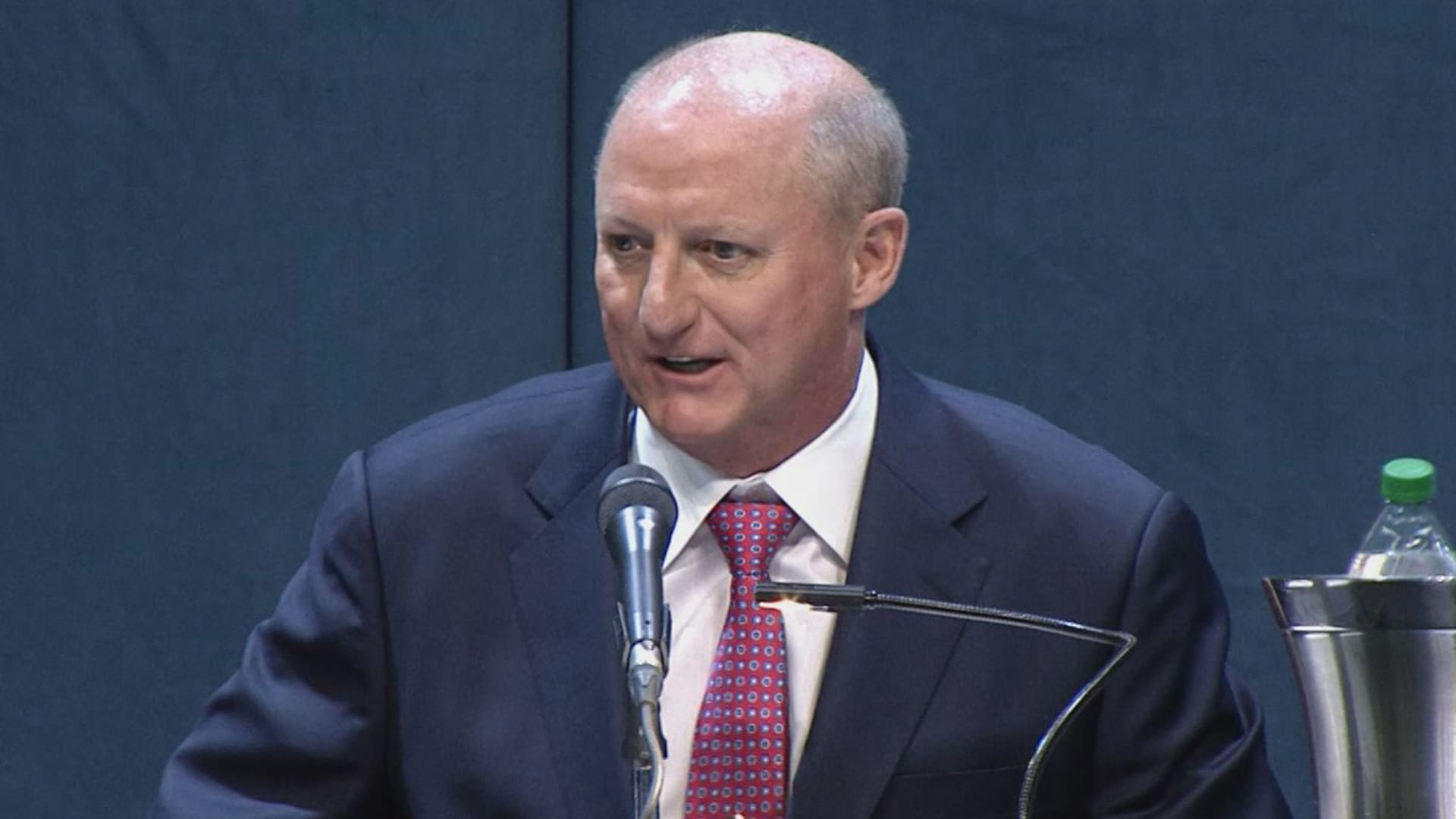
Greg Abel speaks during the Berkshire Hathaway Annual Shareholders Meeting in Omaha, Nebraska on May 3, 2025.
CNBC
Berkshire Hathaway said Thursday it has resumed repurchasing its own shares for the first time since 2024 and separately new CEO Greg Abel purchased $15 million worth of stock himself, an amount equal to his after-tax annual salary.
Abel told CNBC he will continue using his full salary amount to purchase Berkshire shares every year.
The Omaha-based conglomerate disclosed in a regulatory filing that it began buying back its Class A and Class B shares on Wednesday. Berkshire’s policy allows the company to repurchase stock whenever the chief executive, after consultation with the chairman of the board i.e. Warren Buffett, believes that the repurchase price is below Berkshire’s intrinsic value, according to its annual report released over the weekend.
“I absolutely talked to Warren. So how I approached it was, obviously looking at the value, having a view of intrinsic value, consulted with Warren relative to the value and the timing,” Abel told CNBC’s “Squawk Box” on Thursday.
Abel said normally the company wouldn’t disclose the start of the repurchases. “We felt it was important to communicate to our shareholders, our partners, our owners, with the transition of leadership,” he said.
Abel took over for Buffett, 95, in January. Shares of Berkshire have fallen 3% this year and 10% from their record high last May. The stock came under pressure earlier this week after the firm reported a near 30% decline in its operating earnings for the fourth quarter, due in large part to weakness in the insurance business.
The last time Berkshire repurchased shares was the second quarter of 2024. Berkshire B shares added 1% in early trading Thursday following the news.
Abel’s personal buying
In a separate filing, Abel disclosed that he personally purchased $15 million worth of the conglomerate’s stock. The 62-year-old executive’s purchase came a little more than two months into his tenure running the Omaha-based conglomerate.
The transaction increases his personal stake in Berkshire at a time when some investors have questioned whether Buffett’s successor has comparable “skin in the game.” Buffett owns about 37.5% of Berkshire’s Class A shares and has no intention of selling his stake aside from his charitable giving. He has previously said the conglomerate represents roughly 99.5% of his net worth.
“Absolute alignment with our shareholders, our partners, our owners, is critical,” Abel told CNBC. “I already have some shares, but the goal was to continue to demonstrate alignment with them… As the CEO, I absolutely, obviously, believe in Berkshire. with the transition from Warren, and I inherited a company that has an incredible foundation.”
Before the latest purchase, Abel, a longtime Berkshire executive who previously oversaw the company’s non-insurance operations, owned $164.4 million worth of Berkshire stock, according to FactSet.
The CEO said he was committed to doing this every year he is at the helm of Berkshire, which Abel said he hopes is “20 years.”
Abel has emphasized continuity with Buffett’s investment philosophy since taking the helm. He used his first annual shareholder letter over the weekend to reassure investors that the conglomerate’s culture of financial conservatism and disciplined investing will continue “into perpetuity.”
Crypto World
Why is the crypto market up today? Bitcoin and utility protocols reveal on-chain whale inflows


Disclosure: This article does not represent investment advice. The content and materials featured on this page are for educational purposes only.
Fresh institutional inflows into Bitcoin are driving a crypto market rebound, while on-chain data shows whales increasingly moving capital into utility protocols like Mutuum Finance.
Summary
- U.S. spot Bitcoin ETFs saw about $458m in net inflows, helping BTC recover to around $68k after weekend volatility.
- Funds such as iShares Bitcoin Trust (IBIT) from BlackRock led the inflows as institutions treated the recent decline as a buying opportunity.
- Mutuum Finance has raised over $20.7m and launched its V1 lending protocol on the Sepolia testnet, signaling growing interest in utility-driven projects.
The digital asset market is experiencing a notable upward trend. This recovery follows a weekend of high volatility where geopolitical tensions briefly pushed prices lower. The current rally is largely driven by a significant return of institutional confidence, particularly through U.S.-based spot Bitcoin ETFs. Market data shows that large investors are not only stabilizing the “king of crypto” but are also beginning to shift their focus toward emerging utility protocols that offer functional financial tools.
Bitcoin
The primary reason for today’s market surge is the aggressive buying behavior from institutional investors. On Monday, March 2, U.S. spot Bitcoin ETFs recorded approximately $458 million in net inflows. This massive injection of capital effectively absorbed the “weekend shock” that had briefly sent Bitcoin tumbling toward the $63,000 level. By Tuesday morning, Bitcoin had reclaimed the $68,000 mark, signaling a swift rejection of the lower price range.
BlackRock’s IBIT fund remains the dominant force in this recovery, accounting for roughly half of the recent inflows. Over the last three trading sessions alone, U.S. spot ETFs added nearly $1.1 billion in total. This level of buying suggests that institutional desks are treating the recent war-driven volatility as a “dip-buying” opportunity.
In addition to direct ETF buying, the options market shows a measured response to recent headlines. While short-term volatility briefly spiked, it retraced quickly. This indicates that traders are hedging for short-term risks rather than preparing for a long-term bear market. With Bitcoin holding steady near $68,000, the “leverage flush” that occurred in February appears to be over, leaving the market in a much healthier position for growth throughout March.
Utility protocols reveal on-chain whale inflows
While Bitcoin provides the market’s foundation, on-chain data shows that “whales” are increasingly moving capital into utility protocols. These are platforms that provide financial services—like lending, borrowing, and yield generation. As the top-tier market recovers, these utility projects often see the highest growth because they offer yield generated from protocol fees.
One project in this space is Mutuum Finance (MUTM). Mutuum Finance is a decentralized lending protocol that has raised over $20.7 million from a global base of 19,000 investors. Currently, the MUTM token is priced at $0.04. The steady growth of its investor base suggests that whales are looking for projects with high technical transparency and a clear path to delivery.
The power of a detailed roadmap
Utility protocols historically attract large-scale capital by providing a well-explained and detailed roadmap. Professional investors prefer projects that deliver their technology piece by piece. When a team consistently meets its development goals, it builds trust that makes it more attractive during market recoveries. By showing exactly how the technology will scale, these protocols reduce the perceived risk for large-holders.
The Mutuum Finance roadmap is divided into clear phases aimed at building a full-suite decentralized bank. The project is currently in Roadmap Phase 3, but the overall roadmap focuses on:
One-click borrow presets: Simplified risk profiles (Safe, Balanced, Aggressive) to make DeFi accessible to non-technical users. This feature is already integrated into the V1 protocol on the Sepolia testnet, allowing the community to test how these presets adjust the Stability Factor.
Buy-and-redistribute mechanism: Using protocol fees to buy MUTM tokens and reward those who stake in the “Safety Module.” This mechanism is specifically designed to create consistent MUTM buy pressure in the long run, linking the protocol’s growth and transaction volume to the market demand for its native token.
Native over-collateralized stablecoin: The team is planning a native over-collateralized stablecoin to provide a stable medium of exchange within the ecosystem, backed by the interest-bearing assets. This digital asset is designed to maintain its peg through redundant value backing, allowing users to mint liquidity against their holdings without selling their underlying positions.
Layer-2 expansion: To reduce costs, the protocol will expand to L2 networks, ensuring fast and cheap transactions for all users as the platform scales. This migration will significantly lower the gas fees associated with frequent interactions like interest compounding or adjusting collateral positions.
What Mutuum Finance has already delivered
Mutuum Finance has already delivered its functional V1 protocol on the Sepolia testnet. This allows its 19,000 investors to test lending & borrowing mechanisms and core features such as mtTokens (yield-bearing receipts) and automated liquidation bots in a live risk-free environment.
The project has also secured a manual security audit from Halborn and a high safety score from CertiK. By providing a working testing environment before the full mainnet launch, Mutuum is proving that it can meet its technical milestones, which is exactly the kind of delivery that attracts long-term whale interest.
The crypto market’s upward move today is a classic example of institutional “dip-buying” meeting technical delivery. With $458 million flowing into ETFs and Bitcoin stabilizing at $68,000, the path is clear for utility protocols to take center stage. Mutuum Finance, which combines a $20.7 million funding base with a functional V1 protocol, is benefiting from this shift in whale focus.
Disclosure: This content is provided by a third party. Neither crypto.news nor the author of this article endorses any product mentioned on this page. Users should conduct their own research before taking any action related to the company.


Global trading giant Intercontinental Exchange (ICE) has begun a strategic partnership with cryptocurrency trading firm OKX to launch new products.
The deal will see the New York Stock Exchange owner license OKX’s spot crypto prices for crypto futures products, and OKX offer ICE futures and tokenized equities, the companies said on Thursday.
ICE also made a strategic investment in OKX, reflecting a valuation of $25 billion, according to a press release. The terms of the investment were not disclosed.
Alongside the investment, ICE will have a board seat on OKX’s board of directors and establish a broad collaboration to leverage OKX’s blockchain infrastructure alongside ICE’s market technology, said the release.
The joint venture will also aim to advance clearing and risk management solutions, multi-chain custody and wallet architecture, the companies said.
“Our strategic relationship with OKX will expand global retail access to ICE’s pre-eminent regulated markets and accelerate our plans to offer on-chain infrastructure and tokenized assets to U.S. investors,” said Jeffrey C. Sprecher, ICE chair and CEO.
The relationship brings together the operators of two high-performance matching engines and transparent order books, said Star Xu, founder and CEO of OKX, “to help build a more reliable market structure that bridges digital assets and equities, strengthens cross-market price formation, and meets institutional standards for risk and compliance.”
OKX global managing director, Haider Rafique – who played an instrumental part in securing the deal with ICE – said via email: “This relationship is truly unique. We couldn’t be more excited about the new opportunities and products we’ll be able to unlock by collaborating with such a respected and focused partner.”


Billionaire investor Chamath Palihapitiya, a venture capitalist and former Facebook executive, recently argued that bitcoin has a “structural failing” that could limit its long term adoption by governments and central banks.
Speaking on People by WTF podcast during the World Government Summit, Palihapitiya said that for a digital asset to become widely accepted at the sovereign level it must possess characteristics that make it suitable for central bank reserves.
According to Palihapitiya, bitcoin falls short on two important dimensions, privacy and fungibility. Fungibility refers to the idea that each unit of an asset is interchangeable and indistinguishable from another. With physical cash or gold, one unit is effectively identical to any other unit.
Bitcoin, however, operates on a transparent blockchain where transaction histories are permanently recorded. Because coins can be traced back through prior transactions, some units can become associated with illicit activity, meaning certain coins may be treated differently than others.
Palihapitiya argues that this traceability weakens bitcoin’s fungibility and reduces its suitability as a reserve asset for central banks.
So far, only one central bank has publicly disclosed purchasing bitcoin, the Czech National Bank.
By contrast, he says gold satisfies both privacy and fungibility requirements for sovereign institutions, which is why central banks continue to hold large gold reserves.
For that reason, Palihapitiya suggested bitcoin may struggle to achieve another tenfold increase in market capitalization driven by central bank demand. Instead, he hinted that other crypto projects or smaller tokens may eventually address these limitations.
Palihapitiya remains optimistic about innovation in digital finance, particularly stablecoins, which are cryptocurrencies designed to maintain a stable value by being pegged to assets such as the US dollar or commodities.
He pointed to the potential for gold backed stablecoins as an example of financial innovation that could reduce friction in payments and settlement.
Meanwhile, Jason Calacanis, another venture investor and co host of the All In podcast, discussed bitcoin related corporate strategies with crypto entrepreneur Erik Voorhees on the This Week in Startups podcast. Calacanis asked Voorhees about Strategy (MSTR), formerly MicroStrategy, the public company known for holding the largest corporate treasury of bitcoin.
Voorhees, a longtime Bitcoin advocate and founder of crypto exchange ShapeShift, said the strategy of accumulating as much bitcoin as possible is coherent if the company strongly believes in bitcoin’s long term value. Calacanis was more skeptical. He said that when financial structures become difficult to explain or rely on new metrics, such as “community EBITDA”, it raises red flags for him as an investor.
This comes as hedge fund billionaire Ray Dalio recently remarked that “there is only one gold.
Crypto World
BTC price takes aim at $74,000. Surprisingly, the dollar’s rallying too: Crypto Daybook Americas
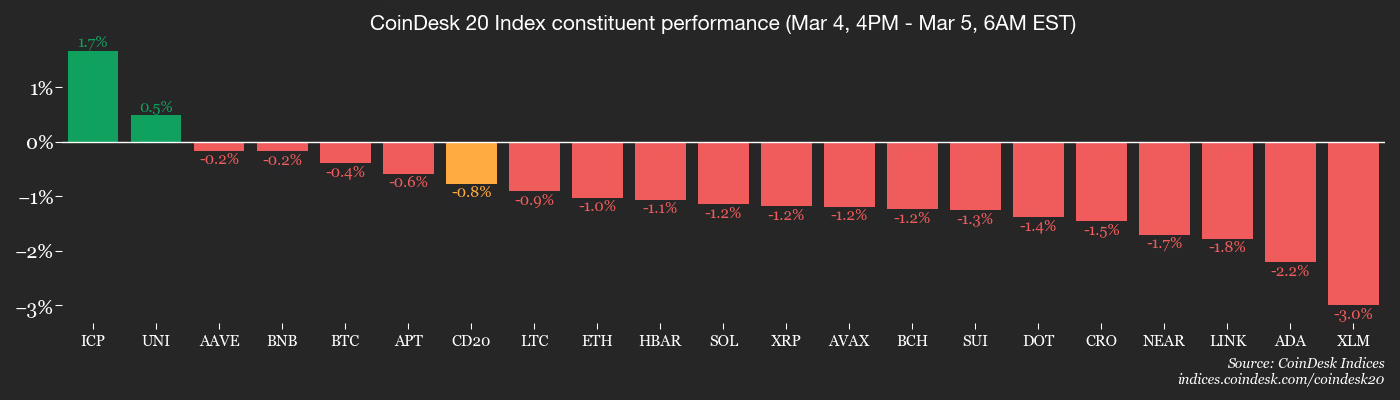
By Omkar Godbole (All times ET unless indicated otherwise)
Bitcoin is rallying alongside the U.S. dollar, a pattern that has surfaced several times since President Donald Trump won the 2024 election.
The cryptocurrency has gained over 10% since the outbreak of war in the Middle East over the weekend. Prices nearly tested the $74,000 mark at one point yesterday and are up over 2% in the past 24 hours. The CoinDesk 20 Index and major tokens including ether (ETH), XRP (XRP) and solana (SOL) rose 2% or more.
For bulls, the rally is notable not just for its magnitude but for the backdrop: It’s unfolding amid risk aversion in global equities and alongside a strengthening dollar. The Dollar Index (DXY) has gained over 1% this week and hit a high of 99.68 on Wednesday, a level last seen in November.
That combination may puzzle many market watchers. A stronger greenback typically weighs on dollar-denominated assets like bitcoin, and historically the two have tended to move in opposite directions.
Yet that inverse correlation has repeatedly been challenged since Trump returned to the White House promising pro-crypto policies. Both BTC and the DXY rose in the lead-up to and aftermath of the election, both fell in March–April 2025. Now both are rallying again.
In the meantime, the demand for BTC from the U.S. appears to be strengthening, a constructive signal for the market. The Coinbase Premium index — which measures the spread between prices on the Nasdaq-listed exchange and offshore giant Binance — rose to 0.0227% today, the highest since December, according to data source Coinglass. A premium on Coinbase is typically a sign of stronger demand from U.S. investors.
The focus now is whether the cryptocurrency can penetrate the historical make-or-break zone around $74,000. A decisive breakout would likely bolster investor confidence and draw additional buyers into the market.
Some traders are also watching the U.S. macroeconomy.
“The US Employment Situation report for February is scheduled for March 6 followed by CPI on March 11, and the next FOMC meeting on March 17-18,” Vikram Subburaj, CEO of Indian exchange Giottus.com said in an email. “All these are potential volatility catalysts for global risk assets, including crypto.”
Other macro observers remain cautious, noting that the current calm tied to the U.S. promise to escort and insure oil tankers may prove fragile.
“All it takes is one Iranian rocket for this fragile equilibrium to pitch into severe discontinuity. The threat of one Iranian rocket hitting paydirt remains real and this isn’t something that can be remedied any time soon,” economist Robin Brooks noted in a blog post. Stay alert!
Read more: For analysis of today’s activity in altcoins and derivatives, see Crypto Markets Today
What to Watch
For a more comprehensive list of events this week, see CoinDesk’s “Crypto Week Ahead“.
- Crypto
- Macro
- March 5, 8:30 a.m.: U.S. initial jobless claims for week ending Feb. 28 (Prev. 212K)
- March 5, 8:30 a.m.: U.S. nonfarm productivity QoQ prel for Q4 (Prev. 4.9%)
- March 5, 4:30 p.m.: U.S. Fed balance sheet update for period ending March 4
- Earnings (Estimates based on FactSet data)
- March 5: Rumble (RUM), post-market, -$0.10
Token Events
For a more comprehensive list of events this week, see CoinDesk’s “Crypto Week Ahead“.
- Governance votes & calls
- Uniswap DAO is voting across two linked proposals to expand v2 and v3 protocol fees to eight L2 networks and enable a new tier-based fee system across all v3 pools. Voting ends March 5.
- Gnosis DAO is voting to provide a grant to fund the continued support, infrastructure, and maintenance of the Revoke.cash security platform. Voting ends March 5.
- Unlocks
- March 5: Ethena (ENA) to unlock 2.24% of its circulating supply worth $18.35 million.
- Token Launches
- March 5: WhiteBit Token (WBT) lists on Kraken.
- March 5: Limitless (LMTS) to be listed on Coinbase.
- March 5: Opinion (OPN) to be listed on Binance, BitMart, BingX, MEXC and others.
Conferences
For a more comprehensive list of events this week, see CoinDesk’s “Crypto Week Ahead“.
Market Movements
- BTC is down 0.13% from 4 p.m. ET Wednesday at $72,849.18 (24hrs: +2.42%)
- ETH is down 1.08% at $2,135.84 (24hrs: +3.81%)
- CoinDesk 20 is down 1.25% at 2,072.03 (24hrs: +2.75%)
- Ether CESR Composite Staking Rate is up 6 bps at 2.91%
- BTC funding rate is at 0.0026% (2.8744% annualized) on Binance

- DXY is down 0.12% at 98.99
- Gold futures are up 1.06% at $5,174.30
- Silver futures are up 2.28% at $84.51
- Nikkei 225 closed up 1.90% at 55,278.06
- Hang Seng closed up 0.28% at 25,321.34
- FTSE 100 is up 0.30% at 10,598.92
- Euro Stoxx 50 is up 0.13% at 5,878.37
- DJIA closed on Wednesday up 0.49% at 48,739.41
- S&P 500 closed up 0.78% at 6,869.50
- Nasdaq Composite closed up 1.29% at 22,807.48
- S&P/TSX Composite closed up 0.47% at 33,942.90
- S&P 40 Latin America closed up 2.26% at 3,619.17
- U.S. 10-Year Treasury rate is up 3 bps at 4.08%
- E-mini S&P 500 futures are unchanged at 6,870.50
- E-mini Nasdaq-100 futures are unchanged at 25,113.50
- E-mini Dow Jones Industrial Average futures are down 0.18% at 48,710.00
Bitcoin Stats
- BTC Dominance: 59.78% (0.9%)
- Ether-bitcoin ratio: 0.02938 (0.38%)
- Hashrate (seven-day moving average): 999 EH/s
- Hashprice (spot): $32.09
- Total fees: 3.03 BTC / $215,909
- CME Futures Open Interest: 111,485 BTC
- BTC priced in gold: 14.1 oz.
- BTC vs gold market cap: 4.88%
Technical Analysis

- The chart from Coinglass shows daily open interest in zcash (ZEC) futures.
- Open interest refers to the number of active futures contracts at any given time.
- The tally has increased to nearly 1.50 million ZEC, rising past a downtrend line.
- The breakout indicates renewed interest in ZEC futures and higher volatility ahead.
Crypto Equities
- Coinbase Global (COIN): closed on Wednesday at $208.93 (+14.57%), +0.10% at $209.14 in pre-market
- Galaxy Digital (GLXY): closed at $24.34 (+17.70%)
- MARA Holdings (MARA): closed at $9.29 (+7.27%), –0.22% at $9.27
- Riot Platforms (RIOT): closed at $16.53 (+8.11%), +0.24% at $16.57
- Core Scientific (CORZ): closed at $15.84 (+3.53%)
- CleanSpark (CLSK): closed at $10.66 (+7.79%), –0.75% at $10.58
- Exodus Movement (EXOD): closed at $12.16 (+12.28%), unchanged in pre-market
- CoinShares Bitcoin Mining ETF (WGMI): closed at $41.20 (+8.76%)
- Circle Internet Group (CRCL): closed at $105.27 (+5.66%), unchanged in pre-market
- Bullish (BLSH): closed at $36.86 (+11.29%), –0.49% at $36.68
Crypto Treasury Companies
- Strategy (MSTR): closed at $146.44 (+10.37%), –0.30% at $146.00
- Sharplink (SBET): closed at $8.13 (+11.98%), –1.60% at $8.00
- Upexi (UPXI): closed at $1.08 (+37.58%), +1.85% at $1.10
- Lite Strategy (LITS): closed at $1.22 (+6.09%)
- Strive Asset Management (ASST): closed at $9.62 (+15.49%), +0.73% at $9.69
ETF Flows
Spot BTC ETFs
- Daily net flows: $461.9 million
- Cumulative net flows: $55.93 billion
- Total BTC holdings ~ 1.29 million
Spot ETH ETFs
- Daily net flows: $169.4 million
- Cumulative net flows: $11.83 billion
- Total ETH holdings ~ 5.79 million
Source: Farside Investors
While You Were Sleeping
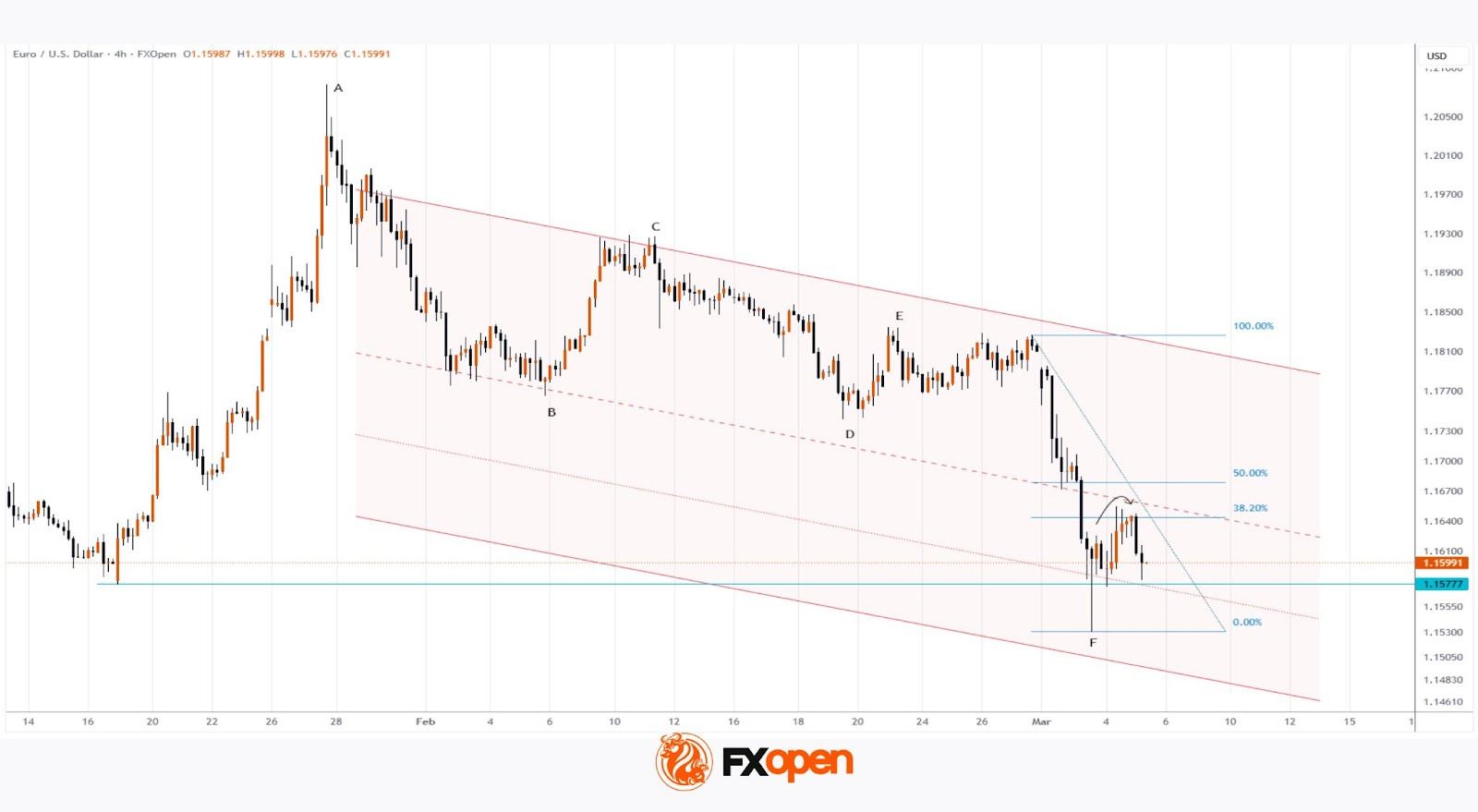
On 3 March, the EUR/USD pair fell below the January low (around 1.15777), establishing the lowest level of the year. As of today, 5 March, the chart shows signs of a continuation of bearish momentum.
On one hand, demand for the USD as a “safe-haven currency” remains elevated amid the ongoing military conflict in the Middle East.
On the other hand, the euro is under pressure because:
→ rising energy prices put the European Union at a disadvantage;
→ traders may be cautious ahead of today’s ECB news (Lagarde’s speech is scheduled for 20:00 GMT+3).
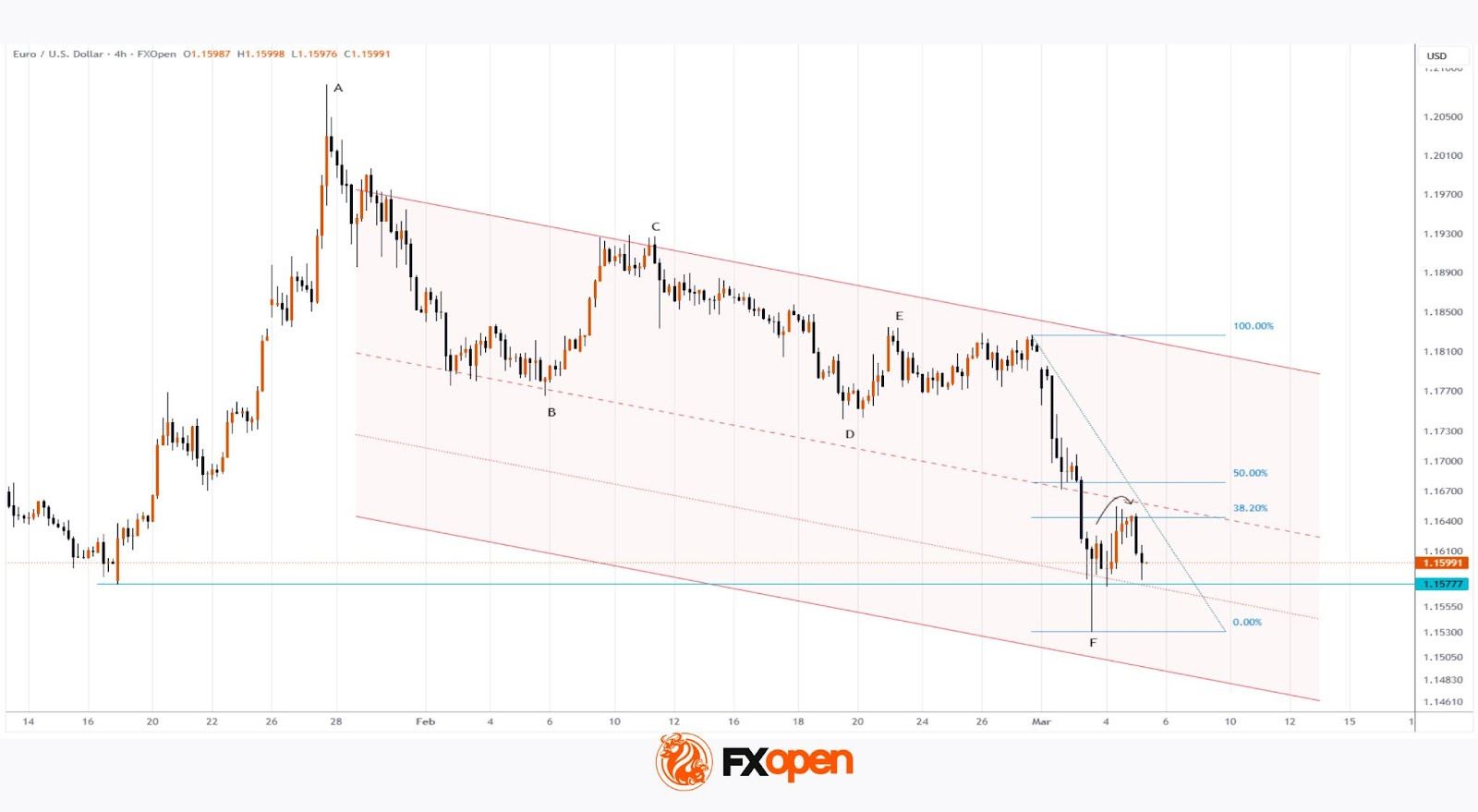
Technical Analysis of the EUR/USD Chart
On 19 February, we:
→ noted that bears held a certain advantage during February;
→ highlighted lower highs and lower lows at points A-B-C;
→ suggested a potential bearish scenario.
Since then, the downward movement has developed into a sequence A-B-C-D-E-F. Analysing the key patterns on the EUR/USD chart now allows us to construct a descending channel.
In this context, yesterday’s bearish reversal (indicated by the arrow) is noteworthy, as it occurred:
→ in the 0.382–0.5 Fibonacci zone, indicating a weak recovery;
→ below the channel median, which acted as resistance.
Considering the above, it is reasonable to state that bears remain in control. Forex traders should not rule out further declines in EUR/USD towards a new yearly low (and a test of the lower boundary of the channel).
However, the long lower shadow at point F suggests aggressive demand around the psychological level of 1.15000, and market sensitivity to Middle East news could rapidly change sentiment.
Trade over 50 forex markets 24 hours a day with FXOpen. Take advantage of low commissions, deep liquidity, and spreads from 0.0 pips (additional fees may apply). Open your FXOpen account now or learn more about trading forex with FXOpen.
This article represents the opinion of the Companies operating under the FXOpen brand only. It is not to be construed as an offer, solicitation, or recommendation with respect to products and services provided by the Companies operating under the FXOpen brand, nor is it to be considered financial advice.

OverDraught, Radcliffe facing fresh licensing action

Iran War: MISL And SHLD Should Get A Big Boost As America Rearms (NYSEARCA:MISL)

Game developer Sillytuna reports losing $24M of crypto in UK ‘wrench’ attack


-

 Politics7 days ago
ITV enters Gaza with IDF amid ongoing genocide
-

 Politics2 days ago
Alan Cumming Brands Baftas Ceremony A ‘Triggering S**tshow’
-

 Fashion6 days ago
Weekend Open Thread: Iris Top
-

 Tech4 days ago
Unihertz’s Titan 2 Elite Arrives Just as Physical Keyboards Refuse to Fade Away
-
Sports5 days ago
The Vikings Need a Duck
-
 NewsBeat5 days ago
Dubai flights cancelled as Brit told airspace closed ’10 minutes after boarding’
-

 NewsBeat5 days ago
Abusive parents will now be treated like sex offenders and placed on a ‘child cruelty register’ | News UK
-

 NewsBeat4 days ago
‘Significant’ damage to boarded-up Horden house after fire
-
 NewsBeat5 days ago
The empty pub on busy Cambridge road that has been boarded up for years
-

 Tech7 hours ago
Bitwarden adds support for passkey login on Windows 11
-

 Entertainment3 days ago
Baby Gear Guide: Strollers, Car Seats
-
 Tech6 days ago
NASA Reveals Identity of Astronaut Who Suffered Medical Incident Aboard ISS
-

 Business7 days ago
Only 4% of women globally reside in countries that offer almost complete legal equality
-
Politics4 days ago
FIFA hypocrisy after Israel murder over 400 Palestinian footballers
-
 NewsBeat4 days ago
Emirates confirms when flights will resume amid Dubai airport chaos
-

 NewsBeat3 days ago
Is it acceptable to comment on the appearance of strangers in public? Readers discuss
-

 Crypto World7 days ago
From Crypto Treasury to RWA: ETHZilla Retreats and Relaunches as Forum Markets on Nasdaq
-

 Tech4 days ago
Viral ad shows aged Musk, Altman, and Bezos using jobless humans to power AI
-

 Business7 days ago
World Economic Forum boss Borge Brende quits after review of Jeffrey Epstein links
-

 Video3 days ago
How to Build Finance Dashboards With AI in Minutes