


AI is coming for the laptop class. While you clack away at your keyboard — writing code or drafting memos or making spreadsheets or scrolling X or perusing DoorDash or reading Vox or dreading death — machines are teaching themselves how to do your job.
Tech
Samsung Galaxy S26 Ultra review: The stealth upgrade

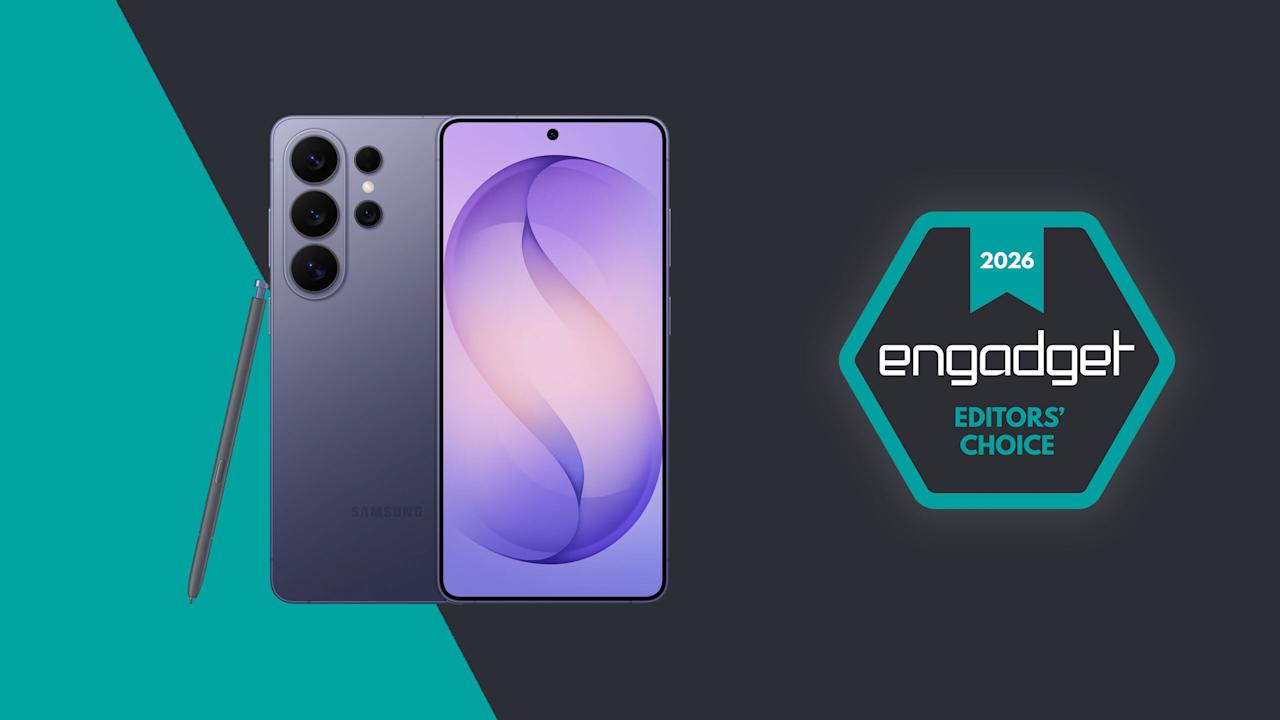
You’d be forgiven for thinking that the Samsung Galaxy S26 Ultra looks a lot like the last four models. That’s because it does, right down to its general design and rear camera layout. But on Samsung’s latest flagship phone, some stealthy upgrades are hidden beneath its classic blocky silhouette that might go unnoticed by the casual observer. Those help make this year’s release feel like a better deal than its most recent predecessor. It remains rather expensive, starting at the same $1,300 as before, but considering the price of RAM these days, that almost feels like a blessing. So while it won’t hit you over the head with monumental changes year over year, it’s subtly one of the best Ultras we’ve gotten in the past half-decade.

Samsung / Engadget
While the S26 Ultra might not wow you with a ton of major improvements, it brings subtle upgrades across the board along with a new standout display for anyone who cares about privacy.
Pros
- Superb Privacy Display
- Great performance
- Strong battery life
- Wider aperture for main and 5x telephoto lenses
Cons
- Expensive
- S-Pen is unchanged
- No built-in magnetic ring for Qi2 accessories
Design: Back to aluminum
After dabbling with titanium frames on the last two Ultras, Samsung returned to aluminum for 2026. The company says this makes it easier to color-match the phone’s chassis to the Corning Gorilla Armor 2 panels on the front and back, though it’s incredibly difficult to see the impact on my black review unit. Elsewhere, the company shaved a few grams off its total weight and a few millimeters off its thickness (7.9mm and 214 grams), but even when directly comparing the new model to last year’s S25 Ultra (8.2mm and 218 grams), that difference is basically imperceptible. I almost think the S26 Ultra’s extra sleekness was just so that people would stop saying the Z Fold 7 is lighter than Samsung’s most premium traditional candybar-style handset.
As always, there’s a built-in storage slot for Samsung’s S-Pen, which is essentially a carbon copy of what we got last year without any functional changes. However, because the phone’s corners are more rounded than ever, one small peculiarity is that now there’s a right and wrong way to insert it. No matter what you do, the stylus will stay put, but if you don’t align the curve on the end of the S-Pen with the shape of the phone’s corner, it just doesn’t look right.
Display: Now with more privacy

The Galaxy S26 Ultra’s display has the same specs as the previous model, except now it comes with a built-in Privacy Display. (Sam Rutherford for Engadget)
The S26 Ultra’s 6.9-inch screen is easily its most undercover upgrade because it sports essentially the same specs as last year. You still get 2,600 nits of peak brightness with a variable 120Hz refresh rate and a max resolution of 3,120 x 1,440. The secret is that with the touch of a button, you can activate Samsung’s Privacy Display, which effectively stops others from spying on your screen when viewed from acute angles (both from the side and up and down).
When you turn the Privacy Display on and look at the phone less than head-on, everything sort of fades to black. Depending on the angle, you may still see an outline of UI elements and some bright spots depending on your content, but the wider you go, the fainter things get. The way it works is that the phone has two sets of subpixels, narrow and wide, the latter of which get turned off when the feature is active. And if you’re really concerned about people snooping on you, there’s an extra level called Maximum Privacy Protection that makes almost everything completely go gray, though there are trade-offs for this.
Even on maximum protection, you can still make out some faint details. But good luck to anyone trying to glean any usable info while the Galaxy S26 Ultra’s Privacy Display is on. (Sam Rutherford for Engadget)

When using the standard Privacy Display mode, there’s very little impact on image quality and brightness, so it’s not that big of a deal to leave it on all the time. If you look closely, you may notice what appears to be a small drop in resolution, though this requires some serious pixel peeping and good eyesight. But with maximum protection on, there’s a noticeable drop in contrast and luminance that, for me, isn’t worth the increased privacy.

The effect is more pronounced in person, but in this side-by-side comparison, you can still see how Maximum Protection mode has an impact on the S26 Ultra’s contrast and color saturation. (Sam Rutherford for Engadget)
Thankfully, there’s a third option, which is to have the phone selectively activate Privacy Display under certain conditions. You can have it automatically turn on when you get notifications or open selected apps (like for banking or authenticators), which is what I prefer. The phone can also enable the feature when you need to enter a PIN, pattern or password. The caveat is that this only applies to system-level prompts like your lock screen. Theoretically, there’s no reason the S26 Ultra can’t do this anytime you’re presented with a password or PIN prompt, but every app needs to be optimized properly, so that isn’t a thing just yet. Regardless, it’s a powerful tool that can prevent people from gleaning sensitive info while you’re and about and I really hope it becomes standard inclusion on all premium phones going forward.
Performance and software: More speed and AI

Apparently this is what Samsung’s AI thinks a Pikachu sticker should look should look like. (Sam Rutherford for Engadget)
The main engine powering the S26 Ultra is Qualcomm’s Snapdragon 8 Elite Gen 5 chip for Galaxy along with 12GB or 16GB of RAM and up to 1TB of storage. Its biggest strength lies in its improved NPU, which is 39 percent more powerful than the previous generation, paving the way for improved AI-based features. That said, the rest of the processor provides some nice but not especially impressive gains in processing speed. Its CPU boasted 19 percent better performance while its GPU is around 24 percent beefier. In Geekbench 6, this translated to a multi-core score of 11,240 for its CPU (up from 9,828 on the S25 Ultra) and a GPU score of 25,403 (up from 19,863). Granted, it’s not like its predecessor ever struggled with performance, but it’s still worth noting that this is essentially as fast as an Android phone can get right now.
Of course, as we progress deeper into the AI era, Samsung has come up with a boatload of new and improved AI-powered tools as well. The most useful of these is Photo Assist, which serves as a one-stop shop for all your editing and content creation needs. In addition to fixing things like reflections or deleting objects in an image, you can use natural language text prompts to generate completely new elements like hats for your pets or pretty much anything else you can think of. And if that’s not enough, there’s also Samsung’s Creative Studio, which is a playground for making all sorts of fun digital art like wallpapers, stickers and greeting cards.
The S26 Ultra’s Now Nudge feature uses AI to find and suggest relevant photos when you use the Samsung Keyboard. (Sam Rutherford for Engadget)

Elsewhere, there’s also an improved document scanner and a call screener that’s better at blocking spam and robocalls. All told, they’re welcome upgrades and they work rather well. Samsung even borrowed an idea from Google’s Magic Cue with its Now Nudge feature, which can surface relevant photos based on context anytime you’re using the Samsung keyboard. Unfortunately, what’s arguably the S26 Ultra’s coolest new feature, Automated App Actions, isn’t available for another week. But the bigger issue is that almost all of these features are things we’ve seen before on rival devices like the Pixel 10 Pro. While they’re nice to have, it’s gotten to the point where these tools are more like table stakes for high-end phones nowadays instead of being reasons you might want to upgrade.
Cameras: The same sensors with some larger apertures

While the S26 Ultra has the same sensors as before, Samsung gave it wider apertures for its main and 5x telephoto cameras. (Sam Rutherford for Engadget)
While the sensors on the S26 Ultra haven’t changed since the previous model, Samsung didn’t completely forget about photo upgrades. Alongside its 10-megapixel 3x telephoto, 50MP ultra-wide and 12MP selfie cam, its 200MP main cam and 50MP 5x telephoto camera have larger apertures at f/1.4 and f/2.9, respectively (up from f/1.7 and f/3.4). So on top of already being able to take excellent photos during the day, the UItra’s primary shooter is noticeably better at night.
In a shot of some Transformers in a dimmed room, the S26 Ultra basically matched what I shot with a Pixel 10 Pro — aside from some minor differences in white balance. Details were sharp and Samsung’s photo was less noisy, which is due in part to a change in the phone’s image processing. But the most impressive example of the Ultra’s improved picture quality was when I took a very challenging backlit shot of a Grogu doll, in which the S26 did a better job of exposing Baby Yoda’s face compared to the P10 Pro. So even without new sensors, Samsung has managed to make an already great main camera just a bit better.
Battery life
The Galaxy S26 Ultra features a 5,000mAh battery, just like what we got on the previous model. That means it’s largely relying on power efficiency gains from its new chip for improved longevity, which it delivers, but it’s not a major leap. On our local video rundown test, the S26 Ultra lasted 30 hours and three minutes, which is only about half an hour longer than before. That said, considering the only phones that have fared better were the OnePlus 15 and 15R, it’s hard to be upset about its overall runtime.
As for charging, the Ultra has gotten a big leap in speed (assuming you have compatible power adapters) compared to its less expensive siblings. When using a cable, it now supports up to 60 watts versus 45 watts for the S26+ or just 25 watts for the base S26. And it’s a similar story when charging wirelessly, with the Ultra now capable of hitting 25 watts when plopped on a pad compared to 20 watts for the S26+ and 15 watts for the S26.
The S26 Ultra has significantly faster wired and wireless charging than its less expensive siblings. Though sadly, it still doesn’t have a built-in ring for magnetic accessories. (Sam Rutherford for Engadget)

The major annoyance is that Samsung still hasn’t given any members of the S26 family a built-in magnetic ring for Qi2 charging or other magnetic accessories. The company claims this was done to help keep the phone as thin as possible, but honestly, I thought we had gotten over the desire for needless sleekness long ago. Sure, you can add that functionality back in by choosing the right case, but that’s not a very premium experience and I sincerely hope this is the last time Samsung makes this omission on its flagship phone line.
Wrap-up
There’s a strange feeling I often get when testing phones. After I got everything updated and set up the way I like, I noticed it even more with the S26 Ultra. The issue is that despite using a brand new device with shiny hardware, better performance and a more refined design, I’m still largely doing the same things and using the same apps as I was before (like Google Maps, Gmail and whatever my go-to mobile games are at the moment). This means my daily flow is basically unchanged from device to device.

This better be the last time Samsung skips putting a magnetic ring inside the Galaxy S line. (Sam Rutherford for Engadget)
However, if you’re paying attention, you’ll notice things like higher framerates while gaming, sharper and more well-exposed photos at night and helpful suggestions like when the phone surfaces relevant photos in the middle of a text conversation. This goes double for the S26 Ultra, whose biggest upgrade — the Privacy Display — is something meant to stop other people from snooping at what you’re doing. When it’s on, you probably won’t even be able to tell, which is kind of the point.
There’s no doubt that the S26 Ultra is an improvement over last year’s phone. It’s faster, it takes better low-light photos and thanks to all of its new AI features, the handset feels smarter too. But it takes a discerning eye to spot and feel all these differences, particularly if you’re upgrading from a device that’s only a year or two old. So while the S26 Ultra remains the top pick as a phone that can do pretty much everything really well, in the grand scheme of things, it’s more of a stealthy, undercover update than an eye-catching new crown jewel.
Continue Reading
Over the past four years, chatbots have gone from neat parlor tricks to hyperproductive polymaths. AI models can now generate new software out of a single English sentence, summarize case law in seconds, read CT scans with superhuman accuracy, and coordinate complex office workflows with scant human oversight.
Large language models (LLMs) — today’s premier form of artificial intelligence — still have their limitations. They can’t reliably fulfill most white-collar workers’ every function. But AI progress is compounding on itself. As LLMs automate the process of building better LLMs, they will kick off a feedback loop of exponential self-improvement.
- Despite AI’s rapid advances, it still hasn’t substantially increased unemployment.
- You don’t necessarily have to outperform AI at your job in order to keep it.
- The go-to evidence for exponential AI progress has serious methodological flaws.
Thus, by the end of next year — if not this one — AI will render much of America’s professional class obsolete and push unemployment to 20 percent. Within a decade, the technology could wipe out virtually all forms of knowledge work.
Or so many of AI’s champions and detractors believe.
In recent weeks, the drumbeat of catastrophic labor-market forecasts has grown louder, with tech CEOs, financial analysts, and journalists penning viral predictions of an impending unemployment crisis.
In my view, the threat of AI-induced unemployment is worth taking seriously. And I’ve sketched out the case for alarm in past essays.
If the AI doomers’ concerns are warranted, however, their certainty is misplaced. Artificial intelligence could trigger mass white-collar layoffs in the near future. But there are plausible arguments against that scenario.
To inject some balance into the AI discourse — and/or, reassure myself that my hard-won verbal skills aren’t about to be less economically valuable than my flimsy biceps — I’ve sought out reasons for optimism about the white-collar labor market. Here are the four that I found most compelling:
1) You can see the AI age everywhere except in the jobs data
The first reason to doubt the doomer scenario for AI and unemployment is that it keeps not happening.
Or, more precisely: Despite the astounding capacities of today’s LLMs, there still aren’t many signs of large-scale, AI-induced job loss.
It takes time for firms to adopt new technologies, of course. But generative AI has been remarkably powerful for a while now. As of late 2024, it could already automate many coding tasks, generate research reports, write ad copy, review legal documents, and make terrible music at a near-human level.
Yet America’s unemployment rate has barely budged over the past two years, hovering near 4 percent.
Even in the industries most suited to AI-driven automation, employment shifts have been modest. Job postings for software developers have actually increased over the past year. Employment in market research, meanwhile, went up after ChatGPT hit the market. Even customer service representatives — arguably, the workers most threatened by chatbots — have not suffered massive job losses: Although employment in the field fell 10 percent from 2023 to 2024, it has held steady since then and remains close to its pre-pandemic level.
What’s more, there are few indications that mass, white-collar layoffs are on the horizon. In a December survey by the accounting firm KPMG, 92 percent of CEOs said they were planning to grow their head counts, even as 69 percent were dedicating a large share of their budgets to AI deployment.
Similarly, a January survey from EY-Parthenon found that 69 percent of CEOs expected that AI would lead them to either maintain or expand their payrolls.
One could dismiss this as sunny bluster. But there is evidence that these executives’ ostensible intuition — that AI adoption and downsizing don’t necessarily go together — holds true in practice. In a study of 12,000 European businesses published in February, firms that adopted AI saw a 4 percent increase in labor productivity — yet did not reduce their staffing in response.
Granted, if you scour the jobs data for portents of an AI-driven unemployment crisis, you can come up with a few. For one, between November 2022 and January 2026, America’s core white-collar industries — finance, insurance, information, and professional and business services — cut their staffing by 1.9 percent. This is unusual; outside of recessions, these sectors have historically added jobs at a steady rate.
For another, a Stanford Digital Economy Lab study suggests that young workers in heavily AI-exposed fields have seen declining job prospects, relative to those in other sectors, since ChatGPT debuted.
Forecasts of an impending white-collar “bloodbath” tend to put a lot of weight on these data points. And yet, both developments likely have less to do with AI adoption than with monetary policy.
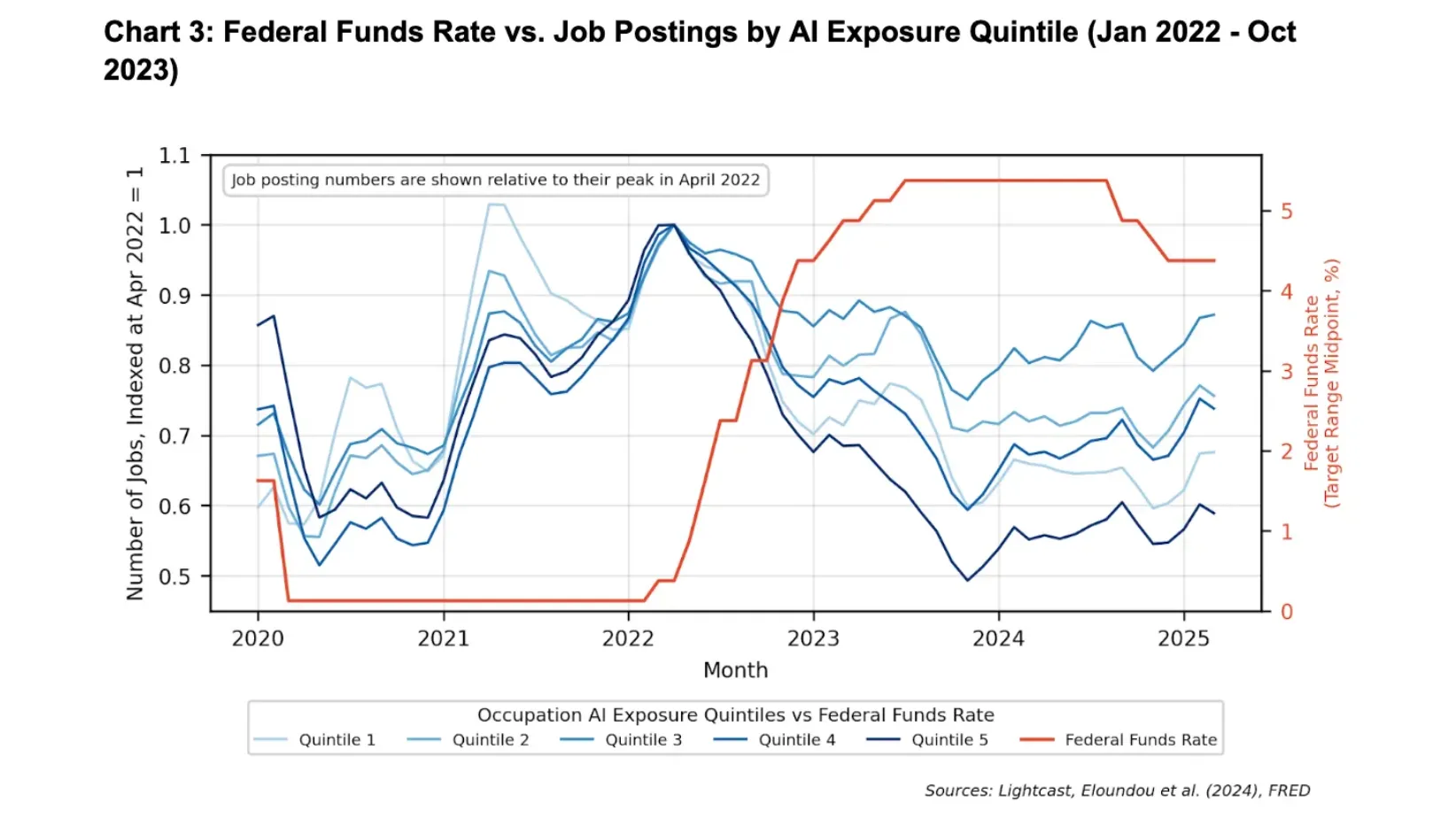
As two economists at Google recently observed, America’s most AI-exposed industries began to slash hiring six months before ChatGPT hit the market in November 2022. And white-collar job postings fell most precipitously in 2023, when corporate deployment of LLMs had barely begun; in the fourth quarter of that year, fewer than 10 percent of large businesses said they were even planning to use AI in the next six months.
This timeline is hard to square with the theory that AI drove the slowdown in white-collar hiring. By contrast, the timing neatly aligns with the Federal Reserve’s tightening cycle.
In March 2022, the central bank began hiking interest rates at a historically aggressive pace. A little over one month later, job postings began to fall in white-collar fields. When the Fed paused its hikes in 2024, that decline bottomed out; when the central bank began cutting rates in 2025, job openings started rebounding.

Courtesy of the Economic Innovation Group
Critically, interest rate hikes disproportionately impact AI-exposed industries. The sectors most susceptible to artificial intelligence — tech, finance, and professional services — are also among the most sensitive to tightening financial conditions. And when companies come under strain, they often pause entry-level hiring.
A pullback in employment caused by the Fed could therefore look a lot like one triggered by LLMs.
None of this is to deny that artificial intelligence has reduced employment in some occupations (for example, AI is almost certainly implicated in the recent decline of computer programming jobs). The point is just that the overall labor market impacts have been remarkably modest, given the scale of AI’s current capacities.
2) White-collar workers don’t need to outperform AI to remain economically valuable
The absence of a one-to-one correlation between increases in AI’s capabilities — and declines in white-collar employment — isn’t entirely surprising.
To remain economically valuable, a human worker does not need to outperform a machine at their job’s core tasks; they merely need to usefully complement that machine’s operations.
Consider translators. LLMs can convert text from one language to another at a speed and cost that no human could ever match. For many tasks, if corporations, authors, and publishers were forced to choose between having access to AI — or the world’s most gifted linguist — they would choose the bot.
And yet, a human translator working with an LLM still produces better text than the machine does by itself. While the latter blitzes through a first draft, the former can correct excessively literal translations of idiomatic expressions, tailor tone to the intended audience, and catch subtle errors that invite confusion or legal risk.
So long as human translators retain this utility, AI progress won’t necessarily reduce demand for their services. In fact, the technology could conceivably increase such demand.
That claim might seem unintuitive. After all, it surely takes fewer people to translate any given quantity of text in the age of generative AI than it did in years prior.
Yet humanity’s appetite for translated text is not fixed. If you drastically increase the efficiency of translation — and thus, reduce its cost — then people will purchase more of it.
And indeed, since the introduction of ChatGPT in 2022, demand for translation has surged. Perhaps for this reason, even as machines have come to match or exceed the skills of human translators across several dimensions, employment in the industry has grown in the European Union and stayed roughly level in the US.
And you can tell a similar story about myriad other fields.
AI can read medical images faster — and, for some types of cancer, more accurately — than any human. Still, a radiologist working with an AI yields better diagnoses than the machine working alone. And as LLMs have made radiology more efficient, demand for imaging has spiked — and with it, radiology employment.
3) People want some things done by people
In some domains, white-collar workers may retain an advantage over AI simply because they are human.
As the economist Adam Ozimek notes, many contemporary occupations could have been automated out of existence long ago, were technology the only concern. We’ve had player pianos and recorded music since the late 19th century. Yet many hotels and bars still pay human beings to tickle the keys for their customers.
“People are often willing to pay a premium for the ‘human touch.’”
For decades, it’s been easy to book your own travel online, relying on aggregators like Expedia and reviews on Yelp. Yet 67,500 Americans still make a living as travel agents. Workout videos make it possible for anyone to perform yoga at home, yet many hire personal instructors. Mechanical reproductions of famous paintings can be had at a low cost, yet people shell out millions for visibly indistinguishable versions that were produced by a specific human hand.
You could have asked ChatGPT to give you four reasons why AI won’t cause mass unemployment, and it would have instantly spit out a listicle. Instead, you’re reading an artisanally crafted explainer that Vox Media Inc. paid me to produce.
In other words, people are often willing to pay a premium for the “human touch.”
This won’t preempt an AI-induced employment crisis, all by itself. Consumers don’t typically care how their smartphone apps were coded or insurance claims were processed or tax returns were prepared. But a market for explicitly human-produced goods and services is likely to persist in many realms — including sales, medicine, legal services, and entertainment.
Heck, there might even be durable demand for journalism that’s conspicuously free of AI’s bizarre syntactical tics. That’s not just cope — it’s a serious possibility.
4) AI progress won’t necessarily be exponential
All these arguments may count for little, if AI’s capacities are truly growing at an exponential rate.
After all, exponential processes tend to creep up on you. When 32 cases of a supervirus become 64, almost no one notices. If that bug keeps doubling every couple days, however, the world will wake up a month later to 2.1 million infections. In that scenario, a glance at the pathogen’s impact on day three would have told you little about its consequences four weeks later.
In a world where AI progress is exponential, similar principles apply. Look around three years after ChatGPT’s debut and you might see little job loss. But if artificial intelligence is recursively self-improving — such that every advance accelerates the next — then today’s AI is only a pale imitation of 2030’s. The former may be to the latter as a hot-air balloon is to a space shuttle.
If so, then examining AI’s impact on jobs over the past four years wouldn’t shed much light on its effects over the next four. Likewise, the fact that white-collar workers can usefully complement AI today would scarcely guarantee their utility in the future.
But it’s not clear that AI has actually been improving at an exponential rate, much less that it will keep doing so, for years on end.
Without question, LLMs’ capabilities have been growing rapidly. But claims that this progress has been exponential tend to rest on a single, widely cited benchmark.
The AI research institute METR has long been the authority on the speed of AI progress. To gauge that pace, it tracks the duration of tasks that LLMs can complete with at least 50 percent accuracy. In this context, duration is measured by how long it would take a skilled human worker to complete the same assignment.
METR’s charts of how this has changed over time are ubiquitous in discussions of AI. And the trends are eye-popping.


Faced with these vertiginous slopes, many jump straight to wondering whether they will enjoy life as a “machine God’s” pet — forgetting to first ask themselves, “Wait, how does METR know that?”
Which is unfortunate, since the short answer is it doesn’t.
METR isn’t spying on every white-collar laborer in America, implanting bugs and honeypots in their break rooms, so as to determine how long it takes each worker to perform their jobs’ tasks.
Rather, to generate its estimates, the institute presents human software engineers with a bucket of coding assignments, measures how long they take to complete their tasks, and then sees whether AI models can perform the same feats. Through this process, METR estimates that the latest version of Claude can autonomously perform tasks that would take a skilled worker up to 14.5 hours to execute.
And yet, as NYU’s Nathan Witkin argues, there are massive problems with METR’s methodology, defects that severely limit what its findings can actually tell us about AI’s capabilities. To name just a few:
METR’s tasks are unrealistically basic. In METR’s own analysis, the bulk of their sample tasks differ from real-world engineering problems in systematic ways. Specifically, the former occur in static environments, require no coordination with other people (or agents), and include few resource constraints. METR also largely excluded tasks in which a single mistake could derail the entire project, so as to “reduce the expected cost of collecting human baselines.”
When the institute charted AI’s progress on its “messiest” tasks — which is to say, its most realistic ones — this was the result:

Viewed like this, AI progress does not look terribly exponential.
METR’s human baselines are unreliable. The sample of engineers who established METR’s baseline for human performance was neither large nor representative. Rather, as of 2025, its testing included only 140 people, recruited primarily from METR staffers’ professional networks.
More critically, on the more complex tasks, these recruits were often operating outside of their areas of expertise. In real life, these assignments would typically be handled by specialists, who would surely complete them more rapidly than random engineers with little domain knowledge.
Making matters worse, METR paid its baseliners on a per-hour basis, giving them an incentive to drag out their tasks.
AI could have simply memorized the answers to many of its assigned tasks. About one-third of the tested tasks had publicly available solutions. For these assignments, the models may have just been recalling answers they had encountered on the internet, in which case their success wouldn’t necessarily reflect growth in their general capabilities. (If a high-school student gains access to a calculus test in advance, and memorizes the answer, their performance on that problem wouldn’t tell us much about their general math skills.)
None of this is meant to disparage METR’s intentions, or to suggest that its data has zero utility. The pace of AI progress is not an easy thing to measure. And the organization is making an admirable effort.
Still, the fact that its charts are AI boosters’ (and doomers’) go-to evidence for exponential progress — despite the extreme limitations of its figures — calls the existence of that progress into question.
Moreover, even if we knew that AI has been improving exponentially over the past three years, we still couldn’t take a continuation of that trend for granted. Technologies routinely improve at an exponential rate for a period, only to stall out at a certain level of capability.
Machines might still replace us
These arguments don’t prove that the laptop class is going to be fine. They merely offer a basis for believing that it might be.
Indeed, everything I just wrote could be true — and AI could still drastically erode knowledge workers’ economic prospects.
Even if most white-collar laborers still usefully complement AI, a large minority may not. Meanwhile, those who remain employable might command drastically lower wages than they once did: When building software merely requires the ability to write instructions in plain English — rather than mastering complicated coding languages — programmers’ bargaining power may plummet.
And while AI-driven productivity gains might increase demand for certain goods and services, Americans’ latent appetite for tax advice, HR compliance audits, and contract review is not infinite. In these areas, AI’s boosts to efficiency are liable to yield job losses.
Finally, AI might not be improving at an exponential rate. But over time, linear gains may be sufficient to drastically reduce knowledge workers’ economic utility.
All this said, as the world’s most influential business leaders and intellectuals discuss the impending elimination of white-collar work as though it were no more hypothetical than tomorrow’s sunrise, it’s worth keeping their narrative’s liabilities in mind: This doomsday scenario has scant support in existing employment trends, sits in tension with multiple economic principles, and relies on dubious assumptions about the pace of AI progress.
In other words, while it’s past time for policymakers to prepare for AI-induced unemployment spikes, knowledge workers don’t yet need to toss our keyboards and learn to plumb.
“Pursuant to the Protecting Americans from Foreign Adversary Controlled Applications Act, apps developed by ByteDance Ltd. and its subsidiaries—including TikTok, CapCut, Lemon8, and others—will no longer be available for download or updates on the App Store for users in the United States starting January 19, 2025,” the archived webpage reads.
As of Thursday, ByteDance apps like TikTok, CapCut (a video editor app). and Lemon8 (an Instagram-like social media platform) remain available on the US App Store, as they are covered by the January 22 deal to transfer TikTok’s US business to a group of investors led by Silver Lake, Oracle, and MGX. But the timing of the deal coincides with Apple’s decision to block this other set of ByteDance apps from being downloaded.
An executive order issued in September by President Trump extended the deadline of the TikTok ban-or-divest law to January 23, 2026. A day before that deadline, TikTok publicly announced it had entered into a deal, saying that “the safeguards provided by the Joint Venture will also cover CapCut, and Lemon8, and a portfolio of other apps and websites in the US.” But the announcement never explicitly elaborated on whether other ByteDance apps would be included in the transfer. A few days later, people started reporting they couldn’t download Douyin in the US.
Geoblocking Solution
The restrictions on downloading ByteDance apps in the US shows how Apple is increasingly using technical restrictions to separate different regional versions of the App Store.
Traditionally, the primary way Apple enforced geographic restrictions on iPhone apps was according to the country where a user registered their Apple ID. To have an Apple account registered in, say, China, a person would typically need to have a phone number, payment method, and billing address in China. But once their account was registered, they could download apps designed for the Chinese market regardless of where they traveled.
In recent years, however, Apple has been developing more sophisticated mechanisms to identify where an App Store user is physically located. In 2023, the tech outlet 9to5Mac reported that Apple devices had created a new system called “countryd” to precisely determine a person’s location based on “data such as current GPS location, country code from the Wi-Fi router, and information obtained from the SIM card.”
Observers theorized that the new system was created in response to the European Union’s Digital Markets Act, which went into effect in 2024 and required Apple to begin allowing people in the EU to download apps from third-party app marketplaces. Apple complied with the EU regulation, but it restricted the accessibility of alternative app stores only to people physically in the territory of the EU.
The exact mechanism Apple uses to enable geoblocking of iPhone apps is unclear, says Friso Bostoen, assistant professor of law at Tilburg University who has studied the effect of EU regulations on Apple. “Presumably, there’s some on-device processing saying, ‘Look, this phone is somewhere in the EU borders, so you get an eligibility green check mark.’” And if the device detects that an EU resident leaves the region for more than 90 days, according to Apple’s policy, that eligibility is withdrawn, Bostoen says.
Tech
Forget Multi-Monitor Setups, Acer’s Nitro EI491CUR 49″ Ultrawide Monitor Can Do Much More for Less


The Acer Nitro EI491CUR, priced at $599.99 (was $800), is a 49-inch ultrawide monitor that eliminates the need to switch between a multi-monitor setup. One single screen provides all the space you need to spread out your work and immerse yourself in an immersive experience, just like having two side-by-side monitors on your desk, sans the unpleasant lump in the middle where the two screens meet.
A large 49-inch curved display with a 32:9 aspect ratio and a resolution of 5120 x 1440 (also known as DQHD) dominates the desk space. You can see every detail, whether you’re working through spreadsheets or getting utterly lost in an open-world game where the horizon stretches far in front of you. The aggressively curved 1000R screen draws the edges in so close that every part of the screen is nearly the same distance away from your eyes, resulting in a consistent look and much decreased eye strain when you’re staring at it for hours.
Sale

Acer Nitro 49” Gaming Monitor | UltraWide DQHD 5120 x 1440 | 1000R 32:9 Curved | AMD FreeSync | 240Hz…
- Vibrant Images: Explore games like never before on this immense 49” VA display. Expand your field of view to encompass large action sequences and…
- AMD FreeSync Technology: Say “goodbye” to stuttering and tearing. With AMD FreeSync, the monitor’s frames are synced with the graphics card’s…
- Quick Refresh Rate: Experience ultra-smooth, lag-free gameplay with faster frame rendering with 240Hz rapid refresh rate. More frames per second means…
The VA panel technology excels in deep blacks and excellent contrast, allowing gloomy scenes in movies and games to appear extremely realistic without washing out. The colors on the matte surface are also rather appealing, especially when viewing HDR content. Motion is extremely smooth thanks to the 240Hz frame rate combined with AMD FreeSync. Competitive games appear silky smooth, with good clean motion and little to no blur or tearing. The response rate is lightning-fast 3ms grey to grey, keeping up with intense gameplay.

In terms of connectivity, they’ve got the fundamentals covered: one DisplayPort 1.4 and two HDMI 2.0 ports for connecting high-resolution feeds from your computer or console. They include the DisplayPort and power cables, as well as the stand, and the build quality appears to be robust. The stand itself allows you to tilt from -5 to 20 degrees and vary the height by up to 5 inches. It’s a large monitor, weighing 36.7 pounds and measuring around 45 inches wide, but the adjustable stand allows you to position it exactly where you want.

Gamers like this over dual (or triple) screen setups because the continuous curve provides a super-natural wrap-around feel. Productivity users have extra screen real space for timelines, code windows, and multiple documents all lined up, which means no need to worry about getting everything in order.
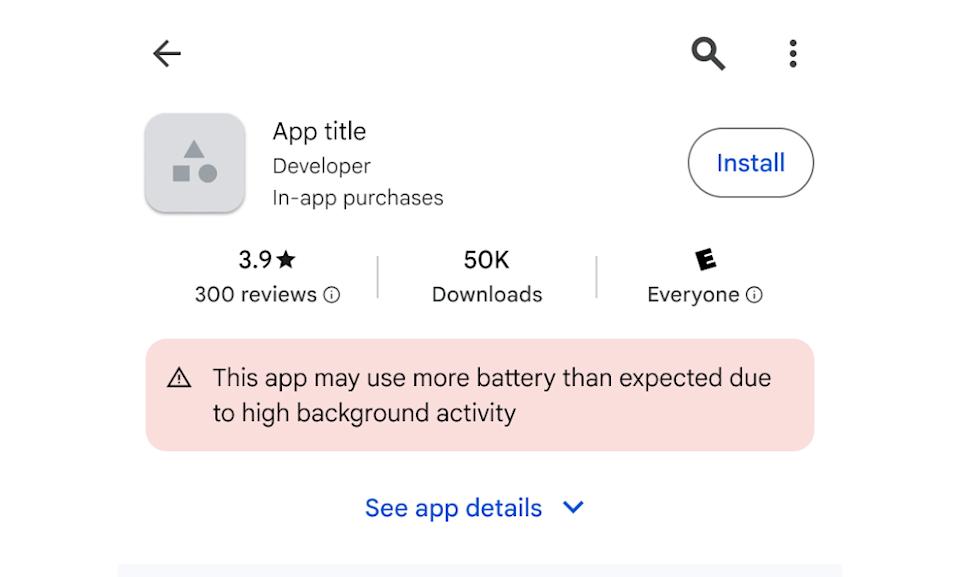
Google is living up to its word and posting warning labels for battery-killing apps. 9to5Google spotted Google’s rollout announcement, which the company previously said would arrive on March 1.
The label says, “This app may use more battery than expected due to high background activity.” If you don’t yet see the warnings, they may not have reached you yet. Google says the banners will “roll out gradually to impacted apps” in the coming weeks.
Play Store battery warning (Google)

Warning labels aren’t the only stick in Google’s fight against infringing apps. They may also be excluded from discovery services like Play Store recommendations.
Google’s definition of battery-draining apps centers around Android’s “partial wake lock” mechanism. This service allows an app to keep the phone’s processor running even while the screen is off. There are logical exceptions where apps do need this: audio playback, location access, etc. But the company apparently sees too many abusing that API for other reasons. And Google wouldn’t want people to assume the problem is with the hardware and switch to an iPhone — because then we’re talking about money.
If you’re a developer, Google’s technical documentation offers much more detail. For everyone else, keep an eye out for those Play Store labels and consider steering clear of those apps until their devs clean things up.

from the merge-ALL-the-things! dept
Hey look everyone! More of that famous populism Trump rode into power on!
The Trump FCC has announced they’re rubber stamping the approval of a merger between two of the nation’s biggest cable companies (Charter, Cox), creating the biggest cable company in the U.S. Struggling Americans were surely clamoring in support of their local shitty cable company getting even bigger, right?
As a condition of the deal, the two companies have promised to be more racist and sexist. More specifically, they’ve promised the FCC they’ll eliminate already fairly pathetic corporate programs acknowledging that systemic racism and sexism exist. The FCC posted this handy infographic on social media that breaks down all of their lies about the deal in an easily digestible way:

Literally none of those claims are true. These deals never result in any of these benefits. There’s more than forty years of concrete evidence proving it. Consolidation across U.S. telecom has consistently resulted in spotty service, high prices, and routinely abysmal customer service.
Cox and Charter don’t directly compete, but their large scale, size, and political influence ensures they’ll have more power than ever to lobby against robust competition more generally.
Remember when Charter was caught creating a fake consumer group to undermine community-owned broadband access in Maine? Or that time New York State regulators found the company was so shitty, and lied so often, that they almost resorted to kicking them out of the state? If you liked that sort of thing, you can now expect more of it, better resourced, at scale. Very exciting!
The debt from the kinds of deals is also always predominately paid off by labor and consumers in the form of mass layoffs and higher prices. These deals never meaningfully serve the public interest, but our captured regulators, consolidated telecoms, and shitty press work together to help pretend otherwise.
The FCC explains the “DEI” provisions this way in their news release:
“Charter has committed to new safeguards to protect against DEI discrimination and has reaffirmed the merged entity’s commitment to equal opportunity and nondiscrimination. Specifically, Charter commits to recruiting, hiring, and promoting individuals based on the factors that matter most: skills, qualifications, and experience.”
You’re not told what these “safeguards” actually are. Just that Cox and Charter won’t try to give minorities or women a leg up in country full of systemic hatred and intolerance because that might be unfair to a dude.
The Trump administration has repeatedly tried to insist that simply acknowledging that systemic racism and sexism exists — or doing literally anything about it — is somehow discriminatory to white men. This is diseased white supremacist thinking; the sheer delusional hubris to think this way, let alone integrate this ignorance into already problematic pro-monopoly policy, is the mind garbage of simpletons.
If you pop around and read the news coverage of this deal (see: this piece from Reuters or this piece at CNN), you’ll notice the consolidated corporate press helps sell the lie that more consolidation somehow serves the public interest. These kinds of stories will parrot the companies’ claims, ignore their history of monopolistic predation, and even downplay the mandated racism as a droll policy bullet point.
CNN author Jordan Valinsky even went so far as to write this sentence with a straight face:
“The transaction is contingent on regulatory approval and could be a litmus test for President Donald Trump’s views on major companies combining.”
Trump’s FCC has rubber stamped every single shitty telecom merger that has crossed its desk. We know Trump loves harmful consolidation, provided he can personally get something from it. A cornerstone of GOP policy has been to coddle monopoly power for literally fifty fucking years! Across every industry in America. None of this is really up for debate. Any “litmus” test was failed long ago.
It’s important to really stop and recognize the way the press routinely normalizes corruption and gives Trump Republicans policy credibility in areas like antitrust that they never had to actually earn. Because there’s just generally so much going on, this merger will largely be ignored. And when the layoffs and higher prices arrive later this year or early next, press and policy folks will be nowhere to be found.
If this country is going to have any sort of real future, it has to seriously come to grips with the fact that it’s broadly too corrupt to function in the public interest (across government, media, policy, and culturally). If future federal and state governments don’t make antitrust and corruption reform a central pillar of all policy in every sector, we’re quite literally cooked.
Filed Under: antitrust, brendan carr, broadband, cable, consolidation, dei, fcc, media, mergers, racism
Companies: charter, cox

Vibe coding is all the rage at the moment if you follow certain parts of the Internet. It’s very easy to dunk upon it, whether it’s to mock the sea of people who’ve drunk the Kool-Aid and want the magic machine to make them a million dollar app with no work, or the vibe coded web apps with security holes you could drive a bus through.
But AI-assisted coding is now a thing that will stick around whether you like it or not, and there are many who want to dip a toe in the water to see what the fuss is about. For those who don’t quite trust the magic machines in their inner sanctum, [jscottmiller] is here with Clix, a bootable live Linux environment which puts Claude Code safely in a sandbox away from your family silver.
Physically it’s a NixOS live USB image with the Sway tiling Wayland compositor, and as he puts it: “Claude Code ready to go”. It has a shared partition for swapping files with Windows or macOS machines, and it’s persistent. The AI side of it has permissive settings, which means the mechanical overlord can reach parts of the OS you wouldn’t normally let it anywhere near; the point of having it in a live environment in the first place.
We can see the attraction of using an environment such as this one for experimenting without commitment, but we’d be interested to hear your views in the comments. It’s about a year since we asked you all about vibe coding, has the art moved forward in that time?
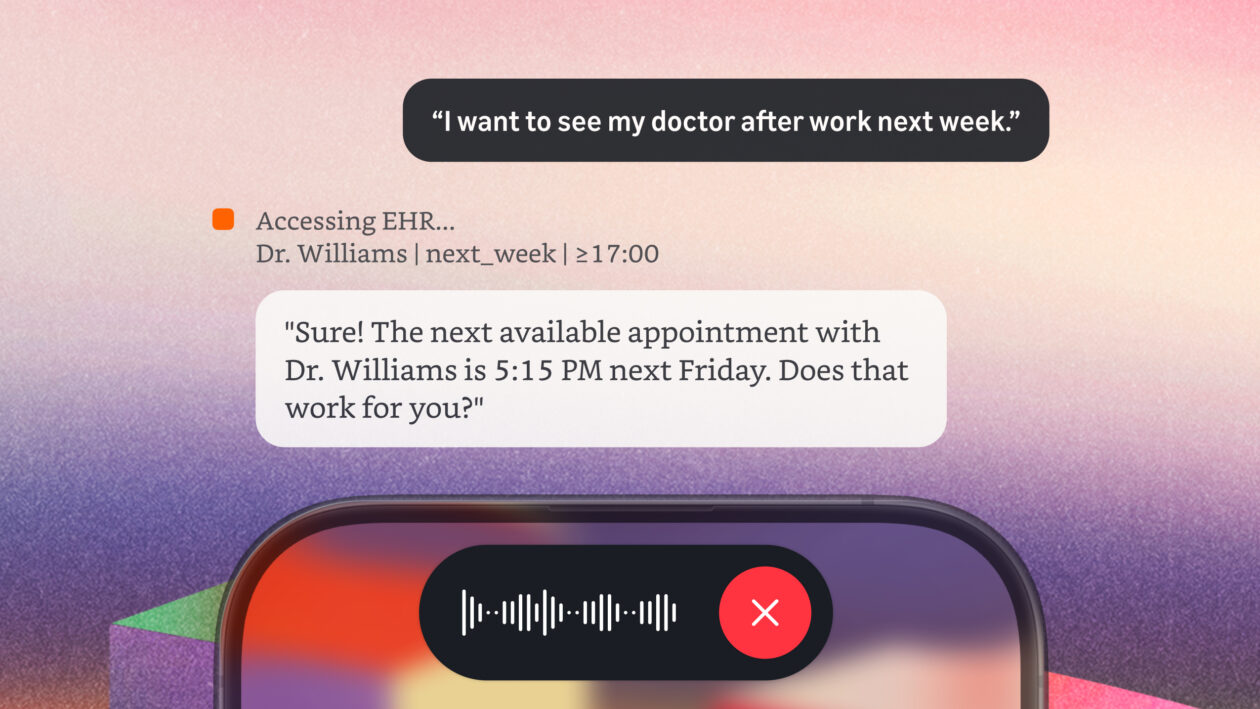

Amazon Web Services is expanding into AI for healthcare, launching a new agentic system that can handle patient calls, document clinical visits and automatically generate billing codes.
Amazon Connect Health, announced Thursday morning, is the first industry-specific extension of the cloud giant’s Amazon Connect system for call centers, which crossed the milestone of a $1 billion annual revenue run rate last year.
It will compete in part with rival Microsoft, which acquired Nuance for $19.7 billion in 2022 and has embedded its DAX Copilot ambient documentation tool into major electronic health record systems. AI scribe startups have raised hundreds of millions of dollars to automate clinical documentation.
Amazon is pitching Amazon Connect Health as a broader solution that spans the full healthcare workflow, from the initial phone call through the post-visit billing code.
The idea is to “not provide just point solutions, point tools, or a collection of capabilities, but think end-to-end about what is the customer problem, and how can we solve it,” said Rajiv Chopra, AWS vice president of Health AI and Life Sciences, in an interview this week.
Early users of the technology include UC San Diego Health, which handles 3.2 million patient interactions annually; One Medical, the Amazon-owned primary care practice that has used the ambient documentation capabilities across a million visits; and Netsmart, which provides EHR software to more than 1,300 community-based healthcare organizations.
Amazon’s move could double as a litmus test for AI adoption in healthcare, where institutions have traditionally been slow to adopt new technology.
A randomized trial published in the New England Journal of Medicine AI in December found that ambient AI documentation (the AI startup Abridge) reduced clinician burnout and cut documentation time by 30 minutes per day per provider. However, hospitals continue to cite concerns about data privacy, the difficulty of integrating AI tools into existing workflows, and unclear return on investment.
Amazon’s new product has five core capabilities: automated patient verification, intelligent appointment scheduling, pre-visit summaries for clinicians, ambient documentation that transcribes and drafts clinical notes during the visit, and automated medical coding for billing.
It integrates natively with Epic, the largest U.S. electronic health records system, and connects to other EHRs through data integration partners. It also connects to AWS HealthLake, Amazon’s cloud-based health data repository, which is getting new agentic capabilities to convert records into standard formats.
Amazon Connect Health comes from AWS’s Applied AI Solutions group, led by Senior Vice President Colleen Aubrey, which is focused on building finished applications for specific industries rather than selling raw cloud infrastructure and tools to developers.
Aubrey, who previously built Amazon’s advertising business, said at AWS re:Invent in December that her team is putting “agentic AI at the heart of everything we do,” describing the technology as “AI teammates” that can work autonomously on behalf of businesses.
Healthcare is the first vertical to get a purpose-built Connect product, but Aubrey signaled that more are in the works. Separately, the group oversees Amazon’s Just Walk Out retail technology and is developing agentic AI tools for supply chain planning and life sciences.
Amazon Connect Health is available in preview starting Thursday.

It’s not necessarily the guys you might expect, Apollo Knapp told me.
These are 6-foot-tall high-school athletes, guys who are social and popular. “They’re the type of people that are friends with everybody, who get dapped up in the hallway every two feet,” said Knapp, an 18-year-old high school senior in Ohio and a board member at sexual violence prevention nonprofit SafeBAE.
But at his school, these are the guys using AI to help them talk to girls. They’ll paste their texts into ChatGPT for feedback before sending, he said. Or, they’ll send their own photos to ChatGPT and ask, “am I cute?” Or, they’ll simply ask for moral support when they’re “too scared, maybe, to confront women.”
Girls and non-binary teens don’t need to lean on ChatGPT as much, Knapp said; they’re more likely to have a circle of friends ready and willing to workshop their texts. But guys are more isolated, socialized to believe it’s weak to talk about their feelings.
Worse, they’ve grown up on a steady diet of media telling them that “if you say the wrong thing” to a girl, “she’s going to accuse you of something,” Knapp said. Even if those messages aren’t accurate, they get inside teen boys’ heads, making them feel like they have to screen everything through ChatGPT to make sure it’s okay.
The drift of boys and young men away from everyone else in American society has been an enduring theme of the last few years. The fear is that guys, especially straight guys, are getting sucked into manosphere podcasts and becoming more and more alienated from the girls and women they, in theory, want to date. This is an oversimplified narrative, and there’s reason to hope that boys and men are more connected, and more interested in connection, than their most unpleasant listening material might suggest.
But in talking to teens and experts about AI and relationships, I did get the sense that boys need better outlets for their feelings than we’re giving them. And while ChatGPT might help some kids in some circumstances, teens of all genders need a more reliable support system — one that doesn’t require an electricity-guzzling data center to answer a question.
After all, Knapp said, “what’s going to happen if you don’t have power, and you have a girlfriend?”
Teens are using AI for dating. The question is how.
It’s hard to know exactly how many young people are talking to ChatGPT about relationship problems, since research on youth and AI is in its infancy. In one recent Pew survey, 57 percent of teens said they had used AI “to search for information,” while 12 percent said they’d used the tools “to get emotional support or advice.” It’s possible to imagine dating inquiries falling in either category.
Anecdotally, experts and teens alike say young people are turning to ChatGPT with everything from low-stakes questions about texting to serious concerns about what might constitute sexual assault.
Val Odiembo, 19, mentors their fellow college students about healthy relationships. As a peer educator, they’re used to getting questions like, “what do I do when my girlfriend says this?” or “is this consent?”
But recently, those questions have been tapering off. Odiembo, a nursing student and SafeBAE board member, thinks students are now asking ChatGPT, instead.
“I’ve had my students say to me, ‘I asked Chat what I should say to this boy,’” Odiembo told me. When that happens, “I die a little bit inside.”
Some young people are using chatbots “to test out being flirty or being romantic or being a little bit sexy and seeing how the chatbot responds to that,” Megan Moreno, a professor of pediatrics at the University of Wisconsin Madison who studies technology and adolescent health, told me.
That kind of experimentation may be more common among boys, who generally engage in more risky behavior online than girls, Moreno said.
Using technology to experiment with flirting and romance isn’t new. Millennial teens turned to chat rooms and AOL Instant Messenger for this purpose. This could be risky — my classmates spent a lot of time catfishing each other avant la lettre — or outright dangerous if teens ended up chatting with adults.
But, as Moreno points out, at least the people you were chatting with online were real humans who could tell you to go away if you said something too gross.
Chatbots, by contrast, “are programmed to be incredibly receptive and sycophantic,” Moreno said. “Even if you say something incredibly inappropriate, the chatbot is going to respond in a way that reinforces that.”
That’s even more problematic when the subject is sexual violence. Young people are increasingly turning to chatbots after sexual encounters to ask if they might have committed assault, Drew Davis, director of strategic initiatives at SafeBAE, told me. The responses he’s seen have sometimes been unhelpful, he said, emphasizing legal defenses or providing reassurances instead of discussing accountability.
SafeBAE is developing an interactive tool that helps young people think about sexual situations that may have been confusing for them, such as those in which both parties were drinking, and connects them with resources to help them take responsibility and apologize if needed.
The goal is “giving them language, giving them tools to be able to do this, that’s not coming from AI,” Davis said. “It’s connecting them with other people.”
Why teens are going to AI in the first place
It’s possible to imagine AI pushing young people even farther apart from one another than they already are. The big question is whether kids are using AI to practice having human relationships or to replace those relationships, Moreno said. In one recent survey, one in five high-school students said they or someone they knew had been in a romantic relationship with an AI.
It’s not hard to see why teenagers (or adults, for that matter) might be drawn to a voice that always has answers but never criticizes. When talking about thorny issues like sex and consent, “I think there’s a lot of shame,” Odiembo said. Teens “feel comfortable going to AI, because AI won’t judge them.”
But some teens also see value in the inevitable challenge and friction of human relationships.
“You need to be called out occasionally,” Knapp, the Ohio senior, said. “That’s how humans evolve.”
Some experts believe that with better guardrails — like a willingness to say, “hey, don’t talk to me like that!” — AI could still be a helpful partner for teens learning to talk to each other. For example, a chatbot could be trained to help kids with social skills. Part of me wonders how much less awkward my adolescence might have been if I’d been able to workshop my jokes with a bot before taking them to the crucible of middle-school homeroom.
It’s also worth noting that AI models are constantly changing and, in some ways, improving. After I talked to the SafeBAE team, I tested ChatGPT and Google Gemini by pretending to be a teenage boy concerned he’d crossed a line with a girl. Both models did a decent job, at least on first response, posing follow-up questions about the situation and encouraging me to take responsibility.
But the young people I spoke with for this story don’t want better chatbots; they want to see humans get better, instead. They want teachers who are better-trained to discuss difficult issues like consent and assault. They want coaches and other adults who can model healthy masculinity for boys, rather than reinforcing stereotypes. And for all teens, they want supportive places to open up about feelings and relationships, some of the messiest and most important aspects of human life.
“I wish people were a little more comfortable having uncomfortable conversations,” Odiembo said.
Families continue to report disturbing conditions at the Texas immigration center where 5-year-old Liam Conejo Ramos was held, including a worm in a child’s food, water that causes rashes and stomachaches, and staff withholding medical care.
Teens and tweens want to see more depictions of “fathers enjoying parenting” and “fathers showing love to kids” in movies and TV, according to a recent UCLA survey. In this, as in all things, the answer is Bluey.
The New York Times did a deep dive into AI slop videos aimed at kids. It is unclear as yet whether endless clips of adult mammals hatching out of eggs are harmful for children, but they are certainly bizarre.
My older kid is currently obsessed with the Ham Helsing series, graphic novels about a pig who hunts vampires.
After I wrote about kids’ recent obsession with the phrase “chicken banana,” one reader wrote in to let me know about a much earlier coinage. “Perhaps it’s my age (almost 80), but as teenagers, my age group regularly heard a jingle for Chiquita Bananas,” he wrote. “We naturally corrupted Chiquita banana into ‘chicken banana.’”
“Sorry to crush the illusion of today’s uniqueness of Chicken Banana, but we ancient folks were using the term ‘chicken banana’ a l-o-n-g time ago,” he added.
As always, if you have a question or want to share a story about kids today or in the past, you can reach me at anna.north@vox.com.

Iranian state media said on Wednesday that it targeted Amazon’s data center in Bahrain due to the company’s support of the U.S. military. The drone strike that occurred on Sunday disrupted core cloud services and caused “prolonged” outages. Two data centers in the UAE were also damaged by drone strikes. CNBC reports: All of the facilities remain offline, according to the Amazon Web Services health dashboard. The attack in Bahrain was launched “to identify the role of these centers in supporting the enemy’s military and intelligence activities,” Iran’s Fars News Agency said on Telegram.
In addition to structural damage, the data centers also experienced power disruptions and some water damage after firefighters worked to put out sparks and fire. Some popular AWS applications experienced “elevated error rates and degraded availability” due to the incident. AWS advised cloud customers to back up their data, consider migrating their workloads to other regions and direct traffic away from Bahrain and the UAE.


It may not feel like it, but 2026 marks a full half-decade since the sixth-generation Ford Bronco officially entered production for the 2021 model year. Ford’s new Bronco brought back a legendary nameplate and put one of the most hyped up and anticipated SUVs of the 21st century into customers’ hands. Going back to our first, hands-on experience with the reborn Bronco back in 2021, the retro-styled 4×4 has very much delivered on the hype.
Over the subsequent model years, Ford has continuously tweaked and updated the Bronco, adding new trims and new packages to keep it fresh. That said, an increasing number of fans and enthusiasts have begun to speculate whether a substantially changed, new, and improved version of the Bronco might be on the way soon.
The speculation makes sense, as five model years is when one usually starts looking for big updates and redesigns. Despite talk of a redesigned or refreshed Bronco, a Ford engineer told The Drive in February 2026 that the SUV won’t be getting a major refresh or design anytime soon. Instead, the current Bronco will receive continued improvements, including one “obvious,” but yet to be disclosed, upgrade for 2027.
Could a V8 or hybrid Bronco be coming soon?
Apart from incremental updates and unique appearance packages, the biggest change to the Bronco lineup as of 2026 came in 2022, when Ford added the wider and more powerful Bronco Raptor to the lineup. So what kind of other “obvious” changes and additions could Ford make to the current Bronco platform before moving on to a new generation?
In other markets like China, Ford has already introduced Bronco-branded EVs and hybrids, which share similar styling and naming but are not the same vehicle as the Bronco sold in America. Given Ford’s big push toward hybrid tech, a plug-in version of the American Bronco that uses both electric and gasoline power could be a very real possibility — and potentially take market share left from the now-discontinued Jeep Wrangler 4XE.
However, Ford could also go the other way, taking another page from Jeep and doing a proper, V8-powered Bronco to compete with the Wrangler 392. Initially, Ford’s position was that the Bronco didn’t need a V8, but aftermarket companies have already shown the possibilities of a 5.0 Coyote-powered Bronco with their own swap kits. Whether this could be pulled off from the factory remains to be seen, but Ford already did a similar move with the F-150 Raptor, responding to customer demand by releasing the V8-powered Raptor R. Either option makes a lot of sense for the Bronco, but right now it’s unclear if and when these options could arrive.
Don’t fix what isn’t broken
It’s easy to see why Ford hasn’t introduced any major changes to the resurrected Bronco over its first five years. Yes, the initial hype and insane dealer markups of the launch period may have faded, but Bronco demand remains very strong, with 2025 being the best sales year yet for the model.
Another thing that the Bronco has going for it in terms of longevity is its decidedly simple, ’60s-flavored design. Five years later, the Bronco still looks unique compared to other SUVs on the road, and its purposely boxy, old-school character is simply less prone to feeling outdated compared to other designs.
Naturally, Ford been leaning into this vintage appeal with special-edition models like the heavily retro 2024 Bronco Heritage Edition. Thus, even when Ford does get around to fully redesigning the current Bronco for a new generation, which might come toward the end of the 2020s, we don’t expect it to stray too far from the core design and character that made the revived Bronco such a hit.

NewsBeat28 seconds ago
US asked Ukraine for help fighting Iranian drones, Zelensky says

Business1 minute ago
Twenty-four US states announce lawsuit to stop Trump’s latest global tariffs

Crypto World2 minutes ago
Ethereum Taps $2.2K as Traders Brace for a Potential Trend Change


-

 Politics7 days ago
ITV enters Gaza with IDF amid ongoing genocide
-

 Politics2 days ago
Alan Cumming Brands Baftas Ceremony A ‘Triggering S**tshow’
-

 Fashion6 days ago
Weekend Open Thread: Iris Top
-

 Tech5 days ago
Unihertz’s Titan 2 Elite Arrives Just as Physical Keyboards Refuse to Fade Away
-
Sports6 days ago
The Vikings Need a Duck
-
 NewsBeat5 days ago
Dubai flights cancelled as Brit told airspace closed ’10 minutes after boarding’
-

 NewsBeat5 days ago
Abusive parents will now be treated like sex offenders and placed on a ‘child cruelty register’ | News UK
-
 NewsBeat5 days ago
The empty pub on busy Cambridge road that has been boarded up for years
-

 NewsBeat4 days ago
‘Significant’ damage to boarded-up Horden house after fire
-

 Tech11 hours ago
Bitwarden adds support for passkey login on Windows 11
-

 Entertainment3 days ago
Baby Gear Guide: Strollers, Car Seats
-
 Tech6 days ago
NASA Reveals Identity of Astronaut Who Suffered Medical Incident Aboard ISS
-

 Business7 days ago
Only 4% of women globally reside in countries that offer almost complete legal equality
-
Politics5 days ago
FIFA hypocrisy after Israel murder over 400 Palestinian footballers
-
 NewsBeat4 days ago
Emirates confirms when flights will resume amid Dubai airport chaos
-

 NewsBeat3 days ago
Is it acceptable to comment on the appearance of strangers in public? Readers discuss
-

 Crypto World7 days ago
From Crypto Treasury to RWA: ETHZilla Retreats and Relaunches as Forum Markets on Nasdaq
-

 Tech4 days ago
Viral ad shows aged Musk, Altman, and Bezos using jobless humans to power AI
-

 Video3 days ago
How to Build Finance Dashboards With AI in Minutes
-

 Business2 days ago
Guthrie Disappearance Enters Fifth Week as Family Visits Memorial