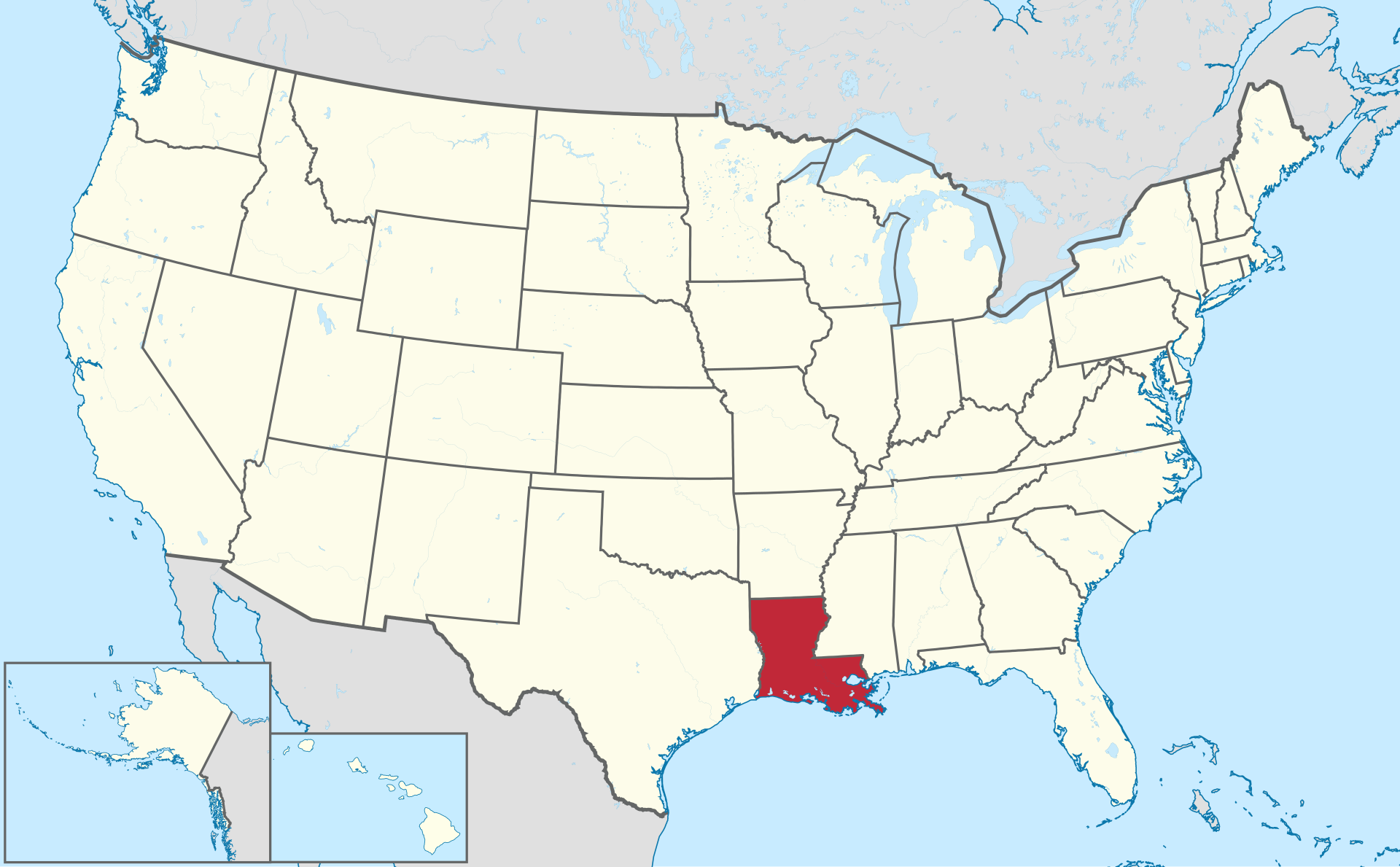
A magnitude 4.9 earthquake struck northwestern Louisiana early Thursday, March 5, 2026, awakening residents across the region and marking the second-strongest recorded tremor in the state’s history, according to the U.S. Geological Survey.
Louisiana Earthquake: Rare 4.9 Magnitude Earthquake Rattles Louisiana, Second-Strongest in History
The quake hit at approximately 5:30 a.m. CST (6:30 a.m. EST), with its epicenter located about 6 miles west of Edgefield in Red River Parish, roughly 36-40 miles south-southeast of Shreveport. The USGS initially reported the magnitude as 4.4 before upgrading it to 4.9 based on refined data. The shallow depth of about 3-5 miles (5-10 km) contributed to widespread felt shaking despite the moderate size.
Residents from Shreveport and Bossier City to Coushatta and beyond described noticeable jolts that rattled windows, shook furniture, rattled pipes and briefly disrupted sleep. Social media flooded with reports of “the house shaking like a truck hit it” and questions about whether it was a train, explosion or genuine seismic event. The tremor was felt across much of northern Louisiana and into parts of eastern Texas, with some accounts extending to areas near Texarkana.
No immediate reports of serious injuries, structural collapses or major infrastructure damage emerged by midday Thursday. Emergency management officials in Red River, Bossier and Caddo parishes activated protocols to assess buildings, bridges and utilities, but preliminary surveys indicated only minor issues such as cracked drywall or dislodged items in homes. The USGS issued a green alert for the event, signaling a low probability of casualties or significant economic losses from shaking.
Seismologists noted the rarity of such an event in Louisiana, a state not typically associated with frequent or powerful earthquakes. The Pelican State’s seismic history is dominated by smaller events, often linked to the regional fault systems or induced activity from oil and gas operations in some cases. The previous strongest quake was a magnitude 5.3 event off Grand Isle in southern Louisiana on Feb. 9, 2006 — an offshore tremor tied to different tectonic dynamics.
Advertisement
Thursday’s quake ranks as the strongest inland earthquake in Louisiana records and the most powerful to affect the Shreveport area in decades. It surpasses recent minor activity in the region, including a 2.9 magnitude event near Coushatta in late February 2026 and several 2.6-3.1 tremors since late 2025. The area’s geology includes parts of the stable interior of the North American plate, but proximity to the New Madrid Seismic Zone to the north and Gulf Coast subsidence features can allow occasional felt events.
Experts from the USGS and local universities emphasized that while the quake was significant for the area, it remains below thresholds typically associated with widespread destruction. “Magnitude 4.9 events produce strong shaking near the epicenter but rarely cause major damage unless structures are particularly vulnerable,” one seismologist commented in initial briefings. The event’s shallow focus amplified intensity, leading to “moderately strong” perceived shaking (Modified Mercalli Intensity V-VI) close to the epicenter.
Local officials urged residents to check for gas leaks, inspect chimneys and report any structural concerns to authorities. The Red River Parish Sheriff’s Office and Louisiana State Police coordinated response efforts, while the National Weather Service and emergency broadcasters disseminated safety information. No tsunami risk existed, given the inland location.
The quake prompted a surge in “Did You Feel It?” submissions to the USGS website, helping refine intensity maps. Community reactions ranged from surprise to curiosity, with some longtime residents recalling faint tremors in past years but nothing of this caliber. Social media posts included videos of swaying light fixtures and personal accounts from as far as 100 miles away.
Advertisement
Geologists continue monitoring for aftershocks, which are possible but expected to be minor. As of early March 6, 2026 (KST — corresponding to late March 5 evening local time), no significant follow-up events had been recorded, though small aftershocks below magnitude 2.0 may go undetected without sensitive instruments.
This event underscores Louisiana’s occasional seismic vulnerability, even in areas considered low-risk. State emergency preparedness officials used the occasion to remind residents of basic earthquake safety: drop, cover and hold on during shaking, and secure heavy objects to prevent hazards in future incidents.
As investigations into the quake’s precise cause continue — potentially natural tectonic stress or linked to regional subsurface activity — northwest Louisiana returned to normalcy Thursday afternoon. Schools, businesses and transportation operated without major disruptions, though the morning’s rare rumble left an impression on a region more accustomed to hurricanes and floods than earthquakes.
The 4.9 magnitude tremor serves as a reminder of nature’s unpredictability, even in stable continental interiors. Authorities and scientists will analyze data in coming days to better understand this unusual addition to Louisiana’s seismic catalog.
Concurrent Technologies Plc (COTGF) Discusses Full Year Results and Leadership Transition with Strategic Business Updates April 17, 2026 6:30 AM EDT
Company Participants
Miles Adcock – CEO & Executive Director Kim Maria Garrod – CFO & Executive Director
Presentation
Advertisement
Operator
Good morning, and welcome to the Concurrent Technologies Plc Final Results Investor Presentation. [Operator Instructions]
Before we begin, I would like to submit the following poll. And I would now like to hand you over to CEO, Miles Adcock. Good morning to you.
Advertisement
Miles Adcock CEO & Executive Director
Good morning, and welcome to our full year results for 2025.
Next slide, please. So my name is Miles. I’m the CEO. This is my fourth set of annual results, and I’m joined by Kim, our CFO. And I should note that at the same time as we issued our full year results, we also announced that Kim has decided to retire at the end of this year. My good friend and colleague, Kim, do you want to say a few words?
Advertisement
Kim Maria Garrod CFO & Executive Director
Yes. So I achieved a milestone birthday this year, and that made me rethink what I was going to do. So I have decided to retire, but I’m in the business until the end of the year. I’m very excited about the business, and I will be watching it very closely after I’ve gone, and I’ll be regularly calling Miles for updates. But I’m fully committed to the business. And as I say, I’ll be taking out for most of this financial year.
Miles Adcock CEO & Executive Director
Advertisement
Thank you, Kim. And just to note, Kim has generously given us until the end of the year to seek a replacement, and I’ve engaged Korn Ferry this week, and we’re working hard at finding a worthy successor.
Business groups have urged the government to cut a raft of regulations ahead of the federal budget, but the finance minister says changes have to make sense.
Mumbai: A clutch of large IPOs is expected to prop up India’s primary market in 2026 even as market uncertainty slows down broader activity compared to the previous two robust years, said Ranvir Davda, co-head of investment banking at HSBC India.
“The number of deals may come down, but the size and aggregate value may still be similar (to the previous years),” said Davda in an interview.
Reliance Industries’ telecom arm Jio Platforms, National Stock Exchange, Zepto, PhonePe, Manipal Hospitals and and SBI Funds Management are among the large issuances expected to hit the market in 2026. Together, these issues could raise ₹1 lakh crore (about $10.8-10.9 billion).
So far this year, 20 companies have raised $2.5 billion, according to Prime Database and ETIG Database. That comes after two record years that saw 94 and 115 mainboard IPOs in 2024 and 2025, raising nearly $21-23 billion.
Advertisement
This year’s IPO fundraise could be between $21 billion and $25 billion.
Live Events
“This year, a larger percentage of companies are mid to large-sized,” said Davda. “Many of these are backed by large groups or private equity investors and, therefore, have the flexibility to wait, ride volatility, and avoid pressing forward if valuations are not aligned.” The early part of this year has been slower for the IPO market, with the West Asia conflict weighing on secondary markets, IPO subscriptions and listing gains, prompting several companies to defer offerings. “This year will be volatile. Windows to complete trades will be shorter, so readiness is critical,” Davda said.
At the same time, companies that need capital are showing more willingness to negotiate.
Issuers are increasingly tapping AIFs, family offices and special situations funds alongside traditional investors, while using pre-IPO placements as a bridge to raise capital with visibility to a listing over the next 6-18 months, he said. According to Davda, technology faces sharper scrutiny amid AI disruption, global uncertainty and profitability concerns, though large consumer-tech and fintech offerings are still likely to proceed as “must-own” India exposures.


















































You must be logged in to post a comment Login