This article was first published in The Conversation UK’s World Affairs Briefing email. Sign up to receive weekly analysis of the latest developments in international relations, direct to your inbox.
Before the first airstrike hit Iran on Saturday morning, analysts were warning that a war against Tehran would be a highly risky business. The regime has been in place for nearly 50 years, has a huge, well-trained and loyal military, proxies throughout the region and a huge stockpile of ballistic missiles and drones – plenty to wreak havoc across the region and beyond.
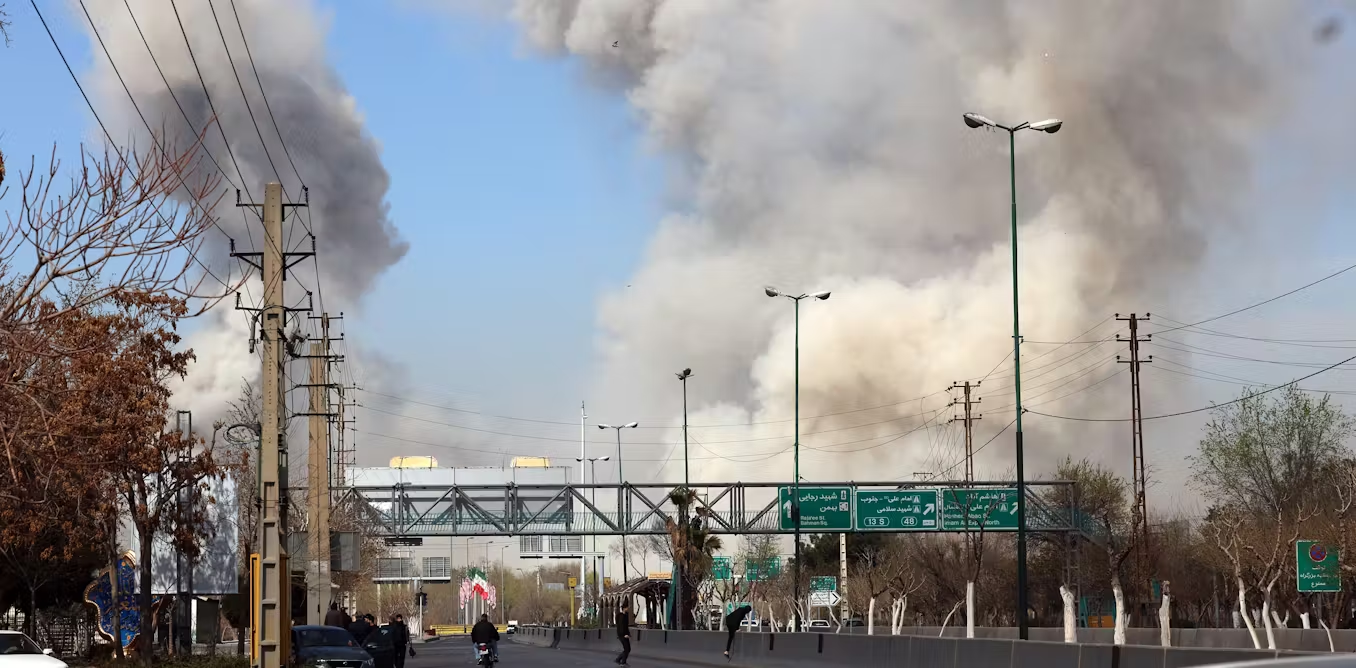
And so it has proved. While Israeli and American forces have been pounding targets across the country, Iran has responded by attacking Israel as well as US military targets in neighbouring Gulf states, including the United Arab Emirates, Bahrain, Saudi Arabia and Kuwait. Attacks have also been reported from Cyprus, Iraq and Jordan.
There is a fresh round of fighting in southern Lebanon after Hezbollah joined Iran in targeting Israel. Beirut is being bombarded.
The economic damage to the region has been enormous. Oil refineries have been shut down, the vital strait of Hormuz – through which 20% of the world’s oil cargo passes – is effectively closed, evacuation flights are leaving the Gulf states around the clock and people are cancelling their travel plans in droves.
And within days of the assassination of Iran’s supreme leader, Ali Khamenei, in a targeted airstrike that also killed a number of his top advisers, a new leader is set to be picked. The smart money appears to be on his son, Mojtaba, known to be cut from very much the same authoritarian clerical cloth as his father. So the notion that with Iran you kill the figurehead and the regime collapses appears to be flawed, to say the least.
Just one week ago, American and Iranian negotiators were engaged in talks in Geneva, which were reported to be making “significant progress”. Now there’s no knowing how this conflict could escalate. On Wednesday, the downing of an Iranian missile over Turkish airspace prompted speculation that Nato would be pulled into a war it clearly doesn’t want. A US submarine sank an Iranian warship in international waters off the coast of Sri Lanka.
There are so many moving parts to this conflict that the sense of jeopardy is at times overwhelming. My email inbox this morning contained a message from Robert Reich, who was Bill Clinton’s secretary of labour between 1993 and 1997 and is a trenchant and energetic critic of the US president, headed: “World War III?
Trump’s and Netanyahu’s illegal war turns global”.
Let’s not second-guess Armageddon just yet. But there’s no denying how dangerous the situation is becoming as the conflict continues to spread. Scott Lucas, an expert in US and Middle East politics at the Clinton Institute, University College Dublin, answers some of the key questions about this fast-developing situation.
À lire aussi :
How dangerous has the conflict in Iran become? Expert Q&A
This has gone beyond what the US president, Donald Trump, referred to as “major combat operations in Iran”. What it might become is anyone’s guess.
What we don’t have to guess is whether Trump is managing to take the American people with him on his foreign adventure. A poll taken on March 2 and published by YouGov/Economist found that US respondents oppose the war by a margin of 45% against to 32% in favour. Predictably, there’s a hugely partisan divide: most Republicans back their president, while Democrats are overwhelmingly anti war.
YouGov/Economist poll, Author provided (no reuse)
Significantly, writes Paul Whiteley of the University of Essex, an expert pollster with an interest in UK and US politics, Independents are also against the war by a significant margin. Looking ahead to November’s mid-term elections, as the US president’s advisers undoubtedly are, things do not look good for Republicans’ chances of holding either the House or the Senate.
À lire aussi :
What Americans think of the war in Iran
And the war looks as if it will not end anytime soon. NBC News was reporting this afternoon that the Trump administration may invoke the Defense Production Act to accelerate the production of munitions, which would effectively move the US economy further on to a war footing.
This would seem to hint at something that analysts have speculated about, namely that a lengthy conflict could exhaust America’s stockpile of munitions. The US and its allies — including Israel and the Gulf states — are most acutely exposed to this shortage of defensive interceptors. It’s only been ten months since the US and Israel waged the 12-day war against Iran and that depleted an enormous number of both countries’ defensive missiles, according to Andrew Gawthorpe, an expert in modern American history at Leiden University.
This inevitably means that Washington will have to pull munitions away from other theatres, including those earmarked for South Korea. It’s also fair to say there will be fewer available for Kyiv’s European allies to purchase for the defence of Ukraine, which will please Vladimir Putin no end.
À lire aussi :
How prepared are the US and its allies for a protracted conflict in Iran?
And whether an air campaign will be enough to achieve regime change – if that is indeed the purpose of this conflict – is debatable, writes Matthew Powell, an expert in air power at the University of Portsmouth. Air campaigns rarely work as intended – they often make matters worse, as the world saw after the Nato air campaign that led to the toppling of the country’s ruler, Muammar Gaddafi. With no coherent ground strategy to follow, things fell apart rapidly, with the terrible results that are with us to this day.
À lire aussi :
Iran conflict: air campaigns rarely work as intended – they often make matters worse
‘Special relationship’ under strain
Keir Starmer certainly doesn’t believe in regime change “from the skies”, or so he told the House of Commons this week when fending off criticism of the UK government’s position on whether and how the UK should be involved in this conflict. As the US-Israeli attacks began, Starmer said that the UK would have none of it (due, in large part apparently, to his assessment of a lack of lawful basis for the campaign) and he was not prepared to allow America to use the UK’s bases in any capacity either.
He has since softened his stance, allowing the US to use some British bases, but purely for defensive purposes, to target Iranian ballistic launch sites that could threaten British interests in the region.
But Donald Trump remains unimpressed and there’s no doubt that this episode has put severe pressure on the so-called “special relationship” between Britain and America. Matt Bar, of Nottingham Trent University, walks us through some of the ups and downs of this relationship over the decades and concludes that it has survived worse setbacks in its time.
À lire aussi :
Iran is putting pressure on the US-UK ‘special relationship’ – but it has survived worse over the years
If this all wasn’t so serious, the US president’s reaction to not immediately getting his way from Starmer would be amusing. In fact it drew an involuntary bark of laughter when I read that, in a press session after a meeting with the German chancellor, Friedrich Merz, on March 3, the US president threw a few barbs Starmer’s way, concluding that: “This is not Winston Churchill that we’re dealing with.”
Indeed. Historian Richard Toye of Exeter University explores that unlikely comparison.
À lire aussi :
What would Winston Churchill make of war with Iran?
The view from Moscow and Beijing
As you’d expect, Beijing was quick to condemn the strikes. China has been heavily dependent on its imports of oil from Iran, and regime change there would threaten this and force it to look elsewhere.
China is linked to Iran in a number of ways, including – significantly – via Tehran’s use of China’s satellite navigation system, BeiDou , which Beijing is touting as a possible replacement for the western Global Positioning System (GPS).
China-watcher Tom Harper, of the University of East London, assesses how this conflict will affect China and concludes that while it will cause turmoil in the short-term, a protracted conflict will play to its benefit in the long term.
À lire aussi :
China set to suffer from turmoil in the Middle East, but it stands to benefit long term
The assassination hit a raw nerve in Moscow. Putin, whose fear of assassination borders on the pathological, watched the killing of a fellow autocrat with undisguised alarm.
Iran is a close ally of Russia. Tehran provided huge numbers of its Shahed drones to Putin to help him wage his illegal war in Ukraine, and Iran has also helped Moscow circumvent the west’s sanctions regime.
Stefan Wolff, an expert in international security at the University of Birmingham, believes that the conflict will play to Moscow’s advantage in the short term at least, as the US diverts munitions earmarked for purchase by Kyiv’s European allies. But he thinks the war is “unlikely to shift the dial significantly towards Russian victory in the long term”.
À lire aussi :
What the conflict in Iran means for Putin and Ukraine

Sign up to receive our weekly World Affairs Briefing newsletter from The Conversation UK. Every Thursday we’ll bring you expert analysis of the big stories in international relations.