











Connect with us

NewsBeat

Defence secretary twice declines to rule out Britain joining strikes on Iran | World News

Published

on

Defence Secretary John Healey interviewed at RAF Akrotiri in Cyprus.

Defence secretary John Healey has twice declined to rule out Britain joining strikes on Iran, when asked by Sky News.

He also said he’d had the option of deploying HMS Dragon to the Mediterranean for weeks.

Interviewed at RAF Akrotiri in Cyprus, the minister was asked by Sky’s Europe correspondent Ali Bunkall if he could rule out Britain joining the conflict in an offensive capacity.

Image:
Defence Secretary John Healey interviewed at RAF Akrotiri in Cyprus.

He responded: “As circumstances in any conflict change, you’ve got to be willing to adapt the action you take.”

Advertisement

Iran war latest: First UK evacuation flight departs
Politics latest: PM to ‘stand firm’ by British values

Mr Healey then listed defensive measures that were being taken, including the use of anti-drone helicopters, deploying HMS Dragon to the eastern Mediterranean, and bringing in planners to co-ordinate an international response.

Pressed on whether he would rule out British aircraft taking part in offensive operations over Iran, Mr Healey again demurred.

“Everything that we have done is defensive, is legal, and is coordinated with other allies,” he said.

Advertisement
HMS Dragon in Portsmouth gearing up for deployment. Pic: Reuters
Image:
HMS Dragon in Portsmouth gearing up for deployment. Pic: Reuters

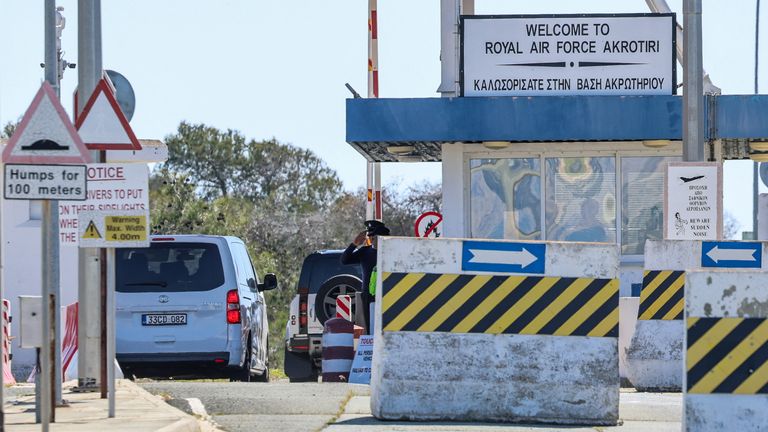
The minister’s visit to the island comes after a drone attack on RAF Akrotiri on Monday, with two more UAVs intercepted en-route to the base later that day.

During his visit, Mr Healey met with his Cypriot counterpart Vasilis Palmas “to discuss how the UK is further reinforcing our air defences to support our shared security”, a government spokesman said.

Iran has been unleashing rocket and drone attacks across the Middle East after the US and Israel launched a joint-attack on the country on Saturday.

RAF Akrotiri, a British sovereign base in Cyprus that was hit by a drone early Monday, causing limited damage, in Cyprus March 4, 2026. REUT
Image:
RAF Akrotiri, a British sovereign base in Cyprus that was hit by a drone early Monday, causing limited damage, in Cyprus March 4, 2026. REUT

In the aftermath of Monday’s drone attack, the decision was made to deploy HMS Dragon, an air-defence warship, to the Mediterranean.

But Sky News revealed on Wednesday that the ship was not ready to depart and would not sail until next week.

Asked when the option of deploying HMS Dragon first crossed his desk, Mr Healey deflected.

Advertisement

Read more:
Kurdish fighters chomping at the bit to fight Iran regime
UK terror threat ‘absolutely’ under review after Iran strikes

An unexploded Iranian projectile that landed in near Qamishli, eastern Syria. Pic: AP
Image:
An unexploded Iranian projectile that landed in near Qamishli, eastern Syria. Pic: AP

He said it was one of the options he’d had available when he made decisions weeks before the start of the conflict to strengthen British defences in the region.

He added that the decision to deploy the warship had been taken because the government was “now in a position to judge better the nature of the Iranian response”.

Source link

Advertisement
Continue Reading
Click to comment

Leave a Reply

Your email address will not be published. Required fields are marked *

NewsBeat

The war’s toll so far on Iran’s military and leadership

Published

on

The war's toll so far on Iran's military and leadership

CAIRO (AP) — The U.S. and Israel are striking a much wider array of targets in Iran than they did during 12 days of war last summer, when their focus was on the country’s nuclear enrichment sites. Now, the aim appears to be destroying Iran’s military and weakening the grip of its theocratic rulers, experts say.

U.S. Central Command alone says it has hit more than 2,000 targets in less than a week, a far heavier barrage than any American bombing campaign in the Middle East in more than a decade, according to Airwars, an independent group that tracks global conflicts. Israel says it has hit hundreds of sites.

From the capital of Tehran to cities across the country, the U.S. and Israeli airstrikes have bombarded the Islamic Republic — its leaders, military bases, weapons factories, soldiers and police, and state TV.

The totality of the damage is not clear. But it is “a more significant blow than anyone expected might happen in such a short time,” Armed Conflict Location and Event Data, an independent monitoring group, said in a statement. Still, even after the killing of Supreme Leader Ayatollah Ali Khamenei, the emergency leadership team still appears to have “the ability for domestic coercion,” said the group, which goes by the acronym ACLED.

Advertisement

The mounting death toll is also difficult to independently assess because of poor communications. An Iranian government agency says at least 1,230 people have been killed. More than 165 people were killed when a school in southeastern Iran was hit, most of them of children, according to Iranian state media.

Here is a deeper look at what has been targeted so far:

Many top officials have been killed

U.S. and Israeli strikes hit Khamenei’s residential compound in central Tehran, killing him in the opening barrages on Feb. 28. Airstrikes also killed the defense minister, the head of the Republican Guard, Khamenei’s top security adviser and other senior figures.

A religious site connected to Khamenei’s predecessor was partially destroyed, and an airstrike smashed a hole through the dome of a building belonging to the Assembly of Experts, a council of senior Shiite clerics tasked with appointing the next supreme leader.

Advertisement

The Revolutionary Guard and Basij come under heavy fire

Many airstrikes have been directed at the Revolutionary Guard, Iran’s most powerful military force, and the Basij, a paramilitary force that brutally enforces Islamic law and crushes any public dissent.

In more than 280 strikes that ACLED documented as of Wednesday, over 20% targeted Revolutionary Guard or Basij positions, mostly in Tehran and in western and southern Iran. Garrisons, air bases, underground complexes, ammunition depots, weapons factories and command buildings have all been attacked.

At the Revolutionary Guard’s headquarters in northern Tehran, several buildings have been demolished, according to satellite photos from Vantor, a U.S. imaging company. Small, local branches of the Basij have also been targeted, according to ACLED.

On Thursday, two sports facilities in Tehran were struck, including the sprawling Azadi Sports Complex, where Iran once hoped to host the Olympics. There is now a giant hole in the roof of a 12,000-person arena, according to video verified by AP. The Guard and Basij have been known to use sports facilities as mobilizing points.

Advertisement

Not every bomb delivers meaningful impact. “A lot of empty buildings” are also being struck, ACLED said.

Destroying missile factories and storage sites is a priority

Eliminating Iran’s missile arsenal and launchers is a top priority, Israeli and U.S. officials say.

A suspected missile site deep in the barren mountains overlooking the central city of Isfahan was struck, as was another outside the western city of Kermanshah. There, roads leading into tunnels beneath a mountain are now pockmarked with craters, according to satellite photos provided by Planet Labs PBC.

On the outskirts of Tehran, several buildings at the Garmdarah missile site were also heavily damaged.

Advertisement

Before the war, Iran was believed to have several thousand short- and medium-range missiles. It is still firing missiles and drones at Israel, American bases in the Persian Gulf, and at energy facilities across the region. A senior Western official, speaking on condition of anonymity to discuss intelligence matters, said Iran has several days’ worth of ballistic missiles if it continues firing at current rates, but it may hold some back to wage a longer campaign.

The military and national police are key targets

Many buildings and assets belonging to Iran’s armed forces have been hit. Satellite photos from Vantor show a capsized ship in the waters of the Konarak Naval Base on Iran’s southern coast after strikes there. A U.S. submarine sank an Iranian warship off the coast of Sri Lanka, which on Wednesday recovered 87 bodies and rescued 32 Iranian sailors.

Manufacturers with ties to the military have also been attacked. In the central city of Isfahan, ACLED documented a strike on Isfahan Optics Industries, which is under international sanctions for its suspected connections to Iran’s nuclear program.

At the main police headquarters in Tehran, strikes flattened multiple buildings, according to satellite photos from Planet Labs. The national police, commanded by a Revolutionary Guard general, is key to Iran’s internal security apparatus and has been involved in violently halting anti-government protests.

Advertisement

Local police stations have also been in the line of fire, including one across the street from Tehran’s Grand Bazaar, where protests began in late December that swelled into massive nationwide demonstrations across the country, before being crushed in early January.

Iranian state TV still on air after multiple barrages

The state TV and radio broadcaster IRIB has faced multiple barrages, though it has continued to stay on air. Its main headquarters, located in a large park in northern Tehran, shows signs of damage.

A strike on Sunday hit an IRIB station elsewhere in the capital, bringing down an antenna. The strike caused heavy damage to the Gandhi Hospital across the street, shattering its façade and sending debris across its wards inside.

So far, nuclear facilities have not been a focus of the attacks

Nuclear facilities have not appeared to be a priority yet, though Israel has indicated it will attack them. Satellite images on Monday show newly damaged buildings at the Natanz nuclear facility in central Iran, the country’s main enrichment site. The International Atomic Energy Agency said there was “no radiological consequence expected.”

Advertisement

The Israeli military said it also struck mountains north of Tehran where it said Iran had secretly moved some nuclear activities to underground bunkers after June’s 12-day war.

Iran maintains its program is peaceful, though its officials had threatened to pursue a bomb while enriching uranium to near-weapons-grade levels.

——

El Deeb reported from Beirut, Biesecker from Washington. Associated Press reporters Sam Metz and Julia Frankel in Jerusalem and Jill Lawless in London, contributed to this report.

Advertisement

Source link

Advertisement
Continue Reading

NewsBeat

The Royal Navy’s destroyer will arrive too late for Cyprus – the French are already here | UK News

Published

on

HMS Dragon will take between five to seven days to get to the region. Pic: PA/Royal Navy

Twice, the air raid sirens sounded around RAF Akrotiri in Cyprus this afternoon. We were rushed inside as soldiers lay on the floor in body armour. It was over quickly.

The British defence secretary, visiting the base at the time, was taken into “a windowless room” just before he was due to dial into a COBRA meeting.

Image:
Defence Secretary John Healey interviewed at RAF Akrotiri in Cyprus

The warning system at the base is quite unsophisticated, unable to be specific like the Israeli equivalent, and so the alarms are sounded out of caution, not necessarily because something is incoming, but it did underline the threat to the island, so close to Lebanon and the Iranian proxy Hezbollah which is believed to be responsible for the attacks.

One drone did get through the defences on Sunday. It flew undetected, low to the sea, and was described as “tiny”.

Advertisement

But it still managed to put a hole in a hangar normally used to house American U2 spy planes.

It probably wasn’t a lucky shot: the hangar, with two U2s parked outside, is clearly visible on Google maps.

The two US U2 spy planes seen on Google Maps satellite view sitting on the tarmac next to hangars at RAF Akrotiri. Pic: Google Maps
Image:
The two US U2 spy planes seen on Google Maps satellite view sitting on the tarmac next to hangars at RAF Akrotiri. Pic: Google Maps

In my interview with John Healey I asked him when the option to deploy a Royal Navy destroyer first hit his desk. He suggested he’d had options for weeks. I pressed him to clarify it was his decision to delay then, and he didn’t disagree.

But afterwards, defence sources told me the Royal Navy only gave him the option on Tuesday.

Advertisement

Either way, whether military planners or the defence secretary himself, the plan came too late for the Cypriot government and people on the island.

The ship won’t depart until next week. A French frigate, the Languedoc, has already arrived off Cyprus. Based in Toulon, it was already much closer of course, but notably able to leave port immediately.

Read more from Sky News:
Day Six of Iran war

Kurds chomping at the bit as they prepare for war

Cyprus is being targeted because of the presence of British military, and they expect the UK to defend it accordingly.

Britain did take some precautions before the war with Iran started. Six F35 jets were sent to complement eight Typhoons permanently stationed in Cyprus.

Advertisement
Vehicles that are part of a convoy carrying British Defence Secretary John Healey. Pic: Reuters
Image:
Vehicles that are part of a convoy carrying British Defence Secretary John Healey. Pic: Reuters

Some of those F35s have been used to shoot down drones over Jordan in recent days.

Ground based, short range air defences have also been deployed and Wildcat helicopters, which have a capability to detect drones, are due to arrive in Cyprus over the weekend.

Senior military commanders argue that events have moved quickly, which they have, although the drumbeat to war was getting louder for weeks and Iran made no secret of its threat to attack widely across the region in response.

Royal Navy Type 45 destroyer HMS Dragon at the Upper Harbour Ammunition Facility (UHAF) in Portsmouth harbour, Hampshire, ahead of being deployed to protect British military personnel in Cyprus. Pic: PA
Image:
Royal Navy Type 45 destroyer HMS Dragon at the Upper Harbour Ammunition Facility (UHAF) in Portsmouth harbour, Hampshire, ahead of being deployed to protect British military personnel in Cyprus. Pic: PA

Attacks on RAF Akrotiri, which houses US personnel and belongs to Britain, still historically one of Iran’s main enemies, should not have come as a surprise.

The British government originally denied the Americans access to use British bases for attacks on Iran because they didn’t agree with the legal basis for the war. It has now reversed that decision based on the theory that American strikes on Iranian missile batteries are helping defend the region, and thereby British interests, from Iranian attacks.

On those grounds, would Britain go further and join in with offensive attacks, I asked the defence secretary. Three times he refused to rule that out.

Advertisement

Source link

Continue Reading

NewsBeat

Premier League: Tottenham Hotspur 1-3 Crystal Palace match highlights

Published

on

Tottenham manager Igor Tudor

Tottenham stay just one point above the Premier League relegation zone following a 3-1 home defeat by Crystal Palace, having had to play more than 45 minutes with 10 men after Micky van de Ven was sent off.

MATCH REPORT: Tottenham Hotspur 1-3 Crystal Palace

Available to UK users only.

Source link

Advertisement
Continue Reading

NewsBeat

Ellers Farm Distillery unveils Three Ridings malt whisky

Published

on

Ellers Farm Distillery unveils Three Ridings malt whisky

Three Ridings has been created by the Ellers Farm Distillery, near Stamford Bridge, in partnership with Castleford maltings company Fawcett & Sons and brewery T&R Theakston Ltd of Masham.

Ellers Farm Founder Chris Fraser says he has wanted to make a whisky since building the Ellers Farm Distillery in 2021, which is noted for its Dutch Barn Vodka.

He told the Press: “The equipment was always designed with that in mind. We had discussions with Theakston and it was something we thought we could do as a team.”

RECOMMENDED READING:

Advertisement

The first whisky was made three years ago but to be sold as whisky it must be aged for three years and a day or more.

Chris continued: “We are just past that and our first release is later this year.”

And the whisky aims to be different to other single malts.

A bottle of Three Ridings whisky (Image: Pic supplied)

Chris explained: “It comes from a couple of things. We take the philosophy that if we could make it with Theakston beer full of flavour, rather than a traditional approach.

Advertisement

“Our processes start by making a brilliant tasting beer and then the distillation takes it forward.”

“It’s also bringing that flavour forward and bringing that characteristic to the whisky.”

“A lot of other whisky distilleries rely on wood in the cask for flavour. We are seeking a balance in flavour from the spirit and the maturation in the wood.”

“We think that makes for a really complex, interesting, great tasting whisky. Really interesting flavours come through when you get to the full whisky being released.”

Advertisement

The first release is of 1,000 bottles and the first 500 can be secured through the Evolutions Collection on the Three Ridings website.

A bottle of Three Ridings whisky (Image: Made with Google AI)

As part of the unveiling, a four part documentary series has been created, showing the collaboration between the maltster, brewer and distiller.

Each episode explores a different chapter in the whisky’s creation, from barley and fermentation to distillation, maturation and the shared belief that flavour should always come before efficiency.

Chris explained: “We thought we had an interesting story to tell with Theakston and Fawcett.

Advertisement

“The really unique thing about English whisky is that unlike in Scotland, you do not have to do it all in one place.”

Both Theakstons and Fawcetts have been around 200 years, he continued, and coupled with the relatively new Ellers Farm, this gave for a “fascinating story.”

Ricky Gervais and Chris Fraser at Ellers Farm Distillery (Image: Pic supplied)

Thus the barley is malted in Castleford and the fermentation and brewing is done in Masham, with the distillation, maturing and blending done at Ellers Farm.

Ricky Gervais, Co-owner of Ellers Farm Distillery said: “I love working with people who care more about doing something properly than doing it quickly. Three Ridings is the result of the pursuit of excellence, and I am very proud of what we have created.”

Advertisement

Simon Theakston, Chairman of T&R Theakston Ltd, said: “The development of Three Ridings Single Malt whisky has been a wonderful adventure, shared with our supremely talented partners, Ellers Farm Distillery and Thomas Fawcett & Sons, building on our near two hundred years of brewing the finest Yorkshire beer here in Masham.

“Developing the ‘wash’ for a new malt whisky is a natural extension of what we do every day and will enable us to extend our reach into this new and exciting market. We could not be any more proud than we are of our association with Three Ridings Single Malt Whisky.”

For more information see: www.threeridingswhisky.com

Advertisement

Source link

Continue Reading

NewsBeat

Scarborough’s Alpamare water park could be sold to new owner

Published

on

Council update on operator of Alpamare water park in Scarborough

​North Yorkshire Council is examining the possible freehold sale of Alpamare as an operational waterpark as part of a request for proposal (RFP) that has been issued to five specialist leisure agents.

​Last month, the authority said that “all options” are on the table for the waterpark at Burniston Road, which it took control of following the collapse of the site’s developer in 2023.

​The site was reopened in July 2024 under the operators of ​Flamingo Land, based in nearby Malton, which originally secured a contract to run it for 12 months, with an option to extend its lease for a further year.

Advertisement

​Its lease is set to expire at the end of October and Flamingo Land has been informed that “the council is exploring future options for the asset, including a potential disposal”.

​Officers are currently exploring a “range of options for the future of the Alpamare site, having regard to its strategic location within the wider North Bay regeneration area”, councillors were told at a meeting in Whitby this week.

​Cllr Liz Colling, chair of the Scarborough and Whitby Area Committee, said that five specialist leisure agents had been invited to propose and present potential strategies for the sale of the site.

​The request for proposal (RFP) is intended to inform the North Yorkshire Council’s understanding of market interest and potential approaches, and is “one element of the wider review being undertaken to inform consideration of future options for the Alpamare site”.

Advertisement

​She told the committee: “The RFP will focus on a freehold sale of Alpamare as an operational waterpark.

​“However, bidders may propose offers incorporating one or more vacant development plots within the North Bay area, where this can be justified as necessary to support Alpamare’s long-term financial viability and contribute positively to the wider leisure and entertainment offer.”

​During Flamingo Land’s remaining term of the lease, officers will continue to review and assess options for the future of the Alpamare site, including, but not limited to, a potential disposal.

​However, while officers will work to progress a preferred option within this timeframe, the council said it may be necessary, subject to mutual agreement, to extend the existing agreement with Flamingo Land.

Advertisement

​“Any preferred option arising from this work will be subject to further appraisal and reported to members for consideration at the appropriate time.”

​​The attraction opened in 2016 with the help of a £9m loan that was granted by the now-defunct Scarborough Borough Council to developer Benchmark Leisure Ltd.

​But the developer went into administration in October 2023, leading North Yorkshire Council to take possession of the site and write off the £7.8m that remained unpaid.

​​Last year, a fact-finding review by the council’s auditor concluded that the decision to grant a loan to Benchmark Leisure Limited was “undoubtedly risky”.

Advertisement

​In 2024, the council did not rule out subsidising the waterpark in the longer term.

Source link

Advertisement
Continue Reading

NewsBeat

Tottenham ratings vs Crystal Palace: Micky van de Ven lets side down as Souza suffers brutal first start

Published

on

Tottenham ratings vs Crystal Palace: Micky van de Ven lets side down as Souza suffers brutal first start

Sarr dispatched the resultant penalty before Jorgen Strand Larsen fired low past Guglielmo Vicario, with Sarr nicking ahead of the Italian goalkeeper to score Palace’s third as Spurs capitulated in a remarkable first-half, with the second 45 little more than an exhibition.

Source link

Continue Reading

NewsBeat

The 10 best travel pillows for long flights and commuting

Published

on

The 10 best travel pillows for long flights and commuting

When I started working at The Telegraph, I didn’t live in London, where our office is, and found myself commuting for hours everyday. If for nothing else, it was great for sneaking in some extra sleep after an early start, although my neck (and back) were not best pleased with the sedentary lifestyle. Since then, I’ve spent many a train journey testing different travel pillows to find the best.

Travel pillows come in all shapes and sizes, some cosy, some cooling, but the best travel pillows support your neck 360 degrees around, to prevent the over-flexing of muscles on any one side.

That all round support is particularly crucial for middle or aisle seats, where you have nothing to rest your head against. The best neck pillows for travel also clip onto your backpack or suitcase, so you don’t need to worry about taking up precious room in your luggage.

Advertisement

You don’t need to spend a fortune to get it right. The Best Value pillow I tried, from Go Travel, cost just £20. Trtl, Cabeau and Bcozzy pillows are more expensive around the £60 mark. “For those who often struggle to find a comfortable sleeping position while in transit, investing in a quality pillow can be a game-changer for achieving restful sleep during long journeys,” says Alex Kallen, founder of travel blog Leap Local.

Which is the best travel pillow? At a glance

JUMP TO THE REVIEWS

Source link

Advertisement
Continue Reading

NewsBeat

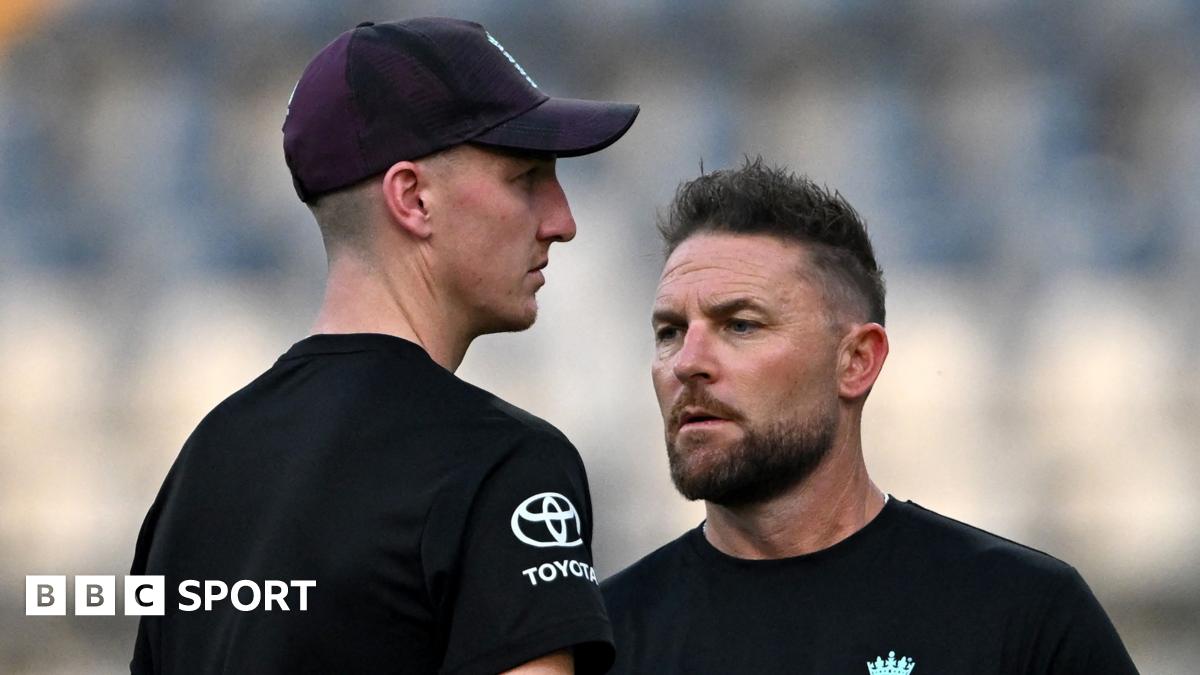
T20 World Cup: Brendon McCullum wants to stay as England coach – but will that be enough?

Published

on

Preview: F1's New Era Dawns

Brook and McCullum have also kept spirits high on this trip, an impressive feat given what had come before.

The tour began with Brook standing up in front of the group in a Colombo hotel and apologising to his team-mates for his Wellington escapades.

In the end he took the blame again, but this time for a dropped catch rather than any trip into the night.

Brook’s drop of Sanju Samson should not distract from a definite improvement in fielding during this tournament, under the eyes of rehired fielding coach Carl Hopkinson.

Advertisement

A slapdash approach to training was another accusation made in Australia but here England have trained hard, often longer into the night than expected.

And while that should be seen as par for the course, McCullum and Brook also deserve credit for their tactical calls on this trip.

Liam Dawson and Sam Curran were recalled to relative success, while Will Jacks excelled in a new role as a finisher.

Brook played the innings of his T20 career after McCullum suggested moving to number three.

Advertisement

But doubt clearly remains whether that is enough to save McCullum, having taken England to a point viewed as the bare minimum before a ball was bowled.

Having your future hinge on a World Cup semi-final against India in Mumbai is the toughest of schools but this was a situation of McCullum’s making.

It was he who oversaw the Ashes planning that did not include a warm-up game, and allowed the mid-series trip to Noosa.

It was on McCullum’s watch Brook, Jacob Bethell and Josh Tongue felt able to visit a nightclub the night before an international fixture.

Advertisement

Just how bad the Ashes were should not and can not be forgotten.

Other key stakeholders are managing director Rob Key and Test captain Ben Stokes, who are both back in the UK after beginning the week stranded in the United Arab Emirates with England Lions.

Key spent time around the squad during this tournament and his position will also be discussed by those above.

Stokes is the most secure, though he and McCullum appeared conflicted in their messaging at times in Australia.

Advertisement

Stokes batted 152 balls for 50 runs in Brisbane and called for his team to “show a bit of dog” in Adelaide but when another defeat came five days later, thus confirming Australia would hold onto the urn, McCullum spoke of his disappointment that England had drifted from their attacking style of play.

Despite that, Stokes backed McCullum before and after the fifth Test in Sydney when he could have been more vague.

Brook was also steadfast in his defence of McCullum on Thursday night, saying the former New Zealand captain was “125%” the man to continue.

“The things he’s done over the four years since he took over has changed English cricket for hopefully the best,” Brook said.

Advertisement

“He’s the best head coach I’ve ever had.”

Critics would say it is no surprise players would back a coach whose key philosophy is a relaxed environment.

There is plenty to be considered over the weeks ahead.

McCullum wants to stay and his players still believe in him. Will that be enough?

Advertisement

Source link

Continue Reading

NewsBeat

NI Council to provide public recycling bins for the first time

Published

on

Belfast Live

Ards North Down to trial bins at Ward Park in Bangor and bowling alleys

A Northern Ireland council is to erect public recycling street bins for the very first time.

Advertisement

Elected representatives at Ards and North Down Borough Council this week agreed to trial recycling litter bins at selected spots in the borough, after councillors admitted its lack of public recycling street bins sent out a “poor message”.

Councillors at the March meeting of the local authority’s Environment Committee this week approved a trial in the borough called “Recycling on the Go.” The £45K trial will commence later in the year for six months, and will focus on plastic drinks bottles and metal drinks cans at Ward Park in Bangor and at bowling greens owned by the council.

READ MORE: Football coming home to Newtownards as Ards FC stadium approved after 25 year wait

READ MORE: Stand-off over Fleadh event in Bangor ends as unionists yield to recommendations

Advertisement

A Notice of Motion was agreed at the Environment Committee last summer stating the council was “pleased” with the recycling rates for waste that had been achieved in the borough, but admitted there were “limited” facilities to recycle litter. The motion stated: “This sends out a poor message to our residents and visitors”.

The council resolved to have a trial designed to “extend recycling opportunities to residents and visitors of Ards and North Down’s public parks and to measure the effectiveness of the scheme infrastructure, communications, and user satisfaction.”

A budget of £45,000 has been set aside for the pilot. This includes £15K for new recycling bins and £30K revenue for communications, operations, and project evaluation.

The official’s report on the trial proposal states: “We propose a phased introduction of new recycling bins, with a pilot exercise in Ward Park and council-managed bowling greens. The containers will be co-located with litter bins in areas of high footfall so that visitors can dispose of rubbish and recycling conveniently at one location.”

Advertisement

It adds: “The scheme will target two key materials streams: plastic drinks bottles and metal drinks cans. These two material streams are recyclable at the kerbside and commonly used by people when out and about.”

It states: “A recent successful pilot by Belfast City Council and environmental charity, Hubbub, found that the recycling comprised almost 50 percent by weight of target material. The trial found that contamination levels were low enough that the recycling could be sent for reprocessing.

“The Ards and North Down pilot will follow the same approach as the Belfast pilot. It will ensure that the containers are clearly labelled with both materials iconography and wording to make targeted recyclable materials clear. This will reduce confusion and contamination.”

DUP Councillor Alistair Cathcart said at the committee meeting: “The key question is whether this will work, and unfortunately when they have been trailed before they havent worked. It is interesting that Belfast has had positive results, which is encouraging.

Advertisement

“I think that starting in the parks is the best thing, and hopefully the behaviour will change around it. The reports show people recycle well at the kerbside, and in their own homes.

“But obviously there are consequences at home: they will not get their bins collected (otherwise). There are no consequences to this (trial), but hopefully changing behaviour and messaging (will get through) that it saves money, as well as being good for the environment.”

Want to see more of the stories you love from Belfast Live? Making us your preferred source on Google means you’ll get more of our exclusives, top stories and must-read content straight away. To add Belfast Live as a preferred source, simply click here.

Source link

Advertisement
Continue Reading

NewsBeat

Why do sports shoes squeak? Here’s what our research reveals

Published

on

Why do sports shoes squeak? Here’s what our research reveals

The unofficial soundtrack of every basketball, squash or hard-court tennis match is the constant high-pitched squeak or shreak of the players’ shoes. But can this squeak be designed out of them while retaining the grip?

That’s the question an international team of engineers and applied physicists, including me, have been investigating. It sounds like a small design tweak. In fact, it cuts to a deep physics problem: how a soft body slides against a rigid one.

Perhaps surprisingly, the mechanism that produces sound when a soft solid slides against a stiffer one has long been the subject of scientific debate. Most theories are linked to the concept of “stick-slip”: when, instead of sliding smoothly, the sliding object rapidly alternates between sticking and slipping.

While it sticks, the soft body (such as a rubber sole) deforms and stores elastic energy. Then it suddenly slips, turning much of that energy into heat through friction – while also releasing rapid vibrations that radiate out as sound.

Advertisement

But this is not exactly what we observed in our experiments.

After Leonardo da Vinci

Our recently published study took inspiration from the simple-but-effective setup used by Leonardo da Vinci in his studies of friction from the late 15th century.

Leonardo da Vinci’s sketches of his pioneering friction experiments.
Codex Arundel, British Library (41r), 1500-05.

Leonardo used a wooden block resting on a flat surface. The block was subjected to two forces: a normal force (its own weight) and a tangential force which was applied using an additional weight attached to a cable.

Advertisement

By stacking and combining multiple blocks, Leonardo discovered the two fundamental laws of friction: that friction is proportional with how hard the surfaces are pressed together, and largely independent of the size of the contact area.

But Leonardo never published these findings, which were finally rediscovered and made public in the 19th century in notebooks scattered throughout Europe. In the meantime, the laws of friction had only been formally enunciated by French physicist Guillaume Amontons in 1699 – two centuries after Leonardo’s studies.

Furthermore, these laws are empirical rather than fundamental, and in extreme cases they break down. This led us to the question of what makes a shoe squeak.


À lire aussi :
Leonardo da Vinci’s early work on friction founded the modern science of tribology

Advertisement

A surprising result

One of the biggest difficulties in friction studies is that the interface being tested (where a shoe sole meets a hardwood floor, for example) is hard to get at, and comes under a lot of pressure while slipping at high speed. Placing sensors at the interface is almost impossible – and even if it were, this would probably alter the frictional response.

Our solution was to use an optical trick: we replaced the hardwood floor with a transparent acrylic plate and mounted an array of LED lights along its sides. When each test object – including multiple rubber blocks – made contact with the plate, light would leak into the contact region, brightening up this area alone. That allowed us to visualise exactly which parts of the soft-rigid interface were in contact.

We used a high-speed camera, capable of capturing up to 1 million frames per second, to film how the contact patches evolved while the “sole” was skidding, and recorded the sounds being emitted with a microphone.

We found that at the point of contact, tiny wrinkles in the surface of the rubber block – known as “opening slip pulses” – were created, which then raced along the interface at nearly 100 metres per second. While most of the block remained stuck in place, these rapidly moving wrinkles created the sound in each friction test.

Advertisement

Surprisingly, even tiny geometrical features at the frictional interface had profound effects on the sound generated. When it was perfectly flat and smooth, the pulses were messy and generated a scratch-like noise of many different frequencies – closer to the sound of peeling adhesive tape than a clean squeak.

But when ridges were present, like those on the soles of sport shoes, the pulses were confined by the width of these ridges, making them very regular (not messy any more). This turned the sound into a more musical tone akin to the squeaks heard on a basketball court.

We were also able to determine what decides the precise pitch of a shoe squeak. In each test, it was largely unaffected by either the speed of sliding or magnitude of the force applied (which relates to the weight of a player).

Rather, the clearest link was with the height of the rubber block – or the thickness of a shoe’s sole. Using this knowledge, we created a series of blocks of different heights in order to play a familiar melody, as shown in this video.

Advertisement

Video: Nature.

Our research lays the groundwork for controlling or suppressing squeaking in many mechanical systems involving soft-on-rigid friction. These range from brakes and tyres to hip and knee replacements, where polymer liners slide against polished metal or ceramic heads.

And yes, it could even lead to the development of squeakless sneakers. Designing intricate patterns that keep plenty of rubber in contact (so the grip stays high) but break the sliding into lots of tiny, out-of-sync microevents could kill the clean note of the squeak, and leave only a soft hush.

Table-top earthquakes

Beyond the realm of sports, this work also relates to much larger geophysical questions. Similar experimental approaches to ours have served as table-top models for studying earthquakes, during which ruptures and slip pulses spread along tectonic faults at extremely high speed.

Advertisement

If we can reproduce earthquake-like slip pulses in the lab, the next challenge is scaling – working out how those centimetre-scale measurements translate to what happens inside real faults in the Earth.

Achieving this could help interpret seismic signals more confidently: using waves recorded far from a fault to infer what has actually happened at the source. Better physics-based models could improve seismic hazard estimates and lead to more reliable hazard maps.

Meanwhile, we’ll keep thinking about squeakless sneakers too.

Advertisement

Source link

Continue Reading

Trending

Copyright © 2025