It’s one thing to create your own relay-based computer; that’s already impressive enough, but what really makes [DiPDoT]’s design special– at least after this latest video— is swapping the SRAM he had been using for historically-plausible capacitor-based memory.
A relay-based computer is really a 1940s type of design. There are various memory types that would have been available in those days, but suitable CRTs for Williams Tues are hard to come by these days, mercury delay lines have the obvious toxicity issue, and core rope memory requires granny-level threading skills. That leaves mechanical or electromechanical memory like [Konrad Zeus] used in the 30s, or capacitors. he chose to make his memory with capacitors.
It’s pretty obvious when you think about it that you can use a capacitor as memory: charged/discharged lets each capacitor store one bit. Charge is 1, discharged is 0. Of course to read the capacitor it must be discharged (if charged) but most early memory has that same read-means-erase pattern. More annoying is that you can’t overwrite a 1 with a 0– a separate ‘clear’ circuit is needed to empty the capacitor. Since his relay computer was using SRAM, it wasn’t set up to do this clear operation.
He demonstrates an auto-clearing memory circuit on breadboard, using 3 relays and a capacitor, so the existing relay computer architecture doesn’t need to change. Addressing is a bit of a cheat, in terms of 1940s tech, as he’s using modern diodes– though of course, tube diodes or point-contact diodes could conceivably pressed into service if one was playing purist. He’s also using LEDs to avoid the voltage draw and power requirements of incandescent indicator lamps. Call it a hack.
Advertisement
He demonstrates his circuit on breadboard– first with a 4-bit word, and then scaled up to 16-bit, before going all way to a massive 8-bytes hooked into the backplane of his Altair-esque relay computer. If you watch nothing else, jump fifteen minutes in to have the rare pleasure of watching a program being input via front panel with a complete explanation. If you have a few extra seconds, stay for the satisfyingly clicky run of the loop. The bonus 8-byte program [DiPDoT] runs at the end of the video is pure AMSR, too.
Yeah, it’s not going to solve the rampocalypse, any more than the initial build of this computer helped with GPU prices. That’s not the point. The point is clack clack clack clack clack, and if that doesn’t appeal, we don’t know what to tell you.
Asha Sharma, who recently replaced Phil Spencer as the head of Microsoft’s Xbox division, provided a short update on the company’s next-generation console. Revealing the codename “Project Helix,” she confirmed that the upcoming device aims to lead in horsepower and will support both Xbox and PC games. Read Entire Article Source link
Platform reviewed: PS5 Pro Available on: PS5, Xbox Series X|S, PC Release date: February 17, 2026
Advertisement
Similar to those titles, Obsidian Entertainment’s fantasy action role-playing game isn’t just sloppy seconds on the PS5 and PS5 Pro, but rather the definitive edition of an already fantastic experience.
Avowed’s arrival on Sony‘s consolesnot only benefits from a year’s worth of additional polish and bug fixes, but also plenty of fresh content and PlayStation-specific bells and whistles, like brilliant DualSense Wireless Controller integration.
Advertisement
DuelSense-fueled fighting
(Image credit: Microsoft / Obsidian Entertainment)
While I began an Avowed playthrough on my Xbox Series X a year ago, I didn’t get to dig very deep into its rich, potential-packed universe. What I remember most from my brief time braving the Living Lands as an envoy of the Aedyr Empire is the game’s rewarding combat, which feels better than ever on the PS5.
Fast, fluid, and superbly supported by weighty impacts of blades, bullets, and arcane abilities, the monster-slaying action was already satisfying as hell. But the combat’s been amped up significantly thanks to the DualSense‘s immersion-ratcheting capabilities.
Obsidian didn’t sleep on the gamepad’s proprietary tech, fully leveraging its adaptive triggers and haptic feedback to make every input – from meaty melee strikes to slow simmering spells – feel as fantastic in your hands as they look on the screen.
Of course, this also folds in that fresh content I mentioned above, as the game’s massive anniversary update introduces a new Quarterstaff for wizard builds. No mere reskin of an existing melee weapon, this two-handed tool of destruction allows mages to crack skulls up-close – as well as unleash powerful spells – in an epic fashion that’d make Gandalf proud.
Advertisement
Sign up for breaking news, reviews, opinion, top tech deals, and more.
Coupled with its next-level DualSense effects, it’s quickly become my favorite way to bring death to the Living Lands.
An update worthy of the gods
(Image credit: Microsoft / Obsidian Entertainment)
While the Quarterstaff is my personal favorite addition, this sorcerer’s best friend barely scratches the surface of the brimming update.
Advertisement
A deep photo mode – with plenty of options for customizing effects, filters, and color gradients – as well as a New Game+ option, will keep both existing envoys and new recruits busy. Beyond that, a trio of new races – Orlans, Aumaua, and Dwarves – join the Humans and Elves, bringing more character customization, perks, and fresh personality and lore to this already layered fantasy universe.
A slew of new difficulty modifiers also invite adventurers of all skill levels to tweak and tailor their experience to their hearts’ content. Factor in the past year of smaller updates – adding everything from polish, bug fixes, and quality of life touches – and PlayStation fans are getting yet another definitive take on a title that was born on Xbox.
If the PlayStation version stumbles at all, it’s in its lack of PS5 Pro-specific enhancements. It packs the now-standard quality (30 frames per second) and performance (60 frames per second) options, as well as a more in-the-middle setting for those with 120Hz displays. You can also chase faster performance by unlocking the frame rate, a welcome inclusion for sure. But there are no meaty ray-tracing features or other enhancements that allow you to truly harness everything under the Pro’s hood.
And what is offered didn’t seem to make much of an impact during my testing. In terms of both visuals and performance, my time playing on the Pro looked and felt pretty comparable to my Xbox Series X experience. Similarly, the standard PS5 and Pro seem to offer near-identical visual quality and performance, with no notable differences between the two.
Advertisement
Don’t sleep on it a second time
(Image credit: Microsoft)
While Pro owners might pine for more features to justify their pricey hardware purchase, the finger can be partially pointed at the fact that Avowed already played smoothly and impressed visually upon its release a year ago. That same sentiment translates to many other elements of the game, including its fantastic storytelling, colorful character interactions, and vibrant, varied world, covered extensively in TechRadar Gaming’s original review of the game.
Unsurprisingly, upon its release, Avowed was another compelling, polished action-RPG from a studio that’s been honing and perfecting its craft for over two decades, starting with 2004’s Star Wars Knights of the Old Republic II: The Sith Lords. Sadly, it got somewhat lost in the sea of last year’s acclaimed genre entries.
Thankfully, that oversight can now be remedied with its PS5 release, which not only reintroduces everything that was great the first time we faced its fungal plague but also brings a brimming treasure chest of fresh features, enhancements, and content.
Advertisement
Whether you’re a PlayStation owner craving the most immersive experience from behind the DualSense or an existing envoy ready to wield the Quarterstaff as one of the new races, Avowed’s second coming is as impressive as a Living Lands sunset…which you’ll definitely want to capture in photo mode.
Should you play Avowed on PS5?
Play it if…
Advertisement
Don’t play it if…
(Image credit: Microsoft)
Accessibility features
Prior to its PS5 release, Avowed already offered an admirable slate of accessibility options for camera adjustments, subtitle settings, difficulty levels, and even an arachnophobia mode for those averse to creepy crawlies. But the game’s new version builds further on this solid foundation, especially in the difficulty department.
A new “custom” difficulty setting allows players to tweak over two dozen modifiers, adjusting everything from player damage and stamina to carrying capacity, enemy attack speed, and much more. But while Avowed more than delivers in most accessibility areas, it still doesn’t offer the suite of colorblind options that have become pretty standard in other games.
Advertisement
How I reviewed Avowed on PS5
I explored The Living Lands for just over 40 hours, adventuring primarily on my PlayStation 5 Pro, but also putting plenty of time into my standard PS5 and Xbox Series X for visual and performance comparisons. I found the best, most balanced experience playing on my Pro in quality mode with the framerate unlocked.
I focused on testing the game’s anniversary update additions, specifically its custom difficulty settings, new Quarterstaff weapon, races, and photo mode. I played primarily on my budget TCL4K display, with HDR enabled and using its built-in stereo speakers, paying particular attention to the game’s DualSense controller integration for vibration and audio effects. I also played a few hours on my PlayStation Portal with PlayStation Pulse Explore earbuds.
On Wednesday, the Trump administration announced that a large collection of tech companies had signed on to what it’s calling the Ratepayer Protection Pledge. By agreeing, the initial signatories—Amazon, Google, Meta, Microsoft, OpenAI, Oracle, and xAI—are saying they will pay for the new generation and transmission capacities needed for any additional data centers they build. But the agreement has no enforcement mechanism, and it will likely run into issues with hardware supplies. It also ignores basic economics.
Other than that, it seems like a great idea.
What’s being agreed to
The agreement is quite simple, laying out five points. The key ones are the first three: that the companies building data centers pledge to pay for new generating capacity, either building it themselves or paying for it as part of a new or expanded power plant. They’ll also pay for any transmission infrastructure needed to connect their data centers and the new supply to the grid and will cover these costs whether or not the power ultimately gets used by their facilities.
The companies also pledge to consider allowing the local grid to use on-site backup generators to handle emergency power shortages affecting the community. They will also hire and train locally when they build new data centers.
Advertisement
The agreement suggests that these promises will protect American consumers from price hikes due to the expansion of data centers and will somehow “lower electricity costs for consumers in the long term.” How that will happen is not specified.
Also missing from the agreement is any sort of enforcement mechanism. If a company decides to ignore the agreement, the worst it is guaranteed to suffer is bad publicity, something these companies already have experience handling. That said, Trump has been known to resort to blatantly illegal tactics to pressure companies to conform to his wishes, so ignoring the agreement carries risks.
That’s important because the companies will struggle to live up to the agreement. (Though Google, for its part, told Ars that it has typically followed the guidelines as a normal part of its process for building new data centers.)
A China-linked advanced persistent threat actor tracked as UAT-9244 has been targeting telecommunication service providers in South America since 2024, compromising Windows, Linux, and network-edge devices.
According to Cisco Talos researchers, the adversary is closely associated with the FamousSparrow and Tropic Trooper hacker groups, but is tracked as a separate activity cluster.
This assessment has high confidence and is based on similar tooling, tactics, techniques, and procedures (TTPs), and victimology observed in attacks attributed to the threat actors.
The researchers note that while UAT-9244 shares the same target profile as Salt Typhoon, they could not establish a solid connection between the two activity clusters.
Advertisement
New malware targeting telco networks
The researchers found that the campaign used three previously undocumented malware families: TernDoor, a Windows backdoor; PeerTime, a Linux backdoor that uses BitTorrent; and BruteEntry, a brute-force scanner that builds proxy infrastructure (ORBs).
TernDoor is deployed through DLL side-loading, using the legitimate executable wsprint.exe to load malicious code from BugSplatRc64.dll, which decrypts and executes the final payload in memory (injected into msiexec.exe).
The malware contains an embedded Windows driver, WSPrint.sys, which is used to terminate, suspend, and resume processes.
Persistence is achieved via scheduled tasks and Windows Registry modifications, which are also used to hide the scheduled task.
Advertisement
Additionally, TernDoor can execute commands via remote shell, run arbitrary processes, read/write files, collect system information, and self-uninstall.
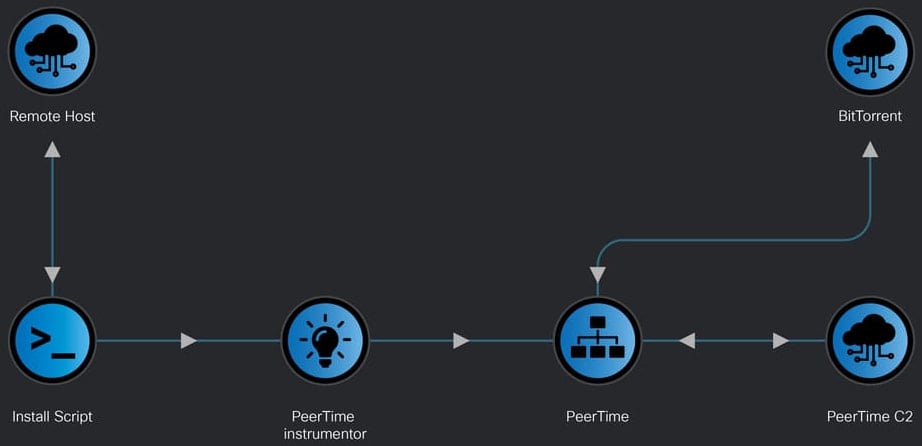
PeerTime is an ELF Linux backdoor that targets multiple architectures (ARM, AARCH, PPC, MIPS), suggesting it was designed to compromise a broad range of embedded systems and network devices used in telecom environments.
PeerTime installation flow Source: Cisco Talos
Cisco Talos documented two versions for PeerTime. One variant is written in C/C++ and the other is based on Rust. The researchers also noticed Simplified Chinese debug strings in the instrumentor binary, an indicator of its origin.
Its payload is decrypted and loaded in memory, and its process is renamed to appear legitimate.
PeerTime, an ELF-based peer-to-peer (P2P) backdoor, uses the BitTorrent protocol for command-and-control (C2) communications, downloads and executes payloads from peers, and uses BusyBox to write the files on the host.
Advertisement
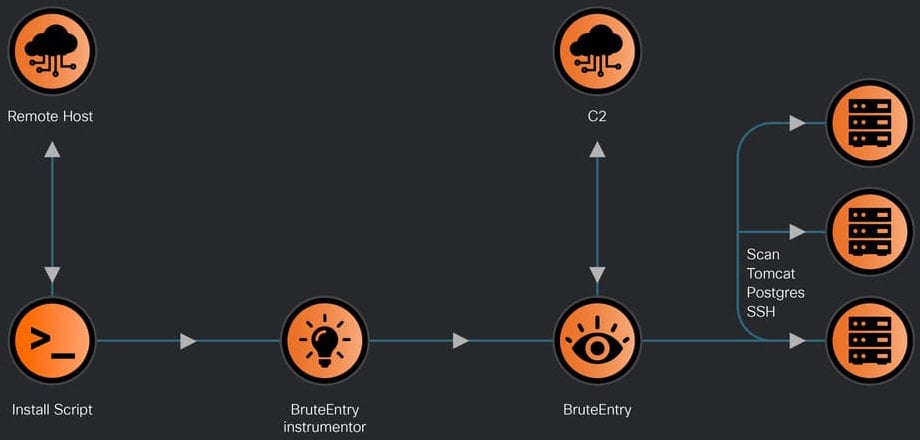
Finally, there’s BruteEntry, which consists of a Go-based instrumentor binary and a brute-forcing component. Its role is to turn compromised devices into scanning nodes, known as Operational Relay Boxes (ORBs).
BruteEntry infection chain Source: Cisco Talos
The attacker uses the machines running BruteEntry to scan for new targets and brute-force access to SSH, Postgres, and Tomcat. Login attempt results are sent back to the C2 with task status and notes.
In a technical report today, Cisco Talos researchers provide details on the capabilities of the three pieces of malware, how they are deployed, and achieve persistence.
Cisco Talos researchers have listed indicators of compromise (IoCs) associated with the observed UAT-9244 activity, which defenders can use to detect and block these attacks early.
Malware is getting smarter. The Red Report 2026 reveals how new threats use math to detect sandboxes and hide in plain sight.
Download our analysis of 1.1 million malicious samples to uncover the top 10 techniques and see if your security stack is blinded.
This is one of those simple deals that’s hard to argue with. The Roku Streaming Stick HD is down to $15.99 from $29.99. If you’ve got an older TV in a bedroom, kitchen, dorm, or guest room that’s missing apps (or just runs painfully slow), this is the quick fix. You plug it in, connect to Wi-Fi, and you’ve got a modern streaming setup without buying a whole new TV.
It’s also a great “keep in a drawer” gadget. If you travel, bounce between rentals, or visit family and end up stuck with a clunky TV interface, a cheap Roku stick can save the night.
What you’re getting
This is an HD streaming stick that plugs into your TV’s HDMI port and comes with a Roku voice remote. Roku’s big advantage is that it’s simple and consistent. You get access to the usual major streaming apps, plus free and live TV options through Roku’s platform.
No fancy specs here, and that’s fine. The point is getting reliable streaming with minimal hassle for very little money.
Advertisement
Why it’s worth it
At $15.99, you’re basically paying impulse-buy pricing for something you’ll probably use for years. This is perfect if:
your TV is older, and the built-in apps are outdated or slow
you want streaming in a second room without spending much
you’re setting up a kid’s room, dorm, or guest space
you just want a clean interface that doesn’t fight you
If you’ve got a 4K TV and you care about the highest resolution, you’d look at a 4K streaming stick instead. But for basic HD streaming and a smoother experience on an older set, this is a great deal.
The bottom line
For $15.99, the Roku Streaming Stick HD is an easy upgrade that fixes a lot of annoyances fast. If you’ve got any TV in your house that feels “behind,” this is the cheap, simple way to bring it up to date.
The CPRight team, from left: Shubham Bansal, Deeya Sharma, Prisha Hemani, and Atharv Dixit with their Holloman Health Innovation Challenge winnings at the University of Washington in Seattle this week. (UW Buerk Center for Entrepreneurship Photo / Matt Hagen)
A team of students from the University of Washington took home the top prize in the Hollomon Health Innovation Challenge on Wednesday as the UW swept the 11th annual competition.
CPRight won the $15,000 Holloman Family grand prize as well as the $2,500 Naturacur Wound Healing Best Idea for a Medical Device prize in the student competition.
CPRight is a real-time CPR feedback device that provides data on compression rate and depth to ensure bystanders perform high-quality, life-saving chest compressions during an emergency.
The company was co-developed alongside ReviveHer, the 2025 Best Idea for Patient Safety prize winner.
The team consists of Shubham Bansal, a neuroscience undergraduate student; Deeya Sharma, a graduate student in the UW School of Medicine; Prisha Hemani, a computer science and engineering undergrad; and Atharv Dixit, an engineering undergrad.
Advertisement
The Hollomon Health Innovation Challenge, hosted by the UW’s Buerk Center for Entrepreneurship in the Foster School of Business, gives students the opportunity to create meaningful solutions to big health-related problems. The competition is open to undergrads and grad students at accredited colleges and universities across the Cascadia Corridor — Washington, Oregon, Idaho, and British Columbia, as well as Alaska.
Other prize winners:
$10,000 WRF Capital Second Place Prize:
TheraT, a drinkable, non-invasive therapy that removes toxins in the gut before they reach the bloodstream, allowing chronic kidney disease patients to lower their reliance on dialysis.
$5,000 Scale LLP Third Place Prize
LegUp Prosthetics, a low-cost system that uses smartphone-based 3D scanning to enable accurate fitting from home, reducing costs and expanding access to prosthetic care for underserved and rural patients. Developed by a UW team of molecular engineering, bioengineering, biochemistry, and mechanical engineering students. They also won the $2,500 Population Health Initiative Best Idea for Addressing Health Access and Disparities prize for their focus on expanding care to underserved and rural patients through a point-of-care healthcare service.
$2,500 Mindful Therapy Group Best Idea in Digital Health Prize
ShiftSpark, a workflow-embedded support platform that helps nurses process stress in real time during a shift. Developed by a team of UW public health students who became the first-ever to win the digital health prize in the challenge after also winning the pitch contest as part of the Buerk’s Digital Health Workshop series.
SoundBio Lab Ignite Prize
TPT-Finder, a handheld, AI-powered surgical tool that helps surgeons instantly distinguish parathyroid tissue during thyroid surgery to prevent costly and life-altering complications. Developed by a UW team of computer science and electrical and computer engineering students. The prize is a six-month membership to the SoundBio Lab biomakerspace in the U-District.
$1,000 Connie Bourassa-Shaw Spark Award
ColoGuide, an AI-powered colonoscopy navigation system building its proprietary data set to automate scope insertion with real-time visual guidance. Developed by UW Medicine students.
This year’s competition attracted 67 participants, two shy of the record set in 2025. Students represented seven schools in the opening round: UW, UW-Bothell, Edmonds College, UW Global Innovation Exchange, University of Idaho, Portland State University, and Seattle University.
There have been 509 participating teams and more than 1,725 students over the 11 years of the challenge and $424,000 awarded.
A €345,000 employment grant from Údarás na Gaeltachta will support the recruitment.
Minister for Rural and Community Development and the Gaeltacht Dara Calleary, TD has approved €12m in funding from his department and its agencies for a range of projects. Calleary also revealed plans for 23 new jobs at Net Feasa, a technology company based in Daingean Uí Chúis, Kerry.
The 23 new full-time positions will double the company’s workforce over the course of the next three years and will be in software development and engineering, artificial intelligence engineering, wireless network operations and customer support. A €345,000 employment grant from Údarás na Gaeltachta will support the recruitment.
Net Feasa, which comes from the Irish language for “network of knowledge”, is a digital transformation company dedicated to “revolutionising” the global supply chain landscape.
Advertisement
“Our mission is to enhance safety, security and visibility, ensuring that every link in the chain is connected and performing seamlessly,” read a statement on the company’s website.
Commenting on the jobs announcement Calleary said: “I am delighted to be here to celebrate this success story. The jobs at Net Feasa are high-quality well-paid roles in an exciting technology company. Net Feasa was founded in a rural Gaeltacht town, but it has a global reach with offices in Singapore, Hong Kong, Taiwan and the United States.
“With the wealth of talent available in rural areas and the support of my department, and agencies like Údarás na Gaeltachta, we are working hard to create more opportunities like this.”
Calleary today (5 March) began a two-day visit to Kerry where he is opening and visiting projects that have been approved for funding.
Advertisement
Among other engagements, he will also visit the site of the new housing project in Baile an Fheirtéaraigh that seeks to address the accommodation shortage for Irish language summer colleges in the area and attend the official opening of GTEIC, a working hub which has had investment of more €2.5m.
The Cathaoirleach of Kerry County Council, Cllr Michael Foley said: “I warmly welcome Minister Dara Calleary to Kerry for a series of important engagements. The Department of Rural and Community Development and the Gaeltacht has supported many projects and initiatives in Kerry in recent years, and I am pleased that the Minister will have the opportunity to see first-hand the very positive work being done across the county.”
Don’t miss out on the knowledge you need to succeed. Sign up for the Daily Brief, Silicon Republic’s digest of need-to-know sci-tech news.
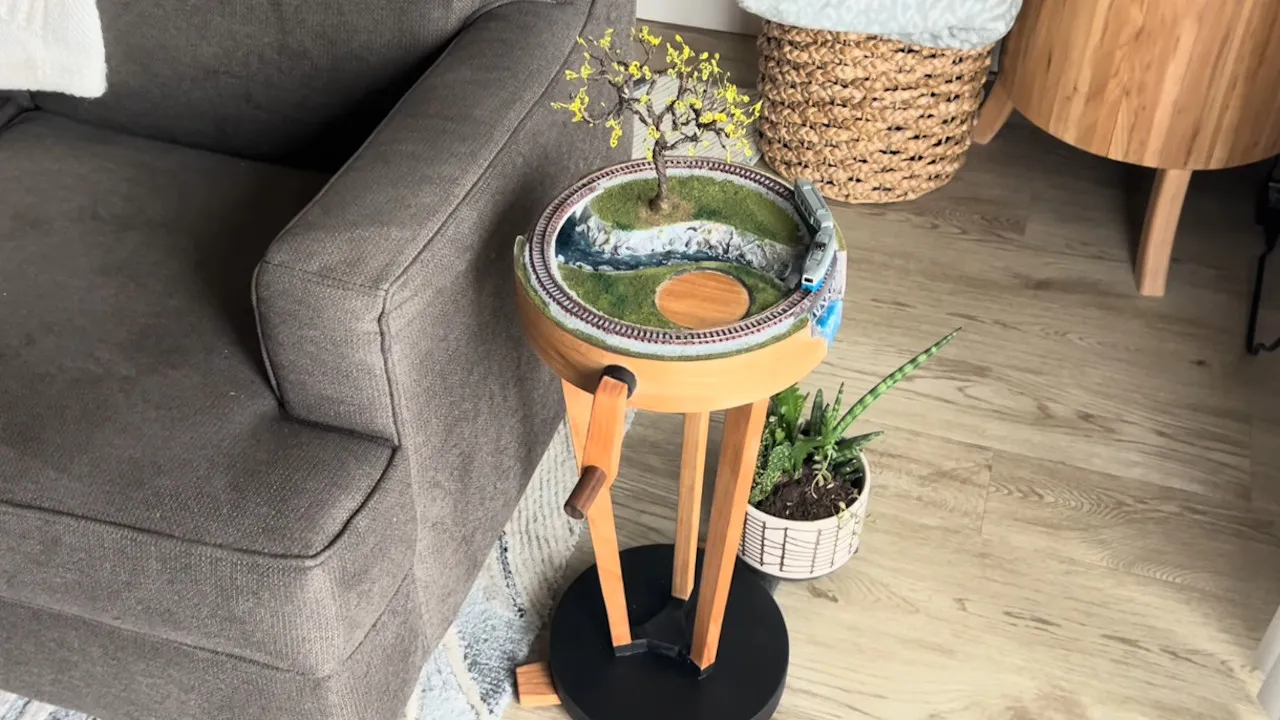
The end table was built from scratch, with [Peter] going through all the woodworking steps required to assemble the piece. The three-legged wooden table is topped with a tiny N-scale model railway layout, and you get to see it put together including the rocks, the grass, and a beautiful epoxy river complete with a bridge. The railway runs a Kato Pocket Line trolley, but the really neat thing is how it’s powered.
[Peter] shows us how a small gearmotor generator was paired with a bridge rectifier and a buck converter to fill up a super capacitor that runs the train and lights up the tree on the table. Just 25 seconds of cranking will run the train anywhere from 4 to 10 minutes depending on if the tree is lit as well. To top it all off, there’s even a perfect coaster spot for [Peter]’s beverage of choice.
People are losing their minds over Apple’s decision to put an iPhone chip in the MacBook Neo. All it shows is that they really don’t understand the engineering of Apple Silicon.
Apple’s A18 Pro is more than an iPhone chip
After years of rumors, the budget MacBook was revived on March 4, 2026. The MacBook Neo is its name, and people are already losing their minds over one key cost-cutting decision. The MacBook Neo has the A18 Pro at its heart, the same chip that powered the iPhone 16 Pro. It’s something that had been rumored, yet still seems to have blindsided some of those looking to create a fuss on social media. Continue Reading on AppleInsider | Discuss on our Forums
SunBriteTV has launched the Veranda 4, a full-shade outdoor 4K smart TV series that takes direct aim at the covered patio market where Samsung’s Terrace line has established the dominant commercial presence over the past several years.
The outdoor TV category has expanded steadily as homeowners invest in permanent alfresco entertainment setups, with weatherproofed screens becoming a standard fixture in residential outdoor living spaces alongside dedicated outdoor audio systems and covered kitchen installations.
The Veranda 4 enters that market with 600-nit brightness driven by a direct LED backlight, a figure SunBriteTV claims sits 58% higher than its previous generation, giving the panel the output needed to hold picture quality in partially shaded environments without washing out in ambient daylight.
An IP55-rated aluminium exterior handles rain, heat, and humidity, while internal components carry additional protective coatings, and SunBriteTV’s Eco Bright Outdoor Technology prevents backlight failure at operating temperatures up to 50 degrees Celsius, covering the range of conditions a permanently mounted outdoor screen would face across summer months in most North American climates.
Advertisement
LG’s WebOS powers the smart platform, supporting access to a wide variety of third-party streaming apps such as Netflix and Disney+. There’s also a redesigned media bay tucked discreetly within the chassis, giving users flexibility to run their own streaming devices without visible cable clutter behind the screen.
Advertisement
Connectivity covers built-in Wi-Fi, Bluetooth 5.0, and voice control, with two integrated 8-watt loudspeakers handling audio for everyday viewing without requiring a separate outdoor sound system for basic use cases.
The Samsung Terrace, which similarly targets covered outdoor environments and carries comparable weatherproofing credentials, starts at a higher price point than the Veranda 4, giving SunBriteTV a potential cost advantage in the residential installation market where budget often determines product selection alongside brand recognition.
Advertisement
The Veranda 4 is available now in 65-inch and 75-inch sizes, priced at $3,198.95 and $4,648.95 respectively, with additional screen sizes launching later in 2026.