

Crypto World
Strange New Chinese AI ‘KIMI’ Predicts the Price of XRP, Ethereum and Dogecoin by the End of 2026

When you plug in a special prompt into AI chatbots, KIMI AI reveals some frankly unbelievable 2026 price projections for top cryptocurrencies.
Markets seem unfazed by the US/Iran war news, a sign that much of the geopolitical risk was absorbed earlier in the year, following aggressive sell-offs triggered by comments from former President Trump regarding possible U.S. military actions linked to Greenland and Iran.
While it’s still early days, crypto’s recovery may actually be on a firm footing.
Here’s why KIMI AI believes XRP, Ethereum and Dogecoin will gain the most.
XRP ($XRP): KIMI AI Forecasts a 6x Move Within 10 Months
In a recent update, Ripple reaffirmed XRP ($XRP) remains central to its vision of establishing the XRP Ledger (XRPL) as a global, enterprise-grade payments infrastructure.
Thanks to near-instant transaction finality and minimal fees, XRPL could secure an early foothold in two of crypto’s fastest-growing verticals: stablecoins and tokenized real-world assets.
XRP is currently trading near $1.41, and KIMI predicts a potential rally toward $8 by New Year, representing a sixfold gain from current levels.
XRP’s relative strength index (RSI) is holding close to a neutral 50, while price action has converged with the 30-day moving average, indicating the downturn may be exhausted.
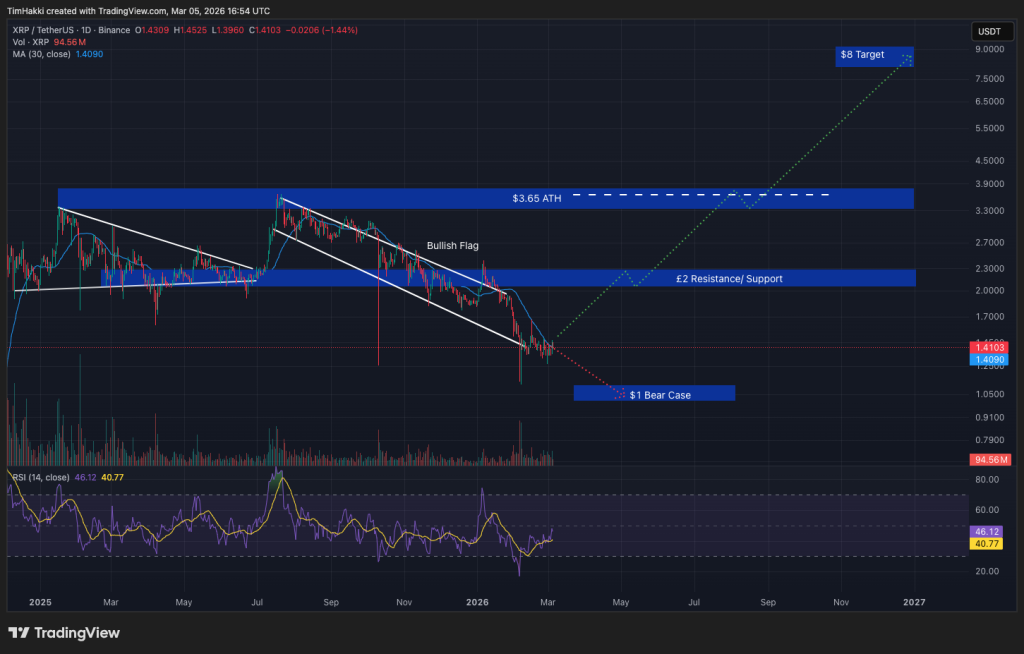
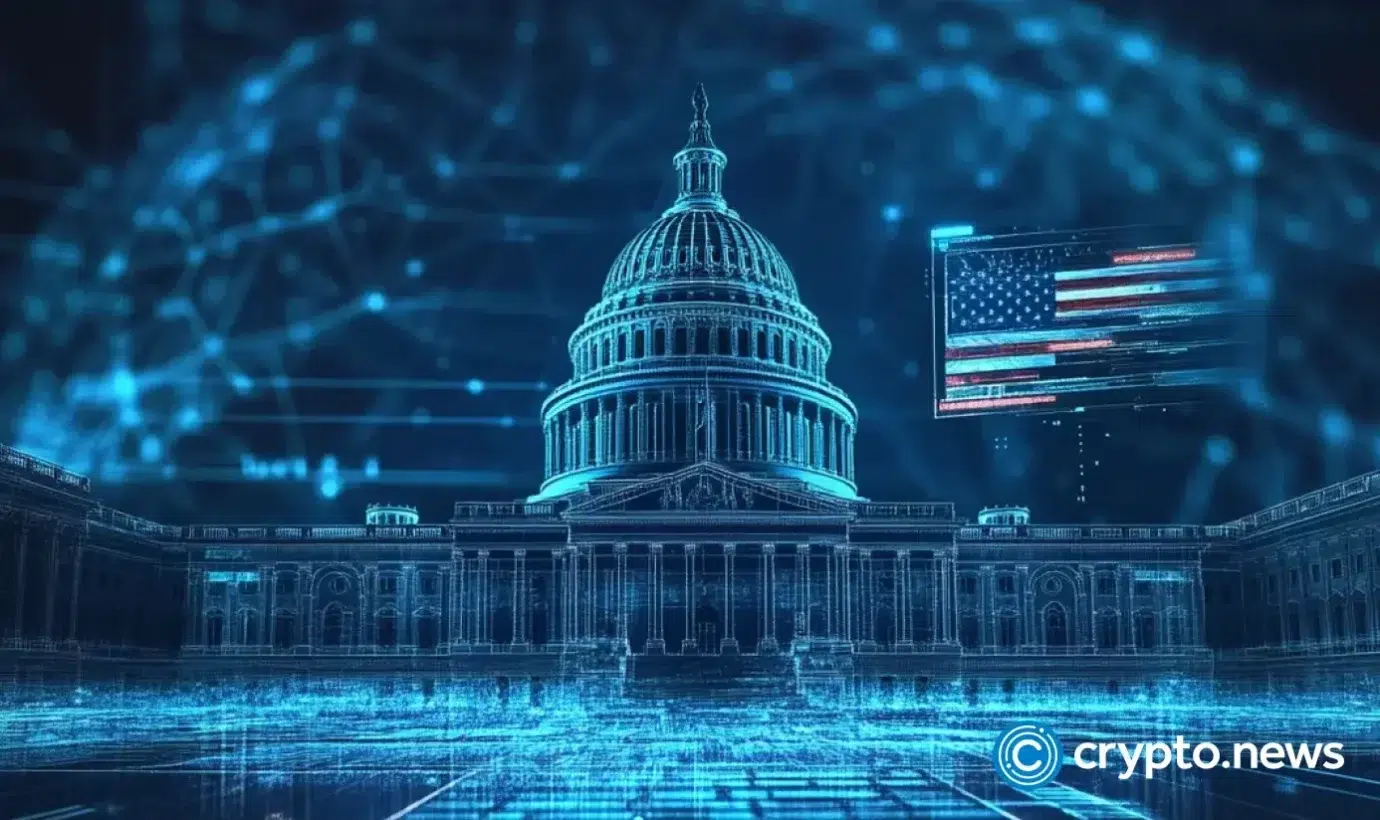
Hitting $8 depends on rising institutional participation following the rollout of U.S.-listed XRP ETFs, Ripple’s expanding international partnerships, and the passage of the CLARITY Act through Congress later this year.
Ethereum (ETH): KIMI AI Sees ETH at $7.500
Ethereum ($ETH) remains the foundation of decentralized finance thanks to an early lead in sophisticated smart contracts.
With a market capitalization of $251 billion and roughly $53 billion locked on chain, Ethereum is the primary settlement layer for blockchain economic activity.
Its strong security record, leadership in stablecoin issuance, and early traction in real-world asset tokenization position Ethereum for increased institutional adoption post-CLARITY.
Regulatory clarity remains a key variable. Institutions require it to deploy larger allocations on Ethereum.
ETH is currently trading below $2,000, with significant resistance expected near $5,000, close to its all-time high of $4,946.05 last August.
KIMI’s scenario suggests that a confirmed breakout above $5,000 could open the door to $7,500 ETH before Christmas.
Dogecoin (DOGE): DOGE to $1? KIMI AI Thinks the Real Target is 3x That!
Originally launched as a joke in 2013, Dogecoin ($DOGE) is now a mature digital asset with a market capitalization around $14 billion, accounting for nearly half of the $32 billion meme coin sector.
DOGE last set an all-time high of $0.7316 during the retail-driven bull market of 2021.
The $1 milestone has long been a psychological target for the Dogecoin community, and KIMI’s outlook suggests that a strong bull cycle could push DOGE close to, or beyond, that level.
From its current price just under $0.10, a move toward $2.80 or higher would represent a 28x return, or 2,700%.
Adoption and utility continue to grow.
Tesla accepts DOGE for select merchandise, while major fintech platforms including PayPal and Revolut now support Dogecoin transactions, reinforcing its real-world utility.
SUBBD (SUBBD): If Altseason is Here, then SUBBD is KING
If the above cryptos follow KIMI’s projected course, then one new token that presale watchers expect will surge alongside them is SUBBD ($SUBBD), an AI-integrated content platform likely to disrupt the $85 billion creator economy.
SUBBD empowers creators with better revenue tools while offering fans more meaningful engagement.
Unlike traditional subscription platforms, which often charge creators up to 20% in fees while limiting community control, SUBBD eliminates intermediaries.
This decentralized approach has already sparked interest, raising $1.5 million during its ongoing presale.
Fans also benefit from an exclusive access ecosystem, including token-gated content, early releases, and member-only discounts, all fostering deeper connections between creators and their supporters.
To stay updated, you can follow SUBBD across X, Telegram, and Instagram, or join the ongoing presale directly through their website.
Visit the Official SUBBD Website Here
The post Strange New Chinese AI ‘KIMI’ Predicts the Price of XRP, Ethereum and Dogecoin by the End of 2026 appeared first on Cryptonews.


Key Takeaways
- Oracle is preparing to eliminate thousands of positions throughout various departments, with cuts potentially beginning this month.
- The workforce reduction stems from escalating expenses tied to an ambitious AI data center expansion strategy.
- Certain positions targeted for elimination are those Oracle anticipates automating through AI technology.
- The tech giant intends to secure $45B–$50B in funding during 2026 for its cloud infrastructure development.
- Oracle’s Q3 fiscal 2026 financial results are scheduled for release on Tuesday, March 10.
Over the last year, Oracle has pushed hard into AI infrastructure, securing major partnerships with OpenAI, xAI, and Meta. However, this aggressive expansion strategy now carries significant financial implications — including substantial workforce reductions.
According to a Thursday Bloomberg report, Oracle is gearing up to eliminate thousands of positions companywide. These workforce reductions may commence as early as this month.
These planned layoffs represent a more extensive initiative than Oracle’s typical periodic workforce adjustments. The cuts will affect numerous business units, with some specifically targeting positions that management expects artificial intelligence to handle in the future.
Earlier this week, Oracle discreetly initiated a review of vacant positions within its cloud computing division, essentially pausing or halting recruitment efforts in that segment.
The underlying issue involves financial constraints. Oracle has invested enormous sums building the data center infrastructure necessary to fulfill its AI cloud service agreements.
Last December, Oracle disclosed that fiscal 2026 capital expenditures would exceed its initial $35 billion projection by $15 billion — bringing the total to $50 billion.
Subsequently in February, Oracle unveiled its intention to raise between $45 billion and $50 billion throughout 2026 to finance additional cloud infrastructure expansion. This funding strategy encompasses a new at-the-market equity offering valued up to $20 billion alongside mandatory convertible preferred securities.
Mounting Expenses, Growing Investor Anxiety
The capital-raising announcement unsettled investors already concerned about Oracle’s increasing debt obligations. The corporation depleted approximately $10 billion in cash reserves during just the first six months of fiscal 2026.
Oracle’s shares declined over 15% throughout the previous year, and the enterprise has fallen short of Wall Street’s revenue projections in eight out of its most recent ten quarterly reports.
As of May 2025, Oracle maintained a global workforce of approximately 162,000 full-time employees.
Major Partnerships and Client Base
Oracle’s principal cloud computing clients comprise OpenAI, Meta, Nvidia, AMD, TikTok parent company ByteDance, and Elon Musk’s xAI venture. The massive $300 billion OpenAI partnership notably elevated Oracle’s position among top-tier cloud service providers.
However, supporting these high-demand customers demands extensive infrastructure — and that infrastructure comes with hefty price tags.
Oracle currently faces the challenge of maintaining its aggressive growth trajectory while implementing greater financial prudence. The upcoming workforce reductions represent one component of this balancing act.
The company will release its third-quarter fiscal 2026 earnings report on Tuesday, March 10.

Quick Overview
- GPT-5.4, OpenAI’s most advanced professional model, became available on March 5, 2026
- Financial professionals gain access to integrated tools connecting FactSet and Third Bridge platforms
- Direct integration now available within Microsoft Excel and Google Sheets environments
- The release positions OpenAI as a direct competitor to Anthropic’s Claude for Financial Services
- ChatGPT Plus, Team, and Pro members can begin using the model immediately
On Thursday, March 5, 2026, OpenAI introduced GPT-5.4, its newest artificial intelligence model designed specifically with professional applications in mind. The update features specialized capabilities tailored for finance industry users.
The updated system can create spreadsheets, documents, and slide presentations with significantly reduced iterations. It performs web searches to compile data and deliver responses to sophisticated queries.
This release incorporates specialized financial capabilities that establish connections with FactSet Research Systems and Third Bridge data services. These features target professionals conducting financial research and developing investment documentation.
The model now functions directly within Microsoft Excel and Google Sheets applications. OpenAI simultaneously released a ChatGPT add-in specifically designed for Excel.
This launch intensifies competition with Anthropic, which previously introduced Claude for Financial Services. Both organizations are vying for enterprise clients prepared to invest in premium AI solutions.
Performance Metrics and Testing Results
During internal evaluations focusing on investment banking spreadsheet operations, GPT-5.4 achieved an 87.3% success rate, representing a substantial improvement from GPT-5.2’s 68.4% score. When human evaluators compared presentations, they selected GPT-5.4 output 68% of the time over its predecessor.
Using GDPval, a benchmark that evaluates AI performance across 44 different professional roles, GPT-5.4 equaled or exceeded human professional standards in 83% of test cases. The previous GPT-5.2 version achieved 70.9% on identical assessments.
The model recorded 75% accuracy on OSWorld-Verified, a benchmark measuring desktop navigation capabilities using visual inputs and pointer commands. Human participants scored 72.4% on the same evaluation.
OpenAI characterizes this as their most accurate model to date. Incorrect statements occur 33% less frequently than with GPT-5.2.
Access and Cost Structure
GPT-5.4 is becoming accessible to ChatGPT Plus, Team, and Pro members starting today under the designation GPT-5.4 Thinking. The preceding GPT-5.2 Thinking version will remain operational for three additional months before discontinuation on June 5, 2026.
Enterprise and Edu subscription holders can activate early access via administrative controls. GPT-5.4 Pro becomes available for Pro and Enterprise tier subscribers.
API usage costs begin at $2.50 per million input tokens and $15 per million output tokens. These rates exceed GPT-5.2 pricing, which stood at $1.75 and $14 respectively.
The system accommodates up to one million tokens of contextual data in Codex. Regular API calls handle 272,000 tokens, with expanded requests incurring double the standard rate.
According to OpenAI, GPT-5.4 delivers superior token efficiency compared to GPT-5.2, potentially offsetting higher per-token costs through reduced overall usage.
The model can be accessed through Codex, the company’s AI development tool, and via the standard API using the identifier gpt-5.4.

Key Takeaways
- AI-related revenue at Broadcom more than doubled during Q1, reaching $8.4 billion thanks to strong sales of custom AI accelerators and networking solutions.
- CEO Hock Tan forecasted that AI chip revenue will surpass $100 billion annually by 2027.
- First quarter adjusted earnings per share reached $2.05, surpassing analyst expectations of $2.03; total revenue of $19.31 billion exceeded projections.
- Management issued Q2 revenue guidance of approximately $22 billion, significantly higher than the Street’s ~$20.5 billion estimate.
- A fresh $10 billion share repurchase program was unveiled, with supply commitments locked through 2028.
Shares of Broadcom advanced approximately 5% during Thursday’s session following robust first-quarter financial results and an optimistic long-term AI growth outlook presented by CEO Hock Tan.
The rally followed Broadcom’s report of adjusted earnings reaching $2.05 per share, narrowly beating the Wall Street consensus of $2.03. Total revenue reached $19.31 billion, marking a 29% increase from the prior year and exceeding analyst expectations of $19.18 billion.
The second-quarter outlook proved particularly impressive. Management projected revenue near $22 billion for the upcoming quarter — substantially above the analyst consensus of $20.5 billion.
Artificial intelligence revenue emerged as the standout metric. The segment more than doubled during the period to reach $8.4 billion, propelled by robust demand for customized AI accelerators and networking hardware.
According to Tan, the customer base has expanded beyond established hyperscale cloud providers. Organizations developing AI agents, automated code generation platforms, and consumer-facing AI applications are increasingly adopting Broadcom’s specialized chip solutions.
The company’s AI semiconductor partnerships include major technology giants such as Alphabet, Meta, OpenAI, and Anthropic.
During the analyst call, Tan expressed confidence that the company has clear “line of sight” to annual AI chip revenue surpassing $100 billion by 2027 — a projection that exceeded even the most bullish Street forecasts.
JPMorgan analysts project the company could generate between $12 billion and $15 billion for each gigawatt of AI infrastructure capacity by 2027. Their revised AI revenue projections “conservatively” reach $120 billion or higher.
Analysts at Goldman Sachs highlighted that Broadcom’s “leadership in AI networking and custom silicon enables the lowest inference cost for its hyperscaler customers.”
Supply Agreements and Profitability
Investor concerns about high-bandwidth memory constraints were prominent heading into earnings. Tan directly addressed these worries, confirming that Broadcom has locked in memory supply and advanced semiconductor wafer capacity extending through 2028.
He also dismissed profitability concerns related to increased AI chip rack shipments. According to Tan, the company has optimized production yields and costs to the point where AI business margins are “fairly consistent” with its broader semiconductor portfolio.
The company is approaching 10 gigawatts of deployed capacity distributed across six major customers — a diversification metric that helped alleviate investor worries about customer concentration.
Capital Returns and Street Sentiment
Complementing the earnings report, Broadcom unveiled a new $10 billion stock repurchase authorization, signaling management confidence in the business trajectory.
Wall Street currently rates the stock as a consensus Strong Buy based on input from 30 analysts — comprising 28 Buy ratings and 2 Hold ratings — with a mean price target of $449.46.
Broadcom’s impressive performance created positive ripple effects across related semiconductor names. Credo Technology shares surged 10% while Amphenol climbed 4%, reflecting investor enthusiasm for copper-based connectivity solutions over optical alternatives in AI server architectures.
Tan indicated that AI chip revenue for the current quarter should reach $10.7 billion, signaling continued growth momentum.

Revolut has applied for a US banking licence to deepen its presence in the market.
Summary
- Fintech firm Revolut has filed an application with the OCC for a US banking charter.
- The licence would grant access to Fedwire and ACH, enabling products such as credit cards and personal loans.
- The $75b-valued company views the US as a strategically critical market for growth.
Revolut, one of Europe’s largest fintechs with a valuation reported around $75b, has applied to the US Office of the Comptroller of the Currency for a banking licence.
If approved, the charter would give the company direct access to core payment rails including Fedwire and ACH, allowing it to offer a broader array of services such as credit cards, personal loans and expanded deposit products. Until now, Revolut has operated in the US via partnerships and a more limited permissions set, which constrained the speed and scope of its product rollout compared with its European footprint.
The application underscores how intensely the firm views the US as a key strategic market, even as competition from incumbents and other neobanks remains fierce. A banking licence would not only improve Revolut’s economics by reducing reliance on third-party intermediaries, it would also give regulators clearer oversight of its balance sheet, risk management and compliance programs. For users, the result could be a tighter integration of fiat, card, savings and crypto functionality—areas where Revolut has sought to differentiate itself by offering exposure to assets like BTC alongside more traditional services.
Fintech, crypto and regulatory convergence
Revolut’s move comes as the boundaries between fintech, traditional banking and crypto services continue to blur. Many digital-first institutions already provide some combination of crypto trading, stablecoin access and on-chain transfers, often in partnership with exchanges such as Coinbase or through their own limited offerings. Securing a full banking licence would position Revolut to more deeply embed these services within a regulated framework, potentially easing concerns for both users and policymakers about the safety and soundness of hybrid platforms.
For US regulators, granting or denying the application will send an important signal about how open the system is to globally active, crypto-friendly fintechs seeking full bank status. The decision will likely take into account not only Revolut’s financial strength and compliance track record, but also broader debates about innovation, competition and consumer protection. As regulatory regimes like MiCA shape expectations in Europe, a US banking licence could help Revolut harmonize its oversight environment across major markets, giving it a stronger base from which to compete with both incumbent banks and emerging digital challengers.
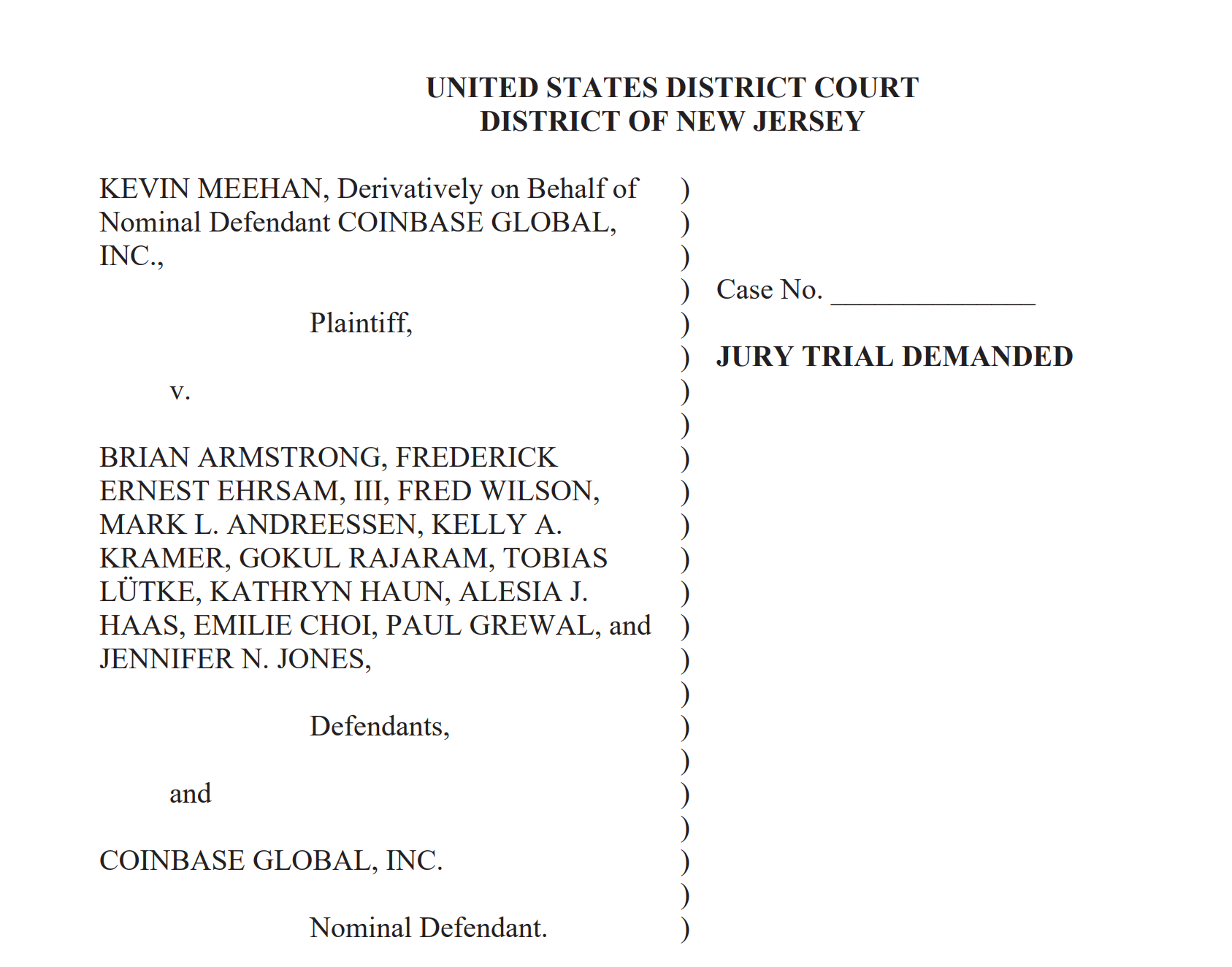
A Coinbase shareholder filed a derivative lawsuit against several of the crypto exchange’s top executives and board members, alleging they failed in oversight of compliance and disclosures, exposing the company to legal and regulatory fallout.
The complaint was filed Tuesday in the US District Court for the District of New Jersey and was brought by shareholder Kevin Meehan on behalf of Coinbase Global. It cites CEO Brian Armstrong, co-founder Fred Ehrsam, and several current and former directors and senior executives, including chief legal officer Paul Grewal and chief financial officer Alesia Haas.
According to the filing, the defendants allegedly made false or misleading statements between April 2021, when Coinbase went public through a direct listing, and June 2023. The plaintiff argues that these oversight failures ultimately exposed Coinbase to regulatory enforcement actions.
In early 2023, Coinbase reached a $100 million settlement with the New York State Department of Financial Services (DFS) over deficiencies in its anti-money laundering (AML) compliance program. In another instance, the company was hit with a $5 million penalty from New Jersey’s Bureau of Securities related to the listing of unregistered securities.
Related: Trump met Coinbase CEO before slamming banks over crypto bill: Report
Shareholder suit seeks damages, insider profit clawbacks
The lawsuit seeks damages on behalf of Coinbase, along with corporate governance reforms and the clawback of compensation and profits allegedly earned by insiders while the company’s compliance issues persisted.
Because the case is structured as a shareholder derivative action, any financial recovery would go to Coinbase rather than directly to shareholders.

The complaint also calls for a jury trial and accuses the defendants of unjust enrichment, abuse of control and breaches of fiduciary duty tied to what it describes as systemic compliance failures.
Cointelegraph reached out to Coinbase for comment, but had not received a response by publication.
Related: Coinbase opens stock and ETF trading to all US users in multi-asset push
Coinbase faces more lawsuits
In January, a Delaware judge allowed a shareholder lawsuit alleging several Coinbase directors conducted insider trading to move forward, despite an internal investigation that cleared the executives. The case claims that insiders, including Armstrong and board member Marc Andreessen, used nonpublic information to avoid more than $1 billion in losses by selling shares around Coinbase’s 2021 direct listing.
In May 2025, Coinbase and two executives also faced a proposed class-action lawsuit from an investor claiming that the company’s stock price dropped after it disclosed a user data breach and allegedly failed to reveal a violation of an agreement with the UK’s Financial Conduct Authority. The lawsuit said the disclosures led to a sharp fall in Coinbase’s share price, causing losses for investors.
Magazine: Bitcoin may take 7 years to upgrade to post-quantum — BIP-360 co-author


The United Arab Emirates’ banking system remains fully operational despite escalating regional conflict between the US, Israel and Iran, the country’s central bank said, as authorities moved to reassure markets following missile and drone attacks on the country this week.
In a statement, Central Bank of the UAE Governor Khaled Mohamed Balama said banks, financial institutions and insurers “continue to operate with full efficiency and stability,” adding that the sector is showing “the highest levels of resilience and stability.”
The statement comes as the UAE’s role as a regional financial center and a growing hub for digital asset companies draws added attention to operational continuity during periods of geopolitical stress.
Central bank cites strong liquidity and capital buffers
Regional tensions escalated after Iranian drone and missile attacks targeted the UAE and neighboring countries last weekend, according to an Associated Press report published on Monday.
Debris from intercepted projectiles reportedly caused fires and damage near several sites in Dubai, including infrastructure around Jebel Ali Port and Dubai International Airport.
Despite these developments, the central bank said the country’s financial sector maintains strong balance sheet indicators.
According to the statement, the UAE banking system’s capital adequacy ratio stands at about 17%, while the liquidity coverage ratio exceeds 146.6%, both above international regulatory thresholds.
Related: Bitcoin first, crypto at scale: Inside the UAE’s layered digital asset strategy
Balama said total assets in the UAE banking and financial sector exceed 5.42 trillion dirhams ($1.48 trillion). The regulator said it continues to coordinate with financial institutions and authorities to monitor developments and ensure operational readiness.
It added that UAE banks implement advanced risk management and business continuity frameworks aligned with international standards.
Crypto companies activate contingency plans
The UAE has emerged as one of the fastest-growing hubs for digital asset firms.
More than 1,800 crypto companies employ over 8,600 people and operate across the UAE, with Dubai’s DMCC free zone alone hosting more than 600 Web3 businesses.
Some digital asset companies operating in the region have also taken precautionary steps amid the geopolitical developments.
On Monday, crypto exchange Bybit began reviewing the safety of its employees in the UAE and activating cross-regional support systems to maintain operations, according to a report from Wu Blockchain.
In an internal letter seen by Cointelegraph, Bitget CEO Gracy Chen told staff that the exchange had activated emergency protocols while monitoring the security situation in the Middle East.
“We have activated emergency protocols and will accompany and support every colleague during this special period,” Chen wrote.
Magazine: Bitdeer sells all Bitcoin, Metaplanet rejects misconduct claims: Asia Express

Intercontinental Exchange (ICE), the owner of the New York Stock Exchange (NYSE), has invested in crypto exchange OKX at a $25 billion valuation and will take a seat on the company’s board, according to a Thursday announcement.
ICE has invested an undisclosed amount in OKX as part of its push into blockchain technology and tokenized stocks, the announcement said.
OKX will provide ICE with a live price feed of crypto assets listed on its platform. OKX will also provide access to ICE’s US futures and NYSE tokenized equities markets to its customer base of about 120 million accounts. The integration is expected to roll out in the second half of 2026.
Haider Rafique, global managing partner at OKX, said the two companies shared a strong strategic alignment in their vision for tokenization and traditional finance (TradFi).
“There was great chemistry in how we looked at the world and the future of tokenized securities, how derivatives should make it to the global stage, how TradFi [and] digital assets should merge together,” Rafique said.
A new chapter for OKX in the US
OKX CEO Star Xu took to X to say the investment is “not an endpoint” but rather the beginning of a deeper collaboration.
He highlighted the partnership’s impact on the exchange’s approach to the US, noting that the company views its presence in the country as a “blank sheet of paper.”
The move comes nearly a year after OKX reentered the US in April 2025, along with the appointment of former Barclays director Roshan Robert as its US CEO.

The collaboration with ICE is an “opportunity to build thoughtfully, engage constructively with regulators and institutions, and contribute to the development of market infrastructure that meets the standards of the world’s most sophisticated capital markets,” Xu said.
Related: TD Securities sees NYSE tokenization as institutional turning point
ICE’s investment in OKX is the latest move by the company into the crypto industry. In January, ICE said that it was developing its own blockchain-based trading infrastructure for tokenized securities.
In November 2025, the stock exchange announced plans to invest $2 billion into the prediction market platform Polymarket in a deal valuing the startup at $9 billion. One of the world’s largest prediction marketplaces, Polymarket has faced mounting scrutiny for alleged insider trading.
OKX did not respond to Cointelegraph’s request to comment.
Magazine: Would Bitcoin really be at $200K if not for Jane Street? Trade Secrets
Crypto World
Zilliqa Launches zUSDC via XBridge as Network Takes Full Control of Stablecoin Infrastructure
TLDR:
- Zilliqa launches zUSDC via XBridge, shifting USDC liquidity from third-party bridges to native network infrastructure.
- The zUSDC contract is live at 0xe59f97Fac09ee00AEEF320485ee45D5CcfbBC1E9, supporting DEX pools and stablecoin trading pairs.
- Debridge support on Zilliqa permanently ends March 31, 2026, requiring all legacy USDC holders to act immediately.
- XBridge receives a full UI overhaul as Zilliqa works toward automated, seamless cross-chain token transfer processing.
zUSDC is now live on Zilliqa through the network’s native XBridge system. This change moves USDC liquidity away from third-party bridging toward Zilliqa-operated infrastructure.
The transition is designed to improve long-term reliability and give Zilliqa direct control over stablecoin operations.
Users currently holding USDC on Zilliqa must act before March 31, 2026. After that date, Debridge support on the network will permanently end, affecting all remaining legacy USDC holders.
Zilliqa Transitions USDC Liquidity to Its Own XBridge Infrastructure
zUSDC is a USDC representation bridged to Zilliqa through the network’s own XBridge system. Its contract address is 0xe59f97Fac09ee00AEEF320485ee45D5CcfbBC1E9.
The token supports stablecoin trading, DEX liquidity pool participation, and arbitrage across pairs such as kUSDC and zUSDT. Zilliqa now holds direct operational control over this stablecoin liquidity within its ecosystem.
Previously, USDC liquidity on Zilliqa depended on external bridging infrastructure from third-party operators. Most of that liquidity was concentrated in DEX pools supporting trading and arbitrage activity.
Running external infrastructure under those conditions created an operational dependency. That dependency came without proportional benefit to the broader network, making this transition a practical move for the ecosystem.
The migration followed a phased process. Existing USDC was first bridged back to Ethereum as the starting point. It was then minted as zUSDC under Zilliqa-managed infrastructure and re-bridged through XBridge.
From there, funds were redeployed into ecosystem trading pools, with each phase structured to keep disruption low throughout.
Zilliqa shared the update on its official channel, stating it was “introducing zUSDC via XBridge on Zilliqa” and that the move improves reliability while keeping “stablecoin liquidity flowing across the ecosystem.”
As part of the Phase 3 ecosystem rollout, a zUSDC trading pair also launched on Plunderswap. Additionally, XBridge received a full UI overhaul, with the refreshed interface now available at xbridge.zilliqa.com.
Users Face March 31 Deadline as Debridge Support on Zilliqa Ends
Users holding USDC on Zilliqa must bridge their assets out through Debridge before March 31, 2026. Two options are currently available for doing so.
The Plunderswap bridge widget is accessible at plunderswap.com/bridge, while the StakeZIL bridge is available at stakezil.com. Both remain operational until the sunset date arrives.
After March 31, Debridge will no longer function on Zilliqa. Users who still hold legacy USDC beyond that point will need to reach out to Zilliqa directly for assistance. The team can be contacted at enquiry@zilliqa.com for support with any remaining holdings.
This transition does not remove stablecoin liquidity from the Zilliqa ecosystem. Rather, that liquidity is being moved to infrastructure that Zilliqa directly owns and operates.
The network frames this as a long-term step toward institutional-grade financial rails that the network itself controls.
Alongside the zUSDC launch, Zilliqa is also improving XBridge’s processing efficiency. The team is actively developing automation for bridge transaction processing.
This effort is aimed at making token transfers faster and more seamless across all chains that XBridge supports.
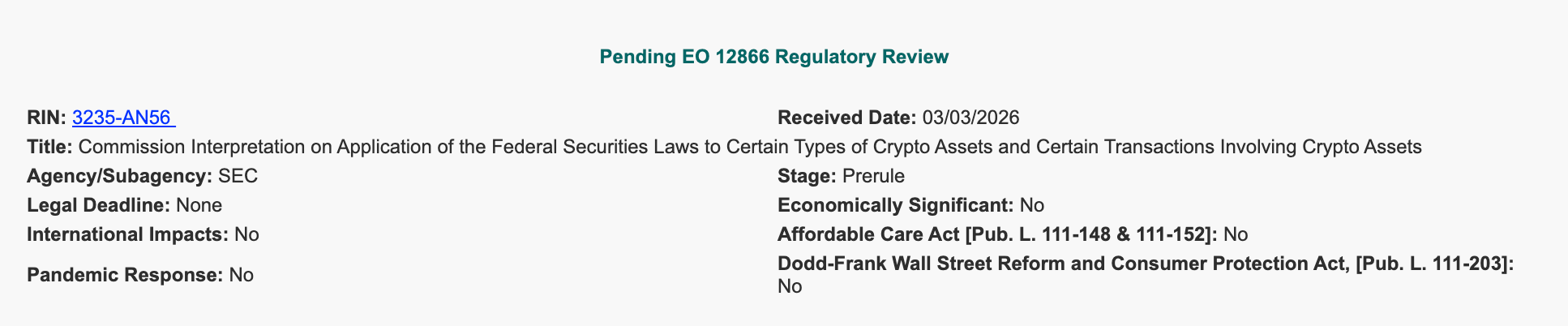
The proposed interpretative application of federal securities laws on digital assets by the SEC reportedly carries more weight than staff-level statements.
Officials at the US Securities and Exchange Commission (SEC) submitted a regulatory proposal to the White House with the potential to change how the government handles enforcement of federal securities laws over cryptocurrencies.
In a Tuesday submission to the White House’s Office of Information and Regulatory Affairs, the SEC sent a “commission interpretation on application of the federal securities laws to certain types of crypto assets and certain transactions involving crypto assets.”
The move reportedly marked interpretative guidance around “token taxonomy” for cryptocurrencies, determining which tokens may be considered securities under the SEC’s purview.

In contrast with rulemaking that requires notice to the public and comment periods, the proposed interpretative application of federal securities laws reportedly carries more weight than staff-level statements. SEC Chair Paul Atkins and Commissioner Hester Peirce said at ETHDenver in February that the agency sought to clarify how tokenized securities fit within existing federal securities laws.
As of Thursday, the proposal was under review by the White House office. Trump administration officials have also held three meetings in 2026 related to passage of the crypto market structure bill moving through the US Senate. The legislation, if passed, is expected to significantly affect how the SEC and Commodity Futures Trading Commission (CFTC) oversee digital assets.
Related: Ex-OpenAI researcher’s hedge fund reveals big Bitcoin miner bets in new SEC filing
Separately, the CFTC on Monday sent its own guidance on prediction markets to the White House. Michael Selig, who chairs the regulator, has claimed that the agency has “exclusive jurisdiction” in overseeing such markets.
SEC and CFTC still lack commissioner appointees
As of Thursday, the SEC is being led by three commissioners and the CFTC by one, in bodies normally consisting of a bipartisan group of five. The commissioners — Selig at the CFTC, and Atkins, Peirce and Mark Uyeda at the SEC — are all Republican members, with no leaders representing Democrats.
US President Donald Trump has not made any public statement signaling that he plans to nominate additional commissioners to either agency.
Magazine: What’s a ‘Network State’ and are there real-life examples? Big Questions
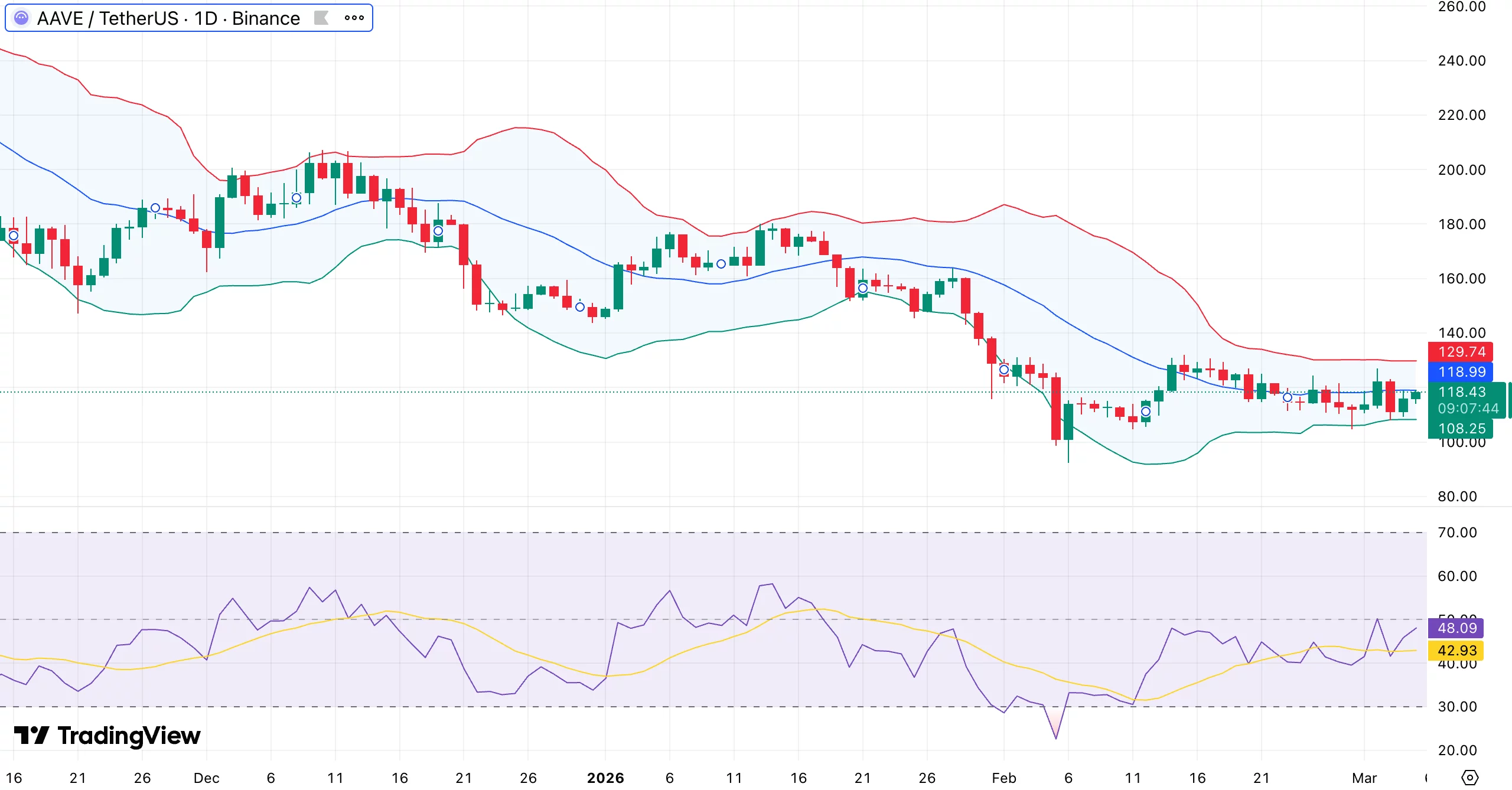
Aave price is approaching a key technical resistance level as the community prepares to vote on a potential deployment on Monad.
Summary
- AAVE trades near $118 as price approaches mid-Bollinger Band resistance around $120.
- The Aave DAO vote to deploy the protocol on Monad has strong community backing.
- A breakout above the 20-day moving average could open a move toward $130
Aave (AAVE) traded at $118.23 at press time, up 3.1% in the last 24 hours and close to the upper end of its weekly range between $105.64 and $124.89. The token has gained about 12% over the past week, though it is still 7% lower over the past month and 45% down year-over-year.
Derivatives activity has slowed slightly. Data from CoinGlass shows trading volume fell 28% to $373 million, while open interest sits at $194 million, down 0.09%.
Aave DAO votes to launch on Monad
The price movement comes as a governance vote by the Aave DAO on deploying the protocol to Monad, which approaches approval. With about 21 hours left, more than 873,000 participants have backed the proposal, while no votes have been cast against it.
The proposal, created on Feb. 24, suggests deploying Aave v3 on Monad, a network built for high-throughput DeFi applications. Its architecture processes transactions in parallel and pipelines execution with consensus, allowing faster processing and lower latency while keeping full compatibility with Ethereum tools.
Supporters say this design could help fintech platforms and on-chain neobanks that require fast settlement, predictable costs, and deep liquidity. If deployed, Aave would act as a core lending layer supporting savings products, credit lines, stablecoin liquidity, and treasury management tools for fintech applications.
If the proposal proceeds, a mid-to-late March launch is being considered. In order to support network liquidity, the plan also calls for the purchase of 10 million GHO units and $15 million in ecosystem incentives from the Monad Foundation.
Market sentiment may be affected by the deployment. Increased user activity and liquidity flows are often the outcome of network expansion. If more users adopt Monad, there may be a greater need for Aave’s lending infrastructure, which could boost the token’s value.
Aave price technical analysis
AAVE is trying to stabilize after weeks of selling pressure. The token is now testing the mid-band, which aligns with the 20-day moving average near $118–$120.
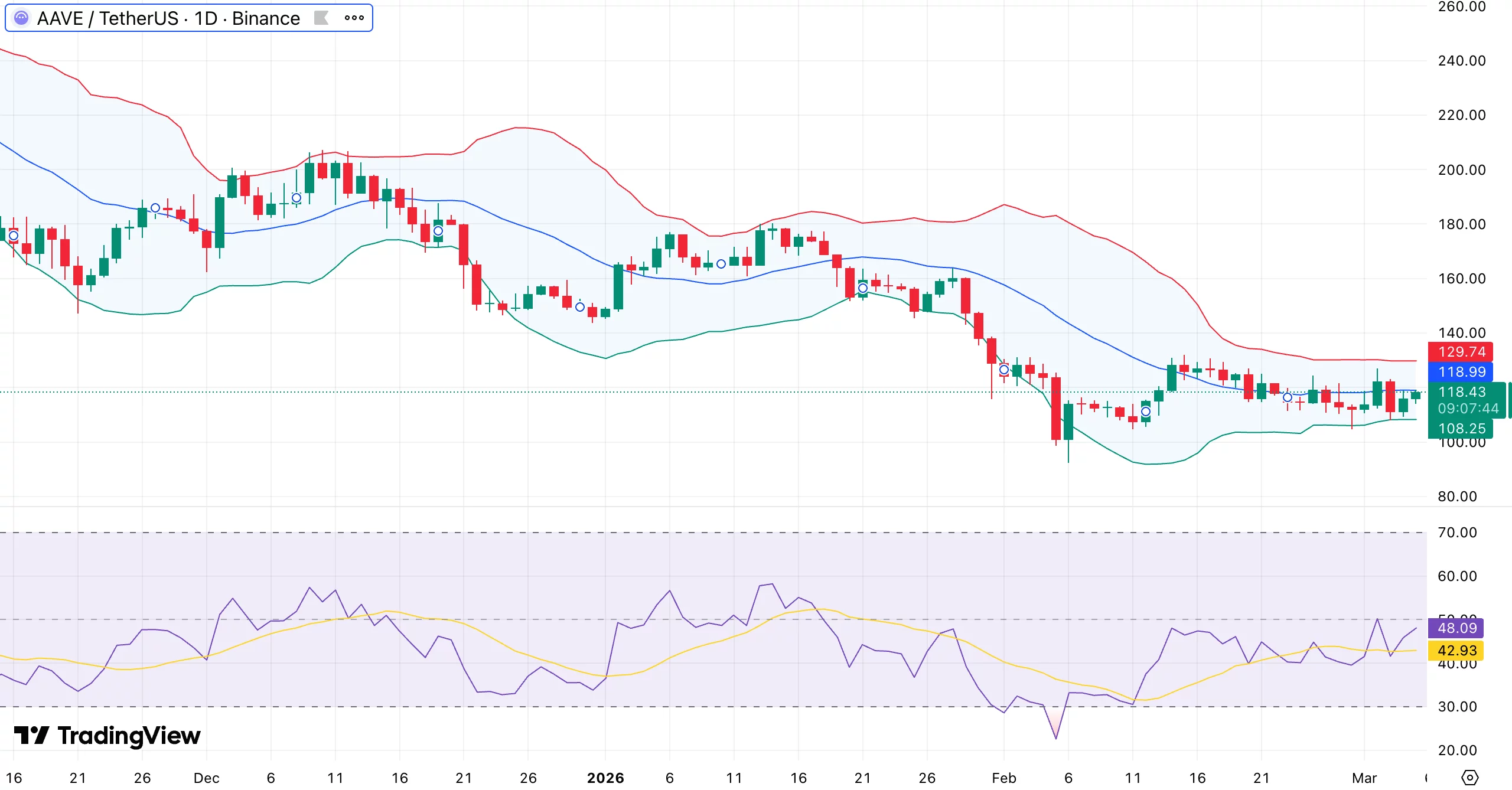
Earlier in February, the price dropped toward the $100 support zone, touching the lower Bollinger Band. Buyers stepped in and a rebound followed, pushing the token back to the mid-band. This level now acts as dynamic resistance.
A move toward the upper Bollinger Band near $130 could be initiated by a break above $120, which would indicate increasing momentum. The price may decline and trade between $108 and $110, which is near the lower band, if the level remains as resistance.
Momentum is steadily increasing. When the relative strength index was near 30, the market was about to be oversold, but it has since risen. It is now approaching the neutral 50 level, suggesting that selling pressure has decreased even though significant bullish momentum has not yet emerged.
Volatility is also tightening as the Bollinger Bands narrow. Such compression often comes before a larger price move. If volatility expands upward, the next resistance zone could appear near $130 to $135. A downside expansion may push the token back toward $100 to $105.
For now, price action is at a decision point. A clean break above the 20-day moving average could trigger a stronger recovery. Failure to hold above the level may lead to another pullback toward the $100 support area.
Form 4 Permian Resources Corp For: 5 March

STRIIKE Co-Founder Kristie Streicher Reveals the Most Common Eyebrow Mistakes and the Easy Ways to Fix Them

Next Gen Xbox officially announced as Project Helix – confirmed to run PC games


-

 Politics3 days ago
Alan Cumming Brands Baftas Ceremony A ‘Triggering S**tshow’
-

 Fashion6 days ago
Weekend Open Thread: Iris Top
-

 Tech5 days ago
Unihertz’s Titan 2 Elite Arrives Just as Physical Keyboards Refuse to Fade Away
-

 NewsBeat5 days ago
Abusive parents will now be treated like sex offenders and placed on a ‘child cruelty register’ | News UK
-
 NewsBeat5 days ago
Dubai flights cancelled as Brit told airspace closed ’10 minutes after boarding’
-
Sports6 days ago
The Vikings Need a Duck
-
 NewsBeat6 days ago
The empty pub on busy Cambridge road that has been boarded up for years
-

 NewsBeat4 days ago
‘Significant’ damage to boarded-up Horden house after fire
-

 Tech20 hours ago
Bitwarden adds support for passkey login on Windows 11
-

 Entertainment4 days ago
Baby Gear Guide: Strollers, Car Seats
-
 Sports8 hours ago
499 runs and 34 sixes later, India beat England to enter T20 World Cup final | Cricket News
-
 Tech7 days ago
NASA Reveals Identity of Astronaut Who Suffered Medical Incident Aboard ISS
-
Politics5 days ago
FIFA hypocrisy after Israel murder over 400 Palestinian footballers
-
 NewsBeat5 days ago
Emirates confirms when flights will resume amid Dubai airport chaos
-

 NewsBeat4 days ago
Is it acceptable to comment on the appearance of strangers in public? Readers discuss
-

 Tech5 days ago
Viral ad shows aged Musk, Altman, and Bezos using jobless humans to power AI
-

 Video4 days ago
How to Build Finance Dashboards With AI in Minutes
-

 Business2 days ago
Guthrie Disappearance Enters Fifth Week as Family Visits Memorial
-
 Crypto World5 days ago
US Judge Lets Binance Unregistered Token Class Action Proceed
-
 NewsBeat4 days ago
Ukraine-Russia war latest: Belgium releases video showing forces boarding Russian shadow fleet oil tanker