The CPRight team, from left: Shubham Bansal, Deeya Sharma, Prisha Hemani, and Atharv Dixit with their Holloman Health Innovation Challenge winnings at the University of Washington in Seattle this week. (UW Buerk Center for Entrepreneurship Photo / Matt Hagen)
A team of students from the University of Washington took home the top prize in the Hollomon Health Innovation Challenge on Wednesday as the UW swept the 11th annual competition.
CPRight won the $15,000 Holloman Family grand prize as well as the $2,500 Naturacur Wound Healing Best Idea for a Medical Device prize in the student competition.
CPRight is a real-time CPR feedback device that provides data on compression rate and depth to ensure bystanders perform high-quality, life-saving chest compressions during an emergency.
The company was co-developed alongside ReviveHer, the 2025 Best Idea for Patient Safety prize winner.
The team consists of Shubham Bansal, a neuroscience undergraduate student; Deeya Sharma, a graduate student in the UW School of Medicine; Prisha Hemani, a computer science and engineering undergrad; and Atharv Dixit, an engineering undergrad.
Advertisement
The Hollomon Health Innovation Challenge, hosted by the UW’s Buerk Center for Entrepreneurship in the Foster School of Business, gives students the opportunity to create meaningful solutions to big health-related problems. The competition is open to undergrads and grad students at accredited colleges and universities across the Cascadia Corridor — Washington, Oregon, Idaho, and British Columbia, as well as Alaska.
Other prize winners:
$10,000 WRF Capital Second Place Prize:
TheraT, a drinkable, non-invasive therapy that removes toxins in the gut before they reach the bloodstream, allowing chronic kidney disease patients to lower their reliance on dialysis.
$5,000 Scale LLP Third Place Prize
LegUp Prosthetics, a low-cost system that uses smartphone-based 3D scanning to enable accurate fitting from home, reducing costs and expanding access to prosthetic care for underserved and rural patients. Developed by a UW team of molecular engineering, bioengineering, biochemistry, and mechanical engineering students. They also won the $2,500 Population Health Initiative Best Idea for Addressing Health Access and Disparities prize for their focus on expanding care to underserved and rural patients through a point-of-care healthcare service.
$2,500 Mindful Therapy Group Best Idea in Digital Health Prize
ShiftSpark, a workflow-embedded support platform that helps nurses process stress in real time during a shift. Developed by a team of UW public health students who became the first-ever to win the digital health prize in the challenge after also winning the pitch contest as part of the Buerk’s Digital Health Workshop series.
SoundBio Lab Ignite Prize
TPT-Finder, a handheld, AI-powered surgical tool that helps surgeons instantly distinguish parathyroid tissue during thyroid surgery to prevent costly and life-altering complications. Developed by a UW team of computer science and electrical and computer engineering students. The prize is a six-month membership to the SoundBio Lab biomakerspace in the U-District.
$1,000 Connie Bourassa-Shaw Spark Award
ColoGuide, an AI-powered colonoscopy navigation system building its proprietary data set to automate scope insertion with real-time visual guidance. Developed by UW Medicine students.
This year’s competition attracted 67 participants, two shy of the record set in 2025. Students represented seven schools in the opening round: UW, UW-Bothell, Edmonds College, UW Global Innovation Exchange, University of Idaho, Portland State University, and Seattle University.
There have been 509 participating teams and more than 1,725 students over the 11 years of the challenge and $424,000 awarded.
The Pentagon has formally designated Anthropic as a “supply chain risk,” ordering federal agencies and defense contractors to stop using its AI tools after the company sought limits on the military’s use of its models. In a written statement, the department said it has “officially informed Anthropic leadership the company and its products are deemed a supply chain risk, effective immediately.” Politico reports: The designation, historically reserved for foreign firms with ties to U.S. adversaries, will likely require companies that do business with the U.S. military — or even the federal government in general — to cut ties with Anthropic.
“From the very beginning, this has been about one fundamental principle: the military being able to use technology for all lawful purposes,” the Pentagon said in the statement. “The military will not allow a vendor to insert itself into the chain of command by restricting the lawful use of a critical capability and put our warfighters at risk.”
A spokesperson for Anthropic did not immediately respond to a request for comment. But the company said last week it would fight a supply-chain risk label in court.
Dario Amodei said Thursday that Anthropic plans to challenge the Defense Department’s decision to label the AI firm a supply chain risk in court, a designation he has called “legally unsound.”
The statement comes a few hours after the Department officially designated Anthropic a supply chain risk following a weeks-long dispute over how much control the military should have over AI systems. A supply chain risk designation can bar a company from working with the Pentagon and its contractors. Amodei drew a firm line that Anthropic’s AI should not be used for mass surveillance of Americans or for fully autonomous weapons, but the Pentagon believed it should have unrestricted access for “all lawful purposes.”
In his statement, Amodei said the vast majority of Anthropic’s customers are unaffected by the supply chain risk designation.
“With respect to our customers, it plainly applies only to the use of Claude by customers as a direct part of contracts with the Department of War, not all use of Claude by customers who have such contracts,” he said.
Advertisement
As a preview of what Anthropic will likely argue in court, Amodei said the Department’s letter labeling the firm a supply chain risk is narrow in scope.
“It exists to protect the government rather than to punish a supplier; in fact, the law requires the Secretary of War to use the least restrictive means necessary to accomplish the goal of protecting the supply chain,” Amodei said. “Even for Department of War contractors, the supply chain risk designation doesn’t (and can’t) limit uses of Claude or business relationships with Anthropic if those are unrelated to their specific Department of War contracts.”
Amodei reiterated that Anthropic had been having productive conversations with the Department over the last several days, conversations that some suspect got derailed when an internal memo he sent to staff was leaked. In it, Amdodei characterized rival OpenAI’s dealings with the Department of Defense as “safety theater.”
Techcrunch event
Advertisement
San Francisco, CA | October 13-15, 2026
OpenAI has signed a deal to work with the Defense Department in Anthropic’s place, a move that has sparked backlash among OpenAI staff.
Advertisement
Amodei apologized for the leak in his Thursday statement, claiming that the company did not intentionally share the memo or direct anyone else to do so. “It is not in our interest to escalate the situation,” he said.
Amodei said the memo was written within “a few hours” of a series of announcements, including a presidential Truth Social post saying Anthropic would be removed from federal systems, then Defense Secretary Hegseth’s supply chain risk designation, and finally the Pentagon’s deal announcement with OpenAI. He apologized for the tone, calling it “a difficult day for the company” and said the memo didn’t reflect his “careful or considered views.” Written six days ago, he added, it’s now an “out-of-date assessment.”
He finished by saying Anthropic’s top priority is to ensure American soldiers and national security experts maintain access to important tools in the middle of ongoing major combat operations. Anthropic is currently supporting some of the U.S.’s operations in Iran, and Amodei said the company would continue to provide its models to the Defense Department at “nominal cost” for “as long as necessary to make that transition.”
Anthropic could challenge the desingation in federal court, likely in Washington, but the law behind the decision makes it harder to contest because it limits the usual ways companies can challenge government procurement decisions and gives the Pentagon broad discretion on national security matters.
Advertisement
Or as Dean Ball — a former Trump-era White House advisor on AI who has spoken out against Hegseth’s treatment of Anthropic — put it: “Courts are pretty reluctant to second-guess the government on what is and is not a national security issue…There’s a very high bar that one needs to clear in order to do that. But it’s not impossible.”
Google has added a share item location feature to Find Hub that generates a secure, encrypted link to a lost bag’s real-time position and lets travellers pass it directly to a participating airline, giving carriers the location data they need to recover missing luggage faster than existing baggage tracing methods allow.
The update addresses a persistent gap in the tracker tag experience, where passengers could see exactly where a missing bag sat on a map but had no direct channel to share that information with airline staff.
More than ten major global airlines now accept Find Hub location links as part of their baggage recovery workflow, including Air India, China Airlines, the Lufthansa Group, Saudi Airlines, Scandinavian Airlines, and Turkish Airlines, with Qantas confirmed as joining the programme in the near future.
Google has also connected the feature to SITA and Reunitus, integrating Find Hub into WorldTracer and NetTracer, the two baggage tracing platforms that power recovery operations for hundreds of airlines across thousands of airports worldwide.
Advertisement
Advertisement
Beyond the airline partnerships, Samsonite has embedded Find Hub technology directly into its latest luggage designs, allowing compatible suitcases to pair with the Find Hub network out of the box without requiring a separately purchased tracker tag to be added by the traveller.
Privacy controls sit at the centre of the sharing mechanism, with encrypted links expiring automatically after seven days, sharing disabling the moment the user’s phone detects the item has returned, and a manual stop-sharing option available at any point from within the Find Hub app.
The feature arrives alongside two separate Find Hub updates rolled out at the same time, including location sharing through Google Messages and the expansion of Find Hub support to Pixel Watch devices, broadening the network’s reach across Google’s hardware ecosystem.
Advertisement
The share item location feature is rolling out now across the Find Hub app, available to users with a compatible tracker tag or Find Hub network accessory connected to their account.
In theory HDMI’s CEC feature is great, as it gives HDMI devices the ability to do useful things such as turning on multiple HDMI devices with a single remote control. Of course, such a feature will inevitably feature bugs. A case in point is the Nvidia Shield which has often been reported to turn on other HDMI devices that should stay off. After getting ticked off by such issues one time too many, [Matt] decided to implement a network firewall project to prevent his receiver from getting messed with by the Shield.
The project is a Python-based network service that listens for the responsible rogue HDMI-CEC Zone 2 requests and talks with a Denon/Marantz receiver to prevent it from turning on unnecessarily. Of course, when you want these Zone 2 requests to do their thing you need to disable the script.
That said, HDMI-CEC is such a PITA that people keep running into issues like these over and over again, to the point where people are simply disabling the feature altogether. That said, Nvidia did recently release a Shield update that’s claimed to fix CEC issues, so maybe this is one CEC bug down already.
Thanks to all our AI usage, it’s no secret that smartphones are getting more expensive. It’s interesting to see how brands are coping with increased costs, and who better to observe than OPPO. The company is preparing to expand its popular K-series lineup in India with the launch of the OPPO K14 5G, which the company has confirmed will debut on March 9, 2026. Last year’s K13x was a pretty well-balanced phone across the board, and OPPO is promising the same for this year, too. Here’s everything you need to know.
Performance & Battery Take the Center Stage
This year, the biggest highlight of the OPPO K14 5G is its massive 7000mAh battery, designed to support extended use without frequent charging. The device also supports 45W fast charging, allowing users to top up the battery quickly when needed. In addition, the phone includes reverse charging, enabling it to power other devices in emergencies. OPPO says the battery system has been engineered to maintain stable battery health for up to five years, aligning with the phone’s focus on long-term reliability.
While the exact processor specs aren’t known, the K14 5G will include an advanced SuperCool VC thermal system. The cooling setup features a large 3900 mm² vapor chamber, combined with expanded graphite layers, to improve heat dissipation during prolonged use. OPPO says the internal layout has been optimized using gamer hand models, which helped engineers identify high-contact areas during landscape gaming.
In terms of optics, the OPPO K14 5G will feature a 50MP primary camera, supported by AI-powered imaging features that automatically adjust scene settings, colors, and exposure to deliver more balanced results. Though we have yet to test these claims against real-world challenges. The phone will run ColorOS 15, which includes OPPO’s system-level rendering architecture and multi-rendering scheduling technology aimed at keeping the camera experience smooth and responsive
All-in-one PCs have always been special, simply because they promise the size of a desktop without the headaches associated with it. Now, Asus has expanded its desktop lineup in India with the launch of the ASUS V501 desktop series and the AiO V400 all-in-one PCs. The new lineup includes the ASUS V501MV Mini Tower with a 15L chassis and the V501SV Small Form Factor model with a compact 9L design. Alongside these, ASUS also introduced the AiO V400 series, which includes the V440 and V470 models designed for clutter-free home setups. Here’s what you need to know.
ASUS V501 Desktop Series for Work and Small Businesses
The ASUS V501 series is built primarily for SOHOs, startups, studios, and small organizations that require reliable daily performance for tasks like accounting, documentation, online meetings, and light creative workloads. The desktops are powered by up to Intel Core 7 240H processors and support up to 64GB of DDR5 RAM, offering enough power for multitasking and productivity-focused workloads.
ASUS says the system is designed for long working hours, thanks to an advanced thermal setup with copper heat pipes. The desktop also runs quietly, with noise levels as low as 38dB under load, making it suitable for office environments and client-facing spaces. Other highlights include fast SSD storage and an 80+ Bronze-certified power supply, which aims to deliver improved energy efficiency for businesses running systems throughout the day.
The ASUS V501MV and V501SV desktops start at Rs 42,990 and will be available from March 16 via ASUS Exclusive Stores, the ASUS eShop, Amazon, Flipkart, and authorized retail partners.
ASUS AiO V400 Series for Homes and Hybrid Work
On the flip side, ASUS introduced the AiO V400 series, which focuses on home users and compact living spaces. The lineup includes the ASUS V440 and V470 AiO PCs, both designed to offer a streamlined all-in-one setup that reduces desk clutter while still delivering reliable performance for everyday tasks. Powered by up to Intel Core 3 processors, the AiO V400 series supports up to 8GB DDR5 RAM and SSD storage, making it suitable for web browsing, streaming, online learning, video calls, and productivity work.
One notable feature is support for HDMI In and HDMI Out, which allows the AiO PC to function as both a standalone computer and a monitor when needed. The ASUS V470 AiO starts at Rs 71,990 and is available via ASUS Exclusive Stores, Croma, the ASUS eShop, Amazon, and other authorized retailers. The V440 model will go on sale starting April 14.
Canvas, the AI planning tool from Google Search, has rolled out across the US, the company said Wednesday. Canvas is essentially a project planning tool with a range of uses, including trip planning. You can select the tool directly from the AI Mode screen at the top of the Google Search results page.
The tool is integrated into AI Mode and can be used on both desktop and mobile devices, including smartphones and tablets. However, because Canvas opens a second screen beside the main chat window, it’s a little trickier to see on a smartphone. You’ll have to toggle between the screens.
Planning trips is one of Canvas’s main functions, with the ability to view and account for flights, hotels and other relevant information in real time.
“Canvas makes it easy to build travel plans customized for your specific needs — bringing together real-time Search data for flights and hotels, details from Google Maps like photos and reviews, and relevant information from sites across the web,” a Google spokesperson told CNET.
Google also notes you can use Canvas as an academic scholarship tracker, which includes dollar amounts and deadlines.
Project planning with AI
Once you’re in the AI Mode screen on Google, you can select the Canvas option from the plus sign that appears on the left side of the box where you type.
Clicking the Canvas button opens the project in a side panel. From there, you can refine the project with the standard chat prompts. You can even look at the underlying code and adjust the Canvas window’s user interface, such as switching to dark mode.
Advertisement
Rose Yao, vice president of product for Google Search, posted a thread on X on Wednesday, sharing a video of a summer camp project for her kids. Canvas created an interactive dashboard that sorts camp options by cost, distance and focus.
“We’re adding support for coding & creative writing tasks, so you can bring even more ideas to life with custom dashboards or interactive tools,” Yao wrote in the post.
Google first announced Canvas for AI Mode in July 2025, and later that year, expanded Canvas’s travel features.
There’s no word yet from Google on when Canvas will expand into other languages and other countries.
For more than a decade, Drop, born as Massdrop in 2012, was one of the most important community-driven marketplaces in enthusiast tech. It wasn’t just another storefront. It was where headphone obsessives, keyboard nerds, and gear junkies pooled their buying power to will products into existence. Some of the most talked-about collaborations in personal audio came out of that model, including limited-run headphones with brands like Sennheiser that delivered genuine performance at prices the traditional retail channel couldn’t touch.
That chapter is now closing.
Following its 2023 acquisition by Corsair, Drop has confirmed it will cease operating as a standalone e-commerce store. The final day to place orders on Drop.com is March 25, with the site officially transitioning away from direct retail on March 31. Going forward, Drop.com will function as a brand and collaboration hub inside the broader Corsair ecosystem, spotlighting licensed partnerships tied to franchises like The Lord of the Rings, Cyberpunk 2077, and Fallout Nuka Cola.
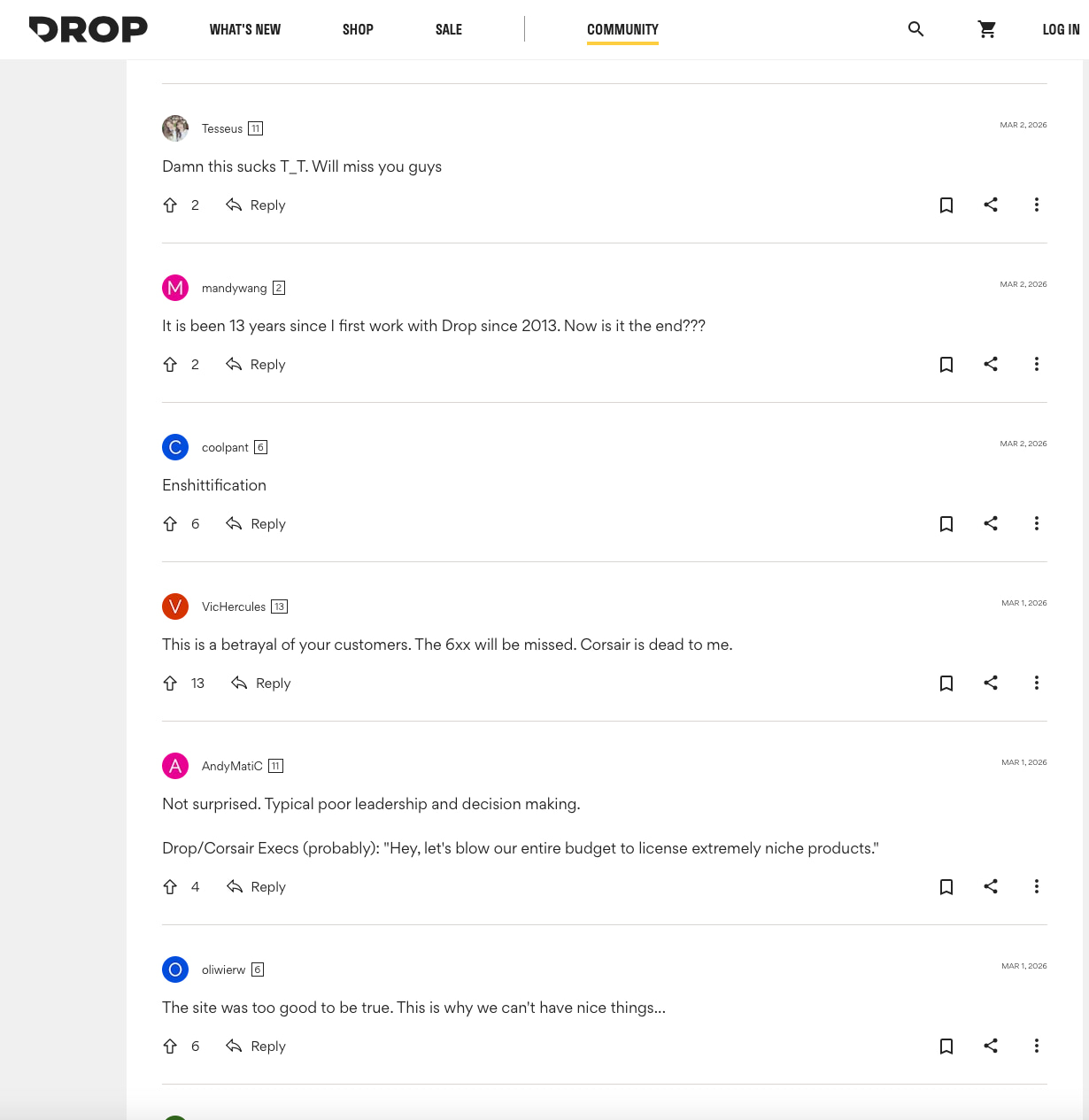
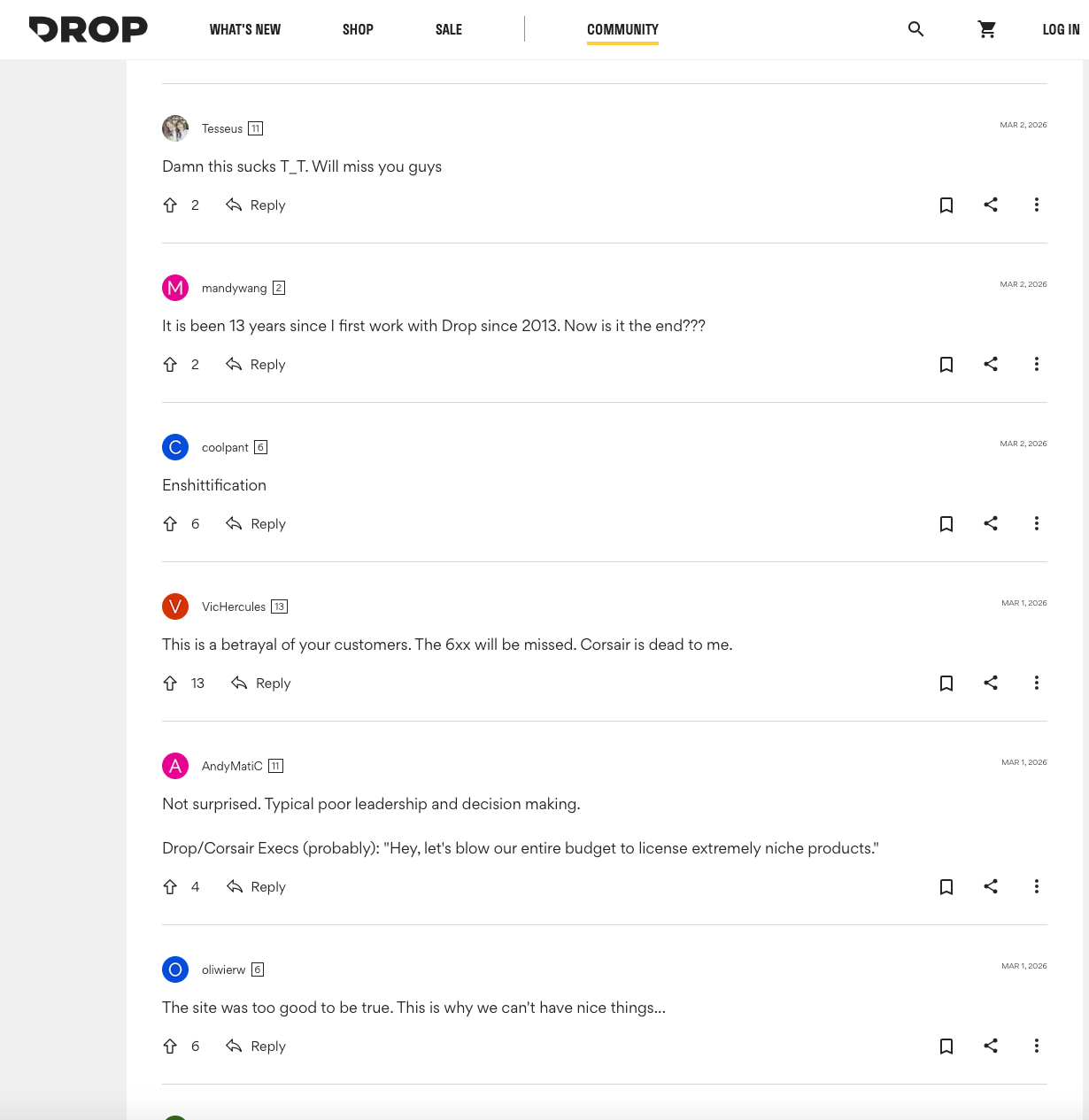
On paper, this is an “evolution.” In practice, it marks the end of the Massdrop model; the community voting, the group buys, the feeling that enthusiasts were steering the ship. And if you’ve spent any time in the forums or comment sections this week, it’s clear the reaction isn’t nostalgic gratitude. It’s frustration. For many longtime members, the independent storefront wasn’t just a place to shop. It was the point.
Advertisement
What the Shutdown Means for Orders, Rewards, Warranties, and Future Availability
Drop’s transition away from operating as a standalone ecommerce store comes with some important deadlines and structural changes that customers need to understand.
The final day to place an order on Drop.com is March 25 at 11:59 PM PT. After that, direct purchasing through the site ends. The good news is that all existing orders, including preorders, will be fulfilled as previously scheduled. There is no disruption to shipments already in the system.
Drop Rewards, however, come with a hard stop. Any unused rewards must be redeemed by March 25. After that date, remaining balances will expire and will no longer be redeemable. If you have credits sitting in your account, this is the moment to use them.
As for products, this is not a complete disappearance. Many Drop designed items will continue to live on through Corsairand partner retail channels. That includes models like the CSTM80 and a range of licensed collaborations. The difference is where and how they are sold. Instead of a centralized community driven storefront, distribution shifts into the broader Corsair retail ecosystem.
Advertisement
Warranties remain intact. All existing product warranties will continue to be honored, and customer service and support will now route through Corsair.
Going forward, select Drop products will be available through Corsair.com as well as major retail partners such as Amazon and Best Buy. In practical terms, Drop transitions from being an independent marketplace powered by its community to becoming a collaboration and product label operating inside a much larger corporate framework.
The Bottom Line
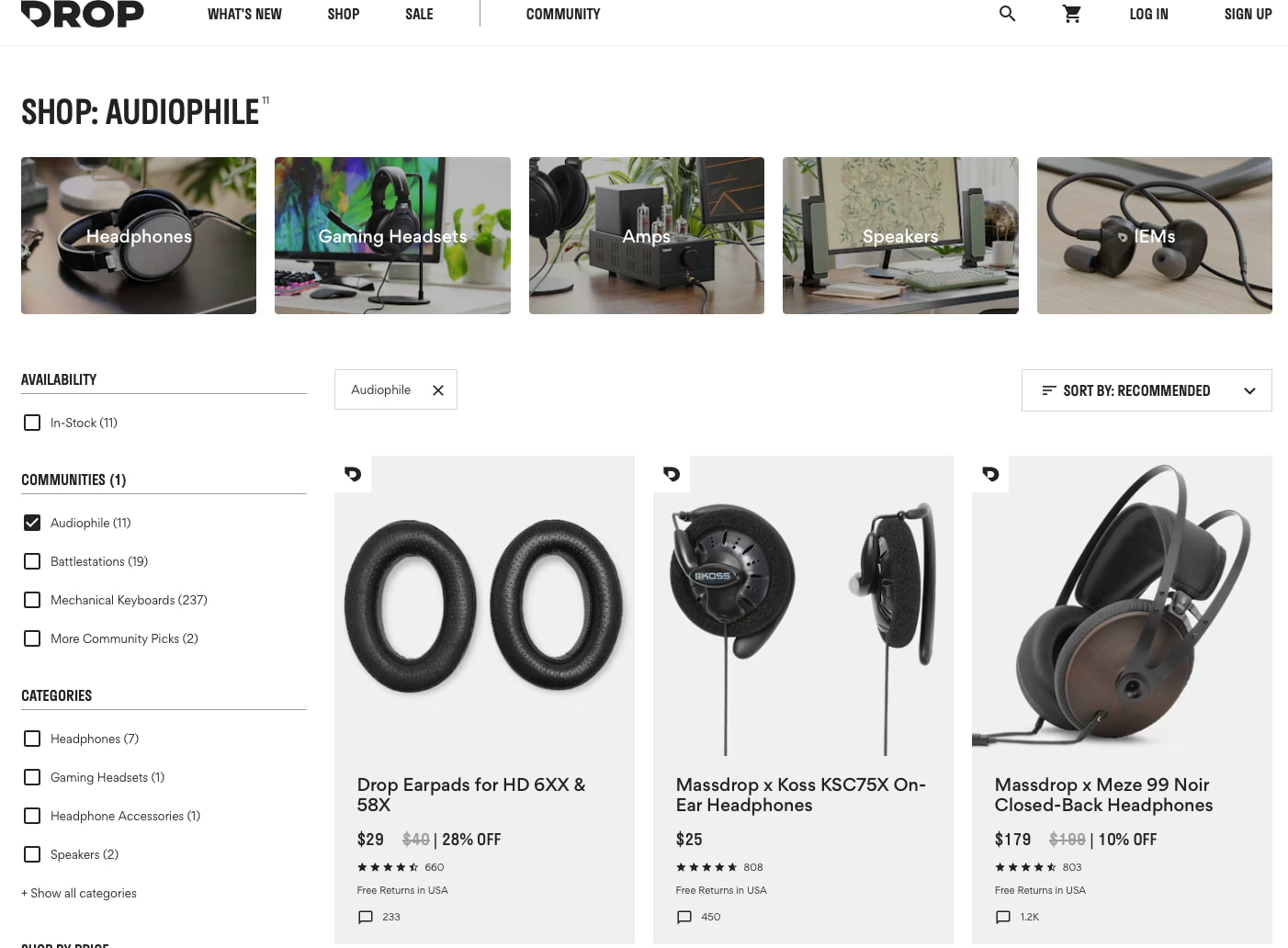
Drop had a real run. At its peak, the platform reshaped how enthusiast audio products came to market. The Drop plus collaborations with Sennheiser, Dan Clark Audio, Meze Audio, HiFiMAN, Beyerdynamic, Koss, and Axel Grell delivered some of the most popular enthusiast headphones of the past decade. These were not gimmicks. Many were category defining products that offered serious performance at prices that disrupted the traditional retail model.
Advertisement. Scroll to continue reading.
Advertisement
Now most of those headline products are sold out or permanently out of stock. The amplifiers and speakers are gone. The group buys are gone. The voting is gone. What remains is a brand being folded into the larger machinery of Corsairdistribution.
The products are not vanishing. The platform that built them is.
It is hard to imagine this new structure fostering the same level of risk taking or enthusiast driven innovation. Community driven product development does not scale easily inside a publicly traded hardware ecosystem. The backlash online is real. Longtime members feel betrayed. At the same time, once the acquisition happened in 2023, this trajectory was not exactly shocking. Consolidation tends to smooth edges. It rarely sharpens them.
For consumers, this is a loss. Drop lowered prices, pushed brands to experiment, and gave enthusiasts a voice that actually influenced final products. It was messy at times. It was also effective. Thirteen years is a respectable lifespan in ecommerce. It was a good run. But when growth, margins, and corporate alignment take priority, the community experiment is usually the first thing to go.
Asha Sharma, who recently replaced Phil Spencer as the head of Microsoft’s Xbox division, provided a short update on the company’s next-generation console. Revealing the codename “Project Helix,” she confirmed that the upcoming device aims to lead in horsepower and will support both Xbox and PC games. Read Entire Article Source link
Platform reviewed: PS5 Pro Available on: PS5, Xbox Series X|S, PC Release date: February 17, 2026
Advertisement
Similar to those titles, Obsidian Entertainment’s fantasy action role-playing game isn’t just sloppy seconds on the PS5 and PS5 Pro, but rather the definitive edition of an already fantastic experience.
Avowed’s arrival on Sony‘s consolesnot only benefits from a year’s worth of additional polish and bug fixes, but also plenty of fresh content and PlayStation-specific bells and whistles, like brilliant DualSense Wireless Controller integration.
Advertisement
DuelSense-fueled fighting
(Image credit: Microsoft / Obsidian Entertainment)
While I began an Avowed playthrough on my Xbox Series X a year ago, I didn’t get to dig very deep into its rich, potential-packed universe. What I remember most from my brief time braving the Living Lands as an envoy of the Aedyr Empire is the game’s rewarding combat, which feels better than ever on the PS5.
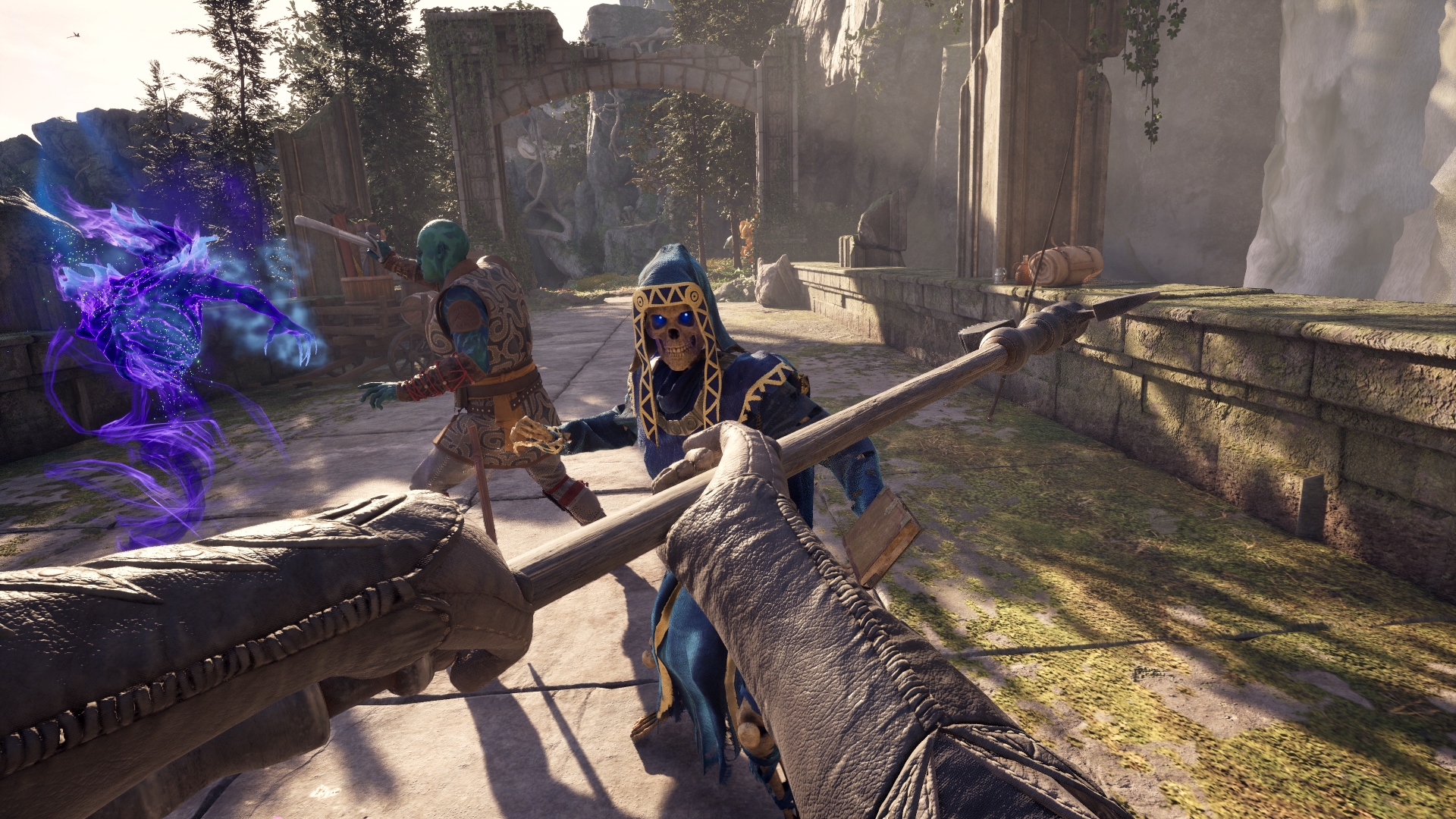
Fast, fluid, and superbly supported by weighty impacts of blades, bullets, and arcane abilities, the monster-slaying action was already satisfying as hell. But the combat’s been amped up significantly thanks to the DualSense‘s immersion-ratcheting capabilities.
Obsidian didn’t sleep on the gamepad’s proprietary tech, fully leveraging its adaptive triggers and haptic feedback to make every input – from meaty melee strikes to slow simmering spells – feel as fantastic in your hands as they look on the screen.
Of course, this also folds in that fresh content I mentioned above, as the game’s massive anniversary update introduces a new Quarterstaff for wizard builds. No mere reskin of an existing melee weapon, this two-handed tool of destruction allows mages to crack skulls up-close – as well as unleash powerful spells – in an epic fashion that’d make Gandalf proud.
Advertisement
Sign up for breaking news, reviews, opinion, top tech deals, and more.
Coupled with its next-level DualSense effects, it’s quickly become my favorite way to bring death to the Living Lands.
An update worthy of the gods
(Image credit: Microsoft / Obsidian Entertainment)
While the Quarterstaff is my personal favorite addition, this sorcerer’s best friend barely scratches the surface of the brimming update.
Advertisement
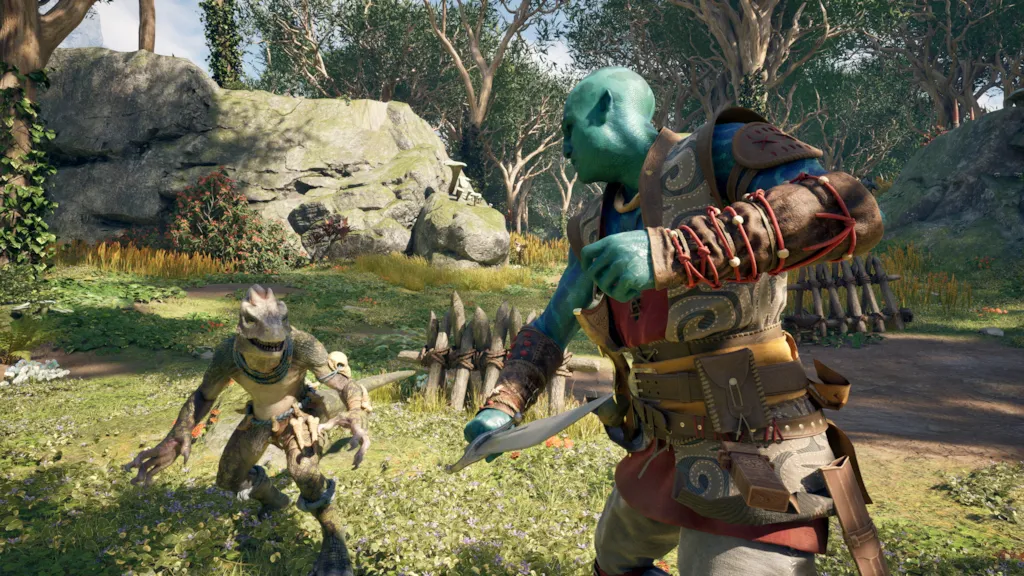
A deep photo mode – with plenty of options for customizing effects, filters, and color gradients – as well as a New Game+ option, will keep both existing envoys and new recruits busy. Beyond that, a trio of new races – Orlans, Aumaua, and Dwarves – join the Humans and Elves, bringing more character customization, perks, and fresh personality and lore to this already layered fantasy universe.
A slew of new difficulty modifiers also invite adventurers of all skill levels to tweak and tailor their experience to their hearts’ content. Factor in the past year of smaller updates – adding everything from polish, bug fixes, and quality of life touches – and PlayStation fans are getting yet another definitive take on a title that was born on Xbox.
If the PlayStation version stumbles at all, it’s in its lack of PS5 Pro-specific enhancements. It packs the now-standard quality (30 frames per second) and performance (60 frames per second) options, as well as a more in-the-middle setting for those with 120Hz displays. You can also chase faster performance by unlocking the frame rate, a welcome inclusion for sure. But there are no meaty ray-tracing features or other enhancements that allow you to truly harness everything under the Pro’s hood.
And what is offered didn’t seem to make much of an impact during my testing. In terms of both visuals and performance, my time playing on the Pro looked and felt pretty comparable to my Xbox Series X experience. Similarly, the standard PS5 and Pro seem to offer near-identical visual quality and performance, with no notable differences between the two.
Advertisement
Don’t sleep on it a second time
(Image credit: Microsoft)
While Pro owners might pine for more features to justify their pricey hardware purchase, the finger can be partially pointed at the fact that Avowed already played smoothly and impressed visually upon its release a year ago. That same sentiment translates to many other elements of the game, including its fantastic storytelling, colorful character interactions, and vibrant, varied world, covered extensively in TechRadar Gaming’s original review of the game.
Unsurprisingly, upon its release, Avowed was another compelling, polished action-RPG from a studio that’s been honing and perfecting its craft for over two decades, starting with 2004’s Star Wars Knights of the Old Republic II: The Sith Lords. Sadly, it got somewhat lost in the sea of last year’s acclaimed genre entries.
Thankfully, that oversight can now be remedied with its PS5 release, which not only reintroduces everything that was great the first time we faced its fungal plague but also brings a brimming treasure chest of fresh features, enhancements, and content.
Advertisement
Whether you’re a PlayStation owner craving the most immersive experience from behind the DualSense or an existing envoy ready to wield the Quarterstaff as one of the new races, Avowed’s second coming is as impressive as a Living Lands sunset…which you’ll definitely want to capture in photo mode.
Should you play Avowed on PS5?
Play it if…
Advertisement
Don’t play it if…
(Image credit: Microsoft)
Accessibility features
Prior to its PS5 release, Avowed already offered an admirable slate of accessibility options for camera adjustments, subtitle settings, difficulty levels, and even an arachnophobia mode for those averse to creepy crawlies. But the game’s new version builds further on this solid foundation, especially in the difficulty department.
A new “custom” difficulty setting allows players to tweak over two dozen modifiers, adjusting everything from player damage and stamina to carrying capacity, enemy attack speed, and much more. But while Avowed more than delivers in most accessibility areas, it still doesn’t offer the suite of colorblind options that have become pretty standard in other games.
Advertisement
How I reviewed Avowed on PS5
I explored The Living Lands for just over 40 hours, adventuring primarily on my PlayStation 5 Pro, but also putting plenty of time into my standard PS5 and Xbox Series X for visual and performance comparisons. I found the best, most balanced experience playing on my Pro in quality mode with the framerate unlocked.
I focused on testing the game’s anniversary update additions, specifically its custom difficulty settings, new Quarterstaff weapon, races, and photo mode. I played primarily on my budget TCL4K display, with HDR enabled and using its built-in stereo speakers, paying particular attention to the game’s DualSense controller integration for vibration and audio effects. I also played a few hours on my PlayStation Portal with PlayStation Pulse Explore earbuds.