

Crypto World
Construction Begins on Quantum Facility Capable of Breaking Bitcoin


The quantum computing race is edging closer to a commercially viable milestone, with PsiQuantum revealing progress toward a facility that could house a million qubits. The company, which has tied its plans to a collaboration with Nvidia, says the ambitious Chicago site will rely on advanced error-tolerant architectures to deliver usable quantum power at scale. In parallel, the crypto community remains deeply engaged in the implications for Bitcoin’s security, a debate that has intensified as quantum research advances and real-world milestones creep closer to feasibility.
Key takeaways
- PsiQuantum is moving toward a 1-million-qubit facility described as capable of powering commercially useful quantum computation, backed by a $1 billion fundraising round announced in September and a collaboration with Nvidia.
- A construction update showed 500 tons of steel erected in six days for the Chicago site, underscoring the rapid pace of on-site development.
- The crypto community is split on risk: some warn quantum breakthroughs could threaten Bitcoin’s cryptography, while others expect the threat to remain distant, potentially a decade or more away.
- Analyses and statements emphasize that only a small portion of Bitcoin addresses would be susceptible today, with broader resistance possible through post-quantum upgrades and other safeguards.
- Key technical benchmarks frame the discussion: preliminary estimates suggest far more qubits than needed to break current cryptography, but practical, scalable quantum systems remain the central hurdle.
Tickers mentioned: $BTC
Sentiment: Neutral
Price impact: Neutral. The article frames potential quantum risk as a broad strategic consideration with limited near-term price signals.
Market context: Quantum progress is unfolding amid a broader crypto market focus on security, post-quantum readiness, and regulatory considerations shaping risk sentiment and investment flows.
Why it matters
The convergence of quantum computing and crypto security is more than a theoretical concern. If large-scale, fault-tolerant quantum devices become viable, the cryptographic foundations underpinning much of today’s digital assets could face fundamental redesigns. The Bitcoin network, which relies on elliptic-curve signatures, would be the most visible test bed for resilience in the face of quantum threats. In 2024, researchers and industry players have intensified discussions about preemptive upgrades, including hard forks and post-quantum cryptographic standards, as a means of safeguarding long-term security without interrupting existing operations.
PsiQuantum’s latest milestones illustrate the industrial-scale ambitions of quantum developers. The Chicago facility, designed to host one million qubits, is emblematic of the sector’s transition from lab-scale experiments to facilities that could underpin commercial computing for AI, simulation, and optimization workloads. A project of this magnitude hinges on both hardware breakthroughs—error correction, qubit coherence, scalable manufacturing—and software ecosystems capable of harnessing quantum advantage in practical use cases. The $1 billion fundraising and the Nvidia collaboration signal a broad, multi-industry push to de-risk the path to practical quantum advantage, even as critics note that true utility remains some years away.
From a crypto-security perspective, the debate has evolved beyond “if” to “when.” Some Bitcoin proponents argue a quantum-capable attacker could eventually compromise keys and signatures, potentially undermining the integrity of holdings and transactions. Others, including prominent voices in the ecosystem, emphasize that current cryptographic schemes can be fortified through a combination of longer-term keying practices and post-quantum cryptography, reducing the immediacy of risk. A widely cited line of reasoning holds that even if a quantum computer could break certain cryptographic keys, the actual volume of affected funds might be limited, given the distribution of private keys across the network and the ongoing movement toward more secure standards.
Academic and industry analyses also illustrate that the number of qubits needed to break modern cryptography is a moving target. A recent preprint suggested that cracking 2048-bit keys would require on the order of 100,000 qubits, while Bitcoin relies on significantly smaller 256-bit keys in its most widely used schemes. The contrast underscores both the promise and the uncertainty of leveraging quantum capabilities for cryptanalytic purposes. The scale and error-correction requirements for a practical attack remain substantial, and much of the crypto community views rapid, decisive “quantum bursts” as a longer horizon phenomenon rather than an immediate crisis.
Beyond the security implications, the quantum discourse intersects with broader tech policy and infrastructure planning. The industry’s attention to post-quantum resilience is feeding into discussions about upgrade paths, governance, and the choreography of ecosystem-wide transitions—whether through protocol-level changes, new cryptographic standards, or multi-year roadmaps to migrate away from vulnerable primitives. The ethical and operational challenges of such migrations—including compatibility with existing wallets, exchanges, and custodians—add layers of complexity to an already evolving landscape.
In public statements, PsiQuantum has stressed that it has no plans to exploit quantum capabilities to extract private keys from public ones. Co-founder Terry Rudolph reiterated at a Bitcoin-focused quantum summit that the company’s mission centers on building reliable quantum hardware and software, not on weaponizing cryptographic breaks. This distinction is important for framing the broader industry’s stance: while the threat is acknowledged, the path to actionable security solutions is a collaborative, proactive process rather than a single, dramatic inevitability.
Within the investment and research communities, assessments like those from CoinShares have suggested that even a quantum breakthrough would not instantly destabilize Bitcoin. They estimated that a relatively small subset of the total Bitcoin supply—roughly 10,230 BTC—would be at “quantum-vulnerable” addresses, which, at prevailing prices, could be managed through routine trading and standard risk controls. Such figures reinforce the view that the market’s immediate reaction to quantum news would likely be measured, with systemic safeguards and hedging strategies mitigating abrupt price shocks.
What to watch next
- Milestones for PsiQuantum’s Chicago facility: timelines for qubit generations, error correction performance, and integration with Nvidia’s hardware stack.
- Advancements in post-quantum cryptography standards and standardized migration plans for Bitcoin and other major networks.
- Regulatory and governance developments around crypto security, including any formal endorsements or requirements for post-quantum readiness.
- New research clarifying the practical qubit counts needed to threaten current cryptography, and whether optimistic estimates translate to real-world risk.
- Public disclosures from major exchanges and wallet providers about their preparedness for quantum-era threats and planned upgrade pathways.
Sources & verification
- PsiQuantum’s fundraising and Nvidia collaboration announcements
- Public posts by PsiQuantum co-founder Peter Shadbolt about the Chicago site and steel construction
- Official statements from PsiQuantum regarding non-use of quantum tools to derive private keys
- CoinShares’ February research on quantum risk to Bitcoin
- ArXiv preprint discussing qubit requirements to break various cryptographic standards
Quantum ambition tests crypto’s future guardrails
The case of PsiQuantum illustrates a defining moment for the crypto ecosystem: a single project’s trajectory toward a million-qubit capability is forging the boundary between theoretical threat and practical reality. The Chicago facility, described as capable of hosting a million qubits and powered by a plan that includes hundreds of tons of steel and a substantial funding package, embodies a new kind of industrial ambition. If realized, it would mark a leap from demonstrations in laboratory environments to a platform that can sustain complex computations at scale—an essential step for applications in AI, materials science, and optimization that quantum machines promise to accelerate.
Yet the same development timeline that excites researchers also intensifies crypto-security debates. The Bitcoin network, by design, relies on cryptographic primitives that must withstand not only current attack methods but also those that quantum machines might enable in the future. The cornerstone question—when could a sufficiently powerful quantum computer emerge to threaten private keys—drives ongoing discussions about potential fork strategies, cryptographic upgrades, and the transitional work needed to preserve user funds without disrupting network operation.
Industry observers emphasize that while the mathematical potential of quantum attacks is real, the practical path from theory to exploitation remains riddled with engineering hurdles. The demand for robust error correction, high-fidelity qubits, scalable control systems, and fault-tolerant software stacks creates a gulf between today’s research devices and a weaponized quantum infrastructure. In this sense, PsiQuantum’s progress is a reminder that the crypto security debate is less about overnight collapse and more about sustained vigilance, iterative upgrades, and cross-disciplinary collaboration among hardware developers, cryptographers, and policy makers.
As posture and preparedness become part of routine risk management, the crypto community’s emphasis on post-quantum resilience—whether through hybrid cryptographic schemes, larger key sizes, or forward-looking migration plans—will continue to shape investor sentiment and infrastructure decisions. The debate is not only about Bitcoin’s long-term security but also about how the wider financial system adapts to a quantum-enabled future. If the next few years deliver measurable progress toward scalable, reliable quantum systems, the industry could begin to operationalize safeguards well before any exploitation materializes, translating research milestones into practical risk management and clearer governance pathways.


TLDR:
- The Fed, OCC, and FDIC confirmed tokenized securities get identical capital treatment to traditional assets at U.S. banks.
- Banks can now use tokenized stocks and bonds as loan collateral under the same rules as conventional securities.
- The guidance covers both public blockchains like Ethereum and private permissioned networks without distinction.
- Derivatives tied to tokenized assets also receive standard regulatory treatment, expanding the scope significantly.
U.S. banking regulators have issued landmark joint guidance clearing banks to hold tokenized securities under the same rules as conventional financial assets.
The Federal Reserve, Office of the Comptroller of the Currency, and Federal Deposit Insurance Corporation released the coordinated announcement together.
It confirms that a tokenized stock, bond, or other asset carries identical capital treatment to its off-chain equivalent. The move removes a regulatory barrier that major financial institutions had cited for years as a reason to stay off blockchain rails.
Banks Can Now Use Tokenized Assets as Standard Collateral
The guidance covers three core operational changes for U.S. banks.
First, tokenized securities are now eligible collateral for loans, treated identically to traditional stocks or bonds. Second, the rules apply regardless of whether the token sits on a public blockchain like Ethereum or a private permissioned network.
Third, financial derivatives linked to tokenized assets receive the same treatment as conventional derivatives.
That last point carries significant weight. Derivatives markets dwarf spot markets in volume. Extending identical regulatory treatment to tokenized derivatives opens a much larger surface area for blockchain adoption.
The announcement does not require new legislation. It is guidance, meaning banks can act on it immediately. No waiting period applies.
For institutions like JPMorgan, Goldman Sachs, and Bank of America, the obstacle was never technological.
According to posts on X, including commentary from @BullTheoryio and @markchadwickx, major banks were awaiting exactly this kind of regulatory clarity before moving capital onto blockchain infrastructure.
Tokenization Market Stands to Absorb Trillions in Traditional Capital
The addressable pool of assets is enormous. Global equity markets alone exceed $100 trillion. Bond markets add tens of trillions more.
Real estate sits on top of that. Most of that capital has remained off-chain, not due to technical limitations, but due to unresolved regulatory questions around how tokenized versions would be treated on bank balance sheets.
That question now has a clear answer. A tokenized Apple share carries the same legal claim, the same ownership rights, and the same balance sheet weight as a traditional share. Regulators have confirmed this directly.
The practical effect is that banks can begin integrating tokenized securities into existing workflows without restructuring their risk or compliance frameworks. This lowers the operational cost of adoption substantially.
Public blockchains are specifically included in the guidance. That detail matters. Many institutions assumed regulators would favor private, permissioned networks.
The explicit inclusion of public chains broadens the infrastructure eligible to handle institutional-grade asset flows

Bitcoin is likely to outperform gold on price performance through to 2029 after gold’s strong recent rally, says macroeconomist Lyn Alden.
“If I had to bet Bitcoin versus gold over the next two to three years, I would bet Bitcoin,” Alden said on the New Era Finance podcast on Wednesday.
“Gun to my head, if I had to say which one I think outperforms, I would say Bitcoin,” she added.
“It’s usually a pendulum between the two. If gold has gone up as much as it did, the entire diminishing return story per cycle is going to be erased in the coming one, too.”
Many crypto industry executives, including Coinbase CEO Brian Armstrong, have predicted that Bitcoin (BTC) will reach $1 million by 2030 with clearer regulations taking shape in the US, which Armstrong called a “bellwether for the rest of the G20.”
Alden dismisses that gold is in a bubble
Bitcoin is often compared to gold as a hedge against inflation and economic uncertainty, with many investors dubbing it “digital gold.”
Alden said gold is seeing “somewhat euphoric” sentiment after it reached a new all-time high of around $5,608 in January.
“I wouldn’t say it’s a bubble, but it’s somewhat euphoric,” she said.

The JM Bullion gold Fear and Greed Index, which tracks sentiment toward gold, posted a “Greed” score of 72 out of 100 on Friday. On the same day, the Crypto Fear and Greed Index, which measures sentiment across Bitcoin and the broader crypto market, posted an “Extreme Fear” score of 18 out of 100.
Alden said that the sentiment toward Bitcoin is “somewhat unfairly negative.” Bitcoin is trading at $71,164, down 44% from its October all-time high of $126,000, according to CoinMarketCap.
Alden said she avoids relying too heavily on rigid narratives about the relationship between the two assets.
“I try to be hesitant about reading into how absolute these things are. Gold and Bitcoin can go up together, they can go down together,” she explained.
Investors debate Bitcoin’s narrative
While the two assets are often grouped together as alternatives to fiat currencies, the relationship isn’t always consistent; sometimes the prices move in tandem during periods of macro uncertainty, and other times they decouple.
Alden’s comments come shortly after billionaire investor Ray Dalio warned against Bitcoin as a long-term store of value and safe-haven asset, arguing that it lacks central bank support and has lingering concerns about its privacy limitations and quantum resistance.
Related: Construction begins at quantum facility big enough to break Bitcoin
“Gold is not a precious metal that’s speculated on,” Dalio said on Tuesday, adding it is the “most established money” that is the second-largest reserve asset held by central banks.
Meanwhile, CryptoQuant CEO Ki Young Ju said in October 2025 that Bitcoin’s correlation with gold is increasing as both assets strengthen their reputations as hedges against macroeconomic uncertainty.
Magazine: Bitcoin may face hard fork over any attempt to freeze Satoshi’s coins


Zerohash is looking to secure a United States national trust bank charter as it plans to operate a federally regulated trust bank.
Summary
- Zerohash has applied for a United States national trust bank charter as it seeks to operate a federally regulated trust bank and expand its services under the GENIUS Act framework.
- Applications for national trust bank charters have surged since the GENIUS Act was passed in July.
Securing a National Trust Bank charter from the Office of the Comptroller of the Currency will allow the company to “expand its service offerings under a federal framework, including those activities that fall under the GENIUS Act,” Zerohas said in its official announcement.
Zerohash is a blockchain infrastructure provider that allows financial institutions and fintech firms to integrate crypto services such as trading, custody, and stablecoin payments. The company has been operating since 2017, with some of its clients including big names like Morgan Stanley, Franklin Templeton, and Stripe.
“Applying for a National Trust Bank Charter is a natural next step in offering robust global licensing coverage and continuing to expand our product offering,” the company’s Chief Legal and Compliance Officer, Stephen Gardner, said in a statement.
According to the OCC’s website, Zerohash filed for a national trust bank charter in February alongside two other applicants, Morgan Stanley and PAYO Digital Bank.
Securing this license allows companies to operate federally regulated trust banks and offer services such as custody and asset safekeeping to financial institutions.
Under Donald Trump’s administration, several crypto firms have applied for this charter, including Trump family-backed World Liberty Financial, alongside other companies like Coinbase.
Since the passage of the GENIUS Act in July, this license has become one of the most sought-after regulatory approvals for crypto companies seeking to operate stablecoin and custody services under a federal framework.
As previously covered, the OCC has issued conditional licenses to multiple applicants, including Bridge, Crypto.com, Circle, Ripple, Fidelity Digital Assets, BitGo, and Paxos.
However, it has drawn criticism from some lawmakers, most notably Elizabeth Warren, who has recently pushed back against World Liberty’s pending bank charter application and raised questions about disclosure of foreign investors tied to the venture.
TLDR:
- U.S. Treasury grants India a 30-day waiver to buy stranded Russian oil cargoes amid Gulf energy disruptions
- Iran-linked attacks on Gulf infrastructure tightened oil supply and lifted global price volatility
- U.S. oil output hit 13.6M barrels daily in 2025 as Trump energy policy expanded production
- Crypto markets track oil volatility since macro liquidity and risk sentiment affect digital assets
The United States moved to stabilize global oil supply after new geopolitical pressure hit energy markets. A temporary waiver now allows Indian refiners to purchase Russian oil cargoes stranded at sea.
The policy aims to ease supply disruptions following attacks on Gulf energy infrastructure. Crypto traders often watch such macro developments because shifts in energy markets frequently influence digital asset liquidity.
Trump Oil Waiver and Global Energy Supply Impact on Crypto Market
Scott Bessent announced a temporary 30-day waiver allowing Indian refiners to buy stranded Russian oil shipments. The Treasury Department framed the move as a short-term measure to maintain oil flow.
According to Bessent, the waiver only applies to cargoes already stranded at sea. The authorization limits transactions that might generate revenue for Russia.
The policy follows attacks on Gulf energy infrastructure linked to Iran. Those disruptions pushed global oil prices higher and tightened supply conditions.
Bessent said the measure also protects global markets from sudden shortages. He noted that the United States expects India to increase purchases of American crude.
The announcement supports the broader energy agenda of Donald Trump. U.S. crude output reached a record 13.6 million barrels per day in 2025.
Treasury data shows production rose by more than 600,000 barrels compared with earlier levels. Officials expect elevated production to continue into 2026.
Energy shocks often influence macro risk sentiment across financial markets. Digital asset traders frequently track oil volatility as a signal of broader liquidity shifts.
Crypto Market Reaction to Energy Volatility and Liquidity Signals
Energy disruptions can affect inflation expectations and monetary policy debates. Those macro forces frequently influence crypto trading activity.
Oil price spikes sometimes trigger wider market volatility. Risk assets including cryptocurrencies often move in response to those macro signals.
Supply shocks also shape global liquidity conditions. When energy prices climb, investors sometimes rotate capital across commodities, equities, and crypto.
The waiver aims to prevent sudden supply shortages in global oil markets. Stable energy supply reduces pressure on transport, manufacturing, and broader economic activity.
Digital asset markets often react when macro uncertainty rises. Bitcoin trading volumes historically increase during periods of geopolitical or energy instability.
Crypto investors also monitor geopolitical developments that affect commodities. Oil, gold, and Bitcoin often appear together in macro risk discussions.
The short-term waiver signals continued coordination between energy and financial policy. That intersection increasingly shapes how investors interpret market risk.
Treasury officials emphasized that the measure remains temporary. The goal centers on stabilizing supply without granting Russia lasting financial benefit.


Bitcoin and global equity markets have stabilized after an early-week sell-off and oil price spike that was triggered by the outbreak of military conflict between the U.S., Israel, and Iran. Bond markets, however, are signaling caution, as rising yields signal renewed inflation concerns and dwindling bets on Fed rate cuts.
BTC, the leading cryptocurrency by market value, traded above $70,000 Friday, up nearly 10% for the week. Prices briefly climbed to nearly $74,000 Wednesday after dropping to around $65,000 over the weekend as geopolitical tensions rattled markets.
The rebound has been mirrored in equity futures. Contracts tied to the S&P 500 slid to a multi-week low of 6,718 points Tuesday before recovering to around 6,840 as of writing.
The initial risk-off move came as oil prices surged following reports that Iran had blocked oil tankers transiting through the Strait of Hormuz, a critical chokepoint for global crude supplies. Markets stabilized after the U.S. moved quickly to calm fears, promising naval escorts and political risk insurance for oil and gas tankers traveling through the strait.
Still, the bond market remains uneasy.
The yield on the 10-year U.S. Treasury note has risen for four consecutive days, climbing from 3.93% to 4.15%. Bond prices move inversely to yields. Meanwhile, the two-year yield, which is more sensitive to interest rate expectations, has jumped from 3.37% to nearly 3.60%.
The move higher in yields suggests traders are reassessing the outlook for monetary policy as the conflict-driven spike in energy prices threatens to rekindle inflation pressures.
According to CME Fed funds futures, investors now see less than a 50-50 chance of two 25-basis-point Fed rate cuts this year, down from nearly 80% before the onset of the conflict.
“The rates market is revealing the tension in this rally,” Bryan Tan, trader at leading digital asset market maker Wintermute, said in an email, noting the rise in yields.
“The conflict between a resilient economy (ISM Services at 56.1, ADP at +63K vs +50K expected) and an inflationary energy shock is historically the kind of setup that keeps the Fed frozen for longer. The Warsh nomination officially hitting the Senate this week adds another layer of hawkish uncertainty,” Tan added.
Some observers note that the inflationary impact of oil shocks typically unfolds gradually across the global economy, suggesting yields could remain elevated in the weeks ahead and potentially cap upside in risk assets such as stocks and cryptocurrencies.
“After major geopolitical shocks, oil prices usually rise gradually for weeks. The average pattern shows oil typically climbing 20–30% within ~60 days after the shock,” analyst Jack Prandelli explained on X. “Markets often underprice the first phase of supply risk. The real move tends to happen once physical disruptions start showing up in flows and inventories.”
Recent strong economic data in the U.S. has also contributed to the rise in yields and the scaling back of rate-cut expectations. Data released Tuesday showed economic activity in the U.S. services sector continued to expand in February, with the ISM index rising to 56.1. The ADP private payrolls report showed 63,000 job creations in February, the strongest reading since July 2025.
Attention now turns to Friday’s nonfarm payrolls report and wage growth figures. A hotter-than-expected print could further weaken expectations for Fed rate cuts and inject fresh volatility into financial markets.


A cryptocurrency holder has claimed that attackers stole roughly $24 million in a crypto robbery following a violent assault, with blockchain security analysts now tracking the movement of the funds on-chain.
Summary
- A crypto user known as “Silly Tuna” claims attackers used violence and threats to steal roughly $24 million in digital assets.
- Blockchain security firm PeckShield said the funds were drained in an address poisoning attack and partially moved to staging wallets.
- Around $20 million in DAI is reportedly sitting in two wallets, while small portions have already been bridged to Arbitrum.
$24M crypto robbery linked to address poisoning
In a series of posts on X, a user operating under the handle “Silly Tuna” alleged that the theft occurred during a physical attack that involved weapons and threats of kidnapping and sexual violence. The user said police have been contacted and described the incident as a “violent assault and theft,” adding that the attackers targeted their crypto holdings.
“Still have limbs, phew,” the user wrote, claiming they were held down while attackers threatened them with axes and forced the transfer of funds.
The victim said the stolen assets were moved to an Ethereum wallet beginning with 0x6fe0…0322 and offered a 10% bounty on any recovered funds. The user also called on blockchain investigators to help trace the transactions.
Blockchain security firm PeckShield later reported that an address linked to the victim had been drained of approximately $24 million worth of aEthUSDC, describing the incident as an address poisoning attack.
According to the firm, about $20 million in DAI linked to the exploit is currently sitting in two attacker-controlled staging wallets, each holding roughly $10 million. These wallets have not yet been mixed, suggesting the funds remain traceable for now.
PeckShield also said the attacker has begun bridging small amounts of the stolen assets to the layer-2 network Arbitrum, a move often used by attackers attempting to fragment or obscure transaction trails.
The incident highlights the growing risk of physical attacks targeting cryptocurrency holders, sometimes referred to as “wrench attacks,” where criminals use coercion or violence to force victims to hand over private keys or execute transfers.
It remains unclear whether any of the stolen funds have been recovered at press time.
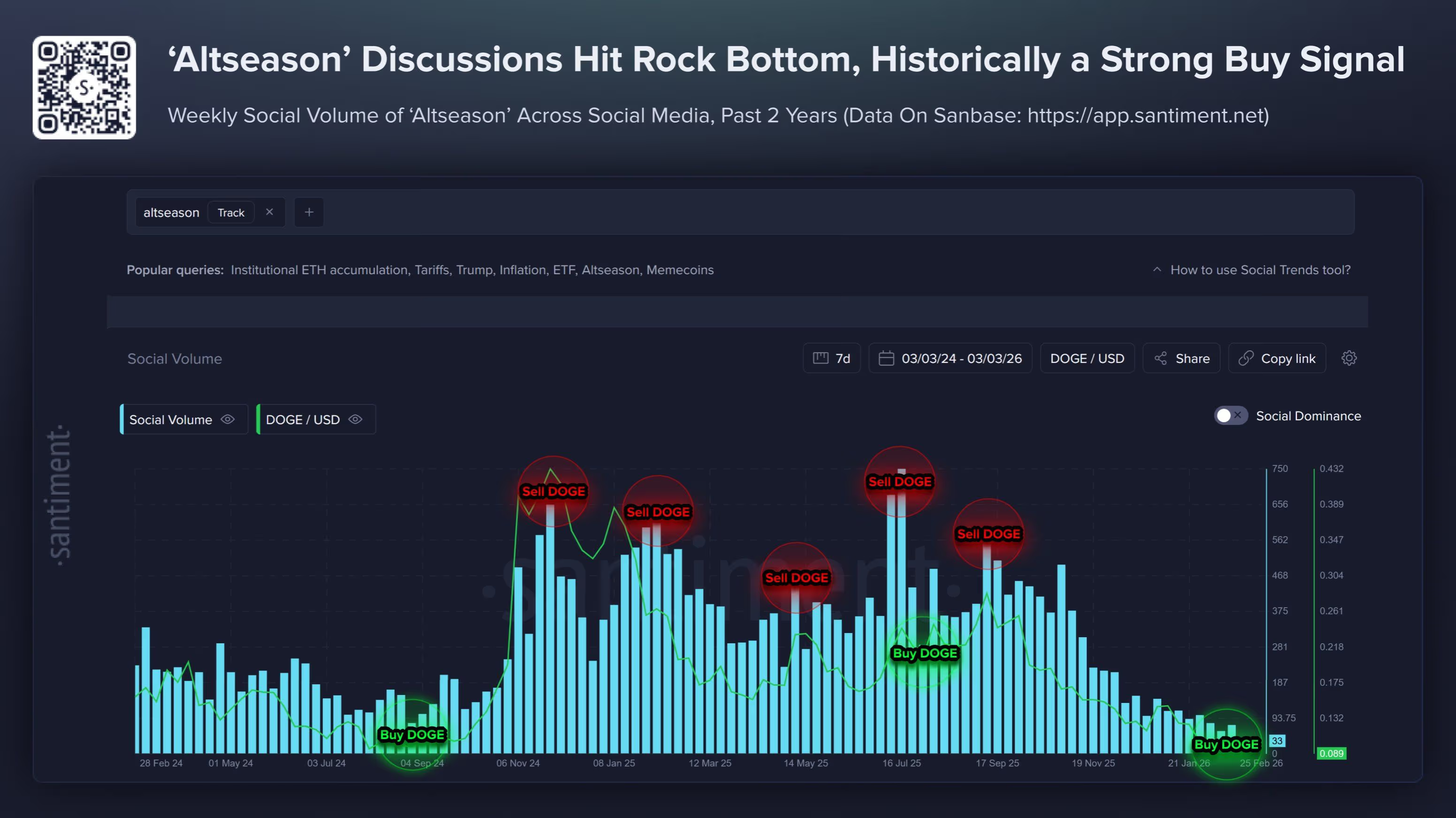
The crypto crowd has given up on altcoins. And that might be the most bullish thing about them right now.
Santiment’s social volume tracker shows weekly mentions of “altseason” across social media have fallen to rock bottom, the lowest reading in at least two years.
The term is essentially a proxy for retail greed and speculation. When everyone’s talking about altseason, it usually marks a top. When nobody’s talking about it, large holders have historically started accumulating.

Every major spike in altseason chatter over the past two years coincided with a local top in DOGE. Every period of silence was followed by a rally. The pattern isn’t perfect, but the correlation between crowd disinterest and subsequent price recoveries is hard to ignore across multiple cycles.
The current apathy is earned. Altcoins have been brutalized since October’s crash. Dogecoin is down roughly 75% from its cycle peak. Solana has shed over 60%. Cardano has lost more than 70%.
The broader altcoin market has been bleeding against bitcoin for months, with capital rotating into BTC and stablecoins rather than chasing lower-cap tokens. There’s simply nothing left to be excited about if you’ve been holding alts through this drawdown.
Other sentiment indicators confirm the exhaustion. The Crypto Fear and Greed Index has spent most of February and March oscillating between “fear” and “extreme fear.”
The Coinbase Premium Index stayed negative for over 40 consecutive days through February, signaling that U.S. retail interest was absent even from bitcoin, let alone more speculative assets. Google Trends data for terms like “best crypto to buy” have flatlined while searches of “bitcoin to zero” hit a U.S. record earlier in the month.
Meanwhile, the on-chain picture has been quietly diverging from sentiment. Bitcoin wallets holding 100+ BTC approached 20,000 for the first time in late February, suggesting large holders were accumulating the dip.
The data does not directly mean a rally is imminent; however, with the ongoing Iran conflict pressuring financial markets all over the world. The altcoin market needs bitcoin to stabilize before it can rotate lower on the risk curve.
The conditions for an altseason aren’t here yet, but the sentiment setup is.


Justin has secured a $10 million settlement in a multi-year lawsuit filed by the United States Securities and Exchange Commission that accused the crypto entrepreneur of alleged fraud and securities violations.
Summary
- Justin Sun settled the SEC’s long-running lawsuit with a $10 million payment from Rainberry, bringing an end to allegations tied to TRX and BTT token sales and trading practices.
- The case, originally filed in 2023 under former SEC Chair Gary Gensler, accused Sun and affiliated entities of unregistered securities sales.
A letter from the SEC made public on Feb. 5 confirmed that neither Sun nor any of his companies involved in the case had admitted or denied the allegations, but the claims would be dropped following the payment of the fine.
With this, the SEC has wrapped up a three-year-long case that was filed under the leadership of former SEC Chair Gary Gensler, who was widely known for his regulation-by-enforcement approach.
Sun, along with affiliated entities including the Tron Foundation, BitTorrent Foundation, and Rainberry, was accused of selling unregistered securities involving TRX and BTT tokens. Further, the SEC alleged that Sun engaged in “manipulative wash trading” of TRX and paid celebrities like Akon, Lindsay Lohan, and Jake Paul to promote BTT without disclosing their compensation.
Sun has reiterated that the SEC’s complaints “lacks merit.”
Rainberry has agreed to pay a $10 million fine as part of the latest settlement.
“Today’s resolution brings closure, but I never stopped building. I will continue to focus on accelerating innovation in the United States and around the world, and look forward to working with the SEC to develop guidance and regulations for crypto going forward,” Sun wrote in a recent X post.
The dismissal comes as no surprise because under President Donald Trump’s administration, the commission has taken a markedly pro-crypto stance and has dropped multiple enforcement actions that were previously brought against major industry players like Coinbase.
However, the decision to drop Sun’s case has also drawn scrutiny from some lawmakers, who believe the move may have been motivated by Sun’s financial ties to Trump-linked crypto ventures.
Soon after Trump’s election, Sun acquired $30 million worth of tokens linked to World Liberty Financial, which has direct links to the president’s family.
Democratic lawmakers, including Representatives Maxine Waters, Ritchie Torres, and Stephen Lynch, have argued that the circumstances surrounding the settlement warrant closer scrutiny and have requested the SEC to reopen the case.
How DeFi Could Handle Failure Without Chaos Decentralized finance has mastered many things: permissionless trading, algorithmic lending, automated market making. But one problem still sits awkwardly in the background — what happens when a protocol fails?
In traditional finance, companies that collapse enter structured legal processes like Chapter 11 bankruptcy, where courts coordinate creditors, restructure debt, and distribute remaining assets fairly. In DeFi, the equivalent often looks more like Twitter threads, governance drama, and panic withdrawals.
What if blockchains had their own Protocol Bankruptcy Courts?
The Missing Layer in DeFi: Orderly Failure
Protocols fail for many reasons:
-
Smart contract exploits
-
Insolvent lending pools
-
Governance attacks
-
Market collapses
-
Oracle manipulation
Events such as the collapse of Terra and the liquidation cascades across Celsius Network and FTX showed how chaotic unwinding can be when billions of dollars in digital assets are involved.
Unlike traditional companies, most DeFi protocols lack a formal mechanism to restructure obligations when something breaks.
Instead, we see:
-
Emergency governance votes
-
Ad-hoc treasury bailouts
-
Community-driven compensation plans
-
Legal interventions outside the chain
A Protocol Bankruptcy Court would aim to solve this by embedding structured crisis resolution directly into smart contracts and governance systems.
What Is a Protocol Bankruptcy Court?
A Protocol Bankruptcy Court (PBC) is a decentralized system that activates when a protocol becomes insolvent or unable to fulfill obligations.
Instead of shutting down chaotically, the protocol enters a structured recovery phase governed by predefined rules.
Think of it as a smart-contract-powered restructuring process.
Key functions could include:
1. Automatic Insolvency Detection
Smart contracts continuously monitor protocol health metrics:
-
Collateral ratios
-
Liquidity reserves
-
Treasury solvency
-
Withdrawal pressure
If thresholds are breached, the protocol automatically triggers Bankruptcy Mode.
2. Creditor Registry
All stakeholders are mapped on-chain:
-
Depositors
-
Liquidity providers
-
Token holders
-
Bond markets
-
DAO treasury claims
The court system creates a transparent creditor registry so everyone knows who is owed what.
No hidden liabilities. No off-chain spreadsheets.
3. Claim Prioritization
A core function of bankruptcy is deciding who gets paid first.
Protocols could encode priority layers such as:
-
User deposits
-
Secured collateral lenders
-
Liquidity providers
-
Governance token holders
This hierarchy could be voted on beforehand through DAO governance.
4. On-Chain Restructuring Proposals
Instead of chaotic community debates, restructuring proposals are submitted through a structured system.
Examples:
-
Treasury-backed compensation plans
-
Tokenized debt issuance
-
Recovery tokens (similar to post-crisis IOUs)
-
Liquidity lock extensions
Voting would determine which recovery plan becomes active.
5. Asset Liquidation Engines
Remaining assets could be distributed through:
Everything happens transparently on-chain.
The Concept of Recovery Tokens
A common tool in restructuring is the issuance of recovery tokens.
After a protocol collapse, affected users receive tokens representing their claim on future revenue.
These tokens could:
-
Earn a portion of protocol fees
-
Be tradable on secondary markets
-
Appreciate it if the protocol recovers
This approach transforms losses into long-term claims instead of instant write-offs.
Why DeFi Needs This
DeFi’s biggest weakness isn’t innovation — it’s crisis management.
Traditional finance has centuries of legal infrastructure for handling insolvency. Blockchains do not.
Protocol Bankruptcy Courts could:
-
Prevent panic bank runs
-
Provide fair creditor coordination
-
Reduce legal uncertainty
-
Preserve the surviving protocol value
-
Turn catastrophic collapses into structured recoveries
Instead of “rug → chaos → lawsuits,” the process becomes “failure → restructuring → recovery.”
The Governance Challenge
Who should run these courts?
Possible models include:
DAO Jury System
Randomly selected token holders review restructuring proposals.
Delegated Arbitration
Specialized governance delegates evaluate claims.
Automated Rules
Smart contracts execute pre-programmed recovery paths.
In reality, a hybrid system is likely.
Risks and Limitations
Protocol Bankruptcy Courts are not a perfect solution.
Challenges include:
-
Governance manipulation during crises
-
Disputes about creditor priority
-
Smart contract rigidity
-
Legal conflicts with real-world jurisdictions
Still, even an imperfect on-chain restructuring process could be far better than today’s improvisation.
A Future Where Protocols Can Fail Safely
Failure is inevitable in experimental financial systems.
The question isn’t whether protocols will collapse, but how they collapse.
If DeFi wants to mature into global financial infrastructure, it needs systems not just for growth, but for orderly failure.
Protocol Bankruptcy Courts could become one of the most important missing layers in decentralized finance — transforming collapse from a chaotic event into a managed, transparent restructuring process.
In a world where code governs capital, perhaps even bankruptcy should be programmable.
REQUEST AN ARTICLE

Security researchers say a bug in Solv Protocol’s smart contracts allowed an attacker to mint an outsized amount of a Bitcoin-backed token and swap it for SolvBTC, the Bitcoin-pegged asset on the Solv network. In total, the incident is estimated at $2.7 million in losses, while the attacker minted 38.05 Solv Protocol BTC (SolvBTC) tokens before converting the bulk into a position on SolvBTC. Solv said fewer than ten users were affected and that it has deployed mitigations and engaged multiple security firms to investigate the exploit. The incident underscores ongoing security challenges in DeFi vaults that rely on cross-chain assets and minting logic.
Bitcoin-based DeFi platforms continue to attract attention for the financial leverage they offer across chains, but this episode shows how a single vulnerability can ripple through a broader ecosystem. The attacker’s maneuver involved 22 separate minting events, culminating in a swap that moved most of the minted tokens into just over 38 SolvBTC, a token pegged to Bitcoin. Pseudonymous researchers described the vulnerability as a re-entrancy-like flaw, a class of attack that has repeatedly exposed weaknesses in smart contracts where external inputs can provoke unintended minting or asset creation. While the precise chain of events remains under audit, the core insight is clear: minting controls on DeFi assets tied to real-world reserves demand robust, multi-layered safeguards.
Solv Protocol has been forthright about its response. In a public post on X, the team explained that they have put measures in place to prevent a recurrence and are collaborating with security firms Hypernative Labs, SlowMist, and CertiK to conduct a comprehensive review. A 10% bounty was offered to the attacker in exchange for returning the stolen funds, a strategy designed to recover value while maintaining a channel for dialogue. So far, there has been no confirmed on-chain communication from the attacker to the bounty address, according to Etherscan data, complicating any near-term recovery plan.
Solv Protocol’s model hinges on Bitcoin deposits backing Solv Protocol BTC, enabling users to lend, borrow, or stake across interconnected blockchains. The project has stressed that it possesses a substantial on-chain Bitcoin reserve—reported at roughly 24,226 BTC, valued at more than $1.7 billion at the time of reporting. This scale underscores the potential systemic impact of the breach, even if the immediate exposure to users appears limited. The event also places a spotlight on the resilience of liquidity providers across cross-chain ecosystems, where smart contract design, reserve accounting, and user protection mechanisms must align to prevent similar exploits in the future.
Initial assessments point to a flaw within a Solv smart contract that allowed excessive minting of a token used within the protocol. Security researchers describe this as a re-entrancy vulnerability, a persistent threat in DeFi that takes advantage of unexpected inputs to force asset creation beyond intended limits. The discourse around the incident has touched on broader lessons for DeFi—namely, the importance of formal verification, rigorous contract auditing, and robust guardrails for minting functions tied to real-world assets. The Solv incident joins a growing catalog of DeFi security episodes that encourage protocols to bake in stronger checks and consensus-driven escalation paths before minting or locking value.
Solv has provided a public wallet address in its update to encourage the attacker to participate in the bounty program. Yet, as of the latest blockchain checks, no on-chain message had arrived at that address. The lack of a reply is a reminder that, even with incentives, adversaries may delay or avoid engagement, leaving affected users and the ecosystem in a state of limbo as investigators map the full scope of the breach. The situation continues to evolve as security firms parse call traces, contract states, and token movements to determine whether additional exploits are possible or if the incident has crossed a boundary into a recoverable event.
The broader crypto community is watching how Solv and its security partners respond to this breach. The cross-chain nature of Solv’s products, coupled with the size of its Bitcoin-backed reserve, makes this incident more than an isolated hack; it tests the durability of risk controls, incident response, and incentive-driven remediation in DeFi’s Bitcoin-linked layer. While the immediate loss is tangible, the longer-term implications hinge on how effectively Solv can close the vulnerability, reassure participants, and demonstrate that cross-chain lending and staking platforms can withstand sophisticated, multi-stage exploits without eroding confidence in the underlying mechanics of wrap-and-bridge systems.
The event also highlights the tension between open, incentive-aligned security practices and the risk of misaligned incentives when large sums are at stake. As Solv and its partners conduct their audits and implement additional safeguards, observers will look for a clear roadmap outlining contract upgrades, formal verification steps, and a revised risk framework for minting and reserve management across Bitcoin-backed tokens. In an ecosystem where liquidity is a prized asset, the balance between rapid response and thorough, verifiable remediation remains the defining challenge for DeFi builders and auditors alike.
Why it matters
From a technical perspective, the Solv Protocol breach underscores how minting controls in DeFi products tied to real assets require exceptionally robust safeguards. A single bug in a contract that governs token creation can unlock outsized supply, enabling attackers to siphon value before guardrails activate. For users, the incident raises questions about the reliability of Bitcoin-backed DeFi vaults and the timeline for remediation—factors that influence whether liquidity remains available and secure across connected chains.
From a market perspective, the breach occurs against a backdrop of ongoing scrutiny of DeFi security practices, audit standards, and bug-bounty programs. The involvement of established security firms signals a serious investigative effort, but the absence of a public attacker-led recovery also underscores the fragility of trust when large on-chain reserves are at stake. For builders, the episode reinforces the need to implement multi-sig governance, formal verifications, and fail-safes that prevent minting beyond predefined caps, especially in systems that bridge Bitcoin to other networks.
For investors and users, the incident serves as a reminder to assess not only the yield or liquidity benefits of cross-chain DeFi products but also the depth and rigor of their security programs. The deployment of independent audits, transparent incident timelines, and concrete upgrade roadmaps will be critical in restoring confidence as the ecosystem weighs the trade-offs between innovation and safety in complex, asset-backed DeFi architectures.
What to watch next
- Updates from Hypernative Labs, SlowMist, and CertiK on the ongoing audit findings and patch implementations.
- Any further on-chain movements of the minted tokens or the SolvBTC asset, including potential recoveries or additional seizures.
- New governance or contract upgrades that address minting guards, emergency pause mechanisms, and reserve reporting.
- Public communications from Solv Protocol about timelines for remediation and user restitution, if applicable.
Sources & verification
- Solv Protocol’s official X posts detailing the incident and bounty offer.
- On-chain data and the transaction reference 0x44e637c7d85190d376a52d89ca75f2d208089bb02b7c4708ad2aaae3a97a958d.
- Public comments from security researchers (Hypernative Labs, SlowMist, CertiK) as cited in related updates.
- The reported figure of 24,226 BTC in Solv’s Bitcoin reserve and the broader context of SolvBTC as a Bitcoin-backed token.
Solv Protocol breach exposes risk in Bitcoin-backed DeFi vaults

Julie Redmond: Drug addicts sleeping rough on our streets should not be accepted as normal

Sinkhole opens at historic golf course, revealing a stunning find

SpyTech: The Underwater Wire Tap


-

 Politics3 days ago
Alan Cumming Brands Baftas Ceremony A ‘Triggering S**tshow’
-

 Fashion6 days ago
Weekend Open Thread: Iris Top
-

 Tech5 days ago
Unihertz’s Titan 2 Elite Arrives Just as Physical Keyboards Refuse to Fade Away
-

 NewsBeat5 days ago
Abusive parents will now be treated like sex offenders and placed on a ‘child cruelty register’ | News UK
-
 NewsBeat6 days ago
Dubai flights cancelled as Brit told airspace closed ’10 minutes after boarding’
-
Sports6 days ago
The Vikings Need a Duck
-
 NewsBeat6 days ago
The empty pub on busy Cambridge road that has been boarded up for years
-

 NewsBeat5 days ago
‘Significant’ damage to boarded-up Horden house after fire
-

 Tech23 hours ago
Bitwarden adds support for passkey login on Windows 11
-

 Entertainment4 days ago
Baby Gear Guide: Strollers, Car Seats
-
 Sports12 hours ago
499 runs and 34 sixes later, India beat England to enter T20 World Cup final | Cricket News
-
 Tech7 days ago
NASA Reveals Identity of Astronaut Who Suffered Medical Incident Aboard ISS
-
Politics5 days ago
FIFA hypocrisy after Israel murder over 400 Palestinian footballers
-
 NewsBeat5 days ago
Emirates confirms when flights will resume amid Dubai airport chaos
-

 NewsBeat4 days ago
Is it acceptable to comment on the appearance of strangers in public? Readers discuss
-

 Tech5 days ago
Viral ad shows aged Musk, Altman, and Bezos using jobless humans to power AI
-

 Video4 days ago
How to Build Finance Dashboards With AI in Minutes
-

 Business2 days ago
Guthrie Disappearance Enters Fifth Week as Family Visits Memorial
-
 Crypto World5 days ago
US Judge Lets Binance Unregistered Token Class Action Proceed
-
 NewsBeat4 days ago
Ukraine-Russia war latest: Belgium releases video showing forces boarding Russian shadow fleet oil tanker