

Crypto World
Protocol Bankruptcy Courts – Smart Liquidity Research

How DeFi Could Handle Failure Without Chaos Decentralized finance has mastered many things: permissionless trading, algorithmic lending, automated market making. But one problem still sits awkwardly in the background — what happens when a protocol fails?
In traditional finance, companies that collapse enter structured legal processes like Chapter 11 bankruptcy, where courts coordinate creditors, restructure debt, and distribute remaining assets fairly. In DeFi, the equivalent often looks more like Twitter threads, governance drama, and panic withdrawals.
What if blockchains had their own Protocol Bankruptcy Courts?
The Missing Layer in DeFi: Orderly Failure
Protocols fail for many reasons:
-
Smart contract exploits
-
Insolvent lending pools
-
Governance attacks
-
Market collapses
-
Oracle manipulation
Events such as the collapse of Terra and the liquidation cascades across Celsius Network and FTX showed how chaotic unwinding can be when billions of dollars in digital assets are involved.
Unlike traditional companies, most DeFi protocols lack a formal mechanism to restructure obligations when something breaks.
Instead, we see:
-
Emergency governance votes
-
Ad-hoc treasury bailouts
-
Community-driven compensation plans
-
Legal interventions outside the chain
A Protocol Bankruptcy Court would aim to solve this by embedding structured crisis resolution directly into smart contracts and governance systems.
What Is a Protocol Bankruptcy Court?
A Protocol Bankruptcy Court (PBC) is a decentralized system that activates when a protocol becomes insolvent or unable to fulfill obligations.
Instead of shutting down chaotically, the protocol enters a structured recovery phase governed by predefined rules.
Think of it as a smart-contract-powered restructuring process.
Key functions could include:
1. Automatic Insolvency Detection
Smart contracts continuously monitor protocol health metrics:
-
Collateral ratios
-
Liquidity reserves
-
Treasury solvency
-
Withdrawal pressure
If thresholds are breached, the protocol automatically triggers Bankruptcy Mode.
2. Creditor Registry
All stakeholders are mapped on-chain:
-
Depositors
-
Liquidity providers
-
Token holders
-
Bond markets
-
DAO treasury claims
The court system creates a transparent creditor registry so everyone knows who is owed what.
No hidden liabilities. No off-chain spreadsheets.
3. Claim Prioritization
A core function of bankruptcy is deciding who gets paid first.
Protocols could encode priority layers such as:
-
User deposits
-
Secured collateral lenders
-
Liquidity providers
-
Governance token holders
This hierarchy could be voted on beforehand through DAO governance.
4. On-Chain Restructuring Proposals
Instead of chaotic community debates, restructuring proposals are submitted through a structured system.
Examples:
-
Treasury-backed compensation plans
-
Tokenized debt issuance
-
Recovery tokens (similar to post-crisis IOUs)
-
Liquidity lock extensions
Voting would determine which recovery plan becomes active.
5. Asset Liquidation Engines
Remaining assets could be distributed through:
Everything happens transparently on-chain.
The Concept of Recovery Tokens
A common tool in restructuring is the issuance of recovery tokens.
After a protocol collapse, affected users receive tokens representing their claim on future revenue.
These tokens could:
-
Earn a portion of protocol fees
-
Be tradable on secondary markets
-
Appreciate it if the protocol recovers
This approach transforms losses into long-term claims instead of instant write-offs.
Why DeFi Needs This
DeFi’s biggest weakness isn’t innovation — it’s crisis management.
Traditional finance has centuries of legal infrastructure for handling insolvency. Blockchains do not.
Protocol Bankruptcy Courts could:
-
Prevent panic bank runs
-
Provide fair creditor coordination
-
Reduce legal uncertainty
-
Preserve the surviving protocol value
-
Turn catastrophic collapses into structured recoveries
Instead of “rug → chaos → lawsuits,” the process becomes “failure → restructuring → recovery.”
The Governance Challenge
Who should run these courts?
Possible models include:
DAO Jury System
Randomly selected token holders review restructuring proposals.
Delegated Arbitration
Specialized governance delegates evaluate claims.
Automated Rules
Smart contracts execute pre-programmed recovery paths.
In reality, a hybrid system is likely.
Risks and Limitations
Protocol Bankruptcy Courts are not a perfect solution.
Challenges include:
-
Governance manipulation during crises
-
Disputes about creditor priority
-
Smart contract rigidity
-
Legal conflicts with real-world jurisdictions
Still, even an imperfect on-chain restructuring process could be far better than today’s improvisation.
A Future Where Protocols Can Fail Safely
Failure is inevitable in experimental financial systems.
The question isn’t whether protocols will collapse, but how they collapse.
If DeFi wants to mature into global financial infrastructure, it needs systems not just for growth, but for orderly failure.
Protocol Bankruptcy Courts could become one of the most important missing layers in decentralized finance — transforming collapse from a chaotic event into a managed, transparent restructuring process.
In a world where code governs capital, perhaps even bankruptcy should be programmable.
REQUEST AN ARTICLE

Crypto World
Arthur Hayes Predicts Fed Money Printing From US-Iran Tensions Could Propel Bitcoin (BTC) Higher

Key Takeaways
- Arthur Hayes, BitMEX co-founder, believes extended US-Iran military engagement may compel the Federal Reserve to reduce interest rates and expand monetary supply.
- Historical precedent shows the Fed has injected liquidity during previous US military operations, according to Hayes.
- Escalating oil prices resulting from regional tensions could drive 10-year Treasury yields upward, potentially prompting Fed intervention.
- Bitcoin dropped from approximately $66,000 to $63,000 when tensions intensified but has since rebounded to the $73,000 level.
- Market observers identify $70,685 as crucial Bitcoin support, with near-term price objectives ranging from $75,000 to $80,000.
Arthur Hayes, who co-founded BitMEX and currently serves as chief investment officer at Maelstrom, believes the escalating US-Iran tensions may initiate a sequence of events culminating in Federal Reserve monetary expansion — potentially benefiting Bitcoin prices.
In analysis published Monday on his blog, Hayes explained how prolonged US military operations in Middle Eastern regions have historically compelled the Federal Reserve to implement rate reductions and inject market liquidity. He cited the 1990 Gulf War, post-9/11 global counterterrorism efforts, and the 2009 Afghanistan troop surge as illustrative examples.
“The cure, as always, is cheaper and more plentiful money,” Hayes noted in his analysis.
In a March 6 post on X, Hayes cautioned that sustained increases in Brent crude prices stemming from US-Iran hostilities could cause 10-year Treasury yields to surge dramatically. Such market turbulence would elevate the MOVE Index — which tracks US bond market volatility — creating what Hayes considers a “prerequisite” for Federal Reserve monetary intervention.
Brent crude has climbed approximately 20% since conflict intensification began, fueled by concerns about Middle Eastern supply constraints. Nevertheless, oil prices declined over 1% Thursday to approximately $80 per barrel following Trump administration announcements of price stabilization measures, including a 30-day exemption permitting India to maintain Russian oil purchases.
Implications for Bitcoin Markets
Hayes contends that Federal Reserve rate reductions or balance sheet growth would increase market liquidity, historically providing positive momentum for Bitcoin and comparable risk assets.
Bitcoin’s response to the military tensions has shown volatility. Prices declined from roughly $66,000 to $63,000 immediately following hostilities escalation. Subsequently, the cryptocurrency has recovered and recently reached a one-month peak of $73,000.
Hayes recommends awaiting definitive indications of Fed policy adjustments — either interest rate cuts or balance sheet expansion — before initiating Bitcoin or altcoin purchases. He has not advocated for immediate market entry.
Probability of a rate reduction at the Federal Reserve’s March 17–18 policy meeting remains minimal. CME Group’s FedWatch tool indicates merely 2.7% odds of a cut at that gathering. Most market observers anticipate the Fed will maintain rates within the 3.50% to 3.75% range.
Expert Technical Analysis
Cryptocurrency analyst Ali Martinez has pinpointed $70,685 as a critical Bitcoin support threshold. Maintaining that price level could facilitate a near-term advance toward $75,000–$80,000, according to market technicians.
Inflation pressures represent an additional consideration. Should inflation remain persistent, the Federal Reserve may possess limited flexibility for rate cuts, potentially constraining any immediate rally in risk assets like Bitcoin.
Hayes has offered comparable forecasts repeatedly in recent months. In January, he suggested potential US military operations in Venezuela as a probable catalyst for Fed monetary easing. Last month, he indicated an AI-driven financial crisis as the subsequent trigger.
In December, Hayes forecasted Bitcoin would reach $200,000 this month, referencing reserve management acquisitions announced by the Fed during that period.
Currently, Bitcoin maintains trading activity within the $70,000–$73,000 corridor, with markets monitoring both Federal Reserve communications and Middle Eastern geopolitical developments.
Remember: Preserve all tokens like [[EMBED_0]], [[IMG_0]], [[LINK_START_0]], [[LINK_END_0]], [[SCRIPT_0]], [[FIGURE_0]] etc. exactly as they appear. These are placeholders for embeds, images, and links that must not be changed.


Bitcoin-focused Solv Protocol was exploited on Thursday, resulting in roughly $2.7 million worth of funds drained from one of its token vaults. The project has offered a 10% bounty to the attackers.
Summary
- Solv Protocol lost about $2.7 million after an exploit drained 38 SolvBTC from one of its Bitcoin Reserve Offering vaults, with fewer than 10 users affected.
- Security researchers estimate that the attacker abused a double-minting flaw in a BitcoinReserveOffering contract.
- The project has offered a 10% bounty for the return of the funds.
Solv Protocol is a DeFi platform that allows users to stake Bitcoin through its Staking Abstraction Layer.
According to a post incident update, roughly 38 Solv Protocol BTC (SolvBTC), which the project uses for yield-generating and lending activities across its ecosystem, was drained from one of its structured yield vaults called Bitcoin Reserve Offerings (BRO).
Solv Protocol said that the incident impacted fewer than 10 users and added that it would compensate for the loss of 38.05 SolvBTC, which amounts to roughly $2.7 million.
While a full post-mortem of the incident is yet to be published, third-party security analysts believe the attacker was able to abuse a double-minting flaw in a BitcoinReserveOffering contract.
Per security firm Decurity’s automated bot, the exploiter was able to trigger the vulnerability 22 times, which allowed them to inflate 135 BRO into roughly 567 million BRO tokens before converting the funds into SolvBTC.
Meanwhile, a pseudonymous crypto researcher identified as Pyro described the incident as a reentrancy attack, a common exploit where repeated calls to a smart contract allow attackers to manipulate internal accounting before balances are properly updated.
In the meantime, Solv Protocol has offered a 10% bounty if the attackers return the funds to the designated address. Further, the project claims to be working with its security partners to patch the vulnerability.
At the time of publication, the attackers have yet to indicate whether they intend to return the stolen funds.
This is one of the several attacks that have targeted DeFi protocols of late.
Earlier in the week, Curve Finance’s sDOLA LlamaLend markets were exploited through a vulnerability tied to the pool’s oracle configuration, and the attacker reportedly made about $240,000 by manipulating the pricing mechanism using a flash loan to trigger liquidations.
In early February, the cross-chain liquidity protocol CrossCurve also lost roughly $3 million after attackers exploited a flaw in its smart contract that allowed spoofed cross-chain messages to bypass gateway validation and unlock funds from the PortalV2 contract.
Bitcoin price fell to near $70,000 on Friday following a sharp rebound the previous day. A looming BTC options expiry event is now keeping investors on edge as the market anticipates potential volatility.
Summary
- Bitcoin price has given up a portion of its gains from this week.
- Over $2.22 billion worth of options set to expire today have spurred concerns around volatility.
- Bitcoin technicals remain bullish despite the current drawdown.
According to data from crypto.news, Bitcoin (BTC) price fell 4.5% to an intraday low of $70,177 on Friday morning Asian time before stabilizing around $70,400 at press time. The bellwether pulled back after facing rejection around $74,000, a key resistance level it had failed to break for over a month.
Bitcoin price fell as investors began booking profits after climbing over 15% in the past 5 days.
This came amid a broader risk-off environment triggered by the ongoing war between the U.S. and Iran, which has led energy prices to soar to multi-month highs. The military escalation has also triggered capital rotation into traditional safe-haven assets, which have seen relatively better performance amid the geopolitical uncertainty.
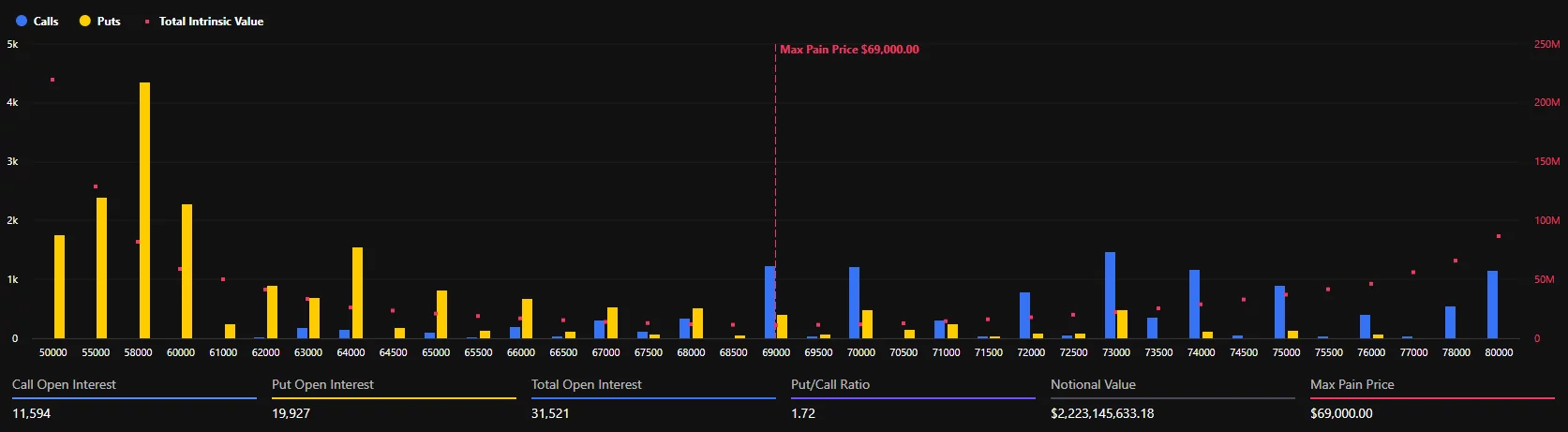
Today, investor sentiment is being kept in check as $2.22 billion worth of Bitcoin option expiry is set to be settled on the Deribit exchange at 8:00 a.m. UTC. Over 31,500 Bitcoin open contracts are set to expire.
At press time, the put-to-call ratio was at 1.72, meaning put options or traders betting on Bitcoin to go lower far surpass the calls that are betting on a rise. The maximum pain level for BTC or the price at which most option contracts expire worthless stood at $69,000, just $1,400 short of the current spot price.
The maximum pain level, also known as the strike price, tends to pull spot prices towards the center around expiry. Therefore, there remains a high risk that Bitcoin price could pull back towards the $69,000 mark as options reach expiry.
Bitcoin has failed to hold above $70,000 six times since the start of February, and losing this key psychological support once again could spook short-term traders who were betting on the current recovery rally.
Despite the concerns surrounding the massive options expiry today, BTC price charts have not yet shown signs of a breakdown.
On the Bitcoin/USDT 24-hour chart, momentum indicators still portrayed a positive outlook at least in the short term.
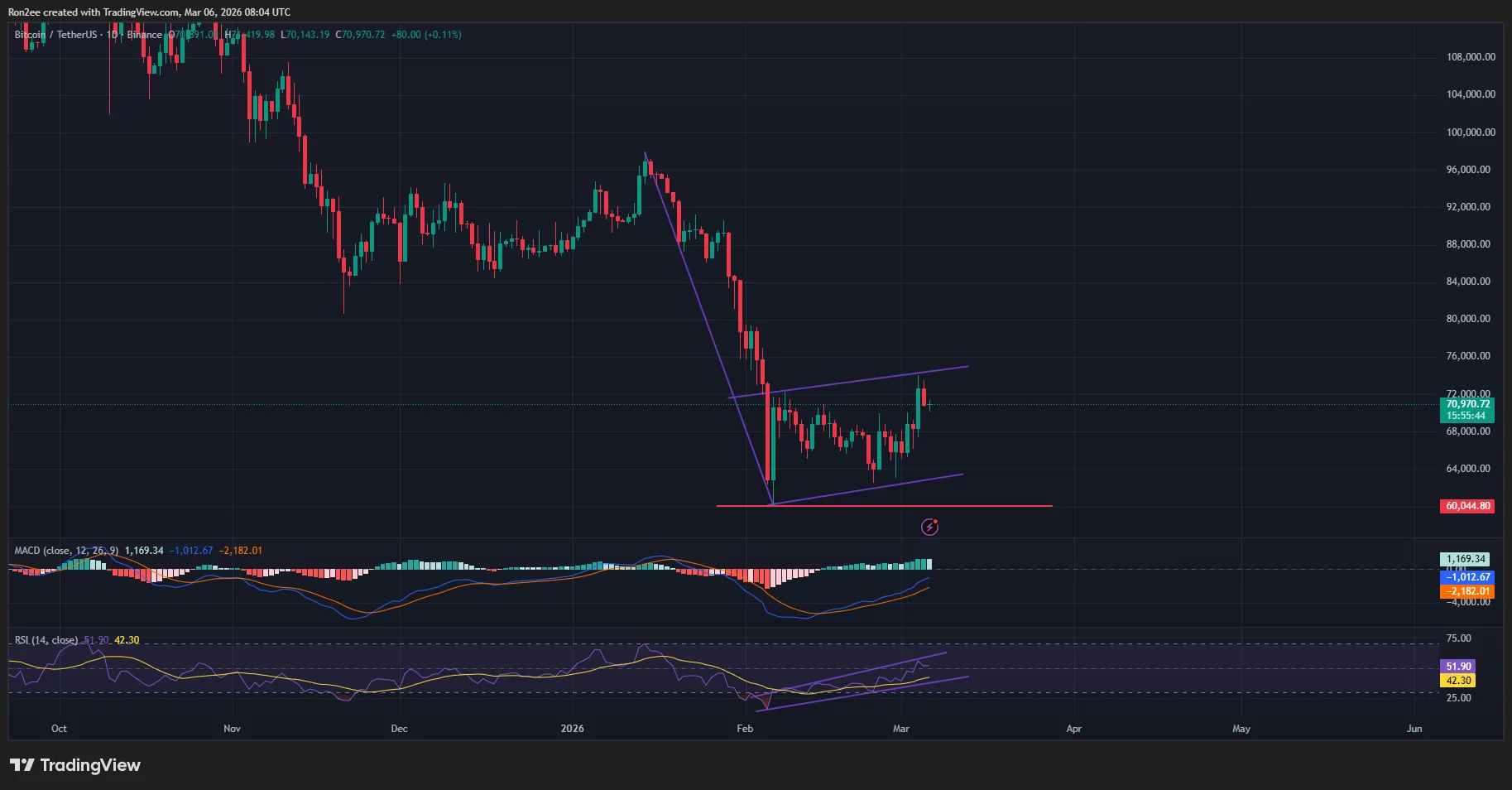
Notably, the MACD line was pointing upwards, suggesting growing buying pressure for the bulls in comparison to the selling pressure exerted by bears. At the same time, the Relative Strength Index has also formed a bullish divergence with the price action.
For now, bulls will be eyeing $72,000 as the next major resistance level to claim, a break above which could likely end its downtrend today.
On the contrary, a move below the $70,000 support could pull BTC price to $69,000 and successively as low as $60,000 as the broader structure remains confined within a bearish flag pattern, which is considered one of the most negative formations in technical analysis.
Disclosure: This article does not represent investment advice. The content and materials featured on this page are for educational purposes only.
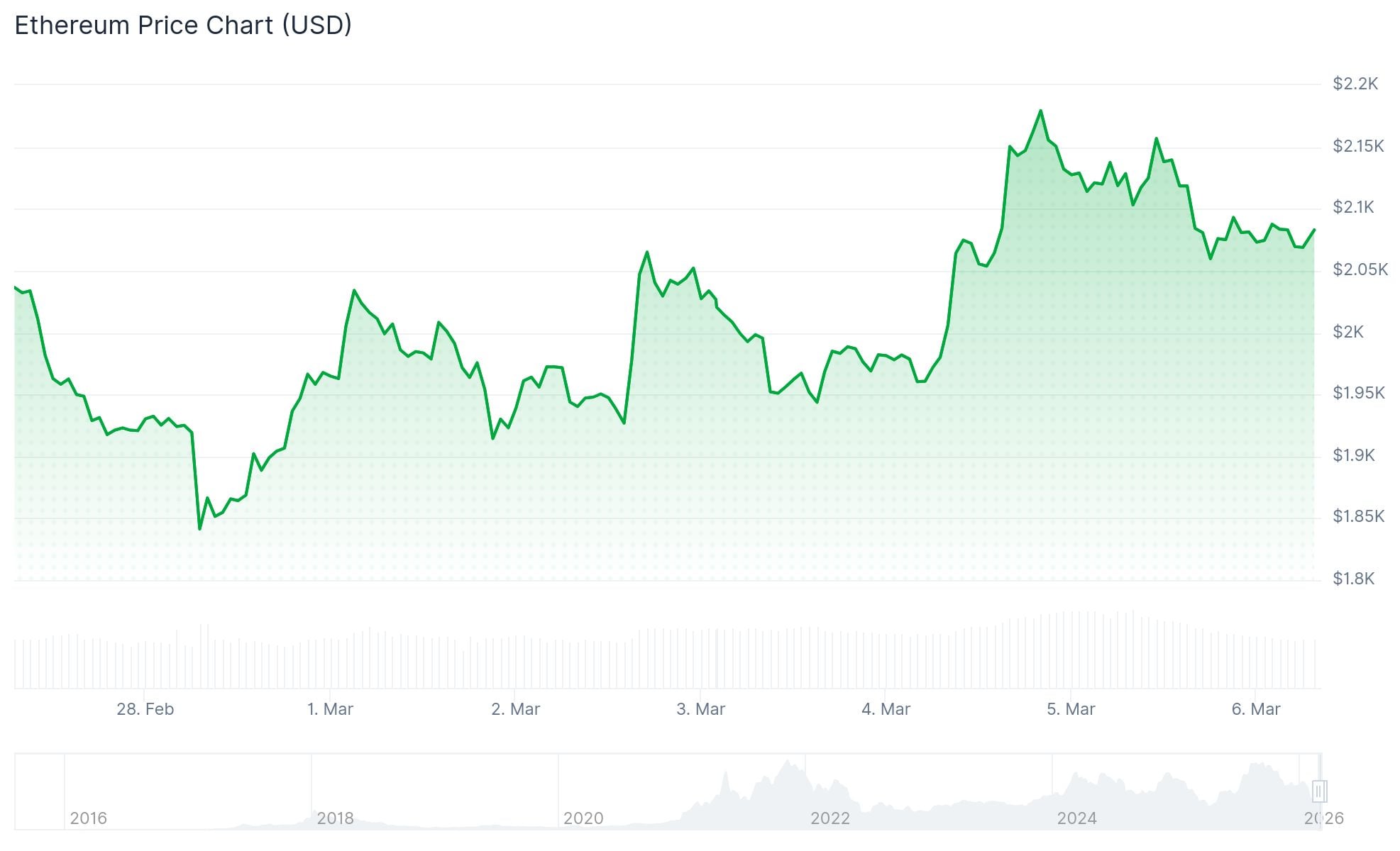
Key Takeaways
- Ethereum declined 6% following a brief rally to $2,200, pressured by US equity market weakness and geopolitical tensions
- Options market skew reached 7%, indicating institutional traders are positioning for potential downside
- US spot Ethereum ETFs experienced combined net outflows totaling $91 million on March 5
- The validator entry queue expanded to 3.4 million ETH, while exit queue contracted to only 58,944 ETH
- Ethereum commands 65% of aggregate blockchain TVL across layer-1 and layer-2 networks, with $55.4B on mainnet
Ethereum is currently exchanging hands near $2,080 following its inability to sustain momentum beyond the $2,200 threshold this week. The pullback occurred amid deteriorating global market conditions, influenced by escalating Middle East tensions and a US judicial decision mandating government repayment exceeding $130 billion in tariff refunds to domestic enterprises.
The second-largest cryptocurrency had mounted an impressive 22% recovery from its February nadir of $1,800, but upward momentum dissipated rapidly. Wednesday’s temporary breach of $2,200 was swiftly followed by a 6% retracement, echoing broader risk-asset selloffs across US markets.
Futures market indicators paint a cautious picture. The 30-day annualized premium for ETH futures contracts remains significantly below the 5% neutral benchmark, suggesting limited appetite for leveraged bullish positions among derivatives traders.
The put-call skew for ETH options expanded to 7% on Thursday. Historical patterns indicate that readings exceeding 6% generally reflect heightened demand for downside protection among sophisticated market participants.
Liquidation data from CoinGlass reveals that ETH traders absorbed $58 million in forced position closures over a 24-hour period, with long positions accounting for $35.7 million of that total.
Institutional Flows and Staking Dynamics
The price deterioration coincided with unfavorable institutional flow data. March 5 witnessed US spot Ethereum ETF products recording aggregate net redemptions of $91 million, signaling a temporary retreat in institutional demand.
This outflow represented a sharp reversal from the more constructive inflows observed during earlier trading sessions in the week, underscoring how rapidly institutional sentiment responds to changing market dynamics.
Meanwhile, network staking metrics present a contrasting narrative. The validator activation queue has ballooned to approximately 3.4 million ETH, while the corresponding exit queue has diminished to merely 58,944 ETH. Prospective validators now face wait times approaching 57 days.
These figures indicate that substantial holders are preferring to stake their ETH for yield generation rather than liquidating positions during market turbulence.
Onchain Metrics and Ecosystem Dominance
Decentralized exchange activity on Ethereum has cooled considerably. Weekly DEX trading volumes contracted to $12.6 billion from $20.2 billion recorded one month prior. Decentralized application revenues similarly declined to $14.1 million over the trailing seven days, representing a 47% month-over-month decrease.
Solana experienced comparable trends, with DEX volumes contracting by 50% across the identical 30-day measurement period.
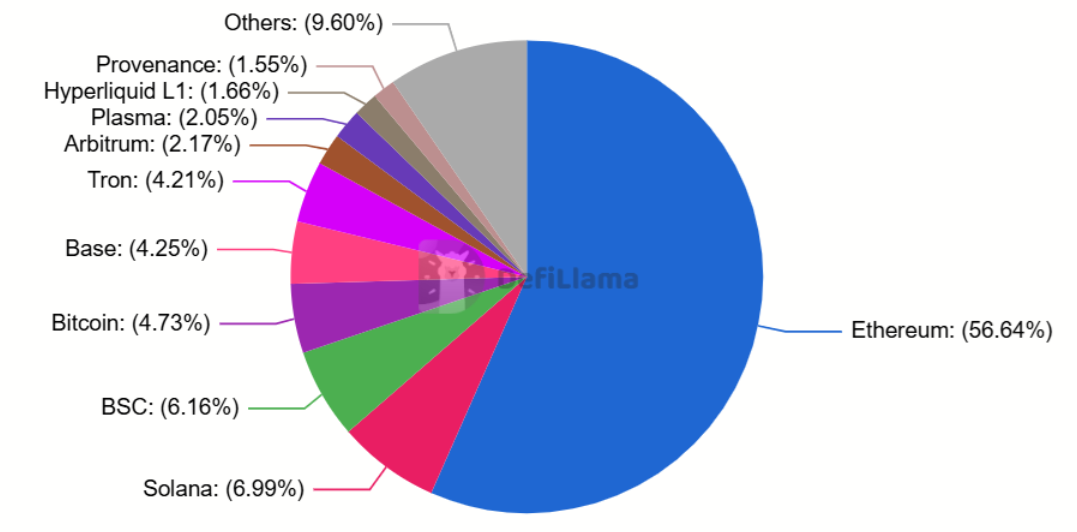
Notwithstanding reduced network activity metrics, Ethereum maintains its commanding position in value locked across the blockchain ecosystem. When accounting for layer-2 scaling solutions, the Ethereum infrastructure captures approximately 65% of total blockchain TVL. The mainnet alone secures $55.4 billion, substantially exceeding Solana’s $6.8 billion.
Technical analysis identifies immediate resistance at the $2,108 level on daily timeframes. A decisive close above this threshold could facilitate a move toward $2,388. Conversely, should support at $1,741 fail to hold, subsequent downside targets emerge at $1,524 and $1,404.
Analysts have identified $1,826 as the lower boundary of the current range structure, representing the next technical attractor should selling pressure intensify in the near term.
Cardano’s native token ADA is drawing renewed attention after the Cardano Foundation announced that the cryptocurrency can now be used for payments at Spar supermarkets across Switzerland, marking a real-world adoption milestone for the blockchain network.
Summary
- Cardano Foundation announced that Cardano can now be used at 137 stores of SPAR in Switzerland, expanding real-world crypto payment adoption.
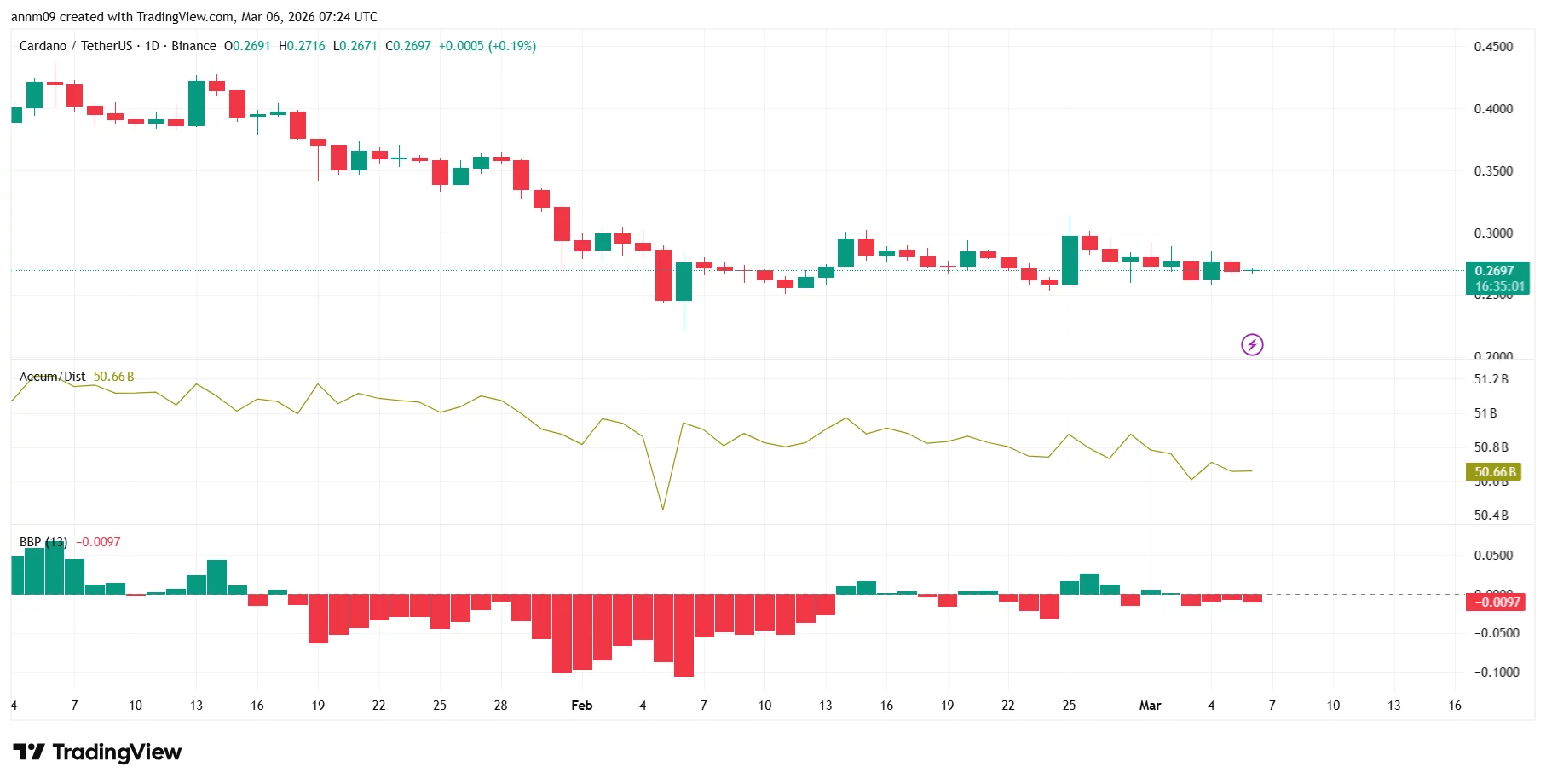
- ADA is trading near $0.27 after weeks of consolidation following a broader downtrend from the $0.40 region earlier this year.
- Technical indicators show weak accumulation and slightly bearish momentum, with key support around $0.26 and resistance near $0.30.
According to the foundation, customers can now pay with the Cardano token (ADA) using a crypto payment integration powered by the OpenCryptoPay gateway, allowing seamless checkout transactions in participating stores.
The rollout makes the Swiss branch of the global retail chain one of the largest supermarket networks in Europe to accept ADA payments.
The initiative reflects Cardano’s broader push toward everyday payment use cases and could help strengthen the network’s reputation as a practical blockchain ecosystem beyond decentralized finance and token speculation.
Retail adoption has historically been a positive sentiment driver for cryptocurrencies, as it signals growing real-world utility. However, the impact on price tends to depend on broader market conditions and investor demand rather than adoption announcements alone.
At press time, ADA is trading near $0.27, showing modest stabilization after a prolonged downtrend that began in early January.
Cardano price prediction after ADA payment rollout across Spar stores
The daily chart shows that Cardano has been trading in a tight consolidation range between $0.26 and $0.30 over the past few weeks following a steep decline from the $0.40 region earlier in the year.
Price is currently hovering around $0.269, with the market forming smaller candles and reduced volatility — a pattern that often precedes a breakout move.
The Accumulation/Distribution indicator, sitting near 50.66B, has been trending slightly downward, suggesting that buying pressure remains limited and that large investors have not yet begun aggressive accumulation.
Meanwhile, the Balance of Power (BOP) indicator remains marginally negative at -0.0097, indicating that sellers still hold a slight advantage in the short term.
Key levels to watch include support near $0.26, which has held multiple times since mid-February. A breakdown below this level could expose ADA to further downside toward $0.24.
On the upside, resistance sits around $0.30, with a stronger barrier near $0.32. A sustained break above these levels could signal the start of a recovery rally if bullish momentum returns to the broader crypto market.
For now, ADA appears to be in a consolidation phase, with traders watching for a catalyst — such as increased adoption or broader market strength — to determine the token’s next major move.
US regulators have clarified that tokenized securities will receive the same capital treatment as their traditional counterparts, saying the rules are “technology neutral.”
The Federal Reserve, the Federal Deposit Insurance Corporation and the Office of the Comptroller of the Currency said on Thursday that they would treat traditional and tokenized securities the same under bank capital requirements.
“The technologies used to issue and transact in a security do not generally impact its capital treatment,” the agencies said.
“An eligible tokenized security should be treated in the same manner as the non-tokenized form of the security would be treated under the capital rule,” the new guidance added.
Under the guidance, financial institutions won’t need to over-collateralize when holding tokenized securities on their balance sheets, as is required when holding unproven and volatile assets.
Many traditional finance companies have shown increasing interest in tokenization, which regulators said prompted them to issue the new guidance.

The agencies said that derivatives referencing an “eligible tokenized security” should also be treated, for capital purposes, as derivatives referencing the non-tokenized form of the security.
The regulators added that tokenized securities are also not affected in their ability to be legally deemed financial collateral, so long as they are liquid and legally owned or controlled by an institution that can sell them if the borrower fails to pay, as part of the terms of a collateral agreement.
“An eligible tokenized security that satisfies the definition of ‘financial collateral’ would qualify as financial collateral for purposes of the capital rule and may be recognized by the banking organization as a credit risk mitigant if all the other relevant requirements in the capital rule are met,” the regulators said.
Related: IRS proposes mandating electronic delivery of tax forms for crypto
Asset tokenization has been a keen point of interest for traditional finance firms, with a long list of heavyweights such as JPMorgan, BlackRock and Franklin Templeton, tipping into the market via investments or infrastructure plays.
One of the major selling points of the space is the ability to trade 24/7 via blockchain, rather than the standard day-trading windows of traditional markets.
Magazine: What’s a ‘Network State’ and are there real-life examples? Big Questions
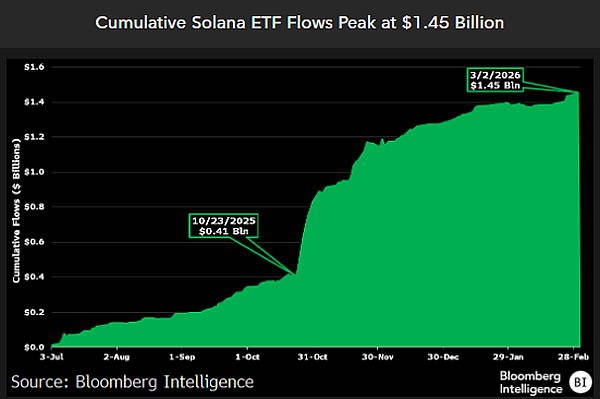
Exchange-traded funds tied to Solana have held on to their early inflows, despite the token having more than halved in price since the funds were launched, which analysts say indicates institutional resilience.
Solana (SOL) is down 57% since Solana ETFs launched in the US in July, but the funds have managed to accumulate $1.5 billion in flows and “not really give any of it up,” Bloomberg ETF analyst Eric Balchunas said on Thursday.
He added that 50% of the inflows to the ETFs are from institutional investors, which Balchunas called a “serious investor base” and a good sign for the future.
Solana ETFs beat Bitcoin on market size basis
Balchunas said that by adjusting Solana’s $50 billion market capitalization to Bitcoin’s (BTC), $1.4 trillion, Solana ETFs have seen the equivalent of $54 billion in net new flows, “which is about DOUBLE where Bitcoin was at the same point.”
Bitcoin had also gained in the months after Bitcoin ETFs were launched, compared to Solana’s price fall, which Balchunas said was “pretty impressive numbers given [the] size and condition of the underlying market.”

Balchunas said that ETFs launching into that kind of market downturn usually make it “near impossible to get inflows.”
“Most wouldn’t even make it to age one or two if they went down 57% in the first six months,” he said. “Solana [is] defying physics here.”
Related: 3 Solana platforms to shutter following devastating $40M hack
Solana ETFs saw their first net outflow day in over a month on Thursday with $6 million exiting the six products, according to CoinGlass. It followed a big net inflow day on Wednesday when $19 million entered the products.
Solana down 70% from all-time high
Solana hit an all-time high in January 2025 amid a memecoin minting frenzy that pushed the token to $293.
Today, it is 70% down from that peak, trading at around $88, having fallen 2.7% on the day and 11% over the past month, according to CoinGecko.

Magazine: Would Bitcoin really be at $200K if not for Jane Street? Trade Secrets

PEI Licensing, the firm behind Original Penguin, has filed a lawsuit in a Florida federal court accusing Pudgy Penguins of trademark infringement, dilution and unfair competition. The complaint argues that Pudgy Penguins’ apparel and branding employ a penguin motif and a family of marks that are confusingly similar to PEI’s federally registered PENGUIN marks. PEI points to a long history with the word mark and penguin imagery—claims the company has used since 1967 (word mark) and 1956 (penguin design on apparel)—and notes a cease-and-desist sent in October 2023 demanding Pudgy Penguins abandon USPTO registrations that resemble PEI’s marks. The dispute sits at the crossroads of traditional IP enforcement and the growing world of NFT-inspired merchandise, underscoring how digital brands are increasingly intersecting with physical goods.
Key takeaways
- PEI Licensing contends that Pudgy Penguins’ use of penguin imagery and the PENGUIN word mark in apparel constitutes infringement, dilution and unfair competition, arguing the marks are confusingly similar to PEI’s established branding.
- The lawsuit was filed in a Florida federal court and seeks sweeping relief, including actions with the USPTO to reject Pudgy Penguins’ trademark applications and to stop further infringement.
- PEI asserts decades of use for its marks, claiming the PENGUIN word mark dates to 1967 and a penguin design on clothing since 1956, bolstering its position on fame and protection against dilution.
- Pudgy Penguins has publicly contested the claims, stating that its marks are visually distinct, target a different audience, and have already received USPTO approvals for multiple applications.
- The case illustrates mounting tensions as NFT-driven communities move into physical goods, raising questions about branding, consumer perception and how the USPTO evaluates cross-domain marks.
Market context: The action sits within a broader trend of traditional IP owners vigilantly defending long-established marks against permutations created by NFT and Web3 brands. As projects push into apparel and lifestyle products, complex questions arise about how to balance protection with the creative expressions that draw communities together in the digital space.
Why it matters
For IP owners, the suit signals a willingness to apply established trademark law to a novel class of products tied to blockchain communities. If PEI succeeds in blocking Pudgy Penguins’ registrations or securing injunctive relief, it could reinforce a framework where decades-old marks are shielded not only from direct counterfeit goods but also from NFT-driven brands that attempt to translate digital identities into tangible merchandise. Such a decision would tilt the risk calculus for NFT projects considering cross-brand collaborations and licensed apparel, potentially encouraging more robust IP screening before launching physical lines.
On the other side, Pudgy Penguins argues that its branding is sufficiently distinct and that it has secured multiple USPTO approvals, which could complicate the path for PEI to demonstrate confusion. The company contends that its audience and market are different from Original Penguin’s, a distinction it believes undercuts PEI’s dilution and infringement theories. The dispute also raises practical questions about how the USPTO evaluates marks that straddle the traditional fashion sector and the evolving Web3 ecosystem, where brand narratives can be built around memes and community-driven imagery rather than conventional fashion houses.
Beyond the courtroom, the case highlights how NFT-native brands increasingly confront IP frameworks that were designed for physical goods and established consumer markets. If the court weighs in on the merits of likelihood of confusion, it could influence future decisions about how aggressively NFT projects pursue trademark protection for marks that sit at the intersection of crypto culture and lifestyle branding. For investors, the outcome may affect how brand licensing strategies are valued in NFT ecosystems—potentially shaping both the attractiveness of licensed collaborations and the perceived risk of dilution for iconic marks used in or alongside digital collectibles.
The dispute also underscores a broader strategic question for creators: when does the protection of a familiar mark justify intervention against a new brand approach that leverages similar visuals? The plaintiff-cum-brand-owner dynamic in this case could serve as a reference point for other NFT projects weighing whether to pursue formal trademark protection for family branding on apparel, or to explore alternative protection strategies that emphasize distinct, non-confusable branding elements while still capitalizing on the appeal of familiar tropes like penguin imagery.
In short, the PEI-Pudgy Penguins case is more than a single litigation. It tests the boundaries of trademark protection in an era where communities can spin up apparel lines quickly around digital assets, and it may influence how quickly regulators and courts adapt traditional IP doctrines to a rapidly evolving branding landscape within the NFT economy.
What to watch next
- Progress of the Florida court case, including any scheduling orders for pleadings or potential motions for preliminary relief.
- USPTO decisions on Pudgy Penguins’ trademark applications, including possible refusals or refusals that could shape the trajectory of the case.
- Any private settlements or public statements that signal a path toward resolution outside the courtroom.
- Subsequent branding initiatives from Pudgy Penguins or other NFT projects seeking apparel licenses might influence how the market interprets IP risk and brand strategy.
- Broader implications for how NFT-based brands structure IP portfolios, especially when expanding into physical goods and lifestyle products.
Sources & verification
- The CourtListener docket for PEI Licensing LLC v. Pudgy Penguins Inc., which outlines the complaint and related filings.
- Public statements from Pudgy Penguins leadership regarding branding and ongoing USPTO filings.
- The October 2023 cease-and-desist letter from PEI to Pudgy Penguins addressing alleged infringement.
- USPTO trademark application records for Pudgy Penguins’ marks cited in the filings.
Trademark clash reshapes NFT IP landscape
In a move that mirrors the growing convergence of fashion branding and blockchain culture, PEI Licensing has brought a formal action in a Florida federal court accusing Pudgy Penguins Inc. of infringing and diluting its long-standing PENGUIN marks. The complaint hinges on two facets: a word mark—PENGUIN—and a penguin design used on apparel. PEI contends that Pudgy Penguins’ branding, which leverages penguin imagery and similar phrasing, risks creating consumer confusion in the market for clothing and related goods. The company emphasizes that its PENGUIN word mark has a long formative history, with first use dating back to 1967 and the penguin design appearing on apparel as early as 1956, asserting that these elements have achieved a level of fame that warrants robust protection against similar use by others.
PEI’s action cites a cease-and-desist issued in October 2023, a document the company says demanded that Pudgy Penguins halt attempts to register PENGUIN marks with the USPTO. The core allegation is that Pudgy Penguins has “misappropriated valuable property rights” by pursuing registrations that could confuse consumers into associating Pudgy Penguins’ products with PEI’s established brand. PEI seeks a broad remedy: court intervention to block Pudgy Penguins’ registrations, to halt ongoing infringement, to destroy products that are likely to cause confusion, and to recover any profits tied to such items. The complaint frames the dispute within classic IP theory—trademark infringement, dilution and unfair competition—applied to a modern context where a digital-native brand seeks to translate a meme-driven identity into tangible merchandise.
Responding to the suit, Pudgy Penguins’ chief legal officer, Jennifer McGlone, told reporters that the company remained surprised by the action, noting that discussions toward a private resolution had been ongoing. She argues that Pudgy Penguins’ marks are visually distinct, target a different audience, and have already secured USPTO approvals for multiple applications, suggesting that PEI’s claims lack merit. The company further pointed to a social-media post as evidence of a clear separation from Original Penguin’s branding, attempting to frame the dispute as a misalignment of audiences rather than a direct encroachment.
The unfolding case spotlights a broader debate about how traditional IP frameworks adapt to the NFT era. As projects move from purely digital assets into physical goods—think apparel and accessories—mark owners must decide how aggressively to defend their portfolios. A ruling in PEI’s favor could reinforce protections against cross-brand apparel lines that resemble established labels, potentially slowing similar collaborations, while a decision for Pudgy Penguins might signal a degree of latitude for NFT–driven brands to leverage iconic imagery without encroaching on long-standing fashion trademarks. The CourtListener docket associated with the complaint offers a window into the procedural posture, including requests to direct the USPTO to reject registrations and to halt further use of marks likely to be confused with PEI’s branding.
Ultimately, this dispute is about more than a single brand’s legal rights. It reflects the evolving expectations of brand protection in a landscape where online communities can rapidly translate digital fame into real-world products. Outcomes could influence how NFT projects plan licensing strategies, assess IP risk, and structure their branding to preserve the trust and loyalty of their communities while navigating traditional trademark scrutiny. As the case progresses, observers will watch not only for a potential settlement but for how the court interprets the balance between protecting a venerable, historic mark and recognizing the creative expressions that drive the NFT ecosystem forward.
Recent business landscape shifts have forced companies to rethink financial management. Remote work, global teams, scattered suppliers — all demand fast, cheap, transparent settlements. Traditional banking works, sure, but often feels like shipping packages by postal carriage in the drone era. That’s why businesses increasingly seek alternatives enabling settlements without intermediaries and currency conversions within minutes.
This piece isn’t about financial miracles or tech wonders. Rather, it’s about building smart payment infrastructure, cutting fees, speeding operations while staying legally compliant. We’ll examine real tools (from classic methods to cutting-edge solutions) and identify where hidden costs lurk.
Anatomy of Corporate Payment Expenses
When Airbnb was gaining momentum, the company faced a challenge: paying hosts across 190+ countries. Bank transfers took 3–7% commission plus several days. The solution became a proprietary payment system — a path later echoed by modern crypto solutions for business, though not every company can afford or justify such investment.
Typical cost structure looks like this: payment system fees (1.5-3.5%), currency conversion (another 2-4% on unfavorable rates), interbank charges ($15 to $50 per SWIFT), internal processing costs (accounting salaries, software). Annually, an average company with €10M turnover might spend up to €350K just on transactional expenses.
Stripe published a 2023 study showing businesses underestimate real payment costs by 40-60%. Hidden expenses include chargebacks, fraud, human error during manual entry, cash flow delays. One mistaken $100K payment can paralyze a department for a week.
Classic Banking: Where Money Gets Lost
Picture a Polish IT company paying contractors in the US, India, and Portugal. Through SWIFT, transfers take 3-5 days, passing through 2-3 correspondent banks, each taking $25-40. Exchange rates set by banks with their own markup. Result: from $5,000 sent, the recipient gets $4,820. The rest vanishes in fees.
An alternative — systems like Wise (formerly TransferWise) — use local accounts to simulate international transfers. Instead of physically moving money across borders, the company sends zloty to Wise’s Polish account, while the recipient gets dollars from their US account. Fees drop to 0.4-1%, timing to one day.
Revolut Business went further, offering multi-currency accounts holding 28 currencies simultaneously. For companies with constant multi-currency settlements, this means buying euros or dollars during favorable rates, not when payment’s due.
Yet classic systems have limits. Payments to certain countries (Argentina, Nigeria, partially Turkey) remain complicated due to currency controls. Weekends and holidays paralyze SWIFT. Most importantly, even modern neobanks still operate within fiat system limitations.
Cryptocurrency Rails: When Speed Matters
When Tesla announced accepting Bitcoin, that was more PR than business strategy. But there are spheres where cryptocurrencies solved real pain points. GameStop launched an NFT marketplace in 2022 not for hype, but to monetize digital assets without intermediaries.
Practical applications run deeper than they appear. Companies use stablecoins (USDT, USDC) for rapid international settlements. Transferring $100K in USDC between Berlin and Toronto takes 15 minutes and costs $2-5, regardless of amount. Particularly relevant for e-commerce: stores can accept payments globally without configuring local payment gateways in each country.
Ripple (XRP) was specifically created for banks — JPMorgan, Santander and others test it for interbank settlements. Settlement speed: 3-5 seconds versus 3-5 days with SWIFT, fees: fractions of a cent. Mass adoption hasn’t happened yet due to regulatory uncertainty.
Businesses need to understand: cryptocurrencies aren’t fiat money replacements, but additional tools. Bitcoin or Ethereum volatility makes them unsuitable for daily settlements without instant conversion. Yet for payments to freelancers in countries with limited banking (Venezuela, Zimbabwe), sometimes it’s the only option.
Multi-Chain Solutions and Their Role
Previously, transferring between different blockchains was a quest: exchange Bitcoin for Ethereum through an exchange, withdraw to wallet, wait for confirmations. Modern cross-chain crypto swaps like those offered by LetsExchange have automated this process, allowing direct asset exchanges between different networks without centralized intermediaries.
Thorchain, Cosmos, and Polkadot built infrastructure for blockchain interaction. Practical business benefit: accept payments in one cryptocurrency, make payouts in another, optimizing fees. For instance, receive USDT on Tron network (fee $1), swap to USDC on Polygon (fee $0.01), and withdraw through Ethereum when gas is cheaper.
Uniswap V3 allows companies to independently provide liquidity and earn from exchange commissions. Some fintechs use this as an additional revenue source: account balances work instead of just sitting idle.
Important nuance — regulatory. The European MiCA (Markets in Crypto-Assets) will take full effect from late 2024, establishing clear rules for crypto business. Companies should consult lawyers before implementing crypto products.
Automation and API Integrations
Shopify processes billions annually, and the key to efficiency is complete automation. Each payment automatically reconciles with invoices, splits between seller and platform, reserves for possible returns. Human intervention only occurs when problems arise.
Modern payment gateways provide APIs for integration with ERP systems (SAP, Oracle), CRM (Salesforce), and accounting (QuickBooks, Xero). This eliminates manual data entry — the main error source. When a client pays an invoice, the record automatically enters accounting, updates inventory, triggers shipping processes.
Plaid built an entire business on connecting financial systems. Through their API, apps can check balances, initiate payments, reconcile transactions without logging into each bank separately. For companies with dozens of accounts across different banks, this proves critical.
Artificial intelligence began analyzing payment patterns. Algorithms detect anomalies (unexpected large payments, new recipients), warn about possible fraud, forecast cash flow. Visa and Mastercard use ML models to block fraudulent transactions before completion.
Geographic Peculiarities and Local Methods
What works in the US can fail in Asia. WeChat Pay and Alipay control 94% of China’s online payment market. Western companies entering the Chinese market must integrate these systems, though they fundamentally differ from familiar card payments.
Latin America lives on Pix (Brazil) and Mercado Pago (Argentina, Mexico). Pix — a state instant transfer system launched by Brazil’s Central Bank in 2020. Within three years, 140+ million users registered. Transactions are free, instant, work 24/7. For business, this means zero fees on receiving payments.
Africa built a unique mobile money ecosystem. M-Pesa (Kenya, Tanzania) processes more transactions than Western Union worldwide. People pay utilities, receive salaries, take microloans — all through SMS, without bank accounts. International companies adapt systems to such realities.
Even within Europe, differences are significant. Germans dislike credit cards, preferring SEPA transfers and cash. Netherlands lives on iDEAL (direct bank payments). Scandinavia nearly abandoned cash. Global strategy must account for local specifics.
Security and Compliance: Invisible Costs
Equifax lost data on 147 million clients in 2017 through an unpatched vulnerability. Compensation cost $1.4 billion. Security investments seem like expenses until you become a hack victim.
PCI DSS (Payment Card Industry Data Security Standard) — minimum requirements for companies processing card data. Certification costs $5K to $500K depending on volumes. But the alternative is worse: data breach fines reach $100K plus card acceptance bans.
KYC (Know Your Customer) and AML (Anti-Money Laundering) — not just bureaucracy. For violations, the European Banking Authority fines millions of euros. HSBC paid $1.9 billion in 2012 for AML requirement breaches. Compliance automation through services like Onfido or Jumio saves money long-term.
Two-factor authentication, biometrics, card data tokenization — standards that became cheaper in recent years. Google Authenticator is free but reduces hack risk by 96%. Tokenization replaces real card numbers with one-time codes — if intercepted, they’re worthless.
Practical Steps Toward Optimization
Auditing current systems is the first task. How much does each transaction type cost? What’s average speed? How much time does accounting spend on reconciliation? Buffer reduced payment processing time from 40 hours monthly to 2 hours simply by switching from manual transfers to automated systems.
Provider diversification reduces risks. If the main payment gateway crashes (Visa and Mastercard had outages in 2018 and 2022), backup picks up the load. Plus you can switch between providers depending on fees for specific regions.
Fee negotiations work. Payment systems are willing to lower commissions for stable clients with predictable volume. One European marketplace reduced acquiring from 2.8% to 1.9% simply by showing annual statistics and inviting competing offers.
Team training investments pay off. Finance professionals need to understand the difference between SEPA Instant and SEPA Credit, know when to use cryptocurrencies versus traditional rails. Shopify Academy teaches payment basics for free — such resources are available to everyone.
Future of Payment Systems
Central banks are launching their own digital currencies (CBDC). Bahamian Sand Dollar has operated since 2020, Chinese digital yuan tests in millions of transactions, ECB plans digital euro by 2028. For business, this could mean instant settlements without intermediaries at all — payment goes directly from company account to recipient’s Central Bank account.
Open Banking forces banks to share data through APIs. In the EU, this is already reality thanks to PSD2. Result — apps like Revolut or N26 can show balances from all banks, initiate payments, build analytics. Traditional bank monopoly crumbles.
Quantum computers threaten modern encryption. IBM and Google work on post-quantum cryptography. Companies should monitor developments — in 5-10 years, entire security infrastructure will need updating.
Embedded finance makes financial services part of non-financial products. Uber doesn’t just call taxis but also credits drivers. Shopify issues business loans to sellers based on sales. Tesla allows buying electric cars on credit without banks. The blurring of lines between fintech and regular business will only intensify.
Cutting Costs Without Disruption
Operational payment costs aren’t fixed. Every company can reduce them by 20-40% without radical changes. An audit, choosing the right tools, and constant optimization suffice. The financial world changes rapidly, but basic principles remain: transparency, speed, security, and reasonable cost. The rest is finding balance between innovation and stability.


Short-selling firm Culper Research says it has taken a bearish position against Ethereum’s native token and companies closely tied to it, arguing that the blockchain’s economic model is deteriorating following recent network changes.
Summary
- Culper Research disclosed a short position against ether and ETH-linked stocks, including BitMine.
- The firm argues Ethereum’s fee revenue has collapsed, weakening the network’s economic incentives.
- Culper claims some network activity metrics may be inflated by spam transactions such as address-poisoning and dusting.
Short seller Culper targets Ethereum and BitMine in bearish report
In a report published March 5, Culper disclosed it is shorting Ethereum (ETH) as well as equity linked to the asset, including BitMine Immersion Technologies, a firm that has built a large treasury position in the cryptocurrency.
The report argues that Ethereum’s recent upgrades, designed to increase block capacity and reduce transaction costs, have had an unintended consequence: sharply reducing fee revenue that supports the network’s validator incentives.
Culper said Ethereum’s fee generation has collapsed in recent months, undermining the narrative that the network’s tokenomics are strengthening over time.
Ethereum’s fee revenue has collapsed, and with it the economic engine that once justified ETH’s valuation, the report stated.
According to the firm, the drop in fees is eroding staking yields for validators, potentially weakening long-term incentives to secure the network. Culper described the dynamic as a possible “death spiral,” in which falling economic rewards discourage participation while further undermining network security and investor confidence.
The report also singles out BitMine, which has accumulated millions of dollars worth of ether as part of a corporate treasury strategy. Culper argues the company’s valuation is heavily tied to the price of ETH and could face significant downside if the cryptocurrency continues to struggle.
Culper’s report also highlights recent on-chain transactions from wallets associated with Buterin, arguing that the Ethereum co-founder has sold tens of thousands of ETH this year, which the firm says undermines bullish narratives around the asset.
“Vitalik is selling, while bulls like Tom Lee are clueless as to ETH’s new reality,” the report said. “We’re with Vitalik.”
Culper also pushed back on bullish interpretations of rising Ethereum transaction counts and address activity, arguing that some of the increase may stem from spam-like on-chain activity such as address-poisoning or dusting transactions rather than organic user growth.
The short thesis arrives amid a period of volatility for crypto markets, with Ether and other major digital assets facing renewed scrutiny over their long-term economic models as scaling upgrades and layer-2 adoption reshape the blockchain ecosystem.

BBC speaks to Iranians at border with Turkey
FTSE 100 today: Stocks open higher as Middle East conflict keeps markets on edge

Arthur Hayes Predicts Fed Money Printing From US-Iran Tensions Could Propel Bitcoin (BTC) Higher


-

 Politics3 days ago
Alan Cumming Brands Baftas Ceremony A ‘Triggering S**tshow’
-

 Fashion7 days ago
Weekend Open Thread: Iris Top
-

 Tech5 days ago
Unihertz’s Titan 2 Elite Arrives Just as Physical Keyboards Refuse to Fade Away
-

 NewsBeat5 days ago
Abusive parents will now be treated like sex offenders and placed on a ‘child cruelty register’ | News UK
-
 NewsBeat6 days ago
Dubai flights cancelled as Brit told airspace closed ’10 minutes after boarding’
-
Sports6 days ago
The Vikings Need a Duck
-
 NewsBeat6 days ago
The empty pub on busy Cambridge road that has been boarded up for years
-

 NewsBeat5 days ago
‘Significant’ damage to boarded-up Horden house after fire
-

 Tech1 day ago
Bitwarden adds support for passkey login on Windows 11
-

 Entertainment4 days ago
Baby Gear Guide: Strollers, Car Seats
-
 Sports14 hours ago
499 runs and 34 sixes later, India beat England to enter T20 World Cup final | Cricket News
-
 Tech7 days ago
NASA Reveals Identity of Astronaut Who Suffered Medical Incident Aboard ISS
-
Politics5 days ago
FIFA hypocrisy after Israel murder over 400 Palestinian footballers
-
 NewsBeat5 days ago
Emirates confirms when flights will resume amid Dubai airport chaos
-

 NewsBeat4 days ago
Is it acceptable to comment on the appearance of strangers in public? Readers discuss
-

 Tech5 days ago
Viral ad shows aged Musk, Altman, and Bezos using jobless humans to power AI
-

 Video4 days ago
How to Build Finance Dashboards With AI in Minutes
-

 Business2 days ago
Guthrie Disappearance Enters Fifth Week as Family Visits Memorial
-
 Crypto World5 days ago
US Judge Lets Binance Unregistered Token Class Action Proceed
-
 NewsBeat4 days ago
Ukraine-Russia war latest: Belgium releases video showing forces boarding Russian shadow fleet oil tanker