


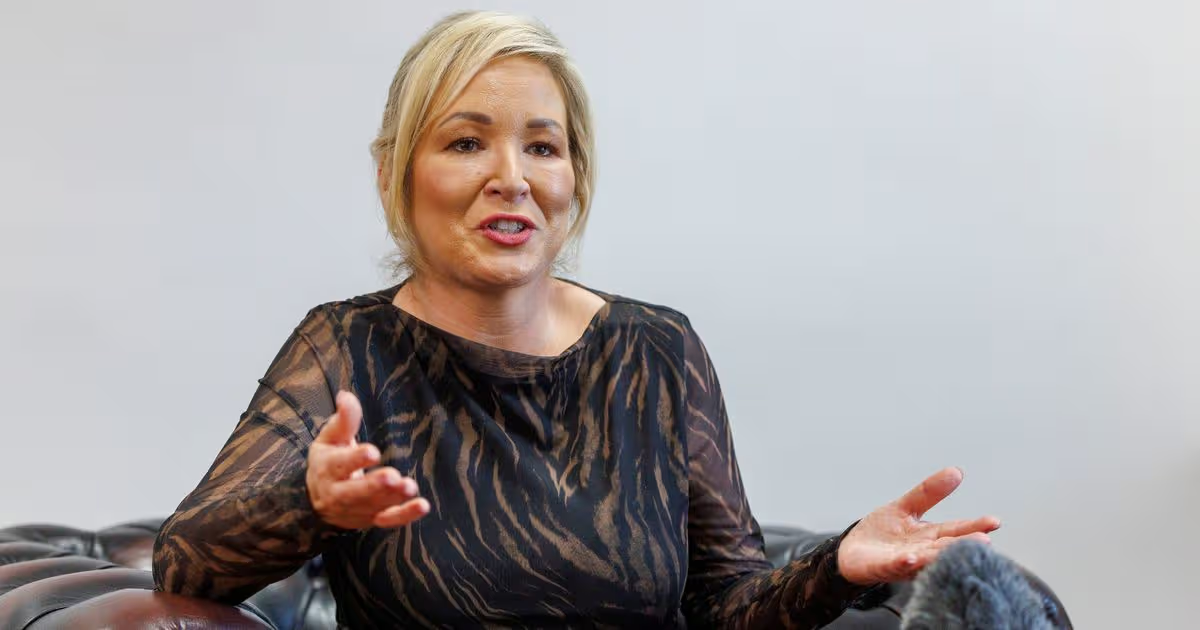
Speaking ahead of International Women’s Day on Sunday, Michelle O’Neill praised the uplift in women “stepping into the political world”, but said too many still face online abuse ranging from comments on their appearance to threats of physical or sexual violence
Stormont’s First Minister has described the “gendered lens” through which her and deputy First Minister Emma Little-Pengelly are criticised.
Speaking ahead of International Women’s Day on Sunday, Michelle O’Neill praised the uplift in women “stepping into the political world”, but said too many still face online abuse ranging from comments on their appearance to threats of physical or sexual violence.
She served as the first female mayor of Dungannon and South Tyrone council from 2010 to 2011 and was the first woman to become deputy first minister in 2020, serving alongside Baroness Arlene Foster, the first female first minister.
Ms O’Neill said her more than 20 years in politics is a “significant time to witness an awful lot of change” and comparing the political world in 2026 to her time in Dungannon council is “day and night actually”.
Of Sinn Fein’s 27 MLAs in the Northern Ireland Assembly, 16 are women, a fact Ms O’Neill said she was proud of, but that there is still a “journey to be travelled”.
“I think that there’s a very ugly climate, and we could describe it at times for women in politics, I think people in politics in general, but women in particular, face an awful lot of misogyny, and it’s not just online,” she told the Press Association.
“We talk a lot about what we receive online, but I, even this week in preparation for International Women’s Day, was speaking to my own team of female MLAs, and you see some of the stories that they have told me of their experience of being a female elected representative – it is scary.
“These are young mothers, in some cases, who have been accosted by people on the street. They regularly feel the pressure from the online abuse… people who think it’s fine to attack them with threats of sexual violence, with physical threats, and it makes a real chilling factor, I think, for women coming forward into politics.”
She added: “As First Minister, I see, even in the Assembly chamber here, a real creeping, real negative commentary and quite an aggressive tone being demonstrated by some of the male elected Assembly members.
“I don’t think that’s a nice space. Let’s disagree where we disagree. Let’s agree where we can also, but don’t be introducing an atmosphere where it becomes a real chill factor, where someone thinks ‘I don’t want to be a part of that’.”
Ms O’Neill is currently serving as First Minister alongside Ms Little-Pengelly, DUP MLA for Lagan Valley, and she said there is “more of a gendered lens to the questions we get asked at times”.
“I don’t recall even whenever Martin McGuinness and Peter Robinson were first and deputy first minister, I don’t recall people focusing on the nature of their relationship,” she said.
She acknowledged herself and her partner in the Executive Office “come from two very different backgrounds, two very different outlooks on life, and two very different outlooks where we think we should be in the future in terms of the constitutional question”.
“But the job for us to do here is actually to work together politically, to lead in the Executive, to try to deliver positive things and make a difference to people’s lives,” she said.
“And that’s where we should be questioned in terms of the policy choices, in terms of what we’ve been able to achieve here and what we’re able to deliver for people, as opposed to, ‘are you mates?’, ‘Do you get on?’, ‘Do you text each other?’ which sometimes, often becomes the starting point for a lot of the questions that women in politics get asked.”
According to Women’s Aid since 2020, 28 women in Northern Ireland have been killed by men and the region is consistently flagged as having one of the highest rates of femicide in Europe.
Legal proceedings are currently ongoing into the murders of 21-year-old Chloe Mitchell and 32-year-old Natalie McNally, who was 15 weeks pregnant when she was killed.
The Executive’s Violence Against Women and Girls Strategy, introduced in 2024, aims to tackle this culture through prevention programmes in schools, stronger protections and support services for victims, and co-ordinated multi‑agency action to reduce gender‑based violence.
Ms O’Neill pledged that strategy would be a priority for her on the return of devolved government and she said she has “lived up to that commitment”.
“I actually feel really, really proud of the work that we have started around ending violence against women and girls,” she said.
“The reality is, unfortunately, that we’re not going to turn this over overnight, but we are making progress and even I’ve just come from an International Women’s Day event, and a lot of the groups were talking to me about the positive work that they’re doing on the ground, speaking to young people.
“We have to change that attitude in society and that’s not just down to us as women. That’s down to everybody in society. Everybody has a part to play.
“I think in terms of the Natalie McNally trial, a beautiful young woman, when you think about Chloe Mitchell and her family, young women are looking at that and thinking, ‘how horrendous is that and that happened in our place, this is our home’.
“And that would make some women, young women, feel naturally unsafe, but I would say to everybody, we’re entitled to be safe, to feel safe and to be safe.”
Want to see more of the stories you love from Belfast Live? Making us your preferred source on Google means you’ll get more of our exclusives, top stories and must-read content straight away. To add Belfast Live as a preferred source, simply click here.