
Connect with us

NewsBeat

Hundreds of people break fast together at York Mosque

Published

on

Hundreds of people break fast together at York Mosque

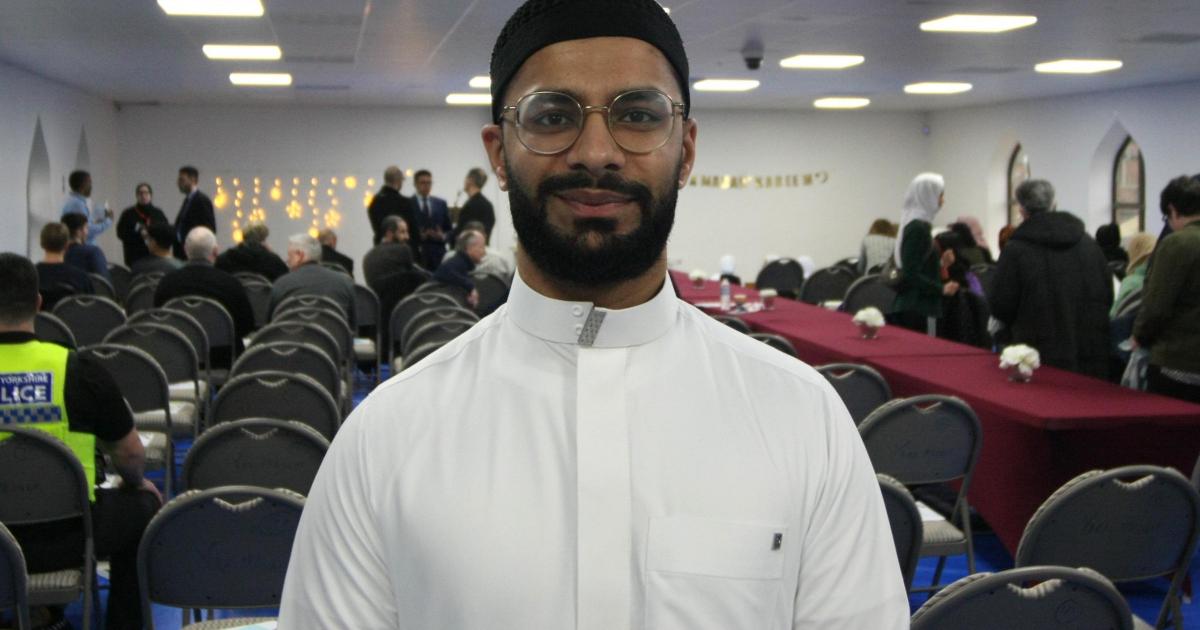
More than 500 people from across York’s communities gathered at the mosque in Bull Lane, off Lawrence Street, for the Ramadan Iftar on Saturday evening (March 7).

It came as Muslims across the country held iftars – the fast-breaking evening meal – on Saturday to mark entering the final 10 days of Ramadan.

Faizal Mohamudbuccus, ambassador for York Mosque, said Saturday’s event was a chance for the place of worship to get together with its wider community during the holy month of Ramadan.

From left, City of York Council leader Cllr Claire Douglas, Faizal Mohamudbuccus, Rachael Maskell MP along with North Yorkshire Police officers and members of the mosque (Image: Dylan Connell)

“With the times that we’re in at the moment, it’s important that we present as one community, on one front, speaking the same language,” he said.

Advertisement

“It’s of paramount importance to show that we’re in solidarity with one another and we’re here for the city of York.

“We are representing York and we want York to be a diverse, multicultural city that accepts everybody and anybody.”

York Mosque where hundreds of people gathered on Saturday evening (March 7) for the Ramadan Iftar (Image: Dylan Connell)

He added that the iftar was an “opportunity for us to share with the public why we fast, the benefits of fasting and what we get out of fasting”.

Mr Mohamudbuccus said Ramadan offers a chance to reflect. “It’s about seeing the kind of person that you are and how you help others.

Advertisement

“It also makes you appreciate what you have compared to other people who are less fortunate around the world.”

‘More and more people come every year’

Imam Ammar Sacha said it was “very heart-warming” that hundreds of people had attended the iftar.

“More and more people come every year,” he said. “It’s a time when the community aspect gets to really be on show, especially in a place like York where we know we have diverse backgrounds and people from all walks of life.

“To see everybody come and show solidarity with each other … it’s very, very nice to see.”

Advertisement

The imam said the event came days after the Archbishop of York joined those at the mosque to break fast.

“He [the archbishop] comes down every year,” Mr Sacha said. “It was nice having him, we had a good chat.”

Preparations underway to break fast during the Ramadan Iftar at York Mosque on Saturday evening (March 7) (Image: Dylan Connell)

The imam added: “We’re constantly trying to make sure that people know what’s happening at the mosque – we’re no different to anyone else.

“We’re opening our doors and having that sense of transparency – but also just showing the mosque is more than a place of worship, it can be a community hub as well.”

Advertisement

Among those in attendance on Saturday were Rachael Maskell MP, the Lord Mayor of York and City of York Council’s executive members.

Ms Maskell hailed the event as a chance to “break down the barriers that are often erected between different cultures”.

“It’s extremely important that the community can come in and meet with the community here and understand what drives this community forward in the heart of our city,” the York Central MP said.

“Some people would never set foot inside a mosque – and may not understand what actually happens [inside], or the values that Muslims hold.

Advertisement

“When they come here, they will learn the essence of the Muslim faith and how that drives the community to serve our city for everybody.”

Source link

Advertisement
Continue Reading
Click to comment

Leave a Reply

Your email address will not be published. Required fields are marked *

NewsBeat

What the UK’s ‘day of reflection’ reveals about COVID memory

Published

on

What the UK’s ‘day of reflection’ reveals about COVID memory

A couple of years ago I dug up an artefact buried under soil, grass and leaves in a park close to my home in Exeter. It was not some ancient object but rather a granite memorial plaque laid down by the local city council only three years before. Dedicated to regional victims of the COVID pandemic, it had been created, forgotten and swallowed by the ground in swift succession.

This illustrates our conflicted relationship with remembering the pandemic in Britain. The urge to memorialise sits awkwardly alongside forces of forgetting and indifference. COVID killed over 230,000 people in the UK and had profound effects on health, wellbeing, child development and economic stability. Yet many people treat it with the ambivalence of waking from a strange dream.

Following its official response to the UK Commission on Covid Commemoration late last year, the British government is now formally stepping into this slippery space of remembering and forgetting. March 8 has been designated as a day of reflection on the pandemic, with the Department for Culture, Media and Sport taking the lead.

Advertisement

And yet how much difference will this day make? What media coverage will it receive? How much public appetite is there for it? In my own work on British remembering and forgetting of the pandemic, I have found much evidence of uncertainty about what should be remembered, who should be centred and when commemoration ought to begin.

Despite the death toll and social consequences, public memory of the COVID pandemic has been marked by hesitancy about what should be remembered, when commemoration should happen, who it should involve and how it should be enacted.

A key challenge is the absence of a unified narrative. Pandemic experiences ranged from bereavement, illness and profound suffering in lockdown to mild inconvenience or even a welcome respite from normal life. Depending on luck and the situation with which you entered into the pandemic, it was anything from deeply traumatic to something people are quietly nostalgic about.

When I asked for short public recollections of the period, I received stories of loss, disrupted lives and exhausted health workers, but was also inundated with descriptions of birdsong and country walks. The responses were later compiled into an online audiobook. Public memory of the pandemic has to find a way of holding these incongruities together.

Advertisement

The day of reflection also has a disorientating relationship with time. COVID had no neat end point, no convenient armistice day around which to orient ourselves. The question of when public remembrance should begin was therefore unclear. Some informal memorials were created not long after the pandemic started, but when the government launched the UK Commission on Covid Commemoration in 2022, it was criticised for being too soon. In reality there is probably no perfect moment for public memorialisation, with the time always feeling either too early or too late for different people.

The question of who should organise remembrance is equally fraught. The state’s slow response to recommendations from the UK Commission on Covid Commemoration has been shaped in part by an awareness that this is politically sensitive terrain. Perhaps remembrance should not be led by the state at all. The grassroots activist group COVID-19 Bereaved Families for Justice UK created the National Covid Memorial Wall in London, and the bereavement charity Marie Curie oversaw earlier versions of the day of reflection.

Focusing collective recollection solely around loss of life nonetheless leaves major gaps in terms of the variety of people’s experiences. But there are also risks in wholly levelling the playing field. The loss of a loved one is not equivalent to Zoom quizzes and sourdough baking. Nor should collective memory erase the extent to which the pandemic’s impacts were systemically uneven, with higher mortality rates in some ethnic minority communities.

Advertisement

Remembering through the lens of war

The day of reflection also sits awkwardly alongside existing patterns of how British people remember. These habits are most prominently shaped by rituals of war memory. The various memorial spaces associated with fundraiser and veteran Captain Sir Tom Moore emerged partly because he so neatly fused thoughts of COVID and the second world war.

But the pandemic was not much like a military conflict. While there were praiseworthy instances of public service, most deaths did not fit a narrative of heroic sacrifice, the virus was not an ideological or national enemy, and comparisons between prime ministers Boris Johnson and Winston Churchill have not endured.

Despite the difficulties of what is remembered, when it should happen, who should lead it and what form it should take, there has been an abundance of memorial creation since 2020.

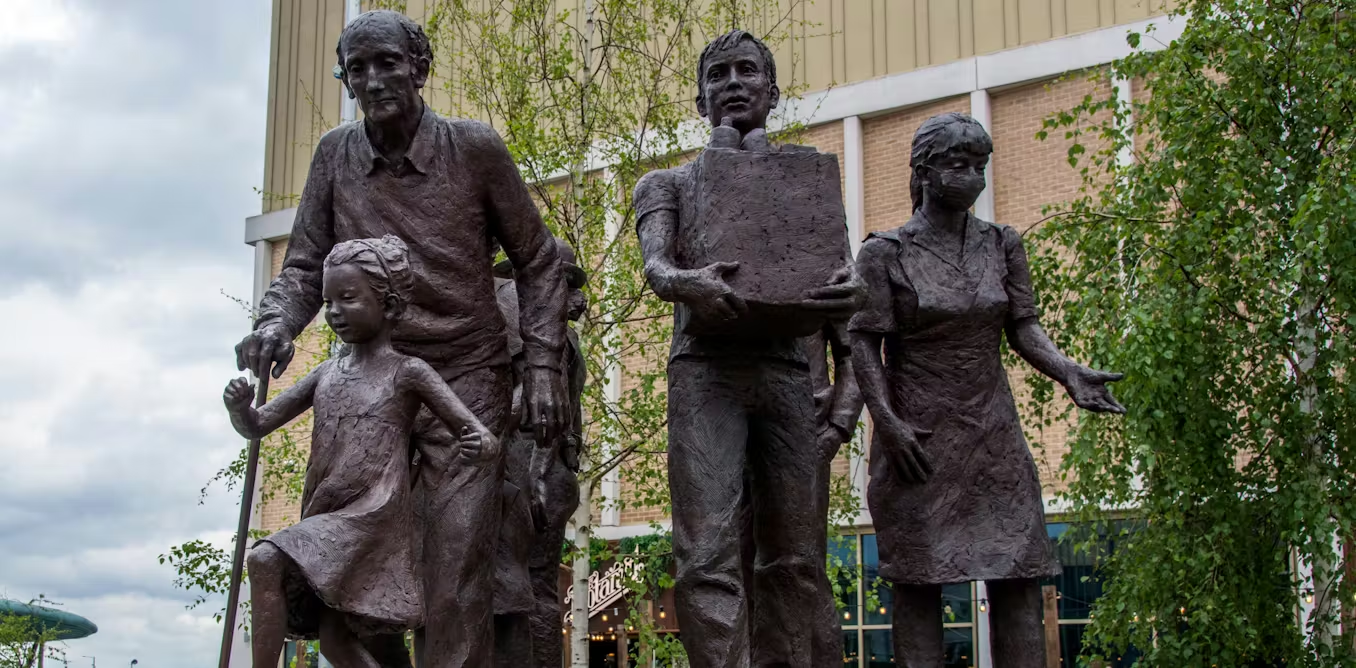
When researching a book on the topic, I visited one built high up a Welsh mountain. I saw one constructed elaborately from wood and later ceremonially set ablaze. Another was framed as a defiant celebration of working-class heroism. One depicts exhausted medical staff cast in bronze. There were many others. Their narratives, forms and origins vary considerably, but what they share is a tenuous grasp on public consciousness. Generally they are little known and, in some cases, their long-term survival is uncertain, dependent on funding, maintenance or continued public interest.

Advertisement

The March 8 day of reflection will not settle the question of how Britain remembers or forgets COVID, but it will reveal how willing we are to try. Any national act of remembrance will only feel meaningful if it can hold together grief, inequality and ambivalence without pretending they are the same.
Source link

Advertisement
Continue Reading

NewsBeat

‘I learned to walk again after being shot 9 times – now I’m helping others follow their dreams’

Published

on

'I learned to walk again after being shot 9 times - now I'm helping others follow their dreams'

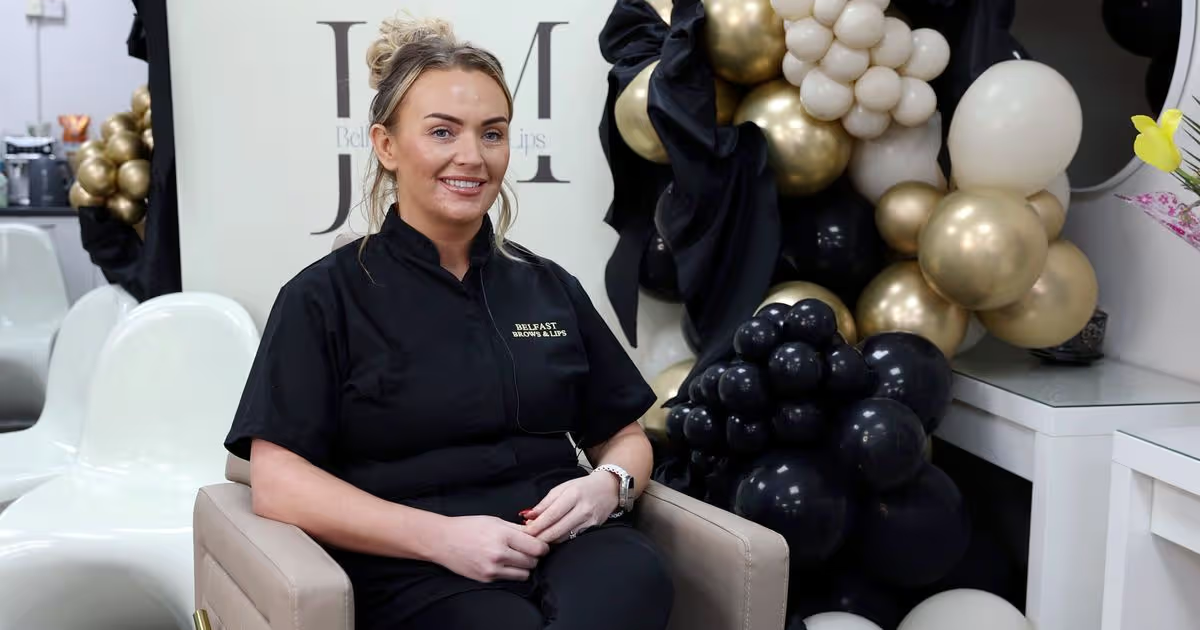
A woman from East Belfast who was shot nine times and “left for dead” has now set up a beauty training salon to help other women follow their dreams.

Jemma McGrath was attacked in September 2013 and underwent one of the longest operations ever carried out at the Royal Victoria Hospital in Belfast. She was left with a broken arm, broken leg, and pins and screws holding her body together.

The now 36-year-old admitted to using drugs in her youth, and previously said she let her life spiral out of control after her dad’s death. After the shooting, she suffered post-traumatic stress disorder which gave her such severe panic attacks she thought she was dying.

READ MORE: Belfast shooting victim Jemma McGrath’s business success celebrated by RoyaltyREAD MORE: East Belfast woman shares secret to a long happy life as she marks 100th birthday

Advertisement

Jemma had to rebuild everything from the ground up, including having to learn how to walk again after being in a wheelchair for months. Now, she is working hard to empower young women and give them a chance to become self-employed through her new training beauty salon on the Shankill Road, Belfast Brows & Lips.

Speaking to Belfast Live, Jemma reflected on being shot 13 years ago, as well how it led to her turning her life around.

She said: “In 2013 I was shot nine times, which left me fighting for my life. I had to learn to walk again, with pins and bolts holding my whole body together, and scars from head to toe.

“For other people that would probably be the end of the road – but for me it was just the beginning. It gave me the determination to create the life I have today.

Advertisement

“I was in a wheelchair for three months and then obviously the mental side of recovery was tough too, but I’ve always been very positive and determined. If I’m really honest with you, I don’t know I would have had the determination that I’ve got today if that hadn’t happened.

“I’m actually a bit emotional when I look back because I literally feel like I’ve created the life I want, where I’ll jump out of bed an hour early for work. After all the hard work, stress, and everything I’ve been through it feels amazing to get to this stage.”

In 2018, Jemma won the Prince’s Trust award for the most innovative business in Northern Ireland and since then has worked with groups such as the Training for Women Newtork (TWN) and the Women Involved in Community Transformation programme.

Through this, she was put through qualifications to be able to teach others the beauty treatments she is passionate about. In the years since, she has taught 130 girls in brows and other treatments, and will soon be offering regulated courses in aesthetics and diplomas in semi-permanent makeup.

Jemma said she is delighted to be able to give back to the community, and help get women onto a good path, working towards being their own bosses.

“It’s amazing so see the growth and how it’s afecting them, they’re all so excited to come to work. They said they couldn’t wait for the weekend to end so they could come in, and if I’m honest I was exactly the same. It’s amazing what we’re doing here,” she added.
Advertisement

“Seeing their passion and their work improve so much, and knowing it was me who trained them, it’s an amazing feeling, you can’t describe it. Just to be able to create this place now where we can all come and learn and grow together as a team, it’s amazing.

“I feel I have the right girls around me, especially when we’re getting started. They’re all so driven and excited to see what can come out of this.

“Whenever I set out I always said I wanted to take women down a different road to what I took, and I feel like I’ve done that. It’s about giving different opportunities so they can grow their own businesses. We’re all about empowering young women here.”

Advertisement

Offering advice to anyone who finds themself in a difficult position, similar to Jemma’s years ago, she said: “If I can build this from where I’ve started, there’s nothing that can stop you as long as you really want it. With a bit of faith, a lot of hard work, you can keep going – never stop and it’ll happen.”

Video by Belfast Live videographer Justin Kernoghan.

For all the latest news, visit the Belfast Live homepage here and sign up to our daily newsletter here.

Source link

Advertisement
Continue Reading

NewsBeat

Pep Guardiola has one Man City regret after ‘best Newcastle win in 10 years’

Published

on

Pep Guardiola has one Man City regret after 'best Newcastle win in 10 years'

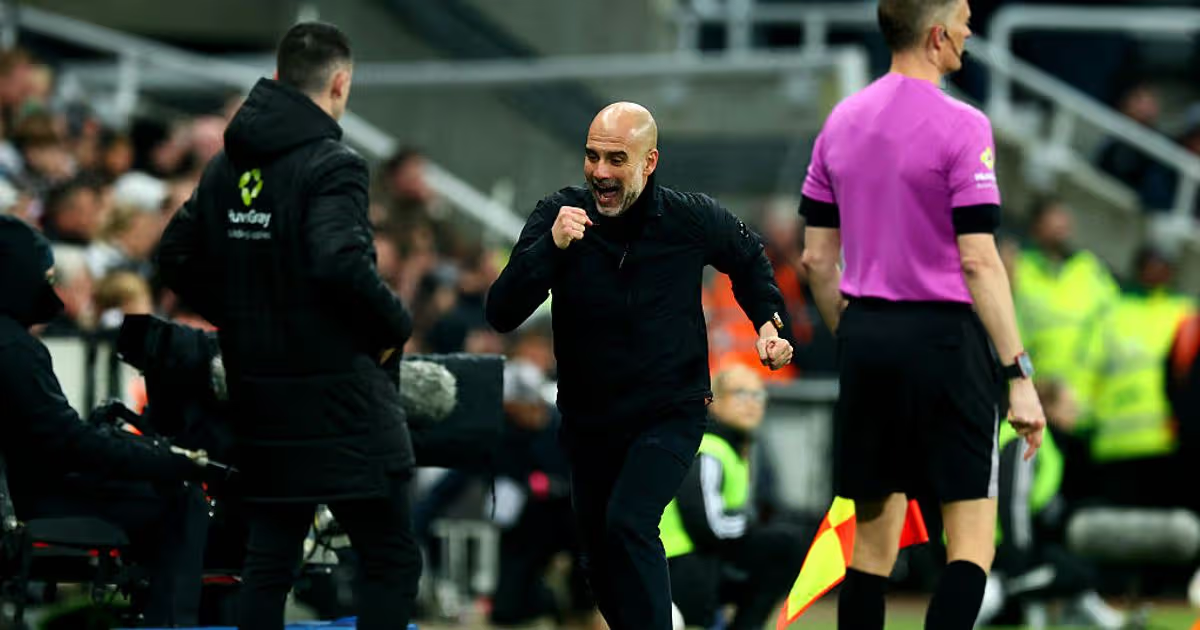
Manchester City manager Pep Guardiola spoke of his delight for his players after their 3-1 win over Newcastle in the FA Cup

A delighted Pep Guardiola put Manchester City’s win over Newcastle in the FA Cup as their best performance at St James’ Park in his 10 years in English football. The Blues picked up their fourth win in three months against Eddie Howe’s side with a 3-1 victory that keeps their dreams of a Quadruple alive.

Advertisement

The victory was even sweeter for City because Guardiola made 10 changes from the side that had drawn 2-2 with Nottingham Forest in midweek in an admission that some players were too tired with Real Madrid coming next in the Champions League on Wednesday. Erling Haaland was left at home and Bernardo Silva, Rodri, Ruben Dias and Marc Guehi remained on the bench in the north-east.

After a difficult start, City rallied and Savinho got the equaliser on his first start in more than two months and then Omar Marmoush scored his fifth and sixth goals of the season – four of them have come against Newcastle – to book City’s place in the FA Cup quarters. Before then, they will head to Madrid with confidence – but with a lone regret from the manager over the number of chances they missed to win by even more.

Get MEN Premium now for just £1 HERE – or get involved in our City WhatsApp group by clicking HERE. You can also join our City Facebook page by clicking HERE and don’t miss out on our brilliant selection of newsletters HERE.

“It’s one of the best feelings,” he said. “Really all the managers have that feeling, look at the performance of Nathan [Ake] – how reliable he is. All of them, there is not one single one that didn’t behave their best. Sometimes you don’t allow them to play much minutes and always you have that feeling. That’s why it’s nice to be in the competitions because it’s nice for them to be involved.

Advertisement

“The only regret I have today is that we missed too many easy chances. That is the only thing we have to really improve because it’s one against one with the keeper, we have to try to finish better.

“Except the first 15-20 minutes that always happens, we talk about that, we could not control but after we dropped and Savinho started to make one against one on the byline we were incredible. It’s the best game we have played against Newcastle here in our period together in 10 years -and a difficult one in the FA Cup.

“I’m really pleased with how we played, how we behaved offensively, defensively, the concentration. It’s top. Eight times in a row in the quarter-finals of the FA Cup means how good this organisation is.”

Source link

Advertisement
Continue Reading

NewsBeat

Donald Trump is clearly bruised by an old ally turning its back in his hour of need | World News

Published

on

Donald Trump is clearly bruised by an old ally turning its back in his hour of need | World News

Lest there be any doubt, the special relationship is pending repair.

Donald Trump had barely left the tarmac at Dover Air Base, a president in mournful respect for America’s fallen, when his attention turned to the UK prime minister.

Trump is clearly bruised by an old ally turning its back in his hour of need.

This is, after all, a president who maintains America’s alliances on America’s terms, who questions why international law should come between old friends.

Advertisement

Iran war latest: follow live

Image:
Pic: AP

On Iran, the legality of conflict remains a point of contention.

That matters to a warrior president in a fight to justify conflict in Iran and, possibly, elsewhere (Trump can’t stop talking about change in Cuba).

Polls show a majority of Americans against the military intervention, and the country is facing the threat of gas prices going up.

Advertisement

Trump needs political capital and, as such, could well use the validation of allies.

Starmer hasn’t been alone in standing firm against Trump on Iran, but the president has picked the special relationship for special treatment.

The UK prime minister has invested heavily in building a rapport with Trump, styling himself as the bridge-builder across the Atlantic.

Read more:
Analysis: Donald Trump’s war with Iran is going global
What is the strategy behind US and Israel’s strikes?

Advertisement

Advertisement

Day 8 Iran War: Videos from the ground

It’s also hardly surprising when the US president picks him as the point man on points of conflict.

And yet, it had been a day of dignity at Dover Air Base in Delaware.

In this conflict, from this White House, dignity isn’t a given.

Advertisement

Dover Air Force Base was the setting for Saturday’s “dignified transfer” of the six American soldiers killed in combat.

The president cut a figure of mournful respect as he stood in honour of the six US soldiers killed in combat, the solemn duty of a commander-in-chief.

It was an image in contrast to the picture presented by his administration during a week of hostilities.


Rumours Trump asked Iraqi Kurds to go into Iran ‘not true’

Advertisement

Take a look at the social media content posted in recent days by White House staffers.

They’ve posted short films portraying the attack on Iraq as a video game. Footage of destruction is intercut with “point-of-view” video in which you, the viewer, are holding the weapon.

You can almost hear the sniggering and high-fiving of a production team playing it for likes.

It’s jingoism and triumphalism for the modern age, and, in conflict, maybe there’s a place for both.

Advertisement

In the context, it’s also tone deaf and tasteless.

Advertisement

Iran’s president responds to Trump

This military campaign has claimed hundreds of lives of various nationalities across a wide area, and Trump is warning there will “likely” be more US casualties.

Currently, the Americans face questions over possible involvement in the bombing of a girl’s school that killed more than 160 youngsters – something Trump claimed was “done by Iran” during a gaggle on Air Force One.

Advertisement

The reminders are everywhere of the horrors of war and its enduring trauma.

This is a military action with so many uncertainties surrounding its rationale and its objectives.

To spin it as entertainment on social media is to diminish the impact on all concerned.

It is jarring, as is the hyperbole passing as commentary by the administration’s political players.

Advertisement

The dignified transfer of US troops threw a focus back onto the absolute certainty of war, reinforced through time – its tragedy and its loss, laid bare.

There are no likes in that.

Source link

Advertisement
Continue Reading

NewsBeat

6 key points after Noah Donohoe inquest week six

Published

on

6 key points after Noah Donohoe inquest week six
6 key points after Noah Donohoe inquest week six | Belfast Live