TCP Circular now hopes to get the scheme on the eastern edge of the port up and running in the next two years
TCP Circular is taking forward job creating plans at the Port of Sunderland.(Image: TCP Circular)
Job creating recycling scheme plans in Sunderland have been revived by a company linked to the original developer.
TCP Circular says it is progressing plans to create a plastics recycling facility at the Port of Sunderland, which could create more than 100 jobs. The firm is co-led by Chris Lach, who is a former deputy CEO and chief commercial officer at Norwegian company Quantafuel, which had secured planning permission in 2023 for the 12-acre site on the eastern edge of the port.
Now an exclusivity agreement between Sunderland City Council and TCP Circular has been signed. TCP now hopes to have the facility up and running in 2028.
It will take waste that would have otherwise been incinerated or disposed of in landfill. Using the high temperature process of pyrolysis, the materials will be heated in the absence of oxygen causing them to break down into raw materials which can be used for manufacturing of new products including high-grade plastics.
Advertisement
The plant is designed to process about 100,000 tonnes a year of “low value plastic waste” including soft food packaging and other domestic and industrial plastics. Raw materials produced will then be shipped from the port to customers in the petrochemical industry and self-generated, non-condensable gas will be used to power the site.
Chris Lach, CEO of TCP Circular, said: “We’re pleased to announce our intention to develop a plastics recycling plant at the Port of Sunderland and look forward to bringing our plans to life in the months ahead. Facilities such as this are greatly needed across the UK as we move towards a more circular economy and reduce CO2 emissions.
“We believe it’s an excellent site and are excited to be working with Sunderland City Council, playing a small part in their ambitious plans to transform the city into a key hub for businesses in the sustainable technologies and green industries. We look forward to updating the community as our plans develop.”
Quantafuel had hoped to open the Sunderland site last year but in early 2024 it was acquired by UK energy-from-waste group Viridor for more than £100m.
Advertisement
Coun Michael Mordey, leader of Sunderland City Council and chair of the Port Board, said: “The green economy accounts for a significant share of economic output here in Sunderland, so it is fantastic news that TCP has chosen Port of Sunderland to house this leading-edge facility. The port is already home to a growing cluster of businesses operating in the circular economy and, alongside our world leading track record in electric vehicle and battery manufacturing, TCP’s investment would be yet another key milestone in our journey as we embed and grow Sunderland’s reputation as a global hub for sustainable investment.”
Olly Harrison, who farms in Tarbock, on Merseyside, said he bought his fertiliser for a good price last year and now believes – due to a wet and cold spring and limited growing days left, added with the costs of diesel for machinery – he may be better off not planting.
Reports of issues with Google Gemini surfaced Monday as users across social platforms and monitoring sites questioned whether the AI chatbot was experiencing another disruption, prompting the familiar query: “Google Gemini is reportedly down now. Are you one of them?”
AFP
As of late Monday, major outage trackers including Downdetector showed fluctuating user reports for Google Gemini, though no widespread global outage was confirmed by Google’s official status pages. Downdetector indicated possible problems in the last 24 hours, with website access cited as the top issue by a majority of reporters.
DownForEveryoneOrJustMe reported no current detection of problems with Gemini, noting the most recent confirmed outage occurred on March 25, 2026, lasting about two hours. That incident saw spikes in complaints starting around 10:06 a.m. Eastern Time.
Recent history shows Gemini has faced intermittent challenges. On March 27, the Gemini AI Studio API suffered a major outage affecting image generation models like gemini-3-pro-image-preview (referred to internally as “Nano Banana Pro”) and Nano Banana 2, with widespread request failures. Earlier in March, users reported latency spikes, 429 errors, and automatic tier downgrades for API projects. March 9 marked the shutdown of Gemini 3.0 in favor of the 3.1 Pro Preview, a migration that some developers said introduced slowdowns for complex tasks.
Google’s AI Studio status page has logged past incidents involving increased error rates, latency in the Gemini API, spend cap issues, and multimodal live API disruptions. Vertex AI customers also saw elevated errors in February. No active broad incident appeared on Google Cloud’s service health dashboard as of Monday afternoon.
Advertisement
Social media buzz reflected user frustration. A post from monitoring account @status_is_down on X (formerly Twitter) asked Monday: “Google Gemini is reportedly down for some users at the moment. Are you one of them?” echoing similar alerts from previous dates like March 25. Scattered user complaints mentioned slow responses, processing loops, or failed generations, though many posts mixed Gemini AI with unrelated topics like K-pop idols or other services.
### xAI’s Grok Unaffected: “No, I’m Not One of Them”
In contrast to the reports swirling around Gemini, xAI’s Grok — the AI built by Elon Musk’s xAI — reported no current issues.
Grok’s official status page at status.x.ai showed “No incidents declared” with high availability across inference endpoints. Downdetector likewise indicated no current problems for Grok. Past incidents for Grok included temporary unavailability on March 10 and March 2, but services appeared stable Monday.
Advertisement
When asked directly if it was “one of them” amid Gemini rumors, Grok responded that it was fully operational and available for users seeking an alternative conversational AI with real-time knowledge via X integration and a focus on truth-seeking without heavy content restrictions common in other models.
xAI has positioned Grok as a more open and maximally truthful alternative in the competitive AI landscape. Users can access Grok via grok.com, x.com, and mobile apps, with subscription options for higher usage limits.
### Broader Context: AI Reliability in 2026
The latest Gemini reports come amid a year of rapid AI evolution and growing pains. Google’s Gemini family has seen model deprecations, performance debates post-migration to 3.1 variants, and API stability questions as demand surges for multimodal capabilities including image and video handling.
Advertisement
Developers have voiced concerns on forums about latency regressions after the Gemini 3.0 shutdown, with some tasks reportedly taking significantly longer under newer previews. Image generation features have been particularly prone to recent hiccups.
Outage monitoring sites remain essential tools for users. Downdetector aggregates crowd-sourced reports, while official pages from Google and xAI provide backend insights. Experts recommend checking multiple sources, clearing cache or trying incognito mode, and testing via different devices or networks during suspected issues.
For businesses relying on AI APIs, repeated disruptions highlight the importance of redundancy — maintaining fallback providers or rate-limit strategies. The March 27 API outage, for instance, impacted image-heavy workflows for numerous developers.
### What Users Should Do If Experiencing Issues
Advertisement
If Google Gemini appears unresponsive:
– Visit downdetector.com/status/googlegemini or aistudio.google.com/status for real-time updates. – Try accessing via gemini.google.com, the mobile app, or integrated Google services. – Check internet connection, VPN status, and browser extensions. – For API users: Review quotas, migrate to recommended models if using deprecated versions, and monitor Google’s Cloud status.
For those seeking uninterrupted access, alternatives like Grok, OpenAI’s ChatGPT, Anthropic’s Claude, or open-source options offer varying strengths in reasoning, creativity, and real-time information.
As AI systems scale, outages — whether partial, regional, or model-specific — have become a recurring feature of the industry. Google has not issued a public statement specifically addressing Monday’s reports as of press time, consistent with its handling of shorter disruptions.
Advertisement
xAI, meanwhile, continues iterating on Grok with an emphasis on reliability and user-centric design. Status monitoring shows consistent uptime outside of brief scheduled or unexpected maintenance windows earlier in the month.
This situation remains fluid. Users are encouraged to report problems directly through platform feedback tools and monitor official channels for resolutions. As demand for generative AI grows across search, productivity, coding, and creative tasks, service stability will likely remain a key competitive factor among leading providers.
The S&P 500 Index increased by 2.66% (total return, in USD) in the fourth quarter of 2025, while the Russell 2000 Index rose by 2.21% (total return, in USD). The fourth quarter demonstrated broad resilience, as the major US indices
Maven originally invested in Kani last year to further develop its platform, grow the team and support customer expansion
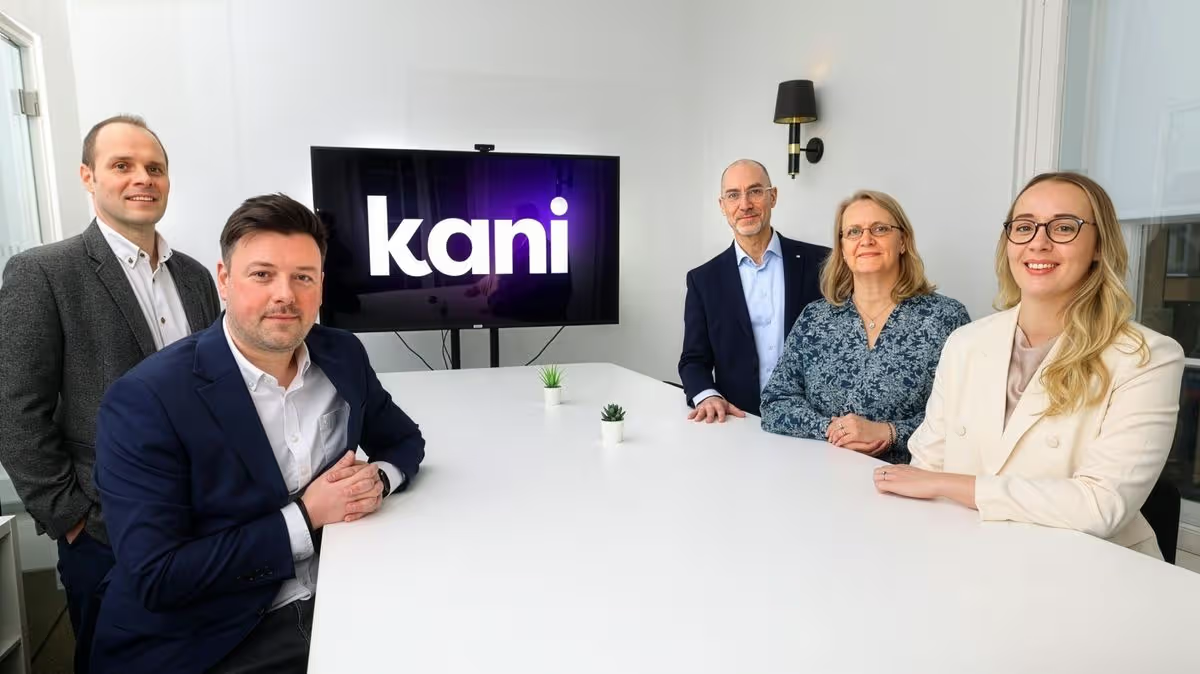
Kani Payments has received further funding from Maven Capital Partners.(Image: Maven Capital Partners)
Fintech firm Kani Payments is set to accelerate overseas expansion after securing investment. The Newcastle-based payments processing business has received the undisclosed amount in a funding round led by private equity firm Maven Capital Partners – the second round the fintech firm has sealed with the organisation.
The company was founded eight years ago to overcome the complex challenges of payment reconciliation and reporting required by banks, payment companies and other fintechs. Kani’s software as a service (SaaS) platform is in demand thanks to digitisation in the financial services sector. Its platform automates and streamlines workflows, helping clients save time and reduce costs while maintaining full compliance with industry and regulatory standards.
Maven originally invested a multmillion-pound sum in Kani in early 2025 to further develop its highly scalable platform, grow the team and support customer expansion. Since then, Kani has seen impressive growth, made a number of key senior hires and secured several significant contracts.
The fresh transaction includes follow-on investment from NPIF II – Maven Equity Finance, which is managed by Maven as part of the Northern Powerhouse Investment Fund II (“NPIF II”), alongside the Maven VCTs.
Advertisement
Kani said the new funding will allow it to invest in new product development to prepare for upcoming regulations, requiring firms to provide audit-ready reconciliation of client funds across the UK and global payments markets. The investment will also support a number of new customer partnerships and accelerate global market expansion.
The business operates across five continents and its platform is currently used by many leading financial services companies such as Cardaq, IDT, Pluxee and TransactPay .
Aaron Holmes, CEO at Kani Payments, said: “Maven has been a hugely supportive partner since their initial investment, and we’re pleased to have their continued backing as we enter the next phase of Kani’s growth. This investment will allow us to keep investing in our platform and supporting payment companies facing growing reconciliation and regulatory complexity.”
Rebecca Minchella, investment manager at Maven Capital Partners, said: “Kani has achieved impressive growth since our initial investment, and we have been really impressed by the expertise and conviction of the team to address the challenges facing fintechs in a fast, evolving payments industry. With the increasing complexity of payment reconciliation and regulatory compliance, demand for Kani’s solution is set continue, in a ever more regulated environment.
Advertisement
“Following a number of significant customer wins, we are delighted to support the team as they scale and accelerate their international expansion.”
Sarah Newbould, senior investment manager, at the British Business Bank, said: “Kani Payments is tackling a critical challenge for financial services firms as payment ecosystems become more complex. Through NPIF II we are committed to backing ambitious technology businesses that are building solutions with global relevance, while continuing to grow from the North East.
“It’s these businesses that are helping to drive forward the government’s Industrial Strategy, boosting UK economic growth while creating new jobs and opportunities for people across the North.”
To find all the planning applications, traffic diversions, road layout changes, alcohol licence applications and more in your community, visit the Public Notices Portal.
LOS ANGELES — Travelers at Los Angeles International Airport (LAX) encountered relatively short TSA security wait times on Monday, March 30, 2026, with official data showing general boarding lines as low as 0 to 3 minutes in the Tom Bradley International Terminal (TBIT) during early morning hours, even as a federal funding lapse continues to cause longer delays at other major U.S. hubs.
In this file photo a United Airlines plane taxis at Los Angeles International Airport on September 27, 2019
According to the official flyLAX.com security wait times page, updated as recently as early Monday, general boarding at TBIT stood at 0–3 minutes while TSA PreCheck lanes reported 0 minutes. Similar low figures appeared across multiple checkpoints in recent days, contrasting sharply with reports of multi-hour lines at airports such as Atlanta, Houston and New York’s JFK amid nationwide TSA staffing shortages triggered by the ongoing Department of Homeland Security funding lapse.
Third-party trackers and traveler reports largely aligned with the official data Monday. Sites like OnAirParking and TakeoffTimer indicated average standard security waits fluctuating between 1 and 25 minutes depending on the hour, with PreCheck lanes consistently clearing in under 5–10 minutes. Early morning peaks occasionally reached 28–36 minutes in some estimates, but most real-time observations described quick processing across LAX’s nine terminals.
The relatively smooth experience at LAX on March 30 comes despite broader challenges facing the Transportation Security Administration. TSA officers have worked without pay since mid-February, leading to elevated call-out rates — sometimes exceeding 30–40% at affected facilities — and hundreds of resignations nationwide. Acting TSA leadership has warned Congress of the highest wait times in agency history at some airports, with lines stretching beyond four hours in extreme cases.
LAX appears to have avoided the worst of the disruptions so far. Airport officials and Delta’s wait-time dashboard reported minimal delays in terminals including T1 North/South and T2, with checkpoints often moving passengers through in 5–10 minutes during mid-morning. Social media posts and Reddit threads from recent days, including March 25–28, frequently noted sub-5-minute experiences in various terminals, with some travelers describing “empty” lines even during typical rush periods.
Advertisement
LAX, one of the world’s busiest airports handling more than 60 million passengers annually, operates a complex security setup across multiple terminals serving domestic and international carriers. The Tom Bradley International Terminal, which processes the heaviest long-haul traffic, has shown the shortest reported waits in recent updates. Other terminals, such as those used by Delta, United and American, reported similarly manageable lines Monday according to airline-affiliated trackers.
Travelers and aviation experts attributed LAX’s better performance to several factors. The airport’s large physical footprint allows for more checkpoint lanes when staffed. Southern California’s spring travel patterns may not yet match the intense spring break surges hitting other regions. Additionally, high enrollment in TSA PreCheck and CLEAR programs — popular among frequent West Coast flyers — helps divert eligible passengers into faster lanes.
Still, officials caution that conditions can change rapidly. The flyLAX website notes that wait times are “subject to rapid change based on passenger volumes and TSA staffing.” Some national reports indicate LAX has occasionally removed or limited real-time wait time displays due to unpredictability caused by the funding situation. USA Today and other outlets reported that several major airports, including LAX at times, have urged passengers to build in extra buffer time rather than relying solely on posted estimates.
The federal funding lapse, now in its sixth week, has strained TSA operations coast to coast. Deputy Administrator Ha Nguyen McNeill told lawmakers that officer absenteeism has climbed significantly, with nearly 500 TSA employees resigning since the lapse began. High call-out rates at hubs like Atlanta (approaching 41%) have forced some facilities to consolidate lanes or operate with reduced capacity, directly contributing to backups.
Advertisement
At LAX, the impact appears milder but not entirely absent. Third-party hourly forecasts from sites like TakeoffTimer projected potential peaks of 27–32 minutes during typical morning and evening rushes (7–10 a.m. and 6–7 p.m.), though actual Monday observations remained lower. Travelers without PreCheck or CLEAR are still advised to arrive at least two to three hours before domestic flights and three to four hours for international departures to account for any sudden surges or additional screening.
Airport and TSA representatives recommend several strategies for minimizing delays:
Enroll in TSA PreCheck or CLEAR if traveling frequently; both services have dedicated lanes at most LAX terminals and can cut wait times dramatically.
Use the MyTSA mobile app for crowd-sourced real-time reports, though official data availability has been inconsistent during the lapse.
Prepare in advance by removing liquids, electronics and outer layers before reaching the checkpoint.
Check your specific terminal’s status via flyLAX.com or your airline’s app, as conditions can vary between terminals.
Consider off-peak flight times when possible to avoid morning and evening rushes.
LAX continues to serve as a critical gateway for domestic travel to cities like New York, Chicago and Las Vegas, as well as international routes across the Pacific and to Europe and Latin America. Despite the national TSA challenges, flight operations Monday showed no widespread ground stops or major airborne delays directly tied to security processing.
The Port of Los Angeles and local tourism officials have not issued any special alerts for March 30, suggesting that passenger flow through security has not reached crisis levels at this major California hub. However, as spring travel demand builds toward summer and the 2026 FIFA World Cup preparations, concerns remain about sustained staffing issues if the funding standoff persists.
Broader context includes ongoing debates in Washington over resolving the DHS funding impasse. TSA unions have highlighted fatigue among officers working without pay and warned that prolonged uncertainty could exacerbate turnover ahead of peak summer travel. Some smaller airports have already faced temporary checkpoint closures or reduced hours due to insufficient staffing.
Advertisement
For LAX specifically, the airport’s modernization efforts — including terminal improvements and technology upgrades like touchless ID verification — have helped streamline processing when staffing allows. The end of the LAX FastLane program earlier in 2026 shifted reliance back to standard PreCheck and general lanes.
Passenger sentiment on social platforms mixed cautious optimism with preparation advice. Recent posts described quick passages through terminals 2, 3, 4 and 7, with some crediting light mid-week crowds on Monday. Others warned that conditions could worsen later in the day or week as business and leisure travel volumes increase.
As of Monday afternoon Pacific time, no major disruptions were reported at LAX security checkpoints. Flight tracking services showed typical operations, with most departures proceeding close to schedule once passengers cleared screening.
Travelers planning to fly from LAX today or in coming days should monitor official sources closely. The flyLAX wait times page, airline apps and the MyTSA platform provide the most current snapshots, though experts emphasize arriving early and staying flexible.
Advertisement
While LAX has fared better than many peers on March 30, the national TSA staffing strain serves as a reminder of vulnerabilities in the aviation security system during periods of fiscal uncertainty. Resolution of the funding lapse would likely stabilize operations quickly, but until then, patience and preparation remain essential for anyone passing through Los Angeles International Airport.
The situation remains fluid. Updates from TSA, LAX and individual airlines will continue to guide travelers as the day and week progress.
Olivia Munn, the actress known for roles in “The Newsroom” and “X-Men: Apocalypse,” continues to balance Hollywood projects with family life alongside her husband, comedian John Mulaney, as the couple raises two young children and Munn opens up about her breast cancer journey.
Munn, 45, and Mulaney, 43, married in an intimate ceremony over the Fourth of July weekend in 2024 at a friend’s home in New York. The low-key event included only their son Malcolm and one witness, with “Law & Order” actor Sam Waterston officiating. Mulaney later confirmed the marriage on “Late Night With Seth Meyers,” calling it “the best” and “the greatest single time of my life.”
The pair first connected as friends for nearly a decade before beginning to date in 2021. They were spotted together publicly that June, and Munn gave birth to their son, Malcolm Hiệp Mulaney, in November 2021. Munn has shared that she “barely knew” Mulaney when she became pregnant, describing their early relationship as whirlwind.
In March 2026, Munn appeared on “CBS Sunday Morning” and reflected on facing the “possibility of death” during her 2023 breast cancer battle. Diagnosed in April 2023, she underwent a double mastectomy, lymph node dissection, reconstructive surgery and a hysterectomy with oophorectomy. She credited Mulaney with attending “every single doctor’s appointment” and lightening the emotional load.
“He just lightens everything,” Munn said of her husband. The couple welcomed their second child, daughter Méi June Mulaney, via surrogate in September 2024. Munn has spoken about the emotional challenges of not carrying the pregnancy herself and how Mulaney surprised her at their wedding with a thoughtful gift honoring their unborn daughter so she would feel present in future photos.
Advertisement
As of early 2026, Malcolm is approximately 4 years old and Méi is around 18 months. Munn has shared parenting moments, including family trips to celebrate Malcolm’s birthday and lighthearted decisions like whether to participate in Elf on the Shelf traditions. She described Malcolm as having transformed Mulaney’s life, noting changes such as protein powder appearing in their home as the comedian embraced fatherhood.
Mulaney has echoed the positive sentiments. In interviews, he has portrayed their relationship as “wild and joyful,” crediting Munn’s strength during her health challenges. The family of four divides time between Los Angeles and New York, with both parents maintaining active careers while prioritizing private family moments.
Munn recently appeared in promotions for Apple TV+’s “Your Friends & Neighbors,” Season 2, debuting in April 2026, where she works alongside James Marsden. She credited Marsden with playing a key role in her 2023 engagement to Mulaney, which occurred at his 50th birthday party around 1 a.m. The proposal story, shared in late March 2026 interviews, highlighted the couple’s unconventional romantic milestones.
The couple’s relationship has drawn public interest for its rapid progression from friendship to parenthood to marriage. Some commentators have speculated on potential challenges given the intense early years, including Munn’s cancer treatment and the demands of raising toddlers while both maintain high-profile careers. However, public statements from Munn and Mulaney consistently emphasize mutual support and happiness.
Advertisement
Mulaney, a former “Saturday Night Live” writer known for stand-up specials and hosting “Everybody’s Live,” has spoken about how fatherhood and marriage have grounded him. Munn, who previously hosted “The Daily Show” and appeared in films like “Iron Man 2,” has focused more on family and selective projects post-cancer.
In recent months, Munn has used platforms like Instagram to share glimpses of family life without oversharing. Posts about Malcolm turning four and Méi as “the sweetest plum” reflect a desire to celebrate milestones privately while occasionally offering fans insight.
The couple’s story includes elements of resilience. Munn’s cancer diagnosis came after the birth of Malcolm but before their wedding and second child. She has discussed the decision to use a surrogate for Méi due to health considerations and expressed gratitude for modern fertility options, including remaining frozen embryos from her IVF process.
Friends and colleagues have described the pair as supportive partners. Munn has noted that Mulaney’s humor helps during difficult times, while Mulaney has praised Munn’s strength as a mother and survivor.
Advertisement
As spring 2026 continues, both stars have upcoming professional commitments. Munn’s television work keeps her visible, while Mulaney balances comedy tours, hosting and family responsibilities. Observers note the couple appears to prioritize low-key living away from constant paparazzi attention, choosing intimate settings for major life events.
Parenting two young children has brought new dynamics. Munn has joked about the chaos of toddlers interrupting significant moments, including a humorous story from their wedding where Malcolm made an announcement about needing to use the bathroom.
Broader public interest in celebrity families often fuels speculation, but Munn and Mulaney have maintained boundaries. They rarely discuss intimate details beyond occasional reflective interviews, focusing instead on themes of gratitude, health awareness and the joys of parenthood.
Munn’s openness about her cancer experience has raised awareness for early detection and reconstruction options. She has encouraged women to advocate for themselves in medical settings and highlighted the importance of support systems, crediting Mulaney as a steady presence.
Advertisement
The family’s blended dynamic includes Mulaney’s previous marriage and recovery journey, which he has addressed candidly in his comedy. Fans appreciate the couple’s authenticity in navigating complex personal histories while building a new chapter together.
As of March 30, 2026, no major new announcements regarding additional children or career shifts have emerged, though Munn has mentioned they are still discussing whether to use their remaining frozen embryo. For now, the focus remains on enjoying their two children and supporting each other’s professional endeavors.
Industry insiders say the couple’s low-drama approach contrasts with many Hollywood relationships, contributing to positive perceptions. Their story resonates with audiences facing similar health or family challenges, offering a narrative of love, recovery and forward momentum.
Munn and Mulaney continue to appear occasionally at events, though they favor private family time. Recent red carpet moments and joint interviews reinforce an image of a united front.
Advertisement
Looking ahead, both stars are expected to remain active in entertainment while centering family. Munn’s health updates suggest continued monitoring post-treatment, with optimism for long-term wellness.
Their journey from surprise pregnancy to secret wedding to growing family illustrates a modern celebrity romance shaped by resilience and commitment. As they raise Malcolm and Méi, Olivia Munn and husband John Mulaney exemplify balancing public careers with private joys amid life’s unexpected turns.
The couple’s story remains one of ongoing chapters, with fans following their milestones through selective shares and occasional media appearances.







.webp?t=1774879489)














































You must be logged in to post a comment Login