

Crypto World
How Hong Kong Is Turning Tokenized Bonds Into Real Market Infrastructure

Key takeaways
-
Hong Kong’s 2026-27 budget marks a shift from experimental digital bond projects to the direct integration of tokenized issuance and settlement into the city’s regulated financial market infrastructure.
-
CMU OmniClear, a subsidiary of the Hong Kong Monetary Authority, will build a digital asset platform to support tokenized bond issuance and settlement. This embeds digital securities within Hong Kong’s established clearing and post-trade framework.
-
Hong Kong has issued multiple tokenized government bonds, including a HK$10 billion digital bond in 2025. Authorities plan to make such offerings a regular feature to deepen market participation and improve liquidity.
-
Hong Kong is introducing stablecoin licensing, digital asset dealer and custodian regulations and compliance rules aligned with global tax transparency standards to support a fully regulated digital asset market.
For years, tokenized bonds were discussed as a future upgrade to capital markets. In Hong Kong, that transition is now moving into practice.
The city’s 2026-27 budget marks a pivotal turning point. Tokenization is no longer confined to isolated experiments but is being integrated into the heart of Hong Kong’s financial ecosystem. By embedding issuance and settlement directly into its post-trade systems, the city is moving beyond one-off digital deals to create a standardized, regulated environment.
This article explores how Hong Kong is integrating tokenized bonds into its financial infrastructure through a new digital platform developed by CMU OmniClear, a subsidiary of the Hong Kong Monetary Authority (HKMA), regular government issuances and supportive regulations. This development reflects a shift from experimental pilots to scalable, institutional-grade digital capital market systems.
Hong Kong’s advancing tokenized bond program
Hong Kong has already completed several rounds of tokenized government bond issuances. In Q4 2025, the government launched its third series, valued at HK$10 billion, approximately US$1.28 billion. Authorities have since confirmed that these tokenized bond offerings will continue on a regular basis.
The 2026-27 budget, however, marked a significant escalation.
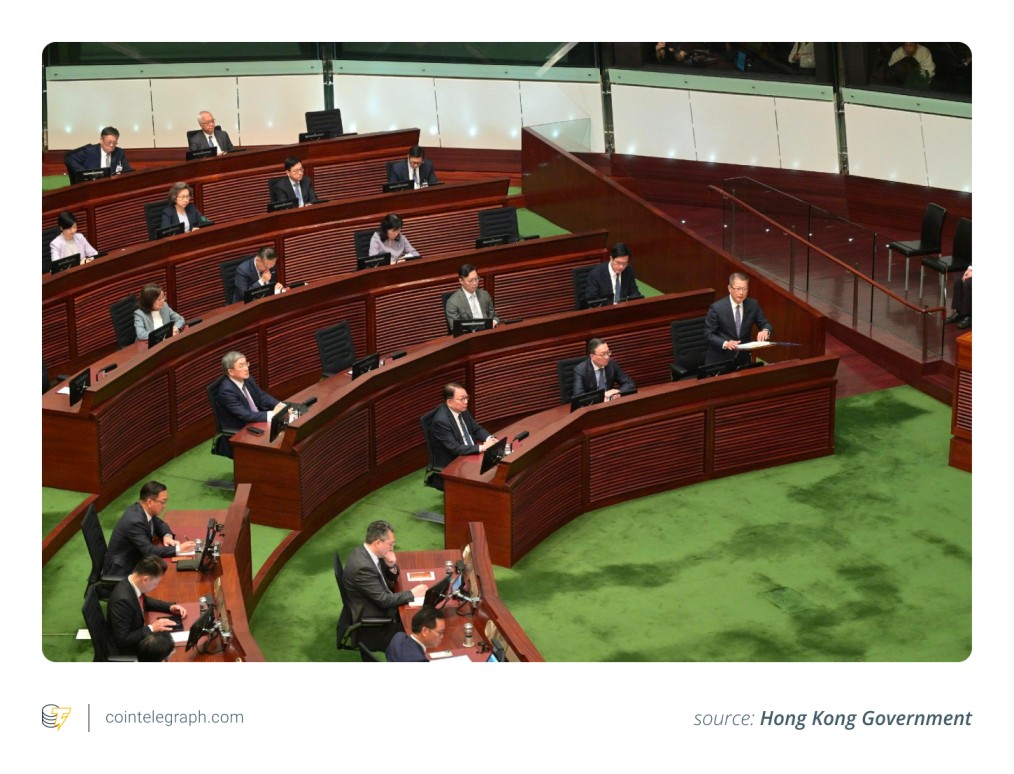
Financial Secretary Paul Chan stated that CMU OmniClear Holdings, a wholly owned subsidiary of the HKMA, will develop a dedicated digital asset platform. The platform is designed to handle both the issuance and settlement of tokenized bonds.
Importantly, the system is being built with long-term expansion in mind. It will:
-
Be progressively extended to support a wider range of digital assets beyond government bonds
-
Establish interoperability with tokenization platforms in other regional jurisdictions
-
Become fully integrated into Hong Kong’s broader post-trade financial ecosystem
This final aspect, deep integration into core market infrastructure, is what elevates tokenization from experimental pilots to a foundational element of the financial system.

CMU OmniClear: From experiment to core infrastructure
CMU OmniClear is far from a standalone startup or proof-of-concept project. It operates as an integral part of Hong Kong’s established clearing and settlement framework. Regulators have entrusted tokenized bond settlement to an entity directly linked to the HKMA. They have integrated digital securities into the same system that already processes conventional financial instruments.
This strategic move reshapes the tokenization story in three key ways:
-
Standardization replaces experimentation: Rather than relying on custom-built, one-off digital bond structures, issuance and settlement can now follow uniform regulatory rules and proven operational protocols.
-
Clear regulatory oversight: With supervision anchored directly under the central banking authority, legal and compliance uncertainty is significantly reduced.
-
Built-in scalability: Core market infrastructure is designed to handle institutional-scale volumes, not just small-scale trials or limited pilots.
Tokenization is no longer an add-on or side project. It is becoming embedded in the core plumbing of Hong Kong’s financial system.
Did you know? The concept of tokenized bonds builds on the broader idea of tokenizing real-world assets (RWAs). Trillions of dollars’ worth of traditional financial assets, such as bonds, real estate and funds, could eventually move onto blockchain-based infrastructure.
Government issuance: Already scaling
Hong Kong’s tokenized bond program is already demonstrating meaningful scale. Rather than building infrastructure in anticipation of future demand, Hong Kong is responding to existing market interest.
The government’s third tokenized bond issuance, completed in late 2025, reached a record size of HK$10 billion, approximately US$1.28 billion to US$1.3 billion, marking the world’s largest digital bond offering to date. This followed earlier digital bond issuances that also attracted strong investor demand. Authorities have now pledged to make tokenized bond issuance a regular practice rather than relying on occasional pilots.
This steady approach delivers several key benefits:
-
Builds investor comfort and familiarity with tokenized products
-
Draws participation from conventional asset managers
-
Reinforces that tokenization has strong official policy support, moving it beyond experimental status
Consistent and predictable issuance is essential to developing deeper, more liquid markets.
Beyond bonds: Building a digital asset ecosystem
Hong Kong’s ambitions extend well beyond tokenized bonds. The 2026-27 budget outlines additional regulatory steps to foster a broader digital asset ecosystem.
Stablecoin licensing regime
The HKMA is moving toward issuing its inaugural set of licenses for fiat-referenced stablecoins, with the first approvals expected in early 2026.
The licensing assessments emphasize:
-
The strength and quality of asset reserves
-
Robust risk management practices
-
Effective anti-money laundering (AML) and compliance controls
-
Well-defined, legitimate use cases
Stablecoins are not inherently tied to bond settlement. However, the introduction of regulated digital fiat equivalents could enable compliant and efficient settlement mechanisms for tokenized securities and other digital assets.
Did you know? The first blockchain bond issued by a multilateral institution was launched by the World Bank in 2018. Called “Bond-i” (Blockchain Operated New Debt Instrument), it used distributed ledger technology to manage bond issuance and settlement.
Licensing for digital asset dealers and custodians
Hong Kong is advancing its regulatory framework by introducing dedicated licensing regimes for key digital asset service providers.
The government plans to table legislation in 2026 establishing licensing requirements for:
-
digital asset dealing platforms, including over-the-counter (OTC) brokers, block traders, and other intermediaries involved in buying, selling, or exchanging virtual assets
-
custodian service providers focused on safeguarding private keys, segregating client assets, and ensuring strong security and operational controls
These measures will bring a broader range of participants under formal supervision. Dealers will face standards comparable to those applied to conventional securities firms, while custodians will be subject to stringent requirements for asset protection and key management.
By covering issuance, trading, custody, and reporting activities, the regime creates a fully supervised ecosystem for tokenized bond markets and other digital securities, enhancing investor protection and market integrity.
Alignment with global tax transparency standards
To reinforce its commitment to international compliance, Hong Kong is amending the Inland Revenue Ordinance to adopt the Organisation for Economic Co-operation and Development’s (OECD) Crypto-Asset Reporting Framework (CARF).
The implementation will apply to reporting by crypto-asset service providers (CASPs), starting in 2027. Information exchanges would begin in 2028, enabling the automatic exchange of tax-related data on crypto transactions with partner jurisdictions.
The move underscores a clear policy stance. Hong Kong’s tokenized and digital asset markets are being designed to be fully interoperable, transparent, and aligned with global standards. These are essential prerequisites for attracting and retaining institutional capital on a sustainable basis.
Did you know? Traditional bond settlement often takes two business days (T+2) in many markets. Tokenized bonds could potentially enable near-instant settlement, reducing counterparty risk and freeing up capital more quickly.
The liquidity layer: Building deeper regulated crypto markets
In early 2026, the Hong Kong Securities and Futures Commission (SFC) issued new guidance enabling licensed virtual asset brokers to provide margin financing for digital assets. Initially, the framework focused on Bitcoin (BTC) and Ether (ETH) collateral, with safeguards for creditworthy clients. The SFC also published a high-level framework allowing licensed virtual asset trading platforms (VATPs) to offer leveraged perpetual contracts.
These developments significantly enhance market liquidity in a controlled manner while preserving strong investor protections and risk management standards. They form part of a multilayered strategy to:
-
Broaden the scope of regulated digital asset markets
-
Uphold institutional-grade guardrails and compliance
-
More seamlessly bridge digital and traditional finance
Tokenized bonds are not standalone experiments. They sit within a comprehensive, integrated digital financial architecture designed for scale and sustainability.
How tokenized bond infrastructure operates in practice
Tokenized bond infrastructure combines several interconnected layers built on blockchain or distributed ledger technology:
-
Issuance: The issuer originates the bond as a digital token directly on a permissioned or regulated ledger, embedding coupon terms, maturity and covenants into smart contracts or digital records.
-
Primary allocation: Subscriptions and allocations occur through regulated intermediaries, such as banks, brokers or platforms, ensuring Know Your Customer (KYC) and AML compliance and orderly distribution to qualified investors.
-
Settlement and custody: True delivery-versus-payment (DvP) is achieved through integrated systems managed by recognized market infrastructure providers, including central securities depositories or clearing houses adapted for tokenization. Custody is handled by licensed providers with segregated assets and secure key management.
-
Post-trade lifecycle: Ongoing events, such as coupon or interest payments, principal redemptions at maturity, and the handling of corporate actions, are automated through programmable logic. This reduces manual intervention, settlement risk and operational costs.
The critical distinction between early pilots and true infrastructure lies in repeatability, institutional integration, and scale. Mature infrastructure enables frequent, large-volume issuances while interfacing smoothly with existing clearing, settlement, custody and reporting systems. This creates the foundation for liquid, efficient secondary markets.
Why this matters for global markets
Hong Kong’s strategy reflects deliberate, long-term positioning in the changing financial sector.
By integrating tokenized bond issuance and settlement into infrastructure closely aligned with the central bank, and by fostering connectivity with regional platforms and counterparties, Hong Kong is working to:
-
Solidify its status as Asia’s leading regulated digital asset and tokenized securities hub
-
Channel meaningful cross-border institutional capital flows into and through the city
-
Offer institutional investors a compliant, scalable and well-regulated tokenization ecosystem
Hong Kong is competing on regulated reliability, predictable rule-making and institutional-grade infrastructure. These factors matter significantly to large asset managers, banks and sovereign wealth funds.
Prevailing risks and challenges
Implementing ambitious infrastructure does not automatically eliminate structural challenges. Several significant hurdles remain:
-
Achieving genuine interoperability across different tokenization platforms, protocols and ledgers
-
Securing legal and regulatory harmonization with other major jurisdictions to enable smooth cross-border issuance, trading and settlement
-
Keeping AML, KYC, sanctions and broader compliance frameworks aligned with the rapid pace of technological change
-
Avoiding liquidity fragmentation, where trading volumes are split inefficiently across siloed digital systems, undermining market depth
Building the digital financial rails is only the first phase. Sustained market adoption, active secondary trading, broad institutional participation and organic liquidity growth will determine whether Hong Kong’s vision translates into lasting global relevance.
Cointelegraph maintains full editorial independence. Guides are produced without influence from advertisers, partners or commercial relationships. Content published in Guides does not constitute financial, legal or investment advice. Readers should conduct their own research and consult qualified professionals where appropriate.

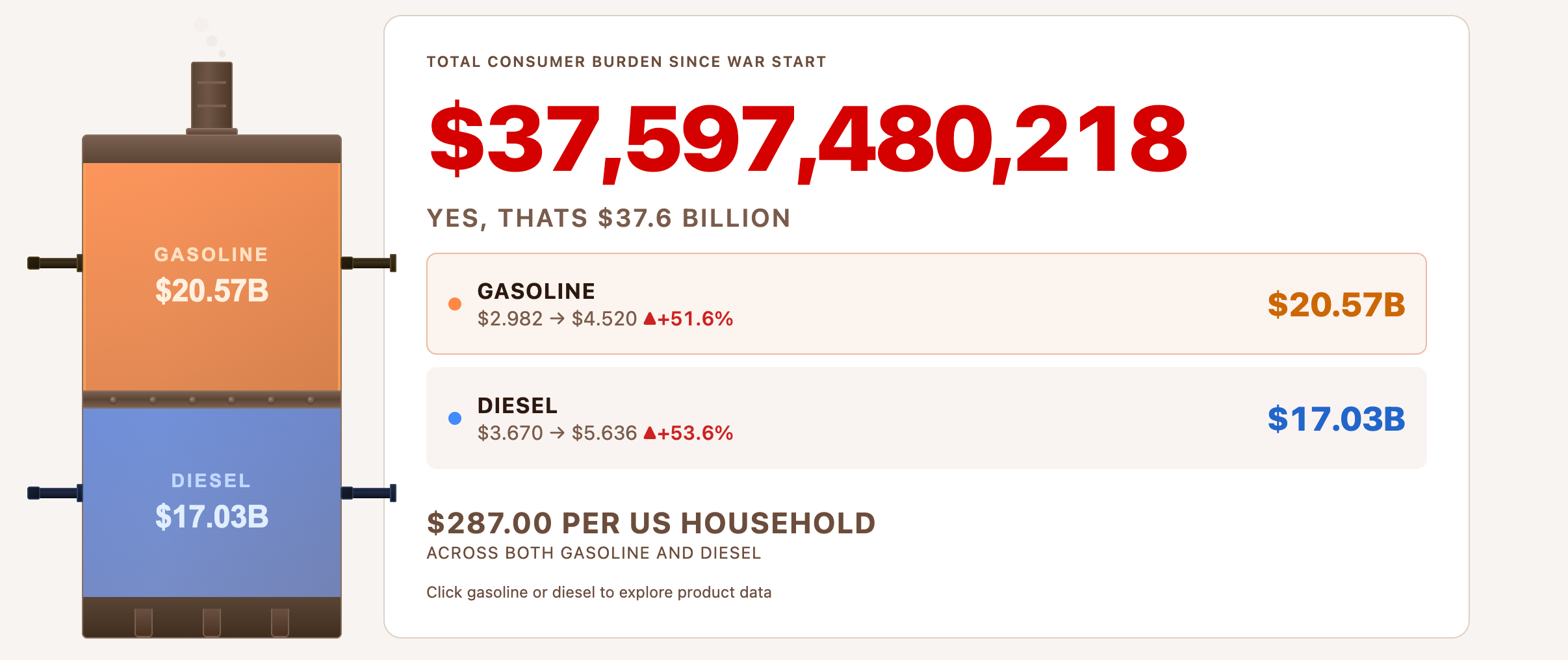
Americans have spent $37.6 billion more on gasoline and diesel since the Iran war erupted on February 28.
This data comes from a live tracker from Brown University’s Watson School of International and Public Affairs.
The Iran War Has Cost Every American Household $287 in Extra Fuel So Far
The figure breaks down to about $287 per US household, with national gas prices now averaging $4.52 a gallon. The price marks a 51.6% jump from the pre-war level of $2.98 over just 72 days.
“Fuel costs are just one part of a war’s consequences, but they come directly out of Americans’ pockets. These costs are rising everyday,” the website reads.
Follow us on X to get the latest news as it happens

The Iran War Energy Cost Tracker is led by Jeff Colgan, director of the Climate Solutions Lab at Brown’s Watson School.
The model compares fuel data from the American Automobile Association with estimated levels had the conflict not occurred. The gap between actual and counterfactual prices forms the cost calculation.
“This is an expense coming directly out of the pockets of American consumers, and consumers,” Colgan said.
It’s not just the households. BeInCrypto previously reported that US airlines spent $5.06 billion on jet fuel in March. That was a 56% jump from February as the conflict disrupted global supply.
Hormuz Closure Drives the Squeeze at the Pump
This highlights the broader economic impact of the conflict, which has led to the closure of the Strait of Hormuz, a critical passage for nearly 20% of global energy shipments.
The impact has also extended beyond energy markets. Inflation among US food and beverage companies rose 7.9% year-over-year in March, marking the sharpest increase in at least a year.
Meanwhile, public sentiment has also turned. A Generation Lab survey of Americans found 77% believe the strikes against Iran were the wrong call.
Subscribe to our YouTube channel to watch leaders and journalists provide expert insights
The post This Is How Much the Iran War Is Adding to Every American’s Fuel Bill appeared first on BeInCrypto.

Christopher Delgado, the former CEO of Goliath Ventures, has publicly apologized to investors for what US prosecutors allege was a $328 million crypto investment Ponzi scheme.
“They put their trust in me, and I failed them,” Delgado told ABC-affiliated television station WFTV in an interview aired on Monday. Delgado said he wanted to publicly explain what happened “from beginning to end” and express “how sorry I am.”
Delgado claimed that he voluntarily returned to the US to face charges of fraud and money laundering brought by the Orlando US Attorney’s Office on Feb. 20. He faces a maximum penalty of 30 years in federal prison if convicted on all counts.
He has been accused of soliciting victims into investing substantial sums of money under false and fraudulent promises of monthly returns generated through crypto liquidity pools. WFTV reported that investors ranged from nurses and teachers to firefighters and retirees.

Christopher Delgado speaking in an interview with WFTV. Source: WFTV
Delgado said Goliath was paying people “an astronomical amount of money” when questioned on how the company allegedly used millions of dollars in investor funds.
The US Attorney’s Office alleged that Delgado ran Goliath as a Ponzi scheme between January 2023 and January 2026 and used some of the funds to purchase four properties in Florida valued at a combined $14.5 million.
The investor funds were also allegedly used to pay for “Goliath’s extravagant business gatherings, Christmas parties, and luxury travel accommodations,” the US Attorney’s Office said.
It claimed one investor lost around $720,000 despite promises from Goliath that he would get a guaranteed return and that his investment could be returned at any time.
WFTV said Delgado is currently on bail, wearing an ankle monitor while confined to his 11,000 square foot estate that was allegedly purchased with investor funds.

Delgado’s 11,000 square foot estate in Florida. Source: WFTV
Delgado claimed there was only $160,000 left in the Goliath Ventures bank account around the time of his arrest.
Delgado said that he didn’t act alone and that he is cooperating with federal law enforcement to provide information about what he claimed is his former colleagues’ involvement in the alleged Ponzi scheme.
JPMorgan sued over ties to Goliath
In March, investors sued Wall Street bank JPMorgan Chase, claiming it helped facilitate fund flows to Goliath.
Related: California man jailed for 78 months over $250M crypto theft conspiracy
A proposed class lawsuit claimed that JPMorgan knew, by virtue of its Know Your Customer obligations, that Goliath was operating as a private equity-style cryptocurrency investment pool despite not being licensed to offer or sell those types of investment products.
The investors alleged that $253 million was deposited into a JPMorgan bank account between January 2023 and June 2025, with roughly $123 million later transferred to Goliath wallets at Coinbase.
Last month, a Florida federal court judge extended the deadline for prosecutors to file an indictment against Delgado to June 26.
Magazine: North Korea denies crypto hacks, Upbit’s bank tests Ripple: Asia Express
The Ethereum Foundation has reported notable progress on the upcoming Glamsterdam upgrade, outlining a credible post-upgrade target and accelerating preparations on several parallel fronts. In a blog post, the foundation said it has established a 200 million gas limit floor as part of Glamsterdam’s rollout, a substantial increase from the current level around 60 million. The move is geared toward delivering a meaningful speed boost for post-upgrade network throughput and set the stage for the long-term scaling roadmap.
The foundation reiterated that the immediate priority is shipping Glamsterdam, which programmers had originally slated for June but are now targeting in the third quarter of 2026. Glamsterdam is billed as a foundational upgrade for the layer-1 chain, aimed at rethinking how the network processes transactions and manages its rapidly expanding data store, effectively “fundamentally updating how Ethereum creates and verifies blocks.”
Beyond Glamsterdam, Ethereum’s roadmap remains anchored by ongoing work on Hegotà, the anticipated next major upgrade, and the Strawmap, the project’s roadmap for quantum-readiness. The Ethereum Foundation noted that Glamsterdam devnets are live and that scoping for Hegotà is well underway, with continued progress being tracked at an interop event held in Svalbard, Norway.
Key takeaways
- Glamsterdam targets a 200 million gas limit floor, a major step up from current levels and a potential driver of higher throughput after the upgrade.
- Official timing has shifted from June toward the third quarter of 2026, with the focus remaining on delivering Glamsterdam and its scaling innovations.
- Enshrined Proposer-Builder Separation (ePBS) stabilization has been confirmed, integrating the division of block-building duties more deeply into Ethereum’s rules.
- EIP-8037, which prices data storage more efficiently, has been finalized to curb uncontrolled state growth as gas limits rise.
- The Ethereum Foundation is undergoing a leadership transition in its Protocol cluster, bringing in new leads while several core developers move on or take sabbaticals.
Glamsterdam: scaling the L1 and redefining block creation
At its core, Glamsterdam is designed to reorganize Ethereum’s transaction processing and block verification so the network can handle a larger daily load without compromising safety. The plan to establish a 200 million gas floor signals the network’s intent to push forward with higher-capacity blocks while maintaining stability during the transition. The move aligns with broader efforts to improve L1 efficiency ahead of subsequent upgrades that promise to broaden the ecosystem’s capabilities for decentralized applications and user experience.
The Ethereum Foundation emphasized that the immediate aim is to ship Glamsterdam, with a revised timeline placing the upgrade in Q3 2026 rather than June. Developers are reportedly actively testing and refining the upgrade in devnets. The Svalbard interop event cited ongoing collaboration and alignment among researchers, developers, and infrastructure teams as they validate cross-component interactions and ensure the upgrade’s components work cohesively in practice.
In parallel with Glamsterdam, the Foundation remains focused on Hegotà, the forthcoming major upgrade, and the Strawmap, Ethereum’s strategic plan for quantum resistance and long-term data management. The combination of these tracks reflects a deliberate, multi-layered approach to scaling Ethereum while preserving its security guarantees and decentralization ethos. The Strawmap, in particular, remains a touchstone for how Ethereum intends to evolve in the quantum era, balancing forward-looking security with practical deployment paths.
Smarter data storage and a more resilient block-building model
Two significant protocol milestones were highlighted as part of the ongoing evolution. First, the enshrined Proposer-Builder Separation (ePBS) has reached stabilization, formalizing how validators outsource block-building duties to a set of specialized builders within Ethereum’s consensus rules. This enshrinement minimizes reliance on external relays and gives the network a longer runway to accommodate larger blocks safely. The shift aims to reduce latency and improve block production efficiency without compromising the core safety properties that underpin Ethereum’s security model.
Second, EIP-8037 has been finalized, introducing smarter pricing for storing state data. By raising the cost of state-creation operations, the proposal helps prevent unsustainable growth of on-chain state as block gas limits rise. The combination of ePBS and EIP-8037 is intended to bolster Ethereum’s data management framework at a time when higher throughput could otherwise accelerate state growth if not properly priced and managed.
These changes are not standalone; they are part of a cohesive effort to ensure that Glamsterdam and subsequent upgrades can deliver meaningful improvements in performance and cost-efficiency while keeping the network resilient against data bloat and security risks associated with larger blocks.
Protocol leadership enters a transitional phase
The Ethereum Foundation also disclosed a leadership transition within its Protocol cluster. Will Corcoran, Kev Wedderburn, and Fredrik have been named as new leads guiding protocol development, signaling a renewed wave of coordination and direction for core research and implementation work. In parallel, two long-standing contributors, Barnabé Monnot and Tim Beiko, are moving on from Foundation roles, and Alex Stokes will be taking sabbatical leave for a period. Corcoran commented that the Protocol cluster is entering a new chapter that emphasizes broad collaboration and continued delivery of Glamsterdam, Hegotà, and the Strawmap. Monnot underscored a commitment to making Ethereum’s distinctive features more accessible to users and to participating in a plural approach to how Ethereum gets built.
The leadership changes come as Ethereum’s development cadence remains intense, with multiple upgrade tracks running in parallel. The aim is to ensure that the core protocol remains adaptable to emerging technologies and user needs while maintaining the reliability that large-scale decentralized applications require. Observers will want to watch how this leadership transition influences cross-team coordination and the prioritization of Glamsterdam’s milestones against Hegotà and the quantum-resilience roadmap embedded in Strawmap.
Roadmap momentum: Hegotà and the quantum-ready Strawmap
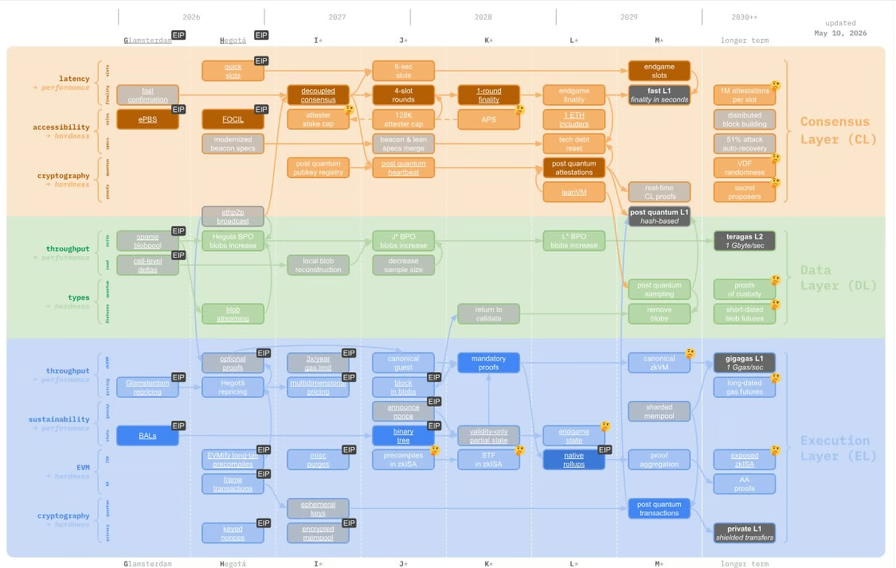
Glamsterdam is the first major upgrade in Ethereum’s extended roadmap, but it sits within a broader program that includes Hegotà and Strawmap. Hegotà is described as the next major upgrade after Glamsterdam, with planning and scoping already underway. Meanwhile, Strawmap continues to guide Ethereum’s approach to future data management and quantum resistance, ensuring that the network remains prepared for anticipated cryptographic challenges and workload growth. The interop activity in Svalbard underscores a shared effort among developers to validate compatibility across components and to align on a coherent sequence of upgrades that collectively advance Ethereum’s long-term vision.
What remains uncertain—and what readers should monitor closely—is the exact timing and readiness of each milestone, especially as Glamsterdam’s timeline shifts earlier or later depending on testing outcomes, network conditions, and coordination across ecosystems. Investors, developers, and users will want to keep an eye on devnet stability, the pace of Hegotà scoping, and the practical implications of ePBS and EIP-8037 on on-chain data costs and validator operations.
Looking ahead, the Ethereum ecosystem appears intent on balancing aggressive scaling with disciplined governance. Glamsterdam’s rollout, paired with smarter data pricing and a strengthened block-building model, positions Ethereum to absorb higher demand while maintaining robustness. As the Foundation continues to rotate leadership and align cross-team priorities, market watchers should watch for concrete milestones in devnet testing, cross-client interoperability, and the emergence of tangible upgrades that translate into improved user experiences and more scalable infrastructure for decentralized applications.
As the roadmap unfolds, traders and builders should stay tuned for updates on Glamsterdam’s progress, the pacing of Hegotà development, and the ongoing refinement of Strawmap’s quantum-ready framework. The coming quarters will be critical in determining how quickly Ethereum can translate these architectural changes into real-world benefits for developers, protocols, and end users alike.
Crypto World
CLARITY Act Momentum Revives XRP ETF Narrative as Flare XRPFi Sees Growing Institutional Attention
The Senate Banking Committee has moved forward with revised language under the CLARITY Act framework to build a US crypto market structure. The move could affect how digital assets are classified and handled within regulated financial systems, depending on how the final rules are shaped and adopted.
While the draft continues to face unresolved political hurdles, including controversial ethics provisions and debate over the scope of regulatory oversight, market participants are increasingly focused on what clearer classification rules could mean for major crypto assets such as XRP.
XRP Institutional Outlook
The discussion has been amplified by expectations that, under a scenario where XRP is treated as a commodity, institutional demand could increase significantly through exchange-traded products. Standard Chartered has projected that XRP ETF inflows could range between $4 billion and $8 billion by the end of the year if such regulatory conditions materialize.
This has led to renewed focus on how XRP-linked capital would be deployed once it enters institutional channels. The asset has not developed the same level of native programmable finance infrastructure seen in other major blockchain ecosystems. As a result, questions are emerging around where large-scale XRP capital would flow for purposes such as yield generation, lending, or structured deployment beyond simple holding or secondary trading activity.
One of the most active areas attempting to address this gap is the emerging XRPFi ecosystem built on Flare, which enables XRP to be deployed into decentralized finance applications through FXRP. According to data cited from DeFiLlama, Flare’s total value locked has reached approximately $457 million, out of which around $200 million is attributed specifically to XRP-related activity.
FXRP allows XRP to be used in lending, staking, trading, collateralization, and vault-based strategies across Flare applications. Since its introduction, XRPFi activity has recorded more than 3.4 million transactions across roughly 16,500 users.
Infrastructure development around XRPFi is also being supported by distribution and protocol-level changes to reduce friction between XRP holdings and DeFi participation. Uphold has announced plans to support direct FXRP minting during the summer, which would allow XRP to be converted into FXRP through exchange-level integration rather than separate bridging interfaces.
Flare Targets Vault and Yield Growth
At the protocol level, Flare is undergoing a governance and economic overhaul that includes a reported 40% reduction in emissions, updated mechanisms for protocol-level MEV capture, and revised burn mechanics as part of its ongoing design changes. Further developments include planned upgrades to XRPFi infrastructure to expand vault availability and improve access to yield strategies, along with the introduction of FAssets v1.3. The update enables direct minting of FXRP using XRPL destination tags.
A separate application layer built on Flare Smart Accounts is also being developed to simplify user interaction with XRPFi systems by enabling XRPL wallet-based access to vaults and strategies while abstracting transaction processes across the Flare execution layer.
The post CLARITY Act Momentum Revives XRP ETF Narrative as Flare XRPFi Sees Growing Institutional Attention appeared first on CryptoPotato.
The Ethereum Foundation has reached several progress milestones on the next Ethereum upgrade called “Glamsterdam” and has named three new leads for its Protocol team.
The Ethereum Foundation said in a blog post on Monday that it had achieved a “credible post-Glamsterdam target,” establishing a 200 million gas limit floor, giving the network a major post-upgrade speed boost from its current gas limit of around 60 million.
“The immediate focus is shipping Glamsterdam,” the Ethereum Foundation said, which had originally scheduled the upgrade for June, but is now likely to be sometime in the third quarter of 2026.
Glamsterdam focuses on scaling the layer-1 chain by reorganizing how the network processes transactions and manages its growing database, “fundamentally updating how Ethereum creates and verifies blocks,” according to the Ethereum website.
The Ethereum Foundation is also continuing preparations for Hegotà, the next major upgrade, and advancing the Strawmap, its quantum-ready roadmap.
“Glamsterdam devnets are now live, and scoping for Hegotà is well underway,” it stated during an interop event in Svalbard, Norway.
Finalizing ePBS and smarter data storage
The EF also confirmed the stabilization of enshrined Proposer-Builder Separation (ePBS), a system that allows validators to outsource their block-building duties to a set of specialized builders.
The new enshrined version builds this separation directly into Ethereum’s rules with less reliance on outside relays, giving the network more time to handle bigger blocks safely.
Related: AI ‘vibe coding’ could put Ethereum roadmap ahead of schedule: Vitalik Buterin
EIP-8037 has also been finalized, which enables smarter pricing for storing data. The proposal increases the cost of state creation operations, avoiding excessive state growth under increased block gas limits.

Glamsterdam is the first upgrade on Ethereum’s long-term roadmap. Source: Strawmap.org
Changes in EF Protocol leadership
The Foundation also announced the “start of a leadership transition” for the Ethereum Foundation Protocol cluster with Will Corcoran, Kev Wedderburn, and Fredrik as the new leads.
Ethereum developers Barnabé Monnot and Tim Beiko are moving on from the Foundation, while Alex Stokes will be on sabbatical, it said.
“There’s a new chapter starting for the Protocol cluster. We’re welcoming new leads and coordinators, and continuing our work toward Glamsterdam, Hegotà, and the Strawmap,” said Corcoran on X on Monday.
“Making Ethereum’s unique features more available to users today is on my mind; so is participating in the plurality of ways that Ethereum gets built,” said Monnot.
Magazine: Strategy reveals why they would sell BTC, Trump Media posts loss: Hodler’s Digest


Former Goliath Ventures CEO Christopher Delgado has publicly apologized to investors while facing federal accusations that he operated a $328 million crypto Ponzi scheme tied to false investment promises and misuse of client funds.
Summary
- Christopher Delgado apologized publicly after U.S. prosecutors accused him of running a $328 million crypto Ponzi scheme through Goliath Ventures.
- Federal prosecutors alleged investor funds were used to buy Florida properties, luxury travel, and company events tied to Goliath Ventures.
- Investors also sued JPMorgan Chase, claiming the bank processed hundreds of millions of dollars linked to the alleged scheme.
According to an interview aired Monday by ABC-affiliated television station WFTV, Delgado said he returned to the U.S. voluntarily to answer fraud and money laundering charges filed by the Orlando U.S. Attorney’s Office on Feb. 20.
“They put their trust in me, and I failed them,” Delgado told the outlet, adding that he wanted to explain what happened “from beginning to end” and express “how sorry I am.”
Federal prosecutors have accused Delgado of running Goliath Ventures as a Ponzi scheme between January 2023 and January 2026 by convincing investors to place large sums into crypto liquidity pool strategies that allegedly promised guaranteed monthly returns. If convicted on all charges, Delgado faces up to 30 years in federal prison.
WFTV reported that victims included nurses, teachers, firefighters, and retirees who were allegedly drawn in through promises that their funds could be withdrawn at any time. One investor reportedly lost nearly $720,000 after being assured that the investment carried guaranteed returns and redemption access.
Inside the alleged Goliath operation
During the television interview, Delgado admitted that Goliath had been paying people “an astronomical amount of money” when questioned about how investor capital was allegedly handled. Prosecutors said part of the money collected from investors went toward purchasing four Florida properties worth a combined $14.5 million.
Court filings from the U.S. Attorney’s Office also alleged that investor money financed luxury travel, large business events, and company Christmas parties linked to Goliath Ventures’ operations.
Meanwhile, WFTV reported that Delgado is currently out on bail under home confinement while wearing an ankle monitor at an 11,000 square foot estate that authorities claim was purchased using investor funds. Delgado told the station there was only about $160,000 left in Goliath Ventures’ bank account around the time of his arrest.
At the same time, Delgado claimed he was not acting alone and said he is cooperating with federal investigators regarding what he described as the involvement of former colleagues in the alleged scheme.
JPMorgan lawsuit
Separate legal action filed in March expanded scrutiny beyond Goliath Ventures itself after investors sued JPMorgan Chase over its alleged role in processing transactions tied to the operation.
According to the proposed class-action complaint filed in federal court in Northern California, investors alleged that roughly $253 million flowed into Chase accounts connected to Goliath Ventures between January 2023 and June 2025. The lawsuit further claimed that about $123 million was later transferred from those accounts to wallets at Coinbase and other crypto platforms.
Plaintiffs argued that JPMorgan should have identified suspicious activity linked to the investment operation through its Know Your Customer and anti-money laundering obligations. The complaint accused the bank of failing to act on large and repeated retail investor deposits that allegedly did not match Goliath’s stated business activity.
Investors behind the lawsuit are seeking damages while arguing that traditional financial institutions should also face liability when alleged crypto fraud operations move funds through regulated banking channels.
Last month, a federal judge in Florida extended the deadline for prosecutors to file an indictment against Delgado until June 26.
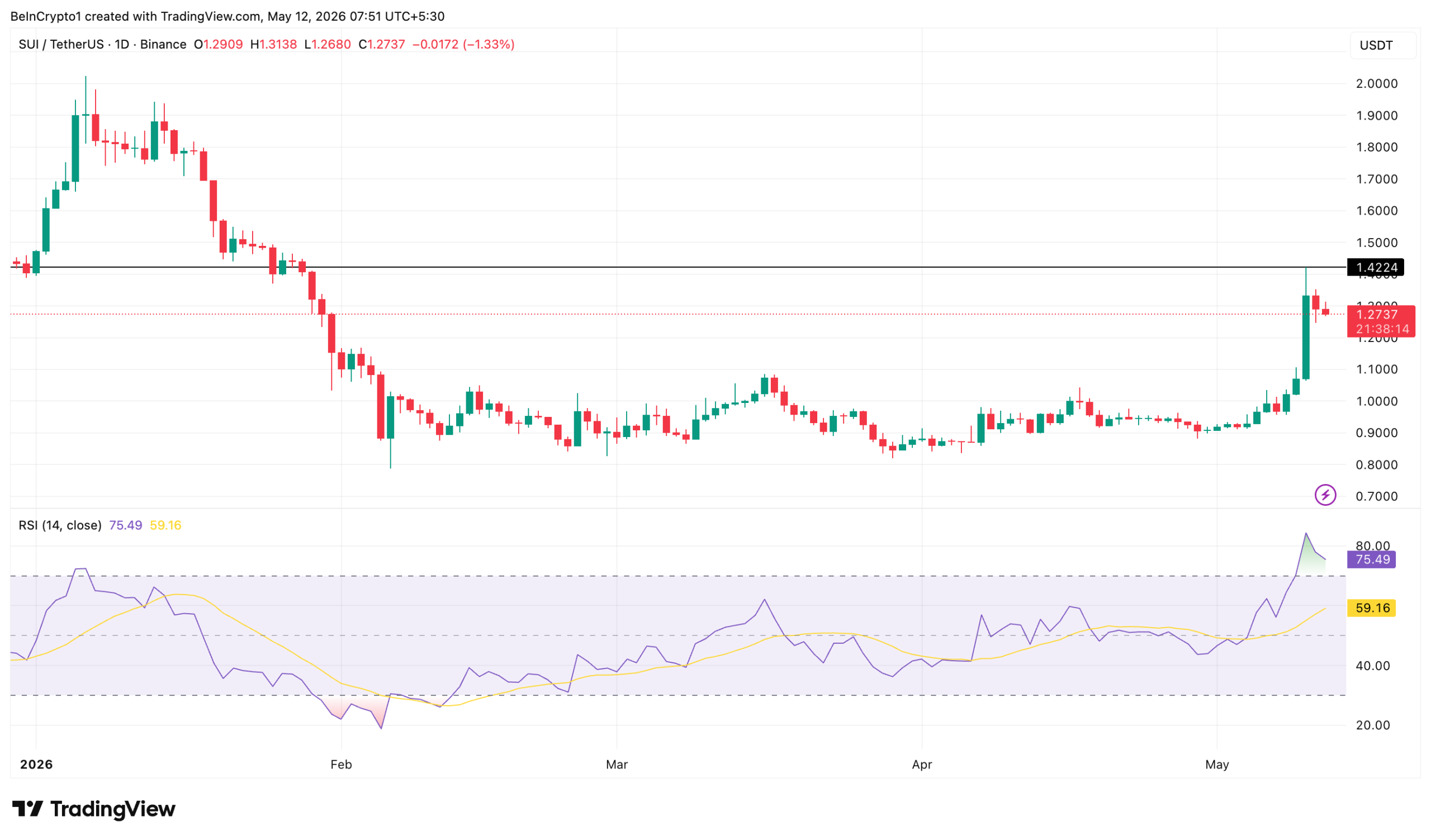
Sui (SUI) has slipped nearly 10% from Sunday’s high, raising questions about whether the altcoin’s recent rally is beginning to lose momentum.
The decline follows a sharp breakout that saw SUI surge almost 40% over the past week, making it one of the market’s top-performing altcoins.
SUI Staking Powered the Rally
Market data revealed that SUI climbed to an intraday high of $1.42 on Sunday, its highest level since late January, before retreating. A key catalyst came from SUI Group Holdings.
The firm revealed that it had expanded its treasury holdings to 108,728,129 SUI. It added that “substantially all” of those holdings are now staked at an estimated 1.8% yield. The shift pulled another 2.7% of supply off the liquid market.
“Two more catalysts compounding: CME Group SUI futures launching May 29 (only the fifth L1 with regulated derivatives access), and Paga partnership for cross-border African payments,” Santiment said.
Follow us on X to get the latest news as it happens
What’s Behind SUI’s 10% Price Drop
Despite the strong rise, SUI pulled back. At press time, the altcoin traded at $1.273, down 4% over the past 24 hours and nearly 10% below Sunday’s peak.
The correction came after SUI’s Relative Strength Index (RSI) surged into heavily overbought territory at 84.4 before cooling to 75.94, suggesting the pullback may reflect a natural market reset following rapid gains.

The broader crypto market also weakened, with total market capitalization slipping 0.33% over the past day amid losses across several altcoins.
“RSI hit 84 yesterday. That’s deeply overbought. A cooldown was inevitable. The broader market also shifted risk-off today. $680M in outflows from BTC and ETH into stablecoins. SUI didn’t dump alone — the whole market did,” an analyst wrote.
Network Activity Continues to Strengthen
Meanwhile, on-chain activity within the Sui Network ecosystem remains strong. DefiLlama data showed that the total value locked (TVL) climbed to around $653 million, up from roughly $541.9 million at the start of May.
Stablecoin supply on the network also rose 4.5% over the past week, while decentralized exchange volumes jumped over 200%.
Santiment further noted that SUI’s social dominance during the rally ranged between 0.13% and 0.15%, still below the 0.38% spike recorded on May 6.
“The conversation isn’t outrunning the price. Institutional supply locks driving a rally look different on-chain than retail FOMO,” the post added.
Nonetheless, SUI remains roughly 76% below its all-time high and continues to trade below its early-2026 peaks, keeping the token in negative year-to-date territory.
Therefore, whether SUI reclaims its January peak depends on investor demand and corporate treasury inflows outpacing monthly token unlocks. Continued network growth and sustained buying pressure could determine the strength of the next move higher.
Subscribe to our YouTube channel to watch leaders and journalists provide expert insights
The post SUI Drops 10% From Sunday’s High: What’s Behind the Pullback? appeared first on BeInCrypto.


DeFi lender Aave and other stakeholders impacted by last month’s Kelp DAO hack have launched a binding Arbitrum governance vote to transfer $71 million in disputed ether into an Aave LLC-controlled address
A Constitutional Arbitrum Improvement Proposal, or AIP, is the DAO’s formal on-chain governance mechanism for approving binding protocol actions. This amended proposal implements Judge Margaret Garnett’s recent court order, which authorizes an on-chain Arbitrum DAO vote to transfer the frozen ETH from its current immobilized address to a wallet controlled by Aave LLC, provided that the restraining notice sought by North Korean terrorism judgment creditors is respected.
If approved, the proposal would move 30,765 ETH from the wallet where Arbitrum’s Security Council immobilized the funds to an Aave LLC-controlled address, as required by the court’s order. However, the assets would remain subject to strict legal restrictions and cannot be freely used, transferred, or deployed by Aave LLC unless permitted by the court.
The legal fight over the frozen assets took an unusual turn after blockchain forensics firms widely attributed the exploit to North Korea’s Lazarus Group. That attribution comes from blockchain analytics firms and external forensic research, and has not been established as a legal finding within either the Arbitrum governance process or the ongoing court proceedings.
Still, that attribution has been cited alongside broader legal arguments by lawyers representing families holding roughly $877 million in unpaid U.S. terrorism judgments against North Korea, who argue that if the assets are ultimately deemed linked to North Korea for enforcement purposes, they could potentially be used to satisfy those longstanding court awards.
Aave disputes that premise, arguing that the ether belongs to users harmed in the exploit, not to the attackers who briefly controlled it, turning the case into a fight over whether the funds should go to DeFi victims or to terrorism creditors.
In a separate lawsuit, many of the same terrorism judgment creditors sued privacy protocol Railgun DAO, alleging it allowed North Korean-linked funds to move through its infrastructure rather than freezing them, as part of a broader strategy to pursue allegedly Pyongyang-linked crypto across decentralized finance.
Voting on the AIP is scheduled to begin May 15.

TLDR
- Between Q1 2025 and Q1 2026, Binance’s artificial intelligence security infrastructure prevented $10.53 billion in potential cryptocurrency theft and user losses.
- The exchange intercepted 22.9 million phishing and scam operations in the first quarter of 2026, safeguarding $1.98 billion in customer assets.
- Artificial intelligence now manages 57% of Binance’s fraud prevention systems, achieving card fraud rates 60–70% lower than industry standards.
- The platform facilitated the recovery of $12.8 million across 48,000 fraud incidents, representing a 41% increase compared to the previous year.
- Industry-wide cryptocurrency fraud reached $17 billion in 2025, marking a 30% surge as AI technology makes malicious attacks more accessible and affordable.
The world’s leading cryptocurrency exchange by transaction volume, Binance, reports that its machine learning-powered security architecture prevented over $10.5 billion in potential customer losses during a 15-month span from early 2025 through March 2026.
According to a Monday blog post from the platform, these security measures successfully stopped 22.9 million phishing and fraudulent schemes during the first quarter of 2026 alone, preserving approximately $1.98 billion in user assets throughout that three-month window.
The cryptocurrency platform has implemented over 24 AI-driven security protocols alongside more than 100 specialized detection models. Machine learning now accounts for 57% of the exchange’s fraud prevention capabilities, resulting in card fraud incidents that fall 60–70% below standard industry rates.
Regarding user verification, Binance reports its customer identification protocols have advanced to identify deepfake technology and artificially generated identities. The platform asserts these improvements provide operational efficiency up to 100 times greater than conventional manual verification processes.
The exchange employs computer vision technology to identify fraudulent payment documentation. Simultaneous language processing algorithms monitor peer-to-peer transactions for suspicious behavior patterns. According to Binance, these integrated systems collaborate to intercept fraudulent activity before customers suffer financial damage.
What the Numbers Show About Crypto Fraud
Cryptocurrency-related fraud totaled $17 billion throughout 2025, representing a 30% escalation from the previous year, based on Binance’s internal data analysis. The exchange attributes this increase to AI technology reducing both the complexity and cost of launching attacks.
Smart contract exploitation now requires as little as $1.22 per targeted contract, reflecting a 22% monthly decline in cost. Sophisticated AI systems are now achieving 72.2% effectiveness rates in simulated attack environments. According to Binance, 76% of AI-powered fraudulent schemes currently fall into the highest classification for scope and severity.
Cybercriminals are deploying deepfake videos, synthetic voice technology, automated phishing operations, and impersonation tactics to compromise users across various communication channels.
Recovery initiatives have expanded in proportion to emerging threats. Binance reports assisting in the recovery of $12.8 million spanning 48,000 separate cases throughout 2025, reflecting a 41% annual growth rate. The platform also supported law enforcement agencies in seizing $131 million in illegally obtained funds and fulfilled over 71,000 information requests from authorities.
New Tools and Industry Comparisons
Binance launched a specialized product named Binance AI Pro, engineered to isolate risk at the fundamental infrastructure level. Within this framework, assets controlled by AI agents remain segregated from primary user accounts. Authorization parameters restrict activities exclusively to trading functions, eliminating withdrawal capabilities. The platform indicates that roughly 12% of external applications submitted to its marketplace have received flags for potential security concerns.
The exchange additionally deployed a withdrawal restriction mechanism designed to mitigate physical security threats against users, which blockchain security firm CertiK projects will surpass previous annual records.
By comparison, JPMorgan estimated in the prior year that its artificial intelligence security infrastructure contributed to preventing approximately $1.5 billion in fraudulent losses.
Binance maintains collaborative relationships with Tether and Tron through the T3 security coalition, which recently immobilized a record-breaking $344 million in USDT tokens connected to Iranian organizations. The exchange has additionally processed more than 71,000 official law enforcement inquiries to date.

Key Highlights
- A new $125M investment vehicle focused on generating returns from Ethereum through DeFi protocols is being launched by Galaxy Digital and Sharplink.
- The capital structure includes $100M in staked ETH from Sharplink and a $25M commitment from Galaxy, which will oversee fund operations.
- Sharplink disclosed a first-quarter 2026 net loss totaling $685.6M, primarily attributed to unrealized depreciation of its Ethereum portfolio.
- Ethereum’s price declined from approximately $3,354 in mid-January to $2,104 by quarter-end in March, with a modest rebound to $2,339 subsequently.
- Galaxy Digital shares have surged 118.5% year-over-year, with Compass Point analysts increasing their target price to $41.
Galaxy Digital and Sharplink have entered into a collaborative agreement to establish an investment fund designed to generate yield from Ethereum assets through decentralized finance mechanisms, despite Sharplink experiencing substantial quarterly losses linked to cryptocurrency market downturns.
The partnership involves a non-binding agreement to create the Galaxy Sharplink Onchain Yield Fund, anticipated to commence operations within the next several weeks with $125 million in committed capital. Sharplink’s contribution consists of $100 million sourced from its staked Ethereum reserves, while Galaxy Digital will inject $25 million and assume investment management responsibilities.
The fund’s strategy centers on allocating resources to DeFi liquidity mechanisms and various blockchain-based yield opportunities. This approach aims to generate supplementary income from Ethereum positions while maintaining long-term exposure to the underlying cryptocurrency.
Sharplink currently maintains a treasury position exceeding 868,000 ETH. During last October’s market highs, this holding approached a valuation of nearly $4 billion. The firm has systematically accumulated its Ethereum position starting in June 2025 and has generated approximately 18,800 ETH through staking rewards during this period.
Mike Novogratz, CEO of Galaxy, noted that institutional appetite for blockchain-based financial products has reached a maturity level where participants can now utilize sophisticated yield generation, liquidity provision, and risk mitigation instruments comparable to traditional financial markets.
Joseph Chalom, Sharplink’s chief executive, characterized the collaboration as a mechanism to enhance the company’s treasury performance while simultaneously supporting the development of the broader decentralized finance infrastructure. Matthew Sheffield, the firm’s Chief Investment Officer, emphasized that the fund structure preserves the company’s fundamental staked ETH position while creating additional value for equity holders.
Sharplink Reports $685.6M First Quarter Deficit
Despite the optimism surrounding the new fund initiative, Sharplink disclosed a net loss of $685.6 million for the first quarter of 2026, equivalent to $3.25 per diluted share.
Approximately $506.7 million of this deficit stemmed from mark-to-market losses on its Ether position. Ether’s value contracted from around $3,354 in mid-January to $2,104 by the conclusion of March, based on CoinMarketCap pricing data. At the time of the fund announcement, Ethereum was valued at approximately $2,339.
Quarterly revenue increased to $12.1 million from $700,000 in the comparable period last year, reflecting expansion in the company’s operational segments. Sharplink concluded the first quarter with $16.9 million in cash reserves.
Galaxy Digital Shows Resilience Despite Continued Losses
Galaxy Digital similarly released its first-quarter 2026 financial results. The firm recorded a GAAP net loss of $216 million, or $0.49 per share, predominantly due to unrealized depreciation on its digital asset portfolio.
Trading activity within Galaxy’s Global Markets division remained consistent on a sequential quarter basis, even as overall industry trading volumes contracted by more than 25%. Financial analysts from H.C. Wainwright and Rosenblatt maintained Buy recommendations on the equity following the earnings release. Compass Point elevated its price objective to $41 from $40, highlighting advancement in the company’s high-performance computing initiatives. Goldman Sachs maintained a Neutral stance with a $21 price target.
Galaxy’s stock has appreciated 118.5% over the trailing twelve months and traded at $29.01 when the fund announcement was made. The company maintains a current ratio of 1.7, indicating that liquid assets comfortably exceed near-term liabilities.
The fund partnership awaits finalization of definitive agreements before becoming legally binding.

Stop frying sausages as they’re juicier using simple butcher-approved technique

The Pieces Of The Forecast Return Puzzle – Choose Your Values

This Is How Much the Iran War Is Adding to Every American’s Fuel Bill

Manchester United reach agreement with Casemiro over contract clause amid transfer speculation

US brings back mandatory military draft registration

Steven Gerrard disagrees with Gary Neville over ‘shock’ Chelsea and Arsenal claim | Football


-
 Crypto World4 days ago
HarrisX Poll Found 52% of Registered Voters Support the CLARITY Act
-

 Fashion4 days ago
Weekend Open Thread: Marianne Dress
-

 Crypto World5 days ago
Upbit adds B3 Korean won pair as Base token gains Korea access
-
 NewsBeat5 days ago
NCP car park operator enters administration putting 340 UK sites at risk of closure
-

 Fashion14 hours ago
Coffee Break: Travel Steam Iron
-

 Tech2 days ago
Auto Enthusiast Carves Functional Two-Stroke Engine from Solid Metal
-

 Politics9 hours ago
What to expect when you’re expecting a budget
-

 Fashion1 day ago
What to Know Before Buying a Curling Wand or Curling Iron
-

 Politics3 days ago
Politics Home Article | Starmer Enters The Danger Zone
-
 Business3 days ago
Ignore market noise, India’s long-term story intact, say D-Street bulls Ramesh Damani and Sunil Singhania
-

 Crypto World7 days ago
UAE Free Zone Deploys Blockchain IDs to Verify Registered Firms
-

 Tech1 day ago
GM Agrees To Pay $12.75 Million To Settle California Lawsuit Over Misuse Of Customers’ Driving Data
-

 Crypto World6 days ago
BlackRock CEO Larry Fink Discusses a New Asset Class
-

 Entertainment5 days ago
Sarah Paulson Called Out For Met Gala ‘Hypocrisy’
-

 Crypto World5 days ago
Robinhood says Wall Street is building onchain
-
 Sports6 days ago
NBA playoff winners and losers: Austin Reaves is not loving Lakers vs. Thunder matchup, but Chet Holmgren is
-

 Entertainment5 days ago
General Hospital: Ric & Ava Bombshell – Ric’s Massive Secret Exposed!
-

 Entertainment6 days ago
Bold and Beautiful Early Spoilers May 11-15: Steffy Revolted & Liam Overjoyed!
-

 Tech6 days ago
Apple and Samsung are dominating smartphone sales so thoroughly that only one other company makes the top 10
-

 Fashion5 days ago
The Best Work Pants for Women in 2026
You must be logged in to post a comment Login