


Connect with us
DAPA Banner

Business

8 Common HR Tasks Made Easier With HR Automation

Published

on

Poorly designed and inadequately maintained workplaces are draining the UK economy of more than £71 billion a year, according to new research from facilities and security services company Mitie.

Managing people has never been simple. In the UK, where employment laws are detailed, and expectations around flexibility keep rising, day-to-day human resources (HR) work can feel relentless.

You’re juggling paperwork, systems, and people issues while trying to keep the business moving. That’s where HR automation steps in, quietly reshaping how teams operate and freeing you to focus on what really matters.

Below, you’ll see how automation takes some of the most common tasks and makes them smoother, faster, and far less stressful—without losing the human touch.

Task 1: Reducing Manual Overload in Core HR Operations

Teams manage numerous repetitive admin tasks that are tied to essential HR processes. Updating employee records, handling approval processes, and maintaining accurate employee data can quickly overwhelm even experienced HR personnel. Manual work also increases the risk of errors, especially when information is scattered across emails and spreadsheets.

This is why specialised solutions, including HR software for small UK firms, should become a core component of your organization’s digital transformation. Modern HR systems replace fragmented tools and ageing legacy systems with unified platforms.

Advertisement

With HR process automation, everyday business processes become more reliable. Tasks that once took hours now happen in the background, without disrupting how your organization works.

Task 2: Performance, Feedback, and Growth Made Continuous

Annual reviews alone rarely support modern work patterns; that’s why companies must keep up. Many organisations now embrace ongoing performance tracking, regular feedback, and clear links to career development to encourage employee satisfaction. But doing this manually across teams is time-consuming.

Digitising processes enables consistent performance management, from everyday check-ins to formal performance appraisal cycles. A goal setting software helps employees understand expectations, track progress, and stay motivated—without creating extra admin load for HR. Moreover, with integrated tools, you can align feedback with talent development goals and provide clearer paths for growth.

Task 3: Smarter Hiring and a Better First Impression

Recruitment is about more than filling roles. It’s about shaping a strong candidate experience from the first click to the first day. Yet many teams struggle to manage CVs, interviews, and feedback efficiently, even with applicant tracking systems in place.

Advertisement

Automation supports recruiting & talent acquisition by streamlining shortlisting, scheduling, and communication. HR automation tools with artificial intelligence, machine learning, and natural language processing integrations ensure no candidate slips through the cracks and help surface the best-fit applicants faster. This saves time and builds trust with candidates who feel informed and respected throughout the process.

Task 4: Onboarding That Sets People Up for Success

The early weeks of a new hire’s journey strongly influence long-term employee retention. In most organizations, though, onboarding is often inconsistent, particularly across multiple locations or time zones. Documents get missed. Training is delayed. New starters feel lost.

Automated workflows create a structured yet flexible onboarding experience. A central learning management system (LMS), which is a software for delivering training and compliance materials, can deliver policies, training modules, and compliance tasks automatically. Combined with employee self-service (ESS) portals—web tools letting staff manage their information—new hires can access information when they need it, improving both confidence and the wider employee experience.

Task 5: Pay, Benefits, and Compliance Without the Headaches

Few tasks carry more risk than payroll processing and benefits administration. Mistakes can damage trust and expose you to legal trouble. Add regulatory requirements, changing tax rules, and benefits enrolment, and the pressure increases.

Advertisement

Automation supports benefit and payroll administration through tools like payroll orchestration (software that streamlines payroll tasks), tax software, and compliance reporting software. These systems handle calculations, deadlines, and compliance checks automatically, reducing errors while protecting sensitive HR data. Strong data privacy regulations, role-based access controls (setting specific system permissions by job role), and a robust security solution help ensure employee trust remains intact.

Task 6: Engagement in Everyday HR Interactions

Employees increasingly expect quick answers and control over their own information. Without automation, HR teams can become bottlenecks, answering the same questions repeatedly and chasing forms.

Digital tools improve employee engagement through responsive employee-centric programs and intuitive ESS portals. Staff can update details, request leave, or check benefits without delay. At the same time, HR workflow automation ensures requests flow correctly behind the scenes.

Ensuring a helpful and personal approach is particularly valuable during employee onboarding for remote teams. New hires can be guided through clear, step-by-step processes that introduce them to company culture, expectations, and colleagues without relying on ad-hoc emails or last-minute calls. When onboarding feels organised and welcoming, employees are more likely to settle in quickly and stay engaged for the long term.

Advertisement

Advanced tools also help create structure around communication, feedback, and development, ensuring no one is overlooked. Scheduled check-ins, pulse surveys, and learning prompts can all be triggered automatically, giving HR better visibility into how people are coping and where extra support may be needed.

Task 7: Supporting Modern Ways of Working

The shift towards hybrid and flexible working has changed what employees expect from HR. People want consistency, fairness, and easy access to support, whether they’re in the office, at home, or splitting their time between the two. Without the right systems, this quickly becomes difficult to manage and can create frustration on all sides.

With technology, HR teams play a crucial role in successful hybrid work arrangements by ensuring everyone operates from the same playbook. Automated workflows, shared dashboards, and centralised policies give employees equal access to information, regardless of where they work. HR can monitor patterns, spot issues early, and support managers with real-time data rather than guesswork.

Task 8: Turning HR Data Into Insight, Not Noise

Finally, automation isn’t just about saving time but about making smart decisions. Centralised HR technology turns everyday activity into data-driven insights that help improve how your organisation functions. Trends in absence, performance, or engagement become visible, helping you act early.

Advertisement

When used well, it gives HR professionals the space to think strategically, support people properly, and contribute meaningfully to business growth.

Conclusion

HR automation doesn’t remove the human element; it protects it. By streamlining admin, improving accuracy, and enhancing the employee journey, you create space for empathy, strategy, and growth. In a fast-changing UK workplace, automation isn’t a luxury. It’s a practical way to make HR work better for everyone.

Advertisement
Continue Reading
Click to comment

You must be logged in to post a comment Login

Leave a Reply

Business

Australian Shares Close Lower as ASX 200 Hits Four-Month Low Amid Geopolitical Tensions and Rate Uncertainty

Published

on

S&P/ASX200

SYDNEY — The Australian stock market extended its losing streak Friday, with the benchmark S&P/ASX 200 index closing at 8,428.40, down 69.40 points or 0.82%, marking a fresh four-month low and its third consecutive weekly decline.

S&P/ASX200
S&P/ASX200

The close came after a volatile week dominated by escalating Middle East conflict, surging oil prices, tumbling commodity values and renewed fears of higher interest rates from major central banks. Since early March, when the index peaked near 9,200, the ASX 200 has shed more than 8%, wiping out year-to-date gains and erasing hundreds of billions in market value.

Trading opened lower and remained under pressure throughout the session, with the index dipping to an intraday low of 8,427.20 before a modest late-session stabilization. Volume was solid as investors repositioned amid heightened uncertainty.

The sell-off reflected broader global risk aversion triggered by Iran’s strikes on key energy infrastructure in Qatar and retaliatory actions involving Israel. Brent crude oil prices surged past US$110 a barrel earlier in the week before paring some gains, but the spike fueled inflation concerns and dimmed expectations for near-term rate cuts.

In Australia, the heavyweight materials sector — dominated by mining giants — bore the brunt of the pain, sliding around 1.5% on Friday. Iron ore, copper and aluminum prices weakened sharply, dragging BHP Group down 1.8% and Rio Tinto 2.9%. Gold miners suffered even steeper losses after bullion prices extended declines amid a stronger U.S. dollar and higher-for-longer rate outlook, with the gold sub-sector down nearly 10% for the week in some sessions.

Advertisement

Banking stocks, another key driver of the index, fell 1.1%. The big four lenders — Commonwealth Bank, Westpac, NAB and ANZ — all finished in the red as bond yields rose on expectations that the Reserve Bank of Australia (RBA) may need to hike rates further to combat imported inflation from energy costs.

Countering the gloom, energy stocks provided the session’s bright spot, rising 0.7% to multi-week highs. Shares of Viva Energy soared on exposure to refined product margins amid disrupted supply chains, while Woodside Energy and Santos benefited from the crude rally. Coal producers like Yancoal and New Hope also rallied as market participants eyed potential substitution demand for gas.

The broader market context included fresh domestic data showing unemployment edging up to 4.3% while jobs growth surprised to the upside. However, money markets fully priced in two additional RBA rate hikes this year, pushing the terminal rate outlook to around 4.6% — the highest in over a decade. Overseas, the U.S. Federal Reserve held rates steady but projected only one cut for the year while lifting its inflation forecast, reinforcing a hawkish global tone.

Analysts noted that the ASX 200’s retreat has brought it dangerously close to bear market territory in certain sub-sectors, particularly resources. The index’s 2.2% weekly drop marked the third straight loss, with cumulative declines since the Iran-related escalation wiping out an estimated A$280 billion in market capitalization across the bourse.

Advertisement

Market strategists pointed to the interplay of geopolitical risks and monetary policy as the primary drivers. “The combination of oil spiking on supply disruptions and central banks signaling caution on easing has created a perfect storm for risk assets,” one Sydney-based fund manager said. “Miners and growth stocks are feeling the heat, while defensive and energy plays are finding some refuge.”

Individual stock highlights included sharp falls in gold names like Northern Star Resources and Newmont, alongside junior miners such as Ora Banda Mining, which plunged more than 7%. On the upside, energy-related counters led gainers, with some coal stocks posting gains of 5-7%.

Looking ahead, investors will monitor developments in the Middle East, where diplomatic efforts — including U.S. calls for de-escalation and international support for securing key shipping lanes like the Strait of Hormuz — could influence oil trajectories. Domestically, upcoming RBA commentary and inflation data will be scrutinized for clues on policy direction.

Despite the recent turmoil, longer-term observers remain cautiously optimistic about Australia’s resource-heavy economy. The nation’s exposure to commodities positions it to benefit if global demand rebounds, though near-term volatility appears set to persist.

Advertisement

The ASX 200’s year-to-date performance now sits down around 3.3%, contrasting with the strong finish to 2025 when the index notched positive returns for the third consecutive year. Technical analysts note the breach of key support levels, with the next major floor potentially near 8,200-8,300.

As markets digest Friday’s close, attention shifts to next week’s corporate earnings tail-end and any geopolitical breakthroughs. For now, the Australian share market remains in correction mode, reflecting the broader challenge of navigating war-induced uncertainty alongside stubborn inflation pressures.

The session underscored the interconnectedness of global events and local equities, with energy security and central bank caution dominating the narrative. While energy stocks offered pockets of resilience, the overall tone was defensive as investors braced for prolonged volatility.

Advertisement
Continue Reading

Business

Quanex Building Products: Expect Outperformance To Keep Building

Published

on

Quanex Building Products: Expect Outperformance To Keep Building

Quanex Building Products: Expect Outperformance To Keep Building

Continue Reading

Business

We need a plan to revive and renew struggling universities in Wales

Published

on

Business Live

For too long Welsh higher education has behaved as though the market around it has not fundamentally changed,

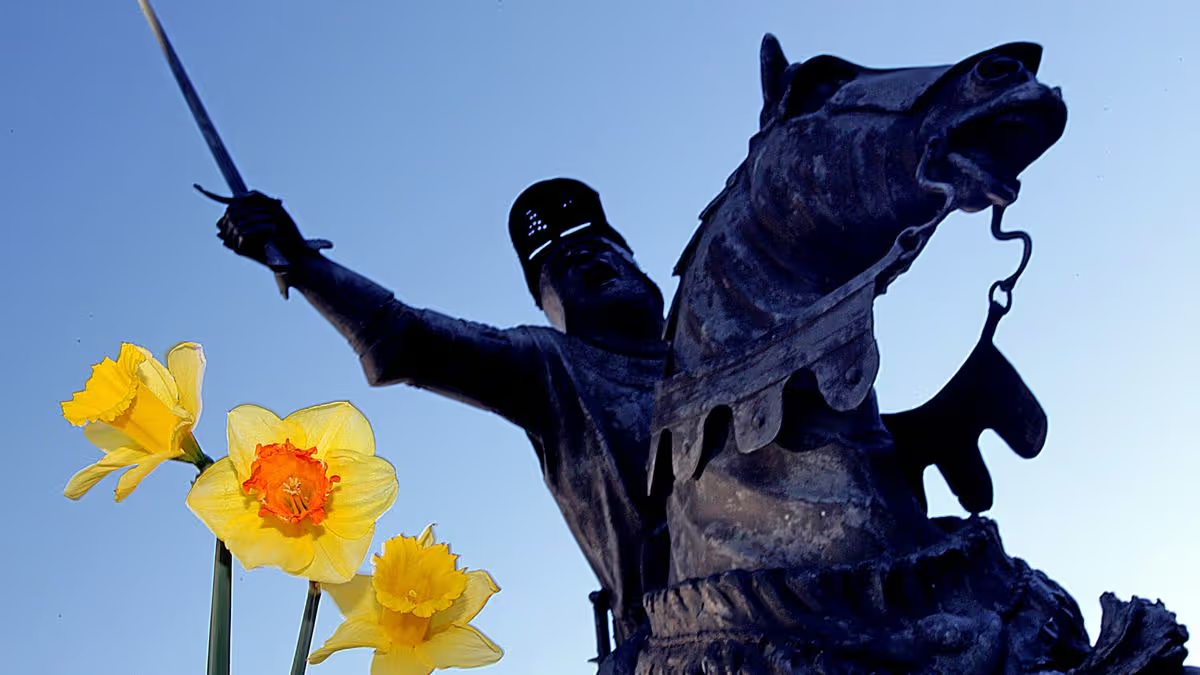
The Owain Glyndwr statue in Corwen

The Owain Glyndwr statue in Corwen .(Image: Ian Cooper )

I was the first in my family to go to university, but I was not the first to understand what education could mean.

My great-grandfather, a quarryman in Gwynedd, was among those who gave what little they could to help establish the University College of North Wales in Bangor in the nineteenth century. Those contributions mattered because they came from people who had very little but believed higher education was worth building for future generations.

That is why the crisis now facing Welsh universities is important, as this is not simply a story about deficits, redundancies and falling student numbers. It is about whether Wales is prepared to let one of its most important national assets drift into decline.

For too long, Welsh higher education has behaved as though the market around it has not fundamentally changed, but students are now more mobile, more selective and more exposed to a competitive UK-wide system than ever before. Welsh universities are not mainly competing with each other, they are competing with powerful English institutions, major city brands and a student market that is making harder judgments about value, employability and experience.

Advertisement

READ MORE: Anglesey Freeport receives £25m of seed funding for projectsREAD MORE: Swansea Civic Centre regeneration plans secures £20m funding boost

Yet Wales has never developed a convincing answer to that challenge, and “Study in Wales” should have become a serious national proposition, built around quality, affordability, community and opportunity. Instead, it has too often felt like a slogan rather than a strategy, and too many institutions have looked and sounded alike, chasing similar students with similar offers.

The deeper problem is not simply that some Welsh students leave Wales, it is that the system has become increasingly dependent on students from elsewhere while the number of Welsh-domiciled students staying in Wales has fallen. That leaves universities more exposed to changes in markets they cannot control.

That vulnerability is clearest in the finances and across the sector – deficits have widened, staff cuts have deepened, and fragility has become impossible to ignore. This is not the problem of a single badly managed institution, and while Welsh universities operate in a difficult UK environment, many also lack the scale and resilience of larger competitors elsewhere.

Advertisement

International students are not the problem as they bring enormous academic, cultural and economic value. The problem is overdependence, and when international recruitment becomes the key support holding up an institution, rather than one part of a balanced model, the risks become obvious.

But this is not just about money, it is also about people. The loss of hundreds of posts across the Welsh university sector is not merely a spreadsheet adjustment. It is the loss of expertise, loyalty and institutional memory. More troubling still is how many staff seem to have been treated during restructuring, and too often, one hears the same themes: poor communication, shallow consultation and a lack of dignity. Universities are meant to embody learning, public service and opportunity, and if they begin treating their own people as disposable, they corrode the values they claim to uphold.

That brings us to governance as good governance is not about committees and paperwork. It is about asking difficult questions early enough to matter. Is student demand really there? Is the subject mix sustainable? Is the capital programme affordable? Is the institution genuinely clear about its mission? Too often in Wales, those questions do not appear to have been asked hard enough.

But the Welsh Government must also confront its own role as universities have too often been treated in Cardiff Bay as a financial pressure to be contained rather than as part of Wales’s productive infrastructure. In policy terms, higher education has been repeatedly downplayed, expected to absorb financial pressures while ministers avoid confronting the scale of the challenge.

Advertisement

That is a serious mistake because universities matter well beyond their campuses. They train nurses, teachers, engineers, entrepreneurs, and public servants on whom Wales relies. They support local jobs, sustain city and town centre economies, attract investment, and help keep talented young people in the country. They are not just education providers but are anchor institutions in the true sense, and if universities weaken, the damage impacts local economies, public services, and national confidence.

The same is true of research, and for too long, Wales has failed to secure anything like its fair share of UK research funding. That matters because research is not an optional extra, it is central to long-term economic growth, innovation and national capacity. If Wales continues to receive far too small a share of UK research and development funding while other parts of the country pull further ahead, we should not be surprised when the gap widens in productivity, commercialisation and high-value employment.

This is not just a university problem but a national economic problem, and every extra pound of research funding helps build laboratories, support skilled jobs, develop new technologies, attract private investment and create spin-out businesses. When Wales loses out, the whole country loses out, and a nation that does not fight for its fair share of research funding is quietly accepting a smaller future.

The good news is that Wales still has outstanding staff, talented students and institutions of real importance, but strengths alone are not enough. Without honesty, reform and a much clearer sense of national purpose, the sector will simply continue to lurch from one crisis to the next.

Advertisement

And in truth, this is not a new aspiration.

More than six centuries ago, when Owain Glyndwr outlined his vision for an independent Wales in the Pennal Letter of 1406, establishing two universities, one in the north and one in the south, was among his chief priorities. He understood then what we must remember now namely that higher education is not secondary to Wales but is central to its future.

The task, then, is not merely to save universities, but to renew and revitalise the higher education system that remains vital to our country’s future. That is the challenge, and that is the opportunity.


Advertisement
Continue Reading

Business

Ex-CEO Bronwyn Barnes accuses Ivanhoe Atlantic of illegal laptop seize

Published

on

Ex-CEO Bronwyn Barnes accuses Ivanhoe Atlantic of illegal laptop seize

Perth-based executive Bronwyn Barnes has accused Ivanhoe Atlantic of seizing a laptop containing her records, as proceedings against her former employer continue in court.

Continue Reading

Business

Allspring Absolute Return Fund Q4 2025 Commentary (WARAX)

Published

on

Allspring Absolute Return Fund Q4 2025 Commentary (WARAX)

Red ladder and stack coin on wooden table with white wall background copy space.

Pla2na/iStock via Getty Images

GENERAL FUND INFORMATION

Ticker: WABIX

Portfolio managers:

Advertisement

Petros Bocray, CFA®, FRM;

Matthias Scheiber, CFA®, Ph.D.;

Rushabh Amin;

and David Kowalske, Jr.

Advertisement

Subadvisor: Allspring Global Investments, LLC

Category: Tactical allocation

FUND STRATEGY

  • Invests in affiliated mutual
Continue Reading

Business

H.C. Wainwright reiterates Intellicheck stock rating on revenue beat

Published

on


H.C. Wainwright reiterates Intellicheck stock rating on revenue beat

Continue Reading

Business

Stephens raises FedEx stock price target to $435 on strong yields

Published

on


Stephens raises FedEx stock price target to $435 on strong yields

Continue Reading

Business

The Retirement System Is Breaking – 8 Risks Most Investors Still Ignore

Published

on

The Retirement System Is Breaking - 8 Risks Most Investors Still Ignore

This article was written by

Leo Nelissen is a long-term investor and macro-focused strategist with a passion for dividend growth, high-quality compounders, and structural investment themes. He combines big-picture macro analysis with bottom-up stock research to identify durable businesses with strong cash-flow potential. Leo also writes for Main Street Alpha, where he publishes deeper-dive research and actionable investment ideas for long-term investors.

Analyst’s Disclosure: I/we have no stock, option or similar derivative position in any of the companies mentioned, and no plans to initiate any such positions within the next 72 hours. I wrote this article myself, and it expresses my own opinions. I am not receiving compensation for it (other than from Seeking Alpha). I have no business relationship with any company whose stock is mentioned in this article.

Seeking Alpha’s Disclosure: Past performance is no guarantee of future results. No recommendation or advice is being given as to whether any investment is suitable for a particular investor. Any views or opinions expressed above may not reflect those of Seeking Alpha as a whole. Seeking Alpha is not a licensed securities dealer, broker or US investment adviser or investment bank. Our analysts are third party authors that include both professional investors and individual investors who may not be licensed or certified by any institute or regulatory body.

Advertisement
Continue Reading

Business

Columbus McKinnon Corporation (CMCO) Presents at Sidoti March Small-Cap Virtual Conference – Slideshow

Published

on

OneWater Marine Inc. (ONEW) Q1 2026 Earnings Call Transcript

Columbus McKinnon Corporation (CMCO) Presents at Sidoti March Small-Cap Virtual Conference – Slideshow

Continue Reading

Business

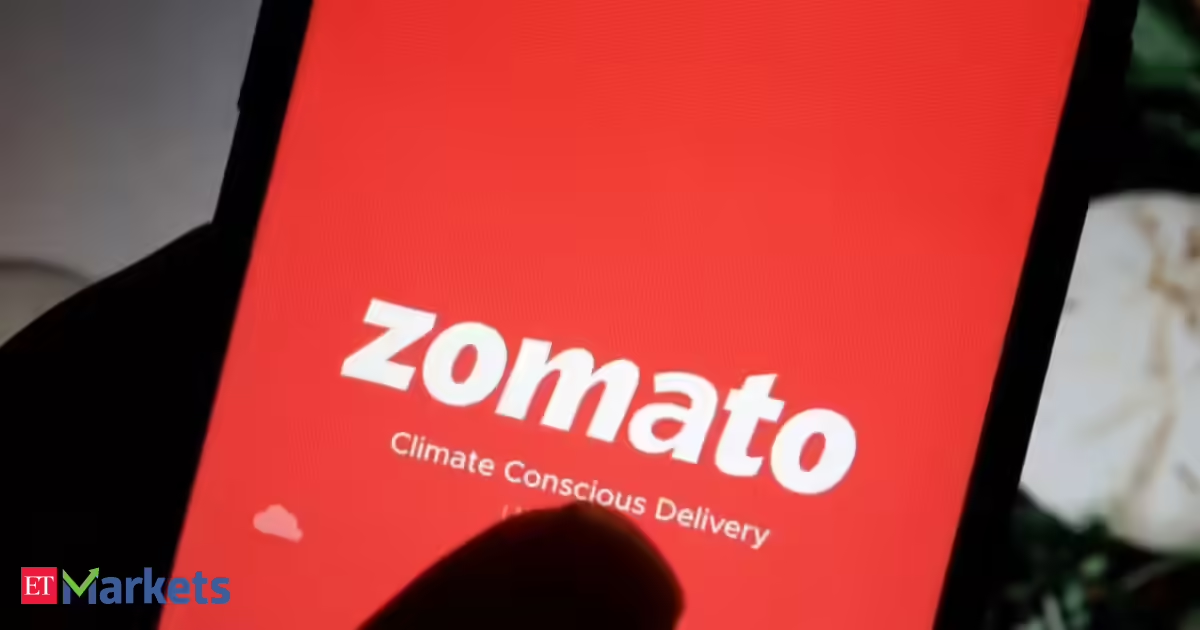
Eternal shares jump 3% from lows as Zomato hikes platform fee by Rs 2.4 per order

Published

on

Eternal shares jump 3% from lows as Zomato hikes platform fee by Rs 2.4 per order
Eternal shares on Friday rose 3% from the day’s low of Rs 230.10 on the NSE to scale the day’s high of Rs 236.70 after its food delivery platform Zomato increased the platform fee by Rs 2.40 per order. The stock witnessed strong investor response with over 5.5 crore shares getting traded on the exchange. The traded value of the shares stood at Rs 1,293 crore.

The stock finally ended at Rs 232.41, up by Rs 3.67 or 1.60% over the last closing price of Rs 228.74.

On a pre-GST basis, platform fee on Zomato is now Rs 14.90 per order from Rs 12.50 earlier, according to a news report by ET Tech. The last such hike was undertaken in September 2025, the report said. Zomato’s food delivery rival Swiggy is currently charging a fee of Rs 14.99 per order, including taxes. Typically, the two players follow each other in changing these levies.

The move comes at a time when urban mobility startup Rapido has launched its food delivery offering Ownly in Bengaluru, claiming that it will not charge any additional fees to customers or restaurants apart from a delivery charge.

Advertisement

Eternal shares have seen significant correction, declining 30% in the past six months. It has underperformed Nifty and the BSE Sensex, which have declined 9% and 10%, respectively in the same period.


The stock is currently trading below its 50-day and 200-day simple moving averages (SMAs) of Rs 265 and Rs 291, respectively, according to Trendlyne data.
Also read | Nifty Bank logs 3rd-worst March fall since the global financial crisis. HDFC Bank, SBI among top culpritsEternal, which also operates quick commerce arm Blinkit, reported a 73% year-on-year (YoY) rise in consolidated net profit to Rs 102 crore. Revenue from operations surged 201% YoY to Rs 16,315 crore.

Revenue growth was mainly driven by an accounting shift to inventory ownership in quick commerce, where revenue now includes the full value of goods sold rather than just marketplace commission. According to Eternal, the like-for-like revenue growth during the quarter was 64% YoY.

Consolidated EBITDA increased 28% YoY to Rs 364 crore, while rising 63% QoQ.

For the food delivery business, adjusted revenue rose 26% YoY to Rs 2,413 crore. Net order value (NOV) increased 17% YoY, accelerating from 13.8% growth in the previous quarter. This marked the second consecutive quarter of NOV growth acceleration, following a trough of 13.1% in Q1FY26. Gross order value (GOV) growth for the third quarter stood at 21% YoY.

Advertisement

Also read | 83% of BSE 500 stocks plunge up to 35% amid Mideast war. Do you own any?

(Disclaimer: The recommendations, suggestions, views, and opinions given by the experts are their own. These do not represent the views of The Economic Times.)

Continue Reading

Trending

Copyright © 2025