


Connect with us

Business

Amazon axes 16,000 more jobs worldwide to ‘remove bureaucracy’

Published

on

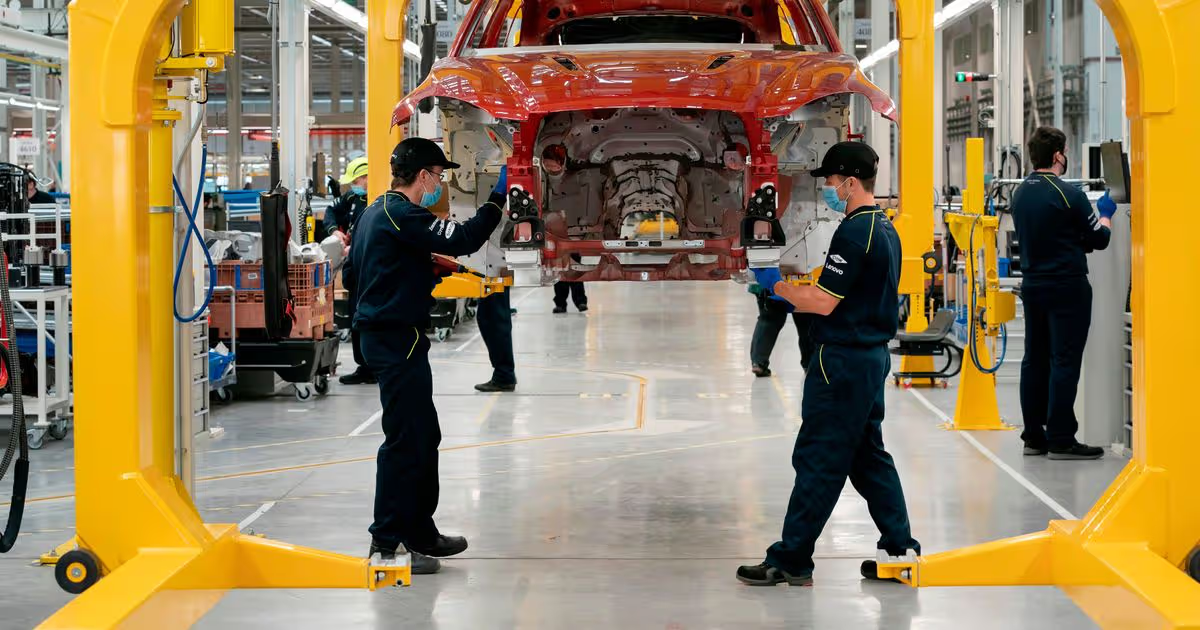
OVER £2M INVESTED INTO UK NICHE VEHICLE PROJECTS Over two million has been awarded to six innovative UK niche vehicle technology projects by the Niche Vehicle Network, including one million pounds worth of government funding. The Niche Vehicle Network Production Readiness and Proof of Concept Competitions, funded by the Department of Business and Trade, via The Advanced Propulsion Centre UK (APC), provide a platform for collaborative R&D of zero tailpipe emission vehicle technologies within the UK niche vehicle sector. Today, the Network has announced that over £2m has been distributed amongst the six winning projects, including over £1m in government grant funding. Two projects have been funded through the NVN Production Readiness Competition. The Production Readiness Competition winners comprised projects led by Carbon Threesixty and Muon Tech. The Hi-DEN Gen2 project, led by Carbon Threesixty, in partnership with Antich & Sons, ULEMCO, and Riversimple Movement, will develop the design, manufacturing, integration, and testing of a conformable hydrogen storage solution to meet the growing demand for Fuel Cell Electric Vehicles and help the UK reach its net zero targets by 2050. The Hi-DEN Gen2 system targets enhanced volumetric efficiency by approaching the storage of hydrogen through arrays of “micro” hydrogen vessels that enables huge increases in storage capacity, efficiency, and vehicle range. The Hi-DEN Gen2 project will build, test and integrate on a vehicle demonstrator a functional full scale hydrogen storage system. Muon Tech will partner with Rock Engineering Limited and Househam Sprayers Limited to bring to market the VXM-35, an integrated electric drive and vehicle control unit. The VXM-35 is designed to fit tight packaging volumes, with high levels of functional safety, reliability & functionality, and will be offered to niche-vehicle OEMs with a co-engineered 35-kW PMAC motor. The plug-and-play solution is ideal for traction applications on-board light vehicles and electric power take-off (ePTO) applications on-board industrial & agricultural vehicles. The HIVED Project will aim to prepare the VXM-35 for production and demonstrate it on-board the world’s first electric crop-sprayer. A further four projects have been funded through the NVN Proof of Concept Competition. One project awarded funding was Bo Mobility, in partnership with Neave Research, with the Boped proof of concept seeking to create a fully functional demonstrator vehicle for a new and innovative omni-category lightweight e-motorcycle. Aiming to enable the niche production of highly optimised vehicles for specific use-cases: the Boped project is a response to the new era of e-mobility tearing apart the rulebook on vehicle categories and capabilities. FR8 Technology, along with FPW Axles and Volta Commercial Vehicles, will produce a demonstrator 16 Tonne rigid delivery vehicle with a low-floor, providing direct access for unloading from the truck to the footpath. Reducing the access height to the load space from a typical 1200mm to just 300mm will be achieved using a radical patent-protected drive system with an e-motor mounted remote from the wheel, driving a gear train in the suspension arm and a double epicyclic reduction at the wheelhead. Quattro Plant, in partnership with Evparts UK and Inetic, are developing a technical demonstrator of an up-cycled off-highway vehicle converting to battery electric powertrain. These vehicles will directly match their ICE equivalents in performance and duty cycle, but have zero tailpipe emissions. The fourth and final Proof of Concept project is led by Raeon, in partnership with Eclipse Performance Vehicles. The project will demonstrate a high-performance application-specific near-production-intent prototype battery, with integrated thermal management, in a high performance L5e vehicle platform. Scott Thompson, Programme Director for the Niche Vehicle Network, said: “We’re delighted to have such an exciting variety of Production Readiness and Proof of Concept projects this year, and the funding being provided to these 17 different SME businesses will be key to enabling them to advance their technology concepts and accelerate their market introduction. The range of vehicle types and technologies being funded demonstrates how important the niche vehicle sector is within the UK automotive sector, supporting the transition to net zero. We’ve got projects developing new powered light vehicles, new architectures for commercial vehicles, EV conversions of existing off-highway vehicles, systems supporting EV agricultural vehicles zero emission, battery systems and novel hydrogen storage solutions suitable for a range of vehicle types. All the projects are focussed on advancing their technology and manufacturing readiness levels, and will help to not only expand the UK low volume EV supply chain, but also creating opportunities for wider adoption in higher volume and adjacent market sectors.” Josh Denne, Head of SME Programmes, APC, said: “APC is delighted to support another cohort of Niche Vehicle Network Production Readiness Competition. This crucial competition provides grants from UK SMEs and their supply chains to take existing low carbon vehicle technologies from demonstration through to production readiness in a compressed timescale, leading to significant economic benefits whilst reducing CO2 emissions. The journey to net-zero must span the whole automotive sector, and these cutting-edge, highly innovative niche vehicle technologies will help the UK reach its climate targets.”

Amazon has announced a further 16,000 job cuts worldwide as it presses ahead with plans to slim down management layers and “remove bureaucracy”, putting an unspecified number of UK roles at risk.

The latest round of layoffs follows the elimination of 14,000 white-collar jobs in October and forms part of Amazon’s broader ambition to shed around 30,000 corporate roles. While the majority of the new cuts will fall in the United States, teams in the UK and India are also affected. Amazon employs around 75,000 people in Britain but has not disclosed how many UK positions could be lost.

The cuts are expected to hit white-collar roles across Amazon Web Services, Prime Video, retail operations and human resources, also known internally as people experience and technology.

In a blog post to staff, Beth Galetti, Amazon’s senior vice president of people experience and technology, said the company was continuing a restructuring programme first outlined last autumn.

“As I shared in October, we’ve been working to strengthen our organisation by reducing layers, increasing ownership and removing bureaucracy,” she said.

Advertisement

US-based employees affected by the cuts will generally be given 90 days to seek alternative roles within the business, while the timing for staff in other countries will depend on local employment rules, Galetti added.

Amazon has previously linked job reductions to the growing use of artificial intelligence, describing the current wave of AI as the most transformative technology since the internet. However, Andy Jassy has downplayed the role of AI in the decision, telling analysts that the layoffs were primarily cultural rather than financial.

“You end up with a lot more people than what you had before, and you end up with a lot more layers,” Jassy said during a recent earnings call.

The company dramatically expanded its workforce during the Covid-19 pandemic to cope with surging demand for online shopping and digital services. Amazon now employs around 1.58 million people globally, the vast majority of whom work in warehouses and fulfilment centres rather than corporate roles.

Advertisement

The current round of cuts is the largest in Amazon’s three-decade history, surpassing the 27,000 jobs eliminated in 2022. Amazon was founded in 1994 by Jeff Bezos, who remains executive chairman and the company’s largest individual shareholder.

The announcement has drawn criticism from trade unions. Rachel Fagan, organiser at the GMB, said the decision would have serious consequences for workers and communities.

“Amazon is showing itself for what it is — a company that cannot be trusted to do the right thing by working people in the UK,” she said. “Thousands of job losses will cause huge damage in towns and cities across the country.

“Decision-makers must recognise Amazon as a business fixated on eye-watering profits at the expense of workers and local people.”

Advertisement

The latest layoffs underline the growing pressure on big tech companies to balance efficiency, automation and cost-cutting with mounting scrutiny over their impact on employment and local economies.


Amy Ingham

Amy is a newly qualified journalist specialising in business journalism at Business Matters with responsibility for news content for what is now the UK’s largest print and online source of current business news.

Advertisement
Continue Reading
Click to comment

Leave a Reply

Your email address will not be published. Required fields are marked *

Business

Farm owner fined over shearer death in the Wheatbelt

Published

on

Farm owner fined over shearer death in the Wheatbelt

A Western Australian farm owner has been fined $22,000 over the death of a shearer who was caught in a decades-old wool press.

Continue Reading

Business

We shouldn’t get hung up on firms being Welsh-owned but those with potential for growth

Published

on

Business Live

Frank Holmes says the real dividing line is not between nationalism and globalism. It is between capability and complacency

Frank Holmes.

Wales is not a large economy pretending to be small. It is structurally small. The overwhelming majority of Welsh firms are micro enterprises, many of them lifestyle businesses, subcontractors or locally oriented service providers.

Advertisement

Medium-sized companies, the real engines of productivity, export intensity and durable wage growth, are comparatively scarce. That imbalance explains much of Wales’ GVA (gross valued added) gap and its persistent productivity under performance.

It also explains why every political cycle returns to the same question: how do we build scale?

Plaid Cymru’s Senedd Election manifesto places ownership at the centre of the answer. The diagnosis is the “ownership gap”, the claim that Wales loses too much value because successful firms are sold externally and profits flow out. The proposed remedy is a stronger state-backed institutional architecture, including a National Development Agency, a more assertive Development Bank of Wales and a procurement system designed to retain wealth locally. The intention is clear. The consequences are more complex.

READ MORE: Next Welsh Government needs to help realise huge potential of renewablesREAD MORE: Construction work starts on two new campuses for Cardiff and Vale College

Advertisement

Growing micro-firms into small companies, and small firms into medium-sized enterprises, requires more than stable local demand. It requires management depth, access to capital, export ambition, product differentiation and competitive pressure.

Public procurement reform may provide revenue stability, and patient capital may bridge funding gaps, but neither automatically produces internationally competitive firms. If policy softens competitive tension too far, firms can survive without truly scaling. The danger is institutionalising smallness rather than overcoming it. Protection can preserve, but it does not necessarily propel.

The comparison with Germany’s Mittelstand is frequently invoked, and rightly so. Germany’s economy is also SME-dominated, yet its mid-sized industrial champions command global niches with remarkable precision. However, the Mittelstand is not simply about local ownership. It is about specialisation, export penetration and long-term governance discipline.

These companies are often family-controlled, but they are globally integrated. They do not fear scale or external markets. They dominate them. The lesson for Wales is not merely to retain ownership but to cultivate firms capable of owning markets. Without export depth and technical specialisation, ownership becomes symbolic rather than strategic.

Advertisement

On inward investment and mergers and acquisitions, the evidence from Wales itself complicates the narrative. Trade sales have historically been the dominant exit route for Welsh businesses, and a large majority of those companies have remained operating in Wales after acquisition.

Ownership change has not equated to economic disappearance. Strategic acquirers frequently bring systems, working capital, distribution channels and professional governance that domestic firms alone may struggle to build. If Wales signals scepticism toward external capital, even indirectly, the likely effect is not an abrupt withdrawal of investment but a repricing. Fewer bidders. Lower valuations. Greater caution. Capital does not debate ideology. It reallocates.

Succession planning illustrates this tension clearly. Most SME owners are not driven by political philosophy but by retirement security, legacy, and compensation for risk taking, job creation and delivering economic impact. They want clarity on valuation, tax treatment, timing and continuity. If policy narrows perceived exit routes, some will accelerate sales, restructure holdings or incorporate elsewhere to preserve flexibility.

Conversely, if a reformed development bank can credibly finance management buy-outs or structured internal successions on competitive terms, domestic retention becomes commercially viable rather than politically aspirational. Employee ownership models have a place, but where vendor financing constrains cash flow and investment capacity, resilience can weaken rather than strengthen. Ideology does not replace financial reality.

Advertisement

For corporate investors considering Wales as a relocation base for services or manufacturing, the evaluation criteria remain unchanged. Skills depth, grid capacity, digital infrastructure, transport connectivity, planning speed and policy stability determine decisions.

The Cardiff Capital Region narrative of cluster strength in semiconductors, energy systems, digital industries and creative production is compelling when matched by execution. Investors seek predictability and technical competence. They do not seek protection from competition. If Wales demonstrates institutional maturity and regulatory clarity, capital will engage. If it projects uncertainty around ownership or capital mobility, investors will hedge their exposure.

The proposal for a stronger National Development Agency sits at the centre of this debate. Properly governed, such an institution can provide patient equity, bridge succession finance gaps and crowd in private capital into strategic sectors. It can smooth cycles and anchor long-term industrial bets.

Poorly governed, it can crowd out commercial lenders, politicise allocation decisions and concentrate valuation risk on the public balance sheet. The difference lies in governance discipline, transparency and a clear commercial mandate. If the institution becomes a co-investor with global capital, Wales strengthens its credibility. If it becomes a gatekeeper of capital flows, Wales narrows its own opportunity set.

Advertisement

The broader impact of economic nationalism on GVA and productivity depends on how it is implemented. Retaining more profits locally can improve multiplier effects and community resilience. Aligning skills provision with industrial needs can raise labour productivity and we must double down on adopting AI too. Supporting domestic succession can preserve employment continuity. Yet if the framework discourages competitive exits, reduces the diversity of capital sources or prioritises ownership retention over operational excellence, productivity growth will slow. Sustainable economic growth requires both rootedness and openness.

External investors can and do bring other benefits, not least experienced management and board members, networks within their portfolio companies, international reach and discipline on planned delivery and governance. This extends to Stock Exchange listed companies, of which there are too few in Wales, with only one FTSE 100 company, Admiral Group, whose shareholders are international.

The real dividing line is not between nationalism and globalism. It is between capability and complacency. Ownership matters when it supports strategic continuity and reinvestment. It becomes irrelevant when firms lack competitive edge. Wales does not need to shield itself from global capital. It needs to negotiate from a position of strength. That strength will come from skills, infrastructure, cluster coherence and disciplined institutions.

The opportunity is genuine. So is the risk. The future of Wales’ economy will not be determined by who owns its companies. Competitiveness and reach beyond Wales is the outcome that ultimately matters.

Advertisement

Frank Holmes is a partner with Gambit Corporate Finance and chair of the Cardiff Capital Region’s Economic Growth Partnership.


Continue Reading

Business

Top 5 mid cap mutual funds to invest in February 2026

Published

on

The Economic Times

ETMutualFunds has shortlisted the top midcap mutual funds based on mean rolling returns, consistency over the last three years, downside risk, outperformance and asset size. The threshold is Rs 50 crore.

Continue Reading

Business

Lamborghini CEO Says EV Market for Luxury Cars Is ‘Close to Zero’

Published

on

Lamborghini CEO Says EV Market for Luxury Cars Is ‘Close

Lamborghini has canceled plans to launch its first fully electric vehicle, saying demand from wealthy buyers is almost nonexistent.

Chief Executive Stephan Winkelmann said the market for high-end electric supercars is “close to zero,” leading the brand to shelve its all-electric Lanzador project.

In an interview with The Sunday Times, Winkelmann explained that the company studied customer feedback, dealer input, and global data for more than a year before making the decision.

The Lanzador, first revealed in 2023 as a powerful “Ultra GT,” had been expected later this decade with a price near $300,000. That plan is now off the table, Fortune reported.

Advertisement

“The decision was made after over a year of continuous internal discussion, engaging with customers, dealers, market analysis, and global data,” Winkelmann said.

He added that the “acceptance curve” for electric vehicles among Lamborghini’s target clients was “close to zero” and flattening.

Investing heavily in a full battery-electric model, he warned, risked becoming an “expensive hobby” and would be financially irresponsible.

Lamborghini Shifts Focus to Plug-In Hybrids

Instead, Lamborghini will focus on plug-in hybrid electric vehicles, known as PHEVs.

Advertisement

“Plug-in hybrids offer the best of both worlds, combining the agility and low-rev boost of electric battery technology with the emotion and power output of an internal combustion engine,” Winkelmann said.

For now, the company plans to keep building traditional combustion-engine cars “for as long as possible.”

According to FoxBusiness, he said Lamborghini buyers want an emotional driving experience, something he believes electric cars currently struggle to provide. “EVs, in their current form, struggle to deliver this specific emotional connection,” he noted.

Lamborghini is owned by Volkswagen AG through its subsidiary Audi. It is not alone in rethinking electric strategies. Stellantis recently took a $26.5 billion charge after scaling back EV production.

Advertisement

General Motors recorded a $7 billion hit tied to changes in its EV plans. Ford Motor Company also announced major write-downs as it pivots toward hybrids and more affordable models.

Originally published on vcpost.com

Continue Reading

Business

Decoded: The viral doomsday AI memo that roiled Wall Street

Published

on

Decoded: The viral doomsday AI memo that roiled Wall Street
Stock market investors are used to shocks from central banks, Trump and geopolitics – not Substack. Yet a 7,000-word essay by James van Geelen appears to have rattled markets all the same.

The founder of Citrini Research published “The 2028 Global Intelligence Crisis” on Sunday, outlining a hypothetical scenario in which accelerating AI adoption leads to widespread white-collar job losses, weaker consumption and mounting financial strain.

The essay describes a “deflationary cascade” in which AI doesn’t just augment workers, it replaces them so efficiently that it destabilises the broader economy.

In a market already jittery about rapid AI developments and heavily concentrated in tech stocks, the scenario struck a nerve. By Monday morning, the post had gone viral across trading desks.

Advertisement

What does the post say?

Citrini’s thesis imagines a near future in which rapidly improving AI agents hollow out software companies,displace white-collar workers, destabilise credit and housing markets, and inadvertently bankrupt the middle class.


It stresses that the scenario is a “thought exercise, not a prediction.” Still, its chain-reaction logic alarmed investors.
The post is written as a retrospective from 2028. In its version of events, AI first drives a surge in productivity and profits before job losses start to weigh on spending and credit.

Here are the key triggers from the post that spooked the market:

1) Death of the middleman

At the heart of Citrini’s thesis is a sharp leap in AI capability. It points to increasingly autonomous tools such as Anthropic’s Claude Code and OpenAI’s Codex as early signs of systems able to execute complex business tasks with minimal human input.

Advertisement

The impact would extend beyond software to travel booking, insurance, real estate commissions, and other industries built on transaction “friction.”
If such agents scale, they could undercut demand for platforms such as Monday.com, Zapier and Asana by allowing companies to manage workflows internally at lower cost. That, in turn, could push vendors like Oracle into sharper price competition.

Nor would it stop there. In Citrini’s framework, personal AI agents transact directly for consumers, bypassing intermediaries such as Uber and DoorDash. Payment networks, including Visa and Mastercard, could face pressure if transactions shift to lower-cost crypto rails.

The common thread: when machines optimise every transaction for efficiency, habitual app loyalty—a cornerstone of many digital business models–begins to erode.

Advertisement

2) Mass white-collar unemployment

Historically, technologies have created more jobs than they destroyed. Citrini argues AI could prove to be the exception.

“AI is now a general intelligence that improves at the very tasks humans would redeploy to. Displaced coders cannot simply move to ‘AI management’ because AI is already capable of that,” the report states.

In this scenario, layoffs in software and other white-collar sectors accelerate, and workers cannot easily transition into higher-value roles. Many shift into lower-paying or less stable jobs, putting pressure on wages and weakening consumer spending.

That softer demand then feeds back into corporate decisions. Instead of hiring, companies double down on automation to cut costs, reinforcing what Citrini describes as a cycle with no natural brake.

Advertisement

3) Financial spillovers

The report extends the shock into the private credit and housing sectors.

Many software firms have been financed by private-credit lenders based on assumptions of steady long-term revenue. If AI undermines those assumptions, defaults could surge. Asset managers such as Hellman & Friedman and Permira, cited in the report, could face pressure if software-backed loans sour.

At the same time, laid-off white-collar workers struggle to service mortgages, triggering housing stress. Combined credit tightening and falling consumer confidence could amplify the downturn.

Advertisement

Citrini ultimately sketches a late-2027 crash that wipes out 57% of the S&P 500.

4) The paradox of “ghost GDP”

Citrini flags what it sees as a growing imbalance: the economy looks healthy on paper, but many households are under strain.

In one scenario, large AI companies continue to post strong profits and productivity gains. Given their heavyweight in stock indices and overall output, headline GDP and market indicators remain resilient.

Advertisement

The problem, the firm argues, is that machines don’t spend. They don’t buy homes, cars or everyday services.

The result is what Citrini calls “ghost GDP” – economic output that shows up in the data but doesn’t filter through to the wider population.

That gap between rising corporate profits and squeezed household finances, the firm warns, could heighten social and political tensions, with anger directed less at Wall Street and more at Silicon Valley.

Advertisement

How did markets react?

Investors were already uneasy about AI disruption. The Substack post sharpened those fears.

US software stocks led the slide. Shares of Datadog, CrowdStrike and Zscaler fell sharply, while International Business Machines suffered its worst one-day drop in decades. Private-equity groups KKR and Blackstone, both cited in the report, also declined.

The broader selloff, which coincided with renewed trade-policy uncertainty in Washington, pushed the Dow Jones Industrial Average down 1.7%, or 822 points, on Monday.

Shares of DoorDash fell about 7% after the note called it a “poster child” for businesses that monetise friction between buyers and sellers. In the scenario, AI agents enable customers and drivers to transact more directly, squeezing margins. On social media, co-founder Andy Fang said the rise of “agentic commerce” would force the company to adapt. “The ground is shifting underneath our feet,” he wrote.

Advertisement

“So far this year, the stock market has been discounting a scenario in which AI is our Frankenstein monster,” said Ed Yardeni of Yardeni Research. His base case is less dire: “We continue to believe that AI is augmenting workers’ productivity rather than making them extinct.”

Also read: IT stock crash wipes out Rs 1.2 lakh crore for LIC & mutual funds in bloodbath not seen since 2008

After the selloff, van Geelen said the report was a scenario, not a forecast. Speaking to Bloomberg, he described it as an attempt to “start a conversation” about a world in which human intelligence is no longer the scarcest resource.

Whether that future materialises is unclear. But the episode shows how quickly AI enthusiasm can turn into market anxiety.

(Disclaimer: Recommendations, suggestions, views and opinions given by the experts are their own. These do not represent the views of The Economic Times)

Advertisement
Continue Reading

Business

UiPath (PATH) Stock Trades Near $10.10 Amid Agentic AI Push, Eyes Q4 Fiscal 2026 Results on March 11

Published

on

UiPath

UiPath Inc.’s stock has shown resilience in late February 2026, closing at $10.10 on February 24 after a 0.69% decline, as the robotic process automation leader leverages its agentic AI advancements and partnerships to counter broader software sector pressures and position for growth in enterprise automation.

UiPath
UiPath

As of February 24, 2026, UiPath (NYSE: PATH) traded in a session range of $9.92 to $10.43 with volume of about 32 million shares. The shares have recovered modestly from recent lows but remain down significantly year-to-date in 2026, reflecting volatility in the automation and AI software space. The 52-week range spans a low near $9.38 to a high of $19.84, with the stock trading at a forward P/S ratio around 3.5 and a forward P/E below 15—levels some analysts view as attractive given the company’s pivot to agentic AI orchestration.

The recent performance follows UiPath’s emphasis on agentic AI, where autonomous agents handle complex workflows beyond traditional RPA bots. On February 23, 2026, UiPath joined the Agentic AI Foundation as a Gold Member, gaining influence in working groups on governance, security, and observability to help shape open standards for interoperable AI agents. This move complements earlier initiatives, including a partnership with OpenAI to integrate frontier models into enterprise workflows via a ChatGPT connector and launches of agentic solutions for healthcare administrative bottlenecks.

UiPath’s latest quarterly results, for fiscal Q3 2026 ended October 31, 2025, reported December 3, 2025, showed revenue of $411.11 million—up 15.9% year-over-year—and EPS of $0.16, beating estimates of $0.15. Annualized recurring revenue reached $1.782 billion, growing 11%, with dollar-based net retention at 107%. The quarter marked UiPath’s first GAAP operating income of $13 million, highlighting improving profitability amid investments in AI-enhanced automation.

Management highlighted alliances with Microsoft, Amazon, Salesforce, and others to expand reach and scalability. Recent recognitions include inclusion in G2’s 2026 Best Software Awards across five categories, underscoring strong user adoption. The company also acquired WorkFusion to bolster capabilities in healthcare AI and other verticals.

Advertisement

Analysts remain divided but generally constructive on the long-term outlook. Consensus among 13-17 firms rates PATH a Hold to Moderate Buy, with average 12-month price targets around $15.62 to $15.77—implying 54-56% upside from current levels. High targets reach $19, while lows sit at $10-$14. RBC Capital recently lowered its target to $14 from $17 on February 23, 2026, maintaining Sector Perform amid software sector concerns and investor sentiment, though earlier adjustments reflected optimism around AI positioning.

Institutional interest persists, with Vanguard Group increasing its stake by 4.9% in Q3 2025, adding over 2.25 million shares to hold nearly 48 million—about 9% ownership valued around $641 million. This supports views of undervaluation, with some models suggesting PATH trades 38% below fair value estimates around $16.19.

Challenges include competition in RPA and AI automation from players like ServiceNow, as well as cautious enterprise spending in some segments. The software sector faces divergence in 2026, with AI leaders potentially gaining while others lag. UiPath’s forward guidance and ARR trends will be key in proving sustained momentum.

The next major catalyst arrives March 11, 2026, when UiPath reports fiscal Q4 and full-year 2026 results after market close, followed by a 5:00 p.m. ET conference call. Consensus expects EPS around $0.20-$0.25 and revenue near $465 million, up about 10% year-over-year. Investors will scrutinize ARR growth, margin expansion, agentic AI adoption metrics, and full-year guidance amid the platform’s evolution.

Advertisement

UiPath, a pioneer in RPA now transitioning to comprehensive agentic automation, benefits from its end-to-end platform and enterprise focus. With AI agents poised as a major 2026 trend for workflow orchestration, the company’s scale, partnerships, and improving profitability position it to capture demand in digital transformation. While near-term volatility persists from sector dynamics, the low valuation and AI tailwinds offer potential for recovery if execution continues.

As the March earnings approach, UiPath’s ability to demonstrate accelerating growth in agentic solutions and sustained enterprise traction will determine whether the current levels prove a buying opportunity or reflect ongoing caution in automation software.

Continue Reading

Business

Bitmine Immersion Technologies (BMNR) Stock Trades Near $19.44 Amid Massive Ethereum Treasury Growth

Published

on

Bitmine Immersion Technologies

Bitmine Immersion Technologies Inc. shares have experienced sharp swings in February 2026, closing at $19.44 on February 24 after rising 1.14%, as the Ethereum-focused treasury company continues aggressive accumulation of ETH tokens, reporting holdings of 4.423 million ETH and total crypto, cash, and “moonshot” assets reaching $9.6 billion.

Bitmine Immersion Technologies

As of February 24, 2026, Bitmine Immersion (NYSE American: BMNR) traded in a session range of $18.65 to $19.60 with volume exceeding 30 million shares. The stock has declined roughly 5-6% over the past week but remains significantly higher over longer periods, with a 52-week range from $3.20 to $161.00 reflecting extreme volatility tied to Ethereum price movements and the company’s concentrated treasury strategy. Market capitalization stands around $8.74 billion.

The latest catalyst came February 23, 2026, when Bitmine announced its ETH position reached 4,422,659 tokens valued at approximately $1,958 per ETH (based on CoinMarketCap data), representing 3.66% of Ethereum’s 120.7 million circulating supply. The company added 51,162 ETH in the prior week—valued at roughly $98-100 million—during what Executive Chairman Tom Lee described as a “mini crypto winter” for the asset. Staked ETH totaled 3,040,483 tokens, generating annualized staking revenues of $171 million at a recent 2.89% seven-day yield, outperforming the Composite Ethereum Staking Rate of 2.81%.

Bitmine highlighted its position as the world’s largest Ethereum staking operation, with 69% of holdings already staked. The company reiterated progress on its Made-in-America Validator Network (MAVAN), a proprietary staking infrastructure set for deployment in early calendar 2026 (Q1). MAVAN aims to provide secure, best-in-class staking for Bitmine’s assets, working with three providers in the interim. Lee emphasized the “alchemy of 5%” philosophy—targeting 5% of ETH supply—now over 73% achieved in seven months.

The treasury update included $691 million in cash and strategic “moonshot” investments, such as a $200 million stake in Beast Industries, alongside minor holdings like 193 BTC. Average daily trading volume of about $700 million ranks BMNR as the 165th most traded U.S. stock, underscoring high visibility despite concentration risks.

Advertisement

The aggressive ETH accumulation has drawn attention amid Ethereum’s price weakness, with the token sliding to levels near $1,958 from 2025 highs. Bitmine’s average cost basis—estimated near $4,000 per token in prior disclosures—has led to substantial paper losses, ballooning to over $8 billion in some analyses as ETH declined. Yet management views current prices as a “perfect bottom” and continues buying, framing it as a long-term institutional strategy leveraging staking yields and DeFi mechanisms.

Recent institutional moves bolster confidence. BlackRock increased its stake significantly in prior periods, and inflows from firms like Sumitomo Mitsui Trust Group and Envestnet Asset Management have supported liquidity. However, leadership changes—including the January 2026 separation of President Erik Nelson with a $605,000 payout—have raised questions about execution during the treasury buildout.

Analyst coverage remains limited but mixed, with some highlighting BMNR’s role as a leveraged ETH play rather than a traditional tech or mining stock. The company’s shift from immersion-cooled Bitcoin mining to an Ethereum treasury focus has reduced self-mining exposure while deferring new site buildouts. No recent quarterly earnings details alter the narrative, with the last reported figures showing ongoing losses (trailing EPS around -$0.93) amid treasury volatility.

The next updates will likely focus on MAVAN launch progress in Q1 2026 and further ETH purchases or staking metrics. Consensus lacks a unified price target due to sparse coverage, but sentiment ties closely to Ethereum’s trajectory—potential rallies could drive BMNR higher, while prolonged weakness might exacerbate losses.

Advertisement

Bitmine Immersion Technologies positions itself as the leading Ethereum treasury for institutional and public market investors, capitalizing on native protocol yields and infrastructure like MAVAN. Its scale—controlling over 3.6% of ETH supply—offers unique exposure but introduces concentration risk in a volatile asset class. As the company advances its staking platform and continues accumulation, BMNR remains a high-beta proxy for Ethereum believers amid the broader crypto market’s fluctuations.

Investors monitoring the stock eye Ethereum fundamentals, including network activity highs and staking economics, as key drivers. With trading volume elevated and institutional stakes growing, Bitmine’s path in 2026 will hinge on executing MAVAN and navigating crypto cycles effectively.

Continue Reading

Business

What is happening to gas and electricity prices?

Published

on

What is happening to gas and electricity prices?

Typical household bills will fall by 7% when the new energy cap takes effect on 1 April 2026.

Continue Reading

Business

Aussie shares top records as results support mega moves

Published

on

Aussie shares top records as results support mega moves

Australia’s share market has broken multiple records as earnings season delivers more outsized company-level moves for bigger players, while mining stocks remain hot assets.

Continue Reading

Business

City of Perth council to vote on $280k bill for governance issues

Published

on

City of Perth council to vote on $280k bill for governance issues

City of Perth councillors are set to vote on spending $280,000 to implement workplace recommendations tonight, continuing a meeting that ran for more than four hours on Tuesday.

Continue Reading

Trending

Copyright © 2025