







The Welsh Liberal Democrats said a strategy needs to support heavy industry and manufacturing that makes up 15% of the Welsh economy

The Liberal Democrats have called for the next Welsh Government to implement its own industrial strategy as part of a long-term plan to strengthen the economy’s manufacturing base.
Ahead of publishing its Senedd Election manifesto later this month the Welsh Liberal Democrats said a dedicated Welsh industrial strategy should work alongside the UK-wide strategy – ensuring Welsh industries receive the targeted support they need while avoiding duplication. Last year the Westminster government published its ten year industrial strategy around eight key pillars, ranging from manufacturing to fintech.
Last week, in its Senedd manifesto, CBI Wales also called for a distinct Welsh industrial strategy, although with alignment to the UK one.
READ MORE: M4 relief road ‘is needed if we want to grow the economy’READ MORE: Leasing deal agreed for third huge floating offshore windfarm in the Celtic Sea
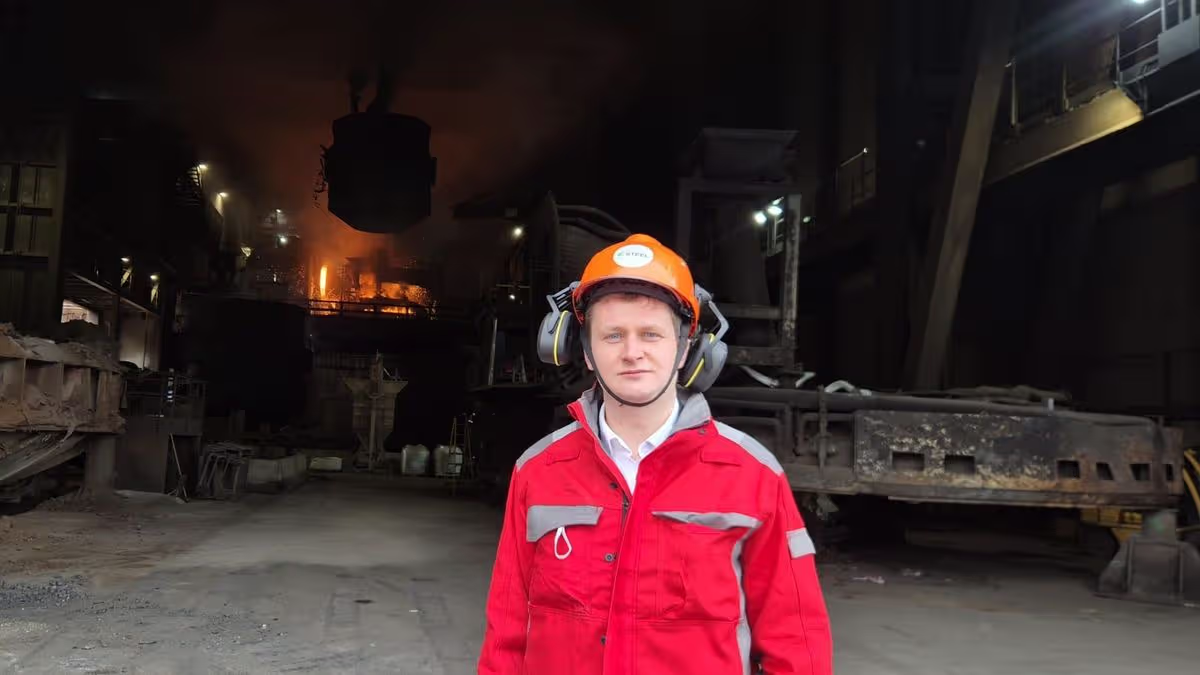
The Welsh Liberal Democrats proposal was highlighted during a visit by David Chadwick MP to the 7 Steel facility in Cardiff, where he met with workers and industry representatives to discuss the challenges facing Welsh heavy industry and manufacturing.
The party says Wales requires a clear and coordinated strategy to support its industrial sectors, recognising the outsized role they play in the Welsh economy. Heavy industry and manufacturing account for around 15% of the Welsh economy, compared with around 9% across the rest of the UK.
The party argues that Wales still has a strong industrial base and the potential to lead in areas such as advanced manufacturing, engineering and green energy supply chains, but that this will require deliberate and sustained action from government.
It highlighted that businesses in Wales consistently raise concerns about high energy costs, poor transport infrastructure and growing skills shortages, which they warn are holding back investment and growth. It added that any serious industrial strategy must also focus on strengthening apprenticeships and technical training to ensure Welsh businesses have access to the skilled workforce they need.
The Welsh Liberal Democrats have previously called for the Welsh Government to reverse recent cuts to the apprenticeship budget, expand higher and degree apprenticeships in sectors such as engineering, manufacturing and construction, and establish regional engineering and technical skills hubs aligned with local employer demand.
Mr Chadwick, who is PM for Brecon, Radnor and Cwm Tawe, said: “Wales has a proud industrial heritage and the skills, expertise and workforce to build a strong manufacturing future. But after decades of deindustrialisation and years of economic drift from the Welsh Labour Government, far too many communities feel their industries have simply been left behind.
“Manufacturing and heavy industry still make up a far larger share of the Welsh economy than they do elsewhere in the UK. That is a strength we should be building on, not something we allow to decline through neglect.
“That’s why the Welsh Liberal Democrats are calling for a dedicated Industrial Strategy for Wales, one that recognises the importance of our industrial sectors, supports innovation and investment, and ensures Welsh businesses can compete and grow.
“After 27 years in power, Welsh Labour has never even attempted to set out a clear strategy to close the wage gap between Wales and England or improve productivity across the Welsh economy.
“The Welsh Liberal Democrats believe economic growth should be at the heart of tackling poverty and creating opportunity. A serious industrial strategy for Wales would be a vital step towards achieving that.”
The party is also calling for rail to be devolved to Wales with a fair block grant adjustment recognising years of underinvestment in Wales’ rail infrastructure. Devolution of rail would uncouple Wales from rail projects in England, such as high speed two, being deemed as Wales and England schemes.
This would see the comparability factor, which sets the rate of a Barnett consequential from an overall increase in DfT spending, rising for Wales from the current 33% in line with nearly 96% for Scotland and Northern Ireland.