
Business
Annaly capital president sells $652k in shares





Seeking Alpha’s transcripts team is responsible for the development of all of our transcript-related projects. We currently publish thousands of quarterly earnings calls per quarter on our site and are continuing to grow and expand our coverage. The purpose of this profile is to allow us to share with our readers new transcript-related developments. Thanks, SA Transcripts Team

No shortage but Aurigny is spending 120% more on fuel than it was prior to the war, its boss says.
Business
Sydney’s 10 Largest Shopping Malls in 2026 Offer Massive Retail Space Amid Strong Sales Growth

SYDNEY — Australia’s retail heart continues beating strongly in Sydney, where the 10 biggest shopping malls by gross leasable area (GLA) are delivering robust sales performance and attracting millions of visitors annually as of early 2026, even as industry-wide productivity gains and targeted redevelopments reshape the sector.

Westfield Parramatta leads the pack in New South Wales as the state’s largest shopping centre, with approximately 140,070 square meters of GLA, according to updated industry compilations. The western Sydney destination houses around 500 stores, including major anchors like David Jones, Myer, Kmart, Target, Coles, Woolworths and Event Cinemas, serving a broad suburban catchment.
Macquarie Centre in Macquarie Park follows closely with about 138,500 square meters of GLA, making it one of the largest enclosed malls in the greater Sydney region. Owned through a partnership involving superannuation funds after a 2025 transaction, the centre features Myer, Big W, Kmart, Coles, Woolworths and Event Cinemas. Its convenient Metro access from Chatswood and Epping has helped sustain high foot traffic.
Westfield Warringah Mall in Brookvale ranks third among Sydney centres with roughly 132,102 square meters. The northern beaches landmark maintains an open-air feel while offering David Jones, Myer, Big W, Target and a strong mix of specialty retailers. Scentre Group has explored rezoning options that could integrate residential towers in future stages, reflecting broader trends of mixed-use development around major malls.
Westfield Bondi Junction, a premium eastern suburbs destination, comes in with approximately 126,895 square meters of GLA. Known for its luxury and fashion focus, it recorded strong sales in 2025 and ranked as the highest-performing NSW centre in national turnover lists. Recent redevelopment stages have enhanced its offering, including refreshed department store spaces.
Westfield Miranda in the south, often called Westfield Miranda, spans around 124,000 square meters. Anchored by Myer, David Jones, Big W, Kmart and Target, it serves southern Sydney residents and continues to perform solidly within Scentre Group’s portfolio.
Other notable large centres include Westfield Burwood and Stockland Green Hills, both of which posted some of the highest year-on-year productivity growth (MAT per square meter) in the 2026 Big Guns report by Shopping Centre News, with increases of 13.2% and 13.5% respectively for the 2025 reporting period.
Westfield Sydney in the central business district, while smaller in pure GLA at around 91,765 to 97,453 square meters depending on measurement, punches above its weight in sales productivity. It achieved specialty MAT per square meter of $26,949 in 2025 data — second only to Chadstone nationally — and welcomed an additional 6,000 square meters of luxury retail in 2025, including new boutiques for Chanel, Moncler and Omega. The centre recorded about $1.157 billion in total annual retail sales and 34.9 million customer visits.
In January 2026, Australian Retirement Trust acquired a 19.9% stake in Westfield Sydney for A$864 million, underscoring institutional confidence in prime CBD retail assets.
Rounding out a typical top 10 list of Sydney-area malls by size are centres such as Westfield Penrith (around 92,000 square meters) in the west and others like Top Ryde City or Broadway Sydney, which excel in productivity or niche offerings despite varying GLA figures.
The 2026 Big Guns report highlighted continued strength in Australia’s major shopping centres, with record numbers achieving billion-dollar moving annual turnover (MAT) figures for 2025. While national leaders like Chadstone ($2.7 billion MAT) dominate overall rankings, Sydney centres such as Westfield Bondi Junction, Westfield Sydney, Westfield Miranda and Westfield Parramatta consistently featured in the national top 10 for sales performance.
Industry analysts attribute the resilience to a combination of experiential retail, luxury and fashion offerings, and convenient locations. Physical retail has rebounded strongly post-pandemic, with big malls benefiting from omnichannel strategies where online research leads to in-store purchases.
Data centre and infrastructure demands linked to broader economic trends, including AI adoption, have indirectly supported retail through increased employment in surrounding areas, though malls themselves focus on consumer spending.
Challenges persist. Rising construction costs and planning hurdles have slowed some expansions, while online competition and cost-of-living pressures affect discretionary spending. However, centres with strong anchors and entertainment options — cinemas, dining precincts and events — have weathered these conditions better.
Scentre Group, owner-operator of most Westfield malls in Sydney, continues investing in reconfigurations. At Westfield Bondi Junction and others, department store spaces are being repurposed for more productive uses, including additional specialty retail and experiential zones.
Smaller but iconic destinations like the Queen Victoria Building (QVB), The Galeries, World Square and Pitt Street Mall complement the big-box malls. These CBD and heritage sites draw tourists and locals for high-end and specialty shopping, with Pitt Street Mall remaining one of Australia’s most expensive retail strips.
The Sydney Outlet Village in Liverpool represents a newer addition to the retail landscape, focusing on outlet-style bargains rather than traditional enclosed mall formats.
Looking ahead in 2026, analysts expect modest GLA growth through infill developments and reconfigurations rather than entirely new mega-malls. Mixed-use projects incorporating residential towers above or beside retail — as proposed at Warringah Mall — could become more common as governments push housing supply near transport hubs.
Sustainability features, such as improved energy efficiency and EV charging, are increasingly standard in mall upgrades to appeal to environmentally conscious shoppers.
Visitor numbers remain high. Westfield Sydney alone sees tens of millions of annual visits, while suburban centres benefit from being community hubs with medical, banking and government services co-located.
Retail employment in these large centres supports thousands of jobs directly and indirectly, contributing to Sydney’s economy amid broader productivity discussions around technology adoption.
For shoppers, the variety is vast: luxury fashion in Westfield Sydney and Bondi Junction, everyday essentials and family entertainment in Parramatta or Macquarie Centre, and beach lifestyle vibes at Warringah Mall.
Tourists often combine mall visits with nearby attractions — Sydney Tower at Westfield Sydney, beaches near Bondi Junction, or parklands around northern and western centres.
Parking remains a key consideration, with most large malls offering thousands of spaces, though public transport access via train, bus and Metro is promoted to reduce congestion.
As Sydney’s population grows, particularly in western and southwestern corridors, demand for quality retail space is expected to rise, potentially supporting further investment in existing assets.
The strong 2025 sales figures released in the 2026 Big Guns analysis suggest confidence is returning, with big malls proving their enduring appeal in an era of digital disruption.
Whether seeking high fashion, household goods or a family day out, Sydney’s top 10 shopping malls by size continue to anchor the city’s retail scene, blending scale with evolving consumer experiences.
- Westfield Parramatta (Parramatta) — Approximately 140,070 m² GLA. Features around 425–500 retailers including David Jones, Myer, Kmart, Target, Coles, Woolworths, and Event Cinemas. It ranks as NSW’s largest shopping centre and recorded strong annual sales exceeding A$1 billion.
- Macquarie Centre (Macquarie Park) — Approximately 138,500 m² GLA. Anchored by Myer, Big W, Kmart, Coles, Woolworths, and Event Cinemas. Well-served by Metro and popular with northern suburbs shoppers.
- Westfield Warringah Mall (Brookvale) — Approximately 132,102 m² GLA. Offers David Jones, Myer, Big W, Target, and a mix of specialty stores with an open-air vibe on the northern beaches.
- Westfield Bondi Junction (Bondi Junction) — Approximately 126,895–131,510 m² GLA. A premium eastern suburbs destination known for luxury and fashion, with strong sales performance and recent redevelopments.
- Westfield Miranda (Miranda) — Approximately 124,000 m² GLA. Serves southern Sydney with anchors including Myer, David Jones, Big W, Kmart, and Target.
- Westfield Burwood (Burwood) — One of the high-productivity centres in Sydney’s inner west, noted for strong year-on-year sales growth in 2025 data.
- Westfield Sydney (Sydney CBD) — Approximately 91,765–97,453 m² GLA (smaller in size but exceptionally high productivity). Recorded specialty MAT per square metre of around $26,949 in 2025, with luxury additions and over 34 million annual visits.
- Westfield Penrith (Penrith) — Approximately 92,000 m² GLA. Major western Sydney hub with Myer, Big W, Target, and broad retail offering.
- Top Ryde City (Ryde) — A growing centre in the northern suburbs with solid GLA and convenient location.
- Broadway Sydney (Ultimo/Glebe) — High productivity performer despite more compact size, popular for its urban mix of retail, dining, and entertainment near the University of Technology Sydney.
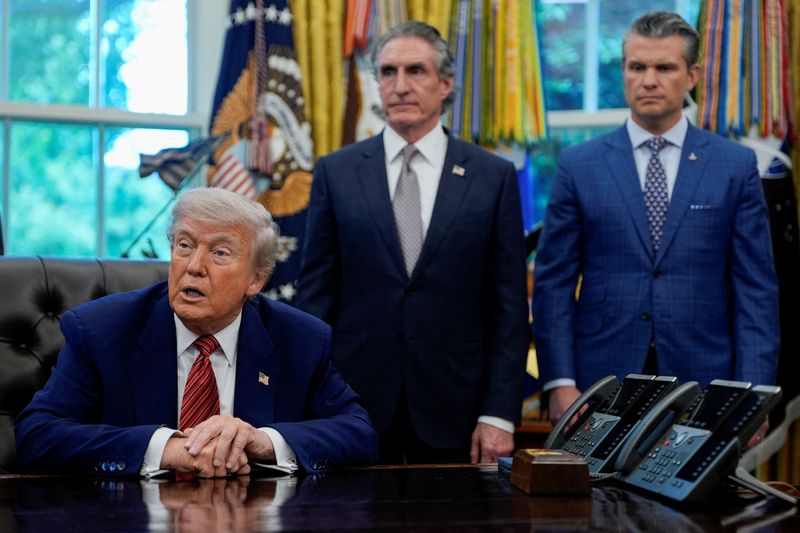

Trump’s budget proposes massive defense spending with 10% cut to other federal programs


Company adds SweetRight Stevia Echo line to SweetRight range.
Business
OSL Group Limited 2025 Q4 – Results – Earnings Call Presentation (OTCMKTS:BCTCF) 2026-04-03
Seeking Alpha’s transcripts team is responsible for the development of all of our transcript-related projects. We currently publish thousands of quarterly earnings calls per quarter on our site and are continuing to grow and expand our coverage. The purpose of this profile is to allow us to share with our readers new transcript-related developments. Thanks, SA Transcripts Team

Two months after 84-year-old Nancy Guthrie vanished from her home in the Catalina Foothills north of Tucson, authorities say they still have no arrests, no named suspects and no clear motive in what they describe as her forcible abduction from bed in the dark of night. The case, which has captivated the nation because of her daughter Savannah Guthrie’s prominence as co-anchor of NBC’s “Today” show, continues to baffle investigators despite thousands of tips, extensive searches and the release of chilling doorbell camera footage showing a masked, armed individual at her doorstep.

Guthrie was last seen alive around 9:45 p.m. on Saturday, Jan. 31, 2026, when her son-in-law Tommaso Cioni drove her home after a family dinner at the nearby residence of her older daughter, Annie Guthrie. She had taken an Uber to the dinner earlier that evening. The next morning, Sunday, Feb. 1, Guthrie failed to appear at a friend’s house for a virtual church service she had planned to watch. Family members grew concerned and went to check on her, discovering she was gone.
Pima County Sheriff’s Office deputies responding to the home found what appeared to be small blood droplets near the front door. Security systems had been disabled, and later reports indicated the back doors were found propped open. Investigators quickly shifted from an initial belief that the elderly woman might have wandered off — a common assumption in cases involving seniors — to treating the disappearance as a criminal abduction.
Sheriff Chris Nanos announced early in the investigation that evidence pointed to Guthrie being “taken against her will.” The FBI joined the probe, and the case was elevated to a federal kidnapping investigation. On Feb. 2, authorities publicly stated they believed she had been kidnapped.
The FBI released night-vision footage from Guthrie’s Google Nest doorbell camera showing a masked and gloved individual, appearing armed, standing at her front door in the hours after she returned home. Additional surveillance images recovered from the property have been analyzed, but officials say they have yielded limited new leads. A glove found near the home and DNA evidence recovered from the scene did not match entries in the FBI’s Combined DNA Index System database.
As the search entered its third month on April 1, questions have mounted about the handling of the investigation. Law enforcement sources told NewsNation that initial responders may have lacked extensive homicide or major crimes experience, with one supervisor reportedly never having led a homicide case before. Critics, including retired Pima County officials, have pointed to possible missteps, such as an early focus on the wandering theory despite evidence of forced entry indicators. Sheriff Nanos has defended the department’s efforts, saying hundreds of investigators have logged thousands of hours and sifted through tens of thousands of tips.
The Guthrie family has been vocal in their pleas for information. Savannah Guthrie, who has largely stayed behind the scenes but appeared in emotional segments, posted a video offering a $1 million family reward for information leading to her mother’s recovery, payable only upon Nancy’s safe return or recovery consistent with FBI guidelines. The family emphasized that “someone knows how to find our mom and bring her home” and urged anyone with even small details to come forward anonymously via the FBI tip line at 1-800-CALL-FBI.
In a recent statement, the family noted: “No detail is too small.” They visited a makeshift memorial near their mother’s home in early March, joined by Savannah, Annie and other relatives. Savannah has described her mother as a deeply religious woman who was active in her church community despite mobility challenges in her later years.
Unverified ransom notes reportedly sent to media outlets, some demanding Bitcoin payments in the millions, have surfaced in media reports but authorities have not confirmed their authenticity or linked them directly to the abductor. Such notes have added to the mystery without producing breakthroughs.
The affluent Catalina Foothills neighborhood, known for its upscale homes nestled among saguaros and mesquite trees with views of Tucson below, has been scoured by search teams, including the use of cadaver dogs at times, though that effort was later paused. Ground searches, aerial surveillance and reviews of extensive neighborhood camera footage have turned up little concrete evidence of where Guthrie might have been taken.
Experts note the case is unusual for several reasons. Abductions of elderly individuals from their homes are rare, particularly without an obvious motive like robbery or immediate family conflict. Guthrie’s family members, including her daughters and son-in-law, were quickly cleared as suspects after interviews and alibis were verified.
The disappearance has drawn parallels to other unsolved cases in the Tucson area, where some families have waited decades for answers about missing loved ones. It has also sparked online speculation and true-crime discussions, with some pointing to similarities with other suspicious vanishings, though authorities caution against unsubstantiated theories.
Nancy Guthrie, née Long, was widowed since 1988 after the death of her husband Charles. She raised three children, including Savannah, who has spoken warmly of her mother’s faith and family devotion. At 84, she lived independently but relied on family nearby for support. She was described as vibrant and engaged in her community despite her age.
As of early April 2026, the investigation remains active with the Pima County Sheriff’s Office and FBI continuing to pursue leads. No arrests have been made, and officials say they are still evaluating evidence, including potential digital footprints and witness statements. A body found in a Scottsdale canal was ruled unrelated to the case.
Public scrutiny of the sheriff’s office has intensified, with some questioning resource allocation and early decisions in a high-profile case that has brought national media attention to Pima County. Sheriff Nanos faces upcoming public hearings that may touch on the Guthrie investigation alongside other departmental issues.
For the Guthrie family, the wait has been agonizing. Savannah Guthrie told co-host Hoda Kotb in a recent interview that the uncertainty is the hardest part, describing how the family found the back doors propped open when they first checked the home. She has urged continued public vigilance, saying even the smallest observation could break the case.
Law enforcement continues to ask the public for help. Anyone with information is encouraged to contact the FBI or Pima County Sheriff’s Office. Tips can remain anonymous, and the substantial reward remains in place.
The case highlights broader challenges in missing persons investigations involving the elderly, where initial assumptions can delay recognition of foul play. It also underscores the emotional toll on families when a loved one vanishes without trace from what should be the safety of their own home.
As the calendar turns deeper into spring, with Easter having just passed on April 5, the Guthrie family and investigators persist in their search for answers. Nancy Guthrie remains missing, her whereabouts and condition unknown more than 60 days after she was last seen. The hope that she is still alive endures, even as the passage of time makes the odds more daunting.
The investigation shows no signs of slowing, but with more questions than answers two months in, the baffling abduction of Nancy Guthrie stands as one of the most perplexing missing persons cases in recent memory — a stark reminder that even in quiet, secure neighborhoods, danger can strike without warning.
Business
3.1 Million Eye Drops Recalled at Walgreens, CVS Over Sterility Concerns: FDA Class II Alert

More than 3.1 million bottles of over-the-counter eye drops sold at major retailers including Walgreens, CVS, Kroger and others have been recalled due to a lack of assurance of sterility during manufacturing, federal health officials said Friday.

The voluntary recall, initiated by Pomona, California-based K.C. Pharmaceuticals, Inc., covers approximately 3,111,072 bottles of various lubricant and redness-relief eye drops distributed nationwide. The U.S. Food and Drug Administration classified the action as a Class II recall, meaning use of the products may cause temporary or medically reversible adverse health consequences, or the probability of serious adverse health consequences is remote.
No illnesses or injuries have been reported in connection with the recall, according to FDA records posted March 31. The agency emphasized that the issue involves a failure to meet sterility standards in production rather than confirmed contamination in the finished products. Still, officials urged consumers to immediately stop using the affected drops and return them to the place of purchase for a refund or proper disposal.
The recalled eye drops were sold under dozens of store-brand and private-label names, including CVS Health, Walgreens, Kroger, Rite Aid, H-E-B, Harris Teeter, Dollar General, Leader, Good Sense and others. They were also distributed through Cardinal Health, military exchanges and additional outlets. Products include artificial tears, advanced relief formulas, redness relief drops and sterile eye drops in 0.5 fluid ounce (15 mL) bottles.
Specific quantities include 378,144 bottles of Sterile Eye Drops Original Formula containing tetrahydrozoline HCl 0.05%, along with hundreds of thousands of bottles each of Sterile Eye Drops AC, Eye Drops Advanced Relief and other variants. Lot codes and expiration dates vary, with many products carrying dates into 2026. Consumers should check the lot number and expiration on the bottle carton or label against the full list available on the FDA website.
Eye drops are considered sterile drug products, and any breach in manufacturing controls can introduce risk of bacterial or other microbial contamination. Such contamination could potentially lead to eye infections, irritation, vision problems or, in rare severe cases, more serious complications, particularly for people with compromised immune systems or pre-existing eye conditions.
Health experts advise anyone experiencing symptoms such as eye pain, redness that worsens, discharge, blurred vision or sensitivity to light after using these products to contact a healthcare provider promptly. The FDA recommends discarding unused portions rather than attempting to return opened bottles in some cases, though retailers may provide specific instructions.
This recall comes amid heightened scrutiny of over-the-counter ophthalmic products following several high-profile eye drop contamination incidents in recent years. Previous recalls involved bacterial and fungal outbreaks linked to certain imported artificial tears, prompting stricter oversight of manufacturing facilities.
K.C. Pharmaceuticals has not publicly detailed the specific manufacturing lapse that triggered the recall. The company initiated the action on or around March 3, with the FDA formally posting the enforcement report on March 31. Retailers began pulling affected inventory from shelves in recent weeks.
Walgreens and CVS, two of the largest pharmacy chains in the United States, confirmed they are cooperating fully with the recall. Spokespeople for both companies said they are notifying customers who purchased the products through loyalty programs or online and facilitating returns. Similar statements came from Kroger and other affected retailers.
Consumers with questions can contact K.C. Pharmaceuticals or check the FDA’s MedWatch website for updates. The agency maintains a searchable database of recalls and provides detailed product photos and lot information to help identify affected items.
The scale of the recall — more than 3 million bottles — underscores the widespread popularity of affordable store-brand eye drops. Millions of Americans rely on these products daily for dry eye relief, allergy symptoms or minor irritation caused by screen time, contact lenses or environmental factors.
Ophthalmologists note that while most people tolerate minor manufacturing variations without issue, sterility is non-negotiable for products applied directly to the eyes. The eye’s surface is particularly vulnerable because it lacks the robust immune defenses found in other parts of the body.
Dr. Elena Ramirez, a spokesperson for the American Academy of Ophthalmology, said in a statement that patients should err on the side of caution with any recalled medication. “If in doubt, throw it out,” she advised. “There are many safe alternatives on the market, including preservative-free single-use vials that reduce contamination risk.”
The recall does not affect prescription eye drops or major national brands produced under different manufacturing processes. Name-brand products from companies such as Refresh, Systane or Visine are not included unless specifically listed in the FDA notice.
Retail analysts said the financial impact on manufacturers and stores is likely significant but contained, given the voluntary nature and the ability to replace inventory quickly. Share prices for major pharmacy chains showed little movement Friday amid broader market activity.
For consumers, the practical steps are straightforward: examine medicine cabinets and bathroom drawers for any eye drop bottles purchased in recent months. Compare lot numbers and expiration dates against the FDA list. Return unaffected-looking but recalled products to the retailer. Consult a doctor or pharmacist if symptoms appear or if the drops were used regularly.
The FDA continues to monitor the situation and has not ruled out additional recalls or enforcement actions if further issues surface at the manufacturing facility. Officials stressed that proactive recalls like this one help prevent potential harm before problems escalate.
In the meantime, health authorities recommend proper storage and handling of all eye care products. Bottles should be kept tightly closed, stored at room temperature away from direct sunlight and never shared between users to minimize cross-contamination risks.
This latest development serves as a reminder of the importance of rigorous quality control in pharmaceutical manufacturing, even for seemingly simple over-the-counter items. As millions of bottles make their way back from store shelves and medicine cabinets, regulators and industry players will likely face renewed calls for enhanced inspection protocols.
Consumers seeking replacements should look for products labeled as sterile and check expiration dates carefully. Single-dose, preservative-free options may provide extra peace of mind for those concerned about contamination.
The full list of affected products, lot codes and distribution details remains available on the FDA’s website under enforcement report event number 98533. Regular updates will be posted as retailers complete their returns and the investigation into the manufacturing process continues.
As spring allergy season ramps up and more people reach for relief, officials urged vigilance. With Easter weekend just passed and many families traveling or stocking up on household essentials, the timing of the public notice aims to reach as many consumers as possible before additional use occurs.
In summary, while the risk to any individual user appears low, the widespread distribution of these 3.1 million bottles warrants immediate action. Checking your eye drops today could prevent unnecessary discomfort or more serious issues tomorrow.
Federal Reserve Bank of New York President John Williams discusses market impacts of the Iran War, inflation outlook and more on ‘The Claman Countdown.’
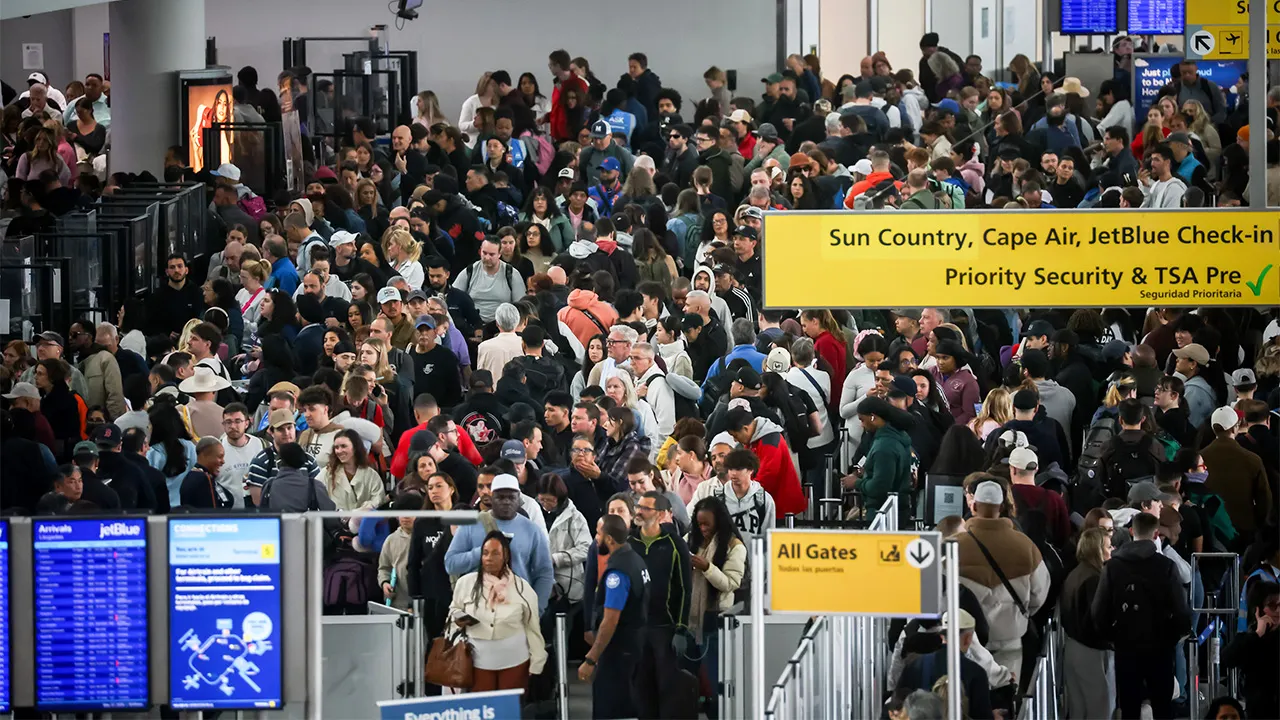
United Airlines is rolling out a new feature to its app that will provide users with estimated TSA security wait times as airport congestion intensifies during a partial Department of Homeland Security shutdown that has strained screening operations.
The feature is launching in a pilot phase at several of the airline’s largest U.S. hub airports, including Chicago, Denver, Los Angeles and Newark, with broader expansion possible if successful.
A nearly seven-week partial shutdown of the DHS has disrupted airport operations, contributing to long security lines and unpredictable wait times. Staffing shortages at the Transportation Security Administration have driven absenteeism above 10% at times, worsening delays at checkpoints.
DELTA SUSPENDS VIP SERVICES FOR CONGRESS MEMBERS AMID DHS SHUTDOWN, TSA DELAYS
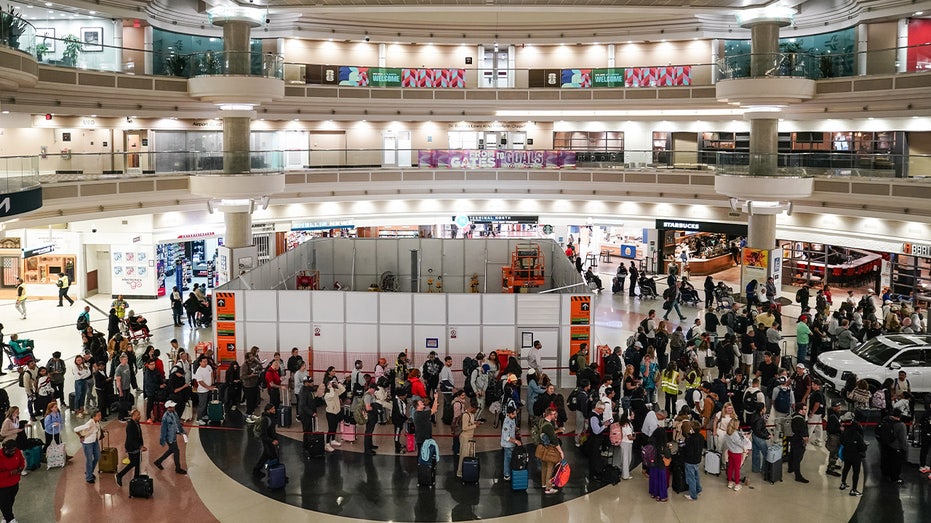
Travelers wait in line at a TSA checkpoint at Hartsfield-Jackson Atlanta International Airport in Atlanta, Georgia, on March 27, 2026. (Elijah Nouvelage/Bloomberg via Getty Images)
Within the United app’s “Travel” section, users can view estimated wait times for TSA screening throughout the day, broken down by lane type, including standard screening and TSA PreCheck.
UNITED AIRLINES CHECKED BAG FEES CLIMBS $10-50 AS FUEL PRICES NEARLY DOUBLE SINCE IRAN WAR
The move reflects a broader push by airlines to provide real-time information as travel demand remains elevated, and airport systems face strain. Security wait times, which can fluctuate widely, have historically been difficult for passengers to predict.
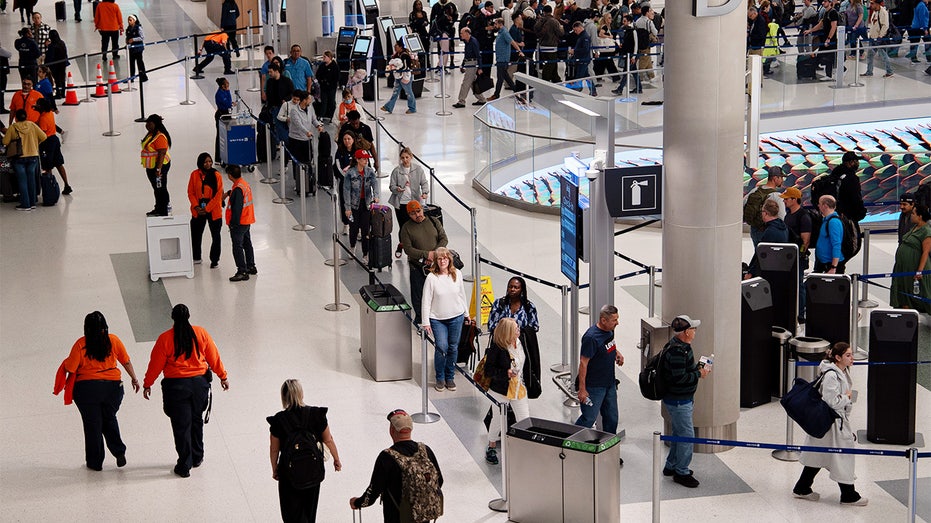
People wait in line to pass through security at George Bush Intercontinental Airport on March 28, 2026, in Houston, Texas. (Danielle Villasana/Getty Images)
Access to wait time estimates could influence when travelers arrive at the airport, which screening lane they choose and how they manage tight departure windows.
United has been expanding its mobile app capabilities as part of a wider effort to shift more of the travel experience onto digital platforms, including baggage tracking with Apple AirTag integration, automated rebooking during disruptions, connection guidance and real-time weather alerts.
| Ticker | Security | Last | Change | Change % |
|---|---|---|---|---|
| UAL | UNITED AIRLINES HOLDINGS INC. | 92.21 | -2.87 | -3.02% |
FRUSTRATED PASSENGERS LASH OUT AT LONG TSA LINES; GOP MESSAGES TO ‘THANK A DEMOCRAT’
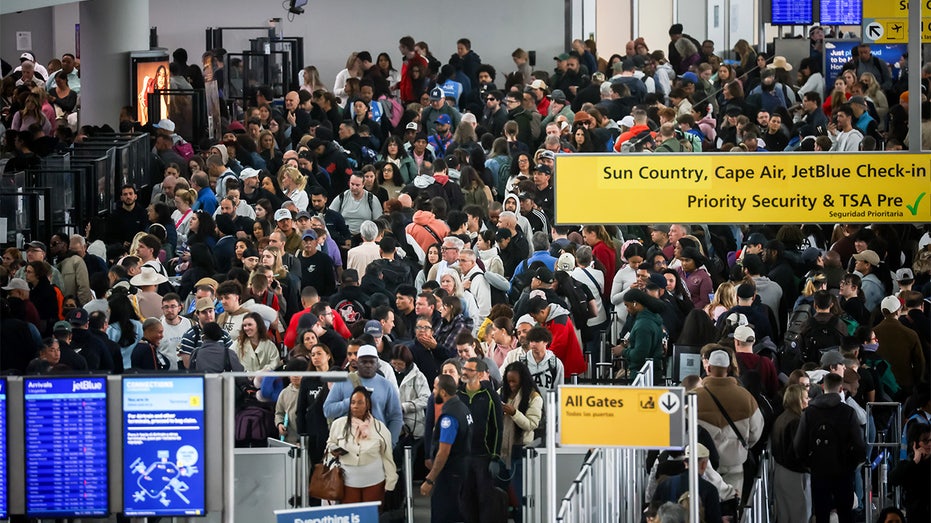
Travelers wait in line at a Transportation Security Administration (TSA) checkpoint at John F. Kennedy International Airport (JFK) in New York, US, on Friday, March 27, 2026. (Michael Nagle/Bloomberg via Getty Images)
The rollout underscores how airlines are attempting to fill information gaps as operational challenges – including staffing disruptions tied to the DHS funding standoff – continue to affect airport performance.
CLICK HERE TO GET FOX BUSINESS ON THE GO
As travel demand remains high, tools that help passengers navigate delays and congestion more efficiently may become increasingly central to airline competition.
United shares are up more than 53% over the past year and down 17.5% year to date.
U.S. employers added 178,000 jobs in March, a solid rebound that far exceeded economists’ expectations and signaled underlying resilience in the labor market despite ongoing geopolitical tensions from the conflict with Iran and surging energy costs. The unemployment rate ticked down to 4.3%, the Bureau of Labor Statistics reported Friday, offering a brighter picture after a sharp February decline partly tied to a health care strike.

The March gain marked the strongest monthly job growth since late 2024 and reversed a revised 133,000-job loss in February, when a strike by health care workers weighed heavily on payrolls. Economists surveyed ahead of the release had forecast only about 60,000 jobs added, making the actual figure a notable positive surprise heading into the long Good Friday weekend.
Job gains were concentrated in health care, construction and transportation and warehousing, sectors that have shown durability even amid broader economic uncertainty. The return of roughly 31,000 striking Kaiser Permanente health care workers contributed to the rebound, but underlying hiring momentum appeared to extend beyond that one-time factor.
“The labor market is demonstrating remarkable staying power,” said one economist who tracks monthly data closely. “After the February stumble, this report suggests the economy isn’t buckling under the pressure of higher oil prices and international uncertainty as quickly as some feared.”
Average hourly earnings rose 0.2% from February and 3.5% from a year earlier, a moderate pace that could ease some concerns about wage-driven inflation even as energy costs climb. The labor force participation rate and other household survey measures showed modest shifts, with the number of unemployed people declining slightly to about 7.2 million.
Friday’s report comes as markets remain on edge over the U.S.-Iran conflict that has driven oil prices sharply higher in recent weeks. Brent crude has spiked on fears of supply disruptions, raising the specter of stagflation — slower growth paired with higher inflation. Yet the stronger-than-expected hiring data provided reassurance that domestic demand and business activity retain momentum.
With stock and bond markets closed for the Good Friday holiday, traders will have to wait until Monday to fully price in the implications. Futures contracts suggested a cautiously optimistic tone, though volatility remains elevated. The CBOE Volatility Index had hovered near elevated levels in recent sessions amid war-related headlines.
The March figures follow a turbulent stretch for the labor market. February’s steep decline, initially reported as 92,000 jobs lost and later revised, had raised alarms about a possible sharper slowdown. Downward revisions to prior months also painted a softer picture of late 2025 and early 2026 hiring. March’s bounce-back helped steady those concerns.
Sector breakdowns highlighted pockets of strength. Health care continued its long-running role as a steady job creator, adding positions even beyond the strike resolution. Construction benefited from milder weather in some regions and ongoing infrastructure projects. Transportation and warehousing saw gains tied to e-commerce and logistics demand.
Manufacturing and retail showed more mixed results, reflecting the crosscurrents of higher input costs from energy prices and resilient consumer spending in certain categories. Government employment remained relatively stable, though federal payrolls have trended lower in recent periods amid budget and policy shifts.
The household survey, which feeds into the unemployment rate calculation, indicated the jobless rate fell to 4.3% from 4.4% in February. The decline came partly as some individuals left the labor force, but the overall picture pointed to a labor market that is neither overheating nor collapsing. Long-term unemployment measures remained contained.
For the Federal Reserve, the data complicates an already delicate balancing act. Policymakers have held the benchmark federal funds rate steady in the 3.5%-3.75% range in recent meetings, citing persistent inflation risks now amplified by oil shocks. The stronger March jobs print may reduce near-term pressure for rate cuts, as officials monitor whether energy-driven price increases feed into broader inflation.
“Robust job growth gives the Fed more room to watch and wait rather than rush to ease policy,” said another analyst. “But if oil stays elevated and begins to slow consumer spending or business investment, the picture could shift quickly.”
President Donald Trump’s administration has pointed to the resilience as evidence that the economy can weather external shocks. White House officials emphasized the job gains in key sectors while acknowledging the challenges posed by higher energy costs for families and businesses.
Consumer confidence surveys in recent weeks had shown some softening amid war headlines and gasoline price jumps at the pump. Yet hiring data suggests employers remain willing to add workers, supporting household incomes that could help sustain spending.
Looking ahead, April’s report will be closely watched for any signs that prolonged higher oil prices are beginning to weigh on hiring. Additional data points, including next week’s consumer price index that may reflect energy costs, will further shape expectations.
International developments also loom large. Any escalation or resolution in the Middle East conflict could swing energy markets and, by extension, influence business decisions on expansion and staffing. European and Asian economies face similar pressures from global energy flows.
Smaller businesses and the gig economy, not fully captured in the nonfarm payrolls survey, have shown mixed signals in private data sources such as ADP reports. Temporary help services, often a leading indicator, posted modest changes in recent months.
The report arrives just after Easter observances, with many families using the long weekend to reflect on economic conditions. For job seekers, particularly recent college graduates entering the market, the data offers some encouragement that opportunities remain available despite headline volatility.
Retail and service sectors critical to spring and summer hiring seasons will be key barometers in coming months. Leisure and hospitality, which took hits during earlier pandemic waves, have stabilized but remain sensitive to consumer discretionary spending affected by fuel costs.
Economists cautioned against reading too much into a single month’s data, noting that seasonal adjustments, weather effects and one-time events like strikes can distort trends. The three-month average of job gains provides a smoother view and still points to moderate expansion.
Broader measures of labor market slack, including the U-6 rate that captures underemployed workers, will offer additional context when updated. For now, the headline numbers suggest the economy retains forward momentum.
As markets prepare to reopen Monday, investors will parse the jobs data alongside any weekend diplomatic developments from the Middle East. Bond yields, which edged higher on the strong report in pre-holiday trading, could see further movement depending on inflation expectations.
In corporate boardrooms, the report may encourage continued investment in American workers even as companies hedge against energy and supply-chain risks. Chief executives have cited labor availability as a bright spot amid other uncertainties.
For American workers, the numbers translate to more opportunities in growing sectors, though wage growth has not kept pace with inflation in recent years for many households. Real earnings trends will depend heavily on how quickly energy prices moderate.
The March employment situation underscores the U.S. economy’s capacity for resilience. After a February setback, hiring rebounded robustly, unemployment eased and key industries continued expanding. Yet with oil prices elevated and geopolitical risks unresolved, the path ahead remains one that demands vigilance from policymakers, businesses and families alike.
Friday’s strong showing provides a measure of reassurance as the nation moves deeper into spring, but it does not eliminate the challenges posed by external shocks. The coming weeks of economic data will determine whether March’s rebound marks a return to steadier growth or merely a temporary lift.

Flat tire? Dead battery? Speedy’s serves stranded Seattle riders as a quicker e-bike picker-upper

THIS IS XRP’S BIGGEST MOMENT EVER!!! (MASSIVE ANNOUNCEMENT JUST WENT LIVE!!!)

Artemis II’s moon-bound astronauts capture Earth’s beauty


-

 NewsBeat7 days ago
The Story hosts event on Durham’s historic registers
-

 NewsBeat21 hours ago
Steven Gerrard disagrees with Gary Neville over ‘shock’ Chelsea and Arsenal claim | Football
-

 Sports7 days ago
Sweet Sixteen Game Thread: Tide vs Michigan
-
Entertainment4 days ago
Fans slam 'heartbreaking' Barbie Dream Fest convention debacle with 'cardboard cutout' experience
-

 Business16 hours ago
No Jackpot Winner and $194 Million Prize Rolls Over
-

 Crypto World2 days ago
Gold Price Prediction: Worst Month in 17 Years fo Save Haven Rock
-
 Entertainment6 days ago
Lana Del Rey Celebrates Her Husband’s 51st Birthday In New Post
-

 Tech5 days ago
The Pixel 10a doesn’t have a camera bump, and it’s great
-
Crypto World3 days ago
Dems press CFTC, ethics board on prediction-market insider trades
-

 Sports3 days ago
Tallest college basketball player ever, standing at 7-foot-9, entering transfer portal
-

 Tech4 days ago
Avatar Legends: The Fighting Game comes out in July and it looks pretty slick
-

 Tech3 days ago
EE TV is using AI to help you find something to watch
-

 Fashion5 days ago
Amazon Sundays: Soft Spring Layers
-

 Business2 days ago
Login and Checkout Issues Spark Merchant Frustration
-

 Fashion7 days ago
When Evening Dressing Gets Colorful for Spring
-

 Tech3 days ago
How to back up your iPhone & iPad to your Mac before something goes wrong
-

 Tech5 days ago
Elon Musk’s last co-founder reportedly leaves xAI
-

 Tech4 days ago
Apple will hide your email address from apps and websites, but not cops
-

 Crypto World4 days ago
U.S. rule change may open trillions in 401(k) funds to crypto
-

 Politics4 days ago
Should Trump Be Scared Strait?
You must be logged in to post a comment Login