Connect with us

Business

AP (Thailand) Public Company Limited 2025 Q4 – Results – Earnings Call Presentation (OTCMKTS:APTHF) 2026-02-26

Published

on

OneWater Marine Inc. (ONEW) Q1 2026 Earnings Call Transcript

This article was written by

Seeking Alpha’s transcripts team is responsible for the development of all of our transcript-related projects. We currently publish thousands of quarterly earnings calls per quarter on our site and are continuing to grow and expand our coverage. The purpose of this profile is to allow us to share with our readers new transcript-related developments. Thanks, SA Transcripts Team

Continue Reading
Click to comment

Leave a Reply

Your email address will not be published. Required fields are marked *

Business

US Stock Market | Wall Street ends lower as tech rally stalls, AI fervor wanes after Nvidia results

Published

on

US Stock Market | Wall Street ends lower as tech rally stalls, AI fervor wanes after Nvidia results
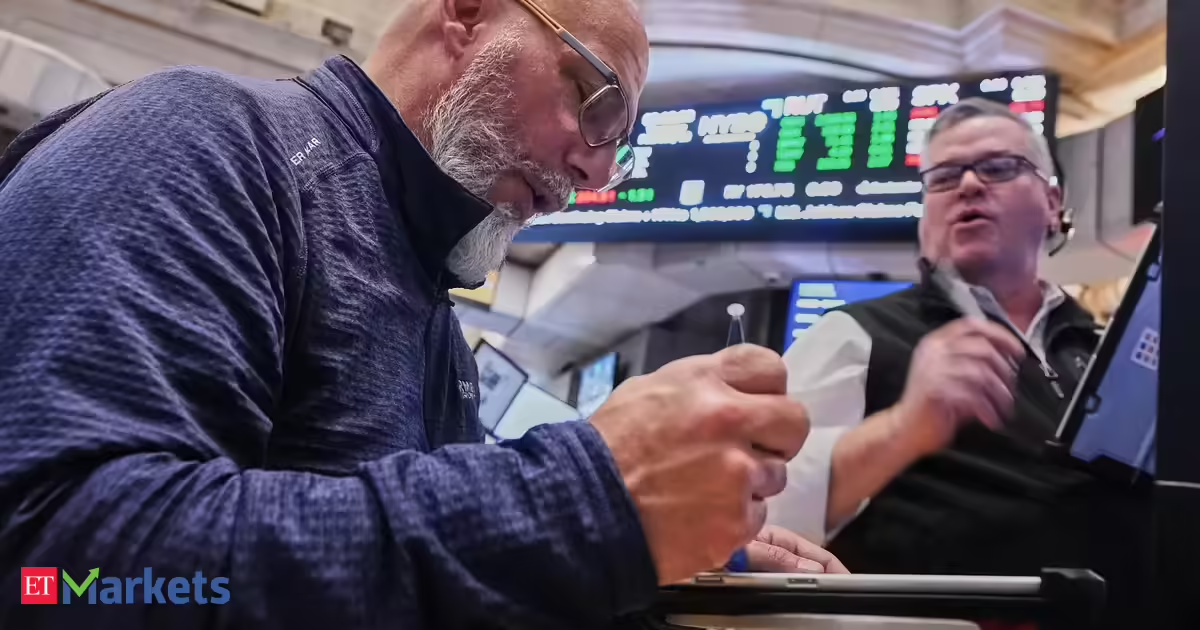
U.S. stocks turned sharply lower on Thursday, the day after earnings from artificial intelligence vanguard Nvidia failed to impress investors, weighing down technology shares which have provided muscle to the recent rally.

A pivot back to cyclical sectors helped keep the Dow close to ‌even, while a ⁠drop in ⁠the Philadelphia SE Semiconductor index dragged the tech-laden Nasdaq down the most.

With Thursday’s drop, the SOX, which has surged year-to-date, was on the verge of snapping what would have been a record 11-week winning streak.

Technology shares in general, and software and chips in particular, have see-sawed in recent weeks as investors wrestle with uneasiness over the massive costs and potential disruption of nascent AI technology.

Advertisement

While all three major U.S. stock indexes are on track for modest weekly losses, the S&P 500 and the Nasdaq are poised to close ⁠lower on ‌the month. The Dow remains on track to post an advance in February.


Nvidia’s fourth-quarter results, posted after Wednesday’s closing bell, were better than analysts expected, and the chipmaker provided above-market ⁠estimates. But the world’s richest company by market cap wrestled with increasingly difficult year-on-year comparisons as its revenue growth decelerates.
“It feels like an Nvidia hangover that’s specific to the AI space,” said Michael Green, chief strategist at Simplify Asset Management in Philadelphia. “The S&P itself is being dragged down by Nvidia and the Magnificent 7, and the Nasdaq is really getting hammered.” “It’s as simple investors being levered long in Nvidia and short the AI disruption,” Green added. “And when that failed to materialize in a large enough scale, they sold out of their position, driving Nvidia down and ‌pushing the stocks they were short back up.”

According to preliminary data, the S&P 500 lost 37.12 points, or 0.53%, to end at 6,909.01 points, while the Nasdaq Composite lost 272.93 points, or 1.18%, to 22,879.14. The Dow Jones ⁠Industrial Average rose 18.61 points, or 0.04%, to 49,500.76.

The S&P 500 software and services index gained ground after being battered in recent weeks on worries of possible disruption from AI. The index got a boost from Salesforce shares, even though the company provided weaker-than-expected revenue guidance.

Trade Desk slid following its disappointing revenue forecast amid mounting pressure from larger rivals. J.M. Smucker surged on the packaged food company’s solid quarterly profit and sales estimates.

Advertisement

C3.ai tumbled after it provided a weaker-than-expected current-quarter sales forecast and announced it would slash 26% of its global workforce.

Celsius Holding jumped after the energy drink maker beat quarterly revenue estimates.

Continue Reading

Business

OrthoPediatrics Corp. (KIDS) Q4 2025 Earnings Call Transcript

Published

on

OneWater Marine Inc. (ONEW) Q1 2026 Earnings Call Transcript

OrthoPediatrics Corp. (KIDS) Q4 2025 Earnings Call February 26, 2026 4:30 PM EST

Company Participants

Trip Taylor
David Bailey – President, CEO & Director
Fred Hite – CFO, Principal Financial & Accounting Officer, COO and Director

Conference Call Participants

Advertisement

Matthew O’Brien – Piper Sandler & Co., Research Division
Matthew Blackman
Caitlin Cronin – Canaccord Genuity Corp., Research Division
Benjamin Haynor – Lake Street Capital Markets, LLC, Research Division
Michael Matson – Needham & Company, LLC, Research Division
Ravi Misra – Truist Securities, Inc., Research Division

Presentation

Operator

Advertisement

Good afternoon, and welcome to OrthoPediatrics Corporation’s Fourth Quarter 2025 Conference Call. [Operator Instructions] As a reminder, this call is being recorded for replay purposes.

I would now like to turn the call over to Trip Taylor, Investor Relations, for a few introductory comments.

Trip Taylor

Advertisement

Thank you for joining today’s call. With me from the company are David Bailey, President and Chief Executive Officer; and Fred Hite, Chief Operating and Financial Officer. Before we begin today, let me remind you that the company’s remarks include forward-looking statements within the meaning of federal securities laws, including the safe harbor provisions of the Private Securities Litigation and Reform Act of 1995. These forward-looking statements are subject to numerous risks and uncertainties, and the company’s actual results may differ materially. For a discussion of risk factors, I encourage you to review the company’s most recent annual report on Form 10-K, which was filed with the SEC on March 5, 2025, to be updated next week and subsequent quarterly reports on Form 10-Q.

During the call today, management will also discuss certain non-GAAP financial measures, which are supplemental measures of performance. The company believes these measures provide useful information for investors in evaluating its operations period-over-period. For each non-GAAP financial measure referenced on this call, the company has included a reconciliation of the non-GAAP financial


Advertisement
Continue Reading

Business

A Beginner’s Guide to Financial Markets

Published

on

Dragon Capital is entering Ukraine’s critical infrastructure through two channels — via the Amber Dragon infrastructure fund and a separate private Power One joint venture with former Ukrenergo CEO Volodymyr Kudrytskyi.

Trading is the process of buying and selling financial assets such as stocks, currencies, commodities, or cryptocurrencies with the goal of making a profit.

Unlike long-term investing, trading often focuses on short-term price movements. Today, trading has become accessible to ordinary people through online platforms and global exchanges like the New York Stock Exchange, NASDAQ, and regional markets such as the Pakistan Stock Exchange.

How Trading Works

At its core, trading is based on price changes. Traders attempt to buy an asset at a lower price and sell it at a higher price. Prices move due to supply and demand, economic news, company performance, global events, and investor psychology.

For example, if a company reports strong profits, its stock price may rise because more people want to buy it. Traders who bought earlier can sell at a profit. On the other hand, bad news can cause prices to fall, leading to losses.

Major Types of Trading

1. Day Trading

Day trading involves opening and closing trades within the same day.
Traders try to profit from small price movements using technical charts and indicators.

Advertisement

Advantages:

  • Fast results
  • Many opportunities daily

Disadvantages:

  • High stress and risk
  • Requires constant monitoring

2. Swing Trading

Swing traders hold assets for several days or weeks to capture medium-term trends. They combine technical analysis with basic market news.

This style is popular among part-time traders because it does not require watching the market all day.

3. Position Trading

Position trading is closer to investing. Traders hold assets for months or even years based on long-term trends and economic outlook.

Famous investors like Warren Buffett follow this philosophy, focusing on strong businesses rather than short-term price movements.

Advertisement

Markets Where Trading Happens

There are several major trading markets:

Stock Market – Buying and selling shares of companies.
Forex Market – Trading currencies like USD, EUR, or PKR. This is the largest financial market in the world.
Crypto Market – Trading digital assets such as Bitcoin and Ethereum.
Commodities Market – Includes gold, oil, wheat, and other physical goods.

Each market has its own risks, volatility level, and trading hours.

Skills Needed to Become a Successful Trader

Market Knowledge

A trader must understand how markets react to news, interest rates, inflation, and global events.

Advertisement

Technical Analysis

This involves studying charts, price patterns, support/resistance levels, and indicators like moving averages or RSI.

Risk Management

Professional traders never risk all their capital on one trade. Many follow the rule of risking only 1–2% of their account per trade.

Emotional Control

Fear and greed destroy more trading accounts than lack of knowledge. Successful traders follow discipline instead of emotions.

Common Mistakes Beginners Make

Overtrading: Taking too many trades without a clear strategy.
Revenge Trading: Trying to recover losses quickly by making risky trades.
Ignoring Stop Loss: Not setting a limit to control potential losses.
Following Tips Blindly: Many beginners lose money by copying others instead of learning themselves.

Advertisement

Is Trading Risky?

Yes, trading carries significant risk. While profits can be attractive, losses are equally possible. Statistics show that many beginners lose money in their first year because they underestimate risk and overestimate quick profits.

However, trading can become profitable with proper education, practice, and patience. Many professionals treat trading like a business, not gambling.

Tips for Beginners

  • Start with a demo account before investing real money
  • Focus on learning, not earning, in the beginning
  • Use small capital while practicing
  • Follow one strategy consistently
  • Keep a trading journal to track mistakes and improvements

Conclusion

Trading offers exciting opportunities to grow wealth, but it is not a shortcut to instant riches. It requires knowledge, discipline, and emotional strength. Whether you choose day trading, swing trading, or long-term positions, success depends on continuous learning and careful risk management.

Advertisement
Continue Reading

Business

Abrams David C buys ContextLogic (LOGC) shares worth $12.3 million

Published

on


Abrams David C buys ContextLogic (LOGC) shares worth $12.3 million

Continue Reading

Business

Globant S.A. (GLOB) Q4 2025 Earnings Call Transcript

Published

on

OneWater Marine Inc. (ONEW) Q1 2026 Earnings Call Transcript

Arturo Langa
Investor Relations Officer

Good afternoon, and welcome to Globant’s Fourth Quarter 202 Earnings Conference Call. I am Arturo Langa, Investor Relations Officer at Globant. [Operator Instructions] Please note, this event is being recorded and streamed live on YouTube.

By now, you should have received a copy of the earnings release. If you have not, a copy is available on our website, investors.globant.com. We will begin with remarks by our Chief Executive Officer, Martin Migoya; our Chief Technology Officer, Diego Tartara; and our Chief Financial Officer, Juan Urthiague, followed by a Q&A, where they will be joined by our Chief Revenue Officer, Fernando Matzkin.

Before we begin, I would like to remind you that some of the comments on our call today may be deemed forward-looking statements. This includes our business and financial outlook and the answers to some of your questions. Such statements are subject to the risks and uncertainties as described in the company’s earnings release and other filings with the SEC. Please note that we follow IFRS accounting rules in our financial statements. During our call today, we will report non-IFRS or adjusted measures, which is how we track performance internally and the easiest way to compare Globant to our peers in the industry.

Advertisement
Continue Reading

Business

The worst day for Nvidia's stock since last spring drags Wall Street lower

Published

on

The worst day for Nvidia's stock since last spring drags Wall Street lower

The worst day for Nvidia’s stock since last spring dragged the U.S. market lower on Thursday, even though most stocks on Wall Street rose.

Continue Reading

Business

NSE invites investment banks to pitch for managing IPO

Published

on

NSE invites investment banks to pitch for managing IPO
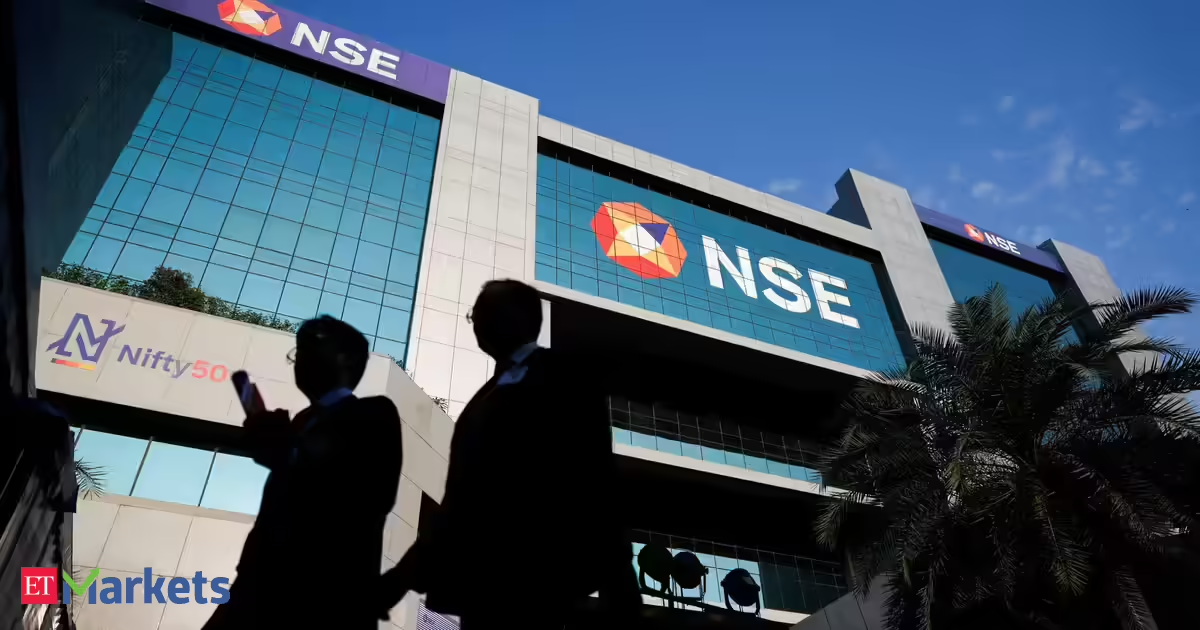
Mumbai: The National Stock Exchange has invited as many as 15 investment bankers to pitch for managing its proposed IPO, said sources in the know. JPMorgan Chase, Kotak Mahindra Capital Company, JM Financial, Axis Capital and ICICI Securities are among bankers in the fray for the mandate to manage the issue, they said.

“The pitching process is expected to commence by mid-March, with the exchange likely to initiate the process of filing its draft red herring prospectus in April,” a source told ET. An email sent to NSE remained unanswered.

Rothschild is assisting NSE to select lead bankers, legal counsels and other intermediaries for the IPO. The IPO will be an offer for sale, which means existing shareholders may dilute their stake while the exchange will receive no fresh funds.

According to people familiar with the IPO details, existing investors are expected to offload about 4-4.5% of the exchange’s total equity. Life Insurance Corporation of India continues to be the single largest investor in NSE with a 10.72% holding. It is followed by Aranda Investments Mauritius Pte at 4.54%, Stock Holding Corporation of India Ltd at 4.44%, SBI Capital Markets Ltd at 4.33%, and Veracity Investments Ltd with a 3.93% stake. It couldn’t be ascertained who will offer their shares in the IPO.

Advertisement

In the unlisted market, NSE is currently valued at ₹5 lakh crore. Based on prices in the unlisted market, the IPO could raise approximately ₹23,000 crore. On Thursday, NSE shares in the unlisted market were trading at ₹2,035 per share. Last month, the Sebi issued the much-awaited no-objection certificate for the IPO, ending a regulatory impasse that had stalled the listing for nearly a decade.


Early in February, NSE’s board approved the IPO and appointed a six-member panel to facilitate the IPO process. The newly-constituted committee is led by Tablesh Pandey, along with public interest directors Srinivas Injeti, Prof. Mamata Biswal, Abhilasha Kumari and Prof. G Sivakumar, as well as NSE’s MD and CEO, Ashishkumar Chauhan.

Continue Reading

Business

Sebi tightens rules on MF classification, overlaps

Published

on

Sebi tightens rules on MF classification, overlaps
Mumbai: The capital markets regulator has tightened rules on classification of mutual fund (MF) schemes and capped portfolio overlaps, leading to the immediate closure of a plan category, potentially forcing a consolidation of thematic investment choices, and likely causing a shrinkage in the returns on arbitrage funds.

“For easy identification by investors, to bring uniformity in scheme names for a particular category across mutual funds and to ensure they remain ‘true to label,’ scheme name shall be the same as its category,” the Securities and Exchange Board of India (Sebi) said.

It scrapped the solution-oriented schemes category, putting a stop to all such subscriptions with immediate effect.

Sebi stressed the need to delink investment plan names and returns. It said the ‘type of scheme’ description in offer documents and advertisements must adhere to a prescribed format. “Words or phrases that highlight or emphasise only the return aspect of the scheme shall not be used in the name,” it said.

Sebi has broadly classified schemes into five categories – equity, debt, hybrid, life cycle and other. The last includes fund of fund schemes and passive ones such as index or exchange traded funds.

Advertisement

Screenshot 2026-02-27 061539Agencies

Cos have Time to Comply
The regulator said no more than 50% of a thematic equity scheme’s portfolio must overlap with other thematic schemes and other equity categories, except for large-cap schemes. “Over a period of time, this could lead to some thematic funds, which may not have scaled, to be merged with similar schemes,” said Aditya Agarwal, cofounder of Wealthy.in, a platform for mutual fund distributors.
Sebi said thematic funds have three years to comply, while the others have six months. Schemes that are unable to meet the portfolio overlap criteria after three years would have to be mandatorily merged with other schemes, it said.
“Sebi has done something it rarely does – admitted a category was pointless and killed it. Solution-oriented funds were always a labelling exercise, and their removal is long overdue,” said Dhirendra Kumar, head of Value Research. “The overlap restrictions on thematic funds are also welcome. They force fund companies to prove their schemes are genuinely different, not just creatively named.”

New Product Category
The regulator also said asset managers could now introduce life cycle funds, while clarifying that foreign securities would not be treated as a separate asset class.

Asset managers have also been allowed to offer both value and contra funds, but the overlap between the two portfolios cannot exceed 50%.

“Arbitrage funds need to restrict debt exposure to only government securities with a residual maturity of less than a year. With arbitrage funds allocating up to 35% to debt, this along with the increase in STT (securities transaction tax) from April could bring down returns from the category by 30-40 basis points,” said the product head at a domestic fund house.

Flip Side
Some believe the regulatory latitude on allowing a new class of schemes could give confusing signals to the average saver.

Advertisement

“I worry that with one hand Sebi is simplifying, and with the other it’s handing the industry new avenues to proliferate – sectoral debt funds, life cycle funds, and an elaborate fund of funds matrix that reads like a regulatory spreadsheet, not an investor guide,” said Kumar of Value Research. “The average investor needs four types of funds, not forty. Every new category Sebi creates becomes an NFO (new fund offering) opportunity for the industry. The real question isn’t whether this circular is well-drafted, which it is. But two years from now, will we have fewer, clearer choices for investors, or just more sophisticated clutter?”

Add ET Logo as a Reliable and Trusted News Source

Continue Reading

Business

PennyMac’s Stark sells $174k in shares

Published

on


PennyMac’s Stark sells $174k in shares

Continue Reading

Business

Form 144 Health Catalyst For: 26 February

Published

on


Form 144 Health Catalyst For: 26 February

Continue Reading

Trending

Copyright © 2025