Connect with us
DAPA Banner

Business

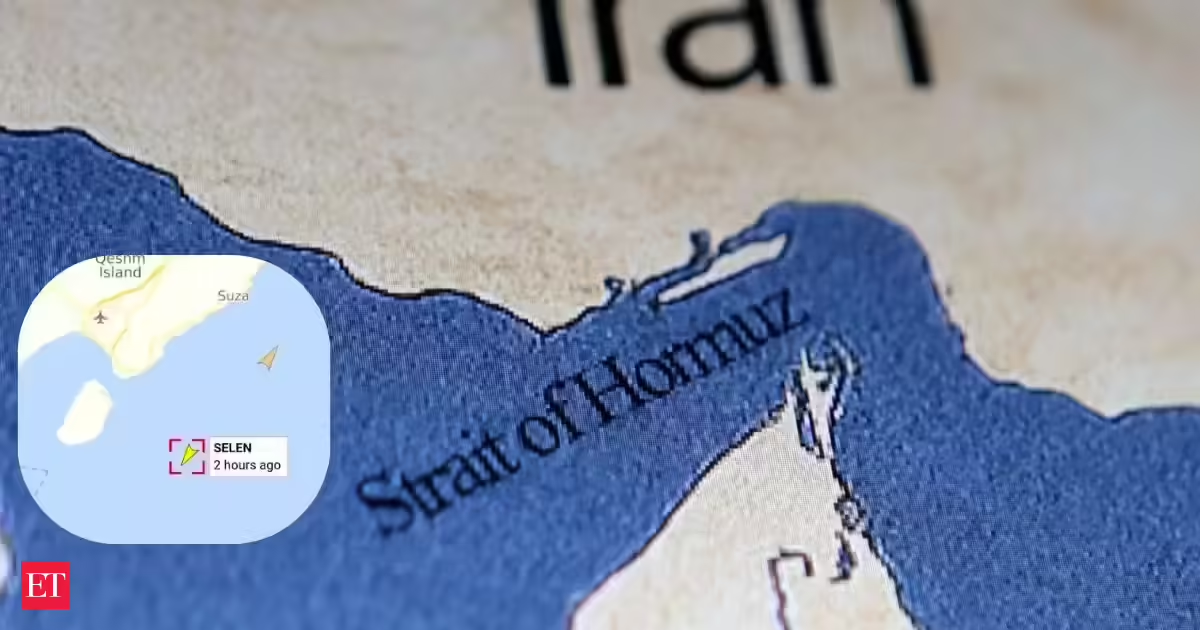
As Asim Munir pitches peace, Iran stops Pakistan’s cargo ship at Strait of Hormuz

Published

on

As Asim Munir pitches peace, Iran stops Pakistan's cargo ship at Strait of Hormuz
Amid Pakistan‘s offer to mediate between Iran, US and Israel to end the conflict in the Middle-East, a cargo ship headed for Karachi was forced to reverse course after Iran denied it passage through the Strait of Hormuz, citing lack of clearance and protocol violations. The move comes at a time when traffic through the crucial energy corridor has slowed sharply amid rising conflict in West Asia.

Pakistan ship stopped

According to a statement from the Iranian Embassy in Kabul, the container vessel SELEN failed to obtain mandatory approval before attempting to cross the strait. Iranian authorities said the ship did not follow established legal procedures required for transit.

Also Read: Madhavan breaks silence on Dhurandhar 2 ‘Gurbani’ scene controversy, says Aditya Dhar gave clear instructions

“The container ship SELEN was turned back by the IRGC Navy due to failure to comply with legal protocols and lack of permission to pass through the #Hormuz Strait”, the statement read.

“The passage of any vessel through this waterway requires full coordination with the maritime authority of the Islamic Republic of Iran”, it said.

Officials from the Islamic Revolutionary Guard Corps Navy later confirmed the action, reiterating that all vessels must secure prior clearance.
Rear Admiral Alireza Tangsiri said the ship was turned back for not obtaining permission to pass through the strait, adding the vessels must now coordinate transit with Iranian maritime authorities.

Pakistan offers to mediate in Iran-Israel-US war

Pakistan has recently stepped forward with an offer to mediate between Iran, the United States and Israel as tensions escalate in West Asia. Prime Minister Shehbaz Sharif publicly said Islamabad would be “ready and honoured” to host peace talks if all sides agree, positioning the country as a neutral venue for dialogue. The proposal gained traction after Donald Trump amplified the offer on social media, signalling openness to third-party facilitation. While Iran has denied any direct negotiations with Washington, it has acknowledged that “friendly states” — including Pakistan — are passing messages between the sides, indicating backchannel diplomacy is underway even as formal talks remain uncertain.

Advertisement

US President held talks with Pakistan’s Army Chief Asim Munir

US President Donald Trump held a conversation earlier this week with Pakistan’s army chief Asim Munir, as Islamabad steps up efforts to present itself as a mediator in the ongoing tensions involving the US, Israel and Iran. Separately, Prime Minister Shehbaz Sharif spoke with Iranian President Masoud Pezeshkian on Monday, according to officials aware of the developments.

These diplomatic contacts came around the same time Trump announced a five-day pause on his threat to target Iran’s power plants. He described his recent engagement with Tehran as “very good and productive” and suggested it could help bring the conflict to an end.

However, the White House made it clear that there are no formal negotiations at this stage and cautioned against reading too much into the developments. “These are sensitive diplomatic discussions and the United States will not negotiate through the news media,” it said.

Trump’s posts on Truth Social briefly pulled down global oil prices, though it remains uncertain whether Pakistan’s outreach played any direct role in that movement. Experts say the lack of concrete progress and continued tensions are keeping markets and the region unsettled.

Advertisement

Pakistan pitches Islamabad as talks venue

According to two officials familiar with the matter, Pakistan has предложed Islamabad as a possible location for high-level talks. The proposed discussions could involve senior US officials such as Vice President JD Vance, along with Trump’s envoys Steve Witkoff and Jared Kushner, and representatives from Iran.

In its official statement after the Sharif-Pezeshkian call, Pakistan said the prime minister briefed the Iranian side on Islamabad’s diplomatic outreach and reiterated its willingness to support peace efforts. “While sharing with the Iranian President the diplomatic outreach efforts of Pakistan’s leadership, the prime minister assured the Iranian leadership that Pakistan would continue to play a constructive role in facilitating peace,” the statement said.

Why the Strait of Hormuz matters now

The Strait of Hormuz remains one of the world’s most sensitive maritime routes, handling nearly 20% of global oil and gas shipments. Any disruption here tends to ripple across energy markets and shipping lanes worldwide.

The latest intervention signals tighter control by Tehran as regional tensions escalate following recent military exchanges involving the United States and Israel.

Advertisement

$2 million transit fee plan raises stakes

Iran has also indicated that some ships may now face a transit fee of up to $2 million while crossing the strait, in what officials describe as a new assertion of sovereignty.

Iranian lawmaker Alaeddin Boroujerdi said the move reflects a shift in how the country manages the waterway.

“Collecting $2 million as transit fees from some vessels crossing the strait reflects Iran’s strength,” Boroujerdi said.

“Now, because war has costs, naturally we must do this and take transit fees from ships passing through the Strait of Hormuz,” he added.

Advertisement

Political ripple in India

The development quickly drew reactions in India’s political circles. Amit Malviya criticised narratives around Pakistan’s diplomatic positioning.

“So much for the ‘Pakistan is brokering peace’ narrative peddled by the usual suspects in India,” he wrote on X.

“Iran has reportedly turned back a vessel bound for Karachi after it failed to secure approval to pass through the Strait of Hormuz”, he added.

‘Open to all except adversaries’

Earlier, Iran’s President Masoud Pezeshkian signalled a conditional openness on access to the strait.

Advertisement

“The illusion of erasing Iran from the map shows desperation against the will of a history-making nation. Threats and terror only strengthen our unity. The Strait of Hormuz is open to all except those who violate our soil. We firmly confront delirious threats on the battlefield,” he wrote in a post on ‘X’.

Continue Reading
Click to comment

You must be logged in to post a comment Login

Leave a Reply

Business

Honey production at all-time low

Published

on

Honey production at all-time low

Demand for honey is trending higher, but honey production is at an all-time low.

Continue Reading

Business

NatWest sells Mentor HR advisory arm as it continues streamlining its operations

Published

on

Business Live

FTSE 100 bank offloads human resources advisory business to private equity-backed Empowering People Group as CEO Paul Thwaite continues strategic streamlining

A sign outside a branch of NatWest

NatWest’s CEO is rationalising the group’s structure(Image: PA Wire/PA Images)

NatWest has offloaded its human resources advisory division to a private equity-backed competitor in the latest transaction by the banking group as it continues to streamline its operations.

Advertisement

The FTSE 100 lender has disposed of Mentor – its small business HR support service – to Empowering People Group, a specialist HR provider backed by Limerston Capital.

Limerston established the group through its 2016 purchase of Adviserplus and subsequent acquisitions of legal and employment businesses including Halborns in 2020 and Learning Nexus in 2022.

Mentor serves approximately 100,000 small and medium-sized enterprise clients and specialises in employment law, HR, health and safety and environmental compliance.

The financial details of the transaction have not been revealed. The roughly 220 staff employed at Mentor are anticipated to transfer to the new owner as part of the agreement, which was reported by Sky News.

Advertisement

The transaction represents the latest in a series of moves by NatWest chief executive Paul Thwaite to rationalise the business’ structure. Last year, the bank sold its workplace pensions fintech Cushon to Willis Towers Watson, as reported by City AM.

Thwaite’s strategy has focused on a more dynamic balance sheet and expansion into sectors that provide a more consistent revenue stream such as wealth management. Banking giants have intensified their push into wealth management over the past year, with the division providing lenders with a more stable and less capital-intensive revenue stream, thanks to its dependence on recurring fees rather than the interest rate volatility that impacts conventional lending.

NatWest spent a substantial £2.7bn – its largest acquisition since the financial crisis – to acquire Evelyn Partners in February, wresting the wealth manager from private equity owners Permira and Warburg.

Thwaite characterised the transaction as establishing the “third growth engine” for the group, with Evelyn’s £69bn assets under management now sitting within the NatWest stable, making it the largest bank-owned wealth manager with combined assets totalling £127bn.

Advertisement

The acquisition did trigger some market unease, though, as NatWest suspended future share buybacks and disclosed plans for £150m of spending – with scope to increase if integration proves challenging – aimed at delivering roughly £100m in annual cost savings.

Continue Reading

Business

Stocks to Watch Today: PDD, Alibaba, KB Home

Published

on

Temu owner PDD reported earnings Wednesday morning

Stocks to Watch Today: PDD, Alibaba, KB Home

Continue Reading

Business

North East Business Awards return to celebrate the region’s best companies

Published

on

Business Live

The awards are now in their 26th year

Winners of the 2025 North East Business Awards

Winners of the 2025 North East Business Awards(Image: Simon Greener/Newcastle Chronicle)

The North East Business Awards are returning to celebrate the best of the region’s business community.

Following a landmark year, which marked the awards’ 25th anniversary in their current form, the event will return to celebrate innovation, entrepreneurship, technology and creativity, as well as some of the people making a difference in the region’s business community.

Winners across 10 categories will be selected from three areas: Northumberland and Tyneside; Durham, Sunderland and South Tyneside; and Teesside. Area winners will be revealed later this year across ChronicleLive, TeessideLive and BusinessLive, as well as in The Journal and The Gazette on Teesside. They will then go head-to-head for the overall titles at the grand final, taking place at Hardwick Hall Hotel in Sedgefield on October 1.

Advertisement

Last year’s awards saw County Durham-based technology firm Filtronic crowned North East Business of the Year, following a remarkable period of growth driven by its cutting-edge radio frequency technology – innovation that attracted the attention of Elon Musk’s SpaceX. Other standout winners included Opencast, Active Families North East, Osbit and Just Williams, highlighting the breadth and diversity of talent across the region.

For 2026, Tyneside software giant Sage returns as headline partner, alongside associate partner Newcastle University. They are joined by category partners Made Smarter and Northumbrian Water, with global management consulting firm Oliver Wyman coming on board as a new partner this year.

North East Business Awards logo

North East Business Awards logo(Image: Lesley Hampson)

Lubna Quraishi, VP of performance marketing, EMEA, at Sage said: “With our global headquarters rooted in the North East, we’re proud to continue our support of the North East Business Awards and by sponsoring the Startup Award.

“Startups sit at the heart of our focus at Sage – they bring fresh ideas, bold thinking and energy to the economy. We’re committed to backing founders with the tools, technology and support they need to turn ambition into sustainable growth, and we’re excited to celebrate the region’s most promising new businesses.”

Advertisement

Estelle Blanks, director of business development and enterprise at Newcastle University, associate partner for the awards, said: “I’m delighted that we are part of the North East Business Awards again this year. Over the coming months, Newcastle University will be moving to a new model that will make it even easier for businesses and the University to work together.

“Innovation thrives across organisational boundaries, and we will continue to play our role in fostering an ecosystem where research, education, innovation and business support one another. When we collaborate to unlock new ideas and opportunities, the whole region benefits – and the Business Awards are a great way to celebrate that.”

Journal editor Graeme Whitfield said: “The Business Awards have now been a fixture on the regional business calendar for more a quarter of a century. But after all that time, we’re still finding great companies to reward for the first time, as well as established firms who keep on doing brilliant things.

“There is no better event for celebrating the best of our region’s amazing companies and the people who work for them.

Advertisement

“I know from going to the awards over many years that winning – or even just taking part – can mean so much to boosting staff morale and raising businesses’ profile. I hope as many companies as possible enter the awards so we can really highlight our great firms to the widest possible audience.”

The awards are now open to entries and more details can be found at nebusinessawards.co.uk

The award categories are:

Start-up Award;

Advertisement

Small Business of the Year;

Business for Good;

Innovation Award;

Best Place to Work;

Advertisement

Growth Award;

Made in the North East;

Business of the Year;

Rising Star;

Advertisement

Business Person of the Year.

Continue Reading

Business

SanBio Company Limited 2026 Q4 – Results – Earnings Call Presentation (OTCMKTS:SNBOY) 2026-03-25

Published

on

OneWater Marine Inc. (ONEW) Q1 2026 Earnings Call Transcript

This article was written by

Seeking Alpha’s transcripts team is responsible for the development of all of our transcript-related projects. We currently publish thousands of quarterly earnings calls per quarter on our site and are continuing to grow and expand our coverage. The purpose of this profile is to allow us to share with our readers new transcript-related developments. Thanks, SA Transcripts Team

Continue Reading

Business

UK factory costs rise fastest since 1992 as PMI signals slowdown and inflation risk

Published

on

The UK is set to ramp up its weapons manufacturing capabilities in a strategic move to reduce reliance on imports from the United States and France, amid growing concerns over the reliability of international defence partners.

UK factory costs have surged at their fastest rate since the aftermath of the Black Wednesday, as rising energy prices linked to the Middle East conflict ripple through the economy and threaten to reignite inflation.

Fresh data from S&P Global shows that production costs in British manufacturing accelerated sharply in March, while overall private sector growth slowed to what economists described as “a crawl”.

The figures, drawn from the closely watched Purchasing Managers’ Index (PMI), point to a rapid deterioration in business conditions, driven by soaring oil and gas prices, disrupted supply chains and weakening demand.

The spike in costs has been directly linked to the surge in global energy prices following the escalation of conflict in the Middle East. The effective closure of key shipping routes such as the Strait of Hormuz has constrained supply, pushing up prices for fuel and raw materials used across manufacturing and food production.

The manufacturing input prices index jumped to 70.2 in March from 56 the previous month, its highest level since late 2022 and the steepest increase since October 1992, the month following Black Wednesday, when the pound’s collapse drove up the cost of imports.

Advertisement

Brent crude oil prices have risen by more than 40 per cent since late February, reaching around $100 a barrel, adding significant cost pressure to energy-intensive industries.

At the same time, the broader UK economy is losing momentum. The composite PMI, which measures activity across manufacturing and services, fell to 51 in March, down from 53.7 in February and below analysts’ expectations.

While still above the 50 threshold that separates growth from contraction, the figure represents a six-month low and signals a marked slowdown.

Both key sectors showed weakening performance. The manufacturing PMI edged down to 51.4, while services activity, a major driver of the UK economy, dropped more sharply to 51.2 from 53.9.

Advertisement

Chris Williamson, chief business economist at S&P Global Market Intelligence, said companies were increasingly attributing lost business directly to the fallout from the Middle East conflict.

“Output growth has slowed to a crawl as firms face heightened risk aversion among customers, rising costs, higher interest rates and ongoing supply chain disruption,” he said.

The rapid increase in input costs is feeding concerns that the UK could face a renewed inflation surge, potentially pushing consumer price growth above 5 per cent later this year if energy prices remain elevated.

Economists warn that the speed of the shift has been particularly striking. Paul Dales of Capital Economics said the scale and pace of the changes had surprised analysts, even given the expected impact of an energy shock.

Advertisement

The PMI data is often seen as an early indicator of official inflation figures, which are produced by the Office for National Statistics. While inflation is expected to remain around 3 per cent in the short term, the Bank of England has already signalled it could rise further in the coming months.

Financial markets have responded by revising expectations for monetary policy, with traders now anticipating multiple interest rate increases this year from the current level of 3.75 per cent.

Higher borrowing costs would place additional strain on businesses and households, further dampening economic activity and complicating the government’s efforts to support growth.

Business sentiment has already weakened, falling to a nine-month low, while companies have continued to cut jobs amid uncertainty.

Advertisement

The UK is not alone in facing these pressures. Similar PMI data shows activity slowing in both the United States and the eurozone, suggesting the energy shock is having a broad global impact.

Pantheon Macroeconomics estimates that the UK economy may grow by just 0.1 per cent in the first quarter of the year, underscoring the fragile state of the recovery.

The combination of rising costs, slowing demand and tightening financial conditions presents a difficult outlook for the UK economy.

With energy prices driving inflation higher and limiting room for fiscal support, policymakers face a narrowing set of options.

Advertisement

For businesses, the immediate challenge is managing cost pressures without eroding competitiveness. For households, the risk is a renewed squeeze on living standards.

And for the economy as a whole, the latest data suggests a familiar and uncomfortable scenario may be emerging, one where weak growth and rising prices collide.


Jamie Young

Jamie Young

Jamie is Senior Reporter at Business Matters, bringing over a decade of experience in UK SME business reporting.
Jamie holds a degree in Business Administration and regularly participates in industry conferences and workshops.

When not reporting on the latest business developments, Jamie is passionate about mentoring up-and-coming journalists and entrepreneurs to inspire the next generation of business leaders.

Advertisement

Continue Reading

Business

At Close of Business podcast March 25 2026

Published

on

At Close of Business podcast March 25 2026

Claire Tyrrell talks to Ella Loneragan about how land developers are taking steps to find a balance between high demand and constrained supply.

Continue Reading

Business

County Durham’s Power Roll strikes agreement to send solar tech to Japan

Published

on

Business Live

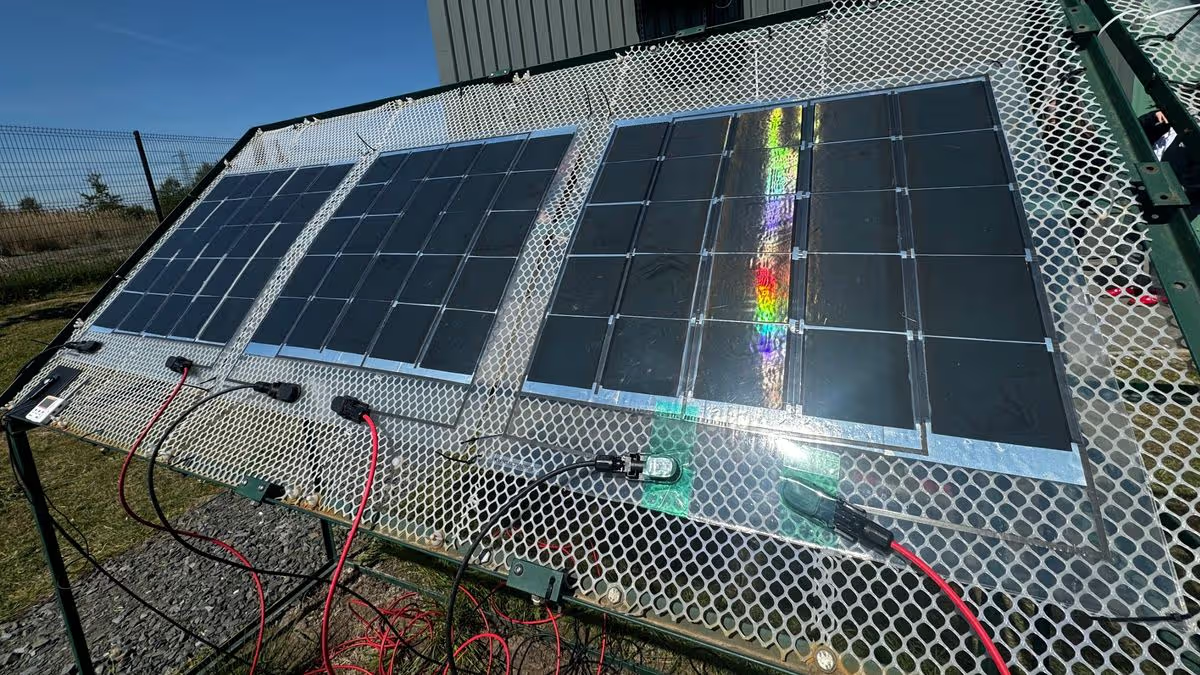
The deal with Tokyo Gas will see the North East-developed solar films used outside of the Europe for the first time.

Power Roll has developed a type of flexible, solar film that can be applied in a wide range of settings.

The deal with Tokyo Gas will see Power Roll’s technology used outside of the Europe for the first time.(Image: Power Roll)

Solar power innovator Power Roll has signed an agreement with Japanese utilities firm Tokyo Gas that will see its products used outside of Europe for the first time.

The joint development agreement will see the two firms work together on making Power Roll’s North East-developed solar film technology ready for the Japanese market. The work will include identifying suitable manufacturing partners in the country.

It will also progress technical designs for the perovskite technology, which brings flexible, lightweight and “ultra low cost” solar technology closer to large scale deployment. Power Roll and Tokyo Gas will look at its wider potential uses, routes to market and certification requirements in Japan.

Trial uses of Power Roll’s technology will be carried out at Tokyo Gas’ facilities. Over a year the partners will collect performance data that will help boost capabilities and reliability in Japan’s climate.

Advertisement

Unlike traditional solar panels, which are typically ground-mounted, Power Roll’s ultra-light solar films can be applied to a variety of surfaces, including rooftops and vertical building facades. The firm says this opens the door to widespread adoption in urban and commercial settings.

Neil Spann, chief executive of Power Roll, said: “This Joint Development Agreement with Tokyo Gas represents a major milestone in our long standing relationship as we work to bring our game-changing solar film technology to market. Tokyo Gas is a natural partner for us, thanks to their expertise, innovation, and commitment to driving clean energy solutions.

“Together, we aim to establish Japan as the global leader in perovskite solar technology while addressing critical energy challenges globally. This partnership underscores the long-term potential of our collaboration to create impactful solutions for renewable energy generation. By combining Power Roll’s cutting-edge solar technology with Tokyo Gas’s market leadership, ability to scale and infrastructure, we are laying the groundwork for a new era in solar power that will redefine how and where solar energy is deployed.”

The agreement follows a North East trade mission – led by North East mayor Kim McGuinness – to Japan in November. During the trip, Ms McGuinness met with Tokyo Gas on behalf of Power Roll, which operates out of Murton.

Advertisement

Ms McGuinness said: “This partnership between Power Roll and Tokyo Gas shows the depth of opportunity there is to secure and grow green energy investment and with that jobs in places like County Durham. I was proud to meet with Tokyo Gas on behalf of Power Roll during our trade mission to Japan last year, when I saw first-hand the global appetite there is in our cutting-edge technology, so I am delighted it has now led to this agreement.

“North East England has the people, the technology and the spirit of innovation to become the home of the green energy revolution. Our engineers and our businesses are making a real difference on the global stage, and we are backing them to deliver the job security and growth opportunities that brings.”

Continue Reading

Business

First Minister commit to further empower the Development Bank of Wales but rules out a new WDA

Published

on

Business Live

Speaking to the CBI Wales North Wales dinner she said she would chair a new national Jobs Council

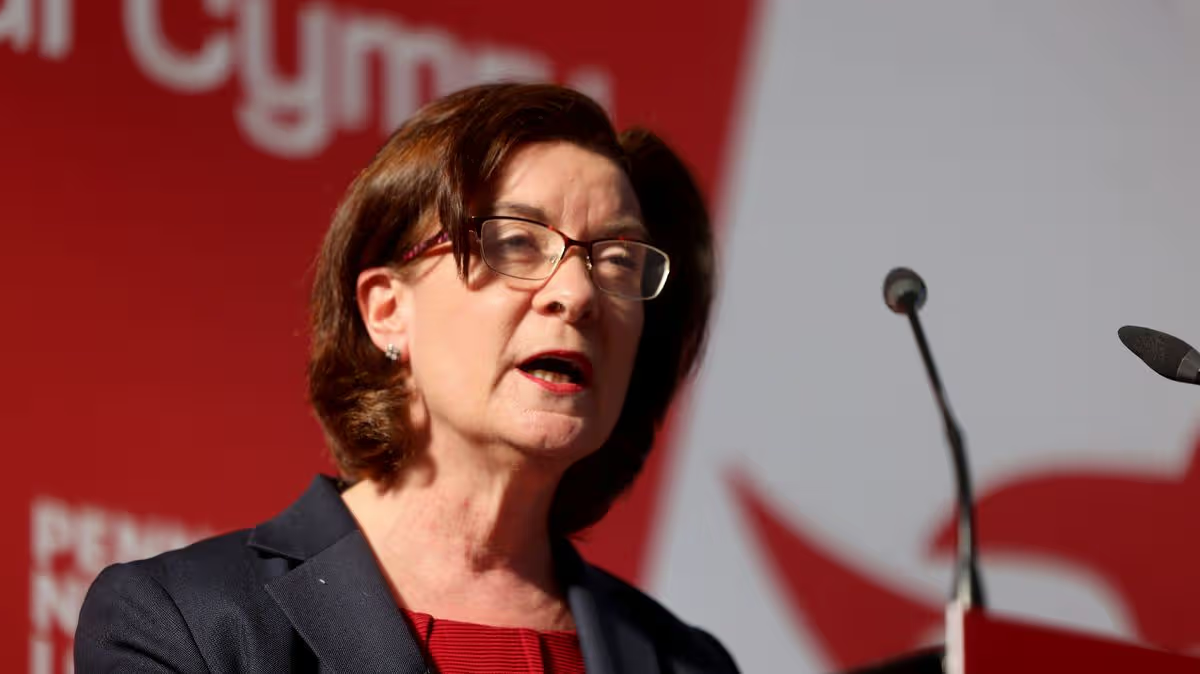
First Minister Eluned Morgan.(Image: John Myers)

First Minister Eluned Morgan said the Development Bank of Wales should be empowered, suggesting a significant increase in its financial firepower to support the growth of SMEs, while also committing to streamlining business support.

Addressing the North Wales dinner of employers body CBI Wales, the First Minister said that if still in office after May’s Senedd Election, she would seek to secure a fairer Welsh share of innovation and research council funding from publicly funded bodies such as research councils and Innovate UK, although she did not indicate how this would be achieved. She also dismissed calls for creating a new version of the Welsh Development Agency.

Advertisement

It was the late Rhodri Morgan, when First Minister, who abolished the arm’s-length Welsh Government WDA back in 2004. While at the time of its demise it had become over-bloated, with more than 1,000 staff and arguably too many business support strands, it remains one of the most recognisable Welsh brands, particularly overseas.

READ MORE: Wales needs to deliver more than 10,000 homes a year to hit government targetREAD MORE: Welsh rugby makes a huge economic contribution shows new report

Plaid has committed to effectively establishing a new streamlined version of the WDA through a national development agency, which will take on Welsh Government business support and inward investment functions. What is not yet clear is the relationship between a new agency -which would seek to attract the best talent from the private sector -and the Development Bank of Wales.

In rejecting calls for a new WDA, the First Minister said: “Wales may give its support to others – those who offer plans for more plans, delay, duplication, indecision and commissions. Also for a new WDA, but with no plan for what it will do, nor the money to make that happen.”

Advertisement

On the Welsh Government’s business support regime, which includes its outsourced Business Wales offer and its wholly-owned development bank, she said: “We will empower the Development Bank of Wales even further. It has already loaned over £1bn and helped deliver tens of thousands of jobs. We will cut down on business bureaucracy by streamlining support and carry out a root-and-branch review of business rates to make them fairer for all.”

In the last few months, the development bank has extended its services so that it can now offer loans to farm businesses.

She did not give any indication as to how the development bank would be “empowered”, but one route would be through securing investment mandates from pension funds, potentially via the British Business Bank, and increased use of UK Treasury-funded financial transactions capital, which has supported development bank lending.

According to a recent report from Martin Broogaard and David Phillips of the Institute for Fiscal Studies, the Welsh Government received £3.4bn (in real terms) in financial transactions capital between 2012–13 and this year. Of this, 80% will have to be repaid to the UK Government, while the remainder can be recycled indefinitely into further loans as repayments are made.

Advertisement

The report adds: “Current plans imply an additional £600m of funding between 2026–27 and 2029–30, but changes in rules mean that this can all be recycled into further loans in the future. This change will enable the Welsh Government to make increasingly large loans over time to the private sector (albeit subject to state aid rules).”

On productivity and research funding, Ms Morgan said: “Productivity sits at the core of the Wales Growth Plan, backed by £500m to support innovation, adoption of new technologies and business expansion. Our productivity rates are increasing more quickly than the UK’s, but we acknowledge that we are starting from a lower base. We will continue to work closely with the UK Government, providing the stable political landscape you need to make investment decisions.

“The UK Government has already committed £14bn for a pipeline of rail projects. I will push to secure Wales’s fair share of the UK’s investment in R&D, which will be essential for those productivity gains.”

The First Minister said her administration has listened to the concerns of business that it requires a planning system that does not deter investment. She added: “We acted, and Wales now has some of the fastest decisions on major energy infrastructure in the UK, with almost two dozen clean energy projects approved since I became First Minister.

Advertisement

“My challenge for the next government has been clear: to make Wales the fastest place in the UK to get planning permission, and if we are leading the next government, we will introduce new degree apprenticeships in planning.”

She also committed to implementing a new Welsh industrial strategy aligned with that of the UK Government. She added: “I am a First Minister who is prepared to choose, to focus and, where necessary, to say no.

“We know we can do more to help business grow much further, especially in advanced manufacturing, renewable and clean energy, digital and AI-driven industries, life sciences and the creative industries. I will personally chair a new national Jobs Council. It will bring together business, unions, the skills sector and government to drive good jobs across every part of Wales.”

Russell Greenslade, director of CBI Wales, said: “The CBI North Wales business dinner showcased the incredible businesses that are contributing to Wales’ impressive economic growth story.

Advertisement

“The First Minister rightly focused on the region’s enterprising firms, our green growth opportunities, and a higher education sector that works in partnership with business to support young people into careers and close the skills gap.

“Long-term sustainable growth depends on the Welsh and UK governments continuing to work in partnership with North Wales businesses.”

Continue Reading

Business

Australia Fuel Crisis Deepens With Hundreds of Stations Running Dry

Published

on

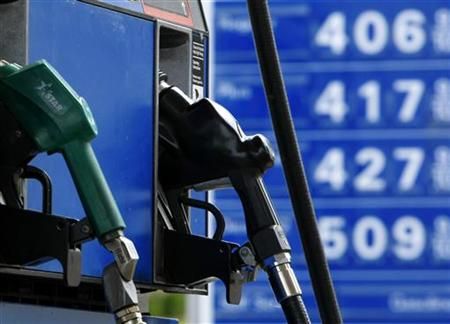
Petrol and diesel pumps along with gas prices are shown at an Exxon station in Carlsbad, Calif.

SYDNEY — Hundreds of petrol stations across Australia have run out of diesel or unleaded fuel amid a worsening supply crunch triggered by the escalating conflict in the Middle East, prompting the federal government to temporarily lower diesel standards for six months and release emergency reserves to ease shortages.

Petrol and diesel pumps along with gas prices are shown at an Exxon station in Carlsbad, Calif.

Energy Minister Chris Bowen told Parliament on Monday that more than 100 stations in Victoria alone had no fuel of at least one grade, while New South Wales reported 164 without diesel and 289 missing at least one type out of more than 2,400 locations. Queensland saw 47 stations out of diesel and 32 without regular unleaded. Similar shortages hit other states, with Victoria recording up to 134 to 160 stations affected in recent days.

The disruptions stem from the U.S.-Israeli military actions against Iran that have severely curtailed oil flows through the Strait of Hormuz, cutting supplies to Asian refineries that provide most of Australia’s imported fuel. Australia imports about 90% of its petrol, diesel and jet fuel, with the vast majority coming via Asian processing hubs. Six fuel shipments bound for Australia were canceled or deferred in recent weeks, exacerbating the strain.

As of mid-March, Australia held roughly 38 days’ worth of petrol, 30 days of diesel and 30 days of jet fuel, according to the latest government figures. Bowen insisted the overall market remains well-supplied at a national level and blamed much of the local shortages on panic buying that has spiked demand by 300% to 400% in some areas. He ruled out immediate rationing but confirmed the government has released about 20% of its strategic fuel reserves — roughly a week’s worth of supply — into the domestic market.

On Tuesday, the government announced it would relax diesel quality standards for six months, allowing higher-sulphur fuel into the system to add nearly 100 million extra litres per month. The move aims to help farmers, truckers and regional communities facing acute shortages. Two remaining domestic refineries are operating at full capacity and have been directed to prioritize Australian supply over exports, with government subsidies to keep them running.

Advertisement

Retail prices have surged sharply. The national average for unleaded 95 petrol rose 18.5 cents to 238 cents per litre in the latest weekly figures, while diesel climbed 36.8 cents to 239.6 cents. Some regional stations reported diesel above $3 per litre, with isolated cases nearing $4. Australia recorded the fastest fuel price increases in the developed world since the conflict began, according to global tracking data.

The crisis has hit key sectors hard. Farmers warned that diesel shortages could delay planting and harvesting, potentially driving up food prices by as much as 50% if prolonged. Trucking operators reported fuel levies rising weekly, with some independent haulers halting operations. Logistics giants like DHL and Australia Post have hiked surcharges significantly, with parcel delivery costs nearly tripling in some cases. Manufacturers spoke of “brutal” price hikes flowing through supply chains.

Panic buying has compounded the problem. Motorists queued for hours at remaining stations, and roadside assistance groups reported a 15% spike in callouts for vehicles running out of fuel. In some rural towns, stations imposed informal limits or sold out entirely by midday. The NRMA in New South Wales noted a surge in stranded drivers.

The government has activated a National Fuel Supply Taskforce and secured interim authorization from the Australian Competition and Consumer Commission allowing major suppliers to coordinate distribution without breaching competition laws. A supply deal with Singapore, one of Australia’s key refined fuel sources, was also inked to stabilize inflows.

Advertisement

An old 2019 national fuel emergency response manual, obtained via freedom of information, revealed contingency plans including a $40 per transaction cap — roughly 16 litres at current prices — that could be imposed only after a formal declaration of a liquid fuel emergency by the Governor-General. Officials stressed no such declaration is imminent and ruled out the $40 limit for now.

Defence analysts expressed concern over Australia’s thin strategic reserves, noting the country has consistently fallen short of the International Energy Agency’s 90-day stockholding obligation. Former senior military figures outlined five short-term options to boost supply, including greater use of domestic oil reserves, accelerated imports from alternative sources and potential military logistics support. A 2025 government war-gaming exercise had already warned of “significant economic impact” from a fuel crisis compounded by other disasters.

Economists warned the crisis could rival the economic shock of the COVID-19 pandemic if oil prices remain elevated and supply chains stay disrupted. Treasurer Jim Chalmers highlighted risks to inflation and growth. Public transport usage has risen as commuters seek alternatives, prompting calls from unions for fare-free services during the crunch.

Prime Minister Anthony Albanese has held talks with the IEA chief and state leaders, urging calm while emphasizing that ships continue to arrive, albeit with some delays. The government has encouraged measures such as working from home where possible, reducing driving speeds and avoiding non-essential air travel to conserve fuel.

Advertisement

Regional areas feel the pain most acutely. In New South Wales and Victoria, farmers and freight operators reported rationing diesel for essential tasks. Some remote communities faced complete outages, forcing residents to travel long distances for fuel.

The Australian Institute of Petroleum and industry groups called for steady consumer behavior to avoid worsening localized shortages. Meanwhile, electric vehicle sales have ticked up at auctions as some drivers seek longer-term alternatives, though high upfront costs limit widespread shifts.

As the Middle East situation evolves, analysts predict the pressure on Asian refineries could intensify in coming weeks, creating a potential “crunch time” for Australia at the end of the supply chain. The International Energy Agency has described the global disruption as potentially worse than the 1973 and 1979 oil shocks combined if the conflict persists.

For now, Bowen and other officials continue to reassure the public that national supply remains adequate until at least mid-April, provided panic buying subsides. Travelers and businesses are advised to fill up early, plan routes carefully and check local station apps or websites for real-time availability.

Advertisement

The crisis has reignited debate over Australia’s fuel security, including calls for greater domestic refining capacity, larger strategic reserves and accelerated transition to alternatives. With prices climbing and stations running dry, the coming weeks will test both government response and public resilience in the face of global energy turmoil.

Continue Reading

Trending

Copyright © 2025