

Business
ASX 200 Edges Higher as Oil Spikes on Iran War Escalation and Chinese AI Model Sparks Chip Stock Rout


SYDNEY — Australia’s benchmark S&P/ASX 200 index clawed out modest gains Monday, rising as much as 0.45% in early trade before paring back to a 0.13% advance by mid-morning, as investors weighed surging oil prices tied to the escalating war between the United States and Iran against a deepening global selloff in semiconductor stocks.
The index sat at 8,797.7 points shortly after noon Sydney time, up slightly on the day after finishing the prior week 0.5% lower at 8,796.7. Futures had pointed to a stronger open, with ASX 200 futures up 54 points, or 0.61%, ahead of the session, but several sectors including materials, industrials, consumer staples, consumer discretionary and healthcare that opened higher had slipped back into negative territory by mid-morning.
Oil surges as Middle East conflict widens
Energy was the standout sector Monday, with Brent crude trading 3.1% higher at $91.07 a barrel, its highest level since June 11 and a 27.8% rally since hitting a low on July 1. The gains came as the war between the United States and Iran entered its sixth month with no sign of resolution. Three U.S. service members have died in the conflict, including two killed in an Iranian missile and drone attack in Jordan and a third during the controlled detonation of a downed Iranian drone in northern Iraq, marking the first American fatalities from Iranian fire since March.
U.S. forces have carried out eight consecutive nights of strikes on Iranian air defenses, coastal installations, and missile and drone storage sites, while Iran has widened its retaliation to strike U.S. allies in the Gulf, hitting a power and desalination plant in Kuwait for a second consecutive day. Shipping traffic through the Strait of Hormuz has collapsed to a fraction of pre-war levels, with just three commodity vessels transiting the waterway on Thursday compared with a daily average of about 125 before the conflict began, as a U.S. naval blockade on Iran-linked shipping remains in force.
The energy-driven rally lifted Australian fuel and gas producers. Viva Energy Group climbed 4.7%, Deep Yellow rose 4.07%, Karoon Energy gained 4%, Woodside Energy Group added 2.71% and Ampol rose 2.64%. Sims, the scrap metals recycler, also featured among the day’s top performers, up 3.04%.
Chip selloff weighs on sentiment
Offsetting the energy gains was a deepening rout in technology and semiconductor shares that has rattled markets across Asia and the United States over the past week. The selloff intensified after Chinese startup Moonshot released an open-weight artificial intelligence model, Kimi K3, that the company says outperforms most rivals on overall capability, trailing only Anthropic’s Claude Fable 5 and OpenAI’s GPT-5.6 by some measures. The 2.8 trillion-parameter model, which Moonshot priced at roughly the level of Anthropic’s Sonnet tier, reignited investor concerns about the sustainability of heavy AI infrastructure spending and the durability of pricing power among leading U.S. and Chinese AI developers.
The Philadelphia Semiconductor Index fell into bear-market territory last week, sliding roughly 10% over five sessions in its worst weekly performance in more than a year and ending Friday down just over 20% from its late-June record, though the index remains up more than 60% for the year to date. The rout spread across Asia, where Taiwan Semiconductor Manufacturing Co. shares fell 7.3% in Taipei even after the company lifted its 2026 capital expenditure guidance to between $60 billion and $64 billion. Taiwan’s benchmark Taiex index dropped 6.5%, extending its decline from a June high to nearly 11%, as foreign investors sold a record $5.8 billion of shares on a net basis. A Bloomberg gauge of Asian chip stocks fell more than 6%, led by memory chipmaker Kioxia, whose shares have roughly halved in recent weeks.
The technology weakness followed a losing week on Wall Street, where the S&P 500 fell 1.01% to 7,457.69 on Friday, the Nasdaq dropped 1.4% and the Dow Jones Industrial Average slid 0.77%, capping weekly declines of 1.6%, 2.9% and 0.9%, respectively. Streaming giant Netflix tumbled 7.2% after issuing soft third-quarter revenue guidance, while International Business Machines Corp. posted its worst week on record following disappointing sales.
On the ASX, technology-exposed and gold names bore the brunt of the pullback. Gold miners fell broadly as the surging U.S. dollar and rising oil prices weighed on the sector, with Regis Resources down 2.84%, Evolution Mining off 2.47% and Genesis Minerals down 1.8%. Alcoa Corp. shares slid 4.61% and Flight Centre, the travel agency, dropped 4.43% as higher oil prices raised concerns about airline fuel costs. Qantas Airways fell 1.37%.
Trade and commodity dynamics in focus
Away from the broader market swings, South Korean steelmaker Posco, one of the largest private buyers of Australian exports, called for an overhaul of how the coking coal market sets benchmark prices, arguing that a narrow set of spot trades distorts the indices used across the industry. Posco’s head of raw materials procurement said reliance on limited transaction data represented a structural vulnerability, echoing similar pressure major miners have faced in the iron ore market from Chinese buyers.
In company news, diversified miner South32 said it exceeded full-year production guidance across its portfolio and lifted fourth-quarter sales volumes 15% as it advances a US$5.6 billion sale of its aluminium business to Alcoa, a deal expected to leave roughly 85% of the company’s pro-forma earnings coming from base and precious metals. Elsewhere, MGX Resources struck a binding deal to sell its Koolan Island iron ore operation to infrastructure investor Crestlink, and gold miner Aurelia Metals reported its strongest quarterly cash flow since 2018 alongside the planned departure of chief executive Bryan Quinn later this month.
Also weighing on investor sentiment was a report that U.S. corporate insiders sold $77.6 billion of stock in the first half of 2026, the second-fastest pace of insider selling in more than two decades and up 20% from a year earlier, a trend some market participants view as a caution signal given elevated valuations. Separately, shares of SpaceX have fallen 18.5% over the past six trading sessions and now sit below their initial public offering price, denting enthusiasm ahead of a wave of anticipated technology listings later this year.
Trading is expected to remain volatile through the session as investors continue to balance the geopolitical risk premium building into oil markets against the unwinding of momentum trades in the technology sector that has defined much of the past week’s global market action.


Australia is already engaged in a conflict with China, former defence minister Linda Reynolds told the Aukus Public Inquiry in Fremantle recently.
Business
Dow Rebounds as Chip Stocks Rally and Iran Signals a Diplomatic Opening Ahead of Earnings This Week
The Dow Jones Industrial Average climbed Tuesday morning, trading at 52,010.37, up 0.33%, or 171.11 points, as semiconductor stocks staged a fresh rebound and easing rhetoric from Iranian officials helped lift broader investor sentiment ahead of a heavy week of corporate earnings reports from major technology companies.
The gains extended into the broader market as well, with the S&P 500 rising roughly 0.6% and the tech-heavy Nasdaq Composite climbing about 0.9%, as chip names took center stage ahead of results due later this week from Alphabet, Intel, IBM and Tesla, among others.
Chip stocks lead the rebound
Semiconductor shares were the standout performers of Tuesday’s session, continuing to recover after a difficult stretch of losses last week. Asian equities had already risen for the first time in four days overnight, with the MSCI Asia Pacific Index climbing 1.7% and chip giants Samsung Electronics and Taiwan Semiconductor Manufacturing Co. among the biggest contributors to that regional rally. South Korea’s Kospi and Taiwan’s benchmark index each gained more than 2.5% overnight, while Japan’s Nikkei 225 rose 2.2% as trading resumed following Monday’s holiday.
That momentum carried directly into U.S. trading, with a broad gauge of American chip stocks rebounding from last week’s sharp selloff and continuing to build on early gains through Tuesday’s session.
A reversal from Monday’s decline
Tuesday’s advance follows a weaker session Monday, when the Dow fell 307.16 points, or 0.59%, to close at 51,839.26, dragged lower in part by a more than 2% decline in Apple shares. The S&P 500 dropped 0.19% to 7,443.28 on Monday, while the Nasdaq Composite slipped 0.05% to 25,508.07, as oil prices advanced following the latest round of military exchanges between the United States and Iran.
Signs of a possible diplomatic opening
Much of Tuesday’s improved sentiment traced back to comments from Iranian officials suggesting a possible path toward renewed negotiations, even as the underlying military conflict continued. The United States completed its ninth consecutive night of strikes on Iranian targets overnight into Monday, but investor sentiment began improving by midmorning London time after Iranian Foreign Ministry spokesman Esmail Baghaei signaled openness to a diplomatic resolution.
Baghaei told reporters that intermediaries had continued exchanging messages with Iran even amid the latest round of U.S. strikes, and said negotiations between the two countries could still be pursued based on each side’s national interests. That comment, while not a formal breakthrough, was enough to ease some of the geopolitical risk premium that had been weighing on markets in recent sessions, contributing to lower oil prices Tuesday after crude had briefly touched $90 a barrel over the weekend.
A pivotal week for earnings season
With markets now entering what TheStreet Pro contributor James “Rev Shark” DePorre described as the heart of earnings season, investor attention is increasingly shifting toward how companies’ quarterly results are received rather than simply whether they beat expectations. “The big question is whether the recent carnage has changed expectations enough to change the response to the numbers,” DePorre said. “Will in-line reports be good enough, or does the sell-the-news dynamic that has been punishing some strong results remain in charge?”
DePorre noted that more than 86% of S&P 500 companies that have reported results so far this season have beaten analyst expectations, “and the market has sold plenty of them anyway,” underscoring how closely investors are scrutinizing forward guidance and capital spending plans rather than headline earnings beats alone.
Intel layoffs add to sector-specific news
Beyond the broader market moves, individual company developments continued to shape sentiment within the technology sector. Intel confirmed plans for a new round of layoffs as part of what the company described as a broader strategic realignment, with more than 5,000 U.S. employees affected so far, concentrated primarily in California and Oregon, alongside additional cuts in Arizona and Texas.
An Intel spokesperson explained the rationale behind the restructuring. “As part of our broader strategy to become a more focused and efficient company, our data center group is aligning its organization to ensure it has the right roles and skills in place to position the business for long-term success,” the spokesperson said, adding that the company remains committed to treating all affected employees with respect throughout the transition.
Markets bracing for a wave of Big Tech results
With Alphabet, Intel, IBM and Tesla all scheduled to report earnings later this week, market participants are looking for the next meaningful catalyst for the broader artificial intelligence trade following a series of sharp sector rotations in recent weeks. Analysts said Wall Street has raised its expectations heading into those reports, given the extent to which capital expenditure guidance from major technology companies has increasingly driven stock reactions this earnings season, often more so than the headline profit and revenue figures themselves.
With chip stocks attempting to build on Tuesday’s rebound and cautious optimism building around potential U.S.-Iran diplomatic engagement, investors are likely to remain focused on this week’s earnings reports as the next major test of whether the broader technology rally can regain its footing following weeks of volatility. At the same time, any further developments in the U.S.-Iran conflict, whether toward continued escalation or renewed negotiation, are expected to remain a significant factor shaping both oil prices and broader market sentiment in the sessions ahead.
Business
Florida Confirms New Burmese Python Breeding Hotspot Outside the Everglades, Alarming Wildlife Experts
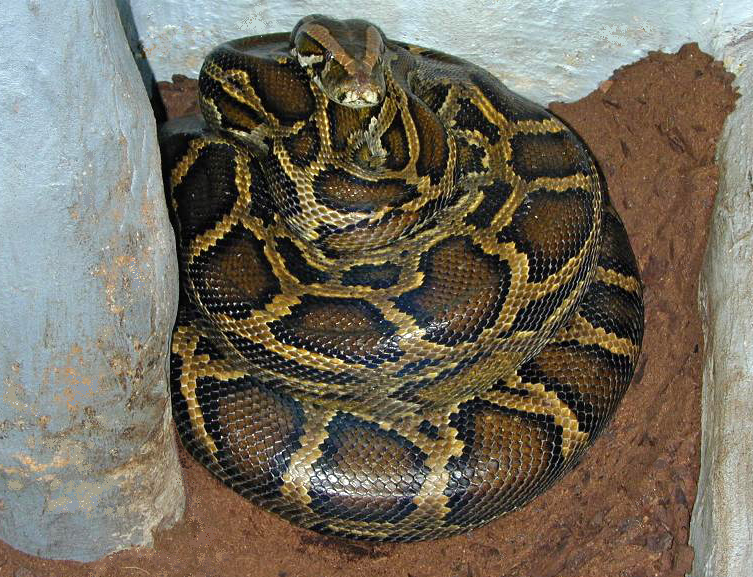
Florida wildlife officials have confirmed that Burmese pythons are now breeding in a new area outside the species’ long-recognized stronghold in the Everglades, a discovery that has renewed concerns among conservationists about the invasive predator’s potential for further spread across the state.
The Florida Fish and Wildlife Conservation Commission confirmed that Burmese pythons are now established in part of western Charlotte County, an area located north of Naples and Fort Myers that lies well outside the species’ traditional core range. For decades, established python populations had been largely confined to areas associated with Everglades National Park before spreading across much of South Florida, stretching between Lake Okeechobee, Key Largo and western portions of Broward and Collier counties.
A distinct population beyond the known range
Unlike a simple isolated sighting, the Charlotte County colony represents a separate breeding population situated beyond the snake’s familiar distribution area, according to wildlife officials. Reports from local communities began steadily increasing several years ago, with sightings clustering around Rotonda West, Placida, Englewood East and South Gulf Cove. Those reports prompted closer monitoring efforts, ultimately leading biologists to conclude that breeding animals were indeed present in the area.
Ian Bartoszek, a wildlife biologist and science coordinator at the Conservancy of Southwest Florida in Naples, explained why officials view removing the snakes as such a priority. “This is a generalist apex predator, and this is the why we’re so interested in removing them from the ecosystem,” Bartoszek said, according to ABC News.
How the snakes likely got there
Wildlife specialists do not believe the Charlotte County population developed through a gradual northward expansion from existing Everglades populations. Instead, available evidence points toward escaped or deliberately released captive snakes as the more likely explanation. Burmese pythons were widely imported into the United States for decades through the exotic pet trade, and both accidental escapes and intentional releases have previously been linked to the species’ broader establishment across Florida. Biologists studying the new Charlotte County colony say its characteristics more closely match what would be expected from a satellite population created through human introduction, rather than one resulting from natural expansion across the landscape over time.
A diet that helps the species thrive almost anywhere
Part of what makes Burmese pythons especially difficult to control is their unusually broad diet. Large individuals are capable of feeding on a wide range of animals, including raccoons, opossums, birds, bobcats and alligators, and have even been documented consuming prey considerably larger than many people might expect a snake to handle.
That dietary flexibility gives the species a significant survival advantage, allowing individual snakes to shift between different available prey sources depending on local conditions, rather than depending on a single food source that could limit their ability to establish themselves in new habitats. Conservation workers involved in python removal efforts describe the snakes as true apex predators, capable of substantially reshaping local ecosystems once a population becomes firmly established in a given area.
The broader ecological toll
The impact of established python populations extends well beyond the loss of individual prey animals. Ecologists studying areas of South Florida where pythons have been present for years have documented steep declines across many native mammal populations in those regions. As larger native mammals disappear from an ecosystem, scientists say the overall diversity of that environment can gradually decline as well, with researchers describing the resulting altered landscapes as simplified systems in which rodents and other invasive species tend to become comparatively more common, even as many native animal populations grow increasingly scarce.
Researchers say this pattern has already repeated itself across multiple areas of South Florida affected by established python populations, and preventing similar ecological changes from taking hold in newly identified areas like Charlotte County remains an ongoing and significant challenge for wildlife managers.
Why most pythons remain undetected
Estimating the true number of Burmese pythons currently living in Florida remains an extraordinarily difficult task for wildlife researchers. The snakes spend much of their time concealed within dense vegetation, wetlands and waterways, making them exceptionally hard to locate even during organized, systematic surveys. Research suggests survey teams may detect only around one to three snakes for every hundred believed to actually be present within a given search area.
Even within Everglades National Park, where specialized removal teams regularly search for pythons as part of ongoing management efforts, locating even a single snake often requires many hours of dedicated fieldwork. That persistently low detection rate suggests that confirmed sightings likely represent only a small fraction of the total number of pythons actually living across the broader Florida landscape.
Decades in the making
The broader Burmese python invasion in Florida has developed gradually over several decades. Federal wildlife records indicate that roughly 180,000 Burmese pythons were imported into the United States between 1975 and 2018, largely through the exotic pet trade. By approximately the year 2000, breeding populations had already become firmly established across South Florida. Since that time, wildlife agencies have relied on a combination of public reports, organized removal programs and ongoing scientific surveys in an effort to slow the species’ continued spread across the state.
Those broader containment efforts now extend to the newly confirmed population in Charlotte County, with officials continuing to monitor both that area and neighboring Lee County for additional python activity. Wildlife biologists say detecting breeding groups early offers the best available chance of limiting further expansion before a new population becomes as deeply entrenched as those already established in South Florida. Even so, officials acknowledge that managing an invasive predator of this size and adaptability remains one of the most demanding ongoing wildlife challenges facing the state of Florida, with the Charlotte County discovery underscoring just how difficult full containment of the species may ultimately prove to be.

Several major indexes across Asian stock markets ended Tuesday’s session. Will the U.S. market follow their lead?
South Korea’s KOSPI Composite Index rose 3.6%, snapping its recent losing streak. Japan’s NIKKEI 225 Index rose 3.3% and China’s Shanghai Composite Index gained 1.8%, the largest one day gains both indexes have recorded in nearly a month, according to Dow Jones Market Data.
Hong Kong’s Hang Seng Index and India’s BSE SENSEX Index were slightly lower, both seeing less than 0.5% losses.

Two 8-12% Target Yield Funds To Buy For Retirement Income


Former Syngenta CEO to fill spot beginning Aug. 17.

Disgraced investment promoter Chris Marco must stay behind bars while the Court of Appeal ponders whether he really is a fraudster.

Why is V2X stock surging today?

ASX-listed Tivan has announced a series of key changes as it moves towards a potential positive final investment decision at its Speewah fluorite project later this year.
Business
Aided By China, Equities Bounce Back; CAD Recovers From The Drop On U.S. Threat Of 50% Tariffs

Aided By China, Equities Bounce Back; CAD Recovers From The Drop On U.S. Threat Of 50% Tariffs

MONEY WILL FLOW LIKE CRAZY! (How To Manifest Success & Riches) | Dr Joe Dispenza

Andy Burnham policies LIVE as Prime Minister tells Cabinet ‘we need to be a cost of living Government’ after first tax cut announcement

Linda Reynolds has questions for Aukus inquiry

Renter of Home in Anne Heche Crash Denies Settlement With Son

No Jackpot Winner as $257 Million Prize Rolls Over to $269 Million Monday Draw

Weekend Open Thread: Staud – Corporette.com
MONEY WILL FLOW LIKE CRAZY! (How To Manifest Success & Riches) | Dr Joe Dispenza

YS Jagan Mohan Reddy Extended Financial Support To Vishakapatnam Fisherman Families #trending #viral

$10,000 ETHEREUM ROBINHOOD TO START ALTCOIN SEASON? #ethereum #xrp #robinhood #stocks
-
 NewsBeat5 days ago
London Mayor Sadiq Khan handed a peerage by Keir Starmer alongside 15 other Labour figures… just days before the PM leaves No10
-

 Fashion4 days ago
Weekend Open Thread – Corporette.com
-

 Politics3 days ago
The House | The City of London can help the new chancellor deliver growth in every postcode
-

 Politics6 days ago
Young campaigners urge incoming PM to act on outdoor junk food ads
-

 Crypto World6 days ago
CFTC blocks Kalshi from unwinding Michigan trades after court order
-
 Crypto World4 days ago
Two July Windows Left: The CLARITY Act’s Senate Fight and What Failure Means
-

 Crypto World3 days ago
Ripple Payments Joins MiCA With 14 Firms, Does It Mean Anything For XRP?
-

 Business5 days ago
Nvidia Stock Slips After Big Tuesday Rally as Huang Confirms Vera Rubin Chip Is Now in Production Today
-

 Politics2 days ago
Democrats look to World Cup watch parties to register thousands of voters
-
 Entertainment6 days ago
Disney’s Most Ambitious Failed Star Wars Attraction Is Coming to SDCC
-

 Crypto World4 days ago
Ripple wins EU-wide access as ESMA adds it to MiCA register
-

 Business5 days ago
Palantir Shares Rise After Expanded Nvidia Partnership and Fresh Analyst Upgrades Ahead of Earnings Day
-

 Crypto World5 hours ago
Grayscale Files For Worldcoin ETF, WLD Registers Sharp Rise
-

 Crypto World5 days ago
Injective Submits SEC Transfer-Agent Registration to Onchain Ownership Records
-

 Tech13 hours ago
Sail Virtually Aboard The “Itanic” With IA-64 Emulator
-
 Tech11 hours ago
Turtle Beach Command Series KB7 review: a nifty screen-equipped gaming keyboard
-

 Tech7 days ago
Dark Secrets Emerge When Jailbreaking LLMs
-

 NewsBeat4 days ago
Registration is now open for March for Men with Kev 2026
-

 News Videos7 days ago
XRP BOMBSHELL… XRP OMBOARDED FOR TRANSACTIONS!!!
-

 NewsBeat1 day ago
Unregistered fitter used Gas Safe logo on business flyers
You must be logged in to post a comment Login