Business
Bank of America report: gas prices squeeze lower-income household budgets

Barrons Roundtable panelists discuss what Americans can expect at the pump.
American household budgets are under pressure from higher gas prices and new data shows that consumers are turning to credit to cushion the blow of elevated fuel costs.
A report by the Bank of America Institute found that lower-income households saw the share of their incomes spent on gas rise to 4.2%, up from 3.9% a year ago and the highest level for the month of March since 2022, based on internal Bank of America customer deposit data that’s been aggregated and anonymized. By contrast, the average household across income groups spent about 3.1% of their income on gas in March, an increase from 2.8% relative to the same time last year.
Additionally, about 10% of lower-income consumers spent more than 10% of their household income in March on gas as prices jumped amid the Iran war constraining oil shipments from the Middle East, compared with just 6% of higher-income households.
“Lower-income households spend more as a share of their income on gas just because they have less room for discretionary spending than middle- and higher-income households,” David Tinsley, senior economist at the Bank of America Institute, told FOX Business. “Those two things together mean that the rising gasoline prices we’ve seen really squeezes lower income households the most.”
GAS PRICES SURGE PAST $4.50 NATIONALLY AS IRAN TENSIONS PRESSURE DRIVERS

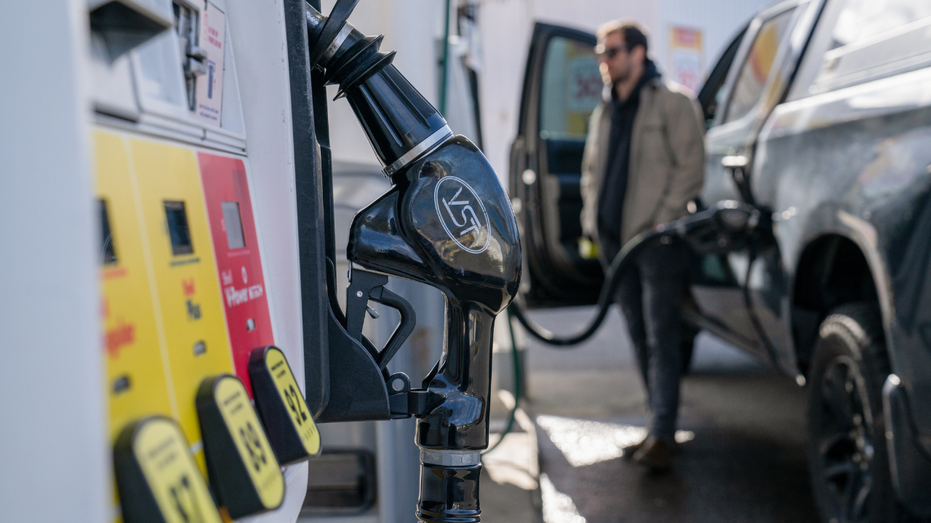
The Bank of America Institute found that American households, particularly at lower income levels, are seeing their budgets squeezed by higher gas costs. (M. Scott Brauer/Bloomberg via Getty Images)
The war in Iran caused the price of oil to rise above $100 a barrel after trading in the $70 range before the conflict began. That, in turn, caused gas prices to surge over 40%, with AAA’s national average rising to more than $4.50 a gallon.
Similar gas shocks strained consumer budgets as the economy dealt with the financial crisis in 2008, and began its recovery in 2011 and 2012. It also surged in the wake of the COVID pandemic when Russia invaded Ukraine in 2022.
“The rise in gasoline as a share of income right now needs to be kept in some perspective. There were also much bigger rises and higher peaks in terms of gas as a share of income and a share of spending just after the financial crisis and also just after COVID,” Tinsley said. “So this is obviously a painful rise for people, no doubt, but it’s not as large as those other incidents.”
GAS PRICE SURGE HITTING LOW-INCOME HOUSEHOLDS HARDEST, FED STUDY FINDS

The Iran war has constrained the flow of oil from the Middle East, spurring a surge in gas prices that’s impacting consumers. (Giuseppe Cacace/AFP via Getty Images)
American consumers are seeing some relief through higher wages, although the scale of those gains varies across income groups and some consumers are turning to credit and buy now, pay later to manage their finances amid the squeeze.
Tinsley said that while higher-income households are seeing strong wage growth up over 5% year over year, lower- and middle-income households aren’t seeing those gains. He noted that among lower-income households, the wage growth was just 1% through March, while it was 2% for middle-income households.
“There’s a couple of other things, wiggle rooms, that people have,” Tinsley said. “They could borrow more on their credit card, and when we look at where people stand relative to their credit card limits, we know they’re not particularly stretched right now relative to their credit card limits. The overall position is roughly where it was just before the pandemic.”
AVERAGE TAX REFUND UP NEARLY 11% FROM A YEAR AGO, IRS DATA SHOWS
“The other thing they could do is use buy now, pay later more,” he said, adding that more lower- and middle-income households are using those options to manage their budgets.
“The downside of that is, at the end of the day, buy now, pay later only smooths your spending over a couple of months, so it’s not going to make that big a difference to the overall story,” Tinsley said. “As it turns out, the people that tend to use buy now, pay later tend to have less borrowing space on their credit cards.”
Larger tax refunds have boosted Americans’ savings across income groups, Tinsley said. (Getty Images)
Tinsley said that one silver lining in the Bank of America Institute’s data is that households across income levels have more savings in the bank relative to before the COVID-19 pandemic.
“These households have about 10% higher deposits, savings deposits, in their accounts. The reason for that is largely tax refunds, so obviously the One Big Beautiful involved a lot of stimulus to consumers, a lot of which came through via refunds this year,” he said.
GET FOX BUSINESS ON THE GO BY CLICKING HERE
“Refunds are running, give or take, around 10% higher and although people are spending some of that, they’re also banking some of it and that can sort of help them weather some of this gas shock for a time,” Tinsley added.
You must be logged in to post a comment Login