Connect with us

Business

Bank of England sounds inflation alarm as it holds interest rates

Published

on


Bank of England sounds inflation alarm as it holds interest rates

Continue Reading
Click to comment

You must be logged in to post a comment Login

Leave a Reply

Business

GM touts new V8 engines in new truck wars

Published

on

GM touts new V8 engines in new truck wars

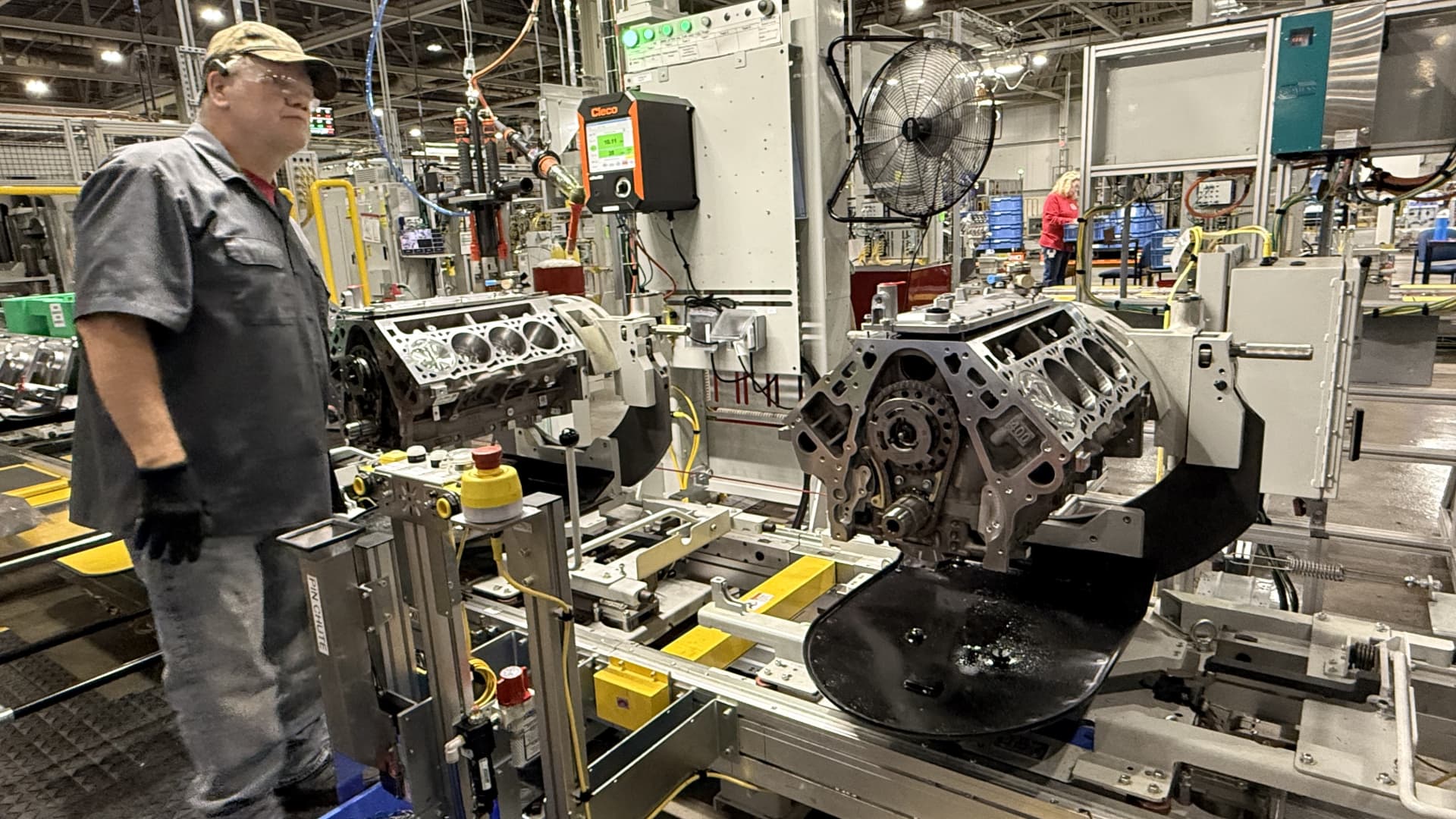
A General Motors employee at the automaker’s Flint Engine plant working on Sept. 16, 2026 to assemble one of its new 5.7-liter Small Block V-8 engines.

Michael Wayland / CNBC

DETROIT — The buzzing of all-electric vehicles has once again been overtaken by the revving of V-8 engines in the Motor City amid deregulation by the Trump administration and lackluster demand for EVs.

General Motors followed Ford Motor this week in touting new and improved gas-powered engines as well as a class-exclusive diesel option to build upon GM’s highly profitable full-size pickup truck business.

Advertisement

The Detroit automaker on Thursday released details of the engine lineup for its upcoming 2027 Chevrolet Silverado 1500 and GMC Sierra 1500 pickup trucks that include two new V-8 engines, a carryover inline-six-cylinder diesel engine and an enhanced four-cylinder turbocharged option.

GM executives said they expect the upgraded engine lineup and the redesigned pickup trucks to continue the automaker’s six consecutive years of sales leadership over its competitors in the segment, including Ford and Chrysler parent Stellantis.

“If we don’t stomp the competition with these trucks, then I’d be very sad and questioning myself. That’s the goal,” GM President Mark Reuss said during a media event Wednesday at the automaker’s massive Flint Engine plant near Detroit. “That’s what success looks like: continued truck leadership.”

While Ford, which also updated its engine offerings for the 2027 model year, is the top-selling full-size truck and brand with its F-Series lineup, Chevrolet and GMC combined have outsold Ford since 2020.

Advertisement

The full-size pickup truck market is more than marketing claims and bragging rights — it’s massively profitable for the Detroit automakers, with Ford previously saying its F-Series business generated more revenue than many Fortune 100 companies.

Full-size trucks in the U.S., including light-duty models and larger variants, are what pay the bills for U.S. automakers and allow them to invest in emerging markets and technologies.

“This is history today and we don’t take that lightly,” Reuss said about the launch of its new trucks with GM’s sixth generation of small-block V-8 engines, which the company first produced in 1955.

The segment continues to help offset losses of EVs, which have been a major focal point for the automotive industry this decade. But that focus has changed with the Trump administration’s moves to remove federal support of up to $7,500 in incentives to purchase an EV and reduce or eliminate federal fuel economy rules and penalties.

Advertisement

GM said the decision to build a new generation of V-8 engines occurred far before the Trump administration’s regulatory changes, as it takes years to develop such products. It said development of its Gen 6 small-block engine started in 2018.

2027 ‘truck wars’

2027 GMC Sierra 1500 AT4X (left) and Denali Ultimate models

Courtesy GMC

While many vehicle segments and automakers have dropped V-8 engine options amid tougher fuel economy standards and improved performances in smaller engines, the large, gas-guzzling models continue to sell well in pickup trucks thanks to their ability to tow and haul heavy things.

Advertisement

Analysts have said all-electric pickup trucks have failed to sell well, among other reasons, because many customers use the vehicles to tow or haul objects, which significantly reduces an EV’s range.

Even as hybrid vehicles have rapidly increased in sales this year, pickup trucks have remained an outlier. Part of that is a lack of choices, but hybrid leader Toyota Motor reports only 18.7% of its Tundra full-size pickup truck sales this year have been hybrids.

“No one has the efficiency on a diesel that we have,” GM’s Reuss said. “So if you look at the performance efficiency, but also in raw performance and range, hybrids don’t do it. … At the end of the day, we have focused on something that the customer wants, and that’s what we have here.”

GM reports a majority of sales of its full-size pickup trucks this year are models with V-8 engines, including 55% for the Chevy Silverado and roughly 61% for the GMC Sierra 1500. The 3.0-liter TurboMax diesel engine represents 20% of sales for Sierra 1500 and 35% of sales for Silverado 1500.

Advertisement

Ram Rumble Bee launches with the 5.7-liter Hemi V-8 (left), with availability starting late 2026; Rumble
Bee 392 (right) and Rumble Bee SRT (center) arrive in the first half of 2027.

Courtesy: Ram Trucks

When Ram dropped its well-known V-8 Hemi engines from its pickups for a more efficient inline six-cylinder, sales suffered so much the brand last year announced plans to resurrect it, but supplies remain tight.

“Ram showed that you can lose buyers by not having [V-8 engines] available,” Brinley said. “Part of it is because of that expectation that there is something that the V-8 is better at.”

Advertisement

Sales

Full-size pickup trucks have led new U.S. vehicle sales for decades, with Ford’s F-Series claiming to be the top-selling vehicle since 1981.

GM’s Chevrolet Silverado has typically followed at No. 2, with Ram not too far behind and the GMC Sierra with varying top 10 sales rankings.

GM’s plans to “stomp” the competition may be easier said than done, but the company has made gains against Ford, which has battled production issues over the past year due to supplier fires.

Pickup truck buyers are among the most loyal customers in the U.S. automotive industry. Mobility Global, formerly S&P Global Mobility, last year reported the Silverado 1500, F-150 and Ram 1500 have regularly ranked among U.S. vehicles with the highest brand loyalty.

Advertisement

However, there can be dips in loyalty when changes are made, such as when Ram canceled its Hemi, or automakers deal with recall issues.

GM’s new V-8 engines, which also are used for its full-size SUVs, come as the automaker continues to deal with issues with some of the engines in its current generation.

The National Highway Traffic Safety Administration opened an investigation into GM’s 6.2-liter V-8 over continued failures, even after the automaker recalled and said it had fixed engine issues.

Norman Peralta, GM executive chief engineer of global engines and battery systems, said the company is cooperating with the NHTSA and is “very confident” the new engines will not have similar problems.

Advertisement

Sales of GM’s pickups through the first half of this year were level for Sierra compared with a year earlier, while Silverado is off 4.6%. That compares with a 19% increase for Ram and a 13% decline for the F-Series amid its supplier issues.

Continue Reading

Business

Intel: I Was Wrong, Buckle Up For What Is Coming (Rating Upgrade)

Published

on

Intel Stock: Q2 AI Has Revived CPU Franchise, Foundry Not Earned Valuation (NASDAQ:INTC)

Intel: I Was Wrong, Buckle Up For What Is Coming (Rating Upgrade)

Continue Reading

Business

Caris Life Sciences: Diagnostics Growth With Room To Run (NASDAQ:CAI)

Published

on

Una doctora ajusta la moderna máquina de mamografía para el paciente

This article was written by

My name is Myriam Hernandez Alvarez. I received the Electronics and Telecommunication Engineering degree from the Escuela Politecnica Nacional, Quito, Ecuador, the M.Sc. degree in computer science from Ohio University, Athens, OH, USA, a graduate degree in Business Management from Universidad Andina Simon Bolivar, Quito, Ecuador, and the Ph.D. degree in computer applications from the University of Alicante, Spain.Disclosure: I collaborate professionally with Edgar Torres H, who is also an author on Seeking Alpha. Our analyses are conducted independently, and we adhere to Seeking Alpha’s Shared Association Guidelines.

Analyst’s Disclosure: I/we have no stock, option or similar derivative position in any of the companies mentioned, and no plans to initiate any such positions within the next 72 hours. I wrote this article myself, and it expresses my own opinions. I am not receiving compensation for it (other than from Seeking Alpha). I have no business relationship with any company whose stock is mentioned in this article.

Seeking Alpha’s Disclosure: Past performance is no guarantee of future results. No recommendation or advice is being given as to whether any investment is suitable for a particular investor. Any views or opinions expressed above may not reflect those of Seeking Alpha as a whole. Seeking Alpha is not a licensed securities dealer, broker or US investment adviser or investment bank. Our analysts are third party authors that include both professional investors and individual investors who may not be licensed or certified by any institute or regulatory body.

Advertisement
Continue Reading

Business

Harvey Nichols takeover ‘dubious’, says Paul Smith chairman

Published

on

Harvey Nichols takeover 'dubious', says Paul Smith chairman

The executive chairman of Paul Smith has questioned the ethics of Frasers Group’s £43.3m takeover of Harvey Nichols, completed through a pre-pack administration in August that is expected to leave suppliers recovering less than 15 per cent of their debts.

“I personally find this whole thing about pre-pack administrations just dubious in terms of ethics and the way business gets done,” Ewan Venters, who was appointed chair of the fashion house last October, told the BBC Big Boss podcast.

Frasers, which is controlled by the billionaire Mike Ashley, bought the luxury department store through the pre-pack process. Critics argue such deals can leave creditors carrying unpaid debts.

Free newsletters
Advertisement

The stories that matter to UK business, straight to your inbox.

Advertisement

According to the latest estimates from administrators, Harvey Nichols’ unsecured creditors, which include Victoria Beckham, Jimmy Choo and Canada Goose, will receive less than 15 per cent of the £270.5m they were owed, leaving suppliers with less than 15p in the pound. Other unsecured creditors include Jo Malone, Puig and Estée Lauder.

Filings show Paul Smith was owed £96,537.50. Preferential creditors such as HM Revenue & Customs are expected to be repaid in full.

“I find it all a bit odd and I don’t think that’s a kind way of doing business,” Venters said. He conceded, however, that Harvey Nichols may have been “about to go to the wall and maybe Mike and his team will … keep it going”.

Venters said kindness was too often seen as a “soft” characteristic in business. “Kindness doesn’t mean just soft. But I think put the value of kindness at the heart of doing business, and I think you do business in a better way, with better results, with a happier outcome. All too often you just see very unkind behaviour which I don’t think leads to a healthier society.”

Advertisement

Pre-pack administrations, in which a company’s business or assets are sold before an administrator is formally appointed, have faced scrutiny over creditor involvement and sales below market value, according to a House of Commons Library briefing.

Frasers declined to comment.

The deal preserved more than 1,000 jobs and secured the immediate future of Harvey Nichols’ UK stores, including its Knightsbridge flagship. The retailer had failed to make a profit for years under its former owner, the Hong Kong billionaire Sir Dickson Poon, who faces losses of £100m from the sale.

The takeover had already raised concern among brand partners, with Frasers reportedly forcing its way into the auction process this summer. The Sports Direct owner’s reputation was previously damaged by Matches Fashion, which was placed into administration in 2024 weeks after Frasers acquired it, putting hundreds of jobs at risk and leaving suppliers unpaid.

Advertisement

In luxury, brands are struggling to attract Gen Z customers, with slower UK sales compounded by the former Conservative government scrapping VAT-free tourist shopping.

Ashley has long sought to move his retail group, which includes Flannels and House of Fraser, upmarket. This summer Frasers increased its stake in Hugo Boss to just below the 50 per cent needed for majority control and installed its chief executive, Michael Murray, as chairman. In July it disclosed a stake in Burberry.

Paul Smith, founded in 1970, reported a near tripling in pre-tax losses to £16.7m in its latest annual accounts. Slower demand and problems in its wholesale operation have contributed to six years of losses.

Venters said he had brought a “more razor-like focus” to the business, including expanding its direct-to-consumer arm and efforts to “right size the wholesale trade and the costs associated with it.”

Advertisement

He said previous management teams had “taken their eye off the ball” and missed the “disruptive behaviour” in the wholesale market, including consolidation that has allowed larger retailers to demand bigger discounts and promotional support. “You end up with a cost base that is higher than you need to service that, and a real conundrum as to how you still get growth.”

Venters said this year would be “a step change”. “We will still be a lossmaking business but we will probably nearly halve the losses in the first year of recovery. And we can see a growth plan that gets us back into profitability and where the business needs to be.”

Jamie Young
About the author

Jamie Young

Jamie Young is Senior Reporter at Business Matters, covering SME finance, employment law and Westminster policy since 2016. He has reported on every Budget and Autumn Statement since 2018, helped make sense of the ‘covid era’ and the bounce-back loan scheme from launch through the fraud investigations, and broke the magazine’s coverage of the 2024 late-payment reforms. He joined Business Matters straight from completing his BA in Administration from Exeter University and is NCTJ-qualified. Reach him at jyoung@cbmeg.co.uk

Advertisement

Advertisement
Continue Reading

Business

UK ranks fourth of 13 countries

Published

on

UK ranks fourth of 13 countries

A business owner in the UK taking £160,000 a year in salary and dividends would face the fourth-highest overall tax bill among 13 developed economies once inheritance tax is included, according to a study published on Sunday by financial education specialists Investing Insiders.

The analysis puts the UK total at £324,982.81. Only Japan, at £370,215.53, France, at £367,817.47, and Ireland, at £348,409.11, generated higher bills. Seven of the 13 countries in the study produced a tax burden of less than £100,000.

Investing Insiders modelled the finances of the same hypothetical individual across each G7 nation and other popular destinations for Britons moving abroad. The calculations covered income tax, dividend tax, inheritance tax and investment taxes, with all figures converted into sterling for a like-for-like comparison.

Free newsletters
Advertisement

The stories that matter to UK business, straight to your inbox.

Advertisement

The business owner persona pays themself a £60,000 salary, receives a £100,000 dividend, makes £20,000 of pension contributions and puts £20,000 into an ISA. The individual also inherits a £1.2m estate from a parent, made up of a £950,000 home, £200,000 in ISAs and investments and £50,000 in other assets.

The business owner was one of four personas the firm assessed. According to the published findings, an average earner on £39,039 faced the UK’s third-lowest burden among the 13 countries, while a £99,000 earner ranked fifth highest and a high earner on £207,000 ranked third highest, at £1,250,381.75. The United States ranked lowest across all scenarios.

Investing Insiders said the study aimed to find which countries allow residents to keep more of their money. It cited a 17 per cent increase over the past year in searches about emigrating or moving abroad. Office for National Statistics figures show 246,000 British nationals left the UK in the year ending December 2025.

On income alone, the UK business owner in the study would take home £31,303.40 from their wage and £63,713.79 from their dividend, along with the full £815 earned from investments, which are tax free inside an ISA. That leaves £44,982.81 in income-related taxes, the sixth highest of the 13 countries.

Advertisement

Ireland topped that measure, with the equivalent of £66,356.11 in tax. France was second at £49,530.10, almost £17,000 less than Ireland.

The study found the UK compared more favourably on pension tax relief. On £20,000 of contributions, it said the government would add £5,486.50 in relief and a further £1,946 could be claimed back through a tax return, taking the total to £27,432.50.

On the £1.2m estate, the study calculated a UK charge of £280,000, the fourth highest in the comparison, which lifted the overall bill to £324,982.81.

Australia, Canada, New Zealand, Portugal and the United States charge nothing on the inheritance in the study’s model, meaning a UK heir would pay £280,000 more than one in those countries. Spain and Italy would each charge less than 5 per cent of the UK figure, according to the analysis.

Advertisement

The firm said inheritance tax accounted for almost 90 per cent of overall charges for its highest-earning UK persona.

The study follows other research and campaigning on the tax treatment of business owners. A Make UK and Bishop Fleming survey this month found that one in five family manufacturers are weighing an overseas sale because of inheritance tax changes.

In June, more than 90 founders and 19 MPs wrote to the Chancellor warning that cumulative tax rises were prompting entrepreneurs to relocate abroad. Concern over wealth leaving the country predates both, with research in 2024 pointing to the largest exodus of millionaires globally from Britain.

Jamie Young
About the author
Advertisement

Jamie Young

Jamie Young is Senior Reporter at Business Matters, covering SME finance, employment law and Westminster policy since 2016. He has reported on every Budget and Autumn Statement since 2018, helped make sense of the ‘covid era’ and the bounce-back loan scheme from launch through the fraud investigations, and broke the magazine’s coverage of the 2024 late-payment reforms. He joined Business Matters straight from completing his BA in Administration from Exeter University and is NCTJ-qualified. Reach him at jyoung@cbmeg.co.uk

Advertisement

Continue Reading

Business

Oracle: Dismiss The Overblown Credit Fears

Published

on

Oracle: Dismiss The Overblown Credit Fears

Oracle: Dismiss The Overblown Credit Fears

Continue Reading

Business

M.P. Evans Group PLC (MPEVF) Q2 2026 Earnings Call Prepared Remarks Transcript

Published

on

OneWater Marine Inc. (ONEW) Q1 2026 Earnings Call Transcript