

Business
Baron Discovery Fund Q1 2026 Commentary (BDFIX)


Sasun Bughdaryan/iStock via Getty Images

Dear Baron Discovery FundShareholder,
Performance
This was a challenging quarter for Baron Discovery Fund ® (the Fund), both on an absolute and relative basis. In the first quarter of 2026, the Fund declined 10.65% (Institutional Shares), trailing the Russell 2000 Growth Index (the Index) by 7.84%. We don’t take this lightly, and we have doubled our efforts to understand what is going on in the market both in the short term, and (far more importantly) as it affects the overall long-term embedded valuations of our holdings in the Fund.
Of the underperformance, five buckets accounted for 7.88% (essentially all of it):
• 2.63% came from Information Technology (IT) (software exposure was entirely responsible for the relative shortfall in the sector, but was partly offset by solid relative performance in areas benefiting from the AI secular growth narrative, such as semiconductor, semiconductor materials & equipment, and electronic equipment & instruments related companies)
• 1.76% came from Consumer Discretionary (higher energy prices, inflation and AI induced unemployment fears, plus noise around “prediction markets” competitors to DraftKings Inc. (DKNG) )
• 1.22% came from Health Care (there were no real standout mistakes here, but the market was negative on life sciences tools and health care technology)
• 1.17% came from our lack of exposure to Energy (higher oil prices related to the Iran action moved the sector up 26%) and Materials (aluminum and chemicals prices are up, also related to Iran);
• 1.09% came from Industrials (some of which related to concerns about commercial aerospace suppliers like Loar Holdings Inc. (LOAR) due to the military action in Iran)
Annualized performance (%) for periods ended March 31, 2026 †
Of the underperformance, in IT, 3.71% of the relative deficit was attributable to software. If we include two health care companies that are software-related ( Waystar Holding Corp. (WAY) and Heartflow, Inc. (HTFL) ), the total adverse impact from software in the quarter was (4.36%) or nearly 60% of our negative relative performance. These software companies almost uniformly beat earnings, yet shares dropped considerably.
Software has been decimated by the so-called “SaaS-pocalypse” which is shorthand for how the revolution of AI is changing the industry. SaaS stands for software as a service. The market has decided that all software companies are AI losers and, as a result, every one of our software holdings saw significant declines in the quarter. Despite generally strong fourth quarter earnings, the sharp declines have pushed software valuations to levels not seen in more than 15 years. Although the short-term results have been difficult, we see this environment as a chance to invest in truly attractive opportunities across software companies that in our view have strong and sustainable competitive advantages. There are multiple potential catalysts that could quickly change the market’s thinking on these software companies, and we want to be there to reap the benefits when that happens.
Companies like Anthropic (ANTHRO) and OpenAI (OPENAI) have created models known as “frontier, ” “foundation, ” or “large language” AI models (LLMs) that have revolutionized the way we search for and categorize information that is generally publicly available. They have extended their LLMs into software coding, in a way that has become much more accessible to the general population, thereby democratizing software development. It is true that this revolution has made it much less expensive to develop basic software (for professionals and consumers alike). Companies that have value propositions based mostly on their actual code are truly at risk of disintermediation in the world of AI. However, we have largely avoided these types of companies. Our companies should have built-in competitive advantages, which extend far beyond the actual code. Our portfolio companies have their own internally developed AI which is custom tailored to their own domains. Here are a few examples of the differentiation which exists in our investments.
1. Deterministic Data/Infrastructure Protection – LLMs take the data that is available to them and search based upon it. If there is an actual answer to the question being asked, it will be returned. Where no actual answer can be found, a probabilistic “guess” is made in order to fill in the blanks. The answer may be correct, or it may not be (in which case you have what is called a “hallucination”). Software companies that deal with private customer data, not available to LLMs, have a prized possession because software using deterministic data will have an actual answer to a question being asked that in many cases cannot be addressed by an outside LLM. In fact, it may be unsafe, illegal, or out of policy for a company to use an external model, or to allow that external model to have access to its proprietary information.
Good examples of this are regulated companies in industries such as health care and finance. The more complex the environment, the more embedded the legacy software will be in the enterprise. Now these legacy software companies can use AI from an outside LLM through a link called an MCP Server (Model Context Protocol) to help fine-tune their own deterministic data. But there is a cost for using outside AI based on the amount of information “tokens” consumed. And breaches of MCP Server software have also been reported (see below). Cybersecurity companies in particular have the advantage of seeing all of a company’s data and parsing it for particular threats to the internal network or application structure of that company.
The brands of these companies are valuable as they have built up years’ worth of trust with their customers. This is why we have invested in SentinelOne, Inc. (S), which provides endpoint protection using its own AI algorithms for cyber-breach discovery and remediation, . The same is true for observability software (which “instruments” everything that moves through a network or attaches to it, as well as the applications and data related to that movement). We own Dynatrace, Inc. (DT) which is architected on its own internal AI to predict failures in network software and hardware (whether in the cloud or on-premise) and works to automatically remediate the issues. It’s used by the largest companies in the world that operate in the most complex environments (airlines, financial giants, and defense companies for example).
Deterministic/infrastructure oriented companies gain nearly all of their value by integrating with and servicing their clients’ needs, rather than just by selling an off-the-shelf software package. Such software provides high return on investment (ROI), auditable security compliance, and peace of mind at a reasonable cost. Even if cheaper software solutions that were coded using LLM platforms came out, they would still have to be integrated and maintained into the enterprise’s architecture, and they would have to link to outside LLM’s for AI capability (which could cost a LOT more to run in the future versus what existing vendors charge for their “tuned” and more specific AI models). We believe that these companies will become even more valuable in an “agentic AI” world, where software autonomously executes tasks based on user goals, operates with its own enterprise privileges, and must be monitored and controlled.
2. Network Effects Vertical Vendors – Some companies serve a very specific customer base and provide increased value by giving each customer the benefit of understanding (using hard to compile domain specific data) what is going on in their industry. Examples of this include ServiceTitan, Inc. (TTAN), which provides software for service trades such as plumbing and HVAC. It is an all-in-one platform for lead generation, job bookings, dispatching, estimating jobs, customer communications, and payments/financing. Each trade has its own specific characteristics and regional data on pricing, competition, service times, and contract terms that ServiceTitan understands deeply. It is not easy to switch the software out, particularly because it helps businesses automate their processes and minimize the overall personnel needed. Procore Technologies, Inc. (PCOR) provides integrated construction software, which is required by many of the major general contractors in order for subcontractors to be able to participate in a construction project. The software combines computer-aided design software blueprints with job scheduling, cost estimations, materials costs, and change order management. In this manner, the job site can be coordinated among all the different parties involved in the construction project. It is truly a community-oriented platform that is not easily replaced.
3. Atoms Plus Electrons – These are hybrids of software and hardware. They are in some ways the most protected because AI in and of itself can’t create hardware. Companies like Netskope, Inc. (NTSK) fit into this category. Netskope is a misunderstood company which provides secure access service edge (SASE) functionality for zero trust network access (ZTNA), data loss protection, and threat protection to its enterprise customers. It uses a proprietary network of worldwide data access centers as gateways for access to enterprise network resources, web resources, and applications. These physical data centers allow much faster data movement as well as for in-line scanning of network data for security purposes. The company is not earning full margins yet because it has invested in building its physical network (which is part of the reason it is down in the quarter). However, NetSkope is now starting to reap scaled revenue benefits, and its physical network gives the company an advantage over purely software-based ZTNA solutions in that it is safer and provides much faster overall network access (lower latency or delay). It cannot be replicated by software alone.
4. Regulated Industries – Some industries like health care in particular are heavily regulated, with extreme penalties for misuse or loss of patient information. And in some cases, such as with Heartflow (which uses AI software to map coronary arteries to assess blood flow and plaque buildup without an invasive procedure), clinical trials and Food and Drug Administration (FDA) approval are required before the software can be used.
While this discussion is important, the more practical question is when the market will begin to recognize the wide dispersion in intrinsic value across the software universe. We believe several catalysts are emerging that should separate the winners from the losers.
First, it is likely that we will see increased merger activity. Private equity funds specializing in software have recently raised tens of billions of dollars and would be very sophisticated buyers of high-quality companies at historically depressed evaluations (we have had eight companies acquired in this space in the last six years). Additionally, we are seeing strategic buyers from within the technology space purchase software companies. Last year we had two software companies purchased by such buyers, including CyberArk Software Ltd. (CYBR), a high-end cybersecurity company which was bought by Palo Alto Networks (PANW) (announced in July 2025 and closed in February 2026).
Second, it is almost inevitable that there will be cyber-attacks based upon usage of LLM based AI within enterprises if the technology is not properly secured and controlled. We have already seen such an attack. In March 2026 LiteLLM, an LLM gateway tool (which allows developers to link their applications to over 100 different LLMs) was used as an attack vector. Poorly secured coding in this widely used tool led to widespread malware infiltration. The attack was so sophisticated that it allowed the attackers to rapidly spread the malware across on-premise and cloud resources and exfiltrate sensitive data to an external server. SentinelOne recently released a technical paper which showed how its own AI-driven software automatically and rapidly protected its users by finding and shutting down this attack and provided an audited trail of the attack vector itself.
Third, we are likely to see partnerships between legacy software companies and LLM providers, which will highlight the “last mile” deterministic data value of legacy software companies. Recent examples include partnerships with OpenAI and transaction processors such as Instacart (CART), as well as a partnership with SentinelOne and Google (GOOGL) (to provide autonomous, AI-based cloud security for Google Cloud customers).
Finally, we expect continued solid financial performance from companies with the protected characteristics described above. During the past quarter, our holdings generally delivered results ahead of expectations and raised guidance. We believe this trend will persist, and that growing free cash flow will ultimately capture investors’ attention. Yet valuations are lower than they have been in over a decade. As we have noted in past letters, software companies have incredible financial characteristics, including outsized margins, strong balance sheets, and the ability to actually generate more free cash flow as they grow (due to the upfront payment of subscription fees). For all these reasons, we have maintained our overweight in the software space, and we believe that we will see significant outperformance for years ahead of us.
Top contributors to performance for the quarter
Advanced Energy Industries, Inc. is a designer and manufacturer of products used to transform, refine, and modify electrical power for use in semiconductor, industrial, medical, data center, and telecommunications end markets. Advanced Energy’s stock rose during the quarter as earnings and guidance were better than expected and as the market began to appreciate the strength that the company would see in both its data center and semiconductor end markets. The company is enjoying the fruits of having repositioned its data center segment to focus on sole-source, differentiated, higher margin business. AI’s increasing power requirements play to Advanced Energy’s strengths in power density and efficiency. The company also recently launched new products into the semiconductor market which are expected to drive strong growth through this year. Combined with the early stages of a recovery in its industrial and medical end markets, Advanced Energy is poised for several years of continued strong growth and margin expansion. The company also remains focused on acquisitions to bolster its product offerings, particularly in the large fragmented industrial and medical spaces.
Masimo Corporation is a medical device company that manufactures and sells a variety of non-invasive patient monitoring technologies, including its well-known pulse oximeters used to measure blood oxygen levels. Shares outperformed for the quarter after Danaher Corporation (DHR) announced that it would acquire Masimo at a 38% premium. This was a special situation driven by an activist investor that worked out very well for the Fund.
Arcellx, Inc. is a biotechnology company which uses CAR-T technology (modifies a patient’s own immune cells to recognize and destroy cancer cells) to treat multiple myeloma. It is due to be acquired by Gilead Sciences Inc. (GILD) in June (around which time we expect that Arcellx will receive FDA approval for its drug called Antio-cel).
Top detractors from performance for the quarter
Intapp, Inc., a vertical software platform serving private equity, legal, and consulting firms, detracted from performance this quarter. The drawdown was driven by a sector-wide AI disruption narrative that hit legal-adjacent software stocks particularly hard, with Intapp declining sharply through mid-February after Anthropic announced new legal tools. We sold our investment in the quarter as we believe that our other software holdings have better overall competitive advantages.
DraftKings Inc. is the leading U.S. digital sports betting and iCasino operator. The stock declined as investors grappled with a guidance range that implied handle (amount bet) deceleration, elevated prediction markets investments to compete with firms like Kalshi (KALSHI) and Polymarkets, and lingering debate around structural hold (the percentage of overage profit per bet) sustainability. The headline concerns obscure what we believe are strong fundamentals in the core sports betting business customer cohorts. Management built 2026 guidance on flat actual hold, a figure that has expanded every year in the industry’s history. Parlay mix, the primary mechanical driver of hold, increased 500 basis points during NFL season and 200 basis points year to date. The $800 million EBITDA midpoint also embeds a $200 million headwind from prediction markets investment, which currently carries no associated revenue. Excluding that impact, implied core business EBITDA exceeds $1 billion. We believe the stock is trading at attractive multiples relative to the company’s long-term earnings potential and think the total addressable market for prediction markets, while nascent, has the potential to accelerate growth.
Shares of Netskope, Inc., a cloud security and networking platform for enterprises, were down due to a combination of sector-wide and technical factors rather than fundamental weakness. The entire application software sub-sector experienced a sharp drawdown as investors weighed AI disruption risks, and recent IPOs like Netskope bore the heaviest losses. Adding to the pressure, Netskope’s lock-up expiration in mid-March made roughly 390 million shares eligible for sale, creating a supply overhang that coincided with the worst of the sub-sector selloff. The business itself performed very well— fiscal fourth quarter (ended January 31, 2026) revenue grew 32%, annualized recurring revenue (ARR) reached $811 million, and grew 31%, the company posted record quarterly net new ARR, and achieved positive free cash flow for the first time. Management guided fiscal 2027 revenue above consensus expectations. We maintain conviction in Netskope’s long-term positioning in the SASE market, where demand for securing cloud and AI workloads continues to grow, and view the current valuation as disconnected from the company’s growth trajectory and competitive standing.
Portfolio Structure
Top 10 holdings
Recent Activity
Top net purchases for the quarter
Forgent Power Solutions, Inc. is a leading manufacturer of electrical distribution equipment used in data centers, the power grid, and energy-intensive industrial applications. Forgent is a low- and medium-voltage equipment specialist and focuses on custom, “engineered-to-order” products (90% or more of revenue) whereas larger competitors in the industry generally focus more on higher voltage and standard products. Forgent differentiates itself from competitors by engaging deeply with customers in the design phase and then offering custom products in shorter lead times than the standard products sold by competitors.
The company has nearly completed a manufacturing footprint investment which will support $5 billion in revenue, giving it one of the largest state-of-the-art manufacturing footprints in the industry. Plus, it has very good visibility with about $3 billion in annualized orders, with a $1.5 billion current backlog. Electrical equipment, especially power transformers, remains a key bottleneck in the broader data center infrastructure build, and Forgent’s capacity planning and manufacturing efficiency are uniquely positioned to take advantage of this supply/demand mismatch. Despite inefficiencies from excess capacity, Forgent already has near best-in-class adjusted cash flow margins, which we expect to continue to expand as the company drives more volume over its large manufacturing footprint. To date, most of its data center business has focused on colocators and neoclouds, with very large opportunities to engage with and support larger hyperscale customers going forward. We believe Forgent can grow its revenues to over $5 billion in the next five years (from $296 million in 2025 and an expected $1.3 billion in 2026) supported by continued robust grid and data center capital expenditure as well as share gains from competitors in the market.
Enpro Inc. is a diversified industrial technology company whose proprietary, value add products and solutions provide critical functionality and protection across a wide range of demanding environments. Today, more than half of revenue is generated from recurring, high margin aftermarket applications, and a similar proportion is exposed to structurally higher growth end markets. Enpro’s Sealing Technologies segment designs, engineers, and manufactures metallic seals, soft gaskets, wheel end products, and gas analyzers and sensors serving general industrial, commercial vehicle, power generation, food and pharmaceutical, aerospace, and petrochemical markets, supported by strong brands such as Garlock, which is widely regarded as the “Kleenex” of its category. The Advanced Surface Technologies (AST) segment is focused on the semiconductor market and provides precision manufacturing, cleaning, refurbishment, and coating services to leading wafer fabrication equipment original equipment manufacturers and foundries, with a particular emphasis on leading edge production.
We believe Enpro can deliver mid to high single-digit organic revenue growth over time, with EBITDA margins expanding into the high 20% range from the low to mid 20% range today, supported by contributions from both segments. Sealing Technologies should continue to achieve above GDP organic growth driven by strong pricing power and ongoing investment in innovation and attractive growth markets. AST is positioned to benefit from a multi year secular growth opportunity driven by increasing leading-edge semiconductor spending and a rising U.S. share of global manufacturing, particularly supported by AI driven demand in the near term. We also expect the company to continue deploying its strong free cash flow toward highly complementary acquisitions, leveraging its operational excellence capabilities to drive value creation. As Enpro continues to scale and margins improve, we believe the business will warrant a more premium valuation, supporting further upside over time.
We added to our position in Dynatrace, Inc., a provider of “observability” software. For the reasons we laid out above we believe that this is a great deterministic data-oriented company, benefiting from significant competitive advantages. However, it is trading at a rock-bottom multiple (13 times free cash flow, with that metric is likely to grow in the mid-teens for the next few years).
We also added to Heartflow, Inc., whose software analyzes CT scans of a patient’s coronary arteries done with contrast, and shows calcification, plaque buildup, and blood flow quality in a three-dimensional model. It is hard to understand how Heartflow would be easily disintermediated, given the customer trust it has built up, and its FDA approved software based on significant clinical trials and millions of real-world CT scan analyses.
Finally, we added to Waystar Holding Corp., which like Heartflow has been lumped into the “AI software losers” bucket. Waystar is a provider of revenue cycle management software to health care providers. The company has an AI driven, end-to-end suite of solutions that saves clients massive amounts of working capital costs by getting claims submitted quickly and correctly, and by automating insurance appeals when necessary. At under 11 times adjusted cash flow, but growing cash flow in the low teens, we believe the company is competitively advantaged and very cheap.
Top net sales for the quarter
We sold several positions in the first quarter, mostly relating to companies set to be acquired. These included Exact Sciences Corporation (a cancer diagnostics company acquired by Abbott Laboratories (ABT) in March), Masimo Corporation, Clearwater Analytics Holdings, Inc. (an investment accounting SaaS company due to be acquired by multiple private equity firms in June), and Arcellx, Inc. We also sold our remaining position in GitLab Inc. (a software company that enables enterprises to coordinate the development and production of software), as we came to the view that the company had the potential to be disintermediated by LLM developed solutions.
Conclusion
We hate to underperform. We “eat our own cooking, ” as we have personally invested meaningful amounts of our net worth in the Fund. Rest assured that we are devoted to our process of investing in competitively advantaged companies with great management teams for the long term. We spend hours every day performing due diligence on our companies, including speaking with management teams, competitors, industry experts, and customers. So, we have true conviction in our investments for the reasons laid out above. Sometimes we are too early. But we believe we are not far away from seeing outperformance related to our hard work. We are grateful that you have chosen to take this journey with us.
Randy Gwirtzman, Portfolio Manager
Laird Bieger, Portfolio Manager
References
- † Historical performance was impacted by gains from IPOs. There is no guarantee that these results can be repeated or the level of IPO participation will be the same in the future.
- 1 The Russell 2000® Growth Index measures the performance of small-sized U.S. companies that are classified as growth. The Russell 3000® Index measures the performance of the largest 3,000 U.S. companies representing approximately 98% of the investable U.S. equity market, as of the most recent reconstitution. All rights in the FTSE Russell Index (the “Index”) vest in the relevant LSE Group company which owns the Index. Russell® is a trademark of the relevant LSE Group company and is used by any other LSE Group company under license. Neither LSE Group nor its licensors accept any liability for any errors or omissions in the indexes or data and no party may rely on any indexes or data contained in this communication. The Fund includes reinvestment of dividends, net of withholding taxes, while the Russell 2000® Growth and Russell 3000® Indexes include reinvestment of dividends before taxes. Reinvestment of dividends positively impacts the performance results. The indexes are unmanaged. Index performance is not Fund performance. Investors cannot invest directly in an index.
- 2 The performance data in the table does not reflect the deduction of taxes that a shareholder would pay on Fund distributions or redemption of Fund shares.
- 3 Not annualized.
Editor’s Note: The summary bullets for this article were chosen by Seeking Alpha editors.
Editor’s Note: This article covers one or more microcap stocks. Please be aware of the risks associated with these stocks.

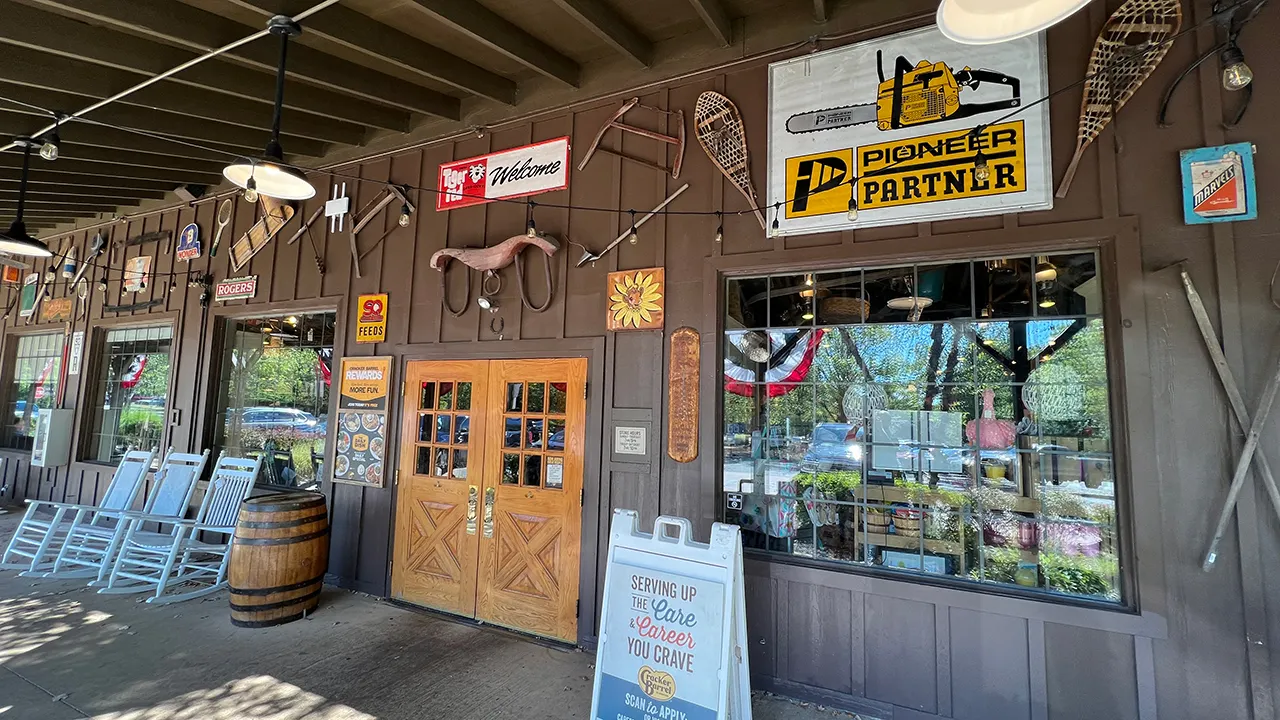
Hometown customers in Lebanon, Tennessee, share their thoughts on Cracker Barrel scrapping its newly unveiled text-only logo to keep its long-standing “Old Timer.”
Traffic at Cracker Barrel locations is yet to fully recover from the backlash against its failed rebrand last year despite signs of improvement, company executives said on the restaurant chain’s most recent earnings call.
The company has been looking to put itself on a more solid financial footing after sales slumped in response to the unsuccessful rebrand that included the removal of the “old timer” from the company’s logo and changes to the restaurant chain’s interior layout, which has long featured a general store.
Cracker Barrel announced on Monday that CEO Julie Masino will step down from the role this summer, with David Deno set to take the helm of the company on Aug. 10. The move follows a slow recovery from the attempted rebrand.
CRACKER BARREL CEO JULIE MASINO TO STEP DOWN

Cracker Barrel CEO Julie Masino is stepping down, effective Aug. 10. (Jeenah Moon/Reuters)
The company noted in its third-quarter earnings last month that while traffic was improving relative to the recent trend, it remained lower than it was in the prior year.
Masino said, “Q3 results exceeded our expectations, driven by our operating and cost actions, while guest-facing metrics continue to improve, and position us for further traffic recovery.”
| Ticker | Security | Last | Change | Change % |
|---|---|---|---|---|
| CBRL | CRACKER BARREL OLD COUNTRY STORE INC. | 52.40 | -1.31 | -2.44% |
CRACKER BARREL COMEBACK GAINS STEAM AS LOYAL CUSTOMER SAYS RETURN VISIT ‘FELT LIKE COMING HOME’
“Comparable store restaurant sales decreased 2.6%, which included a traffic decline of 6.7%,” said Cracker Barrel CFO Craig Pommells. “Although traffic remained negative, we are encouraged by the gradual improvement in the underlying trend.”
Pommells said that “controlling for the variability between last year’s third and fourth quarters and the resulting comparison in the current year, the underlying traffic trend continues to show gradual improvement.”
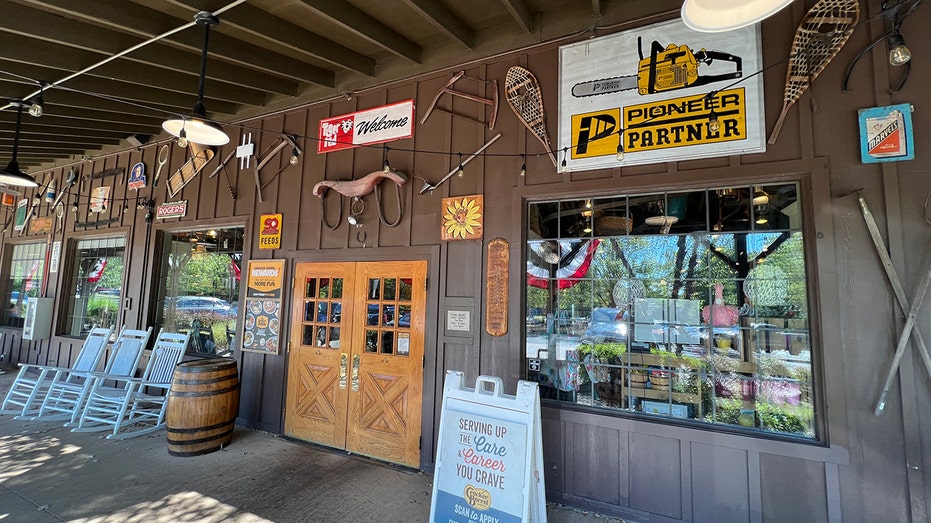
The company noted in its third-quarter earnings last month that while traffic was improving relative to the recent trend, it remained lower than it was in the prior year. (Gregory Walton/AFP via Getty Images)
Cracker Barrel’s stock is down about 18% from a year ago, remaining well below its pre-rebrand levels.
However, it has made significant progress in getting back to those levels this year; the company’s stock is up 105% since the start of 2026.
The company has taken steps recently that aim to improve its financial performance.
CRACKER BARREL SALES, TRAFFIC CONTINUE TO SLUMP MONTHS AFTER FAILED REBRAND
Last week, Cracker Barrel announced that it will sell some of its restaurant properties as well as exiting its Maple Street Business Company business. It sold the Maple Street brand and 35 of its locations to Biscuit Belly LLC, with Cracker Barrel closing the remaining 16 Maple Street restaurants.

Cracker Barrel announced last week that it will exit its Maple Street Business Company business. (Jeffrey Greenberg/Universal Images Group via Getty Images)
The company also completed a sale-leaseback deal involving 26 company-owned locations, which generated about $77 million in net proceeds that it planned to use to pay down debt, while continuing to operate the restaurants by leasing the properties from the new owner.
“A brand isn’t what management wants it to be,” said brand expert Bruce Turkel. “It’s what customers believe it is.”
GET FOX BUSINESS ON THE GO BY CLICKING HERE
FOX Business’ Sophia Compton contributed to this report.

Massachusetts mother goes on trial for killing her three children

Alpha Management Corporation is a family-owned real estate company that has spent decades helping shape the housing market across Greater Boston. Founded by Anwar Faisal, the company began with a simple goal: provide dependable property management built on integrity, innovation and reliable service.
Over the years, that vision has grown into a business that owns, develops and manages residential and commercial properties throughout communities including Allston, Brighton, Brookline, Fenway, Back Bay, Jamaica Plain, Cambridge, Somerville, Newton and Medford.
One area has remained at the centre of the company’s work for more than thirty years. Alpha Management has focused on helping students find practical housing close to universities. As enrolment has grown and on-campus accommodation has struggled to keep pace, many students have needed reliable off-campus options. Alpha recognised that demand early and made it a priority.
The company has worked with both domestic and international students while also partnering with universities to help simplify the housing search. At a time when some landlords hesitate to rent to students because of limited rental histories or other perceived risks, Alpha Management has continued serving this important part of the community.
That long-term approach reflects the company’s wider philosophy. Students contribute to neighbourhood businesses, public transport, restaurants and the local economy, making accessible housing an important part of Boston’s continued growth.
Today, Alpha Management Corporation continues to invest in its properties while maintaining the family values that shaped its beginnings. With decades of experience and a strong understanding of the Greater Boston housing market, the company remains a trusted leader in practical property management and student-friendly housing.
Alpha Management Corporation: Three Decades of Meeting Boston’s Housing Needs
Q&A with Alpha Management Corporation
Q: How did Alpha Management Corporation begin?
Alpha Management Corporation was founded by Anwar Faisal with the idea that property management should be built on integrity, reliable service and long-term relationships. What started as a small family business has grown into a company that owns, develops and manages residential and commercial properties across Greater Boston. Even as the company expanded, the focus on serving local communities has stayed the same.
Q: What has been the biggest change in the Boston housing market during that time?
One of the biggest changes has been the growing demand for housing near universities. Boston has always attracted students from around the world, but university enrolment has continued to increase while on-campus housing has remained limited. That has created lasting demand for practical off-campus accommodation close to campuses.
Q: Why has student housing become such an important part of the company’s work?
We recognised many years ago that students needed dependable places to live. They often value being close to campus more than having large apartments or luxury features. By providing housing near universities, we help meet a genuine need in the community.
Student housing is not a luxury. It is a practical necessity for thousands of people who come to Boston every year to study.
Q: Why do you believe students are so important to the city?
Students contribute far beyond the classroom. They support local cafés, restaurants, shops, transport services and neighbourhood businesses. Their families also visit throughout the year, adding further economic activity.
Universities are a major part of what makes Greater Boston successful, and suitable housing helps support that wider ecosystem.
Q: Some landlords are reluctant to rent to students. How has Alpha Management approached that challenge?
Many students are renting for the first time. They may have limited rental history, limited credit history or require co-signers. Some landlords see those factors as additional risk.
Our approach has been different. We have spent more than three decades working with students and understanding their circumstances. Experience has shown us that with clear communication and proper management, student housing can work well for both residents and property owners.
Q: Has working with universities been an important part of that process?
Yes. We have partnered with universities to help students find housing and make the transition to living in Boston easier. For many domestic and international students, finding accommodation is one of the biggest challenges before classes even begin.
Helping simplify that process has always been an important part of what we do.
Q: Alpha Management operates across many communities. How has that shaped the business?
Every neighbourhood has its own character and housing needs. We manage properties in areas including Allston, Brighton, Brookline, Fenway, Back Bay, Jamaica Plain, Cambridge, Somerville, Malden, Medford, Newton, West Roxbury and Norwood.
Having a broad presence across Greater Boston gives us a better understanding of local markets while allowing us to stay connected to the communities we serve.
Q: What makes successful property management today?
Property management is about much more than maintaining buildings. It is about understanding the people who live in them, responding when issues arise and building trust over time.
That means listening carefully, communicating clearly and taking a long-term view. Those principles have guided the company from the beginning.
Q: How do you see the future of housing in Greater Boston?
Demand will continue to be strong, especially in areas close to universities. That means practical housing solutions will remain important. As the market evolves, there will continue to be opportunities for property owners, universities and housing providers to work together to help meet growing demand.
Q: After more than three decades, what continues to motivate Alpha Management?
The answer has remained remarkably consistent. We want to provide quality housing that meets real needs. We are proud to have helped generations of students find homes near their universities while continuing to invest in communities across Greater Boston.
Our goal has never been simply to manage properties. It has been to provide dependable housing solutions that support residents, strengthen neighbourhoods and contribute to the long-term success of the region.

Invesco is an independent investment management firm dedicated to delivering an investment experience that helps people get more out of life.Be the first to know! Sign up for Invesco US Blog and get expert investment views as they post.Disclosure for all Invesco US articles: Before investing, carefully read the prospectus and/or summary prospectus and carefully consider the investment objectives, risks, charges and expenses. The information provided is for educational purposes only and does not constitute a recommendation of the suitability of any investment strategy for a particular investor. Invesco does not provide tax advice. The tax information contained herein is general and is not exhaustive by nature. Federal and state tax laws are complex and constantly changing. Investors should always consult their own legal or tax professional for information concerning their individual situation. The opinions expressed are those of the authors, are based on current market conditions and are subject to change without notice. These opinions may differ from those of other Invesco investment professionals. NOT FDIC INSURED MAY LOSE VALUE NO BANK GUARANTEE All data provided by Invesco unless otherwise noted. Invesco Distributors, Inc. is the US distributor for Invesco Ltd.’s retail products and collective trust funds. Invesco Advisers, Inc. and other affiliated investment advisers mentioned provide investment advisory services and do not sell securities. Invesco Unit Investment Trusts are distributed by the sponsor, Invesco Capital Markets, Inc., and broker-dealers including Invesco Distributors, Inc. PowerShares® is a registered trademark of Invesco PowerShares Capital Management LLC (Invesco PowerShares). Each entity is an indirect, wholly owned subsidiary of Invesco Ltd. ©2015 Invesco Ltd. All rights reserved.

Sports prop trading allows traders to place positions on sporting events through a funded account after completing an evaluation. Traders follow a set of rules covering areas such as profit targets, drawdown limits, and eligible markets before they can access firm capital.
The global sports trading market was valued at $11.2 billion in 2025 and is projected to reach $123.4 billion in 2026. For entrepreneurs, this creates an opportunity to build a platform that combines trading challenges, reliable technology, and a smooth user experience.
Keep reading to learn how to build and launch a sports prop firm in 2026.
6 Steps to Start a Sports Prop Firm in 2026
Starting a sports prop firm needs the right business model, reliable technology, and clear operating procedures before opening your platform to traders.
Here are the 6 steps to help you build and launch a sports prop firm in 2026:
1) Understand the Sports Prop Firm Model
Before creating a sports prop firm, decide how your platform will operate. The trading model affects your evaluation process, your payout structure, and risk management.
Here are some of the most common trading models used by sports prop firms:
| Trading Model | How It Works |
| One-Step Challenge | Traders complete one evaluation by reaching a profit target while staying within drawdown rules before receiving a funded account. |
| Two-Step Challenge | Traders complete two evaluation phases before qualifying for funding. Each phase has its own trading objectives and risk limits. |
| Instant Funding | Traders pay a higher fee to receive immediate access to a funded account without completing an evaluation. Risk controls are usually stricter. |
| Scaling Programme | Traders begin with a smaller funded account and become eligible for larger account sizes after meeting performance milestones. |
| Subscription Model | Traders pay a recurring monthly fee to access challenges, trading tools or platform features. |
2) Set Up the Legal Structure and Compliance
This will depend on where the company is registered and how it plans to operate. It’s also important to prepare documents such as your Terms and Conditions, Privacy Policy, and user agreements before accepting customers.
Compliance may include data protection requirements, anti-money laundering (AML) procedures, and record-keeping. If your platform operates in multiple countries, local regulations may differ.
3) Choose a White-Label Platform
Building a platform from scratch takes time, technical knowledge, and ongoing maintenance. A reliable and trusted sports prop firm software provider like Sports Prop Tech can help you launch faster by providing the core technology needed to run your business.
A typical white-label platform includes:
- Trader dashboards for tracking account performance and progress
- Challenge management tools for creating and managing evaluation programmes
- User registration and account management
- Reporting and analytics for monitoring trader activity
- Secure payment gateway integration
- Administrative controls for managing users and platform settings
- Sportsbook integrations and live odds feeds
- Automated account management for funded traders
4) Create Clear Trading Rules
Every rule should be easy to understand before someone starts an evaluation. This includes profit targets, daily loss limits, maximum drawdown, payout requirements, and account scaling rules where applicable.
You should also decide which sports, leagues and trading markets are available on the platform. Some firms may focus on major football competitions, while others include basketball, tennis, baseball or additional sports.
Clear rules reduce confusion and help create a consistent experience for every participant. If changes are made, they should be communicated clearly so traders always know what is expected.
5) Set Up KYC and Payment Processing
Before traders can receive payouts, you’ll need a secure process for verifying customer identities and handling payments.
Know Your Customer (KYC) checks are commonly used to confirm that users are who they claim to be. This process may include identity documents, proof of address, or other verification steps depending on your business requirements.
Your platform should support secure deposits, withdrawals, and transaction records. It’s also worth deciding how challenge fees, refunds, and payout requests will be managed.
6) Launch and Market Your Sports Prop Firm
Before opening registrations, test every part of the platform. Check the registration process, payment system, trader dashboard, reporting tools, and email notifications. Beta users can also provide useful feedback before the public launch.
Once everything is ready, focus on promoting your business through channels that match your audience. This may include:
- Search engine optimisation (SEO)
- Affiliate partnerships
- Social media
- Email marketing
- Educational content
Ready to Launch Your Own Sports Prop Firm?
Starting a sports prop firm takes planning, testing and the right technology. Before opening your platform to traders, make sure your trading rules, payment system, compliance checks and user dashboard all work as expected.
Running a few final tests can help you spot issues before launch and give new users a smoother experience. Once everything is in place, you’ll be ready to focus on growing your platform and building your community.
Business
Chiefs Coordinator Eric Bieniemy’s Wife Shot by Couple’s Son Sunday, Hospitalized in Stable Condition

The wife of Kansas City Chiefs offensive coordinator Eric Bieniemy was shot by the couple’s son Sunday night at the family’s home in Virginia, according to multiple reports citing sources close to the situation.
Mia Bieniemy, 57, is hospitalized in stable condition, according to a source. Police in Loudoun County, Virginia, confirmed that a woman was being treated for “serious injuries” from multiple gunshot wounds but did not publicly disclose her identity.
Son Arrested and Charged
Elijah Zion Bieniemy, 27, was arrested and charged with malicious wounding, use of a firearm in commission of a felony, and discharge of a firearm inside of a dwelling, according to the Loudoun County Sheriff’s Office. The sheriff’s office confirmed the arrest and charges against Eric Bieniemy’s son in connection with the shooting. Sources told ESPN that Mia Bieniemy was shot in the chest and arm.
Elijah Bieniemy is being held without bond at a detention center in Loudoun County, according to police.
Details of the Sunday Night Shooting
Loudoun County Sheriff’s Office spokesperson Leah Paul said Monday that police responded to a report of a shooting at a home located on the 20000 block of Northpark Drive in Ashburn, Virginia, at 7:32 p.m. Eastern time on Sunday. Deputies who responded found an adult woman suffering from multiple gunshot wounds, and she was taken to a nearby hospital with serious injuries.
The home is located in Ashburn, Virginia, near Washington, D.C., in an area close to the Washington Commanders’ practice facility, where Bieniemy previously served as offensive coordinator.
Bieniemy Was at Training Camp When Shooting Occurred
Eric Bieniemy left the Chiefs’ training camp and was not in attendance for Monday’s practice. He had been with the Chiefs on Sunday in St. Joseph, Missouri, at the campus of Missouri Western State University for the team’s second practice of training camp, when the shooting occurred hundreds of miles away at his family’s Virginia home.
Bieniemy was with the Chiefs for training camp in Missouri when his wife was reportedly shot at their Virginia home.
Team Confirms Awareness, Offers Few Details
The Chiefs said in a statement they are “aware of the incident involving Eric Bieniemy’s family,” but did not provide further details. The team has not indicated whether Bieniemy plans to return to training camp or take any leave of absence while the situation unfolds.
A Long Coaching Career Across the League
Bieniemy’s coaching career has spanned some of the most notable stretches in recent NFL history. He has long been regarded as one of the best assistant coaches in the league, having served as the Chiefs’ running backs coach from 2013 through 2017 before taking over as offensive coordinator from 2018 through 2022, a period that coincided with the emergence of quarterback Patrick Mahomes and two of the franchise’s Super Bowl championships.
After that run in Kansas City, Bieniemy spent the 2023 season with the Washington Commanders before serving as UCLA’s offensive coordinator in 2024. He then joined Chicago Bears head coach Ben Johnson’s staff, where he was instrumental in helping the team finish third in the league in rushing last season. He returned to the Chiefs as offensive coordinator this year after Kansas City parted ways with former Bears coach Matt Nagy.
Bieniemy rejoined the Chiefs earlier this year as their offensive coordinator, a position he previously held from 2018 to 2022.
Family Ties to the Region
The location of Sunday’s shooting adds a notable layer to the story given Bieniemy’s coaching history in the Washington, D.C., area. His stint as the Commanders’ offensive coordinator under head coach Ron Rivera in 2023 placed him in the same region where his family’s home is located, near the team’s practice facility in Ashburn.
What Comes Next
As of Monday, authorities had not released additional details about what led to the shooting, and the Loudoun County Sheriff’s Office had not commented further beyond confirming the location, timing and charges against Elijah Bieniemy. Mia Bieniemy remained hospitalized in stable condition, according to sources cited by multiple outlets, though her exact prognosis and expected recovery timeline had not been publicly disclosed.
The Chiefs are in the midst of training camp as they prepare for the upcoming NFL season, and it remains unclear how the situation involving Bieniemy’s family will affect his participation in camp in the coming days. The team’s brief statement acknowledging awareness of the incident suggests further details may be forthcoming as the situation develops, though the organization has so far declined to elaborate beyond confirming it is aware of what happened.
This is a developing story, and additional details are expected to emerge as the investigation into the shooting continues and as Mia Bieniemy’s condition is further updated by medical officials or family representatives.


Galimax Flavor V-100 Pearls offer a fermentation derived solution to keep food fresh.


Alex Wendling will continue to lead the company as CEO.
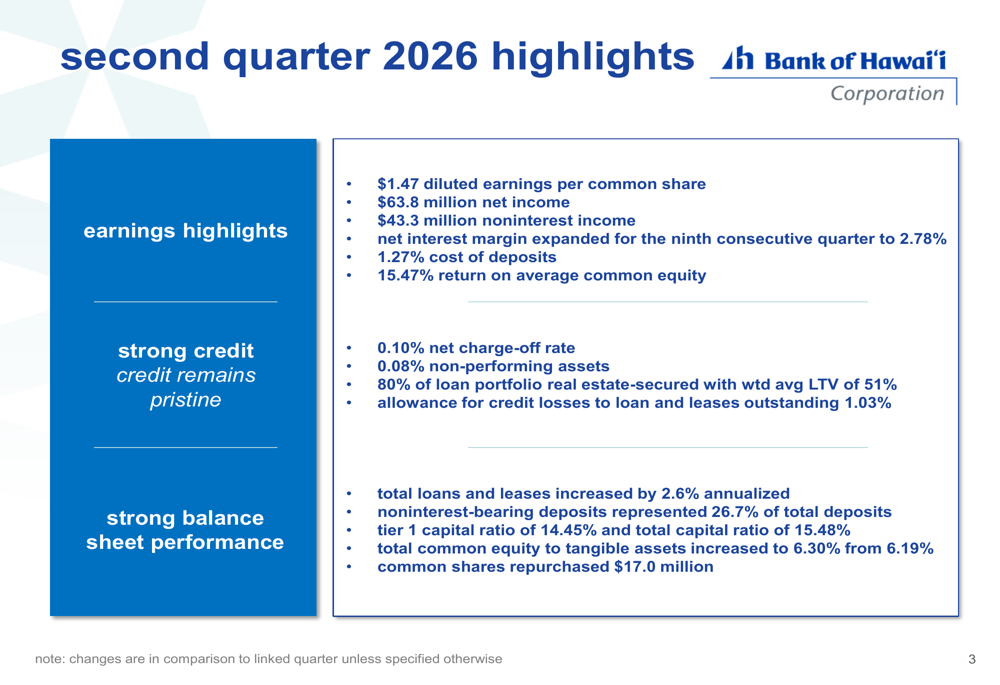
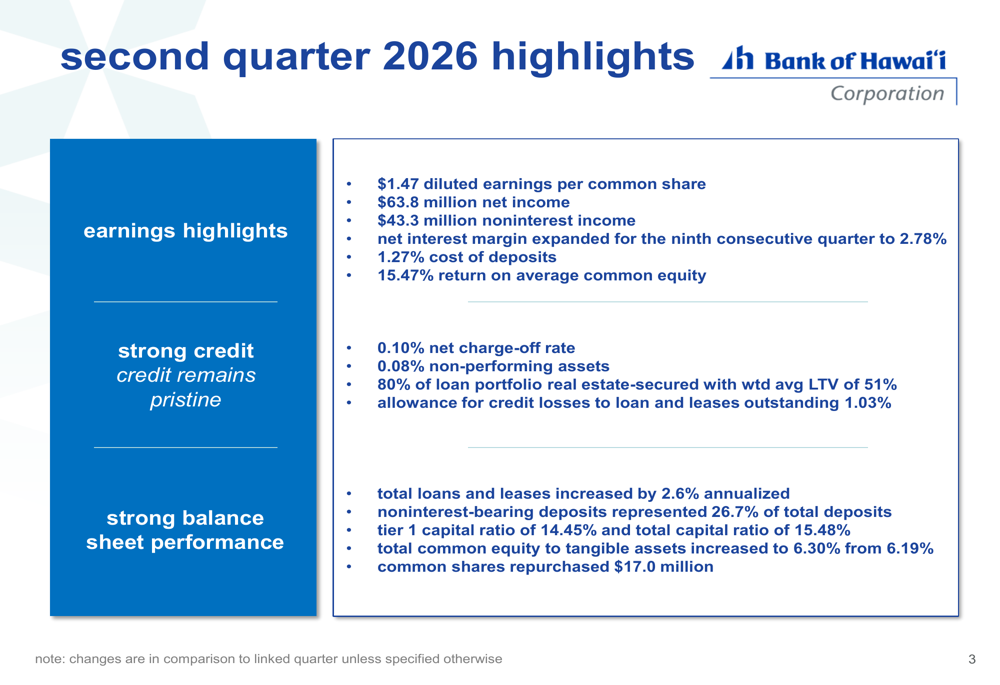
Bank of Hawaii Q2 2026 slides: margin hits 2.78%, shares fall on revenue miss

A JetBlue Airbus A220-300 sits parked at Gate B40 at Boston Logan International Airport in Boston, MA, on Dec. 22, 2025.
Austin DeSisto | Nurphoto | Getty Images
JetBlue Airways is overhauling its fare options as it gears up to launch its domestic first-class seats and, yes, there is a restrictive basic option at the front of the plane.
Travelers flying on JetBlue will start by choosing how much legroom they want and how premium they want their seat to be.
The airline will have an economy section, or “Main,” a section with extra legroom seats that it calls “Even More,” which also come with earlier boarding and priority airport screening, and a domestic first class that it’s named BlueFirst, which it’s slated to debut later this year. From there, customers will have the following options for each class:
- Base: This is the lowest price. It includes a carry-on but not seat selection. Tickets are refundable as a travel credit and there is a fee to change or cancel the reservation. Travelers will earn 1 TrueBlue loyalty point per $1 spent.
- Standard: Seat selection is included, there’s no change or cancel fee (though customers will have to pay a difference in fare) and travelers will earn 3 TrueBlue points per $1 spent.
- Flex: Along with all the options in a standard fare, the perk here is that refunds will go back to the original form of payment.
With the new groupings, JetBlue is getting rid of the “Core” fares it sells now and putting economy class options in a “Main” category.
JetBlue’s lie-flat Mint business class, which is used on longer-haul flights like cross-country trips and flights to European destinations including Paris, London and Milan, will only have the Standard and Flex option.
JetBlue stopped short of offering a basic lie-flat business option that competitors United Airlines and Delta Air Lines launched this year. Those airlines have made similar moves to break up premium economy by offering different fares even at the front of the cabin. United this month said that on some aircraft it will charge a premium for a blocked middle seat.
JetBlue hasn’t yet provided a date for its BlueFirst seats, but the changes come as airlines are racing to capitalize on high demand for pricier seats from consumers seeking extra comfort and perks on board. JetBlue is set to report results on Tuesday.
EMCD Launches Miner Support Program with up to $30M for Miners Amid Industry’s Steepest Profitability Squeeze

Comfort Zone wins €110,000 Connacht Hotel (Q.R.) Handicap

This is for educational purposes only, not financial advice #cryptocurrency #tradingtips #market

Renter of Home in Anne Heche Crash Denies Settlement With Son

No Jackpot Winner as $257 Million Prize Rolls Over to $269 Million Monday Draw

Weekend Open Thread: Staud – Corporette.com
This is for educational purposes only, not financial advice #cryptocurrency #tradingtips #market

Has your account ever been debited with NO Credit alert? #BankingXperience #Finance #bank #shorts

Crypto Live Trading| 27 july #vinbullindia #livetrading #vinbulllive #live #trading #cryptotrading
-

 Fashion3 days ago
Weekend Open Thread: Brooks Brothers
-

 Crypto World6 days ago
Grayscale Files For Worldcoin ETF, WLD Registers Sharp Rise
-

 NewsBeat6 days ago
How a former Blue Peter presenter stunned America’s Got Talent judges
-

 Tech20 hours ago
Intel is reversing course and bringing hyper-threading back to its server chips
-

 Tech7 days ago
Sail Virtually Aboard The “Itanic” With IA-64 Emulator
-
 Tech7 days ago
Turtle Beach Command Series KB7 review: a nifty screen-equipped gaming keyboard
-
 Business6 days ago
New Jersey voter registration controversy explained: How 6,600 noncitizens got on the rolls, and what happens next
-
 Entertainment6 days ago
Johnny Depp’s R-Rated Gothic Cult Classic Gets New Release Ahead of Sydney Sweeney Remake
-

 Crypto World5 days ago
Ethics, other provisions in crypto Clarity Act to be further discussed
-

 Politics9 hours ago
Luke Littler dismantles Gerwyn Price to retain title in Blackpool
-
 NewsBeat7 days ago
Shanghai science forum photos show China’s AI and robotics advances in rivalry with US
-
 Sports24 hours ago
Commonwealth Games boxing: Jadumani Singh seals dominant 5-0 win over Pakistan’s Sumama Rehman to enter quarter-finals | Commonwealth Games News
-

 Sports4 days ago
2026 3M Open leaderboard: Scottie Scheffler finds putter in Round 1, sits three back
-

 News Videos4 days ago
The Peugeot Family: How 200 Years of an “Old Money” Dynasty Died in A Boardroom
-

 Politics1 day ago
Spain sweeps the board at 2026 World Cup with individual awards
-

 Fashion4 days ago
16 Dresses for the High Summer Event
-

 Crypto World7 days ago
Andrew Cuomo joins OKX board as crypto exchange expands in U.S.
-
 Entertainment3 days ago
A New Post-Apocalyptic Gundam Anime Series Blasts Into SDCC
-

 News Videos23 hours ago
BITCOIN JUST ENTERED THIS CRITICAL ZONE…
-

 Crypto World2 days ago
XRP Ledger adds $2.6B as RWA inflows rank second
You must be logged in to post a comment Login