Connect with us
DAPA Banner
DAPA Coin
DAPA
COIN PAYMENT ASSET
PRIVACY · BLOCKDAG · HOMOMORPHIC ENCRYPTION · RUST
ElGamal Encrypted MINE DAPA
🚫 GENESIS SOLD OUT
DAPAPAY COMING

Business

Barratt Redrow tells Andy Burnham to cut taxes and slash red tape to boost housebuilding

Published

on

Business Live

FTSE 100 housebuilder says current constraints are limiting housing delivery and affordable home construction across the UK

Houses under construction

The leading builder says regulatory reform is needed(Image: PA)

Barratt Redrow has urged Prime Minister-to-be Andy Burnham to slash taxes in order to stimulate housebuilding and eliminate “barriers to home ownership”.

Advertisement

The FTSE 100 housebuilder pressed the government to tackle “the increasing regulatory and tax burdens that are constraining viability” to “unlock higher levels of housing delivery, including affordable housing”.

Burnham has pledged to champion affordable housing and has signalled his backing for a wholesale overhaul of property taxation.

In its latest update to investors on Wednesday, the housebuilder outlined the extent of reform required, warning that urgent action on tax and red tape is needed to “tackle the housing crisis, create jobs and drive economic growth”.

Last week, Barratt Redrow joined forces with property portal Rightmove in a joint appeal to the government, calling for stamp duty to be scrapped for first-time buyers in a bid to breathe life back into the housing market, as reported by City AM.

Advertisement

Rightmove revealed that listings for new developments had fallen to their lowest point since January 2017. According to Zoopla, stamp duty hits first-time buyers in London particularly hard, owing to the capital’s inflated property prices.

While the government currently provides a £300,000 stamp duty relief for first-time buyers, nearly eight in ten first-time movers in London still find themselves liable for the tax, the property portal confirmed. Housebuilders have increasingly turned to Andy Burnham for support in recent weeks.

Last month, FTSE 250 housebuilder Berkeley urged the former Greater Manchester mayor to provide “strong political leadership” on housebuilding.

Berkeley had warned there is “no prospect of material improvement” in conditions for housebuilders “without more decisive intervention” from the government.

Advertisement

Barratt Redrow announced on Wednesday that it intends to allow shareholders to capitalise on the “significant discount” between its share price and net assets.

The housebuilder plans to repurchase £386m worth of shares in the year to July next year, describing it as the “most effective way to create long-term shareholder value”.

The company’s share price has fallen to its lowest point in over a decade in recent weeks, having lost nearly 60 per cent of its value over the past five years. Its shares climbed three per cent to 286p when markets opened on Wednesday.

The firm stated it remains well placed to deliver “attractive” returns for shareholders, despite inflationary pressures stemming from the Iran war, “alongside industry headwinds and subdued consumer demand”.

Advertisement

“This buyback only goes so far in reversing the dismal share price performance, and the recent revival of Middle East hostilities shows that there is still plenty that could go wrong for the sector if inflation returns with a vengeance,” said Chris Beauchamp, chief market analyst at IG. Barratt Redrow completed 17,667 homes in the twelve months to the end of June, hitting the upper end of its guidance, amongst which 3,774 were affordable homes.

The housebuilder placed the value of its order book for forthcoming developments at £2.8bn, representing a four per cent decline from £2.9bn recorded at the same point last year.

The firm was formed in October 2024 following a merger between Barratt Developments and Redrow, and now has its headquarters in Leicestershire. The newly combined business will deliver £53m in cost savings as a result of its joint operations this year, it confirmed.

Building cost inflation climbed to three per cent in the wake of the outbreak of war in Iran, Barratt Redrow revealed, pushing average cost inflation across the full year to two per cent.

Advertisement

Recent “volatility” in energy prices and supply chains, triggered by renewed tensions between the US and Iran, could drive building cost inflation higher in the year ahead, the housebuilder cautioned.

“However, the extent of any impact remains uncertain and will depend on movements in energy prices, broader market conditions and the pace at which supply chains normalise,” it added.


Continue Reading
Click to comment

You must be logged in to post a comment Login

Leave a Reply

Business

Slideshow: Summer Fancy Food Show innovations, part 2

Published

on

Slideshow: Summer Fancy Food Show innovations, part 2

Global flavors were trending on the show floor.

Continue Reading

Business

Aker BP ASA (AKRBY) Q2 2026 Earnings Call Transcript

Published

on

OneWater Marine Inc. (ONEW) Q1 2026 Earnings Call Transcript

Karl Hersvik
Chief Executive Officer

Good morning, everyone, and welcome to Aker BP’s second quarter presentation. It was a quarter of strong operational execution and robust financial results. Production averaged 384,000 barrels of oil equivalents per day and operating cash flow was $3.1 billion. And we have raised the lower end and narrowed our production guidance for the year.

Our major projects remain on track with important milestones across Yggdrasil, Valhall PWP–Fenris, Skarv Satellites and Johan Sverdrup Phase 3. At the same time, we continue to strengthen the portfolio for future growth, including through a new strategic collaboration with Equinor. We also maintain a robust financial position with $6 billion in available liquidity and an unchanged quarterly dividend.

Operationally, this was a quarter shaped by seasonally high level of activity with continued high efficiency across the portfolio. Production was lower than in the previous quarter, mainly due to planned maintenance at Edvard Grieg and Ivar Aasen combined with normal quarter-to-quarter variations. Despite these planned impacts, production efficiency was 94%, a very strong performance by industry standards. Production costs increased to $8.8 per barrel, mainly reflecting planned seasonal activity across the portfolio, including maintenance at Edvard Grieg and Ivar Aasen, diving operations at Alvheim and well intervention activity

Advertisement
Continue Reading

Business

TotalEnergies: A Long-Term Play For The Patient (NYSE:TTE)

Published

on

TotalEnergies: A Long-Term Play For The Patient (NYSE:TTE)

This article was written by

Vladimir Dimitrov, CFA is a former strategy consultant within the field of brand and intangible assets valuation. During his career in the City of London he has been working with some of the largest global brands within the technology, telecom and banking sectors. He graduated from the London School of Economics and is interested in finding reasonably priced businesses with sustainable long-term competitive advantages.

Analyst’s Disclosure: I/we have a beneficial long position in the shares of CVX either through stock ownership, options, or other derivatives. I wrote this article myself, and it expresses my own opinions. I am not receiving compensation for it (other than from Seeking Alpha). I have no business relationship with any company whose stock is mentioned in this article.

Please do your own due diligence and consult with your financial advisor, if you have one, before making any investment decisions. The author is not acting in an investment adviser capacity. The author’s opinions expressed herein address only select aspects of potential investment in securities of the companies mentioned and cannot be a substitute for comprehensive investment analysis. The author recommends that potential and existing investors conduct thorough investment research of their own, including a detailed review of the companies’ SEC filings. Any opinions or estimates constitute the author’s best judgment as of the date of publication and are subject to change without notice.

Advertisement

Seeking Alpha’s Disclosure: Past performance is no guarantee of future results. No recommendation or advice is being given as to whether any investment is suitable for a particular investor. Any views or opinions expressed above may not reflect those of Seeking Alpha as a whole. Seeking Alpha is not a licensed securities dealer, broker or US investment adviser or investment bank. Our analysts are third party authors that include both professional investors and individual investors who may not be licensed or certified by any institute or regulatory body.

Continue Reading

Business

Vital Farms: This Egg Could Crack – Strong Sell (NASDAQ:VITL)

Published

on

Vital Farms: This Egg Could Crack - Strong Sell (NASDAQ:VITL)

This article was written by

Always on the hunt for undervalued, promising stocks with a focus on risk and reward. Limited risks and decent to high upside by knowing what one’s owning. I strongly believe that the best investment ideas are often the simplest. If contrarian, the better.

Analyst’s Disclosure: I/we have no stock, option or similar derivative position in any of the companies mentioned, and no plans to initiate any such positions within the next 72 hours. I wrote this article myself, and it expresses my own opinions. I am not receiving compensation for it (other than from Seeking Alpha). I have no business relationship with any company whose stock is mentioned in this article.

Seeking Alpha’s Disclosure: Past performance is no guarantee of future results. No recommendation or advice is being given as to whether any investment is suitable for a particular investor. Any views or opinions expressed above may not reflect those of Seeking Alpha as a whole. Seeking Alpha is not a licensed securities dealer, broker or US investment adviser or investment bank. Our analysts are third party authors that include both professional investors and individual investors who may not be licensed or certified by any institute or regulatory body.

Advertisement
Continue Reading

Business

Scandic Hotels Group AB (publ) (SCAHF) Q2 2026 Earnings Call Transcript

Published

on

OneWater Marine Inc. (ONEW) Q1 2026 Earnings Call Transcript

Operator

Welcome to the Scandic Hotels Group Q2 2026 Report Presentation. [Operator Instructions] Now I will hand the conference over to the speakers, CEO, Jens Mathiesen; and CFO, Par Christiansen. Please go ahead.

Jens Mathiesen
President & CEO

Advertisement

Thank you very much, and good morning, everyone, and thank you all for joining us for this Q2 presentation. My name is Jens Mathiesen. I’m the CEO of Scandic. And together with me, I have our CFO, Par Christiansen, as always. Let’s dive into the highlights. So please turn to Page 2.

We delivered a good quarter with solid growth. We improved our earnings and also higher profitability. The business is performing well across most of our markets, with Finland remaining the exception. Market conditions were favorable, supported by a busy event calendar, strong leisure travel and stable demand for business travel and meetings. Demand was particularly strong in the capital cities of Sweden, Denmark and Ireland. Finland remained challenging throughout the quarter, while the Norwegian hotel market was affected by a hotel strike lasting more than 6 weeks. The recovery in Finland is taking longer than we had expected, but we remain focused on turning the performance around. We now expect a gradual improvement with a stable second half of the year with a financial performance on same levels as last year.

During the quarter, we expanded the hotel portfolio, continued to grow

Advertisement
Continue Reading

Business

Gorilla Technology prices $125 million convertible notes offering

Published

on


Gorilla Technology prices $125 million convertible notes offering

Continue Reading

Business

Welch’s joins frozen sandwich fight

Published

on

Welch’s joins frozen sandwich fight

Company enters category with a bigger sandwich.

Continue Reading

Business

UiPath: Cheap, But Without A Catalyst, I'm Stepping Back To Hold (Downgrade)

Published

on

UiPath: Cheap, But Without A Catalyst, I'm Stepping Back To Hold (Downgrade)

UiPath: Cheap, But Without A Catalyst, I'm Stepping Back To Hold (Downgrade)

Continue Reading

Business

Ashish Kacholia cuts stake in two chemical stocks after 114% rally. What’s driving the move?

Published

on

Ashish Kacholia cuts stake in two chemical stocks after 114% rally. What's driving the move?
Ace investor Ashish Kacholia, widely known for spotting emerging small-cap winners, has pared his holdings in two chemical stocks during the first quarter of FY27, locking in gains after the stocks delivered returns of up to 114% so far this year.

The latest shareholding data available on the BSE shows that Kacholia reduced his stake in Yasho Industries to 2.08% from 2.37% at the end of the March 2026 quarter. He also trimmed his holding in Finotex Chemicals to 2.06% from 2.60%, indicating a reduction of 0.54 percentage points during the quarter.

Yasho Industries’ stock price has delivered a staggering 114% return in 2026 while Fineotex Chemicals has risen 58% in the last six months.

Kacholia is among India’s most closely watched small-cap investors, with his portfolio moves often drawing significant attention from the market. Kacholia’s investment decisions are widely tracked by retail and institutional investors alike, as they are often seen as indicators of emerging opportunities and evolving market sentiment.

Advertisement

Also read: Ashish Kacholia’s picks: 12 stocks rally up to 130% in CY26, 3 turned multibaggers; 2 new Q4 bets


Kacholia, fondly called the ‘Big Whale’ by media, Kacholia started out with Prime Securities and later joined Edelweiss before incorporating his own broking firm, Lucky Securities in 1995. He co-founded Hungama Digital with Rakesh Jhunjhunwala in 1999 and started building his own portfolio from 2003.
As per the Trendlyne data, Ashish Kacholia publicly holds 50 stocks with a net worth of nearly Rs 3,000 crore crore.

Why is Kacholia selling chemical stocks?

Iran war supply constraints – In the fourth quarter last financial year, companies continued to face raw material shortages due to disruptions caused by the West Asia conflict.
India’s chemicals industry, primarily through higher crude oil prices and supply chain disruptions. As many chemical manufacturers rely on crude-derived feedstocks such as naphtha, benzene and methanol, elevated oil prices increase raw material costs and put pressure on profit margins. Disruptions around the Strait of Hormuz also raised freight and insurance costs while delaying shipments of key inputs. Although a weaker rupee may support export realisations, persistent geopolitical tensions and higher input costs are likely to outweigh the benefits, particularly for commodity and petrochemical-linked chemical companies.

Although raw material prices have eased since end-May and availability is gradually improving, JM Financial expects supply chain constraints to persist in the near term, with normalisation likely over the next one to two quarters.

Softening demand –
JM also observed that discretionary demand has weakened due to higher prices, although non-discretionary demand remains stable. While pent-up demand could emerge once supply chains normalise, the brokerage believes chemical prices are unlikely to return to pre-conflict levels, supporting a healthier spreads environment for the industry.

Also read:Ashish Kacholia exits, Madhusudan Kela trims stake in smallcap NBFC stock that’s up over 50% in 2026

China’s muscle power –
InCred Equities said China’s persistent capacity expansion continues to exert significant pressure on the global chemicals industry. It noted that Chinese producers, particularly in petrochemicals, intermediates and commodity chemicals, have added capacity well ahead of demand and are exporting surplus output at lower prices, forcing global competitors to either cut prices or lose market share.

Advertisement

The brokerage believes Indian chemical companies should leverage China’s cost advantage rather than compete directly in commoditised products. It noted that Indian specialty chemical manufacturers have traditionally imported key intermediates and raw materials from China, where production costs remain substantially lower. InCred said the opportunity lies in moving downstream into higher-value products such as specialty chemicals, formulations, pharma intermediates, agrochemical formulations, food additives, electronic chemicals and customised CDMO products. It added that companies focused on differentiated, value-added offerings can benefit from lower Chinese input costs, while those remaining in commodity chemicals are likely to continue facing pricing and margin pressure.

Chemical stocks Q1 outlook – Axis Direct expects a mixed earnings performance for the chemicals and agrochemicals sector in Q1FY27. The brokerage said the delayed onset of the southwest monsoon pushed Kharif-related agrochemical demand into the second quarter, resulting in a relatively subdued quarter for domestic formulation companies.

At the same time, it expects companies with exposure to CDMO, fluorochemicals and refrigerants to outperform on the back of healthy order execution and a favourable product mix.

The brokerage believes pricing pressure from Chinese competition will continue to weigh on commoditised chemical manufacturers, limiting margin expansion. However, within the mid-cap universe, Axis expects companies supported by strong domestic infrastructure-linked order books to deliver healthy growth through robust execution, even as uncertainty persists in export markets.

Advertisement

Ashish Kacholia trims stake in NBFC

Shareholding data available on the BSE shows that Ashish Kacholia’s stake in NBFC SG Finserve fell below the 1% disclosure threshold from 2.37% at the end of the March 2026 quarter, indicating a likely exit.

(Disclaimer: Recommendations, suggestions, views and opinions given by the experts are their own. These do not represent the views of The Economic Times)

Continue Reading

Business

Monumental raises $32m to scale robot bricklayers in UK

Published

on

Monumental raises $32m to scale robot bricklayers in UK

A fleet of more than 150 robots is already laying bricks on real construction sites across the UK and Europe, and the company behind them has just raised $32 million to put more of them to work, in a deal that says as much about Britain’s vanishing trades as it does about the rise of physical AI.

Monumental, the Amsterdam-based construction robotics company, announced the Series B led by Khosla Ventures, with participation from Plural and existing investors including Hummingbird. The money will grow its engineering team, scale the fleet across Europe, deepen its UK presence and fund a US launch this year.

For UK housebuilders and the small firms that supply them, the timing is pointed. The Home Builders Federation estimates the country needs at least 20,000 more bricklayers to hit the government’s target of 1.5 million new homes, yet only around 1,990 completed apprenticeships in 2024. It is a gap Business Matters has tracked closely, with a skills crisis already threatening the 1.5 million homes target and 76 per cent of construction firms struggling to hire.

Monumental’s answer is not to sell machines but to work as an autonomous subcontractor. General contractors hire the company and pay for finished wall, an outcome-priced model that spares builders, many of them SMEs, the financial and technical risk of owning and operating the equipment themselves.

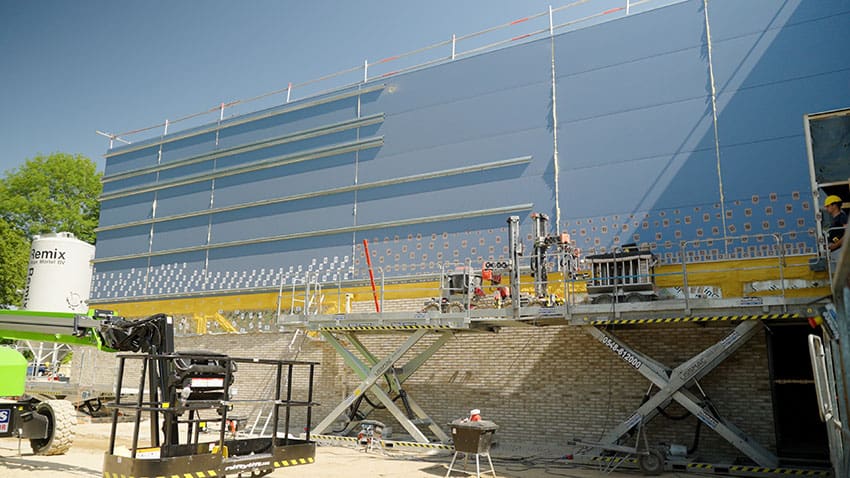
The robots are electric and autonomous, using advanced sensors, computer vision and cranes to lay brick and mortar with millimetre precision, all orchestrated by the company’s AI platform, Atrium. The fleet has built the walls of more than 100 homes across the Netherlands and the UK, along with a school, a community centre, a hotel and canal walls. The pace is accelerating: nearly half of those homes went up in the past three months alone, up from just eight the quarter before.

Advertisement

“The world simply does not have enough people to build what it needs, and that shortage will not be solved by another app or another robot doing backflips on stage,” said Salar al Khafaji, co-founder and CEO of Monumental. “It takes machines that turn up on site and lay real brick all day, to spec, which is what our fleet already does today. Every robot we deploy expands the industry’s capacity to build, bringing a future of beautiful, affordable, bespoke buildings and infrastructure closer to reality. Khosla’s investment lets us put many more of them to work in more countries while expanding beyond bricklaying.”

The backdrop is an industry that technology has barely touched. Since 1945, manufacturing productivity has risen more than eightfold while construction productivity has gained roughly 10 per cent, and has fallen since the 1960s. The result is a housing shortage the Centre for Policy Studies puts at 6.5 million homes, with just 446 homes per 1,000 people, the second-worst rate in Europe. In the capital, where London built just 7 per cent of the homes it needed last year, the delivery gap is starker still.

“Construction costs have exploded while the industry itself has barely changed in decades,” said Vinod Khosla, founder of Khosla Ventures. “That combination has produced the housing crisis: we know how to build, we’ve just made it too expensive and too slow. Monumental is solving this by bringing robotics into the physical world, and the proof is already standing: canal walls, houses, a school, 100 structures already built by robots. Beautiful buildings, built at scale, don’t have to cost what they cost today.”

Founded in 2021 by al Khafaji and CTO Sebastiaan Visser, whose previous company Silk was acquired by Palantir in 2016, Monumental was the first to bring Palantir’s forward-deployed engineering model to robotics. It has recently appointed a dedicated UK country manager and is growing its on-the-ground team here.

Advertisement

Nor is it an isolated bet. From bricklaying to fruit picking, where Dogtooth raised £14 million this month to help growers beat labour shortages, investors are backing robots to do the physical work Britain cannot find the people for. Monumental says its crews move up into safer, higher-skilled roles operating the machines. The bricks, it seems, will get laid either way.

Advertisement
Continue Reading

Trending

Copyright © 2025