
Business
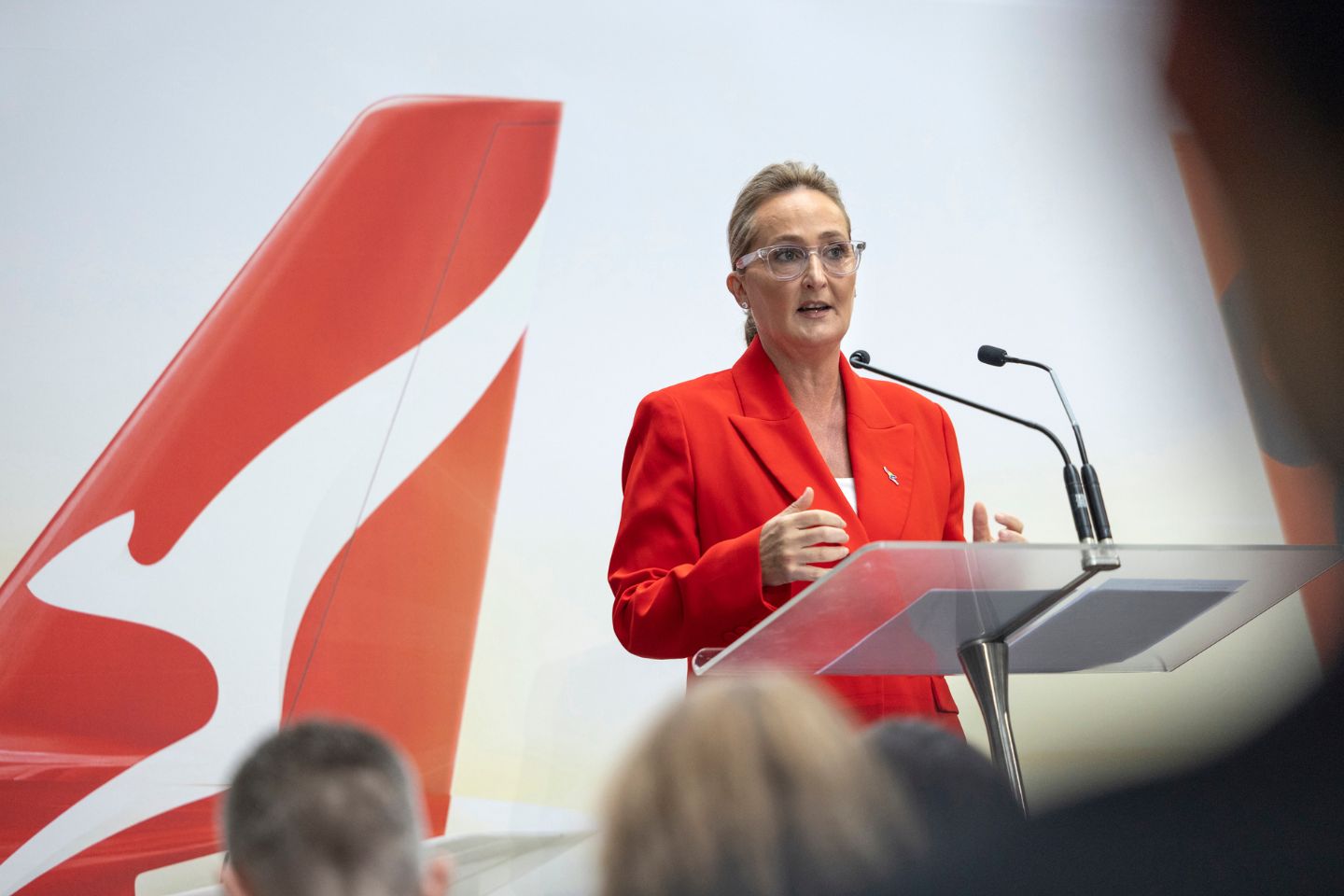
Bumper profit as Qantas rewards loyalty



TV channels for dogs are multiplying but research is mixed on whether dogs are watching.

Operator
Good day, ladies and gentlemen, and welcome to AmpliTech Group’s Quarterly Investor Update Call, where the company will discuss its FY 2025 Financial Results. Present in this call, we have the executive team of AmpliTech Group, Fawad Maqbool, CEO, CTO and Board Chair; Jorge Flores, COO; and Louisa Sanfratello, CFO. [Operator Instructions]
As a reminder, today’s conference is being recorded. I would now like to turn the call over to AmpliTech’s COO, Jorge Flores.
Jorge Flores
Chief Operating Officer
Thank you, operator, and thank you, everyone, for joining today’s call to review the progress of AmpliTech’s growth initiatives and to answer investors’ questions. Following initial management comments, we will open the call to investors’ questions as well. An archived replay of today’s call will be posted to the Investor Relationship section of AmpliTech’s corporate website. This call is taking place on Thursday, April 9, 2026.
Remarks that follow and answers to questions may include statements that the company believes to be forward-looking within the meaning of the Private Securities Litigation Reform Act of 1995. These forward-looking statements generally include words such as anticipate, believe, expect or words of similar importance. Likewise, statements that describe future plans, objectives or goals are also forward-looking. These forward-looking statements are subject to various risks that could cause actual results to be materially different than expected. Such risks include, among others, matters that the company has described in its press releases and in its filings with the Securities and Exchange Commission. Except as described in these filings, the company disclaims any obligation to
CORNING, N.Y. — Corning Inc. shares climbed more than 3% Thursday to trade around $170.30 as investors rewarded the materials science giant’s deepening role in powering artificial intelligence data centers with high-density optical fiber, cable and connectivity solutions amid explosive hyperscale demand.

The NYSE-listed company (GLW) rose as high as $172.22 intraday Thursday, building on a series of strong sessions that have propelled the stock sharply higher in recent weeks. Corning has delivered roughly 89% year-to-date gains in 2026, turning it into one of the standout performers in the broader technology supply chain as AI infrastructure spending accelerates.
Corning, a 175-year-old innovator in specialty glass, ceramics and optical physics, has repositioned itself as a critical enabler of next-generation data center networks. Its Optical Communications segment — which includes fiber, cable and connectivity products — has seen surging enterprise sales driven by Gen AI adoption, with hyperscalers requiring far more fiber density and bandwidth than traditional cloud setups.
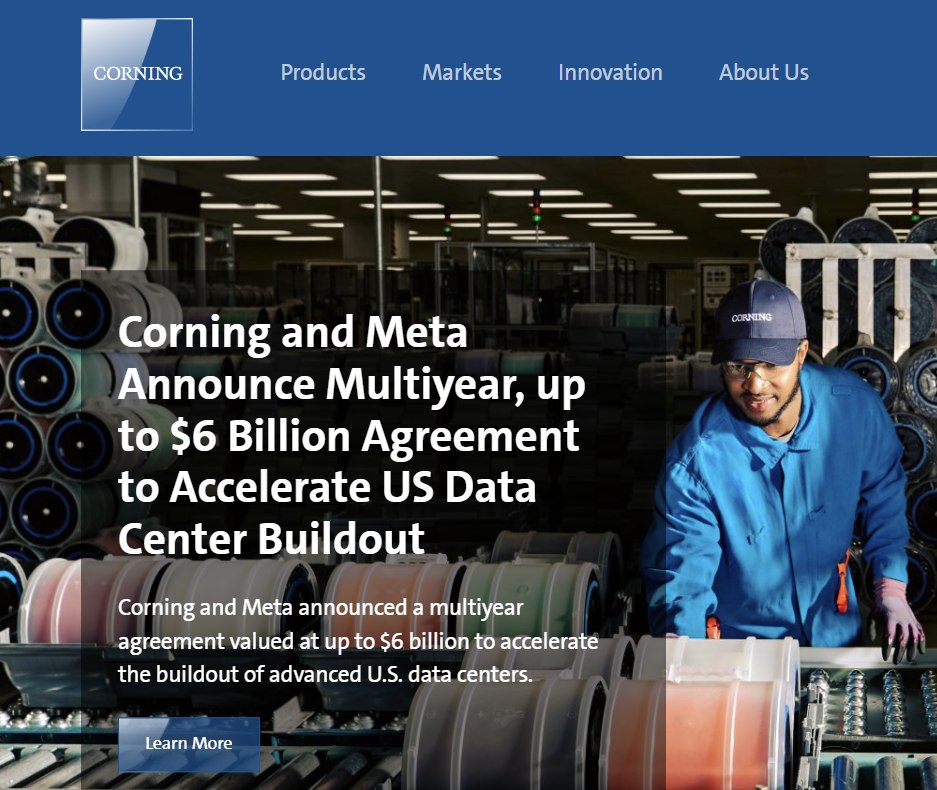
The momentum intensified in January when Corning announced a multiyear agreement with Meta Platforms valued at up to $6 billion. Under the deal, Corning will supply advanced optical fiber, cable and connectivity solutions to support Meta’s AI data center buildout across the United States. The partnership includes a major expansion of Corning’s optical cable manufacturing capacity in Hickory, North Carolina, with Meta serving as the anchor customer. Construction on the expansion officially began in late March.
“Building the most advanced data centers in the U.S. requires world-class partners and American manufacturing,” Meta’s Joel Kaplan said in the announcement. The pact underscores Corning’s commitment to domestic production while addressing the massive connectivity needs of AI training and inference clusters.
Corning showcased additional AI-focused innovations at the Optical Fiber Communication Conference (OFC) 2026 in March. Highlights included a multicore fiber solution that delivers four times the capacity per fiber strand within a standard footprint, reducing the number of connectors by up to 75%, cable mass by 70% and installation time by 60%. The company also introduced the Contour Flow micro cable for denser inter-data-center links, next-generation connectors and co-packaged optics systems designed to scale GPU density in AI networks.
These products address the “nervous system” of AI infrastructure, where fiber optics handle the enormous data movement between thousands of GPUs. Demand for such connectivity is growing at more than 50% annually in some estimates, creating a sustained tailwind for Corning’s optical business.
Financially, Corning delivered record results for full-year 2025. Core sales rose 13% to $16.41 billion, while core EPS jumped 29% to $2.52. In the fourth quarter, core sales grew 14% to $4.41 billion and core EPS increased 26% to $0.72, exceeding expectations. Management highlighted margin expansion, with core operating margin reaching 20.2% in the quarter.
The company upgraded its Springboard growth plan, now targeting an additional $11 billion in incremental annualized sales by the end of 2028 — up from the original $8 billion goal. For 2026 specifically, internal plans call for $6.5 billion in incremental sales, with a high-confidence figure of $5.75 billion.
For the first quarter of 2026, Corning guided for core sales of $4.2 billion to $4.3 billion, representing about 15% year-over-year growth, with core EPS expected in the range of $0.66 to $0.70. The outlook reflects accelerating momentum in optical communications and other segments.
Analysts have grown increasingly bullish. Recent price target hikes include Mizuho raising its target to $160 from $155, BofA moving to $155 from $144 earlier, and UBS to $171. Consensus ratings lean toward Moderate Buy, with average targets in the $130-$150 range, though some firms see potential well above current levels if AI demand sustains. Zacks recently upgraded the stock to a #2 Buy rank on improving earnings estimates.
Corning’s broader portfolio continues to contribute. Its Specialty Materials segment, home to Gorilla Glass used in consumer electronics, benefits from innovations like the new Gorilla Glass Ceramic 3 for foldable devices. Display Technologies and Environmental Technologies segments provide diversification, though Optical Communications has been the standout growth driver tied to AI.
The company maintains a healthy balance sheet and returned capital to shareholders through a quarterly dividend of $0.28 per share. Adjusted free cash flow nearly doubled in 2025, supporting both growth investments and shareholder returns.
Still, risks remain. Corning’s valuation has expanded significantly with the rally, trading at elevated multiples that assume continued strong AI spending. Competition in optical components could intensify, and any slowdown in hyperscaler capex — or shifts in technology architectures that reduce fiber needs — could pressure results. Broader supply chain issues for data center equipment also pose execution challenges.
Management expressed confidence in the outlook. CEO Wendell Weeks noted the transformed financial profile since launching Springboard two years ago, with meaningful margin and return on invested capital gains providing a strong base for future expansion.
“AI growth is expected to be unprecedented,” Weeks and other executives have emphasized, positioning Corning’s 175 years of materials innovation as uniquely suited to solve the density, power and scalability challenges of massive GPU clusters.
The stock’s recent surge accelerated in early April amid broader market optimism and sector tailwinds, with Thursday’s gains coming on solid volume. By mid-afternoon, shares traded near $170.30, up about 3.1% on the session.
Corning employs thousands worldwide and operates manufacturing facilities across North America, Europe and Asia. Its optical products are deployed in data centers globally, but the Meta partnership highlights a strategic push to strengthen U.S.-based production amid national focus on AI leadership and supply chain security.
As hyperscalers including Meta, Microsoft, Google and Amazon pour hundreds of billions into AI infrastructure in 2026, suppliers like Corning that provide the essential “plumbing” for high-speed, high-density interconnects are drawing fresh investor attention.
Upcoming first-quarter 2026 earnings, expected around late April, will be closely watched for further color on optical demand trends, margin performance and any updates to the upgraded Springboard targets.
For now, sentiment favors continued growth. With record backlog visibility from major AI deals, innovative new products and a proven ability to scale manufacturing, Corning appears well-positioned to capitalize on what many describe as a multi-year AI infrastructure supercycle.
Whether the blistering pace can persist will depend on execution, sustained hyperscaler spending and the company’s ability to convert innovation into profitable, recurring revenue streams.
Corning Inc., headquartered in Corning, New York, traces its roots to 1851 and has evolved from early glassmaking to a global leader in materials science. Its technologies touch everything from smartphone screens and automotive emissions control to the fiber optic networks that increasingly form the backbone of the AI economy.
Deborah Honig
Adelaide Capital
All right. Good morning or good afternoon, depending on where you’re dialing in from. Thanks for joining us today. We have a very exciting update with iFabric. They just put out their Q4 and full year 2025 numbers, which were fantastic and offered some guidance on Q1 ’26 as well.
With me today, I have Hylton Karon, CEO; Hilton Price, CFO; and Giancarlo Beevis, COO. We’re not going to work off a presentation. The format will be a quick overview of the company for anyone that’s new to the story, then we’re going to get right into the financial numbers and then open it up for Q&A. There is a Q&A box at the bottom of your screen, so feel free to use that. And even though we’re not working off a presentation, this session will contain forward-looking statements. If you’d like to know more about those, you can find them on the presentation on the company’s website.
With that out of the way, I’d like to introduce and hand the mic over to Giancarlo Beevis, who’s COO of the company and CEO of Intelligent Fabrics division.
Giancarlo Beevis
President & CEO of Intelligent Fabric Technologies (North America) Inc. and Director
Thanks, Deb, very much. Hi, how are you?
Deborah Honig
Adelaide Capital
I’m good, I’m good. Yes, why don’t you tell us a little bit about the company for people that are less familiar?

The brokerage notes that the recent macro-led selloff has dragged down Indian banks, NBFCs and affordable housing finance companies (AHFCs) alike, but contends that “beyond now-attractive valuations, we see several compelling reasons to turn constructive on the segment, driven by an impending inflection in both growth and asset quality.”
It adds that the current correction “is a favorable entry point” and reiterates its Outperform ratings on HomeFirst, Aadhar and Aptus, while maintaining Market-Perform on Aavas and PNB Housing Finance.
What makes Bernstein bullish on housing finance stocks?
Bernstein flags that AHFCs have already undergone a sharp derating over the last 6-9 months, with stock price declines steeper than those of larger NBFC peers. Current price-to-earnings multiples are now at three-year lows despite comparable or superior earnings growth.
“The sharp derating has also meant that valuations are at the lowest point in the last three years, with PE multiples now significantly lower than those of larger NBFCs despite earnings growth being comparable or superior,” the report says, highlighting the valuation gap as a key part of the upside argument.

On fundamentals, the analysts argue that both growth and asset quality are “now approaching an inflection point,” pointing to 3QFY26 data where disbursement growth showed sequential improvement and early-stage delinquencies (1+ DPD) began to stabilise or improve across most lenders. While AHFCs had earlier faced a slowdown in disbursements and a marginal rise in credit costs, Bernstein emphasises that return on assets has stayed above 3% for the segment, supported by improving net interest margins and stable operating expenses.
The report also underlines structural advantages that could help AHFCs ride out any prolonged macro stress. In an environment of tighter liquidity and higher inflation, “AHFCs are better positioned versus their larger NBFC peers,” it says, citing the secured nature of their loan books in both home loans and loan-against-property, and a funding profile marked by longer-tenor borrowings, a high floating-rate share, and access to National Housing Bank (NHB) funding.This combination, Bernstein argues, reduces the risk of sharp margin compression and insulates asset quality relative to unsecured-focused NBFCs.
At a thematic level, Bernstein reiterates that “the long-term thesis remains intact,” anchored in India’s still-low mortgage penetration as a share of GDP and the need for an operationally intensive, opex-heavy model to serve the mass-market borrower that many banks are reluctant to adopt.
The report notes that this model has translated into healthy earnings growth of around 20% and RoAs above 3% even in recent quarters, underscoring the medium-term potential of the affordable housing theme despite near-term volatility.
Top 2 stock picks
Within its coverage, Bernstein’s top picks are HomeFirst and Aadhar Housing Finance, which it describes as “the best franchises in this segment” thanks to diversified geographic presence and a proven ability to scale across markets.
It values HomeFirst using a 22x FY27 earnings multiple with a target price of Rs 1,430, and Aadhar at 20x FY27 earnings with a target of Rs 600, implying strong upside from current levels.
“While valuations are attractive across the sector, we continue to prefer HomeFirst and Aadhar,” the analysts say, adding that Aptus also looks attractive on low valuations, even as structural concerns keep them more cautious on Aavas and PNB Housing for now.

Check out what’s clicking on FoxBusiness.com.
The United States Postal Service is suspending employer pension contributions for workers beginning Friday, citing a looming cash shortfall, the agency announced Thursday.
The move, which affects the Federal Employees Retirement System (FERS), comes just weeks after the Postal Service warned Congress it could run out of cash in under a year without significant reforms, including changes to pension funding and stamp prices.
USPS emphasized that the pause will have no immediate impact on current or future retirees.
“There will not be any immediate detrimental impact to our current or future retirees if normal FERS cost payments are temporarily withheld,” Postal Service Chief Financial Officer Luke Grossmann said.
POSTAL SERVICE SAYS CASH COULD RUN OUT IN UNDER A YEAR WITHOUT CHANGES

A United States Postal Service worker delivers packages on Cyber Monday in New York Dec. 1, 2025. (Bess Adler/Bloomberg via Getty Images / Getty Images)
USPS has previously reported mounting losses over the years, totaling $118 billion since 2007, as volumes of its most profitable product, first-class mail, fell to their lowest levels since the late 1960s.
The financial strain was further exacerbated by global tariffs, high inflation and recent spikes in gasoline prices, along with growing competition from private carriers such as Amazon, which now delivers many of its own packages.
USPS said it typically sends the Office of Personnel Management (OPM), which oversees federal retirement accounts, about $200 million every two weeks to cover pension costs.
By suspending the payments, the agency expects to free up roughly $2.5 billion in the current fiscal year.
While the agency has suspended its employer contributions, it said it will continue transferring employee payroll deductions into retirement accounts.
USPS COULD SLOW SERVICE IN CERTAIN AREAS AS IT SEEKS TO CUT COSTS
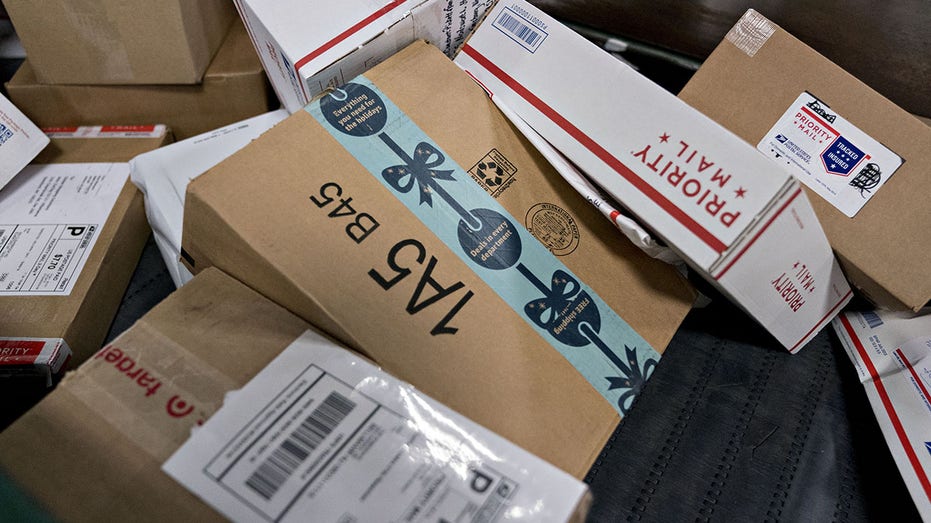
An Amazon Inc. package sits on a conveyor belt at the United States Postal Service Merrifield processing and distribution center in Merrifield, Va., Dec. 19, 2018. (Andrew Harrer/Bloomberg via Getty Images / Getty Images)
Separately, the agency said its Thrift Savings Plan (TSP), a separate retirement savings program similar to a government 401(k), remains unaffected.
USPS will continue processing employee-funded contributions and matching funds into the Thrift Savings Plan (TSP), and noted that workers will be able to contribute more in 2026 under new IRS limits.
Postmaster General David Steiner testified before Congress on the current state of the U.S. Postal Service. (Pool)
In March, Postmaster General David Steiner told a House Oversight subcommittee that the Postal Service could run out of cash within a year without major changes.
Steiner outlined potential cost-cutting steps, including reducing six-day delivery, raising first-class mail prices from 78 cents to $1 or more and expanding borrowing authority after USPS hit its $15 billion debt cap.
GET FOX BUSINESS ON THE GO BY CLICKING HERE
“In order to survive beyond the next year, we need to increase our borrowing capacity so that we don’t run out of cash,” Steiner said in prepared testimony. “The failure to do this could lead to the end of the Postal Service as we know it now.”

The rise in energy prices has hit Asia particularly hard as many nations are heavily reliant on Gulf oil.


Elon Musk’s xAI sues Colorado over state’s new AI law

Partnership for New York City president and CEO Steve Fulop discusses the city’s budget shortfall and Mayor Zohran Mamdani’s proposed property tax hike on ‘The Claman Countdown.’
American homeowners around the country are feeling the squeeze of higher property taxes, with new data showing that the property tax burden rose last year.
Data from analytics firm ATTOM showed that the effective tax rate for single-family homes was 0.9% in 2025, up from 0.86% in 2024 and the highest level since 2020 when the national effective tax rate was 1.1%, according to a Realtor.com report.
It also found that while the estimated value for a single-family home was down 1.7% year over year in 2025, it was still one of the highest recorded readings for single-family home values because 2024’s values were higher than those that preceded it.
“Property taxes in 2025 demonstrate that tax bills reflect more than just home values,” said ATTOM CEO Rob Barber. “Even with a slight dip in prices, higher tax bills combined with declining home values led to an increase in effective tax rates, underscoring the role of local government costs and shifting tax policies.”
NEWSOM RENEWS CLAIM TEXAS, FLORIDA ARE ‘HIGH-TAX’ STATES, CRITICS DISPUTE FRAMING

Homes in the Queens borough of New York City. (Lindsey Nicholson/UCG/Universal Images Group via Getty Images)
The effective tax rate for property taxes varies by state and the report found that the states with the highest effective tax rates for single-family homes tended to be located in the Northeast.
New Jersey led the way with an effective tax rate of 1.58% and a median home price of $544,450. It was followed by Vermont, which had a 1.4% effective tax rate, and Connecticut at 1.36%, both with median home prices at roughly $500,000.
New Hampshire’s effective tax rate was 1.29% based on a $587,450 median home price, while New York had a 1.23% effective tax rate along with a $672,000 median home price.
MAJOR US CITY OFFERS CASH INCENTIVES TO SPARK GROWTH, ATTRACT NEWCOMERS

Some states with lower median home prices also faced higher relative property tax burdens. (Angus Mordant/Bloomberg via Getty Images)
Several states with lower median home prices also made the rankings for the highest effective property tax rates. Ohio’s was 1.32%, while Iowa at 1.25%, Pennsylvania at 1.24%, and Nebraska at 1.24% rounded out the top 10 with median home prices ranging between $272,000 and $345,000.
States with the lowest effective tax rates tended to have notable differences in terms of the median home price for a given state.
Hawaii had the lowest effective tax rate at 0.33% with a median home value of $747,545, while other Western states had similarly low effective tax rates with higher home prices.
HOUSING MARKET GAINING MOMENTUM AS SPRING SEASON BEGINS

States in the West tended to have lower relative property tax burdens. (Saul Loeb/AFP via Getty Images.)
Idaho (0.39%), Wyoming (0.4%), Arizona (0.43%), Utah (0.48%) and Nevada (0.52%) were among the states with the lightest property tax burdens and had median home prices ranging between $444,000 and $575,000.
Two Southern states with lower relative property tax burdens included Alabama with a 0.43% effective tax rate and $333,675 median home price, while Tennessee (0.5%) with a $425,250 median.
Delaware’s 0.48% effective tax rate and its location in the Northeast made it a regional outlier among the ranks of the states with lower property tax burdens, with a median home price just shy of $500,000.
GET FOX BUSINESS ON THE GO BY CLICKING HERE
West Virginia also had a 0.48% effective tax rate with the lowest median home price of $249,750.


White House warned staff not to place market bets amid Iran war, WSJ reports

Fever’s Lexie Hull says online personal attacks have gone too far

Street Smarts: Waymo and Waze Turn Driver Data Into Pothole Repairs

Trump’s Financial Corruption, Explained


-

 Business7 days ago
No Jackpot Winner and $194 Million Prize Rolls Over
-

 Fashion6 days ago
Weekend Open Thread: Spanx – Corporette.com
-

 Business4 days ago
Three Gulf funds agree to back Paramount’s $81 billion takeover of Warner, WSJ reports
-

 Business6 days ago
Expert Picks for Every Need
-

 Sports5 days ago
India men’s 4x400m and mixed 4x100m relay teams register big progress | Other Sports News
-

 Tech2 days ago
How Long Can You Drive With Expired Registration? What Florida Law Says
-
Business5 days ago
No Jackpot Winner, Prize to Climb to $231 Million
-

 Fashion4 days ago
Massimo Dutti Offers Inspiration for Your Summer Mood Board
-
Politics6 days ago
Wings Over Scotland | The quality of mercy
-

 Fashion2 days ago
Let’s Discuss: DEI in 2026
-

 Business5 days ago
Akebia Therapeutics, Inc. (AKBA) Discusses Pipeline Progress and Strategic Focus on Kidney Disease Treatments at R&D Day – Slideshow
-

 Crypto World1 day ago
Bitcoin recovers as US and Iran Agree a Ceasefire Deal
-

 Politics7 days ago
East Jerusalem Palestinian families eviction orders
-

 Politics7 days ago
Why so many children are now classified as ‘disabled’
-

 Crypto World11 hours ago
Canary Capital Files SEC Registration for PEPE ETF
-

 Politics6 days ago
The UK should not pay a penny in slavery reparations
-

 Politics7 days ago
Nuclear rockets, moon bases and NASA’s Mars plan
-

 Tech7 days ago
The Threadless Ball Screw Never Took Off, But Don’t Write It Off
-
 Business7 days ago
HPS FY 2025 slides: SaaS inflection drives 22% revenue growth
-

 Fashion7 days ago
Tory Burch’s Spring 2026 Campaign Goes on a Getaway
You must be logged in to post a comment Login