






Connect with us

Business

Calamos Global Dynamic Income Fund Q4 2025 Commentary

Published

on

Calamos Global Dynamic Income Fund Q4 2025 Commentary

Calamos Investments is a diversified global investment firm offering innovative investment strategies including U.S. growth equity, global equity, convertible, multi-asset and alternatives. The firm offers strategies through separately managed portfolios, mutual funds, closed-end funds, private funds, an exchange traded fund and UCITS funds. Clients include major corporations, pension funds, endowments, foundations and individuals, as well as the financial advisors and consultants who serve them. Headquartered in the Chicago metropolitan area, the firm also has offices in London, New York and San Francisco.  For more information, please visit www.calamos.com.

Continue Reading
Click to comment

Leave a Reply

Your email address will not be published. Required fields are marked *

Business

Saudi Arabia Reallocating Supply Not Cutting Output, Kpler Says

Published

on

Saudi Arabia Reallocating Supply Not Cutting Output, Kpler Says

1144 GMT – Saudi Arabia’s output reduction is occurring in fields that don’t produce Arab Light crude, the main grade that can be exported via the Yanbu terminal on the Red Sea, Amena Bakr, head of Middle East energy and OPEC+ insights at Kpler, says. Bloomberg on Monday reported that Saudi Arabia is starting oil-output cuts as storage fills up due to Hormuz disruptions. “This is not accurate, according to our understanding,” Bakr says in a post on X. “There is a reallocation of supply that’s happening, not a cut.” Saudi Aramco has been diverting more of its crude via the East-West pipeline, which bypasses the Strait of Hormuz, Kpler says. (giulia.petroni@wsj.com)

Middle East Oil Shut-Ins Raise Risk of Lasting Supply Losses

1047 GMT – Prolonged oil production shut‑ins in the Middle East raise the risk of partial or permanent production losses due to reservoir, well, facility, and logistical constraints, according to Societe Generale. “Time is critical: the longer disruptions persist, the greater the likelihood that what initially appear to be temporary outages evolve into more durable supply losses,” Michael Haigh and Ben Hoff say. Risks start increasing after about two weeks offline and intensify beyond a month, with capacity typically returning to only 80%-95% after outages of several months, according to the bank. If more producers beyond Iraq and Kuwait curtail output, quickly restoring pre‑crisis supply would become increasingly difficult.(giulia.petroni@wsj.com)

Surge in Oil Prices May Still Be Short-Lived

0923 GMT – The surge in oil prices may still be short-lived, according to Julius Baer’s Norbert Rücker in a research note. “Oil markets have entered panic mode,” says the head economics and next generation research. While prices have surged to over $100/bbl, most of this move seems to “come from nervousness and sentiment, since tangible and significant fundamental shifts in the conflict are not visible over the weekend,” he says. Rücker still believes the energy price spike will be intense but short-lived. “Meaningful infrastructure damage remains absent, and Iran’s military threat seems to be softening,” he says. Front-month WTI crude oil futures are 15% higher at $104.15/bbl; front-month Brent crude futures are 15% higher at $106.80/bbl. (tracy.qu@wsj.com)

Oil, Gas Expected to Trade Around Current Price Levels Through March

1016 GMT – Oil and gas prices are likely to trade around current levels through March as supply disruptions evolve and some producers begin shutting in output, Julius Baer analyst Norbert Ruecker says in a note. He projects that up to 75% of Middle Eastern oil flows relying on shipping through the Strait of Hormuz could face temporary shut-ins next week, though Saudi Arabia, the United Arab Emirates and Iraq have pipelines that bypass the Strait. Temporary shut-ins may reduce, but not eliminate, the oil market’s surplus this year. Stagnating demand and rising production, particularly in South America, should keep supplies up, he adds. However, rising road fuel prices, particularly in the U.S., are worth watching. If the Trump administration were to impose restrictions on petroleum exports, this would trigger a sharper and longer oil price spike. (jason.chau@wsj.com)

Advertisement

Copyright ©2026 Dow Jones & Company, Inc. All Rights Reserved. 87990cbe856818d5eddac44c7b1cdeb8

Continue Reading

Business

Hims & Hers Health: The Potential Deal With Novo Nordisk Is A Game-Changer (NYSE:HIMS)

Published

on

Hims & Hers Health: The Potential Deal With Novo Nordisk Is A Game-Changer (NYSE:HIMS)

This article was written by

German Buy-Hold-Check investor. With a master’s degree in engineering and management, I am able to understand, quantify, and interpret both the economics and (to some point) the technology of companies.

Analyst’s Disclosure: I/we have a beneficial long position in the shares of HIMS, NVO either through stock ownership, options, or other derivatives. I wrote this article myself, and it expresses my own opinions. I am not receiving compensation for it (other than from Seeking Alpha). I have no business relationship with any company whose stock is mentioned in this article.

Seeking Alpha’s Disclosure: Past performance is no guarantee of future results. No recommendation or advice is being given as to whether any investment is suitable for a particular investor. Any views or opinions expressed above may not reflect those of Seeking Alpha as a whole. Seeking Alpha is not a licensed securities dealer, broker or US investment adviser or investment bank. Our analysts are third party authors that include both professional investors and individual investors who may not be licensed or certified by any institute or regulatory body.

Advertisement
Continue Reading

Business

Iran war impacts heating oil bills for homeowners

Published

on

Iran war impacts heating oil bills for homeowners

Some residents say they have seen prices more than double since the conflict started.

Continue Reading

Business

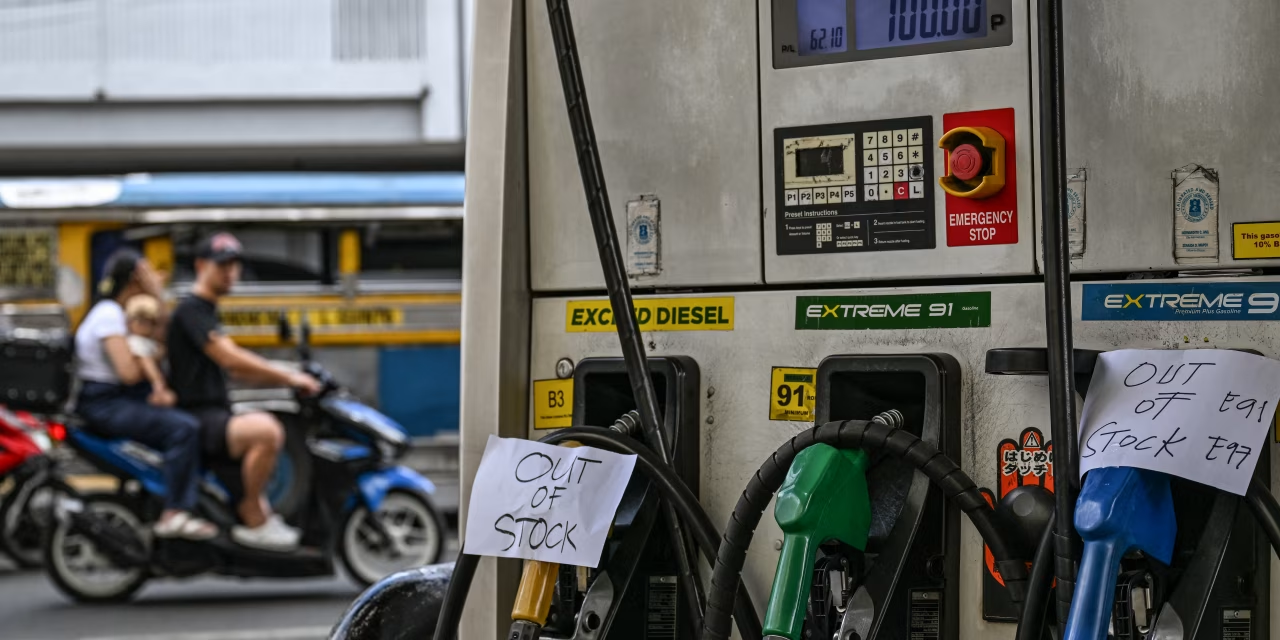
Asia governments to cap fuel prices as oil costs jump

Published

on

Asia governments to cap fuel prices as oil costs jump

The price of crude has surged above $100 on concerns about shortages due to
supply disruptions.

Continue Reading

Business

Relmada Therapeutics stock surges 25% on bladder cancer data

Published

on


Relmada Therapeutics stock surges 25% on bladder cancer data

Continue Reading

Business

Swedish investment firm takes major stake in Yorkshire Water

Published

on

Swedish investment firm takes major stake in Yorkshire Water

EQT has acquired a 42% stake in Kelda Holdings, Yorkshire Water’s parent company

Yorkshire Water

Yorkshire Water’s CEO said the deal was ‘a great step forward’

One of the world’s largest private equity firms has this morning bought a major stake in Yorkshire Water.

Swedish firm EQT has acquired a 42% stake in Kelda Holdings, the parent company of Yorkshire Water. It means that the firm now has three overseas owners, with EQT joining Singaporean sovereign wealth fund GIC and Australian firm TCorp in owning Kelda Holdings.

In a statement to the Stock Exchange, Yorkshire Water described EQT as a “purpose-driven global investor with deep experience in managing long-term strategic assets and a strong track record of managing critical infrastructure”. It said the deal “signals confidence in Yorkshire Water” and its £8.3bn plan for improving the county’s water infrastructure over the next five years.

The deal comes as water companies around the UK remain under intense scrutiny over both their environmental records and overseas ownership. Last week MPs on the Environment, Food and Rural Affairs Committee highlighted Yorkshire Water as one of the main users of bailiffs to collect debt from customers in the water industry. And last month, Yorkshire Water was fined more than £700,000 for polluting a country park stream with sewage three times in a year.

Advertisement

EQT was last year ranked as the second largest private equity firm worldwide based on funds raised and has a wide range of assets around the world in a number of different sectors. It said it would “work in partnership with its co-shareholders and the company’s management team to deliver sustainable operational improvements” and would also be “investing further equity” to strengthen the company’s balance sheet.

Announcing today’s deal, Yorkshire Water chief executive Nicola Shaw said: “This is a great step forward for Yorkshire Water. The EQT team will bring additional expertise to our board, and their backing is a strong vote of confidence in our plan to improve performance and the progress we have made so far.

“EQT has a long-term perspective and their team is committed to supporting the delivery of our £8.3bn investment programme. Their support, together with GIC and TCorp, will enable us to continue to execute our strategy, maintain focus on operational performance, and deliver the investment needed to improve outcomes for customers and the environment across Yorkshire.”

Kunal Koya, partner at EQT Infrastructure said: “Our strong track record as a long-term active owner of large infrastructure assets makes EQT a natural partner for Yorkshire Water. We believe that as a responsible private capital manager, EQT can play an important role in modernizing the UK’s water infrastructure, and the company’s multi-year investment plan reflects that objective.

Advertisement

“Together with Yorkshire Water’s existing investors, we will support the sector’s reform agenda and deliver service improvements for customers across the region and transparency for all stakeholders.”

The deal, which will depend on anti-trust approvals, has been welcomed by the Government. Investment Minister Lord Stockwood said: “I warmly welcome this commitment from a leading global infrastructure investor. EQT’s decision to invest in the UK’s regulated water sector underlines the strength of our investment environment and the trust international partners place in the UK economy. It demonstrates that the UK remains one of the world’s most attractive destinations for long‑term, sustainable investment.”

Continue Reading

Business

Hims & Hers Shares Double on Report of Wegovy Tie-Up

Published

on

Hims & Hers Shares Double on Report of Wegovy Tie-Up

Shares in telehealth company Hims & Hers skyrocketed in premarket trading following a media report that the maker of Wegovy plans to sell the weight-loss drug on the platform, a move that would end a legal spat between the two companies.

Hims & Hers, which markets consumer drugs ranging from treatments for weight loss and erectile dysfunction in men, to treatments for menopausal symptoms in women, is set to offer Novo Nordisk’s NOVO.B 0.99%increase; green up pointing triangle blockbuster Wegovy on its platform, Bloomberg reported, citing an unnamed source.

Copyright ©2026 Dow Jones & Company, Inc. All Rights Reserved. 87990cbe856818d5eddac44c7b1cdeb8

Continue Reading

Business

Asset Allocation: Does Middle East Conflict Change The Calculus?

Published

on

Asset Allocation: Does Middle East Conflict Change The Calculus?

Asset Allocation: Does Middle East Conflict Change The Calculus?

Continue Reading

Business

Oil, Gas Prices Surge as Iran War Forces Gulf Producers to Cut Output

Published

on

Oil, Gas Prices Surge as Iran War Forces Gulf Producers to Cut Output

Oil and gas prices surged Monday as the Middle East war roils energy markets, forcing major producers to shut down output while the Strait of Hormuz remains effectively closed.

In early European trading, Brent crude climbed 11% to $103.14 a barrel and West Texas Intermediate rose 8.9% to $89.49 a barrel, trimming earlier gains on news that Group of Seven ministers are set to discuss the joint release of petroleum reserves. The global benchmarks reached their highest levels since 2022 earlier in the session, touching $119.50 and $103.67 a barrel, respectively.

Copyright ©2026 Dow Jones & Company, Inc. All Rights Reserved. 87990cbe856818d5eddac44c7b1cdeb8

Continue Reading

Business

Strategic oil bets may outperform in current geopolitical crisis: Mark Matthews

Published

on

Strategic oil bets may outperform in current geopolitical crisis: Mark Matthews
The latest surge in crude oil prices, with Brent crude once again climbing above the $100 mark, is sending shockwaves across global financial markets. As investors recalibrate strategies, the question on everyone’s mind is: how long will it take for markets to digest this oil shock?

Mark Matthews, a seasoned market strategist from Julius Baer notes, “How soon before markets begin to digest it? They are digesting it now. We can see the Asian markets. The Japanese stock market, for example, was up as much as 17% in late February; now it is flat on the year. So, we are pricing in this high oil price right now.”

When asked about the potential impact on India, Matthews said, “Last year was a very good year for markets like Japan, China, and the US, but India did not do much. So, there should not be as much downside for India. Of course, you could make the case that India uses more oil than some of those other economies or has to import more, but the Indian economy, like most economies in the world, has become more efficient in its oil usage. The pain point which used to be $80 a barrel is now probably around 100. The good news is that India is now able to buy Russian oil again, which takes some pressure off. But really, for India and the rest of the world, it all depends on how long this war lasts.”

Foreign investor sentiment toward India remains cautious but opportunistic. Matthews explains, “There was a breakout in emerging markets versus the US in February of a very long downward trend channel, it had been in place for more than maybe 15 years. But it was a false breakout because last week emerging markets went down more than the US. In general, they are more vulnerable to high oil prices. Most of the oil that goes through the Strait of Hormuz comes out here to Asia. So intuitively, if the war lasts, emerging markets, because they are primarily Asian, should underperform.”

Advertisement

Looking ahead to the upcoming Federal Reserve meeting, Matthews anticipates measured action. “It is premature for the Fed to react to this war in Iran, but the non-farm payroll reading for February was a loss. That would suggest they would be in favor of cutting interest rates. The market is looking for two rate cuts this year. One reason is because the Federal Reserve does not like to surprise the market. It likes the market to price in broadly what it is thinking. I do not expect one of those to necessarily be next week, but by the end of this year, there should be two.”


Regarding hedging strategies for India, Matthews points to the oil sector rather than precious metals alone. “Gold and silver have done very well, but they are vulnerable because in risk-off events of this size, people like to take profit. With oil over $100 and war not ending soon, there is a case for owning the oil sector, not just in India but globally. Longer term, even when this war ends, if Iran is not stable, the Strait of Hormuz will not be stable either, and that is responsible for about 20% of the world’s oil trade.”
He also highlighted potential central bank responses, saying, “Iran’s game plan is quite obvious. They want to get oil prices as high as possible to put pressure on the US. With high oil prices, we will see inflation, because oil feeds into many aspects of the consumer and producer price indices. Supply chain disruptions, like issues in the Suez Canal, are also inflationary. When you have inflation, it is hard to cut interest rates, and central banks might even have to raise them depending on how long the war lasts.”Finally, Matthews weighed in on China’s position in the current geopolitical landscape. “China has been very prudent in accumulating a large oil reserve—over 250 days’ worth. That is a good thing. But China is the largest buyer of Middle Eastern oil. Longer term, this could incentivize them to diversify, with Russia being an obvious option. Very few are winning in this scenario, but Russia, Norway, Kazakhstan, and Venezuela are among those benefiting.”

As global markets grapple with high oil prices, geopolitical tensions, and inflationary pressures, investors are navigating an uncertain landscape. While India’s underperformance relative to other emerging markets might cushion its downside, exposure to energy-related sectors could offer a strategic hedge in these turbulent times.

Continue Reading

Trending

Copyright © 2025