

Business
China’s annual policy summit to focus on tech shift and debt issuance




However, he notes that momentum oscillators have yet to confirm a full-fledged breakdown, indicating that an outright collapse is not imminent unless key support levels are decisively breached.
Edited excerpts from a chat:
Nifty ended the week around 1% lower as IT stocks pulled the index down. How do you see the market shaping up in the first week of March?
After persistently preventing a breakdown despite multiple attempts throughout the month, the 200-day SMA finally gave way on the last working day of the month. This has raised worries of a retest of February lows of 24571. However, with the first test of the lower Bollinger band, with super trend support at 25033 available within touching distance, we are hopeful of a recovery move in the second half of the week. However, slippage past the 25000 region could negate the prospects of a near-term recovery. That said, oscillators are yet to signal an outright collapse.
In the last 3 days, Nifty IT attempted to climb up. What do you think is this a dead cat bounce or sustainable uptrend? Is it too early to say that IT stocks have bottomed out?
Over the past few sessions, Nifty IT’s bounce looks more like a technical rebound than the start of a sustainable uptrend. The index recently hit a fresh 52 week low near 29875, and despite a minor uptick, it continues to trade below key moving averages, confirming a bearish setup.

On the daily chart, price remains below the immediate resistance at 31100-31300, and only a decisive move above 33200-34400 would indicate a structural trend change. Until then, rallies are vulnerable to selling. The weekly chart reinforces this weakness with the index breaking down from a recent H&S structure, marking a clear bearish phase.
If we look at the seasonality, the last 15 years show that March has been net negative on average for the Nifty IT Index, with a low win rate of just 40% and relatively high volatility, forming a bearish cloud over the sector.Given this backdrop, it is too early to declare a bottom. For a meaningful trend reversal, the index must protect 30,000 and form a higher low and reclaim and hold above 33,200-34,400.
Hence, the recent uptick in Nifty IT is more likely a dead‑cat bounce than the beginning of a new uptrend. The sector remains in a deep corrective phase with no confirmed bottom yet. We will wait for the price to reclaim key resistance zones before treating any bounce as the start of a durable reversal.
In the last 3 trading sessions, have we seen shorts winding up in IT stocks?
Although the first two sessions of the new series witnessed short‑covering in several stock futures, major index constituents such as TCS, Wipro, and Tech Mahindra lost momentum on Friday. Around 60% of the near‑ITM and OTM call option strikes saw fresh short additions, indicating caution at higher levels. Additionally, nearly 60% of stock futures registered short build‑up on Friday, and close to 80% showed short additions on a week‑on‑week basis. Overall, the derivatives landscape suggests that traders remain unconvinced by the recent pullback and may be positioning lightly for further downside before considering fresh bullish exposure.
Metals are doing well. What are the charts telling you?
On the daily chart, the Nifty Metal Index is consolidating just below the 12450-12500 resistance zone, marked by multiple failed attempts to break higher. Candles show tight-bodied price action near the upper band of the previous rally, indicating buyers are still active but facing overhead supply. The trend structure remains positive with price holding above the short‑term moving averages and maintaining higher lows. However, the latest red candle and a mild rollover in the MACD histogram suggest short‑term loss of momentum, warranting caution if 12150-12200 is breached.
On the weekly chart, the index has displayed a strong medium-term uptrend, having broken above prior swing highs with expanding bullish candles. The price continues to ride the green cloud zone, reflecting healthy trend strength. Elevated volumes in recent weeks reinforce the possibility of institutional participation.
If we look at the derivatives picture, it presents mixed signals. Around 80% of metal stock futures saw short additions on Friday, while roughly 60% added longs on a week‑on‑week basis. Furthermore, nearly 80% of the near‑OTM call option strikes witnessed short build‑up on Friday. Taken together, F&O traders appear to be positioning for some short‑term negativity
So, expect near term weakness but a decisive weekly close above 12,500 could trigger the next leg higher.
Tejas was the biggest gainer in the week. How would you trade the stock now?
The steepness of the last two days’ rise as well as the approach of a near term resistance at 441 raises potential for a pause. However, we believe that the stock is poised for larger gains, supported by a narrow range breakout as well as bullish continuation patterns, projecting a near term objective of 522-533. Stop loss may be placed near 389 or 376.
Give us your top ideas of the week.
PARAGMILK (CMP: 202)
View: Buy
Target: 222 – 235
Stoploss – 187The weekly chart shows the stock in a corrective phase after a sharp decline from the 360-380 region. Price has now dropped toward a key support zone around 180-190, which aligns closely with the 200 WMA, historically a strong long‑term support area. The Doji candle formed in the weekly scale reflects a slowdown in bearish momentum, suggesting early signs of stabilization as buyers attempt to defend this level.
Despite the correction, the broader trend structure from mid‑2023 to 2025 still reflects a sequence of higher highs and higher lows keeping the longer‑term uptrend intact.
The weekly MACD histograms have shifted back in favor of buyers. A flattening or upward turn in the MACD line would serve as the first confirmation of renewed strength.
Overall, the stock is positioned at a critical support juncture warranting a pullback toward 225-235, while a decisive close below the 200-week moving average may open downside potential toward 160.
HEG (CMP: 578)
View: Buy
Target: 625
Stoploss – 560HEG is displaying a steady medium‑term uptrend on the weekly chart, supported by consistent higher lows since mid‑2024. The price continues to trade well above the 200‑WMA, indicating strong long‑term structural strength. Recent candles show tightening consolidation between 540 and 600, suggesting the stock is building energy for its next directional move.
The latest bounce from the lower end of this range reflects active dip buying, keeping the overall bias positive as long as the stock holds above 560-40. A decisive weekly close above 600 would confirm a breakout continuation, opening the path toward higher targets.
The weekly MACD remains slightly positive but flat, implying momentum is still neutral and awaiting a trigger.
Overall, HEG remains in a constructive setup. Sustaining above support and breaking past 600 with volume would strengthen the bullish case.

Real estate stocks, especially those tied to Bengaluru, have seen significant drops as AI’s impact on IT jobs sparks housing demand worries. Companies like Brigade Enterprises and Godrej Properties are among the hardest hit. Experts suggest this could be a near-term concern, with any real housing demand impact unfolding gradually.

The latest buying follows three consecutive months of heavy selling. FPIs pulled out Rs 35,962 crore in January, Rs 22,611 crore in December and Rs 3,765 crore in November, according to data from the depositories.
Overall, FPIs have withdrawn a net Rs 1.66 lakh crore (USD 18.9 billion) from Indian equities in 2025, making it one of the worst periods for foreign flows. The outflows were triggered by volatile currency movements, global trade tensions, concerns over potential US tariffs and stretched equity valuations.
According to the data, FPIs invested Rs 22,615 crore in February. This was the highest monthly inflow since September 2024, when they had invested Rs 57,724 crore.
The inflow was driven by secondary market buying, signalling renewed foreign confidence post-2025 outflows, said Vinit Bolinjkar, Head of Research at Ventura.
Javed Khan, Senior Fundamental Analyst at Angel One Ltd, said three key catalysts supported the inflow. These included India-US trade agreements and corrections in India’s market valuation. Additionally, Q3 FY26 earnings grew 14.7 per cent, suggesting confidence in the growth narrative.
Echoing similar views, Varun Gupta, CEO of Groww Mutual Fund, attributed the renewed inflows to improving earnings momentum, moderation in valuations from peak levels and early signs of easing trade uncertainty, with India concluding multiple FTAs, including those with the EU and UK.Sectorally, FPIs were aggressive buyers in financials and capital goods, while continuing to pare exposure to the IT sector. The segment saw outflows of Rs 10,956 crore amid concerns over AI-led disruption.
“FPIs had sold heavily in IT stocks due to the Anthropic shock and continued weakness in the segment. However, they turned buyers in financial services and capital goods,” said VK Vijayakumar, Chief Investment Strategist at Geojit Investments.
Looking ahead, Khan said March flows are expected to remain positive. Q4 earnings will determine whether 15 per cent earnings growth in FY27 is achievable, while rupee stability below Rs 91 to the dollar provides comfort on returns.
Vijayakumar said FPIs are likely to adopt a wait-and-watch approach before increasing exposure to emerging markets. However, improving GDP growth prospects and a healthy corporate earnings outlook for FY27 bode well for medium-term flows.
Meanwhile, the ongoing conflict in the Middle East has triggered a risk-on sentiment in financial markets. Its impact on crude prices and currency movements remains a key monitorable, he added.

Rupak De, Senior Technical Analyst at LKP Securities, noted that the index has also slipped below the 200-day moving average (DMA), signalling continued weakness in the near term. “The RSI indicator has turned sharply bearish. In the short term, the index may remain under selling pressure, with rallies likely to be sold into. Immediate support is placed at 25,000 and 24,750, while resistance is seen at 25,370,” De said.
Here are 2 stock recommendations for Monday:
Buy RR Kabel at Rs 1,562 | Upside: 6%
Stop Loss: below Rs 1,515
Target: Rs 1,655
RR Kabel is showing a bullish continuation setup on the weekly timeframe. Price has broken above a multi-month consolidation zone near Rs 1,520–Rs 1,550, confirming a range breakout. The stock is trading above its 20/50/100/200 EMAs, indicating strong trend alignment and medium-term bullish structure. The 20 EMA has crossed above the 50 EMA, supporting positive momentum. RSI (14) is near 58–60, holding above the midline without being overbought, suggesting further upside potential. Volume expansion on breakout strengthens the move. Higher highs and higher lows confirm trend reversal from the previous corrective phase.(Drumil Vithlani, Technical Research Analyst, Bonanza Portfolio)
Buy Siemens at Rs 3,418 | Upside: 6%
Stop Loss: Rs 3,315 – Rs 3,330
Target: Rs 3,590 – Rs 3,620
Siemens Limited has given a fresh breakout on the daily chart, closing decisively above recent swing highs with strong bullish momentum. The price is trading above its 20/50/100/200 EMAs, indicating a well-established uptrend. RSI is hovering near the 65 zone, reflecting strengthening momentum without entering extreme overbought territory. Volume expansion on the breakout further validates buying interest. Traders can consider initiating fresh long positions at current levels, maintaining strict risk management as long as the price sustains above the breakout zone.
(Drumil Vithlani, Technical Research Analyst, Bonanza Portfolio)
(Disclaimer: Recommendations, suggestions, views and opinions given by the experts are their own. These do not represent the views of Economic Times)


Waves of blasts heard over Dubai, Doha for second day, witnesses say
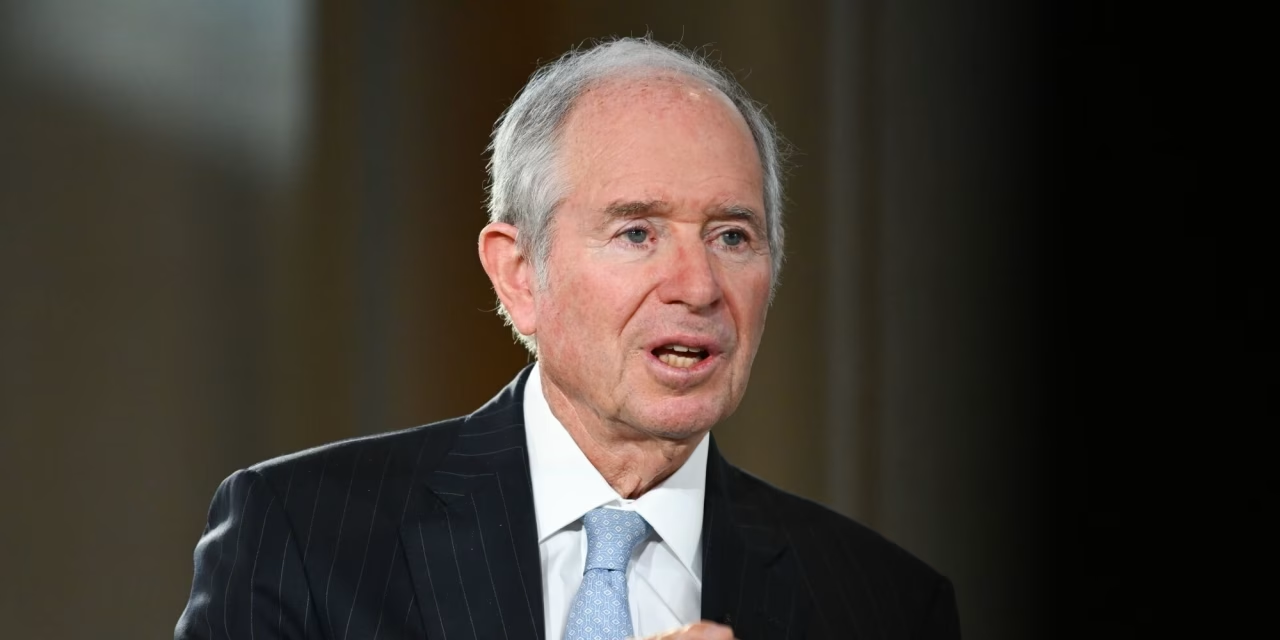
Blackstone CEO Steve Schwarzman collected more than $1.2 billion in dividends and compensation in 2025, according to the firm’s annual filing.
The haul, which was in line with Schwarzman’s previous record in 2022, came despite lackluster performance for the firm’s shares. Including dividends, those lost 7.9%, compared with a 17.9% total return for the S&P 500.
As in previous years, the vast majority of Schwarzman’s take, around $1.1 billion, came from dividends on his roughly 20% stake in Blackstone.

Asian investment into Australia reached a series of record-breaking milestones in 2025, with Japan, Korea, Singapore, and Malaysia reshaping bilateral economic ties through landmark deals and strategic capital deployment, even as global macroeconomic headwinds tested investor confidence across the region.
Key takeaways
- Japan’s M&A market surged 83.9% to US$218.5 billion in 2025, marking the third consecutive year of record Japanese investment into Australia.
- Korea’s POSCO sealed a landmark A$1.2 billion lithium deal while Hanwha cemented its defence presence through a 19.9% stake in Austal, signalling Asia’s deepening strategic ties with Australia.
- Critical minerals, defence, real estate, and renewables are set to dominate Asia-Pacific deal flow into Australia throughout 2026.
These are the central findings of MinterEllison’s 2026 Asia Report: Year in Review, the fifth annual edition of the firm’s flagship Asia practice publication tracking cross-border deal activity, regulatory shifts, and sector-by-sector investment trends across Australia’s key Asian partner economies.
Japan: Unprecedented M&A and Historic Leadership
Japan’s M&A market reached unprecedented levels in 2025, recording 3,472 transactions valued at a combined US$218.5 billion, an extraordinary 83.9% surge compared to 2024.
Sanae Takaichi became Japan’s first female Prime Minister, signalling a decisive pivot toward economic growth and a commitment to lifting defence spending to 2% of GDP.
Japanese investment in Australia reached record levels for the third consecutive year, with real estate, energy security, and data centres emerging as priority sectors. The landmark A$55 billion Mogami-class frigate contract further cemented defence collaboration as a key pillar of the bilateral relationship heading into 2026.
Korea: Lithium Billions and a Expanding Defence Presence
Korea delivered one of the year’s most consequential bilateral transactions. POSCO Holdings committed A$1.2 billion into Mineral Resources’ lithium assets, securing a 30% interest and long-term access to spodumene concentrate from Tier-1 assets at Wodgina and Mt Marion.
Meanwhile, Australia-Korea cross-border investment volumes grew 20% year-on-year in the first three quarters of 2025. On the defence front, Hanwha’s stake in Austal Limited was approved at 19.9%, positioning the Korean conglomerate as Austal’s largest single shareholder and reflecting deepening strategic industrial ties between the two nations.
China: Record Trade Surplus, Subdued M&A
China’s domestic economy showed signs of stabilisation in 2025, posting a record US$1.189 trillion trade surplus while accelerating overseas manufacturing investment across Southeast Asia.
Inbound M&A from Chinese companies into Australia remained subdued, as FIRB approval challenges continued to constrain deal activity.
Australia charted an independent China strategy under its re-elected government, prioritising trade while maintaining security commitments. MinterEllison anticipates 2026 deal flow will emerge primarily through minority equity interests, joint ventures, and licensing agreements in sectors including EVs, mining, biotech, and fintech.
Singapore and Malaysia: Capital, Infrastructure, and Renewables
Singapore delivered political certainty following Prime Minister Lawrence Wong’s landslide election victory, though overall M&A activity softened amid US-driven global headwinds.
Capital markets reform initiatives deployed approximately S$3.95 billion to local asset managers, while IPO fundraising reached its highest level since 2019 at S$2.54 billion. Australian real estate remains a key deployment target for Singapore-based capital in 2026.
Malaysia rounded out a strong year for Southeast Asian investment into Australia, backed by solid GDP growth of 4.7 to 5.0%. Sime Darby Property acquired the largest Melbourne CBD development site in five years, while Gamuda Berhad secured infrastructure contracts exceeding RM8 billion and entered Tasmania’s renewable energy market. Fortescue’s green hydrogen collaboration in Sarawak highlighted the growing maturity of bilateral clean energy ties.
The 2026 Asia Report presents a region demonstrating strategic purpose despite a volatile global backdrop. Critical minerals, defence, real estate, and renewables are expected to drive deal activity across all five markets in the year ahead, reinforcing Australia’s position as a preferred destination for Asian capital.
Other People are Reading
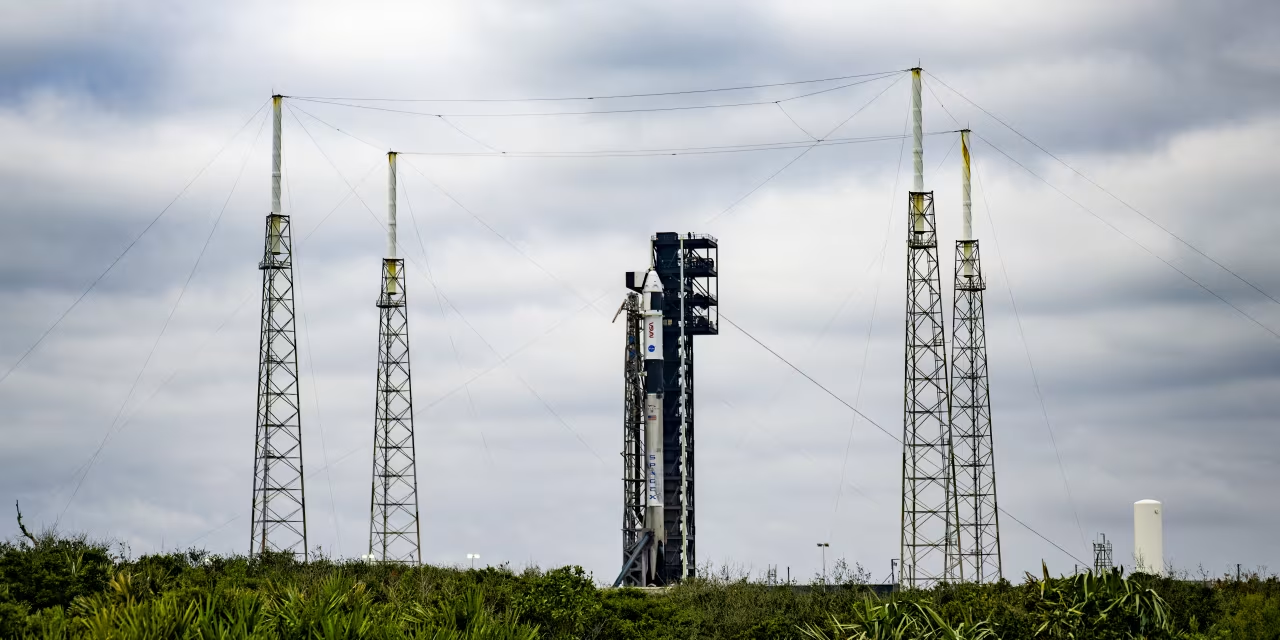
SpaceX Readies Confidential IPO Filing. What That Means.
Stocks’ Season of Discontent Could Linger Well Past Winter. Plus, Picks Among BDCs.

Investors have been betting for years that artificial intelligence would change everything. They got some proof of it this month—and then they started selling.
The S&P 500 and the Nasdaq fell in February, each suffering its worst month since tariff turmoil started to crop up in markets last spring. Among the hardest-hit: software businesses, tech companies and the financial firms invested in, or threatened by, the rapid evolution of AI technology.
Copyright ©2026 Dow Jones & Company, Inc. All Rights Reserved. 87990cbe856818d5eddac44c7b1cdeb8

TOP 5 HOTTEST FINANCIAL AUDIT GUESTS
Nifty below 200-DMA but oscillators yet to signal outright collapse: Anand James

6 Polymarket traders net $1M on US-Iran strike, insider fears: Report


-

 Sports6 days ago
Women’s college basketball rankings: Iowa reenters top 10, Auriemma makes history
-

 Fashion2 days ago
Weekend Open Thread: Iris Top
-

 Politics6 days ago
Nick Reiner Enters Plea In Deaths Of Parents Rob And Michele
-

 Business4 days ago
True Citrus debuts functional drink mix collection
-

 Politics2 days ago
ITV enters Gaza with IDF amid ongoing genocide
-
Sports1 day ago
The Vikings Need a Duck
-

 Crypto World5 days ago
XRP price enters “dead zone” as Binance leverage hits lows
-

 Tech4 hours ago
Unihertz’s Titan 2 Elite Arrives Just as Physical Keyboards Refuse to Fade Away
-

 Business7 days ago
Mattel’s American Girl brand turns 40, dolls enter a new era
-

 Tech5 days ago
Unsurprisingly, Apple's board gets what it wants in 2026 shareholder meeting
-
 NewsBeat15 hours ago
Dubai flights cancelled as Brit told airspace closed ’10 minutes after boarding’
-

 Business7 days ago
Law enforcement kills armed man seeking to enter Trump’s Mar-a-Lago resort, officials say
-

 NewsBeat3 days ago
Cuba says its forces have killed four on US-registered speedboat | World News
-
 NewsBeat3 days ago
Manchester Central Mosque issues statement as it imposes new measures ‘with immediate effect’ after armed men enter
-
 NewsBeat20 hours ago
The empty pub on busy Cambridge road that has been boarded up for years
-
 NewsBeat6 days ago
‘Hourly’ method from gastroenterologist ‘helps reduce air travel bloating’
-

 Tech7 days ago
Anthropic-Backed Group Enters NY-12 AI PAC Fight
-

 NewsBeat11 hours ago
Abusive parents will now be treated like sex offenders and placed on a ‘child cruelty register’ | News UK
-

 NewsBeat7 days ago
Armed man killed after entering secure perimeter of Mar-a-Lago, Secret Service says
-

 Politics7 days ago
Maine has a long track record of electing moderates. Enter Graham Platner.