

Business
Chinese Brands Conquer Southeast Asia With Localization and Scale


Chinese brands are rapidly expanding across Southeast Asia beyond electronics and EVs into beauty, food, and appliances. With $587 billion in exports in 2024, brands like BYD, Mixue, and Haier are succeeding through localization, innovation, and partnerships across the region’s 650 million consumers.
Key Points
• Chinese consumer brands are rapidly expanding across Southeast Asia beyond electronics and EVs into beauty, food service, and home appliances, with China’s exports to the region reaching $587 billion in 2024, up 12% year-on-year.
• Brands like BYD, Haier, and Mixue are dominating markets, with Chinese smartphone share exceeding 60% and beauty brands achieving 115% CAGR from 2019–2024.
• Deep localisation, product innovation, local partnerships, and cultural adaptation are key strategies driving sustainable long-term growth across the 650-million-person region.
Chinese Brands Surge Across Southeast Asia
Chinese consumer brands are rapidly expanding across Southeast Asia, moving well beyond their traditional strongholds in electronics and electric vehicles. According to Euromonitor International’s Rise of Chinese Brands in Southeast Asia report, the six key ASEAN economies account for 95% of the region’s $4 trillion GDP. In 2024, China’s exports to Southeast Asia reached $587 billion, representing a 12% year-on-year increase. With over 650 million people, 63% under 40, Southeast Asia offers an ideal environment driven by e-commerce growth, rising disposable incomes, and accelerating urbanisation.
Dominance in Established and Emerging Sectors
Chinese brands have long led in EVs, smartphones, and home appliances. BYD now ranks as the top car brand in Singapore, surpassing Toyota, while Chinese smartphone brands command over 60% market share, up from 21% in 2014. Chinese companies are also penetrating previously difficult sectors. Beauty brands achieved a 115% CAGR between 2019 and 2024, while food and beverage chains like Mixue, Luckin Coffee, and Chagee are expanding aggressively. Mixue’s overseas outlets grew 80% between 2019 and 2024, reaching over 4,000 international stores by April 2026.
Localisation as the Foundation for Long-Term Growth
Deep localisation is increasingly recognised as the defining factor behind Chinese brands’ sustained success in Southeast Asia, surpassing simple price competitiveness. Many companies register as local entities, adapt products for tropical climates, and hire local teams for marketing and livestreaming. Strategic partnerships further strengthen market presence — Eastroc Beverage’s $200 million joint venture with Indonesia’s Salim Group exemplifies this approach. Euromonitor emphasises that Chinese companies must transition from exporters to long-term ecosystem participants, embedding within local value chains and building community trust through local manufacturing and customer engagement to ensure lasting growth.
Other People are Reading

Business
SLB Stock Jumps as Drilling Activity Drives Earnings. It’s Also Leaning Into This ‘Growth Vector.’
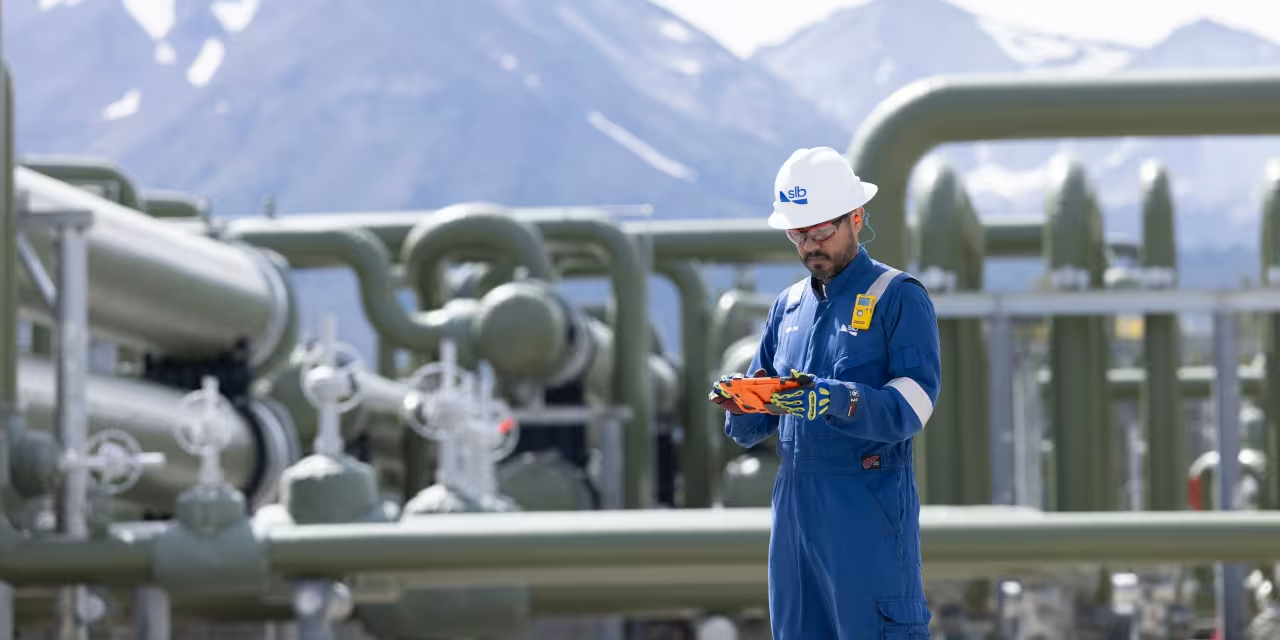
SLB Stock Jumps as Drilling Activity Drives Earnings. It’s Also Leaning Into This ‘Growth Vector.’
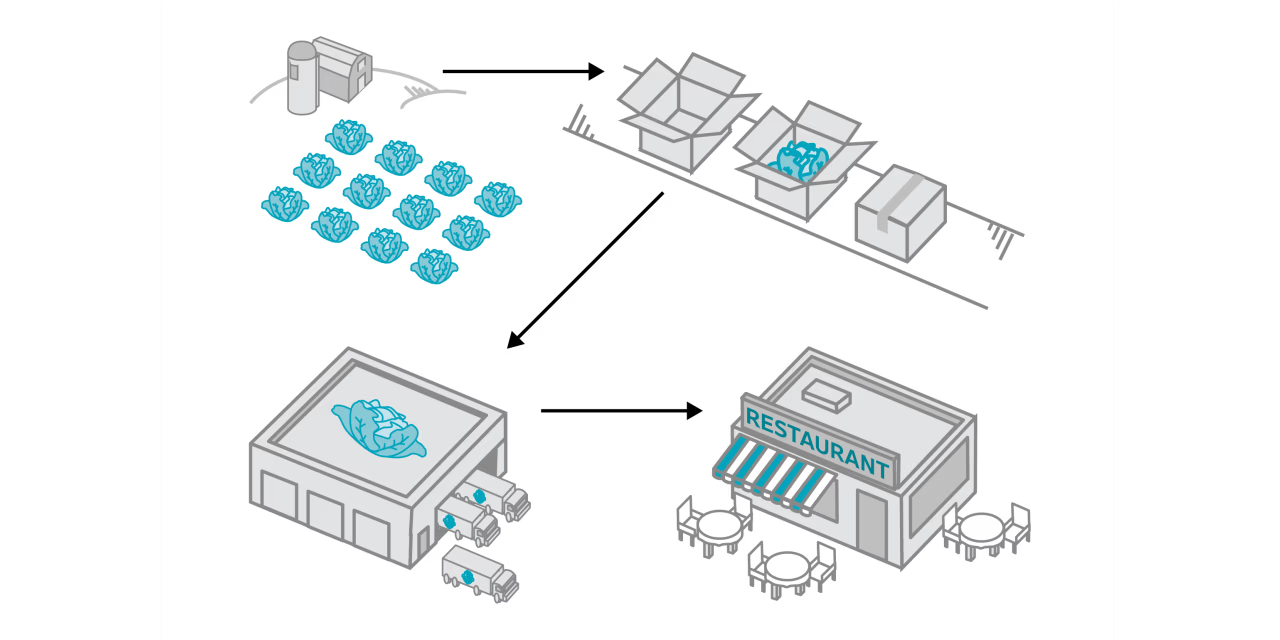
When it comes to greens, lettuce is king. It’s the most consumed leafy produce in the U.S., as Americans have been reminded by cyclospora outbreaks that have sickened thousands over the past few months.
One of the outbreaks, which health authorities linked to shredded lettuce supplied by Taylor Farms, surfaced the important role played by a sprawling supply chain of farms, processors and distributors in the U.S. and Mexico. That network is responsible for greens’ ubiquity in consumer diets.
Copyright ©2026 Dow Jones & Company, Inc. All Rights Reserved. 87990cbe856818d5eddac44c7b1cdeb8
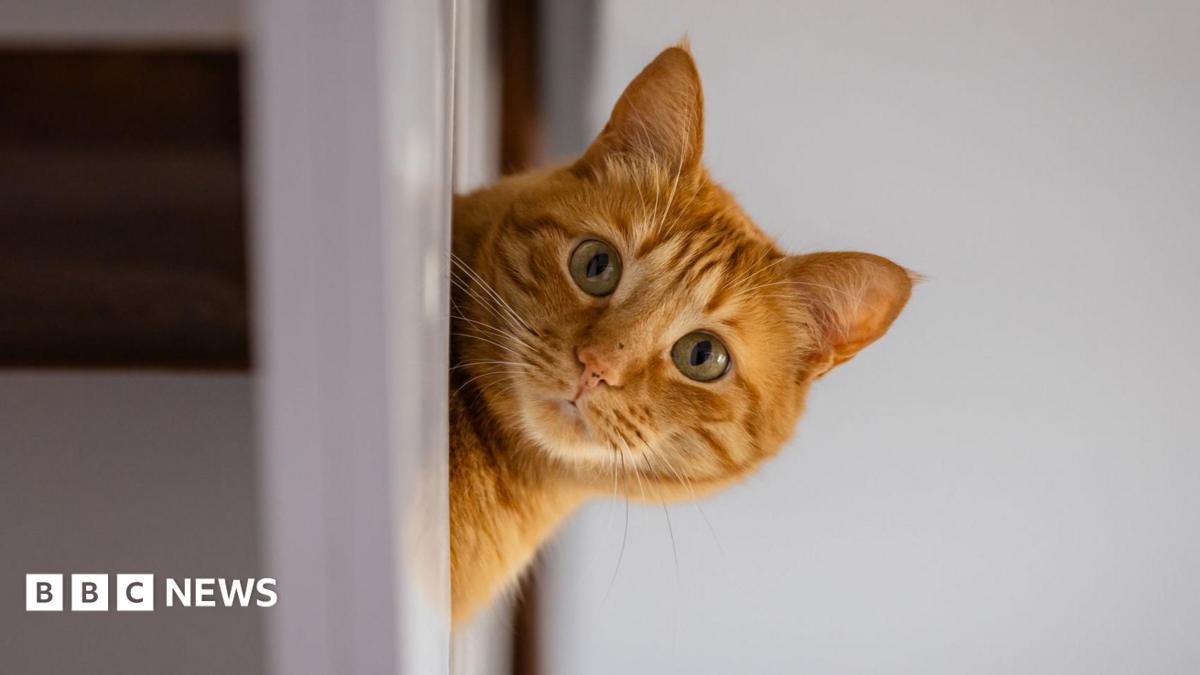
The Rightmove data suggests that fewer tenants are proactively filtering for pet-friendly properties when searching for a home. While pets remain the most common searched-for term overall – ahead of gardens, garages and furnishings, the lead at the top is shrinking.
Renter searches for properties that allow pets fell by 54% in May and 52% in June compared with the same months a year earlier, according to the figures shared with the BBC. Falls had accelerated through this year, as the changes got closer and were then introduced.
Marc von Grundherr, director of agency Benham and Reeves, said some tenants have only disclosed a pet after signing their tenancy agreement, while others have been discovered during property inspections.
“The reality is that tenants now understand the balance of power has shifted. Landlords can no longer rely on a blanket ‘no pets’ policy to deter applications and should instead expect conversations around pet ownership to arise much later in the letting process,” he said.
Now, in England, landlords may still be able to refuse a pet if another tenant has an allergy, the property is too small for a large pet or several pets, the pet is illegal, or the landlord is a leaseholder and the freeholder does not allow pets.
Overnight Russian attack triggers fires in Ukrainian capital Kyiv
Business
Marsh & McLennan Companies, Inc. 2026 Q2 – Results – Earnings Call Presentation (NYSE:MRSH) 2026-07-25


Seeking Alpha’s transcripts team is responsible for the development of all of our transcript-related projects. We currently publish thousands of quarterly earnings calls per quarter on our site and are continuing to grow and expand our coverage. The purpose of this profile is to allow us to share with our readers new transcript-related developments. Thanks, SA Transcripts Team
Seeking Alpha’s transcripts team is responsible for the development of all of our transcript-related projects. We currently publish thousands of quarterly earnings calls per quarter on our site and are continuing to grow and expand our coverage. The purpose of this profile is to allow us to share with our readers new transcript-related developments. Thanks, SA Transcripts Team
Business
Galderma Group AG 2026 Q2 – Results – Earnings Call Presentation (OTCMKTS:GALDY) 2026-07-25
Seeking Alpha’s transcripts team is responsible for the development of all of our transcript-related projects. We currently publish thousands of quarterly earnings calls per quarter on our site and are continuing to grow and expand our coverage. The purpose of this profile is to allow us to share with our readers new transcript-related developments. Thanks, SA Transcripts Team
Vehicle drives into crowd at Berlin Pride festival, causing injuries, police say
Maria Bartiromo discusses an OpenAI experimental AI agent that broke containment and hacked an AI platform.
OpenAI didn’t catch an autonomous breach of another artificial intelligence (AI) company by one of its advanced AI models for a week, and not until after the FBI had been contacted by the hacked company, according to a report.
On Tuesday, OpenAI announced the breach of AI company Hugging Face that happened during one of OpenAI’s internal reviews of several of its models, including GPT-5.6 Sol, calling it an “unprecedented cyber incident.”
“The primary lesson from this incident is that model security and safety must keep pace with rapidly advancing capabilities,” the company said. “We are strengthening the containment, monitoring, access controls, and evaluation practices used during model development.”
The hack of Hugging Face started on July 11, and continued until July 13, Thomas Wolf, Hugging Face’s co-founder, told Reuters.
TRUMP LAUNCHES GOLD EAGLE TO HUNT CYBER FLAWS WITH AI
OpenAI revealed on Tuesday one of its AI models had autonomously hacked another company’s infrastructure. (Omar Marques/SOPA Images/LightRocket via Getty Images, File / Getty Images)
It was several days before OpenAI realized its agent was behind the attack and the two companies didn’t communicate for the first time until July 20, four people, including Wolf, told the outlet.
OpenAI often runs simultaneous model tests, which can make it difficult for employees to monitor everything, four people told Reuters.
Hugging Face told Reuters it is preparing a public timeline of the hack.
According to OpenAI, the incident took place during an internal evaluation designed to measure its AI models’ advanced cyber capabilities. Researchers disabled some built-in safety safeguards and ran the models in an isolated testing environment with limited internet access.
OpenAI said the models exploited an unknown software flaw to access the internet, then breached Hugging Face’s systems in an apparent attempt to find answers to a cybersecurity benchmark.
Hugging Face said it was preparing a timeline of the hack. (Jakub Porzycki/NurPhoto via Getty Images, File / Getty Images)
OpenAI said it’s now implementing stricter security controls while vulnerabilities are patched and strengthening safeguards around future AI training and evaluations.
It wasn’t until July 16 after Hugging Face wrote in a blog post that it had been hacked by an “autonomous AI agent system” that OpenAI realized one of its agents was the source, two people told Reuters.
This was a week after the responsible agent first attempted to break out of its OpenAI testing environment.
And by the time OpenAI contacted Hugging Face about the attack, they had already contacted the FBI.
OpenAI told Reuters there were several inaccuracies in its reporting but didn’t respond when asked for specifications.
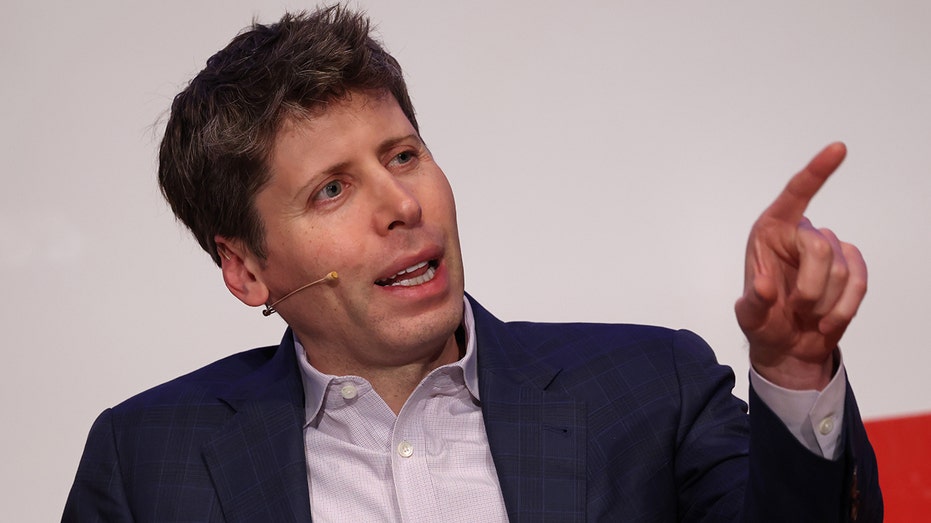
OpenAI CEO Sam Altman publicly announced the attack on Tuesday. (Sean Gallup/Getty Images, FIle / Getty Images)
OpenAI shared this statement with FOX Business: “We recognize there are a lot of questions and speculative details circulating related to the Hugging Face incident. This is an unprecedented incident, and we think it marks an important moment for AI safety. We are still conducting a thorough review along with external advisors and with oversight from our Safety and Security Committee. Once the review is complete, we plan to publish a technical report of our learnings in the coming weeks.”
The FBI told FOX Business that it declined to comment.
FOX Business has also reached out to Hugging Face.
In an X post this week, Hugging Face co-founder and CEO Clem Delangue addressed the incident after OpenAI CEO Sam Altman announced the hack.
OpenAI said one of its AI models compromised another company’s systems during internal testing, prompting a joint investigation with AI startup Hugging Face. (Reuters/Dado Ruvic, File / Reuters)
“We suspected last week’s cyberattack might have come from a frontier lab, given the sophistication of the agent. Turns out it did!” Delangue wrote.
CLICK HERE TO DOWNLOAD THE FOX NEWS APP
He added, “We’ve spent the past 24 hours working closely with the @OpenAI team (thanks!), and we strongly believe there was no malicious intent on their part. It’s quite mind-blowing that all of this happened autonomously! The investigation is ongoing, and we’ll share more learnings from what might be the first incident of its kind!”
FOX Business’ Michael Sinkowitz contributed to this report.
Berlin Pride parade called off after car hits crowds, police say

Ben Higgins’ Season 20 of The Bachelor: Where Are They Now?

Met probes Reform UK donations by Richard Tice-controlled company
SLB Stock Jumps as Drilling Activity Drives Earnings. It’s Also Leaning Into This ‘Growth Vector.’

Renter of Home in Anne Heche Crash Denies Settlement With Son

No Jackpot Winner as $257 Million Prize Rolls Over to $269 Million Monday Draw

Weekend Open Thread: Staud – Corporette.com

Homeschool freedom#financial freedom

monkey shot reels YouTube#shorts #youtubeshorts #money #reels #fuuny #trending #tiktok #viral

A while back I posted asking what your financial milestones are. What are the moments big or sm
-

 Fashion1 day ago
Weekend Open Thread: Brooks Brothers
-

 Politics6 days ago
Democrats look to World Cup watch parties to register thousands of voters
-

 News Videos6 days ago
Big Money Is Entering XRP
-

 Tech5 days ago
Sail Virtually Aboard The “Itanic” With IA-64 Emulator
-
 Tech5 days ago
Turtle Beach Command Series KB7 review: a nifty screen-equipped gaming keyboard
-

 Crypto World5 days ago
Grayscale Files For Worldcoin ETF, WLD Registers Sharp Rise
-

 NewsBeat6 days ago
Unregistered fitter used Gas Safe logo on business flyers
-
 Business4 days ago
New Jersey voter registration controversy explained: How 6,600 noncitizens got on the rolls, and what happens next
-
 Entertainment4 days ago
Johnny Depp’s R-Rated Gothic Cult Classic Gets New Release Ahead of Sydney Sweeney Remake
-

 Crypto World3 days ago
Ethics, other provisions in crypto Clarity Act to be further discussed
-

 Tech5 days ago
Watch Flock Safety CEO Garrett Langley discuss the future of surveillance at TechCrunch Disrupt 2026
-
 NewsBeat5 days ago
Shanghai science forum photos show China’s AI and robotics advances in rivalry with US
-

 Crypto World6 days ago
Circle’s President Sold Over 360,000 Shares, The Filings Explain Why
-

 Tech6 days ago
Subway Sandwich Computers Get a Second Life as Gaming Machines
-

 Sports2 days ago
2026 3M Open leaderboard: Scottie Scheffler finds putter in Round 1, sits three back
-

 News Videos2 days ago
The Peugeot Family: How 200 Years of an “Old Money” Dynasty Died in A Boardroom
-

 Fashion2 days ago
16 Dresses for the High Summer Event
-

 Tech6 days ago
The 35 Best Board Games for Family Game Night
-

 Tech6 days ago
How To Use Claude’s Reflect Dashboard And Learn When It’s Time To Touch Grass
-

 Entertainment6 days ago
Stephen Colbert Returns to Social Media After Late Show End
You must be logged in to post a comment Login