Business
Commonwealth Bank Shares Slip 1% on Heavy Volume as ASX Weighs Broader Market Pressures

SYDNEY — Commonwealth Bank of Australia (ASX: CBA), the nation’s largest lender by market capitalization, closed lower Friday amid elevated trading activity and ongoing volatility in the financial sector, finishing at A$175.64, down A$1.72 or 0.97% from Thursday’s close of A$177.36.
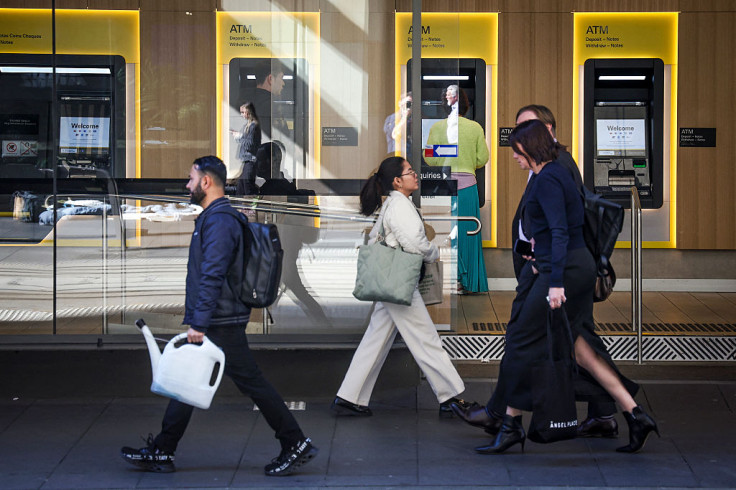
DAVID GRAY/AFP via Getty Images

The decline came on robust volume of approximately 5.74 million shares traded, well above the four-week average, as investors digested recent economic signals and repositioned portfolios. CBA opened at A$178.00, reached an intraday high of A$179.56 but retreated to the session low of A$175.64 before settling at the bottom of the range. The weighted average price (VWAP) hovered around A$176.00, reflecting selling pressure throughout the day.
Friday’s performance extended a pattern of choppy trading for CBA shares in March 2026. The stock has fluctuated between recent highs near A$180 and support levels around A$175, influenced by broader ASX movements and sector-specific factors. Year-to-date in 2026, CBA has gained about 9.4%, building on a strong 20% rise over the past 12 months, though it remains below its 52-week peak of A$192.00 reached in mid-2025.
The pullback aligns with a softer tone across Australian equities, where the benchmark S&P/ASX 200 index has faced headwinds from global interest rate uncertainty and commodity price swings. Banking stocks, which dominate the index due to the “big four” lenders’ weightings, have been particularly sensitive to expectations around Reserve Bank of Australia (RBA) policy and net interest margin pressures.
CBA’s recent half-year results, released in February 2026, provided a strong backdrop for earlier gains. The bank reported record cash net profit after tax of A$5.45 billion for the six months to December 31, up 6% from the prior period and beating consensus estimates. The outcome reflected market share gains in home loans, business lending and deposits, alongside stable credit quality and contained arrears. An interim dividend increase to A$2.35 per share, fully franked, underscored confidence in capital levels and earnings resilience.
However, analysts have cautioned that the post-results rally may have run its course. TradingView data shows a consensus leaning toward sell or strong sell ratings from most covering analysts, with an average price target implying significant downside potential from current levels. Some forecasts suggest CBA could trade as low as A$90 in extreme scenarios, though more moderate views point to A$130-155 over the next 12 months. The bank’s high price-to-earnings ratio of around 28 times trailing earnings has fueled debate about valuation sustainability in a potentially higher-for-longer rate environment.
Friday’s trading saw no major company-specific news driving the move, but broader commentary highlighted concerns over operating expenses, which rose 5% in the half-year update, including a 10% jump in technology spending. Investors continue monitoring how CBA balances digital investment with cost discipline amid competitive pressures from fintechs and other banks.
Dividend yield remains attractive at approximately 2.82% based on recent payouts, drawing income-focused investors even as growth expectations moderate. The upcoming final dividend payment, expected later in the year, will be a key focus, along with any guidance on full-year profit outlook.
CBA’s market capitalization exceeds A$290 billion, making it a cornerstone of the ASX 200 and a bellwether for the Australian economy. Its performance often influences sentiment toward the broader banking sector, including peers like Westpac, NAB and ANZ.
Looking ahead, traders will watch for RBA commentary on inflation and rates, potential shifts in housing market dynamics and any updates on credit growth. With the interim dividend ex-date already passed and payment scheduled for late March, focus may shift to the next earnings cycle in August.
Despite Friday’s dip, CBA shares have shown resilience in 2026, benefiting from Australia’s robust economic fundamentals and the bank’s dominant retail franchise. Analysts describe it as a high-quality name with strong capital buffers, though near-term headwinds from margin compression and subdued credit expansion could cap upside.
As markets close the week, CBA’s retreat underscores the challenges facing Australia’s biggest bank in navigating a complex macro landscape. Investors remain divided: some see value in the yield and stability, while others anticipate further consolidation or correction as valuations adjust to evolving rate expectations.
You must be logged in to post a comment Login