






Business
Dividend Harvesting Portfolio Week 264: $26,400 Allocated, $2,869 In Projected Dividends
I am focused on growth and dividend income. My personal strategy revolves around setting myself up for an easy retirement by creating a portfolio which focuses on compounding dividend income and growth. Dividends are an intricate part of my strategy as I have structured my portfolio to have monthly dividend income which grows through dividend reinvestment and yearly increases. Feel free to reach out to me on Seeking Alpha
Analyst’s Disclosure: I/we have a beneficial long position in the shares of NVDA, MO, BP, T, O, NNN either through stock ownership, options, or other derivatives. I wrote this article myself, and it expresses my own opinions. I am not receiving compensation for it (other than from Seeking Alpha). I have no business relationship with any company whose stock is mentioned in this article.
Disclaimer: I am not an investment advisor or professional. This article is my own personal opinion and is not meant to be a recommendation of the purchase or sale of stock. The investments and strategies discussed within this article are solely my personal opinions and commentary on the subject. This article has been written for research and educational purposes only. Anything written in this article does not take into account the reader’s particular investment objectives, financial situation, needs, or personal circumstances and is not intended to be specific to you. Investors should conduct their own research before investing to see if the companies discussed in this article fit into their portfolio parameters. Just because something may be an enticing investment for myself or someone else, it may not be the correct investment for you.
Seeking Alpha’s Disclosure: Past performance is no guarantee of future results. No recommendation or advice is being given as to whether any investment is suitable for a particular investor. Any views or opinions expressed above may not reflect those of Seeking Alpha as a whole. Seeking Alpha is not a licensed securities dealer, broker or US investment adviser or investment bank. Our analysts are third party authors that include both professional investors and individual investors who may not be licensed or certified by any institute or regulatory body.
Business
Is Kuwait International Airport Open Today? Airport Remains Closed to Commercial Flights
Kuwait International Airport (KWI), the country’s primary aviation hub, stays fully closed to regular commercial passenger traffic as of March 24, 2026, with no arrivals or departures listed on official flight status pages and no confirmed reopening timeline amid the escalating U.S.-Israeli military campaign against Iran that has disrupted Gulf airspace and inflicted direct damage on the facility.

The airport’s official website (kuwaitairport.gov.kw) shows zero scheduled flights for today or the immediate future, displaying messages such as “Unfortunately, we cannot find a flight. Please try a new search” across both arrivals and departures sections. Last updates on the site, timestamped March 23, confirm the absence of any operational activity, reflecting broader airspace restrictions imposed since early March due to security threats, missile exchanges and drone strikes.
Multiple reports indicate the closure stems from physical impacts, including repeated drone attacks on airport infrastructure. A March 15 incident targeted the radar system—the third such strike since March 2—causing damage that has rendered key navigation and control equipment inoperable. Authorities have cited the need for structural repairs to Terminal 1, comprehensive safety assessments and a stable regional environment before resuming operations. Kuwait’s Civil Aviation Authority and Kuwait Airways have emphasized passenger and aircraft safety as the priority, with Chairman Abdulmohsen Al-Faqaan stating the airport is “fully ready for operation” technically but held back by current circumstances and airspace closure.
The conflict, now in its fourth week following initial U.S.-Israeli strikes on February 28, has triggered widespread airspace shutdowns across the Middle East. Kuwait’s airspace joined closures in Iran, Iraq, Israel, Bahrain, Qatar and parts of the UAE and Saudi Arabia, stranding hundreds of thousands of travelers regionally. Airlines including Kuwait Airways, Jazeera Airways, Gulf Air, Qatar Airways, Saudia and international carriers like Pegasus, Flynas, IndiGo and Turkish Airlines have suspended or canceled flights to and from Kuwait through late March or April in some cases, rerouting passengers where possible or offering rebooking options.
Kuwait Airways announced postponements of all incoming and outgoing flights “due to the current situation in the region and in the interest of passenger and aircraft safety.” Some carriers have facilitated repatriation for Kuwaiti citizens via alternative routes, such as through Jeddah, Saudi Arabia, where land border crossings remain open for those able to secure visas.
Drone strikes early in the conflict caused minor injuries to workers and limited material damage, but cumulative effects—including explosions near facilities and radar hits—have compounded operational challenges. Video footage and reports from outlets like Reuters and Visegrad24 documented impacts, prompting evacuations and heightened alerts. The Directorate General of Civil Aviation (DGCA) has outlined three conditions for reopening: completion of repairs, regional security stabilization and clearance from aviation regulators.
Travel advisories reflect the severity. The U.S. Embassy in Kuwait updated its guidance on March 3, renewing warnings amid ordered departures for non-essential personnel. The UK Foreign Office advises against all but essential travel to Kuwait and neighboring states. Global media, including Time, BBC and Bloomberg, report over 27,000 flight cancellations to Middle East hubs since fighting intensified, with ripple effects stranding passengers from Europe to Asia.
Despite the shutdown, limited non-commercial or emergency operations may persist, though no public evidence indicates active flights. Flight tracking platforms like Flightradar24, FlightAware and FlightStats show no live arrivals or departures, with delay indices low due to zero activity. Weather conditions remain favorable—clear skies, moderate temperatures—but pose no factor in the closure.
The situation has strained regional travel, with Kuwait Airways and others coordinating support for affected passengers. Some reports suggest partial restrictions rather than total closure in isolated accounts, but official sources and airline notices consistently describe full suspension of commercial services. No recent announcements from the DGCA or airport authority indicate imminent resumption, leaving travelers to monitor updates via airline apps, the official website or helplines.
As the Iran conflict continues—with ongoing strikes, diplomatic efforts and oil market volatility—the outlook for Kuwait International Airport remains uncertain. Repairs to critical systems could take weeks, and full normalization depends on de-escalation in the broader region. Passengers with bookings are urged to contact carriers directly for rebooking, refunds or alternative arrangements, as widespread chaos persists across Gulf aviation networks.
The closure highlights vulnerabilities in Middle East air travel during geopolitical crises, where airspace decisions and infrastructure integrity can halt operations abruptly. For now, Kuwait International Airport stands silent, its runways empty as authorities prioritize safety over swift resumption.
Business
HS2 trains could run slower than planned to save money
This means HS2 trains could not be tested at their intended operating speeds until a bespoke test track, or the railway itself is complete, something DfT sources claim would delay completion of the project by several years and cost billions of pounds.
Business
Trump admin strikes deal to scrap Biden wind projects for oil push
U.S. Interior Secretary Doug Burgum breaks down President Donald Trump’s ‘masterclass’ in energy diplomacy ahead of his meeting with oil executives in Venezuela on ‘Kudlow.’
FIRST ON FOX: The Trump Department of the Interior secured a landmark agreement with energy giant TotalEnergies to redirect nearly $1 billion away from “unreliable” and “ideological” wind farm projects approved under the Biden administration and instead invest in U.S. oil and natural gas as part of the president’s “energy dominance agenda.”

Secretary Doug Burgum announced the agreement with TotalEnergies on Monday at the CERAWeek conference, an annual gathering of global oil and energy leaders in Houston.
TotalEnergies is renouncing its U.S. offshore wind leases and instead investing a total of $928 million in oil, natural gas and liquefied natural gas production in the U.S., according to the department. Additionally, after the department paused all leases for large-scale offshore wind projects under construction in the U.S. due to “national security risks,” TotalEnergies has pledged not to develop any new offshore wind projects in the country.
| Ticker | Security | Last | Change | Change % |
|---|---|---|---|---|
| TTE | TOTALENERGIES SE | 88.17 | -0.58 | -0.66% |
The department said that “under this innovative agreement driven by President Donald J. Trump’s Energy Dominance Agenda, the American people will no longer pay for ideological subsidies that benefited only the unreliable and costly offshore wind industry.”
OIL PRICES SLIDE AS US EXPANDS INFLUENCE OVER GLOBAL ENERGY MARKETS

President Trump, l., and an oil drill, r. (Getty / Getty Images)
As part of the agreement, TotalEnergies will invest $928 million in the development of a liquefied natural gas plant in Brownsville, Texas, as well as shale gas production and upstream conventional oil in the Gulf of America.
In turn, the U.S. will terminate wind farm leases in the Carolina Long Bay Area and in the New York Bight area. Both of these leases were granted to TotalEnergies by the Biden administration in 2022. The U.S. will be reimbursing TotalEnergies for these investments.
According to the department, these reinvestments “directly advance the Trump Administration’s ongoing efforts to lower costs for American families, increase baseload and grid reliability, and help maintain global leadership in artificial intelligence.”
Burgum called the agreement “yet another win for President Trump’s commitment to affordable and reliable energy for all Americans.”
TRUMP WEIGHS LIFTING IRAN OIL SANCTIONS AS ENERGY PRICES SOAR AFTER QATAR LNG STRIKE

Interior Secretary Doug Burgum delivers remarks outside the White House on March 19, 2025 in Washington, D.C. (Getty Images)
“Offshore wind is one of the most expensive, unreliable, environmentally disruptive, and subsidy-dependent schemes ever forced on American ratepayers and taxpayers,” Burgum told Fox News Digital.
He added that the administration welcomes TotalEnergies’ commitment to “developing projects that produce dependable, affordable power to lower Americans’ monthly bills while providing secure U.S. baseload power today — and in the future.”
U.S. Attorney General Pam Bondi also commented on the deal, telling Fox News Digital that “today’s agreement prioritizes affordability for hardworking American consumers over the prior administration’s ideological, ineffective energy policies.”
Bondi predicted that “Americans will benefit from this significant investment in our energy industry,” which she said will “also enhance our national security and grid reliability.”
OIL PRICES WILL COME DOWN ‘VERY, VERY FAST’ AFTER CONFLICT, FORMER ENERGY CHIEF SAYS

Madaket beachgoers walk along the beach in this 800mm telephoto view that compresses distance of the Vineyard Wind turbines 15 miles away. (Stan Grossfeld/The Boston Globe via Getty Images / Getty Images)
Patrick Pouyanné, CEO of TotalEnergies, told Fox News Digital that the company is “pleased” to sign onto the agreement with the DOI and to support the administration’s energy policy.
GET FOX BUSINESS ON THE GO BY CLICKING HERE
He explained that the decision to renounce the offshore wind developments in favor of U.S. oil investment was made in consideration that offshore wind projects are “not in the country’s interest.”
Pouyanné said these investments will help supply Europe with “much-needed” U.S. liquified natural gas and provide gas for U.S. data center development. He said TotalEnergies believes this is “a more efficient use of capital in the United States.”
Business
Organic Valley debuts protein-focused milk

The milk provides 13 grams of protein per serving.
Business
Vital Proteins adds functional sparkling water

The collagen-supporting water is available in three flavors.
Business
OnlyFans owner Leonid Radvinsky dies at 43
Leo Radvinsky became a billionaire after investing in the site, known for its pornographic content.
Business
Jean-Claude Bastos’ Beyond’ Podcast Features a Probing Conversation on Architecture, Intelligence, and the Nature of Design
What does architecture have to do with the physics of the universe, the efficiency of a 1950s French automobile, and the limits of artificial intelligence?
Quite a lot, it turns out, as described by Chris Moller, the New Zealand architect and inventor who sat down with investor and philanthropist Jean-Claude Bastos for the second episode of his new podcast, Beyond: Hosted by Jean-Claude Bastos.
The show, which positions itself at the intersection of science, technology, nature, and human perception, made its presence known with a conversation that resisted easy categorization. Moller, a veteran of both European urbanism and New Zealand experimental design, spent the better part of an hour unspooling a philosophy that draws on Buckminster Fuller, Antoni Gaudí, medieval hilltowns, and quantum mechanics, across a single conversation. The result is an episode that challenges listeners to reconsider what “architecture” actually means, and what gets lost when a discipline becomes captive to regulation, data, and convention.
About the Host: Jean-Claude Bastos and the ‘Beyond’ Concept
Jean-Claude Bastos’ career spans private equity, venture capital, philanthropic investment, and authorship, including his 2015 book The Convergence of Nations: Why Africa’s Time is Now, and his work has consistently operated at the boundary between commerce and social purpose.
His new podcast extends that boundary-crossing impulse into the realm of ideas. Beyond is described as a series that lives “at the frontier where technology, nature, and the unknown converge.” Drawing on his background in high-level finance, experimental agriculture, and direct engagement with indigenous knowledge traditions, Bastos approaches each episode as what the show calls a “field researcher at the edge of knowledge.” The stated goal is not to preach or predict, but to explore the territory between instruments and intuition: the space between measurement and meaning.
The podcast’s format reflects this ambition. Rather than conducting standard interviews structured around career highlights and promotional talking points, Jean-Claude Bastos tends to open with a philosophical provocation and let the conversation find its own shape. The second episode, featuring Moller, is a strong illustration of what that approach yields.
The Guest: Chris Moller and a Philosophy Built on Less
Chris Moller brings an unconventional biography to the conversation. A New Zealand native with a background spanning industrial design, product design, architecture, and urbanism, Moller spent two decades living and working in Europe. His early years there were devoted to studying medieval Southern European hilltowns, which he describes as models of long-term sustainability, resilience, and organic community design. He drew ten sketches a day as a discipline of perception, using the ritual to force deeper looking rather than passive observation.
Moller later co-founded the European architectural firm 333 and completed projects across the continent before returning to New Zealand following the global financial crisis of the late 2000s, a period he describes as one of prompting a return to first principles. He has also appeared on the New Zealand adaptation of the television series Grand Designs and invented a structural system called “Click Raft,” which embodies the philosophical commitments central to this conversation.
His intellectual influences are formidable and wide-ranging. He cites Buckminster Fuller as a defining inspiration, with particular attention to Fuller’s insistence on doing more with less. He references Louis Kahn’s meditations on silence and form. He draws on the engineering genius of Pier Luigi Nervi and the analog modeling techniques of Antoni Gaudí. These are not casual name-drops; Moller uses each figure to build a coherent, if expansive, argument about what design could be if freed from the constraints of standardization, regulatory mediocrity, and the misapplication of digital tools.
Architecture as the Nature of Nature
The central provocation of the episode is Moller’s insistence that architecture, properly understood, is not a professional discipline concerned with buildings. It is, in his framing, \”the nature of nature\”: the underlying structural logic of everything from plants to galaxies to the rhythms of the human body. When Bastos asks where architecture begins for him, Moller reaches immediately for the universal rather than the professional.
“I don’t mean human architecture,” Moller says in the episode. “I mean the architecture of nature, the architecture of the universe, the architecture of everything, or the nature of nature.” This isn’t presented as mysticism; Moller grounds the claim in physics, biology, and engineering history. He points to the Pantheon in Rome as an example of what he calls “architectural intelligence”, a structure so precisely calibrated to its site, its acoustic properties, and its solar orientation that it functions as a kind of instrument of place and time.
The conversation moves naturally from this broad definition into the specifics of form and efficiency. Moller’s concept of the “bent universe”, derived from the way mass bends light and energy, argues for the superior structural logic of curvilinear forms over the straight-line geometries that dominate industrial construction. Curves, he contends, allow designers to do more with less material, distributing forces more efficiently and reducing the redundancy that plagues standardized production. His Click Raft system is a direct application of this principle, weaving tension and compression forces through sign-curve geometries to create stable, lightweight structural diaphragms.
The Citroën Argument: Old Genius vs. Modern Innovation Theater
One of the episode’s most entertaining threads is Moller’s sustained admiration for the Citroën 2CV, a car he currently owns, as a case study in genuine design intelligence. The vehicle weighs under 400 kilograms while carrying four adults. Its canvas roof was not a styling choice but a decision about weight and center of gravity. Its door hinges are formed from extensions of the sheet metal itself. Its engine was designed in a week by an Italian racing engineer and can be driven flat-out all day without mechanical complaint.
Moller uses the 2CV to make a pointed critique of what passes for innovation today. He compares it to a friend’s highly engineered Lotus, which at just under 500 kilograms is heavier than Citroën’s mass-market family car. He finds that gap damning. The Citroën DS, another model he discusses with evident reverence, is described by French philosophers of its era as the architectural equivalent of a medieval cathedral. Moller argues that a Tesla, for all its digital sophistication, does not approach that level of conceptual reinvention.
For Jean-Claude Bastos, this thread clearly resonates with broader themes he has pursued throughout his career, namely that genuine solutions to pressing problems often emerge not from resource accumulation but from fundamental rethinking of assumptions. It is a logic that applies as readily to African innovation ecosystems as to automotive engineering.
A Critical View of AI in Architecture
The episode’s most pointed exchange concerns artificial intelligence and its role in design. When Bastos presses Moller on whether AI can bring architecture to a genuinely new level, Moller’s response is direct: “I think it’s a distraction.”
His critique is not technophobic but structural. AI systems, as currently deployed in architecture and design, optimize for quantity of data rather than quality of insight. They burn enormous resources: water, energy, physical infrastructure to process information that, in Moller’s view, is largely irrelevant to the deep questions of good design. The principles of the curvilinear universe, he argues, are already available. What is missing is not computational power but the will to apply different organizational and creative principles to how buildings are conceived, invested in, and produced.
Moller draws a compelling contrast with Gaudí’s analog tensile modeling technique. By hanging weighted strings and measuring their catenary curves, Gaudí could instantly determine the compression geometry of vaults and domes like those of the Sagrada Família. The redistribution of forces across the entire structure was instantaneous and precisely measurable, and Moller insists it was faster than any contemporary simulation. The lesson he draws is not that technology is bad, but that analog methods are sometimes faster, more precise, and more closely connected to physical reality than their digital successors.
Jean-Claude Bastos pushes back gently on this position, raising the possibility that AI-mediated perception of previously invisible data, including hyperspectral imaging, ultrasound, and subtle energy fields, might eventually spark new forms of intuition rather than replacing it. Moller acknowledges the possibility but remains skeptical that current trajectories lead there.
Memory, Place, and Architectural Intelligence
Beyond the technical debates, the episode explores more contemplative territory. Both Bastos and Moller discuss the way spaces hold memory, not metaphorically but in the sense that buildings encode information about when and where they were made. Moller describes a church in northern Italy, roughly a thousand years old and built on top of earlier spiritual structures, possibly five thousand years old, whose solar orientation has drifted measurably from its original alignment. The building, in his framing, knows where it is in spacetime. That is what architectural intelligence actually looks like.
This line of inquiry connects to what Moller calls the “genius loci”, a Roman concept meaning the spirit of a place, and it connects to his argument that architects, like preventative medical practitioners, have an ethical responsibility to design with deep respect for the conditions and character of a site. He observes that this responsibility is rarely acknowledged in contemporary practice, which tends toward dissonance with natural systems rather than harmony with them.
The conversation closes with Moller advocating for a return to embodied, analog, and intuitive modes of understanding. “We need to use our bodies more,” he says, “to pull ourselves back from the digital vortex.” It is a statement that could serve as the episode’s thesis, one that fits squarely within the broader inquiry that Jean-Claude Bastos has set for the Beyond podcast series.
A Podcast Worth Following
The second episode of Beyond: Hosted by Jean-Claude Bastos demonstrates what the show is capable of at its best: a conversation that takes ideas seriously, resists simple conclusions, and trusts the listener to follow a sustained argument across an hour of freewheeling intellectual exchange. Moller is a genuinely original thinker, and Jean-Claude Bastos proves an effective interlocutor, curious, well-prepared, and willing to push without dominating.
For listeners interested in design, sustainability, the philosophy of technology, or simply in the kinds of conversations that rarely make it into mainstream media, this episode merits attention. New episodes of the podcast are available on YouTube, with updates shared on Instagram and Facebook.
Business
LaGuardia flight cancellations, delays grow after Air Canada plane collision
Atlanta and New Orleans travelers are frustrated with long waits at TSA security checkpoints amid the partial government shutdown, as travel peaks during spring break. (WAGA, WVUE)
Flight cancellations and delays are increasing at New York City’s LaGuardia Airport after an Air Canada Express flight collided with a fire truck while landing late Sunday night.
At least 295 flights departing from LaGuardia were canceled as of 10:30 a.m. ET on Monday, while 15 were delayed, according to data from flight tracking website FlightAware.
The tracker also showed at least 288 flights headed to LaGuardia were canceled as of 10:30 a.m. ET on Monday, and 19 were delayed, according to FlightAware.
FlightAware’s figures show that between LaGuardia’s scheduled arrivals and departures, a total of 582 flights have been canceled and 34 delayed.
LAGUARDIA PLANE CRASH AIR TRAFFIC CONTROL AUDIO REVEALS FRANTIC CALL FOR TRUCK TO ‘STOP, STOP, STOP’

Debris hangs from a damaged Air Canada Express jet that had collided with a ground vehicle at New York’s LaGuardia Airport in Queens, New York on March 23, 2026. (Shannon Stapleton/Reuters)
The Air Canada Express CRJ-900 jet, operated by the airline’s regional partner Jazz Aviation, was carrying 72 passengers and four crew members and arrived from Montreal. It was designated as Flight 4686 and the collision crushed the nose of the airliner.
Both the pilot and first officer were killed, according to Jazz and the Port Authority of New York and New Jersey, while dozens of injuries were reported.
FRUSTRATED PASSENGERS LASH OUT AT LONG TSA LINES; GOP MESSAGES TO ‘THANK A DEMOCRAT’

People sit at Terminal B of LaGuardia Airport, after an Air Canada Express jet collided with a ground vehicle, in Queens, New York on March 23, 2026. (Shannon Stapleton/Reuters)
Kathryn Garcia, executive director of the Port Authority, said 32 of the 41 injured had been released, while nine remained in the hospital with “serious injuries.”
Garcia said the fire truck was responding to a separate United Airlines aircraft that had declared an emergency when it “reported an issue with odor.”
Air traffic control audio indicated that the fire truck was cleared to cross Runway 4, at taxiway “Delta,” before controllers frantically tried to get the fire truck to stop.
TSA UNION LEADER WARNS AIRPORT SECURITY RISKS WILL ‘GET WORSE’ AS MAJOR TRAVEL EVENTS LOOM

Stranded travelers sleep on the ground as their flights were cancelled after an Air Canada Express jet collided with a ground vehicle at New York’s LaGuardia Airport in Queens, New York, on March 23, 2026. (Bing Guan/Reuters)
The National Transportation Safety Board (NTSB) said it was deploying a team of experts to investigate the incident, while the Federal Aviation Administration said the airport was expected to remain closed until 2 p.m. ET.
LaGuardia is one of the busiest airports in the country. It served over 30 million annual passengers in 2025, according to the Port Authority of New York and New Jersey, with a wide range of airlines operating at the airport.

A screen at Ronald Reagan Washington National Airport shows canceled flights to New York’s LaGuardia Airport after an Air Canada Express jet collided with a ground vehicle there, in Arlington, Virginia, on March 23, 2026. (Jonathan Ernst/Reuters)
GET FOX BUSINESS ON THE GO BY CLICKING HERE
The flight disruptions stemming from the incident at LaGuardia come amid travel disruptions caused by the weeks-long partial government shutdown of the Transportation Security Administration (TSA), which has led to a rise in absences among workers at airport security screening lines.
Reuters contributed to this report.
Business
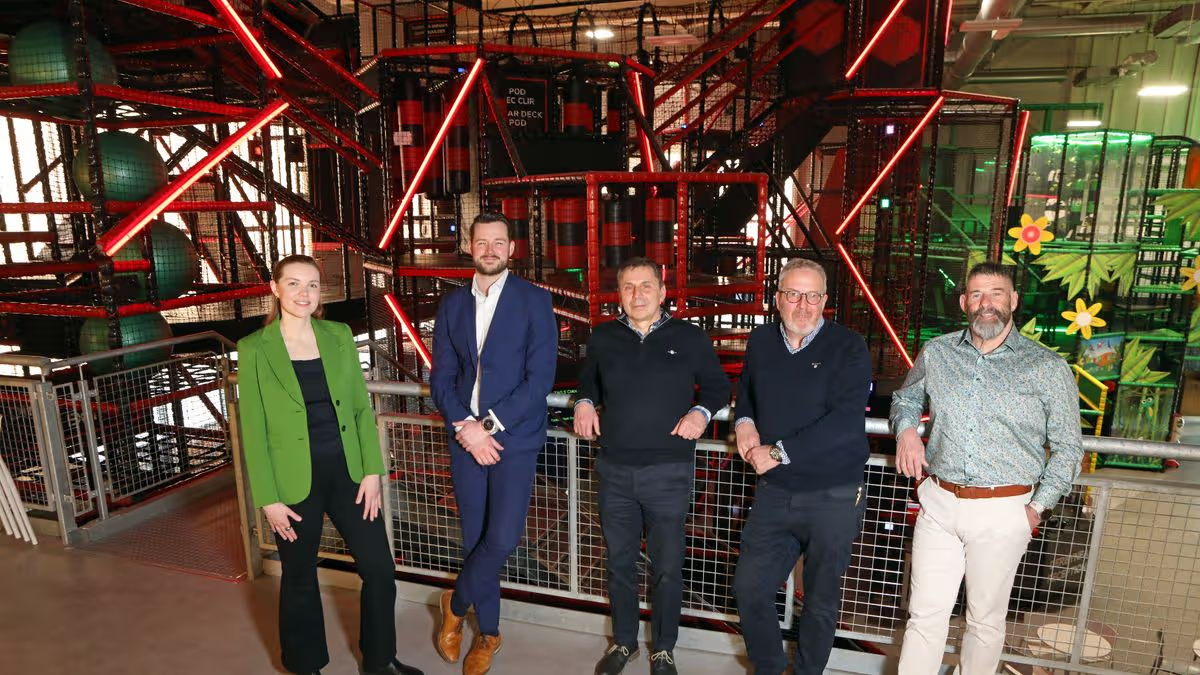
Pauline Black helps celebrate hub funding
The Lottery funding for the Destination Ball Hill group will allow it to expand services for locals.
Business
Pfizer Lyme disease vaccine fails trial, company to seek FDA approval
A tick (Ixodida) – carrier for several diseases of humans and animals, for exampel the dangerous Lyme disease, babesiosis, anaplasmosis, Powassan virus disease and many more.
Fhm | Moment | Getty Images
Pfizer on Monday said it will seek regulatory approval for a Lyme disease vaccine candidate despite the shot failing a late-stage trial.
Pfizer said the vaccine missed the trial’s statistical goal because not enough people in the study contracted Lyme disease to be confident in the results. Still, the company said the shot reduced the rate of infection by more than 70% in people who received the vaccine versus placebo, efficacy the company thinks is strong enough to take to regulators.
“The efficacy shown in the VALOR study of more than 70% is highly encouraging and creates confidence in the vaccine’s potential to protect against this disease that can be debilitating,” Pfizer Chief Vaccines Officer Annaliesa Anderson said in a statement.
A vaccine for Lyme disease isn’t expected to become a best-seller for Pfizer, with the company’s partner Valneva estimating peak annual sales of $1 billion. Pfizer expects overall revenue of around $60 billion this year, with its Covid-19 vaccine representing more than $5 billion of that forecast.
But Pfizer had billed the Lyme vaccine results as one of its major catalysts this year, and it represented a chance to introduce the only human vaccine for Lyme disease.
Moving forward with a shot that technically failed a clinical trial under an administration that has preached stricter scrutiny for vaccines may prove risky for Pfizer, and it could serve as a litmus test for vaccine policy in the U.S.
Lyme disease is an illness caused by bacteria most commonly spread to humans from ticks. It can cause arthritis, muscle weakness and pain. About half a million Americans are diagnosed with or treated for Lyme disease every year, according to estimates from the Centers for Disease Control and Prevention.
Despite the disease’s prevalence, especially in the Northeast, there isn’t a vaccine for humans available. A company that would later become GSK introduced a shot called LYMErix in 1998 but pulled it only a few years later after public concerns about safety tanked demand. That experience hobbled development of Lyme vaccines for humans, though multiple companies now make them for dogs.
Pfizer and Valneva have faced their own setbacks. In 2023, the companies dropped about half of the participants in the Phase 3 trial because of quality concerns with third-party clinical trial site operator Care Access. The trial had initially enrolled about 18,000 people and after the cuts ended up with about 9,400.
The companies’ vaccine targets the outer surface protein A of the bacteria that cause Lyme disease. A vaccinated person creates antibodies that are passed to a tick and prevent the bacterium from being transferred from the tick to the human. The series involves three shots in the first year, then a booster dose the following year.
The companies said they didn’t observe any safety concerns in the trial.
-
Fashion3 days agoWeekend Open Thread: Adidas – Corporette.com
-
Crypto World3 days ago
NIO (NIO) Stock Plunges 6.5% as Shelf Registration Sparks Dilution Worries
-
Politics3 days agoJenni Murray, Long-Serving Woman’s Hour Presenter, Dies Aged 75
-
Tech6 days agoAre Split Spacebars the Next Big Gaming Keyboard Trend?
-
Business7 days agoHow the UK and China Trade Agreement Could Shape UK Businesses in 2026
-
Crypto World2 days agoBest Crypto to Buy Now: Strategy Just Spent $1.57 Billion on Bitcoin During Fear While Early Investors Quietly Enter Pepeto for 150x Potential
-
News Videos5 days agoRBA board divided on rate cut, unusually buoyant share market | Finance Report | ABC NEWS
-
Crypto World2 days agoBitcoin Price News: Bhutan Sells $72 Million in BTC Under Fiscal Pressure, but the Smart Money Entering Pepeto Sees What the Market Does Not
-
Politics5 days agoThe House | The new register to protect children from their abusers shows Parliament at its best
-
Tech3 days agoinKONBINI Lets You Spend Summer Days Behind the Register
-
Politics6 days agoReal-time pollution monitoring calls after boy nearly dies
-
Crypto World5 days agoCanada’s FINTRAC revokes registrations of 23 crypto MSBs in AML crackdown
-
Sports4 hours agoRemo Stars and Kano Pillars Strengthen Survival Hopes in NPFL
-
NewsBeat5 days agoResidents in North Lanarkshire reminded to register to vote in Scottish Parliament Election
-
News Videos5 days agoPARLIAMENT OF MALAWI – PAC MEETING WITH REGISTRAR OF FINANCIAL ON AMARYLLIS HOTEL – INQUIRY LIVE
-
Politics4 days agoGender equality discussions at UN face pushbacks and US resistance
-
Business24 hours agoNo Winner in March 21 Drawing as Prize Rolls to $133 Million for Next
-
Business5 days agoWho Was Alex Pretti? 5 Key Facts About the ICU Nurse Killed by Federal Agents in Minneapolis
-
Tech19 hours agoGive Your Phone a Huge (and Free) Upgrade by Switching to Another Keyboard
-
Sports4 days ago
Vikings Free Agency Enters Phase 2 with Key Questions

You must be logged in to post a comment Login