

Business
F&O Talk: Nifty looks weak on chart, says Sudeep Shah; outlines HDFC Bank, Bluestone Strategy after Q1

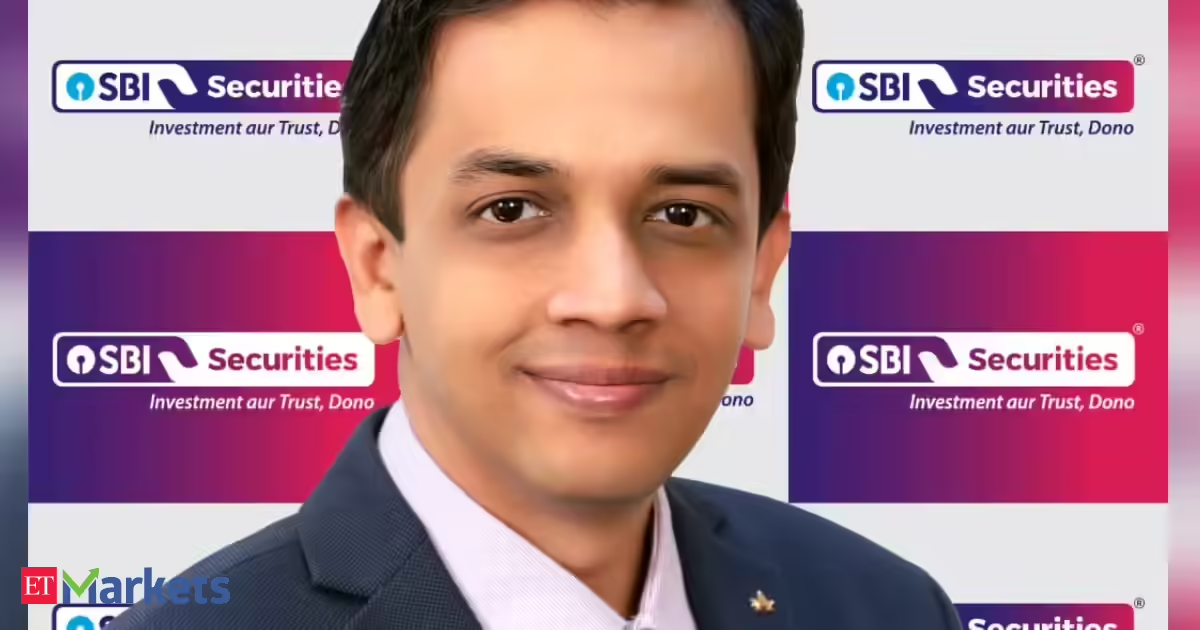
Analyst Sudeep Shah, Vice President and Head of Technical & Derivatives Research at SBI Securities, interacted with ETMarkets regarding the outlook for the Nifty and bank, as well as an index strategy for the upcoming week. The following are the edited excerpts from his chat:
Nifty slipped over 2% this week, plunging in all five sessions. What is your view on Nifty going forward?
Last week, the benchmark Nifty index traded within a narrow range during the first two trading sessions. However, selling pressure intensified during the final three sessions, resulting in a sharp correction. Eventually, the index ended the week at 23,767 level, registering a decline of 2.33%. A sharp surge in Brent crude oil prices amid the escalation of the US-Iran conflict, coupled with a notable rise in the US 10-year bond yield, weighed heavily on investor sentiment across global markets. Amid this sharp deterioration in sentiment, Friday’s price action offered the first sign that the decline may be approaching a crucial juncture.On Friday, the index found support near the 61.8% Fibonacci retracement level of its recent upward rally from 23,070 to 24,531 and staged a modest pullback. Consequently, the index formed a bearish candle with a small lower shadow on the weekly chart, indicating some buying interest at lower levels. Notably, Friday’s recovery was largely driven by strength in the large-cap space. While the Fibonacci support triggered a pullback, the momentum indicators tell a more cautious story beneath the surface.

From a technical perspective, the index is currently trading below its key short and long-term moving averages, while the 20-day and 50-day EMAs are trending lower, reflecting weakening momentum. The daily RSI is hovering around the 43 mark and remains below its 9-day average, indicating subdued momentum. Meanwhile, the MACD histogram continues to remain below the zero line, further reinforcing the prevailing bearish undertone. With momentum still tilted in favour of the bears, the battle now shifts to a crucial support zone that could determine the index’s next directional move.
Going ahead, the 23,650–23,600 zone will act as an important support area for the index. A sustained move below 23,600 could extend the correction towards 23,450, followed by the 23,300 level. On the upside, the 50-day EMA zone of 23,950–24,000 is likely to act as an important hurdle.
Rough week for bank stocks as the index declined over 3% this week. How are charts looking for Bank Nifty?
The Bank Nifty witnessed heightened volatility during the week. After scaling a high of 58,228, the index came under sharp selling pressure and underwent a meaningful correction. However, buying interest emerged near the 56,000 level, helping the index stage a strong recovery from lower levels. Despite the rebound, Bank Nifty ended the week around 56,700, registering a loss of more than 3%.
On Friday, the index briefly slipped below its crucial 200-day EMA, indicating weakness in the broader trend. However, it managed to recover and close above this long-term moving average, highlighting the importance of this support zone. Meanwhile, momentum indicators and oscillators are currently signalling a sideways to range-bound trend, suggesting a lack of strong directional momentum in the near term.
Going forward, the 56,000-55,800 zone is expected to act as a key support area, as it coincides with the 50% Fibonacci retracement of the previous upward rally. A decisive and sustained breakdown below 55800 could trigger another round of selling pressure, paving the way for a sharper correction towards 55,000, followed by 54,400 in the short term.
On the upside, the 20-day EMA zone of 57,300-57,400 is likely to remain a significant resistance hurdle. Any pullback rally is expected to face supply pressure around this region, and a sustained move above it would be required to improve the near-term technical outlook.
What is the options data indicating about Nifty’s near-term trading range, and where are the key Call and Put positions building up ahead of the Monthly expiry?
The Put Call Ratio (PCR) slipped from 1.13 on July 17 to 0.68 on July 23 as bears attempted to gain the upper hand. Following the sharp pullback from 23,600 levels on July 24, the PCR improved to 0.83. Despite this recovery, call writers maintained dominance at the week’s close. Over the past four sessions, a steady rise in open interest alongside falling prices has signaled the buildup of short positions in index futures.
For context, Nifty had been consolidating within the 24,531–23,785 band for 28 sessions and the July 24 close below the lower end of this range confirmed a breakdown, raising concerns of further downside.
On the downside, the 23,600 strike carries significant put open interest, with put writing nearly eight times higher than call writing. This level is a crucial support zone, coinciding with the strong buying seen on July 24 after Nifty’s gap closed. Ahead of the monthly expiry, Nifty is most likely to hold this level, though any decisive breach could trigger put writers’ exit and accelerate near term weakness. On the upside, the 24,000 strike has notable call open interest, with call writing nearly three times higher than put writing, making it a strong resistance zone to watch as expiry approaches.
What are some stocks that are looking good for the week ahead?
Despite the broader market weakness, a few stocks continue to display strong relative strength and positive technical setups. HAL, Manappuram Finance, Titan, and United Spirits are currently looking promising and could remain in focus in the week ahead. Their resilient price structures and favorable momentum indicators suggest the potential for outperformance.
Can you share your outlook on Bluestone, HDFC Bank, Infosys, and IndusInd?
Bluestone delivered its strongest ever weekly close, surging nearly 29% following its quarterly results. The stock now trades comfortably above key short and long term moving averages, with a rising ADX signaling robust trend strength. The MACD’s expanding green histogram bars further reinforce bullish momentum. While a phase of healthy profit taking cannot be ruled out given RSI and ADX nearing peak levels, immediate support lies in the Rs 710–700 zone. The bullish bias is expected to persist as long as the stock holds above this zone.
HDFC Bank ended the week with a sharp 9% loss, recording lower closes across all five sessions. The stock trades well below its key moving averages and has closed below the lower band of the Bollinger Band for four consecutive days, a sign often associated with strong trends. RSI has slipped below 40, reflecting growing bearish momentum. The Rs 725–720 zone remains a critical support, and a decisive breach could trigger further weakness.
Infosys slipped over 5% for the week, closing below its key moving averages. The RSI continues to fall, indicating bearish momentum, while DI has crossed DI+ on the ADX with widening lines, underscoring strong seller control. The MACD line remains below the zero line on both daily and weekly charts, reinforcing the bearish bias. As long as the stock trades below the Rs 1,075–1,080 zone, weakness is likely to persist.
IndusInd Bank attempted a consolidation breakout on July 21 but failed to sustain higher levels, slipping below its 20 day EMA after quarterly results. RSI dropped sharply from 73 to 52, signaling loss of bullish momentum, while the MACD line crossing below the signal line points to building downside pressure. Unless the stock reclaims the Rs 1,045–1,050 zone, it is likely to remain under pressure.
(Disclaimer: Recommendations, suggestions, views and opinions given by the experts are their own. These do not represent the views of Economic Times)


Israel kills senior Hamas-led police official in Gaza, medics say


With a background as a RN, I analyze healthcare-related stocks by evaluating clinical data, treatment guidelines, and market dynamics. After completing my MBA, I expanded into tech. My writing is influenced by books such as “Superforecasting” and “Fooled by Randomness.”
Analyst’s Disclosure: I/we have no stock, option or similar derivative position in any of the companies mentioned, and no plans to initiate any such positions within the next 72 hours. I wrote this article myself, and it expresses my own opinions. I am not receiving compensation for it (other than from Seeking Alpha). I have no business relationship with any company whose stock is mentioned in this article.
This article is intended to provide informational content and should not be viewed as an exhaustive analysis of the featured company. It should not be interpreted as personalized investment advice with regard to “Buy/Sell/Hold/Short/Long” recommendations. Financial models presented here, including DCF, rNPV, and scenario analyses, are illustrative tools based on the author’s assumptions and are highly sensitive to inputs; small changes can materially alter outputs. The predictions and opinions presented reflect a probabilistic approach, not absolute certainty. Efforts have been made to ensure accuracy, but inadvertent errors may occur. Readers are advised to independently verify information and conduct their own research. Investing in stocks involves inherent volatility and risk. Before making any investment decisions, it is crucial for readers to conduct thorough research and assess their financial circumstances. The author is not liable for any financial losses incurred as a result of using or relying on the content of this article.
Seeking Alpha’s Disclosure: Past performance is no guarantee of future results. No recommendation or advice is being given as to whether any investment is suitable for a particular investor. Any views or opinions expressed above may not reflect those of Seeking Alpha as a whole. Seeking Alpha is not a licensed securities dealer, broker or US investment adviser or investment bank. Our analysts are third party authors that include both professional investors and individual investors who may not be licensed or certified by any institute or regulatory body.
Maine Democrats nominate Troy Jackson to replace Platner in US Senate race
LSEG’s Lipper reviews transaction affecting fixed-income fund flow data
Business
Lionel Messi’s Wife Defends Argentina on Social Media Amid Fierce Backlash After World Cup Final Loss

Lionel Messi’s wife, Antonela Roccuzzo, publicly defended Argentina’s national team this week amid a wave of criticism following the country’s 1-0 loss to Spain in the 2026 World Cup final, as commentators, fellow players and Argentina’s own president weighed in on the fallout from a contentious final.
Roccuzzo reposted a message from writer and media figure Connie Ansaldi on Instagram, marking one of the more direct public responses from within Messi’s inner circle to the criticism that followed the final. “Proud to be Argentine. Argentina is exactly like a family; we may disagree and quarrel amongst ourselves, but if someone from outside comes and insults us, we will tear out their liver,” the reposted message read.
Where the criticism came from
Sunday’s final, decided by a Ferran Torres goal in extra time, drew sharp criticism both for Argentina’s on-field performance and for the team’s conduct following the match, including an on-pitch altercation involving several players. Former England defender Gary Neville was among the most pointed critics of Argentina’s performance, saying on his show “The Overlap,” “They played like a bag of s***. Sometimes, if it looks like s*** and it smells like s***, it is s***. What we watched was a performance that was really poor.”
British commentator Piers Morgan separately branded Argentina’s conduct following the final a “disgrace,” describing their actions as “disgusting,” while German World Cup winner Toni Kroos offered a more measured take, saying simply that “football won” following the result.
Argentina’s president weighs in
The criticism extended beyond football commentary into national politics, with Argentine President Javier Milei taking to social media to defend the country following the loss. “The problem with Argentina is that we stand out. We don’t go unnoticed, people are jealous of us, and we’re good at almost everything. I’m sorry, but someone had to say it,” Milei wrote on Instagram.
A tribute to her husband
Beyond her defense of the broader national team, Roccuzzo also shared an emotional personal tribute to Messi directly following the loss, posting images of the visibly emotional forward on the field after the final whistle. “You will always be the best, @leomessi. Not just because of your talent, but because you have never stopped being yourself,” she wrote. “Because no matter what happens, you never give up; you always fight to the very end and give your all until the final second. That strength, that mindset, and the way you pick yourself up time and time again are what make you unique.”
Roccuzzo continued the message with a broader reflection on what her husband represents beyond the sport itself. “Thank you for showing us every day that true success is built through hard work, sacrifice, and perseverance, without ever losing sight of who you really are. You are the best example for our children and an inspiration to millions of people. I admire you more than words can express, and I feel immensely proud to walk through life by your side. I love you so much.”
A pattern of public support throughout the tournament
Roccuzzo’s tribute following the final continued a pattern of public messages of support she offered throughout Argentina’s World Cup run. Following the team’s dramatic Round of 16 comeback victory over Egypt, a match marked by its own VAR controversy, Roccuzzo posted photos of herself and the couple’s three sons at the stadium, writing “Let’s go Argentina” in Spanish, followed by a brief message directed at Messi: “@leomessi no more words left.” Earlier in the tournament, after Messi scored his 18th career World Cup goal, Roccuzzo wrote, “What a privilege to see you make history again and again.”
Messi’s own reaction to the loss
Messi has largely kept his own public comments about the final brief, expressing deep disappointment over the result while also extending congratulations to Spain. He has not publicly commented on the surrounding criticism of the team’s conduct or offered any indication about whether the 2026 tournament marked his final World Cup appearance, a question that has continued to generate speculation given his age and the physical toll of a lengthy international career spanning six World Cup tournaments.
A well-established partnership
Messi and Roccuzzo, who have known each other since childhood in their hometown of Rosario, Argentina, married in 2017 and share three sons: Thiago, Mateo and Ciro. Roccuzzo has remained a consistent, visible presence throughout Messi’s international career, frequently attending matches with their children and posting messages of support across his major tournament appearances, including Argentina’s 2022 World Cup title run in Qatar.
A broader wave of reaction
Sunday’s final and its aftermath generated a broad range of reactions beyond Roccuzzo’s response, spanning football commentary, political statements and continued debate over specific refereeing and conduct issues during the match itself. That range of reaction reflects both the significance of the result, Argentina’s bid to become back-to-back champions falling just short, and the intensity of scrutiny that has followed the Argentine team throughout the tournament, dating back to earlier controversies during the group and knockout stages.
With the tournament now concluded and questions still swirling about Messi’s international future, attention is likely to remain focused on whether he chooses to continue playing for Argentina heading into future competitions, or whether Sunday’s final marked the close of his World Cup career. In the meantime, Roccuzzo’s public defense of both her husband and the broader national team reflects a family that has consistently presented a united front throughout Messi’s decorated, if occasionally contentious, run on international football’s biggest stage.

The author is a director at a small Boston-based software company where he oversees India operations across HR, finance, and business development. His broader professional background spans entrepreneurship, operations, and management across multiple industries. Earlier in his career, he was involved in building out a bottled beverages plant, reflecting a longstanding interest in business building, execution, and commercial strategy. He also holds a PhD in history and teaches part-time at a local college, bringing a research-driven and analytical perspective to both his professional and investing workHe has been investing in U.S. equities for nearly two decades, having started well before international access to U.S. markets became commonplace for Indian investors. Over time, he has developed a style that sits between value and growth. He is most interested in businesses where long-term earnings potential, competitive positioning, or strategic optionality are not yet fully reflected in the stock price. His work is grounded in valuation, but he also looks closely at business quality, management execution, industry structure, and the durability of growth.His primary sector focus is software, IT, and AI, including the growing application of AI across industries such as healthcare. He is especially interested in companies with scalable models, improving economics, and the ability to compound earnings over time. At the same time, his interests are not limited to technology. He also follows real estate-related opportunities, including REITs, and remains open to writing on other sectors where the investment case is compelling.On Seeking Alpha, he aims to write thoughtful, research-based articles that combine business analysis with valuation discipline. His goal is not simply to identify attractive stories but to assess whether the market is mispricing risk, growth, or long-term earnings power. He writes to share well-reasoned ideas with serious investors, refine his own thinking through public analysis, and contribute to a more disciplined discussion around investing. The author is associated with another Seeking Alpha analyst – Dr. Manimala M.
Analyst’s Disclosure: I/we have no stock, option or similar derivative position in any of the companies mentioned, and no plans to initiate any such positions within the next 72 hours. I wrote this article myself, and it expresses my own opinions. I am not receiving compensation for it (other than from Seeking Alpha). I have no business relationship with any company whose stock is mentioned in this article.
Seeking Alpha’s Disclosure: Past performance is no guarantee of future results. No recommendation or advice is being given as to whether any investment is suitable for a particular investor. Any views or opinions expressed above may not reflect those of Seeking Alpha as a whole. Seeking Alpha is not a licensed securities dealer, broker or US investment adviser or investment bank. Our analysts are third party authors that include both professional investors and individual investors who may not be licensed or certified by any institute or regulatory body.
Business
Only Four Countries Now Host Trillion-Dollar Companies in 2026 as AI Boom Reshapes Global Wealth Map

A small and increasingly exclusive club of nations is now home to the world’s most valuable public companies, as a historic run in artificial intelligence spending pushes corporate valuations to levels once considered unthinkable.
As of late July 2026, roughly a dozen publicly traded companies carry market capitalizations above $1 trillion, and only four countries can claim to host them: the United States, Taiwan, South Korea and Saudi Arabia. The lineup reflects a global economy increasingly organized around semiconductors, cloud computing and the artificial intelligence infrastructure race, with chipmakers and technology platforms crowding out nearly every other industry from the top of the rankings.
The United States still dominates
America remains the undisputed center of the trillion-dollar economy. Nvidia, the AI chip designer, has emerged as the world’s single most valuable company, with a market capitalization exceeding $5 trillion. The Santa Clara, California-based firm’s graphics processing units have become the backbone of AI data centers worldwide, and its rise has been one of the fastest wealth creation stories in stock market history. Nvidia crossed the $1 trillion threshold in 2023 and the $4 trillion mark just two years later, in July 2025, before continuing its climb this year.
Apple and Alphabet, Google’s parent company, both sit above $4 trillion, while Microsoft and Amazon remain comfortably in the trillions as well. Rounding out the American contingent are Broadcom, Meta Platforms, Tesla, drugmaker Eli Lilly, memory-chip manufacturer Micron Technology, and Warren Buffett’s Berkshire Hathaway — the lone non-technology name on the list and the only company built primarily on insurance and diversified holdings rather than software or silicon.
That gives the United States roughly 11 companies above the trillion-dollar line, by far the largest concentration in the world. Analysts tracking global market capitalization say American firms account for the overwhelming majority of value among the world’s top 50 and top 100 public companies, a dominance built on decades of tech-sector leadership that has only accelerated since the generative AI boom began in 2023.
Taiwan’s chip giant joins the ranks
Taiwan Semiconductor Manufacturing Company, commonly known as TSMC, has become Asia’s first trillion-dollar company and remains the most valuable business based outside the United States, with a market capitalization above $2 trillion. TSMC manufactures advanced chips for Nvidia, Apple and nearly every other major technology company, making it one of the most systemically important firms in the global electronics supply chain. Its dominance in cutting-edge chip fabrication has made Taiwan a focal point of both the AI investment boom and broader geopolitical tension over semiconductor supply chains.
South Korea enters the club — twice
South Korea has become the newest entrant to the trillion-dollar tier, and it arrived with two companies rather than one. Samsung Electronics crossed the $1 trillion threshold for the first time this year, becoming just the second Asian company to do so after TSMC. The milestone came amid a sharp rally in chip stocks tied to surging demand for high-bandwidth memory used in AI servers, with Samsung shares jumping more than 15% in a single session in May after the company reported an eightfold increase in quarterly operating profit.
SK Hynix, Samsung’s domestic rival in memory chips, also joined the trillion-dollar tier this year. The combined value of the two South Korean chipmakers has, at times, surpassed the combined market capitalization of China’s two largest internet companies, Alibaba and Tencent, according to data reported by Bloomberg in February — a shift that underscored how the AI-driven memory chip boom has reordered valuations across Asian technology markets. The rally has also helped push South Korea’s benchmark Kospi index above 7,000 points for the first time.
Saudi Arabia’s oil giant remains the outlier
Saudi Aramco, the state-controlled oil producer, continues to hold its position as the world’s most valuable non-U.S., non-technology company, with a market capitalization near $1.7 trillion. Aramco went public on the Saudi Exchange in December 2019 in what remains the largest initial public offering in history, and it remains the only trillion-dollar company built primarily around fossil fuel production rather than software, chips or consumer technology. The Saudi government owns roughly 90% of the company, with the country’s sovereign wealth fund holding a significant additional stake.
A narrower club than before
The current four-country lineup is notably narrower than it was just a few years ago, when Chinese internet giants such as Alibaba and Tencent regularly featured among the world’s most valuable companies. Their retreat from the trillion-dollar tier reflects a broader shift in investor enthusiasm away from Chinese consumer internet platforms and toward the chipmakers and cloud infrastructure providers powering the AI buildout in the U.S., Taiwan and South Korea.
Market analysts note that membership in the trillion-dollar club is fluid. Companies can drop below the threshold during downturns and climb back above it as investor sentiment shifts, meaning the list of countries represented could expand or contract in the months ahead. Walmart, for instance, has approached the trillion-dollar threshold from below in recent months, and further gains in retail or other sectors could eventually add a wider range of industries — and potentially additional countries — to the list.
For now, though, the story of the trillion-dollar economy remains a story about semiconductors and artificial intelligence. Nine of the roughly dozen companies above the threshold are directly tied to AI chips, cloud computing or the software platforms built on top of them. The exceptions — Berkshire Hathaway, Eli Lilly and Saudi Aramco — stand as reminders that insurance, pharmaceuticals and energy can still produce world-beating valuations, even in a market increasingly defined by silicon.
With earnings season underway across major exchanges, investors are watching closely for signs of whether the AI-fueled rally that has lifted Nvidia, TSMC, Samsung and their peers can be sustained, or whether the trillion-dollar club will see further reshuffling before the year is out.
US aimed to send envoys to Brazil to question its electoral system – sources


I am Gen Alpha. I have more than 14 years of investment experience, and an MBA in Finance. I focus on stocks that are more defensive in nature, with a medium- to long-term horizon. I provide high-yield, dividend growth investment ideas in the investing group iREIT®+HOYA Capital. The group helps investors achieve dependable monthly income, portfolio diversification, and inflation hedging. It provides investment research on REITs, ETFs, closed-end funds, preferreds, and dividend champions across asset classes. It offers income-focused portfolios targeting dividend yields up to 10%. Learn more.
Analyst’s Disclosure: I/we have a beneficial long position in the shares of TPG either through stock ownership, options, or other derivatives. I wrote this article myself, and it expresses my own opinions. I am not receiving compensation for it (other than from Seeking Alpha). I have no business relationship with any company whose stock is mentioned in this article.
I am not an investment advisor. This article is for informational purposes and does not constitute as financial advice. Readers are encouraged and expected to perform due diligence and draw their own conclusions prior to making any investment decisions.
Seeking Alpha’s Disclosure: Past performance is no guarantee of future results. No recommendation or advice is being given as to whether any investment is suitable for a particular investor. Any views or opinions expressed above may not reflect those of Seeking Alpha as a whole. Seeking Alpha is not a licensed securities dealer, broker or US investment adviser or investment bank. Our analysts are third party authors that include both professional investors and individual investors who may not be licensed or certified by any institute or regulatory body.


The Investment Doctor is a financial writer, highlighting European small-caps with a 5-7 year investment horizon. He strongly believes a portfolio should consist of a mixture of dividend and growth stocks.
He is the leader of the investment group European Small Cap Ideas which offers exclusive access to actionable research on appealing Europe-focused investment opportunities not found elsewhere. The a focus is on high-quality ideas in the small-cap space, with emphasis on capital gains and dividend income for continuous cash flow. Features include: two model portfolios – the European Small Cap Ideas portfolio and the European REIT Portfolio, weekly updates, educational content to learn more about the European investing opportunities, and an active chat room to discuss the latest developments of the portfolio holdings. Learn more.
Analyst’s Disclosure: I/we have a beneficial long position in the shares of BAC either through stock ownership, options, or other derivatives. I wrote this article myself, and it expresses my own opinions. I am not receiving compensation for it (other than from Seeking Alpha). I have no business relationship with any company whose stock is mentioned in this article.
I also have a long position in BAC.PR.B and BAC.PR.L
Seeking Alpha’s Disclosure: Past performance is no guarantee of future results. No recommendation or advice is being given as to whether any investment is suitable for a particular investor. Any views or opinions expressed above may not reflect those of Seeking Alpha as a whole. Seeking Alpha is not a licensed securities dealer, broker or US investment adviser or investment bank. Our analysts are third party authors that include both professional investors and individual investors who may not be licensed or certified by any institute or regulatory body.

The Most Disappointing Sci-Fi Sequel Of All Time Is A Streaming Hit On HBO Max

Person trapped behind door – North Yorkshire fire calls
Israel kills senior Hamas-led police official in Gaza, medics say


-

 Fashion24 hours ago
Weekend Open Thread: Brooks Brothers
-

 Politics6 days ago
Democrats look to World Cup watch parties to register thousands of voters
-

 News Videos6 days ago
Big Money Is Entering XRP
-

 Crypto World4 days ago
Grayscale Files For Worldcoin ETF, WLD Registers Sharp Rise
-

 Tech5 days ago
Sail Virtually Aboard The “Itanic” With IA-64 Emulator
-
 Tech5 days ago
Turtle Beach Command Series KB7 review: a nifty screen-equipped gaming keyboard
-

 NewsBeat5 days ago
Unregistered fitter used Gas Safe logo on business flyers
-
 Business4 days ago
New Jersey voter registration controversy explained: How 6,600 noncitizens got on the rolls, and what happens next
-
 Entertainment4 days ago
Johnny Depp’s R-Rated Gothic Cult Classic Gets New Release Ahead of Sydney Sweeney Remake
-

 Crypto World3 days ago
Ethics, other provisions in crypto Clarity Act to be further discussed
-

 Tech5 days ago
Watch Flock Safety CEO Garrett Langley discuss the future of surveillance at TechCrunch Disrupt 2026
-
 NewsBeat5 days ago
Shanghai science forum photos show China’s AI and robotics advances in rivalry with US
-

 Crypto World5 days ago
Circle’s President Sold Over 360,000 Shares, The Filings Explain Why
-

 Tech5 days ago
Subway Sandwich Computers Get a Second Life as Gaming Machines
-

 Sports2 days ago
2026 3M Open leaderboard: Scottie Scheffler finds putter in Round 1, sits three back
-

 News Videos2 days ago
The Peugeot Family: How 200 Years of an “Old Money” Dynasty Died in A Boardroom
-

 Fashion2 days ago
16 Dresses for the High Summer Event
-

 Tech6 days ago
How To Use Claude’s Reflect Dashboard And Learn When It’s Time To Touch Grass
-

 Tech5 days ago
The 35 Best Board Games for Family Game Night
-

 Entertainment6 days ago
Stephen Colbert Returns to Social Media After Late Show End
You must be logged in to post a comment Login