
Business
Fiji Declares Formal National HIV Emergency as Infections Surge 12-Fold Over the Past 15 Years, UN Warns


WELLINGTON, New Zealand — Fiji has declared a national HIV emergency after new data showed an estimated one in every 60 people in the South Pacific island nation is living with the virus, prompting the government to significantly expand testing and treatment efforts as officials confront what they describe as a fast-worsening crisis.
According to the Joint United Nations Program on HIV and AIDS, new infections in Fiji have increased twelvefold over the past 15 years. The agency said approximately 9,000 people were living with HIV in the country in 2025, a striking figure for a nation with a population of fewer than one million. UNAIDS data showed that only 39% of those infected knew their HIV status, while just 22% of people living with the virus were receiving antiretroviral treatment, underscoring significant gaps in both diagnosis and care.
The scale of the shift has been particularly stark among specific population groups. Officials said one in every 60 adults in Fiji now has HIV, compared with one in 167 just five years ago. Among pregnant women specifically, the rate is even higher, with one in every 50 estimated to be living with the virus.
Fiji’s Health Minister, Antonio Lalabalavu, announced the elevated emergency designation in a video statement posted to Facebook this week, framing the move as a necessary escalation given the scale of the crisis. “This means HIV is now a national crisis and the government is treating it like one. No more business as usual,” Lalabalavu said. “More people in Fiji are living with HIV than ever before.”
The declaration marks a further escalation from an earlier response. Lalabalavu had designated HIV an “outbreak” in Fiji in January 2025, but said the country’s Cabinet decided this month that classification was no longer a sufficient response to the scale of the problem, prompting the shift to a formal national emergency designation. That elevated status requires government agencies across multiple sectors to coordinate directly with the health ministry in addressing the crisis, rather than treating it as a matter for health authorities alone.
Lalabalavu said part of the apparent rise in case numbers reflects expanded testing efforts reaching more of the population than in previous years, rather than new infections alone. As part of its response, the government said it is expanding access to free HIV testing and free treatment for anyone who tests positive, alongside a needle exchange program aimed at reducing transmission among people who inject drugs. Officials acknowledged, however, that stigma surrounding the illness remains a significant obstacle to getting more people tested and into care. Addressing that concern directly, Lalabalavu said the government’s approach was centered on support rather than punishment. “This is about protecting people — not judging them, not watching them, not shaming them,” he said.
Public health analysts have linked much of the recent surge to the growing use of injected methamphetamine, which has expanded rapidly across the Pacific region as drug trafficking networks increasingly use island nations as transit points for narcotics moving between larger markets. That pattern of rising injection drug use has been identified as a significant driver of new HIV transmissions in Fiji and other Pacific nations grappling with similar trends.
Fiji’s crisis fits within a broader, uneven pattern of HIV prevalence across the Pacific Islands. HIV rates have generally remained low throughout most of the region, with a notable exception in Papua New Guinea, where infections have surged dramatically since 2010, producing the highest and fastest-growing HIV case numbers in the Pacific. Papua New Guinea’s government declared its own national HIV crisis in June 2025, roughly a year before Fiji’s latest escalation.
Public health officials have expressed concern that even nations with historically low HIV prevalence remain vulnerable to sudden outbreaks given the region’s demographic and infrastructure challenges. Most Pacific Island nations have very small populations, and health services in many of these countries are inconsistently funded or unevenly available, conditions that can make it difficult to identify and contain the spread of the virus once transmission begins accelerating.
UNAIDS Executive Director Winnie Byanyima addressed Fiji’s situation directly in a statement, framing the country’s crisis as part of a broader global warning. “A stark reminder to the world that AIDS is not over,” Byanyima said, describing the significance of Fiji’s emergency declaration within the context of ongoing global efforts to control the HIV epidemic decades after it first emerged as a major public health threat.
With Fiji now formally treating HIV as a national emergency, the coming months are likely to bring closer scrutiny of the government’s expanded testing and treatment programs, along with continued monitoring from regional and international health bodies tracking whether the country’s response succeeds in narrowing the substantial gaps in both diagnosis and treatment access that UNAIDS data has identified as central weaknesses in the country’s response to date.

Business
Strategy Shares Soar 13.66% as Bitcoin’s Sharp Rally and Wall Street Upgrades Fuel Renewed Momentum
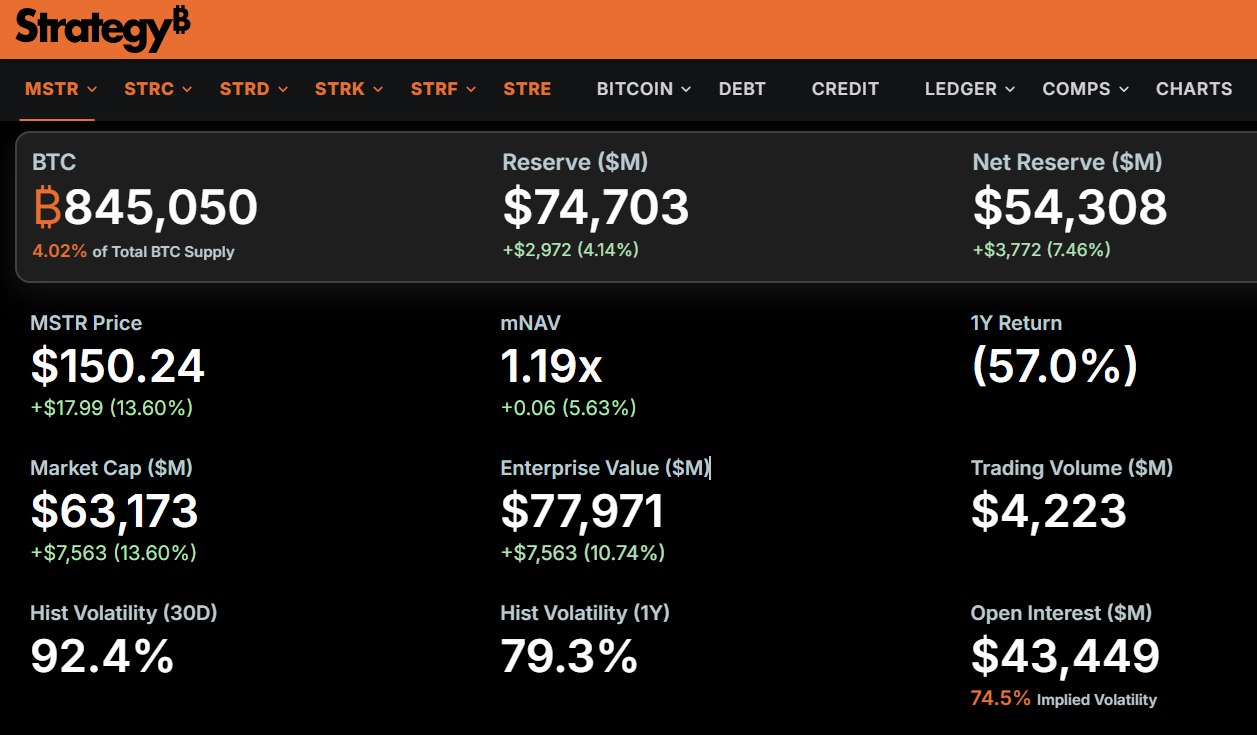
TYSONS CORNER, Va. — Shares of Strategy Inc. surged 13.66% to $150.32 in Friday trading, adding $18.07, as the world’s largest corporate holder of bitcoin rode a sharp rally in the cryptocurrency’s price alongside a wave of bullish price target increases from Wall Street analysts.
Strategy’s stock, which trades as a highly leveraged proxy for bitcoin’s price given the company’s massive holdings of the cryptocurrency, tracked bitcoin’s own advance closely throughout Friday’s session. Bitcoin climbed sharply after the Federal Reserve’s interest rate decision earlier in the week signaled a less aggressive path for future rate increases than some investors had feared, sparking a broad rally across risk assets that extended directly into crypto-linked equities including Strategy, Coinbase and Robinhood. Crypto stocks extended those gains further into Friday’s premarket session after the Securities and Exchange Commission introduced a new exemption for trading tokenized U.S. securities, according to market commentary, adding a fresh regulatory tailwind to the sector.
Strategy, formerly known as MicroStrategy before adopting its current name in August 2025, holds approximately 845,050 bitcoin, a position worth roughly $66 billion at recent market valuations and the largest corporate bitcoin treasury in the world. The company’s executive chairman, Michael Saylor, reaffirmed the company’s long-standing commitment to continuing that accumulation strategy in recent public remarks, saying, “We’re never going to stop” buying bitcoin, even as the company’s own disclosures show it has periodically paused new bitcoin purchases in favor of other capital allocation priorities during short stretches this year.
Indeed, Strategy disclosed that it skipped bitcoin purchases for a second consecutive week between September 8 and September 13, instead deploying $139.3 million toward repurchasing its own common stock and STRC perpetual preferred shares. Over a broader recent window, the company has deployed between roughly $139.3 million and $176.3 million toward those buybacks, even as it maintains a sizable U.S. dollar reserve of approximately $5.1 billion, including between $1.3 billion and $1.44 billion in cash, giving the company meaningful flexibility to continue its buyback program, its bitcoin accumulation strategy, or both, depending on market conditions.
Wall Street’s assessment of the stock has grown increasingly bullish in recent sessions. Barclays raised its price target on Strategy shares to $160 from $125 earlier in the week, according to market data. Alliance Global launched coverage of the stock with a Buy rating and a $217 price target, citing the company’s substantial bitcoin holdings and what the firm described as its potential to outperform bitcoin itself over a six-to-18-month bull market cycle. Other firms, including B. Riley and Canaccord, have also raised price targets or initiated bullish ratings on the stock in recent sessions, while Bernstein has maintained an Outperform rating even after trimming its own price target. Overall, 15 analysts currently cover Strategy with a consensus Strong Buy rating and no sell recommendations, with an average 12-month price target near $228.53, implying substantial potential upside from Friday’s trading levels even after the day’s sharp gain.
Beyond its bitcoin holdings, Strategy has continued to invest in its original business as a provider of artificial intelligence-powered enterprise analytics software, offered through products including Strategy One, which gives non-technical business users direct access to data-driven insights, and Strategy Mosaic, a data governance layer designed to provide consistent definitions and oversight across an organization’s various data sources. The company recently announced plans to launch a seven-city U.S. “AI Transformation Forum” in partnership with Google Cloud, a move market commentators have pointed to as evidence the company remains actively invested in its analytics business rather than functioning purely as a bitcoin holding vehicle.
That software business has provided a source of operating cash flow even as the company’s headline financial results have been dominated by the accounting treatment of its bitcoin holdings. Strategy reported more than $8.2 billion in net losses for its most recent quarter, a figure driven primarily by fair-value accounting adjustments tied to fluctuations in bitcoin’s price during the period, rather than losses from the company’s core software operations.
Strategy’s stock has exhibited extreme volatility over the trailing year, with shares ranging from a 52-week low of $81.81 to a high of $365.21. That wide trading range reflects the company’s role as an amplified proxy for bitcoin sentiment, with the stock tending to move more sharply in both directions than the underlying cryptocurrency itself, a dynamic that has made it a popular vehicle for traders seeking leveraged exposure to bitcoin’s price movements through a conventional, exchange-listed equity rather than direct cryptocurrency ownership.
Incorporated in 1989 and headquartered in Tysons Corner, Virginia, Strategy has undergone a dramatic transformation over the past several years from a traditional enterprise software company into what it now describes as a bitcoin treasury company operating across the United States, Europe, the Middle East, Africa and other international markets, offering investors varying degrees of economic exposure to bitcoin through a range of equity and fixed-income securities.
With bitcoin’s rally showing few signs of slowing as Friday’s session progressed, and Wall Street analysts continuing to raise price targets on the stock in response, investors are likely to keep treating Strategy’s share price as one of the most direct and heavily traded proxies for broader cryptocurrency market sentiment in the sessions ahead, for better or worse given the stock’s well-documented history of sharp moves in both directions.

Neeral Shah launched YardLink in 2018 to move construction buying off the phone and onto a platform. It now lists more than 1,000 vetted UK suppliers across 2,400 depots, and raised a $17.5m Series A led by Beringea in October 2022. He tells Business Matters why an industry burned by software is right to be sceptical.
What do you currently do at YardLink?
I lead YardLink, a B2B digital procurement marketplace for the construction industry. In simple terms, we connect construction businesses with local suppliers for equipment hire, materials and services, all through a single platform.
What that means in practice is that buyers and site managers running multiple projects can source exactly what they want, when they need it, and get full visibility around what has been ordered and what is being spent, in real time, instead of piecing it together from spreadsheets, emails and WhatsApp chains. That covers plant, powered access, tools, site welfare, power and lighting and waste disposal on the hire side, and building materials and fuels on the buy side.
Day to day, my focus splits between product direction, commercial strategy and the team. We are a scaling business, so a lot of my energy goes into making sure the right decisions are being made quickly, the right people are empowered to make them, and that we are staying focused on the problems that actually matter to our customers.
What was the inspiration behind your business?
My family has been involved in the construction supply chain for generations, so I grew up with an instinctive understanding of how the industry works. But the specific moment came while I was providing trade finance for construction procurement. I kept seeing the same problem: enormous amounts of capital tied up in assets that would sit underutilised on sites, and procurement processes that were fragmented, slow and almost entirely manual.
I then spent time in strategy at a fast-growing tech startup, which is where I saw the power of digital marketplaces to solve exactly this kind of problem. The lightbulb moment was realising that what had transformed retail, travel and logistics could do the same for construction procurement, an industry that was, and in many ways still is, running on phone calls and pen and paper. Construction is one of the least digitised industries, with more than 95 per cent of supply chain transactions still conducted over the phone, by email and on paper.
How big is the problem in money terms?
We commissioned research with 250 senior procurement decision-makers which found the average UK construction project runs £7.6m over budget. Procurement is not the whole of that, but it is a meaningful part of it, and it is the part nobody has been measuring properly.
The distance figure tells a similar story. Around 95 per cent of what goes through our platform is delivered from within 15 miles of site, against an industry average of about 60 miles. That is fuel, time and emissions, and it comes from having enough local suppliers on the network to make proximity possible.
Investors have started to notice the category. ProcurePro raised $11m for construction procurement software this year, and there is far more capital going into this than when we started. That is good news, because the problems facing the sector are not going to be fixed by any one company.
Who do you admire?
This has evolved as I have moved through different phases as a founder, so I will answer it in three parts.
In the early days, building YardLink from nought to one, I really admired Brian Chesky, the founder of Airbnb. His early story is full of lessons about product obsession, design thinking and sheer hustle in the face of an industry that told them their idea would not work. What stuck with me most was not just the vision, it was how transparent and empathetic he has been about sharing the ups and downs since.
As the business scaled and my role shifted from founder to CEO, I found myself drawn to Dara Khosrowshahi, the CEO of Uber. I have heard him speak a few times and what comes through is how level headed and calm he is. He stepped into Uber at one of its most turbulent moments and steadied it, not through bravado but through culture, transparency, fairness and a clear set of values.
But if I am honest, the person I admire most is not a founder or CEO at all. It is my grandfather. He ran a small business himself, but what I remember most is his calm. No matter what was happening around him or the family, he carried this steady, reassuring presence, the sense that everything was going to be okay. Building a business will always have chaos in it somewhere. The kind of leader, and person, I want to be is one who brings calm into that chaos, the way he did.
Looking back, is there anything you would have done differently?
I would have trusted myself more. Being a founder is isolating, especially in the early stages. You are constantly looking outward for answers, to mentors, to peers, to your investors, because you assume they have seen more than you have. Being venture-backed, that meant leaning into a growth oriented mindset, and a lot of the advice I received pushed hard in that direction.
But there were moments where that advice sat at odds with what my gut was telling me. I wanted to make sure we were building a business that actually worked, not just chasing growth for the sake of it. Looking back, I did not always have the confidence to push back and say no, even when I believed I was right.
If I could go back, I would tell myself to back my own judgement more often. Advice from smart people is valuable, but nobody understands the business the way the founder does.
What defines your way of doing business?
Reliability and trust, above everything else. Construction is an industry that has been let down by technology before. Platforms that promised transformation and then did not work on a live site, in the middle of a programme, when the stakes were highest. That scepticism is completely rational and it has shaped everything about how we build and run YardLink.
We use a model I would describe as digital plus human in the loop. The platform handles the speed and the visibility, but there are real people on our team who take accountability when something goes wrong and make it right. That combination is what builds trust in an industry that has learned to be cautious about new technology.
The other thing that defines how we operate is a genuine commitment to the supplier side of the marketplace, not just the contractor side. Our supplier network is the product: vetting them properly, measuring their performance continuously and giving them a reason to keep improving their service standard.
What advice would you give to someone starting out?
Just get started. I spent time wanting to get the idea to a point of perfection before committing to it, and what I have learned is that there is no such thing as a perfect moment or a perfect product. The only way to find out if something works is to put it in front of real customers and listen to what they tell you.
Beyond that, say no more than you say yes. Early on there is a tendency to chase every opportunity because everything feels urgent. But focus is the scarce resource in a young business. The founders I have seen struggle most are often the ones doing too many things adequately rather than a few things exceptionally well.
And build the team early. The people around you will determine whether the idea becomes a company. I have been incredibly fortunate to have a team that really cares about what we are building, and that has made every difficult period easier to navigate.


Financial Serenity is a quantitative research column specialized in ETFs. We analyze all ETFs to understand which ones hide traps and which ones deserve attention. The ultimate goal, however, is the product of this selection process: an ETF portfolio capable of maintaining linear price growth (at least indexed to the inflation rate) while generating sustainable, recurring income streams. The analytical key is therefore portfolio construction, asset allocation, and the application of proprietary strategies for average purchase cost management.
Analyst’s Disclosure: I/we have no stock, option or similar derivative position in any of the companies mentioned, and no plans to initiate any such positions within the next 72 hours. I wrote this article myself, and it expresses my own opinions. I am not receiving compensation for it (other than from Seeking Alpha). I have no business relationship with any company whose stock is mentioned in this article.
The author expresses only personal opinions and does not provide financial advice. The content is for informational purposes only and should not be considered as investment recommendations. The author assumes no responsibility for any investment decisions made based on this article. Always conduct your own research or consult with a financial advisor before making any investment choices. The author makes no guarantees regarding the data, and the user agrees that the author shall not be held liable for the user’s use of the data.
Seeking Alpha’s Disclosure: Past performance is no guarantee of future results. No recommendation or advice is being given as to whether any investment is suitable for a particular investor. Any views or opinions expressed above may not reflect those of Seeking Alpha as a whole. Seeking Alpha is not a licensed securities dealer, broker or US investment adviser or investment bank. Our analysts are third party authors that include both professional investors and individual investors who may not be licensed or certified by any institute or regulatory body.


Hit follow for stock deep dives and long-term thesis tracking. Independent Equity Analyst tracking high-quality businesses built for multi-decade compounding. My focus is simple: identifying quality compounders, mispriced growth, and underappreciated optionalities while ignoring short-term noise. Whether evaluating mega-cap tech levers or under-the-radar global equities, I prioritize structural moats, capital allocation, and asymmetric upside. Feel free to reach out for collaborations or to connect!
Analyst’s Disclosure: I/we have a beneficial long position in the shares of VICI either through stock ownership, options, or other derivatives. I wrote this article myself, and it expresses my own opinions. I am not receiving compensation for it (other than from Seeking Alpha). I have no business relationship with any company whose stock is mentioned in this article.
Seeking Alpha’s Disclosure: Past performance is no guarantee of future results. No recommendation or advice is being given as to whether any investment is suitable for a particular investor. Any views or opinions expressed above may not reflect those of Seeking Alpha as a whole. Seeking Alpha is not a licensed securities dealer, broker or US investment adviser or investment bank. Our analysts are third party authors that include both professional investors and individual investors who may not be licensed or certified by any institute or regulatory body.

Taylor Riggs and Stuart Varney discuss Apple’s newly unveiled foldable iPhone Duo. The premium device boasts the thinnest design and largest screen yet, with prices ranging up to $3,000 depending on storage options.
Apple fans eager to get their hands on the latest iPhone crowded stores worldwide on Friday.
The 18 Pro and Pro Max lineup, unveiled last week at Apple’s annual event alongside its foldable phone Duo, features a reimagined camera with a DSLR-like aperture, improving performance in low-light environments and offering enhanced depth of field.
Apple also announced that the new line of iPhone 18s will be able to detect AI-generated photos by creating an unalterable Reference Image that lives alongside the edited one.
INSIDE JOHN TERNUS’ FIRST APPLE LAUNCH EVENT AS CEO: FOLDABLE IPHONE DUO, AI AND MORE

Different color phones in Apple’s iPhone 18 Pro lineup (Apple Inc.)
The iPhone 18 Pro starts at $1,199, and the iPhone 18 Pro Max starts at $1,299 with lease options through Apple Upgrade.
Apple CEO John Ternus, who succeeded Tim Cook earlier this month, visited the company’s flagship store on Fifth Avenue in New York City Friday. He posed for pictures and signed autographs for customers inside and outside the location in Midtown Manhattan.
APPLE UNVEILS FIRST FOLDABLE IPHONE, IPHONE 18 PRO LINEUP, NEW WATCHES AT ANNUAL LAUNCH EVENT
Apple CEO John Ternus poses for a photo with people at the Apple Fifth Avenue flagship store during the launch of the Apple iPhone 18 Pro and 18 Pro Max in New York City Sept. 18, 2026.
The new iPhone marks the launch of the new-and-improved Siri, powered by Apple Intelligence. The new Siri, called Siri AI, was announced in June but was delayed until now to make sure everything was right, according to Apple.
APPLE ENTERS A NEW ERA AS JOHN TERNUS TAKES OVER AS CEO
Customers inside the Apple Inc. store on Regent Street during the sales launch of their latest products in London Sept. 18, 2026.
Siri AI runs on Google Gemini models and is able to perform features such as pulling information from messages, photos, emails and more. Users will also be able to draft messages and emails, edit photos and access past conversations with Siri.

People line up outside the Apple Store at the Menlo Park Mall in Edison, N.J., Sept. 18, 2026. (Fox News Digital)
Business
Coinbase Shares Jump 11.72% as SEC’s Tokenized Stock Rule and Bitcoin Rally Fuel Broader Crypto Surge

NEW YORK — Shares of Coinbase Global Inc. jumped 11.72% to $194.36 in Friday trading, adding $20.39, as the cryptocurrency exchange rode a broad rally across crypto-linked equities tied to a sharp rebound in bitcoin’s price and a new regulatory development from the Securities and Exchange Commission.
Coinbase shares extended gains that began in premarket trading, when crypto-linked stocks including Coinbase, Strategy Inc. and Robinhood Markets all advanced sharply as investors responded to the SEC’s introduction of a new exemption allowing trading of tokenized U.S. stocks, according to market commentary. The move was widely interpreted as a regulatory tailwind for exchanges like Coinbase that have positioned themselves to benefit from the broader tokenization of traditional financial assets onto blockchain infrastructure.
The rally in Coinbase shares also tracked a sharp advance in bitcoin’s own price, which traded above $80,000, up roughly 5.5% over the prior 24 hours, as investors across markets reacted favorably to the Federal Reserve’s interest rate decision earlier in the week, which signaled a less aggressive path for future rate increases than some had anticipated. That relief rally extended broadly across risk assets, with cryptocurrency and crypto-linked equities among the most direct beneficiaries given their historically close correlation with broader shifts in risk appetite.
Beyond the sector-wide rally, Coinbase also benefited from company-specific news. The exchange was named a founding brokerage partner for a new Cashtag Partner Program launched by the social media platform X, an arrangement that will allow X users to initiate stock and cryptocurrency trades directly through the platform. The partnership extends Coinbase’s reach into a large, established social media user base and reflects the company’s ongoing effort to broaden distribution for its trading and custody services beyond its own standalone app and website.
Sentiment toward bitcoin’s broader price trajectory has also turned notably more optimistic among some prominent crypto research analysts in recent days. Zach Pandl, head of research at Grayscale, told clients that he believes bitcoin’s June low near $58,000 marked the bottom of the current market cycle, offering what he described as a “green light” for the asset’s outlook from that point forward, according to reporting on his comments. That kind of bullish institutional commentary has added to the broader wave of positive sentiment that has lifted both bitcoin itself and the equities of companies whose businesses are closely tied to its price.
Coinbase’s own strategic positioning has increasingly emphasized the broader convergence of cryptocurrency infrastructure with both artificial intelligence and the tokenization of traditional financial assets. In investor materials, the company has described crypto as “the native execution rail for the agent-led economy,” pointing to projections that AI-native finance agents could process as much as $35 trillion in transactions by 2030. Coinbase has separately highlighted the rapid growth potential of tokenized real-world assets, an area the company has said currently represents a market of roughly $30 billion but could grow to as much as $16 trillion by 2030, alongside continued expansion of the stablecoin market, which the company has said stood at approximately $305 billion as of the first quarter of 2026 and could grow tenfold to $3 trillion by the end of the decade.
Coinbase’s total crypto trading volume across the industry has grown more than 50-fold over the past seven years, reaching roughly $14 trillion as of the first quarter of 2026, according to figures the company has cited from CoinDesk Data, CoinMetrics and Dune Analytics, underscoring the scale of growth in the broader market the company has built its business around facilitating.
The company’s leadership team includes chief executive officer and co-founder Brian Armstrong, along with a board of directors that includes venture capitalist Marc Andreessen, Coinbase co-founder Frederick Ernest Ehrsam III, and Shopify president Tobias Lütke, among others, following the company’s most recent annual shareholder meeting held in the spring. Alesia Haas serves as chief financial officer, while Emilie Choi serves as president and chief operating officer.
Coinbase’s stock has traded within a wide 52-week range spanning from $139.11 to $402.16, reflecting the substantial volatility that has characterized the company’s shares since its 2021 public listing, a pattern closely tied to swings in the broader cryptocurrency market the company’s revenue and trading volume depend heavily upon. That volatility has made Coinbase, alongside companies like Strategy and Robinhood, one of the more closely watched proxies for broader investor sentiment toward the cryptocurrency sector as a whole, with the stock’s price movements often amplifying shifts in bitcoin and the broader crypto market during periods of heightened trading activity.
With bitcoin’s rally continuing to build momentum and the SEC’s new tokenized securities exemption still in its early days of implementation, investors are likely to watch closely for further regulatory guidance and additional company-specific partnerships in the sessions ahead, as Coinbase and its crypto-linked peers continue positioning themselves at the center of the broader convergence between traditional finance, artificial intelligence and blockchain-based asset tokenization that has increasingly defined the sector’s growth narrative heading into the final months of the year.
takasuu/iStock via Getty Images
PGIM Target Date Funds Overview
The PGIM Target Date Funds combine PGIM’s asset management capabilities, insights into participant behavior, and Prudential’s leadership in pension risk transfer. Together, these provide us with a unique vantage point to assess the retirement

Troubled Australian developer Bathla granted one-year extension to complete projects

GXO Logistics options sweep points to asymmetric bullish bet through January 2027

James Cobb founded Crowd Connected at the Surrey Technology Centre in Guildford in 2013, after years as a tour manager and event safety specialist. The company now has more than 400 deployments across 30 countries, working with Informa, Live Nation, Coachella, CES and PCMA. He tells Business Matters why he still hoovers the office on a Friday.
What do you currently do at Crowd Connected?
I am the founder and CEO of Crowd Connected, a location intelligence company I started in Guildford in 2013. At its simplest, we help organisations understand what people are actually doing in physical spaces.
The digital world measures everything. Every click, search and transaction leaves a trail of data. Yet a surprising amount of the physical world is still managed using assumptions, rules of thumb, booking systems and somebody’s best guess.
Our technology measures things such as movement, occupancy and dwell time across events, venues, university campuses and other complex spaces. The platform handles indoor positioning, wayfinding, occupancy counting and asset tracking, and it self-calibrates rather than requiring anyone to walk a site fingerprinting it first, so it goes live in hours. We have now supported more than 400 deployments across 30 countries, including Informa events and conferences and music festivals such as Coachella and BST Hyde Park, and tracked more than 250,000 delegates.
My role has changed considerably as the company has grown, but I still spend a lot of time sitting in the gap between the technology and the customer problem. I like understanding why something works, why it does not and whether what we are building genuinely creates value.
We have deliberately remained a fairly small team. There was a time when I was slightly embarrassed about that, because startup culture can encourage you to measure success by headcount. I am not anymore. A small team forces discipline. You have to automate, build products properly and be very clear about what actually creates value. Scaling without locking into fixed costs is a live question for a lot of owner-managers, and headcount is the biggest fixed cost most of them take on.
What was the inspiration behind your business?
Before Crowd Connected I spent many years working in live events, initially as a tour and production manager and later specialising in event safety.
Festivals are effectively temporary cities. You plan everything in extraordinary detail, from how many people can fit into an area, to how quickly a crowd can move through an entrance, to how long it will take to empty a car park. What struck me was how little real measurement sat behind some of those plans.
I remember being challenged at a licensing hearing about where some traffic-flow figures had come from. The honest answer was that I had stood on a corner in a hi-vis jacket and counted how many cars could turn left out of a car park onto a single carriageway in ten minutes.
I simply thought there had to be a better way, so I started experimenting with technology, initially with early GPS equipment and previous-generation Bluetooth devices. At one Wembley Stadium show I strapped a Bluetooth transmitter to a handrail to see whether I could use it to estimate crowd density. That question, how do people really move through physical spaces, has effectively been my career ever since.
Crowd Connected grew out of that frustration with the gap between the plan and reality. Our early breakthrough was an Innovate UK backed proof of concept with Live Nation at Wireless Festival. The technology has changed enormously since then, but the underlying problem is much the same.
Who do you admire?
I admire people who are prepared to discover that they are wrong. One of our company values is “I seek to be corrected, not just validated”, and I increasingly think it is one of the hardest things to do well in business. We are all very good at collecting evidence for what we already want to believe.
I studied history and philosophy of science, so my examples are often historical. Darwin had a rule that any observation contradicting his theory had to be written down immediately, because he knew inconvenient facts fade from memory faster than convenient ones. If you do not admire him for the theory of evolution, you can admire him for that.
Closer to home, I admire people who change their position in a meeting. It is a small thing but I notice it every time.
Looking back, is there anything you would have done differently?
When I was at university, Procter and Gamble contacted me and invited me to an event to learn about its graduate programme. I could not, or more accurately would not, make the date they suggested, and rather arrogantly assumed that if they really wanted me they would work around me. They quite reasonably explained that it did not work like that, so I did not go.
It sounds like an incredibly small decision, because it was. I was not turning down a job. I was turning down lunch. But looking back, it was absolutely the wrong decision, made for the wrong reasons.
What I failed to understand was that an opportunity does not have to be something you want to do for the rest of your life to be worth taking. A few years inside an organisation like P and G could have taught me an enormous amount about management, strategy, finance and leadership, a lot of which I have had to learn the hard way.
What defines your way of doing business?
In live events, you very quickly learn that the plan and reality are not necessarily the same thing. In business I try to apply the same discipline: ask questions, look for evidence and pay particular attention to information that suggests you might be wrong.
I also believe quite strongly in autonomy. Earlier in my career I liked the feeling of being the person with the radio whom everybody needed in order to make a decision. I now realise that is usually evidence of a badly designed organisation. If everything has to come through one person, you have created a bottleneck, not a leader.
Good leadership is about creating systems, giving people responsibility and then letting them get on with it.
What advice would you give to someone starting out?
Treat opportunities as opportunities to learn rather than permanent decisions. When you are young, it is very easy to imagine that every choice closes off all the alternatives. Usually it does not. If an opportunity is going to expose you to interesting people, problems or skills for a couple of years, that can be enormously valuable even if you eventually decide it is not what you want to do.
I would also say that founding a business is considerably less glamorous than people sometimes imagine. I still hoover our office on a Friday. If you calculated my hourly rate you could probably make a convincing argument that this is economically irrational, but that slightly misses the point. In a small company nobody should think a job is beneath them.
And finally, learn to stop as well as start. Once we invest time and emotion in an idea, it becomes surprisingly difficult to walk away from it. Being willing to stop something that is not working can be every bit as important as having the confidence to begin.

Daily Deal: MOGICS Power Bagel Travel Power Strip

PARKOUR VS MONEY HEIST! 6 | BAD GUYS: No ESCAPE, THE BOAT IS HERE… LET’S GO! (BELLA CIAO) Epic POV

Kennedy relative hails ‘national hero’ for standing up to Trump over Kennedy Center

Weekend Open Thread – Corporette.com

Memory prices are slowing because buyers ran out of money

Micron Stock Climbs Above $1,031 as AI Memory Crunch and a $50 Billion Outlook Fuel the Rally
PARKOUR VS MONEY HEIST! 6 | BAD GUYS: No ESCAPE, THE BOAT IS HERE… LET’S GO! (BELLA CIAO) Epic POV

Crypto Crashing Due To This (i’m sorry)

Bro Made A Financial Decision #mindset #selfimprovement #mc #dc #motivation #discipline
-

 Tech5 days ago
The Latest Weird Thing to Play Doom Is the Mapped-Out Brain of a Fruit Fly
-

 Crypto World4 days ago
Kraken Lets xStocks Holders Earn Yield Through DeFi
-

 Entertainment7 days ago
News Specials, Movies, Shows, More
-

 Crypto World2 days ago
US Charges Robinhood Engineers Over Crypto Listing Trades
-

 Crypto World6 days ago
Can AI Build a Startup in 72 Hours? Elon Musk's Team Will Livestream the Test
-

 Crypto World4 days ago
Elon Musk Drops a Bombshell: Grok 5 Could Be the AGI Breakthrough
-

 Crypto World3 days ago
What Is the Status of the U.S.-Iran Peace Talks? Here's What Both Sides Are Saying
-

 Business6 days ago
Rivals Sam Altman and Elon Musk Rally Behind Dario Amodei’s Call for a Slowdown in AI Development
-

 Crypto World7 days ago
Robinhood Chain Never Stopped But its Blobs Did Stop Reaching Ethereum For 14 Minutes
-
 NewsBeat4 days ago
‘Sick conspiracy’: Trump says only guardrails AI needs is ‘a strong and smart (High IQ!) president’ in all-caps rant
-
 Crypto World5 days ago
New Tesla Roadster Uses SpaceX Tech. Will It Impact the Stock Price?
-
 Crypto World4 days ago
NVIDIA Analysis: Attempted Rising Wedge Breakout Amid Pressure on the AI Sector
-
 Entertainment7 days ago
New Horror Movie Officially Earns a Rare Stephen King Recommendation
-

 Business6 days ago
Marvell: Most Potent Setup Of The AI Factory Decade
-

 Crypto World4 days ago
Revolut Attackers Warn of Ongoing Daily Customer Data Leaks
-

 Crypto World4 days ago
DOJ Seeks to Seize $61M in Iran Oil Funds From Binance Accounts It Vouched For
-

 Crypto World7 days ago
Bitcoin ETFs lose $462.7M as Ethereum funds gain $196.9M
-
 Crypto World5 days ago
3 Token Unlocks to Watch in the Third Week of September 2026
-
Crypto World4 days ago
Can Circle’s Arc Repeat Robinhood Chain’s Meme Coin Boom?
-
Business4 days ago
SK Hynix ADRs Fall More Than 6% as Memory Rally Breaks on Fears of Slower AI Spending
You must be logged in to post a comment Login