
Business
Five signs your business has outgrown off-the-shelf software


When standard solutions start holding you back, it might be time to think about something built for your business.
Most UK businesses start with off-the-shelf software. Makes sense. Tools like Xero, Salesforce or Monday.com are affordable, quick to deploy, and cover the basics well. For early-stage companies focused on survival and growth, these ready-made solutions provide what you need without a big upfront investment.
But as your company grows and your processes get more sophisticated, you may notice these standard solutions becoming more hindrance than help. The software that once felt like a perfect fit starts to feel restrictive. Frustrations build. Work slows down.
Here are five warning signs that your business might be ready for bespoke software and what to do about each one.
Your team spends hours on manual workarounds
When staff resort to copying data between spreadsheets, keeping shadow systems in Excel, or doing repetitive tasks that feel like they should be automated, something is wrong. These workarounds creep in gradually; a quick fix here, a temporary solution there, until suddenly your operations depend on a patchwork of manual processes.
Workarounds rarely stay small. What begins as a simple spreadsheet to track information your CRM cannot handle eventually becomes a document that multiple team members depend on. Before long, you have unofficial systems running alongside your official ones. That creates risk.
One manufacturing client we spoke to had three staff spending two days each week manually reconciling data between their CRM, accounting system, and inventory management tool. The annual cost? Over £45,000 in wages alone. That’s before counting the errors that crept in, the delays in decision-making, or the frustration the team felt every week.
Manual processes often also end up kept in the minds of certain colleagues. When the person who understands how all the workarounds fit together goes on holiday or hands in their notice, the business faces real operational risk.
What to look for: Ask your team where they spend time on repetitive data entry or checking. If you hear phrases like “we have to do it this way because the system can’t” or “I keep my own spreadsheet for that”, you’ve found a workaround worth investigating.
You’re paying for features you don’t use
Enterprise software bundles hundreds of features into their pricing tiers. Sales teams show off impressive functionality during procurement. Six months later you realise your team only uses a fraction of what you bought. You’re subsidising functionality designed for completely different industries.
This isn’t just about money, though the costs add up. Research from Productiv found the average UK business wastes roughly 30% of its software spend on unused licences and features. For a company spending £50,000 a year on software subscriptions, that’s £15,000 going nowhere.
Those unused features also create clutter. Staff waste time clicking through menus and options that have nothing to do with their work. Training new employees gets complicated because they need to learn which parts of the system to use and which to ignore. The cognitive load slows everyone down.
There’s also an opportunity cost. Money spent on features you don’t need is money not spent on solutions that could actually change how you work.
What to look for: Review your software subscriptions and honestly assess feature usage. If you’re on an enterprise tier but only using basic functionality, or if new staff consistently struggle to learn your systems, feature bloat may be costing you more than you think.
Your processes have to fit the software, not the other way around
This is the most telling sign. When you find yourself changing how your business operates to accommodate software limitations, the tail is wagging the dog.
Every business has processes that give it an edge – how you handle customer enquiries, manage stock, or deliver services. These processes often evolve over years of learning what works best for your specific customers, suppliers, and market. They represent hard-won knowledge.
Off-the-shelf software is designed for the average business in your sector. It bakes in assumptions about how companies like yours typically operate. If your approach is what sets you apart from competitors, forcing it into a standard mould risks eroding the very thing that makes customers choose you.
A recruitment agency we know built its reputation on a distinctive candidate screening process. When they adopted a popular applicant tracking system, they had to abandon several steps that candidates consistently praised. Within a year, their placement success rate had dropped measurably. The software worked exactly as designed. It just wasn’t designed for their approach.
This cuts both ways. Sometimes adapting to software best practices improves your operations. The question is whether you’re making a conscious choice to adopt better processes, or simply surrendering to software limitations because you have no other option.
What to look for: Listen for phrases like “we used to do it differently but the system wouldn’t allow it” or “I know this seems inefficient but that’s how the software works”. Your tools should support your processes, not dictate them.
Integration has become a nightmare
Modern businesses rely on multiple software tools working together. The average SME now uses between 20 and 50 different applications. When your systems can’t talk to each other properly, you end up with data silos, duplicate entries, and a fragmented view of your operations.
Maybe your ecommerce platform doesn’t sync properly with your warehouse management system. Your CRM can’t pull data from your accounting software without someone doing it manually. Your project management tool doesn’t connect with your time tracking system, forcing staff to log hours in two places.
These headaches multiply as businesses grow. Each new application creates potential connection points with every existing system. What starts as a manageable set of integrations can quickly become an unwieldy web of data flows, many of which break whenever one vendor updates their software.
The real cost is often invisible. Decisions made on incomplete information. Customer service hampered by lack of data access. Management flying blind because no single system shows the full picture.
Some businesses try to solve this with integration platforms like Zapier or Make. These work well for simple connections but struggle with complex business logic. They can also become a maintenance burden, with automations breaking silently and causing data problems that take hours to untangle.
What to look for: Map out how data flows between your systems. If you rely on manual exports, scheduled batch updates, or integration tools with dozens of conditional rules, your systems may have outgrown their ability to work together.
Your software vendor’s roadmap doesn’t match yours
Software companies prioritise features based on what benefits their largest customer segments. If your business has specific requirements outside the mainstream, you may wait years for functionality that never arrives. Worse, you might watch features you depend on get removed.
This dependency creates strategic risk. When your plans hinge on whether a third-party vendor decides to build a particular feature, you’ve lost control of something important. You’re essentially outsourcing part of your product roadmap to a company with entirely different priorities.
The challenge gets sharper as your business becomes more sophisticated. Early-stage companies need generic functionality – invoicing, customer management, basic reporting. Standard software handles this fine. But as you develop your own processes, enter niche markets, or pursue differentiation strategies, your requirements diverge from the mainstream.
Vendor lock-in makes it worse. Once your data and processes are embedded in a platform, switching costs become substantial. You may find yourself stuck with software that no longer serves you well, but which you can’t easily leave.
What to look for: Review your feature request history with key vendors. If you’ve been asking for the same functionality for years without progress, or if recent updates have moved the product away from your needs, the fit between your business and your software may be weakening.
What are the alternatives?
Seeing these signs doesn’t mean you need to replace everything tomorrow. Wholesale system replacement is expensive, disruptive, and often unnecessary. Many businesses do better with a hybrid approach – keeping off-the-shelf tools for commodity functions like email or basic accounting, while investing in bespoke software development for the processes that truly set their business apart.
The UK bespoke software market has changed a lot in recent years. Fixed-price quotes, transparent development processes, and specialist firms focused on SMEs have made custom software accessible to businesses that would never have considered it a decade ago. Projects that once needed enterprise budgets can now be delivered at realistic prices for growing companies.
The key is working out where standard software genuinely serves you well, and where it’s quietly costing you money, time, or competitive advantage. Not every process needs custom software. But the processes that define your business – that create value for customers and set you apart from competitors – often benefit from purpose-built tools.
A sensible approach might involve:
- Auditing your current software to identify which tools deliver value and which create friction
- Adding up the cost of workarounds including staff time, error rates, and delayed decisions
- Prioritising pain points based on business impact rather than technical complexity
- Starting small with a focused project that addresses your most pressing issue
Making the business case
If you’re thinking about bespoke software, you’ll likely need to justify the investment to stakeholders. The good news is that the business case often writes itself once you add up the hidden costs of your current setup.
Start by documenting the workarounds your team performs daily. Calculate time spent on manual data entry or reconciliation. Note the features you wish existed but can’t find. Estimate revenue lost to slow processes or poor customer experiences. This audit often shows that the true cost of sticking with ill-fitting solutions far exceeds the investment needed for something better.
Think about the strategic value too. Software built around your processes protects and strengthens what makes your business distinctive. It can become a competitive advantage – something rivals can’t simply buy from the same vendor you use.
Choosing the right partner
If several of these signs ring true for your business, it’s worth talking to a specialist UK software company. A good one will help you work out whether bespoke software makes commercial sense and be honest when it doesn’t.
Look for partners who take time to understand your business before proposing solutions. Be wary of those who jump straight to technical specifications without grasping the commercial context. The best development relationships feel collaborative, with technical expertise applied in service of business outcomes.
Ask about their experience with businesses your size and in your sector. Request references and speak to previous clients. Understand how they handle changes in requirements, because they will come up. Clarify pricing structures upfront – surprises in software development tend to be expensive.
The decision to invest in bespoke software is a big one. But for businesses showing these warning signs, it can unlock operational improvements that standard solutions simply can’t deliver.


Black Hawk Acquisition receives Nasdaq notice for market value non-compliance

A Sam’s Club in Miami, July 7, 2025.
Joe Raedle | Getty Images
Walmart-owned Sam’s Club said Wednesday it will raise its annual membership fee by $10.
Starting on May 1, the warehouse club — which directly competes with Costco and BJ’s Wholesale Club — will charge $60 per year for basic membership and $120 for its higher-tier option. It currently charges $50 for club members and $110 for Plus members and last raised annual fees in October 2022.
In a statement, Sam’s Club said it has “adjusted our membership pricing to support the things our members love,” citing perks including its assortment, expanded hours and better curbside pickup and delivery options.
Still, those new fees will be below those of rival Costco, which charges $65 per year for its basic membership and $130 per year for its higher-tier option. Costco hiked its fees in 2024. The fees bring Sam’s Club in line with BJ’s, which charges $60 per year for its basic membership and $120 per year for its higher-tier membership.
Sam’s Club is hiking membership fees as its annual sales and membership grow. Net sales for Sam’s Club in the U.S. grew by about 3.1% to $93 billion last fiscal year, according to Walmart’s fourth-quarter earnings report. That growth has come in part from an expanding digital business: In the holiday quarter, the warehouse club’s e-commerce sales increased by 23% year over year. Store and website visits increased, too, with transactions rising 5.3% year over year in the same quarter.
Higher gas prices, driven by the Iran war, have drawn more attention to one of warehouse clubs’ key perks: cheaper prices at the pump. Gas prices hit a nationwide average of $4.018 this week, according to travel association AAA. That’s the highest price since August 2022, when the Russia-Ukraine war drove up energy prices.
Sam’s Club does not disclose its membership count, but said that it hit a record high in the three-month quarter that ended Jan. 31. Membership for the retailer is estimated to be more than 30 million, with a similar proportion of members opting into the higher-tier level as at Costco, according to David Bellinger, a retail analyst for Mizuho Securities.
Based on the equity research firm’s estimate, the membership fee increase could bump up annual income from the subscriptions by more than $200 million. That would translate to a 2 cent annual earnings per share lift for parent company Walmart.
Membership fee increases for current members will take effect when they renew at the end of their billing cycle. Sam’s Club said it emailed members about the fee increase on Tuesday.
As part of the fee change, Sam’s Club said members of its higher-tier level, called “Plus,” will be able to earn up to $750 per year in Sam’s Cash rewards on eligible purchases, up from $500 per year.

The chancellor tells the BBC it is “too early” to say exactly who would get help but hinted any support would not arrive until the autumn.


Sword-wielding Massachusetts man arrested over threats to Trump, FBI says

Form 13D/A Connect Biopharma Holdings Limited For: 1 April

Form 144 Burlington Stores For: 1 April

Nike Inc. shares tumbled more than 14% Wednesday, plunging as low as $45.19 intraday after the athletic giant issued a disappointing sales forecast for the current quarter despite beating Wall Street expectations for its fiscal third quarter.

The stock traded around $45.28 midday, down roughly $7.57 or 14.32% from Tuesday’s close, on heavy volume exceeding 49 million shares in the first hours of trading. The sharp decline pushed Nike shares to levels not seen in nearly nine years and extended year-to-date losses to about 29%, with the stock now down roughly 66% over the past five years.
Investors reacted harshly to Nike’s projection that revenue in the fiscal fourth quarter ending May 2026 would fall 2% to 4%, missing consensus estimates that called for a modest 1.9% increase. Executives also flagged an expected 20% sales drop in the key China market during the period, compounding concerns about the pace of the company’s ongoing turnaround under CEO Elliott Hill.
“This quarter we took meaningful actions to improve the health and quality of our business,” Chief Financial Officer Matt Friend said on the earnings call Tuesday. “We delivered third-quarter results in line with our expectations, and our teams continue to execute with discipline.” Yet the forward-looking comments overshadowed the beat, sending the stock sharply lower in after-hours trading Tuesday and accelerating the sell-off Wednesday.
Q3 Results: Beat on Top and Bottom Lines, But Margins Under Pressure
For the quarter ended Feb. 28, Nike reported revenue of $11.3 billion, flat on a reported basis and down 3% on a currency-neutral basis, slightly ahead of the $11.24 billion Wall Street anticipated. Earnings per share came in at 35 cents, topping the 28-to-30-cent consensus forecast despite a 35% year-over-year decline. Net income fell 35% to about $500 million.
Gross margin contracted 130 basis points to 40.2%, hurt in part by 300 basis points of higher tariffs in North America. Nike Direct sales declined 7%, with digital down 9% and stores down 5%, while wholesale edged up 1%. Running remained a bright spot, helping offset softness elsewhere.
The company highlighted progress on its “Win Now” actions, including marketplace cleanup by pulling some “unhealthy” classic footwear styles — a move that created roughly a five-percentage-point headwind to revenue. Executives said they aim to complete these efforts by year-end to set up stronger growth ahead.
Challenges Mount: China Weakness, Tariffs and Slow Recovery
Nike’s struggles in China have become a major drag. The world’s second-largest market for the brand faces intense local competition, shifting consumer preferences and broader economic softness. The projected 20% decline in the current quarter underscores how quickly conditions have deteriorated there.
Tariffs added another layer of pain. Higher duties on imports from key manufacturing countries like Vietnam, Indonesia and China squeezed margins and raised costs by hundreds of millions of dollars. Broader geopolitical tensions and potential reciprocal tariffs announced earlier in the year have kept pressure on the supply chain.
The turnaround story, which gained traction when Hill returned as CEO in late 2024, has taken longer than many hoped. Nike has focused on elevating product innovation, streamlining inventory, reducing reliance on heavy promotions and strengthening its direct-to-consumer channels. While these steps have improved brand health in some areas, revenue has remained flat to slightly down for multiple quarters.
Analysts noted the guidance reset signals the recovery could stretch well into 2027 or beyond. “The deliberate actions to clean up the business are necessary but are clearly weighing on near-term results,” one retail watcher said. Wall Street consensus price targets still sit well above current levels — around $75 on average — but several firms have grown more cautious in recent weeks.
Market Reaction and Investor Sentiment
The 14% drop Wednesday marked one of Nike’s worst single-day performances in years and amplified frustration among long-term holders. The stock has now declined for four straight years, raising questions about whether 2026 will finally mark an inflection point.
Some value-oriented investors viewed the sell-off as an opportunity, pointing to Nike’s still-dominant brand, massive global reach and consistent dividend — recently declared at 41 cents per share, payable April 1. The forward price-to-earnings ratio hovers in the low 20s, below historical averages for the company.
Others remained wary. “Investors are losing patience with the turnaround timeline,” a portfolio manager told reporters. “Beats on the quarter are nice, but without clearer signs of accelerating growth, the stock will stay under pressure.”
Social media and trading forums lit up with debate. Posts ranged from calls to buy the dip to warnings that Nike could test even lower levels if macro conditions worsen. Options activity showed elevated implied volatility, reflecting uncertainty heading into the rest of the year.
Broader Industry Context
Nike’s woes reflect challenges facing much of the athletic apparel sector. Competitors like Adidas and Under Armour have also navigated inventory gluts, shifting fashion trends away from bulky sneakers and rising costs. Consumers, particularly younger buyers, have grown more selective amid inflation fatigue and economic uncertainty.
At the same time, Nike retains significant advantages: unparalleled marketing muscle, deep athlete partnerships and a pipeline of innovation that includes advanced footwear technology and sustainability initiatives. Running and basketball categories continue to show resilience, while the company invests in women’s products and lifestyle extensions.
Executives expressed confidence that once the “Win Now” cleanup concludes, Nike can return to low-single-digit to mid-single-digit growth with expanding margins. Full-year 2026 guidance remains muted, however, with revenue expected to stay in the low single digits at best.
What’s Next for Nike
Attention now turns to execution in the fourth quarter and updates on the “Win Now” progress. Nike plans to provide more color on its long-term strategy in coming months, including potential new product launches and marketing campaigns aimed at reigniting consumer excitement.
For investors, key questions include:
- How quickly can China stabilize?
- Will tariff impacts ease or worsen under evolving trade policies?
- Can gross margins rebound as inventory normalizes and promotional activity eases?
- Will direct-to-consumer momentum return once wholesale channels stabilize?
Retail analysts recommend monitoring same-store sales trends, inventory levels and regional breakdowns in future reports. Dividend yield has risen with the stock’s decline, offering some income support for patient holders.
Nike remains headquartered in Beaverton, Oregon, with operations spanning design, manufacturing partnerships and retail worldwide. The company employs tens of thousands and sponsors countless athletes and teams globally.
As trading continued Wednesday, the sell-off appeared broad-based with no major rebound in sight. Volume stayed elevated as traders digested the implications for the rest of 2026.
Whether this marks a capitulation low or another leg down will depend on Nike’s ability to translate operational improvements into visible top-line momentum. For now, the iconic swoosh faces a tough stretch as it fights to restore investor confidence in its comeback story.

“Estate agents are having to employ fewer people because they can’t afford them alongside their fees to Rightmove,” said Newman, who is also a former Competition and Markets Authority (CMA) panel member. “As a result, their services can’t be as effective.”

The Guildford Hotel has changed hands after 20 years, purchased by Western Australian billionaire Leonie Baldock for $17.1 million.

Gatestone Institute senior fellow Gordon Chang joins ‘Mornings with Maria’ to warn China’s support for Iran could escalate the conflict and raise risks of a broader global war ahead of President Donald Trump’s Beijing trip.
A new investigation by Congress detailed how China is buying sanctioned oil from rogue regimes around the world at a discount.
The House Select Committee on China released its report on how China is evading sanctions to purchase tens of millions of barrels of oil from countries like Iran, Russia and Venezuela that are the subject of U.S. sanctions, using a “shadow fleet” of tankers to transport sanctioned oil.
It found that sanctioned oil accounted for one-fifth of China’s total oil imports after the country became the buyer of last resort for those rogue regimes, which allowed it to stockpile a large strategic reserve of oil while buying at below market rates.
CHINA-RUSSIA’S COOPERATION HANDS THE US A ‘GRIEVOUS LOSS’ AS IRAN CONFLICT ESCALATES, EXPERT WARNS
Selling oil is a key component of the economies of Iran, Russia and Venezuela, and the report noted that energy exports yielded roughly $120 billion in revenue for Russia in 2024, about 30% of its total revenue.
Iran’s oil revenue is projected at more than $50 billion in 2025, which represents about 35% of its budget. Similarly, crude oil sales were Venezuela’s main source of hard currency.

China has been a key consumer of sanctioned oil from countries like Iran, Russia and Venezuela. (Reuters)
“From this sanctioned crude, China assembled a massive strategic petroleum reserve – roughly 1.2 billion barrels by early 2026, equal to approximately 109 days of seaborne import cover – at well below market cost from the very barrels Western sanctions were designed to strand,” the committee wrote.
The select committee said China relies on foreign suppliers for about 70% of its oil, much of which is delivered by sea routes that could be blockaded by U.S. and allied naval forces during a crisis, such as one stemming from a Taiwan contingency. That vulnerability prompted Chinese leaders to declare energy security an “urgent requirement in great-power competition” and build its massive reserve.
The report detailed how China uses a shadow fleet of tankers, which are generally older tankers that operate through opaque ownership structures under foreign flags with non-Western insurance that allow them to avoid complying with Western maritime laws.
MULTIPLE CHINESE VESSELS RETREAT AT STRAIT OF HORMUZ AFTER IRAN WARNINGS IN RARE ALLY MOVE

China has built a substantial oil reserve in part through shipments conveyed by shadow fleet tankers. (Stefan Sauer/picture alliance via Getty Images)
The panel cited data from commodity data and analytics firm Kpler, which tracks vessel movements and trade patterns using satellite imagery, that found shadow fleet and sanctioned tankers moved about 10.3 million barrels of crude oil per day last year, with about one-third going to China.
Additionally, it moved 2.2 million barrels per day of heavy refined products like fuel oil and crude residuals, with China receiving about 10.3%; while China also received about 45.8% of the shadow fleet’s chemical and biological cargo.
“China is the buyer of oil from desperate, rogue regimes through illicit, hard-to-track channels involving shell companies, Chinese refineries and a shadow fleet of oil tankers,” said Select Committee on China Chairman John Moolenaar, R-Mich.
“This investigation brings to light key information on how the Chinese Communist Party keeps the economies of Iran and Russia afloat while fueling its own authoritarian agenda.”
US WEIGHS ASKING CHINA TO CURB RUSSIAN, IRANIAN OIL PURCHASES
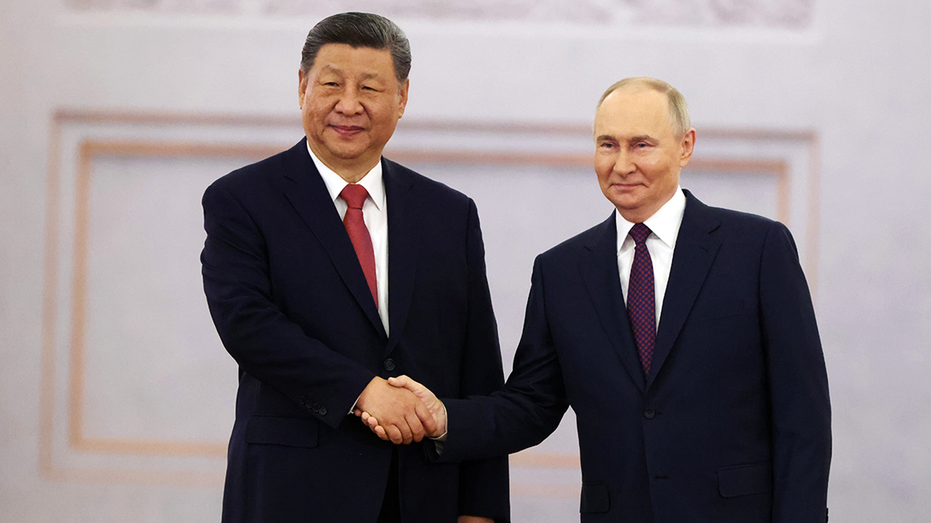
Chinese President Xi Jinping and Russian President Vladimir Putin have deepened the relationship between the two countries, with the energy trade a key component of their partnership. (Contributor/Getty Images)
China’s oil sources have been under pressure after U.S. action to detain Venezuelan leader Nicolás Maduro and enforcement activities targeting Venezuelan oil, as well as the war in Iran, which has slowed the flow of oil tankers through the Strait of Hormuz.
Before the war, China imported 3.4 million barrels per day of oil from Gulf producers via the Strait. While Iran’s shadow fleet continues to make deliveries at near pre-war levels, shipments from other countries in the region have slowed to a halt, prompting China to ban fuel exports and raise retail prices to mitigate the impact of the oil disruption.
The committee’s investigation led to several policy recommendations for lawmakers to consider as they look to counter the flow of sanctioned oil that benefits rogue regimes.
Those suggestions include authorizing sanctions on ports, terminal operators and similar businesses that receive cargo transported by shadow fleet vessels and establishing a whistleblower reward program for reporting sanctions evasion – particularly in transshipment hubs like Singapore, Hong Kong, Malaysia and Dubai.
GET FOX BUSINESS ON THE GO BY CLICKING HERE
They also include having financial regulators probe potential commodity market manipulation and transactions by entities involved in systematically purchasing and routing steeply discounted Russian crude by foreign refiners.
The panel also called for creating a contingency framework with major oil producers like Saudi Arabia, the UAE and Iraq to expand supply because sustained lower prices would reduce the discount available on sanctioned crude oil from Iran and Russia.

DWP admits Youth Job Grant is actually nonsense

Man City hero has wild World Cup nightclub celebration with arm still in sling

Why Market Cap Won’t Matter For XRP


-

 News Videos7 days ago
Parliament publishes latest register of MPs’ financial interests
-

 Business6 days ago
Instagram, YouTube Found Responsible for Teen’s Mental Health Struggle in Historic Ruling
-
 Tech6 days ago
Intercom’s new post-trained Fin Apex 1.0 beats GPT-5.4 and Claude Sonnet 4.6 at customer service resolutions
-

 NewsBeat5 days ago
The Story hosts event on Durham’s historic registers
-

 Sports5 days ago
Sweet Sixteen Game Thread: Tide vs Michigan
-
Entertainment2 days ago
Fans slam 'heartbreaking' Barbie Dream Fest convention debacle with 'cardboard cutout' experience
-
 Entertainment4 days ago
Lana Del Rey Celebrates Her Husband’s 51st Birthday In New Post
-
Crypto World1 day ago
Dems press CFTC, ethics board on prediction-market insider trades
-

 Sports1 day ago
Tallest college basketball player ever, standing at 7-foot-9, entering transfer portal
-

 Crypto World43 minutes ago
Gold Price Prediction: Worst Month in 17 Years fo Save Haven Rock
-

 Tech3 days ago
The Pixel 10a doesn’t have a camera bump, and it’s great
-

 Entertainment7 days ago
HBO’s Harry Potter Series Will Definitely Fail For One Big Reason, And It’s Not J.K. Rowling Or Snape
-

 Tech2 days ago
EE TV is using AI to help you find something to watch
-

 Crypto World2 days ago
U.S. rule change may open trillions in 401(k) funds to crypto
-

 Tech1 day ago
How to back up your iPhone & iPad to your Mac before something goes wrong
-

 Fashion6 days ago
En Vogue in Brown Leather and Tailored Neutrals by Atelier Savoir, Styled by J Bolin
-

 Tech2 days ago
Apple will hide your email address from apps and websites, but not cops
-

 Politics2 days ago
Should Trump Be Scared Strait?
-

 Tech2 days ago
Flipsnack and the shift toward motion-first business content with living visuals
-

 Fashion6 days ago
What Are Your Favorite T-Shirts for the Weekend?
You must be logged in to post a comment Login