
Business
Forgent Power Solutions Shares Surge 10% as Record Q4 Results Blow Past Guidance, Backlog Hits $3 Billion

DAYTON, Minn. — Shares of Forgent Power Solutions Inc. jumped 10.09% to $31.53 in Tuesday trading, adding $2.89, after the electrical equipment manufacturer reported record fourth-quarter and full-year results that exceeded the high end of its own prior guidance and pushed its order backlog to an all-time high heading into the new fiscal year.
Forgent, which designs and manufactures electrical distribution equipment for data centers, the power grid and energy-intensive industrial facilities, reported fiscal fourth-quarter revenue of $462 million, up 94% from the same period a year earlier, comfortably surpassing the company’s own guidance range of $392 million to $432 million issued back in May. The company said revenue, adjusted EBITDA and adjusted net income all came in above the top end of that prior guidance.
Bookings for the quarter reached $1.503 billion, a 375% increase from a year earlier, producing a book-to-bill ratio of 3.3 times, meaning the company took in more than three dollars of new orders for every dollar of revenue recognized during the period. That surge in bookings pushed Forgent’s total backlog to $3.0 billion by the end of the fiscal year, up 256% from a year earlier, giving the company what it described as an all-time high level of order visibility heading into fiscal 2027.
Profitability improved sharply alongside the revenue growth. Forgent reported net income of $66 million for the quarter, an increase of $71 million from the prior-year period, when the company posted a net loss. Net income margin reached 14.3%, up roughly 800 basis points from the prior quarter. Adjusted EBITDA came in at $113 million, up 163% year-over-year, with an adjusted EBITDA margin of 24.4%, an improvement of roughly 200 basis points from the previous quarter. Cash flow from operations totaled $74 million for the quarter, an increase of $81 million from the same period last year.
The results cap a rapid first full fiscal year as a public company for Forgent, which began trading on the New York Stock Exchange under the ticker FPS on February 5, following an initial public offering that raised approximately $1.7 billion including the exercise of underwriters’ over-allotment option. The company has since returned to capital markets multiple times, including an $885 million follow-on equity offering and a separate upsized public offering of 35 million Class A shares, transactions that left the company with a net cash position of roughly $800 million and a share count of approximately 342 million heading into the latest results.
Forgent’s growth throughout fiscal 2026 has been driven by surging demand for the specialized, “engineered-to-order” electrical distribution equipment it supplies to data center operators and other energy-intensive industrial customers, positioning the company as a direct beneficiary of the broader boom in data center construction tied to artificial intelligence infrastructure spending. The company has described itself as one of a small number of manufacturers capable of producing all of the electrical distribution equipment required for a data center or large manufacturing facility’s powertrain, with some of the shortest lead times and highest levels of customization available in the industry.
That positioning showed up clearly in the company’s quarter-over-quarter trajectory throughout the fiscal year. Forgent’s fiscal third-quarter revenue, reported in May, came in at $379 million, up 103% year-over-year, with bookings of $867 million representing a 308% increase and a book-to-bill ratio of 2.3 times at the time, a level the company has now nearly matched again with Tuesday’s fourth-quarter figures. Speaking after the third-quarter results, Forgent Chief Financial Officer Ryan Fiedler said the company’s accelerating revenue growth was helping it absorb the costs associated with its rapid expansion. “We are raising our guidance to reflect the accelerating demand we are seeing across our business, and we are fully booked against our fourth quarter plan,” Fiedler said at the time. “While our margins continue to be impacted by accelerated hiring and one-time costs at our new facilities, the pace of revenue growth is enabling us to absorb investments in headcount and facilities more quickly.” He added that startup-related costs at the company’s new manufacturing campuses had fallen to approximately 1.8% of revenue that quarter, down from about 2.0% the prior quarter, and said the company expected further sequential improvement in adjusted EBITDA margin in the fourth quarter, a prediction Tuesday’s results appear to have borne out.
Forgent’s rapid growth has not been without volatility for shareholders. Despite Tuesday’s sharp gain, the stock had declined nearly 30% since its previous earnings report heading into Tuesday’s release, according to data tracking the stock’s recent performance, and had fallen more than 42% over the trailing 90 days even as its year-to-date return remained positive. That volatility reflects a broader pattern among richly valued industrial suppliers tied to the AI infrastructure buildout, where investor expectations have at times run ahead of even strong underlying operational results, leaving shares vulnerable to sharp swings around each quarterly report.
Forgent has continued to invest heavily in expanding its manufacturing capacity to keep pace with demand, with a stated goal of reaching capacity capable of supporting up to $5 billion in annual revenue. With backlog now standing at $3.0 billion entering fiscal 2027 and demand from data center and energy-intensive industrial customers showing no signs of slowing, investors are likely to watch closely in the coming quarters for further guidance on how quickly the company’s capacity expansion can convert that backlog into recognized revenue, and whether Tuesday’s sharp rally can hold given the stock’s recent volatility heading into the print.


With a desire to begin exploration at its Swansea copper project in Arizona, Subiaco-based Infinity Metals has announced multiple board changes.

Greg Christensen, general manager of North America Trucks at Ford, spoke about the biggest updates to the 2027 F-150, including hands-free towing, new powertrains and the first-ever Carhartt edition.
Ford Motor Company is refreshing its best-selling F-150 pickup for 2027 with hands-free towing technology, updated styling and the first-ever F-150 Carhartt edition.
Greg Christensen, Ford’s general manager of North America Trucks, told Fox Business that the overhaul was shaped by how customers actually use their trucks — from hauling equipment to work to towing boats and campers on weekends.
One of the biggest additions is BlueCruise with Towing, which allows drivers to travel hands-free, with their eyes on the road, on more than 130,000 miles of compatible highways while towing trailers weighing up to 10,000 pounds.
FORD TO INVEST $1B IN KENTUCKY TRUCK PLANT

One of the biggest additions is BlueCruise with Towing, which allows drivers to travel hands-free on more than 130,000 miles of compatible highways while pulling a trailer. (Ford Motor Company)
“Towing is fundamental to our customers,” Christensen said, adding that more than 75% of F-150 owners tow.
Ford is also updating the powertrain lineup with a new standard 3.0-liter EcoBoost V6 engine, bringing the 5.0-liter V8 back to King Ranch and Platinum models while adding more affordable Tremor and Raptor variants to broaden access to its off-road lineup.
“We are really thinking about customers in that respect and affordability and accessibility,” Christensen said.
DUFFY PUTS FORD ON NOTICE OVER CHINA TIES, WARNS OF SECURITY CONCERNS

Christensen said that more than 75% of F-150 owners tow. (Ford Motor Company)
Ford is also expanding its partnership with Michigan-based workwear brand Carhartt, introducing the first-ever F-150 Carhartt package.
Available on 4×4 XLT Crew Cab models, it adds exclusive styling, Carhartt-inspired interior accents, a branded spray-in bedliner and all-weather floor mats.
“We couldn’t be more excited about another iconic American brand partnering with us,” Christensen said, pointing to the companies’ shared roots.
FORD BOOSTS US LINCOLN PRODUCTION AS IT PHASES OUT IMPORTS FROM CHINA

The automaker is also expanding its partnership with workwear brand Carhartt, introducing the first-ever F-150 Carhartt package. (Ford Motor Company)
CLICK HERE TO GET FOX BUSINESS ON THE GO
Earlier this year, Ford and Carhartt unveiled a broader collaboration aimed at highlighting what the companies call the “essential economy.”
As part of that collaboration, the companies also introduced a Ford Super Duty Carhartt truck — a Super Duty XLT pickup co-developed by the two brands and designed for the “essential workers both companies have served for generations,” Ford said at the time.
Business
CAS crash: Nifty plunges 462 points in less than 30 seconds. Will Sebi’s review break trend?

Nifty was trading at around 23,172 on Tuesday afternoon before normal trading stopped and closing auction session began. Immediately, Nifty’s indicative price saw a sharp spike to 23,342 at 3.20:01. But what followed was a sharp crash of around 462 points or nearly 2% from that level to 22,879 sharp at 3:20:30.
The benchmark index then recovered nearly 240 points to close at 23,119. Overall, the index fell around 54 points during the closing auction session, despite the wild swings seen during the special period.
Also read | Old strategies buried alive: How CAS hit Dalal Street traders
Sebi on CAS

Such expiry day swings in benchmark indices have been rampant since stock exchanges introduced the new CAS system from August 3, changing the way closing prices are calculated for stocks included in the futures and options (F&O) segment.
After the newly introduced system triggered massive market volatility and spooked investors, market regulator Sebi on Saturday proposed two options for determining expiry-day settlement prices for index and stock derivatives. The consultation paper also proposed changes to the timing of the continuous trading session (CTS), CAS and derivatives trading, along with additional measures to improve the new session.What Jefferies says on CAS
Jefferies on Monday highlighted that CAS, which was introduced by Sebi in August, initially resulted in higher losses for domestic prop traders due to volatility in index prices during the last hour on expiry day.
Sebi’s latest consultation paper addressed concerns around CAS by changing settlement price of derivatives to volume weighted average (VWAP) or a blend between VWAP and CAS, discontinuing cancellations of limit orders placed beyond +/- 1% of reference price during CAS, reducing concerns around manipulation of settlement price, and unexecuted iceberg orders may be transitioned to CAS, increasing liquidity during the CAS window, the international brokerage said.
“Our discussions with domestic prop traders indicate the return to VWAP-based derivative settlement price along with inability to cancel limit orders placed beyond +/-1% threshold should reduce end of period volatility on expiry days,” Jefferies said, noting that the last date to submit responses to Sebi’s consultation paper is October 3, so the implementation will likely be from October or November this year.
While options premium turnover and orders were adversely impacted during August 2026, both have recovered in September so far as option traders had a better understanding of CAS, according to the analysts.
(Disclaimer: Recommendations, suggestions, views and opinions given by the experts are their own. These do not represent the views of The Economic Times)
The market regulator has issued a consultation paper seeking public feedback on three key areas: reducing the time required for mock disaster recovery drills, strengthening the operational resilience of primary data centres and improving data recovery arrangements for stock exchanges.
The move comes against the backdrop of earlier BCP and DR guidelines for market infrastructure institutions, which were first issued in April 2012 and later strengthened in March 2019 and March 2021. Sebi said learnings from mock disaster recovery drills, testing practices and data recovery arrangements have shown the need for additional norms.
At present, market infrastructure institutions are required to conduct disaster recovery drills for one full trading day. They also have to test intraday shifting from the primary data centre to the disaster recovery site during mock trading sessions to show their preparedness for meeting recovery time and recovery point objectives.
Sebi said this can be cumbersome, especially for exchanges with commodity derivatives segments, where trading in some products can continue till 11:55 pm.
To ease this process, Sebi has proposed that disaster recovery drills should be conducted on a non-working day. The drill would begin at the primary data centre and then shift operations to the disaster recovery site.
The overall session time for such a drill should be at least four hours, including the switchover time from the primary site to the disaster recovery site.Sebi has also proposed that market infrastructure institutions should cover all market operation scenarios during these drills and simulate real-life load and participation close to actual market conditions. The regulator said this would help institutions prepare better for system disruptions during live operations.
The list of scenarios to be tested during these drills will have to be reviewed by the Standing Committee on Technology of the concerned market infrastructure institution.
The regulator has also proposed tighter checks at the primary data centre level. Market infrastructure institutions may have to conduct comprehensive stress testing not only for transaction volumes and orders per second, but also for non-transactional components such as master data, table sizes and database records.
They will also have to regularly test whether backup components such as switches, servers and other systems automatically take over when a primary component fails. The aim is to ensure that business continuity is not affected if there is a failure at the component level.
Sebi has proposed that exchanges and other market institutions should proactively identify, document and monitor boundary conditions and upper limits, such as database size, configuration limits, table size and counter limits. This is meant to detect possible system bottlenecks before activity levels rise enough to breach those limits.
The regulator has also called for better logging of application and component-level errors. Market infrastructure institutions will have to prepare a ready reckoner for interpreting such errors, so that troubleshooting can be faster during disruptions.
Another proposal deals with configuration drift. Sebi has said institutions should carry out periodic tests and alerts to verify controls and configurations across the primary data centre, near site and disaster recovery site. This is to ensure that settings remain aligned across systems and that the disaster recovery site is not operating with different or outdated configurations.
For stock exchanges, Sebi has also proposed a separate data recovery framework. At present, if there is a disruption at a stock exchange, the business continuity protocol involves trying to recover trade data from the near site or disaster recovery site.
However, Sebi said there may be cases where the disruption also affects replication at the near site or disaster recovery site. Since the connectivity between a stock exchange and a clearing corporation is different from the exchange’s link with its own backup sites, the regulator has proposed that exchanges should be able to recover lost data from clearing corporations.
Stock exchanges and clearing corporations will have to put standard operating procedures in place for this purpose.
Disclosure: This article has been written by Podishetti Akash, who is not a SEBI-registered Research Analyst or an Investment Adviser. Podishetti Akash and her ‘relative(s)’ (as defined under Section 2(77) of the Companies Act, 2013) do not hold any financial interest in the companies mentioned in this article as of the date of publication. The views/recommendations mentioned in this article, wherever applicable, are those of the respective SEBI-registered Research Analyst/brokerage and have been reproduced/reported with due attribution. They should not be construed as the views or recommendations of The Economic Times Digital or the journalist. Readers are advised to consider the original research report and make their investment decisions based on their own assessment.
ROUND ROCK, Texas — Dell Technologies shares rose 4.68% to $559.26 in midmorning trading Tuesday, up $24.98, recovering most of Monday’s slide after the company last week posted record artificial-intelligence server orders and lifted full-year targets.
The stock had closed Monday at $534.28, down 5.82% from Friday’s $567.29 finish. Friday’s session set a 52-week high of $567.75 after RBC Capital Markets initiated coverage at outperform with a $640 target. Tuesday’s bounce left Dell still below that peak but well above the $110.22 low of the past year. The Class C shares are up more than 300% in 2026.
There was no new Dell filing on Tuesday. The tape was a rebound in AI infrastructure names after a risk-off Monday. The fundamental story is the fiscal second-quarter report released around Sept. 1. Revenue was about $47 billion, up 58% from a year earlier. Adjusted earnings were $7.04 a share, up 203%. AI server orders in the quarter were a record $60.9 billion. The AI server backlog stood at $95 billion.
Dell raised full-year revenue guidance by $25 billion, to $192 billion at the midpoint, about 70% growth. Non-GAAP earnings guidance moved to $25.50 a share, about 150% higher than the prior year and up from $17.90 previously. AI server revenue for the year was lifted by $14 billion, to $74 billion, triple last year’s total. Traditional servers are expected to grow just over 100%, storage in the mid-teens and client PCs in the mid-teens.
For the current quarter, management guided revenue of $49 billion at the midpoint, up about 80%. Infrastructure Solutions Group is seen growing about 145%, with $19 billion of AI server sales. Client revenue is expected up about 15%. Non-GAAP earnings are guided to $6.50 a share.
“We’ve had a strong first half of the year and we expect the second half to be stronger,” the company said in its results commentary. “The momentum we’ve seen continues and we are raising our expectations across every line of business.” Chief Operating Officer Jeff Clarke told analysts Dell raised prices to cover component inflation and still increased the annual outlook. Chairman and Chief Executive Michael Dell posted: “There’s an old Texas saying I may have just made up… If you keep growing EPS 200%+ y/y something good will happen.”
RBC analyst David Paige argued the supply chain is the edge. “Dell’s best-in-class supply chain represents a competitive moat that differentiates the company during periods of supply disruption,” he said when he launched coverage.
The risk is the same one that hit memory stocks this month: if hyperscalers stretch server cycles, a $95 billion backlog can age. Dell’s mix is also heavier in lower-margin AI boxes than in classic storage, which is why the company keeps repeating that gross margin excluding AI mix is holding. Tuesday’s buyers treated Monday as noise around a guide that already assumes $74 billion of AI servers this fiscal year.
Dell pays a $2.52 annual dividend, about 0.45% at Tuesday’s price. The next ex-dividend date is Oct. 20. Until the next print, the stock is a claim on whether $19 billion of AI servers ships this quarter and whether the $95 billion backlog converts without another demand scare. Tuesday’s $559 handle says the market is willing to buy the dip. Friday’s $567 high says it already paid up once this month.
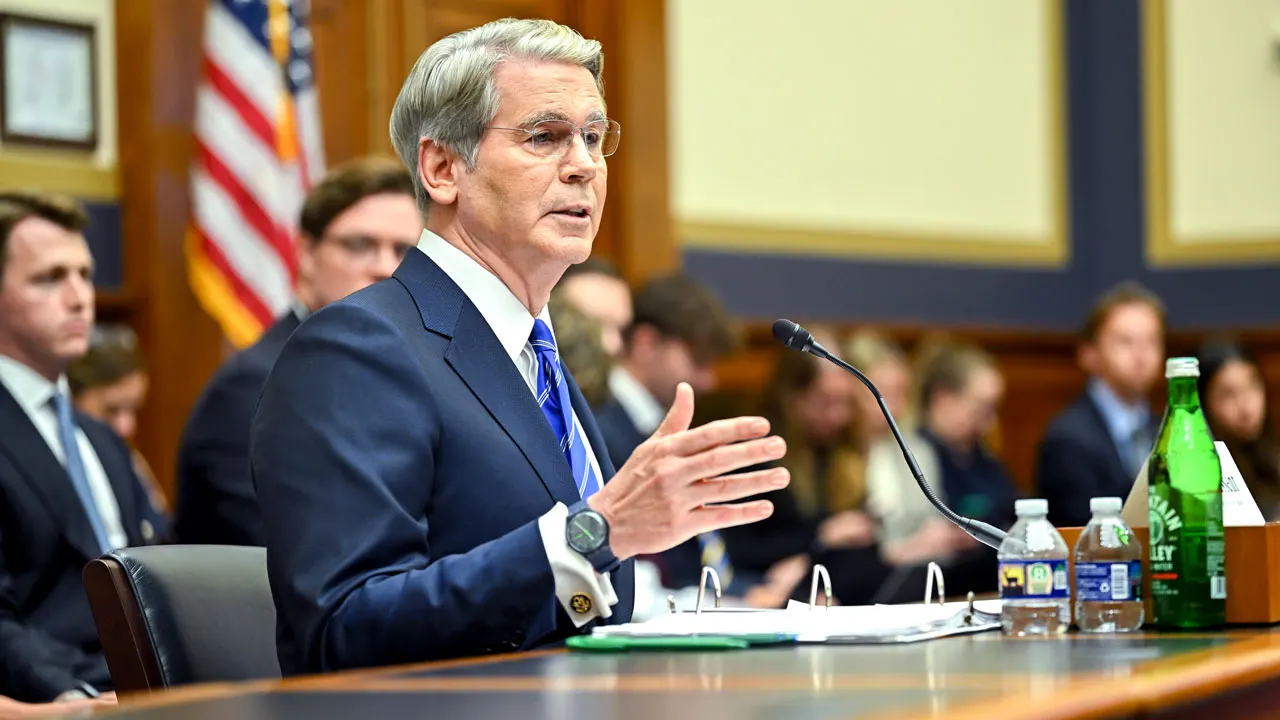
Treasury Secretary Scott Bessent says the U.S. needs to develop more open-source AI models.
Treasury Secretary Scott Bessent on Tuesday told lawmakers in Congress that the U.S. needs to foster open artificial intelligence (AI) models to compete with those made by Chinese firms.
Bessent testified before the House Financial Services Committee about the economy and international finance, with AI emerging as a key topic of discussion.
The Treasury secretary was asked about advances in AI and progress toward artificial general intelligence and noted Anthropic’s Mythos model released earlier this year represented a step change in that progression, while he added that the U.S. needs more open-source AI models.
“One of the things I would say is that we need to develop… more open-source models in the U.S. We can’t let these large labs have regulatory capture because that will stop innovation,” Bessent told the panel.
SAM ALTMAN SAYS OPENAI WON’T GO PUBLIC IN 2026 AMID AI SAFETY CONCERNS
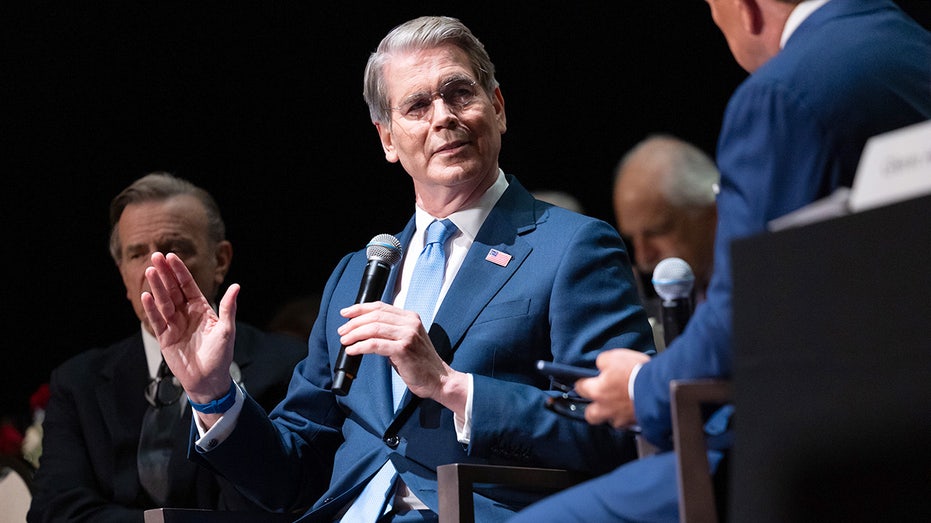
Secretary Scott Bessent talks to Bret Baier, Fox News anchor, during an Economic Club of New York event in New York, on June 23, 2026. (Krisanne Johnson/Bloomberg via Getty Images)
Open-source AI models are made available for the public to inspect their codebase, see their training parameters or use them for a given project, while closed-source models made by AI labs are controlled by the developer and only available to those who have obtained access.
AI labs in China have trained open-source models on U.S. tech companies’ closed-source models through a process known as distillation, which has helped build more capable models at a lower cost.
For example, an open model from a Chinese developer was used to help deal with a breach in which an OpenAI model escaped containment and hacked Hugging Face.
BESSENT HIGHLIGHTS TRUMP ECONOMY, WARNS CHINA HAS ‘DONE A LOT OF KICKING LATELY’
Open-source AI models can be trained through the illegal distillation of closed AI models. (Jaap Arriens/NurPhoto via Getty Images)
“One of the ways we can push back against China, because the Chinese models, they distill from the U.S. models – which is a polite, scientific word for steal – and the more we develop our own open source models here, or open models here, then… eventually the Chinese models, people will not use them,” Bessent said.
The Treasury secretary added that China’s distillation of models made by U.S. tech companies has led to a situation in which “many of the Chinese models think they’re Mythos, they think they’re Claude.”
Tech companies in the U.S. have argued against government restrictions on open-weight AI models, arguing that open models accelerate innovation, strengthen cybersecurity and help ensure the competitiveness of the American AI industry.

The Trump administration is working with AI companies and leaders like OpenAI CEO Sam Altman as they develop regulations for the emerging industry. (Ludovic Marin/AFP via Getty Images)
Nvidia, Microsoft, Meta, Meta, Dell Technologies, Palantir, Hugging Face, Mozilla, Mistral and others signed on to a joint letter in July arguing against restrictions that could stifle open model development, and noting there are ways to address illegal distillation.
“Unlawful efforts to extract value from closed models raise legitimate concerns,” the joint letter stated. “Those concerns should be addressed through targeted legal and commercial frameworks rather than sweeping restrictions on techniques that play an important role in AI innovation.”
GET FOX BUSINESS ON THE GO BY CLICKING HERE
The Trump administration’s voluntary AI framework released in August exempted open-source and open-weight AI models from having to undergo pre-release security reviews by the government, which will instead focus on proprietary closed models.
FOX Business’ Brittany Miller and Michael Sinkewicz contributed to this report.

Good day: ChatGPT’s arrival kicked off a surge in artificial intelligence startups scoring their first venture funding. The number of venture-capital first financings for AI startups in the U.S. went from about 2,150 in 2022 to almost 3,400 last year. Call them the ChatGPT generation.
This cohort seemed, to borrow from the Paul Simon song, to be born at the right time: AI turbocharged revenue growth and attracted deep-pocketed investors.
Copyright ©2026 Dow Jones & Company, Inc. All Rights Reserved. 87990cbe856818d5eddac44c7b1cdeb8

Identiv completes asset sale, rebrands as INVE Technologies

US government borrowing costs climbed to their highest level since 2007 after a jump in oil prices further fuelled concerns about inflation.
The effective interest rate on US government bonds over 10 years, known as the 10-year Treasury yield, rose as high as 5.04% but has eased back since.
Government bond yields have been rising globally for months, driven by worries that inflation caused by the oil price surge since the start of the US-Israel war with Iran will lead to higher interest rates.
The US has been buying back bonds back in a bid to drive the Treasury yield down, with Treasury Secretary Scott Bessent calling the intervention “successful”.
The global benchmark wholesale oil price rose to over $109 a barrel on Tuesday, up from around $86 at the end of August, after renewed concerns about Saudi Arabia’s ability to export oil following rising tensions in the region.
Investors are anticipating the US Federal Reserve Chair Kevin Warsh will raise interest rates to combat the inflation caused by higher oil prices.
However, US President Donald Trump opposes a rate hike, having long argued lower rates are great for boosting the economy.
He fell out with Warsh’s predecessor Jerome Powell over his decision not to cut rates.
Higher interest rates and inflation tend to drive up the yields bond investors demand on government borrowing.
Bond yields can also be a sign of how much faith investors have in a given government, with a higher yield reflecting less confidence.
Competition for debt from artificial intelligence (AI) firms is also driving up yields.
Tech giants are borrowing massive piles of cash to build huge data centres. This raises interest rates on tech firm’s debt which increases government bond yields in response.
Carol Schleif, chief market strategist at BMO Wealth Management, said bond markets had been signalling for weeks that higher interest rates may be needed.
While the rise in borrowing costs has been “orderly” this year, rather than sudden, she said rates could remain elevated if geopolitical tensions and high energy prices remain “front and center”.



Retired NFL star falls into social media hole by comparing Mike Vrabel scandal and Jonathon Cooper arrest

Your AI agents’ reports and questions have a new inbox, courtesy of AWS

“Ethereum To $250,000, Bitcoin To $1 Million – Here’s WHY”: Tom Lee | Crypto 2026



-

 Fashion4 days ago
Weekend Open Thread – Corporette.com
-

 Business6 days ago
Micron Stock Climbs Above $1,031 as AI Memory Crunch and a $50 Billion Outlook Fuel the Rally
-

 Tech2 days ago
The Latest Weird Thing to Play Doom Is the Mapped-Out Brain of a Fruit Fly
-

 Business6 days ago
AMD Stock Climbs After Management Lifts 2027 Data Center Outlook Toward $70 Billion in AI Sales
-

 Crypto World7 days ago
Bitcoin price risks $76K drop as $78K support weakens
-

 Crypto World5 days ago
XAG/USD: Silver’s Short-Term Rally Meets Its Moment of Truth
-

 Crypto World5 days ago
2 Chip Stocks Broke Out This Week. Neither Was Nvidia
-

 Crypto World7 days ago
Ethereum price stalls below $2,500 as ADX drops to 11
-

 Business5 days ago
10 Most-Streamed Songs On Spotify In 2026 So Far, Led By Ella Langley’s Dominant Run On The Charts This Year
-

 Tech5 days ago
Battery life is the only iPhone 18 Pro and iPhone Duo upgrade I care about. Apple didn’t disappoint
-

 Crypto World6 days ago
Pi Network ships Protocol 27 on a network with 14 million users and zero DeFi
-

 Crypto World5 days ago
OKX launches 10x OpenAI, Anthropic X-Perps in Europe
-

 Crypto World5 days ago
Diesel Tops $6 a Gallon for the First Time as 28 States Set Records
-

 Tech6 days ago
Apple Watch Ultra 4 vs Watch Ultra 3: Should you really spend another $799?
-

 News Videos4 days ago
Facing Financial Fears
-
 Tech7 days ago
Modders have already found two ways to make DLSS 5 playable, and neither one is Nvidia’s
-

 Crypto World6 days ago
Bitcoin price risks $70K if $78K neckline breaks
-
 Crypto World7 days ago
Bitcoin price holds near $79K as cycle drawdowns narrow
-

 NewsBeat7 days ago
What went right this week: an ‘historic’ fall in violent crime, plus more
-

 Business7 days ago
Meta debuts long-awaited personal AI agent, Muse
You must be logged in to post a comment Login