Business
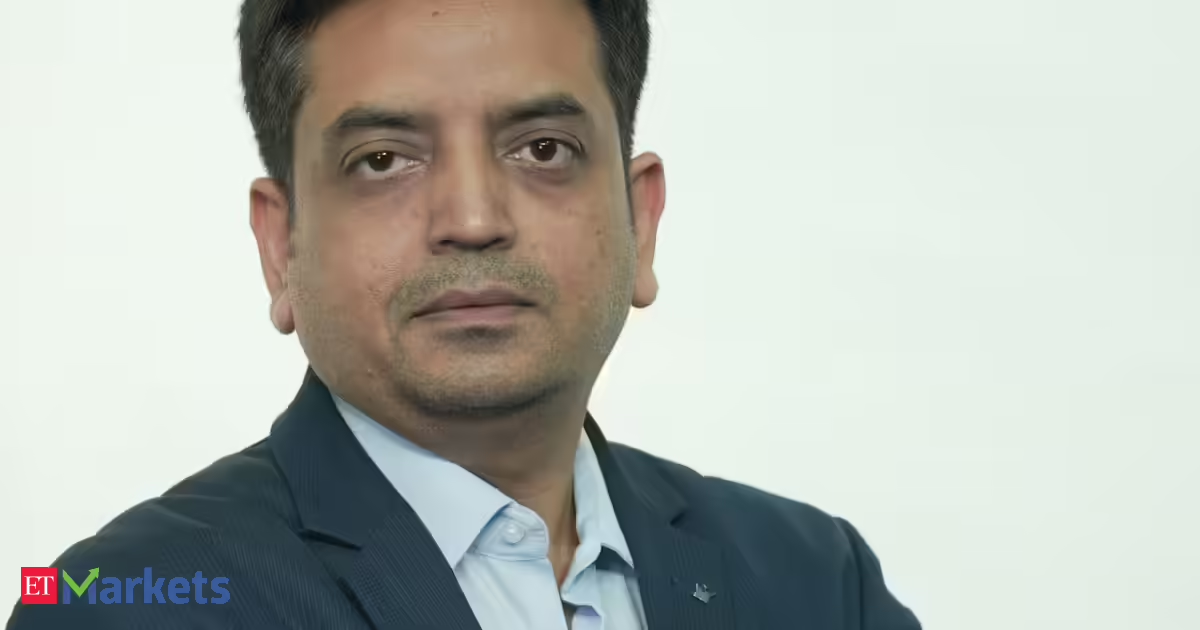
From geopolitics to crude oil: Deepak Jorwal highlights key risks investors must track in 2026
Deepak Jorwal, Head of Products at Motilal Oswal Private Wealth, highlights that developments ranging from conflicts impacting trade routes to fluctuations in crude oil prices are emerging as key risks that could influence inflation, interest rates, and overall market sentiment.
While such uncertainties may trigger short-term volatility, Jorwal emphasizes the importance of staying disciplined, maintaining diversified portfolios, and using global allocation and rebalancing strategies to navigate these evolving risks effectively. Edited Excerpts –
Q) Geopolitical tensions seem to be escalating across regions. How should global investors interpret these developments from a macro and market perspective?
A) Over the past few years, global markets have had to navigate several geopolitical flashpoints—from the Russia–Ukraine conflict to the ongoing tensions in the Middle East.
These events matter primarily because of their impact on energy supply, trade routes and global supply chains, which in turn influence inflation and growth expectations.
These in-turn also affect the monetary & fiscal policies. For example, the Strait of Hormuz carries nearly 20% of the world’s oil supply, so any disruption there can quickly push crude prices higher and influence global inflation expectations.
Similarly, tensions that affect key shipping routes can increase freight costs and disrupt supply chains, creating short-term uncertainty for businesses and markets.However, from a market perspective, history suggests that geopolitical shocks tend to create short-term volatility rather than long-term structural damage.
Over the past 25 years, multiple global conflicts have triggered corrections and heightened volatility, yet the market has in most cases delivered double-digit returns over the following 12–24 months as uncertainty gradually eased and economic fundamentals reasserted themselves.
For long-term investors, these periods often present the most compelling opportunities to accumulate high-quality businesses at attractive valuations. The key is navigate such periods with discipline, patience, and courage.
As the uncertainty eventually settles—as they always do—those who stayed invested and acted decisively during the turbulence are typically the ones who emerge strongest.
However, geo-political uncertainty has become more frequent than earlier. Hence, the need is to construct the portfolio across asset classes to have diversification, following the investment charter and remain committed to that while managing strategic and tactical allocation inline with one’s objective.
Q) Historically, markets tend to react sharply to geopolitical shocks but recover quickly. Is it time to diversify globally and which markets are looking attractive?
A) Global diversification is becoming increasingly relevant for Indian investors, not just from a return perspective but also for currency and opportunity diversification.
While India remains structurally strong—with GDP growth of ~6–7% and healthy earnings outlook—it represents only a small share of global market capitalisation, whereas markets like the MSCI World Index are heavily dominated by the United States at ~60–65%. This highlights the need to look beyond domestic markets to access a broader opportunity set.
A key driver is also currency diversification—investing globally allows exposure to stronger currencies like the US dollar, which can help hedge against long-term rupee depreciation.
Markets like the US, Taiwan, South Korea, and Japan offer access to sectors such as AI, semiconductors, and advanced manufacturing—areas where India has limited representation.
The idea is not to replace India exposure but to complement it—combining India’s domestic growth story with global innovation and sector leaders. This balanced approach helps improve portfolio resilience while capturing growth opportunities across geographies.
Q) How could rising crude oil prices and commodity volatility reshape the global investment landscape?
A) Rising crude oil prices and commodity volatility can significantly reshape the global investment landscape by influencing inflation, growth, and capital flows.
For India, which imports over 85% of its crude needs, sustained high oil prices typically lead to higher inflation, a wider current account deficit, and pressure on the rupee due to increased dollar demand.
This can weigh on consumption and delay interest rate cuts, impacting overall market sentiment. Globally, elevated energy prices tend to keep inflation sticky, limiting central banks’ ability to ease monetary policy and potentially slowing economic growth.
However, the impact is uneven—energy-exporting economies benefit from higher prices, while import-dependent countries face macro pressures. This divergence is important for global asset allocation.
At the same time, commodity dynamics are being reshaped by structural trends. The energy transition and electrification are driving demand for materials like copper, lithium, and nickel, while oil and gas remain critical in the near term.
Additionally, the rapid growth of AI and data centres is increasing global energy demand, linking technology growth more closely with power and commodity markets.
From an investment perspective, this environment is leading to greater interest in real assets and commodities as both inflation hedges and structural plays.
Gold continues to act as a safe haven during geopolitical uncertainty, while metals linked to clean energy and infrastructure are gaining traction.
Overall, commodity volatility is pushing investors toward more diversified portfolios that balance traditional assets with exposure to energy, metals, and global macro themes.
Q) What role does rebalancing play during volatile periods when asset prices move sharply due to geopolitical shocks?
A) Rebalancing is a key discipline during volatile periods, as sharp market moves can quickly shift portfolios away from their intended allocation.
We typically recommend rebalancing either periodically or when allocations deviate by around 5–10%.
This helps investors trim assets that have risen sharply and redeploy into areas that have corrected, enforcing a “buy low, sell high” approach.
Volatility also creates opportunities to add to fundamentally strong assets that may have fallen due to market sentiment rather than real weakness. Over time, consistent rebalancing improves portfolio stability and enhances risk-adjusted returns.
Q) How can investors use ETFs to achieve better asset allocation across equities, debt, gold and international markets?
A) ETFs have become a practical way to build diversified portfolios across equities, debt, gold, and international markets, offering broad exposure in a transparent and relatively low-cost format.
However, investors need to be mindful of a few practical aspects. Liquidity is critical—while large ETFs trade efficiently, less liquid ones can have wider bid-ask spreads, especially for sizeable investments.
Prices may also deviate from the underlying value due to demand-supply dynamics, particularly in volatile markets or in segments like debt , international ETFs.
In addition, ETFs require a demat and trading account, and investors incur brokerage costs on every transaction, which can add up over time compared to some traditional products.
When these factors—liquidity, pricing efficiency, and transaction costs—are carefully considered, ETFs can be effective tools for disciplined asset allocation and portfolio rebalancing.
Q) Which global ETF themes—such as technology, semiconductors, or global indices—do you believe investors should track in the current environment?
A) As investors rethink allocations amid shifting global dynamics, international exposure serves as a valuable complement to India’s structural growth story.
Select global markets offer reasonable valuations, attractive earnings growth potential, and increasing institutional participation, making them compelling for long-term investors.
A balanced approach could include large, stable economies like diversified basket of Emerging Markets, US and thematic ETFs focused on AI, semiconductors, defence, blockchain tech and other high-growth sectors, rather than taking overly granular or speculative bets.
US continues to account for the largest share of global equity market capitalisation and houses many of the world’s leading technology companies. Emerging markets present a good mix of technology, commodities and consumption growth stories. China (~25% weight in EM basket) continues to be one of the largest economies in the world and a major driver of global manufacturing and commodity demand.
Q) Ideally what percentage of capital should be diversified globally for someone who is 30–40 years old? And if someone wants to deploy fresh capital what would you advise?
A) For Indian investors, allocating around 10% of the equity portfolio to global markets is a sensible approach, regardless of age.
The benefits—access to opportunities not available in India, hedge against currency depreciation or benefit from it, and broader diversification to reduce risk—apply to all investors.
This global allocation can be spread across Emerging Market ETFs, broad US market ETFs, and thematic ETFs focused on technology, AI, semiconductors, and data centres, offering both structural growth and exposure to global innovation.
For deploying fresh capital, a staggered investment approach is recommended to manage market volatility.
Investors can leverage the Liberalised Remittance Scheme (LRS), which allows outward investment of up to $250,000 per financial year, or newer platforms through GIFT City, which are gradually broadening access to global markets.
This approach helps investors systematically build meaningful global exposure while maintaining India as the core of the portfolio.
(Disclaimer: Recommendations, suggestions, views, and opinions given by experts are their own. These do not represent the views of the Economic Times)

Business
HAL Trust: Still Trading At A Discount
Business
Earnings call transcript: Scott Technology’s H1 2026 shows steady growth

Earnings call transcript: Scott Technology’s H1 2026 shows steady growth
Business
Google Says No to Back Button Hijacking on Browsers, Details Punishments for the Practice
Google is putting its foot down on “back button hijacking,” an infamous deceptive practice where users are kept on a long loop of pressing the back button but are either not brought anywhere or redirected to other pages instead of the previous one.
While some may deduce that ads are preventing them from going back, the website itself that hosts the ads is the one locking them on that specific page and not allowing them to return.
Google Says No to Back Button Hijacking on Browsers
Google has explained in their latest blog post on the Google Search Central that they are now introducing a new spam policy on back button hijacking, which is now considered by the platform as a deceptive practice.
According to Google, back button hijacking is a practice where users click the “back” button, but instead of being brought to the previous page, they are directed to other pages, made to stay on the current one, or bombarded with unwanted ads.
Google expects that websites should make the back button work as intended, and when users click on it, they should be taken back to the previous page they saw.
With this, Google is now categorizing it as part of malicious practices under the spam policies of the platform, saying that websites that continue these practices in the future will violate its guidelines.
Google Will Punish Back-Button Hijackers, Websites
According to Google, pages that practice back button hijacking “may be subject to manual spam actions or automated demotions,” which will impact the site’s performance in Google Search results.
The company said that it is now giving site owners time to make the necessary changes as the new policy will take effect in two months, specifically on June 15, 2026.
Google said that sites that practice this should ensure that they are not “doing anything to interfere with a user’s ability to navigate their browser history” or else face the punishments that the company has laid out.
Should back button hijacking stem from the site’s included libraries or ad platform, Google still wants them to remove or disable any code to prevent the malicious practice.
The latest policy change came after Google allowed AI-generated headlines from Discover to Search.
Originally published on Tech Times
Business
Ukraine war use gives rise to US Defence deal for Orthocell
The Perth developer of a collagen nerve repair surgical wrap has inked a deal for access to over 200 US Department of Defence medical sites after validating its effectiveness on the battlefield of Ukraine.
Business
Bitcoin climbs to 4-week high of $74,945
The largest cryptocurrency climbed as much as 2.4% to $74,945, its highest since March 17, before paring gains to trade around $74,400. Smaller tokens also advanced, with Ether up 5.5% to over $2,370.
The moves followed President Donald Trump’s claim that Iran had reached out to his administration for potential peace talks, even as the US began a naval blockade of the Strait of Hormuz.
Asian stocks also climbed on optimism that a deal would help ease oil prices and boost economic growth.
Since its crash from an all-time high of $126,000 in October, Bitcoin has been trading in a tight range for the past two months.
However, the token has fared better than many traditional assets since the US war with Iran started at the end of February. It is up more than 10% since Feb. 27, while gold has fallen nearly 10%. The S&P 500 index is roughly flat for the same period.
Business
Donald Trump Claims US-Iran Talks Could Resume in the Next Two Days

US President Donald Trump has claimed that talks between his country and Iran may resume in the coming days.
The revelation was made by a New York Post reporter, who said Trump had called her with the news.
US-Iran Talks May Resume
According to a report by The Guardian, the New York Post reporter said that Trump called to say that he had an update on the situation.
“You should stay there, really, because something could be happening over the next two days, and we’re more inclined to go there,” Trump said.
Trump also sang praises for Pakistan’s army chief, Field Marshal Asim Munir, who is arranging the talks, saying that Munir is doing a “great job.”
“He’s fantastic, and therefore it’s more likely that we go back there,” said the US President.
According to The Guardian, a Pakistani official said that talks may resume soon, but it may take longer than Trump expected.
US Continues Strait of Hormuz Blockade
The update comes as the United States continues its blockade of the Strait of Hormuz. According to the BBC, more than a dozen US warships are now implementing the blockade.
The blockade is believed to be targeting Iran’s oil revenue as well as the significant amount the Middle Eastern country is making from charging tolls.
However, the BBC notes in its report that at least four Iran-linked shipping vessels were able to cross despite the blockade.
China has spoken out against the blockade, calling it “dangerous and irresponsible.”
The country went on to say that the move would only “exacerbate tensions and undermine the already fragile ceasefire agreement.”
Business
Binance founder Changpeng Zhao on ‘Freedom of Money’ book, prison stint and Trump pardon
Binance founder Changpeng ‘CZ’ Zhao sheds light on his book, ‘Freedom of Money,’ as well as his interactions with Sam Bankman Fried and Gary Gensler during an interview with FOX Business’ Charlie Gasparino.
Changpeng Zhao, better known as CZ, is a survivor.
A childhood of poverty in China. Flipping hamburgers to pay his way through college before the self-described computer nerd entered the cutthroat world of high-frequency trading.
Soon came his nascent bet on something called bitcoin, the first and most popular decentralized digital asset, the creation of the world’s largest crypto exchange, Binance, navigating more than a few crypto winters, plus a stint in jail after being targeted during what many believe was the Biden administration’s over-zealous crackdown on all things crypto.
CRYPTO EXPERT EXPLAINS WHY BITCOIN MAKES ‘PERFECT RECORD’ FOR TRACKING DOWN CRIMINALS

Changpeng Zhao, founder and chief executive officer of Binance, attends the Viva Technology conference dedicated to innovation and startups at Porte de Versailles exhibition center in Paris, France, on June 16, 2022. (Benoit Tessier/Reuters)
His new book, “Freedom of Money,” details his life journey, a survivor’s tale, he tells me in an exclusive interview for FOX Business. The book explains how he is still standing, quite nicely, I should add, following a pardon from President Donald Trump and with his enormous net worth estimated at more than $100 billion.
CZ is no longer with Binance, having left when the feds came calling back in 2023, though he remains its largest shareholder. Now a free man, he is looking to be a thought leader for the crypto business. “Freedom of Money,” will certainly help in that regard.
Binance founder Changpeng Zhao speaks to FOX Business’ Charlie Gasparino on politics and crypto, Larry Fink’s transformation regarding crypto, the adoption of the technology and more.
Those looking for stylistic prose in this 364-page tome will be disappointed. English isn’t CZ’s first language, of course, and he wrote this book in federal prison, he said, which is no easy task.
COINBASE CEO: BIG BANKS ARE TRYING TO ‘KILL THE COMPETITION’ THROUGH CRYPTO REGULATION

Binance founder Changpeng Zhao. (Zed Jameson/Bloomberg )
“There’s a terminal… You can get on there for 15 minutes. You can type, [but] there’s no cut and paste… if you cut one paragraph and want to move it to a different place… So, I just do a brain dump. Just type as fast as I can, and then I have to get off, and I wait for an hour to get back on the computer.”
That said, this is a book worth reading for the simple fact that CZ explains the rise of crypto (it’s now a $3 trillion business being embraced by the biggest banks and financial firms in the world) as well as his own journey in a clear, relatable narrative. He name-drops a ton, which is where this book shines, particularly his description of his last meeting with another famous crypto player known by his initials.
SEN RICHARD BLUMENTHAL: CRYPTO IS A GAMBLE OUR FINANCIAL SYSTEM DOESN’T NEED
That would be SBF, or Sam Bankman-Fried, the founder of the now-defunct FTX crypto exchange serving a 25-year sentence after being convicted of multiple fraud charges tied to the collapse of his company, when $8 billion in customer funds went missing. In CZ’s telling, as FTX was imploding, SBF came to him hat in hand for a loan in such a way that made him think something was up, and it wasn’t good.
Binance founder Changpeng ‘CZ’ Zhao discusses going to jail, his pardon by President Donald Trump, the Biden administration’s war on crypto and more during an exclusive interview with FOX Business’ Charlie Gasparino.
“He was just like he was just mumbling, like, can you give me a billion or whatever?” CZ tells me. “We’re talking about billions, right? I would expect him to say, look, I needed 4.387 billion, right?… He was like, it’s two, six is four. I was like, what’s going on? I think there was a lot of lying involved.”
CLICK HERE TO GET FOX BUSINESS ON THE GO
CZ decided against the loan, and not long after FTX went bust, as did SBF’s career.

Former FTX CEO Sam Bankman-Fried arrives for a bail hearing at Manhattan Federal Court on Aug. 11, 2023 in New York City. (Michael M. Santiago/Getty Images)

CZ would face his own issues. In my interview, he explains the charges against him, the Biden administration’s approach to regulation – why he thinks it went so hard against crypto and how former SEC Chairman Gary Gensler went from an industry supporter to what he believes is an adversary – and his controversial pardon by Trump.
Business
Hancock to pay iron ore royalties
Rival heirs are entitled to Gina Rinehart-led Hancock Prospecting’s iron ore royalties over some mining tenements in the Pilbara, the state’s highest court ruled.
Business
Britain’s Prince Harry speaks of struggles of fatherhood on Australia tour

Britain’s Prince Harry speaks of struggles of fatherhood on Australia tour
Business
Incoming Bank of Korea chief signals potential for hawkish shift amid surging import costs

Incoming Bank of Korea chief signals potential for hawkish shift amid surging import costs
-
Politics4 days agoUS brings back mandatory military draft registration
-
Sports4 days agoMan United discover Nico Schlotterbeck transfer fee as defender reaches Dortmund agreement
-
Fashion4 days agoWeekend Open Thread: Veronica Beard
-
Politics5 days agoMalcolm In The Middle OG Turned Down ‘Buckets Of Money’ To Appear In Reboot
-
Politics3 days agoWorld Cup exit makes Italy enter crisis mode
-
Crypto World6 days agoCanary Capital Files SEC Registration for PEPE ETF
-
Business4 days agoTesla Model Y Tops China Auto Sales in March 2026 With 39,827 Registrations, Beating Cheaper EVs and Gas Cars
-
Crypto World1 day agoThe SEC Conditionalises DeFi Platforms to Be Avoided for Broker Registration
-
Crypto World1 day agoSEC Signals Exemption for Crypto Interfaces From Broker Registration
-
Crypto World7 days agoBitcoin recovers as US and Iran Agree a Ceasefire Deal
-
NewsBeat2 days agoPep Guardiola and Gary Neville agree over Arsenal title problem that benefits Man City
-
Business5 days agoOpenAI Halts Stargate UK Data Centre Project Over Energy Costs and Copyright Row
-
Business3 days agoIreland Fuel Protests Enter Day 5 as Blockades Spark Shortages and Government Prepares Support Package
-
Politics5 days agoLBC Presenter Mocks Trump Over Iran War Failures
-
Crypto World4 days agoFederal judge blocks Arizona from bringing criminal charges against Kalshi
-
NewsBeat3 days agoJD Vance announces ‘no agreement’ with Iran over nuclear weapons fear
-
Tech5 days agoA version of Windows 10 released a decade ago is now eligible for additional security patches
-
Crypto World22 hours agoSEC Proposes Certain Crypto Interfaces Don’t Need to Register as Brokers
-
Business4 days agoIMF retains floor for precautionary balances at SDR 20 billion
-
NewsBeat18 hours agoTrump and Pope Leo: Behind their disagreement over Iran war

You must be logged in to post a comment Login