Connect with us
DAPA Banner

Business

GIC Re withdraws marine hull war cover in high-risk regions

Published

on

GIC Re withdraws marine hull war cover in high-risk regions
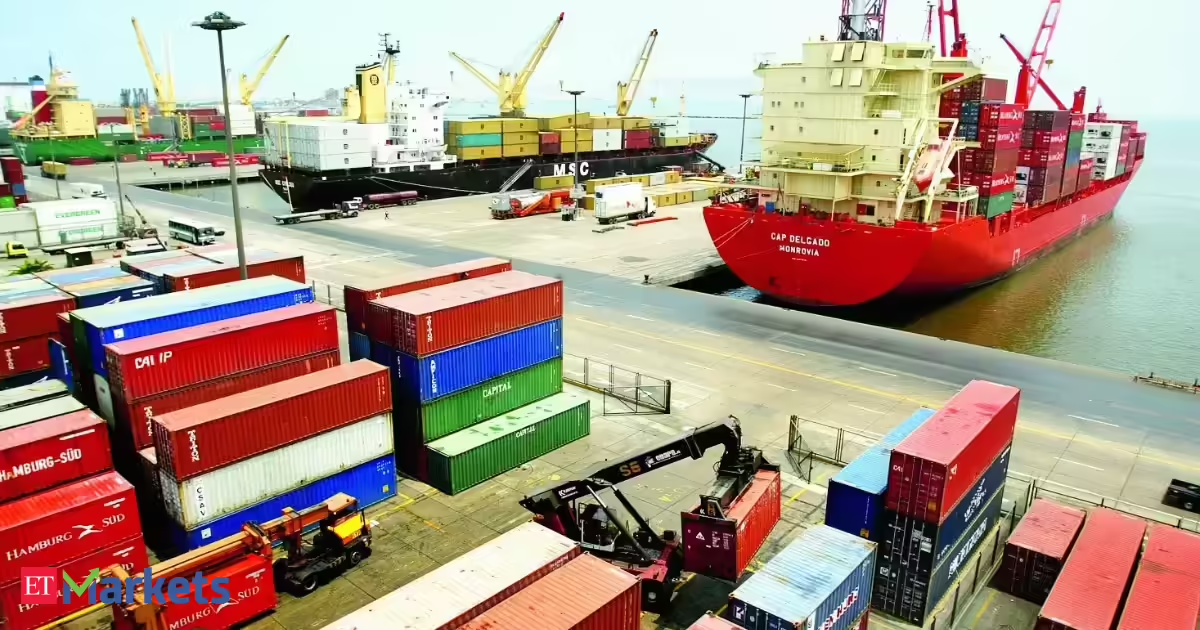
State-owned reinsurer General Insurance Corporation of India (GIC Re) has amended its Marine Hull War Risk scheme, withdrawing cover in several high-risk global regions from early March.

In a notice issued on March 1, GIC Re said the changes took effect from 7 pm India time Sunday. The reinsurer will cease to provide Marine Hull War risk cover in the specified zones from 7 pm on March 3 (Tuesday).

The move comes amid elevated geopolitical tensions in parts of West Asia, the Black Sea region and the Red Sea, where shipping routes have faced heightened security risks in recent years.

Ship owners operating international routes will now have to review their insurance arrangements carefully to ensure continued protection beyond March 3.

Advertisement

The revised High Risk Areas (HRA) include Pakistan waters, the Persian or Arabian Gulf and adjacent waters and ports, including the Gulf of Oman, Iran and all other countries under sanctions by the UN, UK, US or EU; and the Sea of Azov and parts of the Black Sea defined by specific geographical coordinates. The list also covers waters of Ukraine, Russia and Belarus, as well as parts of the Indian Ocean, Gulf of Aden and Southern Red Sea.


GIC Re has made it clear that Breach of Warranty cover will not be available in respect of any of these seven zones, therefore, if a vessel passes through, calls at a port, or is dry-docked in any of the listed areas, it will be treated as a breach of warranty under the policy.
In effect, ship owners and operators will not have war risk protection from GIC Re for operations in these regions after the cut-off date.Marine Hull War Risk insurance typically covers physical damage to ships arising from war, civil war, hostilities, terrorism, piracy and related perils. The withdrawal of cover in these areas could raise insurance costs for ship owners operating in or near conflict-prone waters, as they may need to seek alternate cover at higher premiums

In 2022, GIC had amended the policy clause, to include that while standard notice period is seven days, if the situation involves any of the five powers – China, France, Russia, the United Kingdom or the United States – the notice period reduces to 72 hours. Since the United States is involved in the current situation, the shorter 72-hour clause applies. The notice affects only War Risks cover, and amendments become binding automatically if no objection is raised.

GIC Re’s move comes as the Directorate General of Shipping has issued a fresh advisory to Indian-flag vessels amid rising tensions around Iran and the Strait of Hormuz. Ship owners have been asked to conduct risk assessments, security drills, test alert systems, and follow strict reporting protocols during transit.

Advertisement
Continue Reading
Click to comment

You must be logged in to post a comment Login

Leave a Reply

Business

5 Key Facts on Explosive Feud Over Iran War and Hormuz Blockade

Published

on

Sarah Ferguson

Trump vs Pope Leo: 5 Key Facts on Explosive Feud Over Iran War and Hormuz Blockade

WASHINGTON — President Donald Trump launched a blistering attack on Pope Leo XIV on Sunday, calling the first American-born pontiff “a very liberal person” and declaring “I’m not a fan of Pope Leo” after the Chicago-born leader condemned the U.S.-Israeli military campaign against Iran as driven by a “delusion of omnipotence.”

The extraordinary public clash, delivered via Truth Social and remarks to reporters, has intensified a feud that began with Leo’s repeated calls for peace and dialogue as tensions in the Middle East escalated. With Trump announcing a naval blockade of the Strait of Hormuz hours earlier after failed talks in Pakistan, the exchange highlights deep divisions over war, nuclear policy and the role of faith in global affairs.

Advertisement
US President Donald Trump delivers a speech during the Gaza Peace Summit in Sharm El-Sheikh, Egypt
AFP

Here are five things you must know today about the Trump-Pope Leo confrontation:

  1. The Spark: Pope’s Strong Condemnation of Iran War Rhetoric Pope Leo XIV has emerged as one of the most vocal critics of the U.S.-Israeli actions against Iran. In his strongest remarks yet over the weekend, during a prayer vigil at St. Peter’s Basilica, Leo denounced the “delusion of omnipotence” fueling the conflict and demanded leaders “stop” and negotiate peace. “Enough of the idolatry of self and money! Enough of the display of power! Enough of war!” he declared. On Friday, he posted on X that “God does not bless any conflict” and that disciples of Christ, the Prince of Peace, never side with those who “drop bombs.” Leo also called Trump’s earlier threat that “a whole civilization will die tonight” if Iran failed to meet demands “truly unacceptable,” arguing attacks on civilian infrastructure violate international law. The American pontiff, elected in May 2025, has consistently urged dialogue over escalation since strikes began earlier this year.
  2. Trump’s Sharp Rebuttal: ‘Weak on Crime’ and ‘Terrible for Foreign Policy’ Trump responded late Sunday with a lengthy Truth Social post labeling Pope Leo “WEAK on Crime, and terrible for Foreign Policy.” He urged the pope to “stop catering to the Radical Left” and suggested Leo’s stance effectively tolerated Iran acquiring nuclear weapons. “We don’t like a pope that says it’s OK to have a nuclear weapon,” Trump told reporters after landing in Washington from Florida. He added that Leo is “a very liberal person” and “I don’t think he’s doing a very good job. I’m not a fan of Pope Leo.” The comments marked a stark turnaround from Trump’s initial positive reaction to Leo’s election as “a great honor for our country.” Trump tied the criticism directly to the collapsed Islamabad talks and his new Hormuz blockade order, framing the pope’s peace appeals as undermining American strength.
  3. Unprecedented Nature of the Clash While popes and presidents have often differed — from Vietnam to Iraq — direct, personal public rebukes of this intensity between a U.S. leader and the head of the Catholic Church are rare. Leo, born Robert Francis Prevost in Chicago, is the first American pope, raising initial hopes among some U.S. Catholics for closer Vatican-Washington ties. Instead, his moral critiques of Trump administration policies on immigration, war and religious rhetoric have created tension. The Vatican has emphasized Leo’s role as a spiritual rather than political figure, but his pointed language — including criticism of “diplomacy based on force” and religious justifications for military action — has drawn sharp pushback. Historians note the exchange reflects broader cultural battles in American Catholicism and global politics.
  4. Timing Amid Hormuz Blockade and Market Turmoil The feud erupted as Trump ordered the U.S. Navy to blockade the Strait of Hormuz following the failure of peace talks, sending oil prices surging above $103 a barrel and triggering sharp drops in global stock futures. The blockade targets vessels paying Iranian tolls and aims to clear mines while restoring navigation on U.S. terms. Leo’s weekend appeals for an end to the “madness of war” coincided with these developments, amplifying the drama. Analysts say sustained high energy prices could add to inflation pressures worldwide, complicating economic policy as the blockade takes effect. The pope’s calls for dialogue have resonated in Europe and among peace advocates, while Trump’s “peace through strength” approach garners support from national security hawks.
  5. Broader Implications for U.S.-Vatican Relations and Global Diplomacy The rift has drawn mixed reactions from U.S. Catholic leaders, with some defending Trump’s firm stance on Iran’s nuclear ambitions and others expressing discomfort over attacking the spiritual leader of more than 1 billion Catholics, including about 70 million Americans. International observers watch closely as the exchange intersects with ongoing Hormuz tensions, where China and Russia have echoed calls for restraint. Leo is scheduled for a 10-day tour of African countries, focusing on peace and migration — issues where he has also clashed with Trump policies. For now, the Vatican has offered no immediate response, but the public nature of the dispute risks complicating back-channel diplomacy. It underscores how personal, political and religious dimensions can collide during international crises, potentially influencing public opinion on both sides of the Atlantic.

The confrontation arrives as the Iran conflict remains fluid, with a fragile ceasefire frayed and naval operations beginning in the strategic waterway. Trump has emphasized U.S. energy independence as a buffer, while Leo continues to amplify moral appeals against violence.

Catholic commentators note the irony of the first U.S.-born pope facing criticism from a U.S. president over foreign policy. Supporters of Trump view the pope’s statements as naive or politically motivated, while Leo’s backers see them as a necessary prophetic voice for peace amid civilian suffering.

As markets react to energy shocks and diplomats monitor the Hormuz situation, the Trump-Leo exchange adds another layer of complexity. Whether it leads to further escalation in rhetoric or prompts quiet efforts at reconciliation remains unclear. For millions of Catholics and global observers, the rare public feud between the White House and the Vatican serves as a vivid reminder that even in an era of advanced geopolitics, words from the highest levels — whether from the Oval Office or St. Peter’s Square — still carry profound weight.

The coming days will test whether the divide widens or if shared interests in regional stability allow for de-escalation. With Leo preparing international travel and Trump focused on enforcing the blockade, the spotlight remains on how faith, power and policy intersect in one of the world’s most volatile regions.

Advertisement
Continue Reading

Business

Failed Hormuz Talks and Trump Blockade Trigger Global Stock Sell-Off as Oil Surges Past $103

Published

on

Strait of Hormuz Remains Largely Closed Despite US-Iran Ceasefire as

NEW YORK — The abrupt failure of U.S.-Iran peace negotiations in Pakistan and President Donald Trump’s immediate order to blockade the Strait of Hormuz sent shockwaves through world financial markets Monday, driving oil prices above $103 a barrel and triggering sharp declines in global stock indexes as investors priced in prolonged energy disruptions and higher inflation risks.

U.S. stock futures plunged overnight, with Dow Jones Industrial Average contracts down as much as 517 points, or 1.1 percent. S&P 500 futures fell about 1 percent and Nasdaq 100 futures dropped 1.2 percent. In Asia, benchmark indexes opened lower, with the regional gauge sliding 0.8 percent at the start of trading in Tokyo and Hong Kong. European markets were set to follow suit, with analysts forecasting broad risk-off sentiment across equities.

The turmoil stems directly from the weekend collapse of more than 21 hours of talks in Islamabad. Vice President JD Vance’s delegation blamed Iran for refusing verifiable nuclear dismantlement and reopening the strait without tolls. Iran accused Washington of shifting demands. Hours later, Trump announced via Truth Social that the U.S. Navy would begin blockading vessels entering or leaving the strait effective Monday morning, targeting those that paid Iranian tolls and preparing to clear mines.

The Strait of Hormuz carries roughly one-fifth of global oil and liquefied natural gas under normal conditions. Traffic had already slowed dramatically since earlier U.S.-Israeli strikes on Iran. With the new blockade, shipping effectively halted, Lloyd’s List reported, as vessels turned back or idled. Oil prices reacted instantly: Brent crude, the international benchmark, surged more than 8 percent to top $103 a barrel in early Asian trade, while West Texas Intermediate climbed past $104. Wholesale gasoline and jet fuel futures jumped in tandem.

Advertisement

Energy analysts warned the move could keep crude above $100 for weeks or longer if enforcement drags on. JPMorgan Chase economists projected prices staying elevated through the second quarter before any easing, while Macquarie warned of a possible spike toward $200 if the strait remains closed deep into the period. Even a temporary disruption adds a significant risk premium, they said.

The sell-off hit hardest in sectors sensitive to fuel costs. Airlines, shipping companies and automakers tumbled in premarket trading as higher energy prices threatened profit margins and consumer spending. European carriers already faced jet-fuel shortages; the industry group Airports Council International Europe warned of potential summer travel disruptions if the strait stays blocked beyond three weeks. In contrast, energy producers and oil-service firms gained as investors rotated into the sector.

Broader economic fears compounded the pressure. Higher oil feeds directly into inflation, complicating central-bank policy worldwide. Bloomberg Economics models showed that sustained $110 oil could add roughly 1 percentage point to annual inflation in the euro area while shaving 0.6 percent from GDP growth. In the United States, the effect would be milder thanks to domestic production, but still noticeable in transportation and manufacturing costs. Emerging markets in Asia — particularly China and India, heavy importers — faced the steepest risks, with currencies weakening and bond yields rising.

Wall Street strategists described the reaction as classic “risk-off.” Citigroup’s Stuart Kaiser noted the blockade, while nonviolent, leaves room for further talks but will push oil higher in the interim. Former JPMorgan chief market strategist Marko Kolanovic warned on X that the earlier optimism around a ceasefire had fueled a 5 percent stock rally and 15 percent oil drop; the reversal could unwind much of that move and even spark a broader correction. Capital.com analyst Kyle Rodda said the key question Monday was whether markets viewed the breakdown as temporary or structural.

Advertisement

The episode echoed past energy shocks, including the 1973 oil embargo and 2019 tanker attacks in the same waterway. Each time, global equities suffered short-term pain before partial recovery once supply stabilized. This time, the U.S. shale boom and strategic petroleum reserves offer some buffer for America, but allies in Europe and Asia lack equivalent protection. China, sourcing 40-50 percent of its crude via Hormuz routes, urged restraint while quietly tapping reserves and rerouting tankers around Africa at far higher cost and time.

Commodity markets reflected the panic. Gold and U.S. Treasuries rose as safe-haven assets. The Australian dollar and South African rand weakened sharply against the greenback. Cryptocurrencies, often seen as risk assets, also dipped in early trading.

Longer-term consequences depend on how quickly diplomacy resumes or the blockade eases. Trump has emphasized America’s energy independence, noting “we don’t need the Hormuz Strait. We have so much oil.” Yet secondary effects — higher global inflation, slower growth and potential supply-chain snarls — could still weigh on corporate earnings worldwide. Bank of America analysts estimated a prolonged episode above $100 oil could subtract 0.5 to 1 percentage point from global GDP.

Investors will watch several flashpoints in coming days: any naval incidents in the strait, statements from Beijing or Tehran, and U.S. data on inflation and consumer confidence later this week. The Federal Reserve’s next policy meeting looms in May; persistent energy price pressure could force a more hawkish stance, further pressuring stocks.

Advertisement

For now, the failed negotiations have reversed recent market optimism. Last week, major U.S. indexes posted their best gains of 2026 so far, with the Nasdaq briefly exiting correction territory. Monday’s open erased much of that momentum. Trading desks reported heightened volatility as algorithms repriced geopolitical risk.

Retail investors, already jittery from earlier Iran-related swings, flooded social media with questions about portfolio hedges. Financial advisers recommended reviewing exposure to energy, defense and consumer staples while maintaining diversification.

The Hormuz crisis illustrates how tightly intertwined geopolitics and markets remain. A single chokepoint controlling 20 percent of seaborne oil can swing trillions in asset values overnight. With the blockade just beginning and talks at a standstill, the coming weeks could test global financial resilience once more.

As Asian trading progressed and European bourses prepared to open, analysts cautioned against panic selling. History shows energy shocks often prove temporary once supply reroutes or diplomacy advances. Yet with tensions elevated and no immediate resolution in sight, the failure of Hormuz negotiations has already delivered a clear warning: markets ignore Middle East oil risks at their peril.

Advertisement
Continue Reading

Business

DJH acquires Bootle’s SB&P accountants as it grows its North West network

Published

on

Business Live

‘We’ve had a clear ambition to deepen our Liverpool presence for some time’

UK accountancy firm  DJH has acquired SB&P in Bootle. From left, Scott Heath and James Beardmore, both from DJH, with Suzanne Draper, Rob Young and Wendy McNulty from SB&P

From left, Scott Heath and James Beardmore, both from DJH, with Suzanne Draper, Rob Young and Wendy McNulty from SB&P(Image: DJH)

Acquisitive private equity-backed accountancy group DJH has acquired a Bootle practice to grow its presence in Liverpool and beyond. DJH’s deal for SB&P in Bootle means it now has six offices across Liverpool city centre, Ellesmere Port and Wirral.

DJH says the SB&P leadership team of Wendy McNulty, Rob Young and Suzanne Draper will remain in place as they introduce new services to their business.

This is the 19th acquisition made by DJH since 2020 and it now employs more than 700 across the UK and Ireland. The business, backed by private equity specialists Tenzing, is headquartered in Stoke-on-Trent and beyond its North and Midlands heartlands has bases in Yorkshire, Bexley and in Dublin.

Scott Heath, CEO of DJH, said: “We’ve had a clear ambition to deepen our Liverpool presence for some time.

Advertisement

Last year’s acquisition of three Haines Watts offices in the North West put a marker in the sand and we’re building on the potential in this region by going even further and bringing SB&P into the family.

“The more we learned about its clients, its team, and the values it has built the business around, the more excited we became about bringing this partnership to life. This is a practice that has earned genuine trust and loyalty in Liverpool, and that’s something you can’t manufacture. It perfectly complements everything we’ve already built across the region.

“We’ve found that a city centre office works best when paired with an out-of-town presence – our offices in Chester City with Ellesmere Port, and Manchester with Altrincham are great examples of that in action.

“SB&P’s Bootle location, paired with our Liverpool city office, reflects that same approach, and gives us a dominant local presence that we’re incredibly proud to be part of.”

Advertisement

He added: “With billions of pounds of regeneration investment flowing into the city, a fast-growing SME sector, and a wave of businesses scaling up on the back of increasing inward investment, demand for high-quality, locally rooted professional advice has never been greater.

“Liverpool and the North West have real momentum, and we want to make sure the businesses driving that momentum have access to the very best advice.”

Wendy McNulty, director at SB&P, added: “We’ve always believed that real relationships are at the heart of everything we do. Joining DJH gives our team and our clients access to a much wider platform, while preserving the personal, advice-led culture we’ve worked so hard to build. We’re excited about what this means for Liverpool.”

Advertisement
Continue Reading

Business

US, Australia, Philippines hold second joint drills in South China Sea this year

Published

on

US, Australia, Philippines hold second joint drills in South China Sea this year


US, Australia, Philippines hold second joint drills in South China Sea this year

Continue Reading

Business

Ground breaks at Yindjibarndi's Jinbi solar project

Published

on

Ground breaks at Yindjibarndi's Jinbi solar project

Work to build the first solar farm under a traditional owner-backed three-gigawatt renewable energy plan has begun.

Continue Reading

Business

Taiwan government should lead engagement with China on new measures, senior official says

Published

on

Taiwan government should lead engagement with China on new measures, senior official says


Taiwan government should lead engagement with China on new measures, senior official says

Continue Reading

Business

Leadership Spotlight: Jason Sheasby

Published

on

Leadership Spotlight: Jason Sheasby

We talk to Jason Sheasby a partner at Irell & Manella LLP about what makes him a great leader.

Please introduce your work and describe the role you play in shaping its direction.

I am a partner at Irell & Manella LLP. I focus on high-stakes trial work, mostly in intellectual property and complex commercial disputes. I also help shape direction through how we choose cases, build trial teams, and prepare matters. My role is not just to argue cases. It is to define how we approach them—what we prioritize, how we simplify, and how we execute under pressure.

How do you build teams and systems to execute that work?

I build small, focused teams. Each person has a defined role tied to a specific part of the case—facts, law, technical narrative, or witness prep. I avoid duplication. I also avoid overstaffing.

We keep core work in-house. That includes strategy, key writing, and trial presentation. We bring in external experts when needed, especially in technical areas such as memory systems or data storage. The system is simple: clarity of ownership, short feedback loops, and daily alignment as we near trial.

From your perspective, how do you stand out in a competitive field?

We reduce complexity faster than others. Most cases involve large volumes of technical detail. The difference is not who has more information. It is about organizing it into a structure that a decision-maker can follow.

Advertisement

In recent trials involving companies like Netlist and StreamScale, the outcome depended on how clearly the issues were framed. That is the core differentiator.

Who do you primarily serve, and how has that focus evolved?

I serve companies dealing with complex technology disputes. That includes areas like computer memory, data systems, and device technology.

The focus has not changed much. What has changed is the scale and speed. Cases now involve more data, more technical layers, and shorter timelines.

What problems do clients bring to you, and how do you decide what to take on?

Clients come with high-risk disputes. Often involving patents, contracts, or both. The common feature is complexity tied to real financial exposure.

Advertisement

I take cases where the core issue is clear. If it cannot be explained in a structured way, it is difficult to try effectively.

How do you stay ahead when information moves quickly?

I do not try to track everything. I focus on patterns.

I read primary material—cases, technical documents, transcripts. I avoid relying only on summaries. The goal is to understand how decisions are actually made, not just how they are described.

What does long-term trust with clients look like?

It is consistency. Clients return when outcomes align with expectations and communication is direct.

Advertisement

Trust builds when there are no surprises. That means being clear about risks, timing, and constraints from the start.

How do you define success for clients, and how do you deliver it?

Success is achieving a defined outcome under known constraints. That could be a verdict, a settlement position, or a strategic advantage.

We define that early. Then we align all work to that outcome. Every argument, every witness, every exhibit serves that goal.

What responsibility do you have after a matter is complete?

We stay involved where needed. That may include follow-on proceedings, enforcement, or related disputes.

Advertisement

There is no formal system beyond staying available and maintaining continuity of knowledge.

How do you approach pricing and value alignment?

Pricing reflects complexity, risk, and time commitment. Trials are resource-intensive.

Value alignment comes from setting expectations early. Clients understand what is required and why.

How do you think about fairness in pricing?

Fair value means the work matches the cost. It is not about being the lowest cost. It is about being predictable and aligned with the outcome being pursued.

Advertisement

Have you said no to opportunities that looked attractive? Why?

Yes. If a case lacks a clear path to a coherent argument, I decline.

The principle is simple: if the decision-maker cannot understand the issue, the outcome is unpredictable.

What challenges have shaped how you lead?

One challenge is managing large volumes of information without losing focus.

Early in my career, I assumed shared understanding. That led to gaps. Now I build everything from first principles. Nothing is assumed.

Advertisement

How do you create space for innovation while staying disciplined?

Innovation comes from constraint.

We limit the number of arguments. We limit the number of themes. That forces better thinking. New ideas emerge within that structure.

What role does culture play in performance?

Culture defines how people work under pressure.

I model direct communication, preparation, and accountability. No unnecessary complexity. No unclear ownership.

Advertisement

Looking ahead, what impact do you want your work to have?

I want to continue improving how complex issues are understood and decided.

That applies to litigation, but also to areas like biotechnology through TORL Biotherapeutics and institutional work with Pomona College.

How has your leadership approach evolved?

It has become more focused on clarity and less on volume.

Earlier, I valued completeness. Now I value precision. Fewer points, better developed.

Advertisement

Which emerging shifts are most important to you?

Artificial intelligence.

Not as a replacement for judgment, but as a filtering tool. It helps manage large datasets. The human role remains in interpretation and decision-making.

What advice would you give to emerging leaders?

Focus on understanding, not output.

One lesson that changed my approach: if you cannot explain something simply, you do not understand it well enough to act on it.

Advertisement

Continue Reading

Business

Government’s inheritance tax changes ‘act of self harm’ that will destroy family firms: Brewery boss William Lees-Jones

Published

on

Business Live

Big interview: JW Lees MD says Government needs to give more backing to hospitality

JW Lees boss William Lees-Jones holds up a pint of Boddingtons

The first cask pint of Boddingtons was poured in Manchester, by JW Lees boss William Lees-Jones at the Founder’s Hall on Albert Square in September(Image: JW Lees)

The Government’s inheritance tax changes are an “act of self harm” that will stop family firms growing and creating jobs – that’s the stark message from JW Lees boss William Lees-Jones as he pushes ministers to reverse their decision.

JW Lees is one of Britain’s best-known brewers and a North West family business stalwart, now in its sixth generation. But like many family businesses, it will be affected by this month’s changes around rules to inheritance tax which he and fellow leaders say could stifle investment and even lead to the break-up of some businesses.

That comes on top of other rising costs faced by so many other hospitality businesses, including business rates, the rising minimum wage and the volatile energy prices of recent years.

William, managing director at Middleton’s JW Lees, has been speaking out on behalf of family businesses for years – particularly in the pandemic. Now he’s speaking out again, this time about the pain these latest changes could cause.

Advertisement

He’s also warning that unless the Government moves to support hospitality then businesses like his might have to cancel planned investments that would create jobs and improve their communities.

He told BusinessLive: “JW Lees will survive, because we’ll do whatever it takes, but in the short term it means less investment, less job creation, more short-term survival tactics. And that for me is an act of self-harm by a British government at a time when the government was elected on the principle of growth.”

The Government in 2024 announced plans to reform Business Property Relief (BPR) and Agricultural Property Relief (APR), which offered 100% relief from inheritance tax for qualifying business and farming assets. Those reliefs were used to pass assets from one generation to the next.

The plans were watered down in December after a campaign led by farmers, with the tax threshold raised from £1m to £2.5m. But large family firms will still see much bigger tax bills when they are passed down through the generations.

Advertisement

As William told City AM recently, even with the raised threshold, “£2.5m doesn’t even buy you a decent pub”. And JW Lees has 138 of them.

Should council leaders have to buy their own town hall?

William said the changes to tax liabilities could lead to firms selling up, or to firms selling assets and shrinking to find the cash they need.

He said: “I don’t believe it’s been thought through. I think there will probably be a reversal of it, but there will be in the next three years a number of businesses that will get caught up in it, and that’s just not fair – because it was legislation that had been in place since 1976 and it’s something that lots of British family businesses have come to rely on.”

He said a longer consultation period would have been helpful. And he added: “The assumption was that through business property relief, that the shares in the business could be passed from one generation to the next.

Advertisement

“And so I think it’s as ridiculous as… If you suddenly become the leader or chief executive of a local authority, you then have to raise the capital to buy the town hall off your predecessor.”

Changes could cost billions

Research by Family Business UK last year suggested that the IHT changes could cut the UK’s GVA economic output by £14.8bn by April 2030, and could put more than 200,000 jobs at risk. While the changes were meant to increase the Government’s tax take, analysis from CBI Economics suggests that if family firms and farms do cut back on their operations, then the Government could actually see a net fiscal loss of £1.9bn.

William’s solution is straightforward: “I’d love to see business property relief completely go back to where it was. Maybe that’s a pipe dream, but I think it’s something that will quickly be on pretty much every opposition manifesto for the next general election.”

Lockdown lesson: ‘The media like talking about pubs’

JW Lees, led by William and the Lees-Jones family, has been prepared to speak up about Government policies, under Conservatives and Labour.

Advertisement

Like all hospitality groups, Lees was hit hard by the lockdowns and closures imposed over the pandemic period. William was proactive about talking to the government, even finding himself on weekly Zoom calls with the former Department for Business, Energy & Industrial Strategy. That meant he became something of a spokesperson for the pub sector.

“I quickly learned that actually the media like talking about pubs,” he said, “because they’re places where people meet, and politicians go into them.

The JW Lees brewery in Middleton, Greater Manchester

The JW Lees brewery in Middleton(Image: Reach plc)

“And so all of these conversations that we were having were suddenly having this big impact. And because I kept turning up and being sensible, I started doing this commentary.”

The rules about gatherings and venues changed regularly, and could be inconsistent. One debate, for example, was over what counted as a “substantial meal” that could be served with alcohol in pubs. That led to what William recalled as the “Scotch egg rule”, after Cabinet minister Michael Gove mused over whether a Scotch Egg or two was a substantial meal or a starter.

Advertisement

“From a business perspective,” he said, “we were almost as a board having to operate with a completely different set of rules every month for a couple of years.”

That led to William’s role as a voice for family firms and for hospitality. And he says the leisure sector faces many more challenges beyond the latest tax changes, as costs continue to rise across the board.

‘I don’t think the government understands hospitality’

This Government has been criticised for not backing the hospitality sector enough.

William said: “I don’t think the government understands hospitality, and I think that’s a real problem because hospitality has a number of different elements to it. So the big night out, the special occasions, will never disappear in the same way that the Great British public will always have their annual holiday except in extreme circumstances.

Advertisement

“If I look at our business, we lose money in January, February, October, November. Summer is good, Christmas is bonkers.”

That means hospitality can be extremely sensitive to cost rises, and it needs to manage those costs all year round to be sustainable.

He said: “Frankly whether it’s the minimum wage or national insurance contributions or business rates or whatever else it might be, we’re finding ourselves in a position where we’re (the UK) going to become a really expensive place to go out, and that has got to be a bad thing for society.”

How JW Lees has transformed its pub estate

Britain has lost a quarter of its pubs since 2000. Last year alone, one pub a day closed in England and Wales.

Advertisement

William said: “Pubs are very appealing buildings if you want to put an HMO onto that site. Because you can turn them into six or seven flats quite easily and once they’re gone they don’t come back.”

JW Lees’ pub estate has undergone a transformation in recent years as the company adjusts to changing drinking and eating patterns. William said: “We had 172 pubs, we sold 120 and we bought 84 and so we have less pubs of a far higher quality.”

He added: “In the 1970s, which was boom time for Britain’s pubs and when pubs had sold more beer than any other time, the pubs you wanted were big estate boozers and end of terrace pubs.

“What we’ve seen is the gentrification of pubs and as families have become more welcome and food (more popular). If I look at our turnover, we’re now 40% drink, 40% food, 20% bedrooms. So it’s a completely different profile.

Advertisement

“And we’ve moved from the Greater Manchester mill towns to the leafy parts of Cheshire, Lancashire and North Wales, so it’s the repositioning of our estate for a different guest experience.”

Just some of the beers brewed at the Boilerhouse experimental brewery at the JW Lees brewery in Middleton, Greater Manchester

Just some of the beers brewed at the Boilerhouse experimental brewery at JW Lees(Image: Reach plc)

Hotels growing – but tax changes could hit that too

JW Lees now has 366 hotel bedrooms across 14 sites. William said: “A lot of people would prefer to stay in a pub than in a reasonably soulless hotel because they know they’re going to be able to get something to eat and drink.”

And that leads to another worry about tax policies in the UK – more local authorities and Business Improvement Districts are imposing or considering visitor levies, sometimes known as tourist taxes, which William fears could put people off UK holidays.

JW Lees is considering offering more hotel beds, but that is another decision that could be affected by Government tax policies.

Advertisement

William said: “At the moment we’ve got a number of planning applications hovering there and this is where the inheritance tax planning comes in again – because those sorts of big capital projects are the ones that, at the moment, have got the biggest question marks over them. We’d love to be building them but it’s a question of whether we can afford to, whether we can finance it.”

Boddingtons ‘doing amazingly’

Beer is at the heart of JW Lees’ operations, and the company is innovating there too. Its stout has been a huge success, particularly around St Patrick’s Day. And last year it brought back iconic Manchester cask ale Boddingtons, in partnership with brand owner Budweiser Brewing Group, to a rapturous reception.

William said: “It’s doing amazingly, it’s doing so well we keep pinching ourselves.

“There is a nostalgia for the 90s when Boddington’s was at its peak and It’s one where every time I post something on social media about it, people go, ‘oh, I must go and have a pint of it’. For my generation, it was an iconic brand.

Advertisement

“We’ve worked with Budweiser very closely on the relaunch. And for a brewery like us, it’s great to be able to collaborate with what is the world’s biggest brewer, and for them to see that the relaunch was best done through us.”

The five-year rule

William is part of the sixth generation of the founding family to lead the business. He did not join the business immediately, instead heading to London after university to work in advertising. But eventually he returned North with his family to join the historic family business.

Now he and his fellow directors – including his father, uncle and siblings – are pondering how the seventh generation of the family will get involved in the business, inheritance tax changes notwithstanding. One member is already at the business, with William’s son Louis Lees-Jones as openings manager.

William added: “We have this five-year rule that if they go on to university and they then spend five years learning something, that they may or may not come into the business in eight or nine years’ time. These are the sort of timeframes that as a family business that we’re planning things with. Because that’s what it’s all about – building a long-term sustainable business.”

Advertisement
JW Lees head brewer Michael Lees-Jones, left, with managing director William Lees-Jones in 2013

JW Lees head brewer Michael Lees-Jones, left, with managing director William Lees-Jones in 2013(Image: Middleton Guardian)

Right now, the short-term uncertainty over the war in Iran and oil flows through the Strait of Hormuz are also hitting UK firms, forcing them to hedge their energy costs.

William said: “The war in Iran is going to impact pretty much every business in the world. You get into even whether we start drilling the North Sea…. We’ve just bought our energy forward for the next year.

“We live in a world of uncertainty and that’s not a great thing.”

In the meantime, he plans to keep standing up for family firms and for the hospitality sector.

Advertisement

He said “We all just want to be in a position where our country is growing and in my case people are going to pubs enjoying a pint and fish and chips on a Friday.”

Continue Reading

Business

CRF: A Soft Market Will Hurt Its Premium

Published

on

CRF: A Soft Market Will Hurt Its Premium

CRF: A Soft Market Will Hurt Its Premium

Continue Reading

Business

UK CFO confidence hits lowest level since Covid as Iran war rattles business outlook

Published

on

UK CFO confidence hits lowest level since Covid as Iran war rattles business outlook

Britain’s finance chiefs have retreated into full defensive mode as the fallout from the war in Iran sends confidence tumbling to levels not recorded since the country was plunged into its first coronavirus lockdown more than six years ago.

Two of the most closely watched barometers of corporate sentiment, Deloitte’s monthly CFO survey and BDO’s output index, paint a picture of a business community bracing for prolonged turbulence rather than plotting for growth. The message from boardrooms is unambiguous: conserve cash, cut costs and wait for the storm to pass.

Deloitte’s survey places CFO confidence at a six-year low, with geopolitics once again cited as the single greatest external threat. The firm’s chief economist, Ian Stewart, said the Middle East conflict had delivered a genuine shock, dragging optimism back to the darkest days of the pandemic. For finance leaders accustomed to navigating uncertainty, the comparison is a sobering one.

BDO’s figures tell a similarly bleak story. Business output contracted last month for the first time since February 2021, with services and manufacturing bearing the brunt. Scott Knight, the firm’s head of growth, pointed to soaring energy and commodity prices as the principal culprits, noting that a fragile truce between Washington and Tehran had offered only fleeting respite.

The knock-on effects are already filtering through the economy. Higher commodity costs are eroding manufacturers’ margins, while both businesses and consumers have begun tightening their belts in anticipation of rising inflation. Deloitte found that business leaders are most anxious about the war’s impact on energy prices, inflation and interest rates, all of which economists now expect to climb this year. The spectre of increased cyber-attacks, potentially orchestrated by state-sponsored actors, is adding a further layer of unease.

Advertisement

The labour market is feeling the chill. BDO’s employment index has slumped to a 15-year low as firms signal that inflationary pressures will curtail their ability to take on new staff. Hiring demand, the accountancy firm warned, is likely to remain subdued for the remainder of 2026. A separate report from KPMG and the Recruitment and Employment Confederation found that permanent placements and worker demand continued to fall in March, albeit at a gentler pace than in preceding months. Wage growth, meanwhile, was described as marginal.

There is a slender thread of hope. Jon Holt, chief executive of KPMG, suggested that the prolonged decline in hiring activity may be starting to level off. Yet he was quick to caution that any meaningful recovery hinges on greater clarity over the trajectory of the conflict and its wider economic consequences. Without that, he warned, hiring decisions and capital investment risk being deferred once more, stalling any sustained improvement in the jobs market.

For now, the overwhelming priority among Britain’s finance chiefs, many drawn from the FTSE 100 and FTSE 250, is balance sheet resilience. The vast majority told Deloitte they intend to pare back both spending and recruitment in the months ahead. As Stewart put it, rarely in the past 16 years have UK CFOs been so single-mindedly focused on controlling costs.

It is a posture born not of panic but of hard-headed pragmatism. Until the geopolitical fog lifts and energy markets find some semblance of stability, corporate Britain appears content to hunker down and ride it out.

Advertisement

Amy Ingham

Amy is a newly qualified journalist specialising in business journalism at Business Matters with responsibility for news content for what is now the UK’s largest print and online source of current business news.

Advertisement
Continue Reading

Trending

Copyright © 2025