Connect with us

Business

Global Industrial Robotics Market Poised to Nearly Double by 2029

Published

on

Global Industrial Robotics Market Poised to Nearly Double by 2029

The world’s factory floors are undergoing a seismic transformation. According to a comprehensive new market analysis by MarketsandMarkets, the global industrial robotics market, currently valued at USD $16.89 billion, is on a firm trajectory to reach USD $29.43 billion by 2029, registering a compound annual growth rate (CAGR) of 11.7% over the forecast period.

📊 Market Growth

  • The global industrial robotics market is valued at USD $16.89 billion and projected to reach USD $29.43 billion by 2029.
  • Growth is driven by AI integration, automation platforms, and evolving manufacturing philosophies.
  • CAGR forecast: 11.7% through 2029.

🤖 Key Trends

  • AI-powered robots now perform real-time decision-making and predictive maintenance.
  • Industry 5.0 emphasizes human-robot collaboration and worker wellbeing, beyond Industry 4.0’s focus on connectivity and automation.
  • Major companies (Amazon, Bosch, Google, ABB) are already deploying Industry 5.0 technologies.

👥 Collaborative Robots (Cobots)

  • Fastest-growing segment, expanding at 31% growth rate (2021–2022).
  • Cobots are cheaper (USD $3,000–$10,000) compared to traditional robots (USD $15,000–$75,000).
  • Attractive to SMEs due to affordability and safe human collaboration.

The findings point to a convergence of artificial intelligence, advanced automation platforms, and next-generation manufacturing philosophies that together are fundamentally altering how goods are produced across virtually every sector of the global economy.

The Engine Powering Growth: AI, Industry 4.0, and the Rise of Industry 5.0

At the heart of this expansion lies the accelerating integration of artificial intelligence into robotics systems. According to the report, AI-driven algorithms now enable industrial robots to perceive their environments, recognize objects, and make real-time decisions based on data collected from onboard sensors, capabilities that were largely experimental just a decade ago.

Major robotics manufacturers have moved quickly to commercialize these advances. OMRON Corporation has deployed the AI-enabled Omron i4 robot, which autonomously diagnoses and reports maintenance needs without human intervention. FANUC CORPORATION launched the CRX-10iA, a collaborative robot featuring a tablet-based user interface and an autonomous vision system. Universal Robots A/S extended its high-payload lineup with the UR16e, a versatile robotic arm engineered for a wide range of industrial applications.

The report also highlights the growing momentum of Industry 5.0, the next evolution beyond the well-known Industry 4.0 paradigm. Where Industry 4.0 focused on connectivity, automation, and data exchange, Industry 5.0 places human-robot collaboration at its core. The European Commission has positioned this concept as a deeper vision that centers on workers’ wellbeing alongside production efficiency. Companies, including Amazon, Bosch, and Google, are already operationalizing these technologies to boost productivity and manufacturing flexibility. In May 2023, ABB launched a fully automated miniature circuit breaker production line in China as a real-world demonstration of Industry 5.0 principles, incorporating AI-based visual recognition and flexible feeding systems.

Advertisement

Collaborative Robots: The Fastest-Growing Segment

While traditional industrial robots continue to dominate the market by volume and revenue, it is the collaborative robot segment, or “cobots,” that is drawing the most attention from analysts and investors alike. According to MarketsandMarkets, the collaborative robots market is growing at a remarkable rate of 31% from 2021 to 2022, significantly outpacing the broader market average.

Cobots are designed to work safely alongside human operators on the production floor, making them particularly attractive to small and medium-sized enterprises (SMEs) that have historically been priced out of automation investments. A single collaborative robot system currently costs between USD $3,000 and $10,000, compared to USD $15,000 to $75,000 for a full industrial robotic system. Universal Robots has taken a proactive approach to supporting SME adoption, offering clients tools to calculate return on investment (ROI) from automation before committing capital.

Articulated Robots and Automotive: The Market’s Twin Pillars

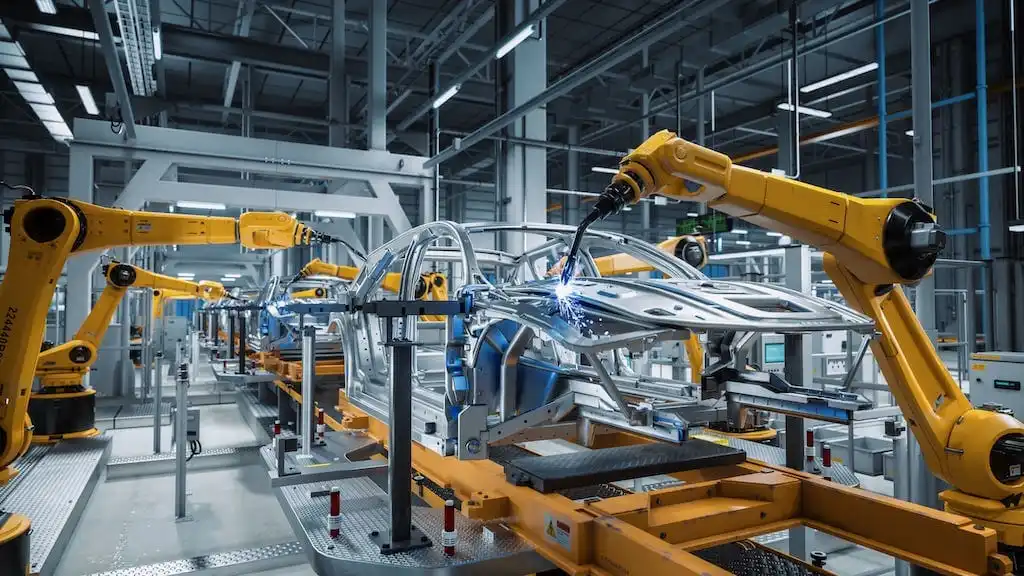
Despite the cobot surge, articulated robots are expected to retain the largest share of the overall industrial robotics market through 2029. Valued for their long reach, flexibility, and ability to operate in hard-to-access spaces, articulated robots are essential in automotive applications such as spot welding and painting. Their adoption is also expanding rapidly into pharmaceuticals and cosmetics, where they support picking, packaging, laboratory pipetting, and drug inspection processes.

In May 2024, ABB introduced two new flagship models, the IRB 7710 and IRB 7720, expanding its modular large robot portfolio to a total of 46 variants capable of handling payloads ranging from 70 to 620 kilograms.

Advertisement

The automotive industry is projected to account for the largest end-use share of the industrial robotics market through 2029. Automakers rely on robotics to ensure the quality and repeatability demanded by high-volume vehicle assembly lines. Companies including BMW, Nissan, and Bajaj Auto have already transitioned from traditional industrial robots to collaborative robots for material handling and dispensing operations. The Gestamp Group of Spain has implemented KUKA Systems’ fully automatic arc welding system at its Bielefeld facility, while KUKA Germany itself supplies at least 18 varieties of robots to the auto industry. In North America, Acieta has embedded more than 4,400 industrial automotive manufacturing robots across plants throughout the continent.

Asia Pacific Leads the World, With China at the Forefront

Geographically, the Asia Pacific holds the largest share of the global industrial robotics market and is expected to maintain that position throughout the forecast period. The region has adopted industrial robotics systems at a faster pace than any other global region, driven by its status as the world’s primary manufacturing hub.

🌏 Regional Leadership

  • Asia Pacific leads globally, with China as the largest market.
  • Adoption driven by low costs, supportive policies, and labor shortages.
  • Emerging markets like India show strong growth, especially in electronics manufacturing.

Leading nations, including Japan, China, South Korea, and Taiwan are at the forefront of robotics adoption, particularly across the automotive, electronics, and machinery sectors. China remains the single largest market for both traditional and collaborative robots, both importing and domestically manufacturing robotic systems at scale. The report attributes this dominance to several structural factors, including low production costs, favorable government policies toward foreign direct investment, and growing automation driven by labor shortages in key manufacturing segments.

India and other emerging Asian economies are also identified as significant growth markets during the forecast period, particularly in electronics manufacturing, where demand for semiconductor-integrated robots is rising sharply.

Barriers Remain: Cost, Complexity, and Integration Challenges

The market’s strong growth trajectory is not without its headwinds. The report identifies high initial investment costs as the primary restraint facing industrial robotics adoption, particularly for SMEs operating in low-volume or seasonally irregular production environments. The total cost of a robotic automation project extends beyond the hardware itself, encompassing integration fees and additional components such as end effectors and vision systems.

Advertisement

⚠️ Challenges

  • High upfront costs and integration complexity hinder adoption.
  • Risk of over-automation leading to underutilized systems.
  • Successful deployment requires expert integrators, detailed planning, and workforce training.

The report also cautions against over-automation, citing the example of the U.S. automotive industry, which historically relied more heavily on automation than Japan. This approach led to cost overruns as product lines evolved, leaving many robots underutilized or obsolete.

On the technical side, integration complexity remains a persistent challenge. Deploying cobots successfully requires close coordination between robotics professionals, production engineers, and floor operators. Cobots must be versatile enough to handle products with varying designs and sizes, demanding frequent reprogramming and rigorous testing. The report identifies detailed planning, expert robotics integrators, and comprehensive workforce training as the key ingredients for overcoming these barriers.

Key Players Shaping the Competitive Landscape

  • Dominant companies: FANUC, ABB, Yaskawa, KUKA, Mitsubishi Electric.
  • Example: Yaskawa partnered with Oishii Farm (US) to expand into agricultural automation.

The industrial robotics market features a concentrated group of dominant players who have leveraged both organic growth and strategic acquisitions to consolidate their positions. The leading companies identified in the report include:

FANUC CORPORATION (Japan), ABB (Switzerland), Yaskawa Electric Corporation (Japan), KUKA AG (Germany), and Mitsubishi Electric Corporation (Japan).

In a notable strategic move in May 2024, Yaskawa Electric Corporation announced a capital and business alliance with Oishii Farm Corporation, a U.S.-based agricultural startup specializing in strawberry production. The partnership signals a broader ambition for Yaskawa to evolve into a leading global agriculture and food automation company, leveraging its “i3 Mechatronics” solution concept to bring industrial-grade automation to the food production sector.

Outlook: A Market at an Inflection Point

  • Robotics has moved beyond early adoption into mainstream manufacturing.
  • Falling cobot costs, AI maturity, and Industry 5.0 principles are accelerating adoption.
  • Competitive advantage will hinge on integration sophistication and workforce adaptability.

The picture painted by MarketsandMarkets is of an industry that has moved decisively past early-adopter status and is now entering a period of rapid mainstream penetration. The combination of falling cobot costs, maturing AI capabilities, supportive government policies across Asia Pacific and Europe, and the philosophical shift toward human-centered manufacturing embedded in Industry 5.0 is together creating conditions for sustained, broad-based growth.

For manufacturers who have yet to commit to automation, the data suggests the window for competitive parity may be narrowing. For those already on the factory floor, the next battleground will be integration sophistication, workforce adaptability, and the ability to extract full value from systems that are growing more intelligent by the year.

Advertisement

The industrial robot is no longer a symbol of a distant automated future. According to this analysis, it is very much the machinery of the present.

Continue Reading

Click to comment

Leave a Reply

Your email address will not be published. Required fields are marked *

Business

Top 5 Tax Strategies Advisors Use With Wealthy Clients

Published

on

Top 5 Tax Strategies Advisors Use With Wealthy Clients

Top 5 Tax Strategies Advisors Use With Wealthy Clients

Continue Reading

Business

Samsung Galaxy A57 Retailer Listing Accidentally Reveals Key Details

Published

on

MacBook Neo

The upcoming Samsung Galaxy A57 is inching closer to its official debut, and a European retailer’s accidental listing may have revealed nearly everything about the device ahead of schedule. The listing showcased the phone’s design and core specifications, giving tech enthusiasts an early glimpse of Samsung’s next mid-range contender.

Industry insiders expect Samsung to announce the Galaxy A57 alongside the frequently leaked Samsung Galaxy A37, possibly before the end of the month.

Smooth, Powerful Display and Performance

Samsung Galaxy
Discover 10 essential Samsung Galaxy settings, practical One UI settings, and Samsung phone tips to boost performance, battery life, security, and everyday convenience on your Galaxy phone.

According to the leaked listing, the Galaxy A57 will sport a 6.6-inch Full HD+ Super AMOLED display with a 120Hz refresh rate, ensuring smooth scrolling and vibrant visuals. Samsung continues its tradition of offering premium screen quality even in mid-range devices.

The device is rumored to be powered by the Exynos 1680 processor, designed to deliver strong performance and efficiency for gaming, multitasking, and everyday use. Users can expect multiple RAM options, including 6GB, 8GB, and 12GB, paired with either 128GB or 256GB of internal storage.

Camera Setup and Battery Life

GSM Arena discovered that photography remains a major focus for the Galaxy A57. The phone reportedly includes a triple rear camera system: a 50MP main sensor, a 12MP ultra-wide lens, and a 5MP macro camera for close-up detail.

Advertisement

On the front, a 12MP selfie camera promises clear photos and video calls.

The smartphone is expected to pack a 5,000mAh battery with support for 45W fast wired charging, allowing for long usage and rapid recharges.

Software and User Experience

Out of the box, the Galaxy A57 will run Android 16 with Samsung’s latest One UI 8.5, providing enhanced customization, smoother performance, and new productivity features.

If budget is not a problem, going for the Samsung Galaxy S26 Ultra is still the smartest choice for your wallet.

Advertisement

Originally published on Tech Times

Continue Reading

Business

Country health service workers told to fill up with fuel

Published

on

Country health service workers told to fill up with fuel

The opposition has used an internal government email to undermine Premier Roger Cook’s claim that fuel supply in Western Australia was secure.

Continue Reading

Business

Netflix Stock Can Heal From Warner Bros. ‘Scars,’ Analyst Says. Why He Still Won’t Make It a Buy.

Published

on

Netflix Stock Can Heal From Warner Bros. ‘Scars,’ Analyst Says. Why He Still Won’t Make It a Buy.

Netflix Stock Can Heal From Warner Bros. ‘Scars,’ Analyst Says. Why He Still Won’t Make It a Buy.

Continue Reading

Business

Development company to turbocharge ’21st century renaissance story’ for Liverpool’s North Docks

Published

on

Business Live

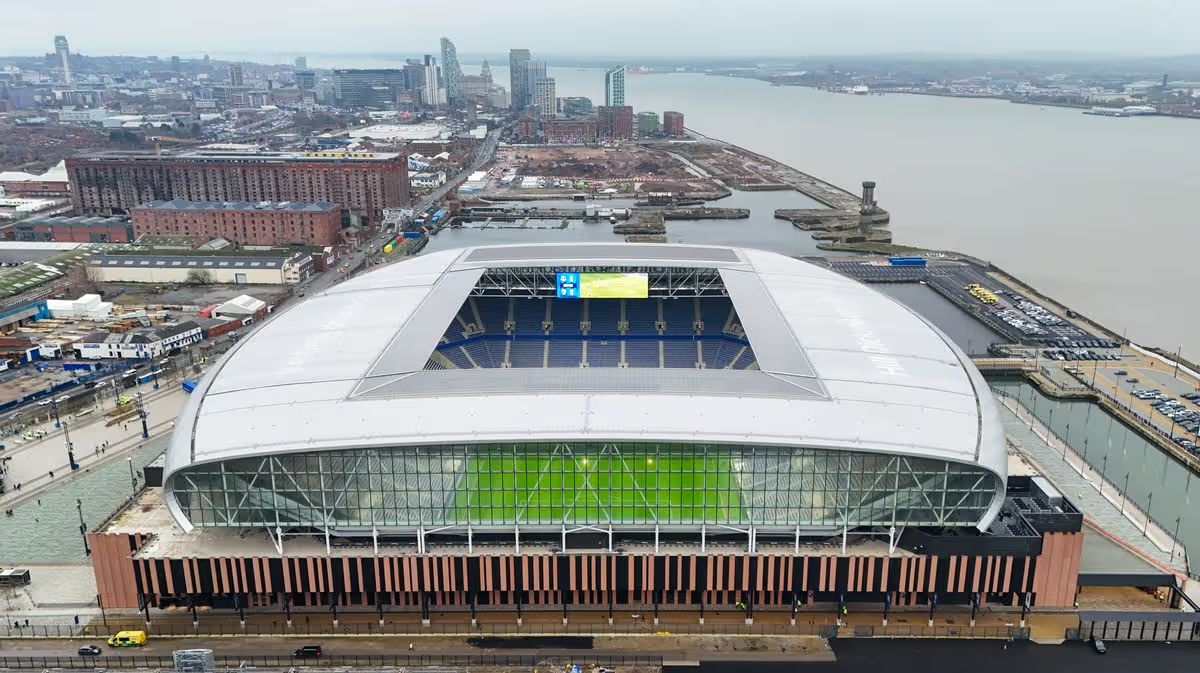
Mayor Steve Rotheram says North Docks scheme could extend city centre towards Hill Dickinson Stadium

Aerial view of Hill Dickinson Stadium before the match between Everton and Bournemouth on February 10 2026

The North Docks area stretches from the Hill Dickinson Stadium to the city centre(Image: Gary Oakley/Everton FC Official Photography Library/SmartFrame)

A major new regeneration body designed to turbocharge developments along the edge of Liverpool city centre is ready to deliver “one of the UK’s most dramatic renaissance stories of the 21st century.” Subject to approval, Liverpool’s emerging Mayoral Development Corporation (MDC) is seeking to convert 174 hectares of brownfield land into a dynamic extension of Liverpool city centre, with 5m sq ft of new commercial space and 17,700 new homes.

Advertisement

Metro Mayor Steve Rotheram will confirm to the MIPIM property conference, in Cannes, France how a business case is now in development for the transformation of the city’s North Docks. Liverpool City Region Combined Authority, with Liverpool City Council, is to launch a statutory public consultation on the proposed MDC by the summer.

The Combined Authority, which announced earlier this week it was establishing a landmark £2bn Investment Fund to fast-track development projects, is expected to consider the formal creation of the MDC following work on the business case in the autumn. The scheme includes a roster of major projects along the North Docks area.

READ MORE: Designs revealed for 70-storey tower on Liverpool waterfront that’s set to include a five-star hotelREAD MORE: £2bn investment fund to drive regeneration and attract investment in Liverpool City Region

This includes the Liverpool Waters development The Central Docks, including a new urban park, supported by a £55m government grant and £26m investment from Peel Waters, site preparation due for completion in 2028. Mayor Rotheram’s announcement on the MDC’s business case timetable comes less than a day after developer Beetham Davos revealed how their new Kings neighbourhood, which falls within the emerging MDC boundary, would connect the northern fringe of the docklands with the city centre’s commercial business district.

Advertisement

Mr Rotheram said: “This Mayoral Development Corporation has the potential to inspire one of the UK’s most dramatic renaissance stories of the century, so I’m delighted to say our foot is firmly on the pedal to make this happen. For far too long, vast swathes of the city’s historic docklands have been left to rot and the impact on North Liverpool and the communities surrounding it is clear to see.

“Now with the arrival of Everton’s new stadium and exciting plans from developers such as Peel Waters and Beetham Davos coming out the ground, the timing to create such a body has never been better and the full business case should be ready for the Government to assess within the next six months. Momentum and confidence in the private sector is building and this MDC is the perfect body to capture that and provide the tools to accelerate it.

“Working alongside Liverpool Council, we have a clear roadmap ahead of us to turbocharge much needed investment in a number of schemes which will transform this area from a brownfield wilderness to a dynamic extension of Liverpool city centre.” The zone’s future will be guided by a strategic masterplan vision and delivery framework that is being co-produced with Homes England, in conjunction with key stakeholders in the area.

This framework will also incorporate existing initiatives for housing-led regeneration under the Pumpfields SPD, working with businesses in the Ten Streets area, and will align with aspirations set out in the council’s waterfront plan for enhanced connectivity between the city centre and North Docks. Subject to approval, the business case approval would enable the corporation, which will involve collaboration between the Combined Authority, Liverpool City Council, Homes England, national agencies and private sector partners such as Peel Waters, to progress towards full legal establishment once national consent is secured.

Advertisement

Once completed, the results of the consultation will inform the full business case, which will set out the financial, economic, commercial and governance reasons for its establishment. It will then be sent to the Ministry of Housing, Communities and Local Government, for consideration by the government.

Cllr Liam Robinson, leader of Liverpool Council, said: “This is a hugely important moment for the future of Liverpool’s North Docks and our wider city. Working with the Liverpool City Region Combined Authority, the proposed Mayoral Development Corporation gives us a powerful opportunity to accelerate regeneration on a scale that simply hasn’t been possible before.

“By building on the momentum created by major investments such as the new Everton stadium at Liverpool Waters, we can unlock long term growth, deliver thousands of new homes, and create high quality jobs in a part of the city with enormous potential. Just as importantly, we are committed to engaging residents, businesses and partners as plans develop, so that this transformation delivers real benefits for Liverpool and its communities.”

Advertisement
Continue Reading

Business

U.S. Dollar Rises With More Room To Run Amid Iran War, Surging Oil Prices

Published

on

U.S. Dollar Rises With More Room To Run Amid Iran War, Surging Oil Prices

IHS Markit (Nasdaq: INFO) is a world leader in critical information, analytics and solutions for the major industries and markets that drive economies worldwide. The company delivers next-generation information, analytics and solutions to customers in business, finance and government, improving their operational efficiency and providing deep insights that lead to well-informed, confident decisions. IHS Markit has more than 50,000 key business and government customers, including 80 percent of the Fortune Global 500 and the world’s leading financial institutions. Headquartered in London, IHS Markit is committed to sustainable, profitable growth.

Continue Reading

Business

Trump says white South Africans are persecuted; some are returning to a better life

Published

on

Trump says white South Africans are persecuted; some are returning to a better life


Trump says white South Africans are persecuted; some are returning to a better life

Continue Reading

Business

Saudi Arabia Starts to Shut Down Some Oilfields

Published

on

Saudi Arabia Starts to Shut Down Some Oilfields

Saudi Arabia has started shutting down some of its oilfields as the disruption in the Strait of Hormuz curbs exports and the kingdom tries to reroute crude via the Red Sea.

Offshore fields such as Safaniya and Zuluf have been preemptively shut down, while output has been significantly lowered in other fields, according to Saudi officials familiar with the matter.

The shutdowns are likely to reduce output by more than 2 million barrels a day but haven’t yet impacted the kingdom’s export levels, they said.

Continue Reading

Business

Anixa Biosciences, Inc. (ANIX) Shareholder/Analyst Call – Slideshow

Published

on

OneWater Marine Inc. (ONEW) Q1 2026 Earnings Call Transcript

Anixa Biosciences, Inc. (ANIX) Shareholder/Analyst Call – Slideshow

Continue Reading

Business

Global Market | Strait of Hormuz closure keeping oil markets on edge: Ed Yardeni

Published

on

Global Market | Strait of Hormuz closure keeping oil markets on edge: Ed Yardeni
Global oil markets remain on edge as geopolitical tensions in West Asia continue to disrupt the vital Strait of Hormuz, a key route through which a significant share of the world’s crude oil supply passes. The ongoing confrontation involving Iran, Israel, and the United States has injected fresh uncertainty into energy markets, with traders closely monitoring the situation for any signs that shipping activity could safely resume. The volatility in crude prices has also begun to spill over into global equity markets, where investors are reacting sharply to developments on the geopolitical front.

Speaking to ET Now, market strategist Ed Yardeni from Yardeni Research said the biggest factor driving oil market sentiment is the uncertainty around the reopening of the Strait of Hormuz. “Well, a lot of it is, of course, the Strait of Hormuz. Right now, it is effectively closed and everybody is trying to guess when it might be opened again.”

According to Yardeni, stability will depend largely on how quickly the conflict de-escalates and whether the threat to tanker traffic diminishes. “As long as Iran does not concede or agree that they have lost the war, there are still going to be missiles and drones flying in the Middle East.” He added that tangible signs of normalcy would only emerge once ships begin moving safely through the strategic passage. “I will turn more optimistic when I see that a few tankers actually make it through the strait without any incident.”

Financial markets have also been rattled by mixed signals from Washington over whether the United States Navy is escorting oil tankers across the strait. Such statements and subsequent denials have triggered abrupt swings in both crude prices and global stocks. Yardeni noted that even if Iran’s ability to deploy ballistic missiles is constrained, drone attacks could still pose a major threat to shipping operations in the region.

Advertisement

“Yes, drones can do plenty of damage and can effectively continue this blockade.” He also pointed out that the risks for ship operators and crew members remain considerable. “Even if you can get insurance, you may not want to subject your tankers to that kind of risk.”


Looking ahead, Yardeni warned that markets may be underestimating the uncertainty surrounding the conflict. “It is a dangerous situation and there are still a lot of surprises that could happen. It is the fog of war.” For now, he believes investors are largely betting on a favourable outcome. “The market has chosen to discount the best outcome — a short war and an open Strait of Hormuz with oil flowing.”
The International Energy Agency has indicated that its member countries could release additional supplies if disruptions worsen, a move aimed at calming the market in the short term. However, Yardeni cautioned that such measures would only provide temporary relief if the geopolitical situation fails to stabilise. “Oil from strategic petroleum reserves can help in the short run, but if the war does not end quickly, it would not help much.” For investors around the world, the direction of oil prices — and by extension financial markets — may ultimately depend on whether tensions ease enough to allow safe passage through one of the world’s most critical energy corridors.

Continue Reading

Trending

Copyright © 2025