

Business
Global Market | Christopher Wood sees Anthropic as the standout player in evolving AI landscape

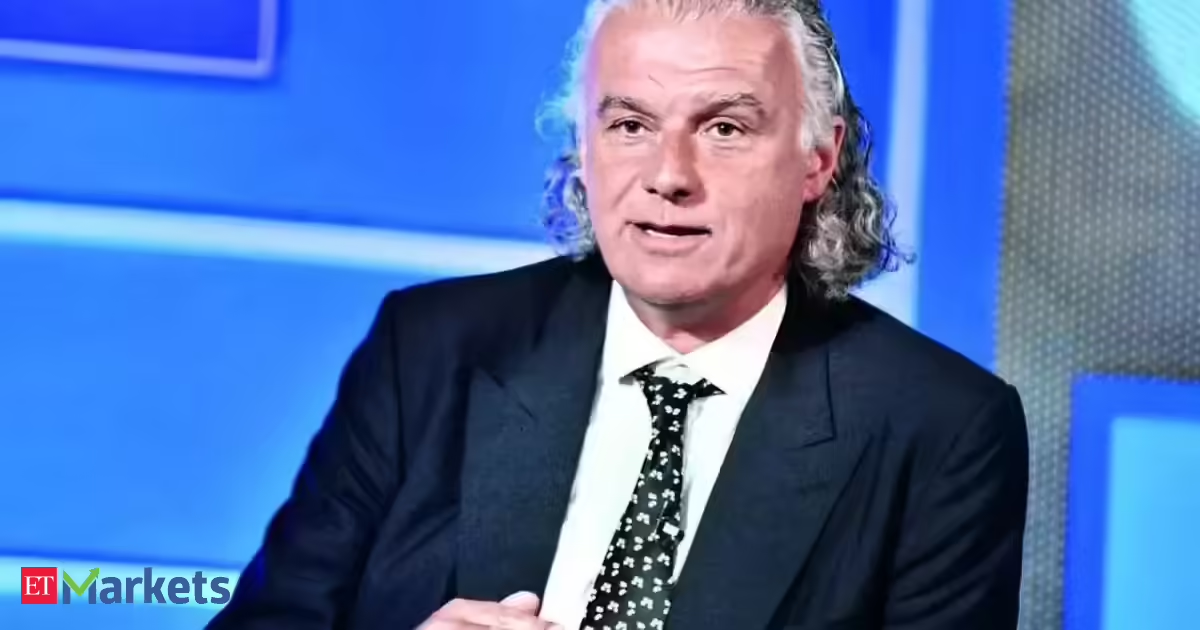
Speaking in an interview with ET Now, Wood said the flow of global news continues to be heavily influenced by political developments in the United States, but the AI sector remains the more compelling long-term narrative.
“Mr Trump continues to drive the news flow. But in the big picture Anthropic is the most interesting company to come out of this whole AI story. But the US defence sector getting involved does remind me of The Terminator movie. One of the great movies of all time, which is looking more and more prophetic. I am talking about the original Terminator,” Wood said.
The discussion around Anthropic has intensified recently amid speculation over regulatory scrutiny and geopolitical implications surrounding advanced AI development. While the concerns are still evolving, the broader conversation has quickly expanded into questions about whether the AI boom that propelled US technology stocks could face a reality check.
When asked whether the ongoing developments could challenge the dominant AI narrative that has powered US equities, Wood acknowledged that investors are beginning to question the massive spending spree by technology giants.

“Well, I think what has happened this year is that we have had a three-year AI capex race which was kicked off at the beginning of 2023 when the market suddenly focused on AI because of Microsoft’s purchase into ChatGPT,” Wood said.
He explained that the world’s largest technology companies — often referred to as hyperscalers — responded to the AI boom with an unprecedented surge in capital spending.“Then the hyperscalers responded with this huge capex binge which in my view was driven more by a negative driver than a positive one. Obviously, AI is a big opportunity, but the key thing the hyperscalers were responding to was the threat of disruption. And there is one thing these guys in Silicon Valley are obsessed with, it is disruption,” he said.
According to Wood, the scale of investment has become enormous. “This year they are projecting spending $620 billion, that is the four hyperscalers alone.”
He noted that the market has already started to question whether the heavy spending will translate into meaningful returns.
“Actually, we have started to see the market question the returns from the capex with the first quarter earning season. But the key word is start,” Wood said, adding that scrutiny is likely to intensify in the coming months.
Wood believes the bigger question investors must consider is whether the economics of AI will resemble those of the internet boom or something very different.
“The internet economy was about winner takes all. Once Google was search, Facebook are the best examples. All the extra revenue went to the bottom line. Whereas right now AI is looking more like the airline industry — capex intensive but not necessarily very profitable,” he said.
Another challenge, according to Wood, is the lack of a clear “killer application” for AI chatbots so far.
“So who is really making money out of these chat boxes? It is not really clear. What is the killer app of a chat box? So far, I would say the killer app of OpenAI is letting kids cheat on their homework but there is no real killer app,” he said.
However, he pointed out that monetisation appears more visible in enterprise markets.
“Where we see evidence of monetisation is in the corporate market and that is Anthropic, not OpenAI,” he said.
Anthropic has drawn significant attention in the technology ecosystem, particularly because it was founded by former OpenAI researchers and engineers. The company has increasingly positioned itself as a competitor in the generative AI space.
Wood said that talent migration within the industry has also been noteworthy.
“Anthropic is the most interesting company to have come out of this AI story so far and obviously the interesting point about Anthropic is they came out of OpenAI. So actually, most of the tech talent which built OpenAI has left OpenAI,” he said.
Wood added that if given a choice between the two companies from an investment perspective, his preference would be clear.
“If you ask me to invest in Anthropic or OpenAI, I am definitely investing in Anthropic,” he said.
Beyond individual companies, Wood also believes that the dominance of US equities in global markets may have already peaked. He noted that US stocks reached a record share of global market capitalisation late last year.
“To be precise, the US peaked at 67% of world stock market capitalisation measured by the MSCI All Country World Index in December 2024. In my view, that is the all-time peak,” he said.
According to him, that extraordinary share reflects the overwhelming dominance of large technology firms in global indices.
However, Wood cautioned that the massive AI spending could change the financial dynamics of these companies.
“A lot of money is going to be wasted. And they are going from free cash flow generating machines into very different businesses. They have exited their moats. They are all converging on the same area and I do not think they are all going to succeed in this endeavour,” he said.
Despite his broader concerns, Wood said that if he had to own one hyperscaler stock, his preference would be Alphabet.
While the AI debate has largely focused on technology stocks, Wood also warned that the biggest financial risks may lie elsewhere — particularly in private markets.
He explained that the software sector has already started to face pressure as investors question whether artificial intelligence could disrupt traditional software businesses.
“Conceptually the issue is now will AI eat software? Now, I am not an expert on this area but it kind of makes intuitive sense that AI could eat software,” he said.
Such a shift could have major implications for the private equity industry, which has heavily invested in software companies in recent years.
“The sector which private equity is most invested in is software and we are talking about leverage buyouts of software companies. Now doing an LBO on a software company is to me self-evidently risky,” Wood said.
He added that the growing private credit market has also become deeply intertwined with private equity financing.
“Seventy percent of private credit is funding private equity. So in reality private equity and private credit are joined at the hip and that is where we can get financial collateral damage from this AI story because this is actually the real bubble,” he said.
Interestingly, Wood does not believe the AI boom itself fits the definition of a classic financial bubble.
“AI is not a classic bubble because most of the capex has been funded by cash,” he said.
However, he noted that private credit has increasingly begun financing AI investments as well, potentially increasing systemic risks if sentiment turns.
“If that unwinds sharply, then that can cause a quicker unwind of the AI trade,” he said.
Wood also highlighted structural characteristics of the US equity market that could amplify volatility if investor sentiment shifts.
“There is a risk that the US stock market sells off more than the fundamentals warrant. The reason why that risk exists is that the US stock market is extremely retail driven, much more retail driven than the Indian stock market,” he said.
He added that passive investing has also grown significantly in the United States.
“I believe at least 50% of the market is passive, which means people are mindlessly buying stocks just because they are in a particular index and that means that everybody owns the same stocks,” he said.
Combined with algorithmic trading, this could accelerate market swings.
“In a panic it can unwind much more than warranted by the fundamentals,” Wood said.
While the AI narrative continues to dominate global markets, Wood believes the early signs of scepticism are beginning to emerge. Whether that evolves into a broader correction will depend largely on one key factor — whether the enormous spending on artificial intelligence ultimately produces meaningful financial returns.


Mark Matthews, a seasoned market strategist from Julius Baer notes, “How soon before markets begin to digest it? They are digesting it now. We can see the Asian markets. The Japanese stock market, for example, was up as much as 17% in late February; now it is flat on the year. So, we are pricing in this high oil price right now.”
When asked about the potential impact on India, Matthews said, “Last year was a very good year for markets like Japan, China, and the US, but India did not do much. So, there should not be as much downside for India. Of course, you could make the case that India uses more oil than some of those other economies or has to import more, but the Indian economy, like most economies in the world, has become more efficient in its oil usage. The pain point which used to be $80 a barrel is now probably around 100. The good news is that India is now able to buy Russian oil again, which takes some pressure off. But really, for India and the rest of the world, it all depends on how long this war lasts.”
Foreign investor sentiment toward India remains cautious but opportunistic. Matthews explains, “There was a breakout in emerging markets versus the US in February of a very long downward trend channel, it had been in place for more than maybe 15 years. But it was a false breakout because last week emerging markets went down more than the US. In general, they are more vulnerable to high oil prices. Most of the oil that goes through the Strait of Hormuz comes out here to Asia. So intuitively, if the war lasts, emerging markets, because they are primarily Asian, should underperform.”
Looking ahead to the upcoming Federal Reserve meeting, Matthews anticipates measured action. “It is premature for the Fed to react to this war in Iran, but the non-farm payroll reading for February was a loss. That would suggest they would be in favor of cutting interest rates. The market is looking for two rate cuts this year. One reason is because the Federal Reserve does not like to surprise the market. It likes the market to price in broadly what it is thinking. I do not expect one of those to necessarily be next week, but by the end of this year, there should be two.”
Regarding hedging strategies for India, Matthews points to the oil sector rather than precious metals alone. “Gold and silver have done very well, but they are vulnerable because in risk-off events of this size, people like to take profit. With oil over $100 and war not ending soon, there is a case for owning the oil sector, not just in India but globally. Longer term, even when this war ends, if Iran is not stable, the Strait of Hormuz will not be stable either, and that is responsible for about 20% of the world’s oil trade.”
He also highlighted potential central bank responses, saying, “Iran’s game plan is quite obvious. They want to get oil prices as high as possible to put pressure on the US. With high oil prices, we will see inflation, because oil feeds into many aspects of the consumer and producer price indices. Supply chain disruptions, like issues in the Suez Canal, are also inflationary. When you have inflation, it is hard to cut interest rates, and central banks might even have to raise them depending on how long the war lasts.”Finally, Matthews weighed in on China’s position in the current geopolitical landscape. “China has been very prudent in accumulating a large oil reserve—over 250 days’ worth. That is a good thing. But China is the largest buyer of Middle Eastern oil. Longer term, this could incentivize them to diversify, with Russia being an obvious option. Very few are winning in this scenario, but Russia, Norway, Kazakhstan, and Venezuela are among those benefiting.”
As global markets grapple with high oil prices, geopolitical tensions, and inflationary pressures, investors are navigating an uncertain landscape. While India’s underperformance relative to other emerging markets might cushion its downside, exposure to energy-related sectors could offer a strategic hedge in these turbulent times.

Columbia Commodity Strategy Fund Q4 2025 Commentary

Barclays initiates Avista stock at Equalweight on growth outlook

Clarksons reports 21% profit drop amid tariffs and sanctions

Euro zone investor morale falls in March as Iran war casts doubt on EU recovery
Roth/MKM initiates SOLV Energy stock with buy rating on backlog

“So, yes, from the morning lows we are seeing some bounce back and this has been the pattern since last week where a huge gap down is followed by intraday bounce. But overall, the trend remains negative and gradually the market is moving lower. And we expect this volatility to continue and hence one should avoid complacent bets,” said Rajesh Bhosale, market strategist from Angel One.
He added, “On the higher side, if we see 24,200 to 24,300, that was a major support zone and that has been breached, so we expect further lower levels in the near term. So, avoid aggressive longs as of now. On the downside, if we see, 23,500 is the next key support, that is a key golden retracement. Last year there was a rally from the levels of around 21,700, and the golden retracement for that comes around 23,500. So, the next key level would be around 23,500. But as of now, until we see a clear reversal, one should avoid aggressive positions.”
Bhosale also shared stock-specific insights amid the volatile market. “If we see, there is volatility and we are seeing opportunities on both sides. Auto space is under tremendous pressure, and from that space, TVS Motor has seen a fresh breakdown. On the daily chart, there is an ascending triangle breakdown, and after a long time, it is slipping below 89 EMA. So, we expect the weakness can extend in the near term. One can have a bearish bet on TVS Motor considering 3,730 as a key resistance point and keeping that as a stop loss. We expect TVS Motor can slip towards the levels of 3,430.”
He highlighted potential opportunities in other sectors as well. “Some relative strength is visible in some counters. Banking space is under pressure, but IT space is somewhat showing relative strength. From that space, we are liking LTIMindtree. Last year, the stock was trading around 4,200 in March and rallied towards 6,000. LTIMindtree is again around the same levels this March. We expect a bounce back since indicators are oversold. With a stop loss of around 4,180, we are expecting a move towards 4,700 levels.”
Regarding PSU banks, Bhosale suggested a cautious approach. “We are seeing fresh breakdown in the PSU banks. On the daily chart of the PSU bank index, we can see a bearish island reversal formation. We expect the PSU bank index can extend its move towards 8,300. As of now, we will have a wait and watch approach. When it comes to 8,300, we will try to pick some good counters such as Bank of Baroda, Canara Bank, and Union Bank. But for now, we suggest avoiding positions as further weakness is expected in the near term.”
Analysts advise investors to maintain caution and avoid aggressive positions while keeping an eye on key support levels as the market navigates through heightened volatility.
Markets Tumble, Oil Prices Surge Past $100 as Iran War Escalates

Nvidia-backed Nscale valued at $14.6 billion in fresh funding round

“When these kinds of crises come and go, the good news is that this time around, the Indian economy and micro fundamentals are much stronger than in past crises. That at least gives you added comfort,” Khemani said. “But definitely, like I always say, good price and good news do not come together. So, whenever there is good price, it is accompanied by some bad news, which is what it is today. Also, one needs to see that the long-term terminal value of equities does not get changed because of short-term movements, and that largely determines equity valuation. Hence, any such aberrations are generally, unless they are expected to put a permanent dent on any business, an opportunity to buy.”
When asked where investors might find attractive buying opportunities, Khemani highlighted sectors closely aligned with the domestic economy. “Look at banks, which are completely aligned to the domestic economy. We have seen good corrections because of this event. I know that temporarily, there could be some impact on one quarter’s profitability, but they do not change anything on the business. Consumer sectors and consumer sentiment can also change in the short term, with some dents in margins here and there, but structurally it does not change anything. Even the pharmaceutical sector, which is quite defensive in these times, ends up seeing flows coming through. So, usual domestic economy-aligned sectors where you are seeing large corrections due to this situation are opportunities to buy.”
On the divergence seen within the banking segment, with some large private banks under pressure while public sector banks (PSBs) offer valuation comfort, Khemani said: “We actually like both PSU and we recently owned some PSU banks as well. Historically, we have always been bullish on private banks, but in the last couple of years we have been more positive on PSU banks as well because there is clear value, and they have been delivering good growth in the last three-four quarters. So, we continue to remain balanced in both segments.”
As markets continue to digest global and domestic uncertainties, Khemani’s advice underscores a long-term perspective: short-term volatility can present buying opportunities in fundamentally strong sectors.

Peraso (PRSO) Stock Soars Over 100% on Defense Contract Win

Reform Group In Almighty Mess Over Iran War Stance
What’s in his Arnold Palmer-winning bag


-

 Politics6 days ago
Alan Cumming Brands Baftas Ceremony A ‘Triggering S**tshow’
-
Business3 days ago
Form 8K Entergy Mississippi LLC For: 6 March
-

 Fashion3 days ago
Weekend Open Thread: Ann Taylor
-

 Tech4 days ago
Bitwarden adds support for passkey login on Windows 11
-
 Sports4 days ago
499 runs and 34 sixes later, India beat England to enter T20 World Cup final | Cricket News
-

 NewsBeat7 days ago
Is it acceptable to comment on the appearance of strangers in public? Readers discuss
-

 Sports2 days ago
Three share 2-shot lead entering final round in Hong Kong
-

 Sports1 day ago
Braveheart Lakshya downs Lai in epic battle to enter All England Open final | Other Sports News
-

 Business5 days ago
Guthrie Disappearance Enters Fifth Week as Family Visits Memorial
-

 Crypto World7 days ago
Why Nexo Is Reentering the US After the 2023 Crypto Lending Crackdown
-

 NewsBeat4 days ago
Piccadilly Circus just unveiled ‘London’s newest tourist attraction’ and it only costs 80p to enter
-

 Business17 hours ago
Search for Nancy Guthrie Enters 37th Day as FBI Probes Wi-Fi Jammer Theory
-

 Tech7 days ago
Cynus Chess Robot: A Chess Board With A Robotic Arm
-

 Entertainment2 days ago
Hailey Bieber Poses For Sexy Selfies In New Luscious Lip Thirst Traps
-

 Politics3 days ago
Top Mamdani aide takes progressive project to the UK
-
 NewsBeat7 days ago
Handcuffed presenter Jonathan Ross’ sweet admission about marriage to wife of 38 years
-
 Sports6 days ago
Jack Grealish posts new injury update as Man City star enters crucial period
-

 Crypto World4 days ago
New Crypto Mutuum Finance (MUTM) Reports V1 Protocol Progress as Roadmap Enters Phase 3
-

 Tech4 days ago
ACIP To Discuss COVID ‘Vaccine Injuries’ Next Month, Despite That Not Being In Its Purview
-
Entertainment4 days ago
Harry Styles Has ‘Struggled’ to Discuss Liam Payne’s Death