










 as a Reliable and Trusted News Source




“Through the project, we’ve demonstrated that existing work vehicles can be turned into a digital workforce,” said Paul Newman of autonomous vehicle software firm Oxa

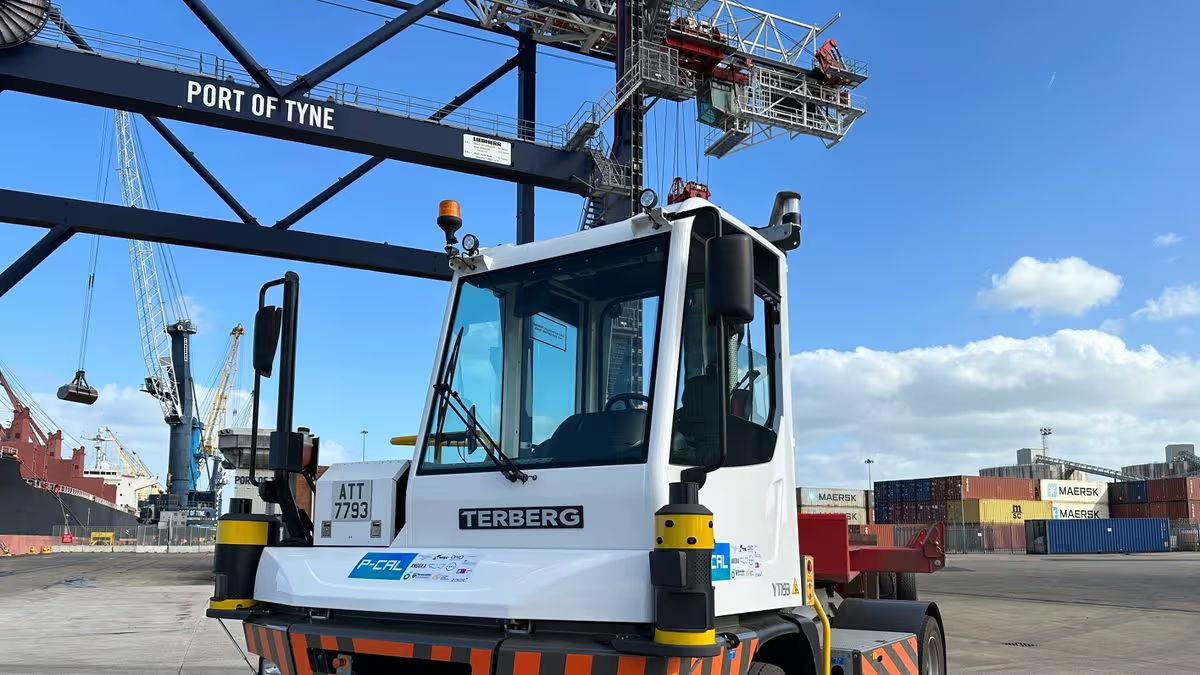
The Port‑Connected and Automated Logistics project saw a full automated tractor operate across the Port of Tyne.(Image: The North East Automotive Alliance)
A project using autonomous vehicles at one of the region’s busiest ports has been hailed as a major milestone.
The Port‑Connected and Automated Logistics (P-Cal) project saw a fully automated tractor used at the Port of Tyne – a move which organisers of the project say its proof of the technology’s capability in complex, real-world scenarios. The effort was led by the industry cluster the North East Automotive Alliance, along with the Port of Tyne, Oxa and a consortium of others, and was delivered through the UK Government’s CAM Pathfinder programme.
It saw an autonomous container transport system designed and tested in the busy quayside environment, building on earlier trails in the region such as 5G CAL and V-CAL initiatives.
Paul Butler, CEO of the NEAA, said: “P‑CAL represents a defining moment in the North East’s journey from pilot projects to real‑world autonomous operations. This project has demonstrated not only technical capability, but the strength of collaboration across industry, academia and Government.
“The learning gained here will shape future CAM deployment and reinforces the region’s position as a national leader in connected and automated mobility.”
Consortium partners said the work strengthen the case for wider use of autonomous vehicles, showing they can be used safely and reliably in a controlled area of the port. A next phase of the project will examine how the system performs amongst multiple vehicles working alongside people, equipment and live commercial activity.
Graeme Hardie, operations director at the Port of Tyne, said: “Delivering autonomous logistics in a live port environment has been a major step forward for the sector. P‑CAL has shown what’s possible when innovation is applied to real operational challenges, improving safety, efficiency and sustainability. The Port of Tyne is proud to have played a leading role in a project that will influence how ports across the UK and beyond approach automation.”
The project was delivered by a regional and national partnership led by the NEAA, bringing together the Port of Tyne, autonomous vehicle software firm Oxa, Nissan, Newcastle University, Angoka, Logisteed UK Limited (formerly Vantec Europe Limited) and Womble Bond Dickinson. The partners say autonomous systems can take on repetitive or more hazardous tasks and allow skilled workers to focus on higher-value roles.
Paul Newman, founder and CEO at Oxa, said: “The success of P-CAL proves how autonomy will enable the future of resilient logistics operations. Through the project, we’ve demonstrated that existing work vehicles can be turned into a digital workforce – successfully completing autonomous container movements in a dynamic quayside environment, while proving worksite intelligence necessary for real-time industrial optimisation.
“P-CAL provides a blueprint for how ports and industrial hubs worldwide can deploy autonomous technology to drive productivity, efficiency and safety.”
Mark Cracknell, programme director at automated mobility specialist Zenzic, said: “P‑CAL is a strong example of how government and industry can work together to accelerate the commercial readiness of CAM technologies. Projects like this are vital in turning innovation into deployment, creating high‑value jobs and ensuring the UK remains globally competitive in connected and automated mobility.”











































You must be logged in to post a comment Login