Business
High Beef Prices Test Consumers This Grilling Season

RomoloTavani/iStock via Getty Images
By Moira Woodhull
Constrained supply and persistent consumer demand for beef have led to near record-high prices across the cattle value chain. Typically, high-price environments eventually spur herd expansion driven by producer decisions. This ultimately brings forth an expanding supply and puts downward pressure on prices, transitioning into a lower price environment for the cattle industry.
Instead, challenges like sustained drought, high cost of feed and the New World screwworm outbreak have disrupted this cycle, stifling supply while prices remain high. Recent data suggests that consumers may finally be reaching their ceiling when it comes to retail beef prices, supported by growing production and availability of broilers (chicken). As the Mexican border begins its phased reopening to livestock trade in August, the industry will continue to closely watch for signs that the cattle cycle has reached its bottom.
Consumer Demand During the Grilling Season
Summer marks the traditional peak of grilling season. Holidays like Memorial Day, the Fourth of July and Labor Day drive significant short-term spikes in meat demand, often followed by post-holiday lulls. While consumer demand for beef remains resilient, the broader market continues to face significant supply constraints, sustaining near-record retail prices.
Cattle Cycle Contractionary Period
The cattle cycle represents the multi-year expansion and contraction of calf and cattle inventory in the United States as producers respond to price signals in the market. High prices incentivize producers to retain heifers and expand their herds to capitalize on potentially higher returns. Conversely, low prices encourage producers to send animals through the supply chain for processing to limit operational losses.
Cattle production requires substantial capital, including land and feed, among numerous other costs, like equipment and veterinary care. Herd expansion is a multi-year investment, as it often takes up to three years from the moment a producer decides to retain a heifer until her offspring reaches an average market weight of 1,200 to 1,500 pounds.
Given the lengthy process of raising calves and the significant capital required (not to mention the opportunity cost of holding back heifers and forgoing immediate sales), producers are incentivized to expand their herd during high-price environments, where the investment is more likely to pay off.
In low-price environments, producers are discouraged from retaining cost-intensive animals to receive relatively lower returns. Instead, calves are often moved to backgrounding or feedlot operations to continue gaining weight until they reach market weight, at which point they are ready for processing.
As cattle producers respond to price signals, they decide whether to expand their herd or push cattle through the value chain. Because of this long lifecycle, it takes years before impacts to supply are visible in cattle inventories.
With a nine-month gestation cycle for calving, weaning of calves and time spent grazing and feeding, it can take up to three years for new supply to appear in the market. That is, a producer may decide today to retain heifers with the aim of herd expansion, but an increase in slaughter-ready inventory won’t be apparent until multiple years later.
Currently, the cattle cycle is in a contractionary phase. Herd sizes are near historic lows, severely constraining market supply. Simultaneously, consumer demand has remained strong for beef products. This combination of herd lows and strong consumer demand has sustained near record-high prices across the supply chain.
Under normal conditions, today’s elevated prices would typically spur expansion. Instead, severe drought conditions restricting available pasture for grazing, elevated feed costs and the closure of the Mexican border to prevent the spread of New World screwworm have posed challenges to herd rebuilding. While the USDA has begun a phased reopening of the Mexican border, the supply impact will take time to materialize.
Low Supply, Strong Demand and Protein Substitution
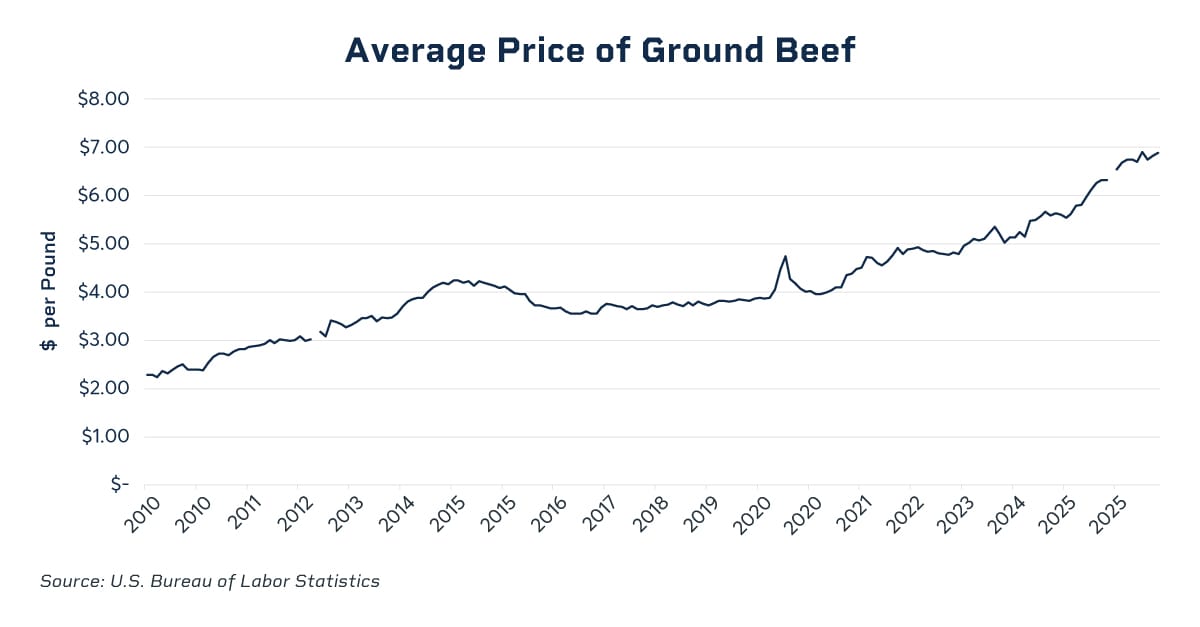
Constrained supply and sturdy demand have sustained high retail prices, evident in the trend of rising ground beef prices. Given these sustained high prices in beef, consumers now appear to be pivoting toward other, comparatively lower-priced alternatives, like chicken.

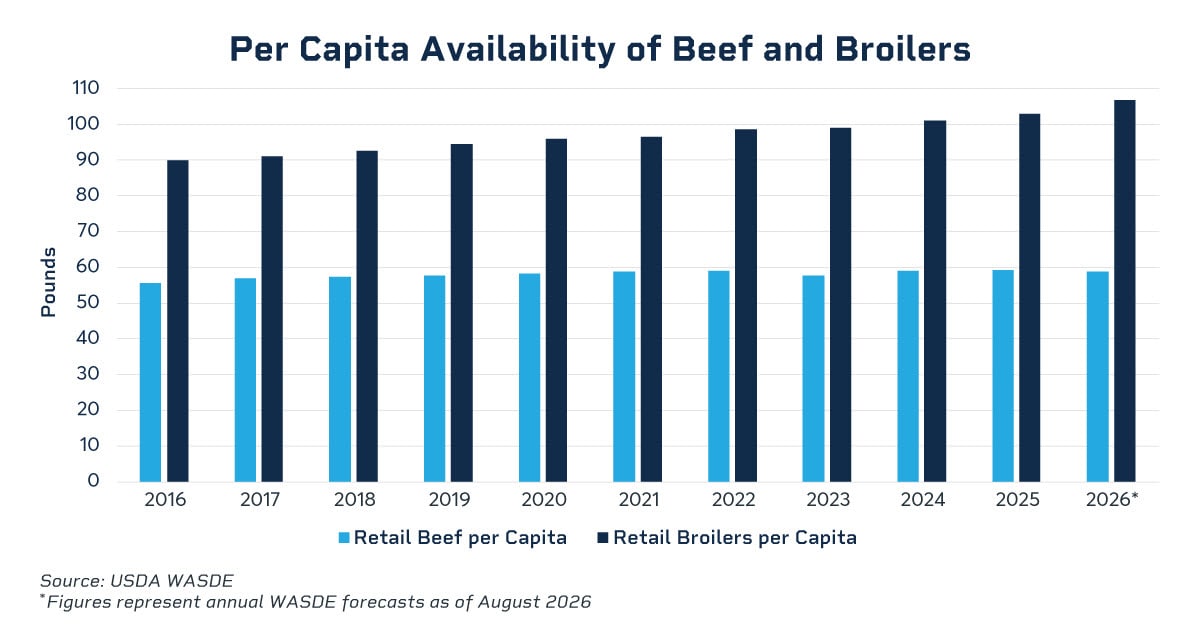
The USDA’s August 2026 World Agricultural Supply and Demand Estimates (WASDE) report projects annual beef production at 24,967 million pounds, down nearly 4% from 26,003 million pounds in 2025. On the contrary, 2026 broiler production is projected to reach 49,623 million pounds, up 3.4% from 48,006 million pounds in 2025.
Per-capita domestic availability, or “disappearance”, is used as a proxy for domestic consumption and currently reflects gradual shifts in the beef and broiler markets. As of August 2026, the USDA forecasts per-capita retail beef availability falling slightly and per-capita retail broiler availability trending upward. Even so, beef demand remains resilient, showing minor signs of softening despite historical price headwinds.

Managing Risk with CME Group Lean Beef Trim Futures and Options
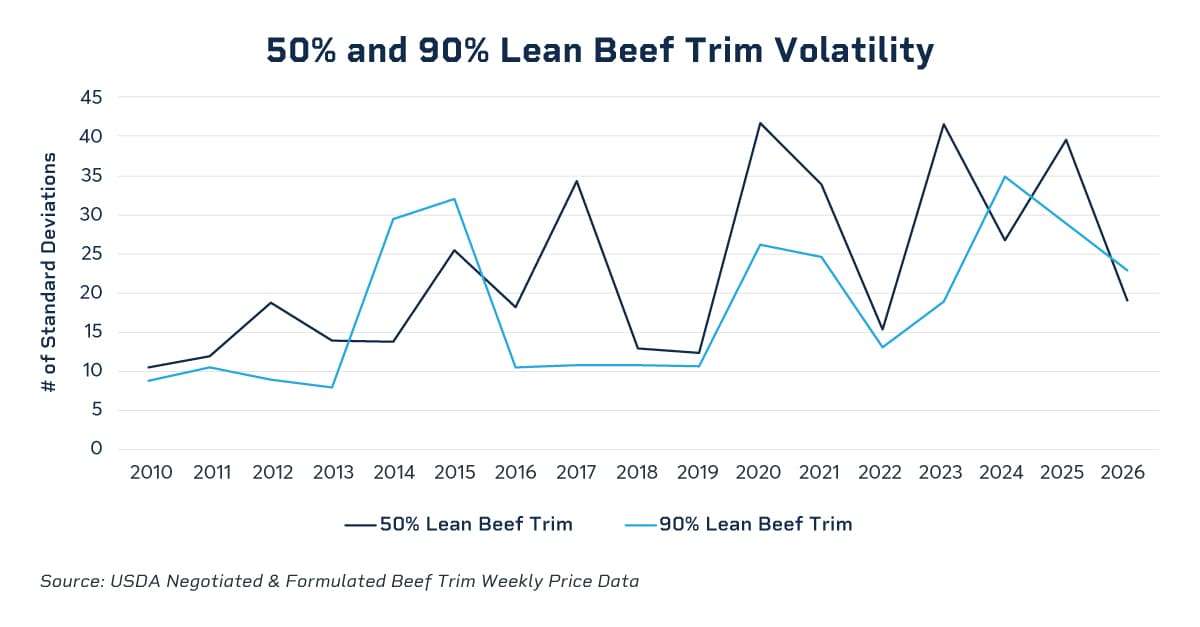
As the industry navigates supply challenges and uncertainty over when the cattle cycle will bottom, tight inventories are contributing to sharp price swings at the processing level. Key processing inputs to ground beef continue to experience price volatility, as seen in price swings for both 50% lean beef trim and 90% lean beef trim.
With the introduction of 50% and 90% Lean Beef Trim futures and options, CME Group now offers market participants hedging tools across the entire beef value chain, from feeder and live cattle to beef trim.
You must be logged in to post a comment Login