


Connect with us

Business

Homebuyers defy 6% mortgage rates as housing market stays resilient

Published

on

Homebuyers defy 6% mortgage rates as housing market stays resilient

Despite mortgage rates just dipping below the 6% mark, American homebuyers aren’t retreating just yet.

While high mortgage rates have historically chilled demand, the latest data reveals a defiant consumer base: new home sales remain higher than year-ago levels, and a massive surge in refinancing suggests homeowners are pouncing on any slight dip in borrowing costs.

Advertisement

Recent data from the Census Bureau reveals that while new home sales dipped slightly by 1.7% in December, the market remains surprisingly resilient, with annual sales outpacing 2024 levels by nearly 4%. 

The Mortgage Bankers Association additionally reported Wednesday that refinance applications are 150% higher than the same week last year, and up 4% from the previous week, potentially signaling that homeowners who bought at 7% or 8% are racing to lower their monthly overhead.

TRUMP PLEDGES TO MAKE HOUSING AFFORDABLE WHILE KEEPING VALUES UP

“The growth in mortgage demand reflects the gradual erosion of the lock-in effect, which began in early 2022 with the Fed [pivoting] to higher interest rates. Rising inventory in many markets has brought more choices to consumers and slowed home price growth,” StreetMatrix real estate analyst Jonathan Miller told Fox News Digital.

Advertisement
US flags hang from brick homes at sunset

New home sales and mortgage application data offer a fresh pulse on the state of America’s housing market. (Getty Images)

“While many potential homebuyers are still hoping for mortgage rates to fall sharply,” he continued, “there is a growing recognition that they won’t return to the rock-bottom levels coming out of the pandemic and that home prices are only getting higher.”

It’s a potential sign that buyers are still acclimating to a new normal of borrowing costs, even as the median price tag for a new build jumped to $414,400 last month.

“The existing home market… remains constrained by the lock-in effect, with many owners unwilling to trade a 3% mortgage for a 6% one,” Palm Beach-based RWB Construction Management’s Robert Burrage chimed in. “So while both markets are supply-limited, new construction has been more agile in stimulating demand.”

Housing supply currently sits at 7.6 months. Anything over six months typically cues a buyer’s market, giving shoppers more leverage to negotiate for concessions.

Advertisement

“Because we build exclusively for end users, not as a spec developer, our pipeline looks very different from what you see in the national new home sales data,” Burrage noted.

“When a custom home starts, it’s typically tied to a committed client who has already secured financing or is paying cash. That removes a lot of the speculative risk from the equation,” he expanded. “So even if new home sales tick down nationally, that doesn’t necessarily translate into excess inventory in the true custom segment. These homes aren’t sitting on the market waiting for a buyer, they’re being delivered to one.”

“The opportunity cost isn’t just about the rate, it’s about price trajectory and competition. Buyers and sellers get the same memo when rates are falling. The perception of improved affordability for buyers with lower rates are offset with sellers believing that can get a higher price because buyers have more financial strength to purchase. If we learned anything during the housing boom five years ago, [it’s] that lower rates push housing prices higher,” Miller added.

Advertisement

StreetMatrix’s analyst also noted that beneath the national surface, Florida is seeing a 2.7% year-over-year price cooling as national averages remain resilient. That decline could be tied to high insurance and maintenance costs.

“Across the Sun Belt, states like Florida are experiencing a housing market reset after a prolonged period of price growth, and inbound migration is waning. Expect a period of more modest sales and price growth going forward,” Miller said.

GET FOX BUSINESS ON THE GO BY CLICKING HERE

Advertisement

On the national level, Miller advises keeping a close eye on U.S. jobs and wage numbers throughout 2026.

“We’ve been in a rapid housing growth period where affordability remains strained, but distressed sales remain limited so far,” he said. “Thankfully, mortgage lenders didn’t lose their minds like they did during the great financial crisis. If jobs and wages hold, the market is more likely to grind sideways than correct.”

READ MORE FROM FOX BUSINESS

Advertisement
Continue Reading
Click to comment

Leave a Reply

Your email address will not be published. Required fields are marked *

Business

Lowe’s Says Homeowners Remain Reluctant to Remodel

Published

on

Lowe’s Says Homeowners Remain Reluctant to Remodel

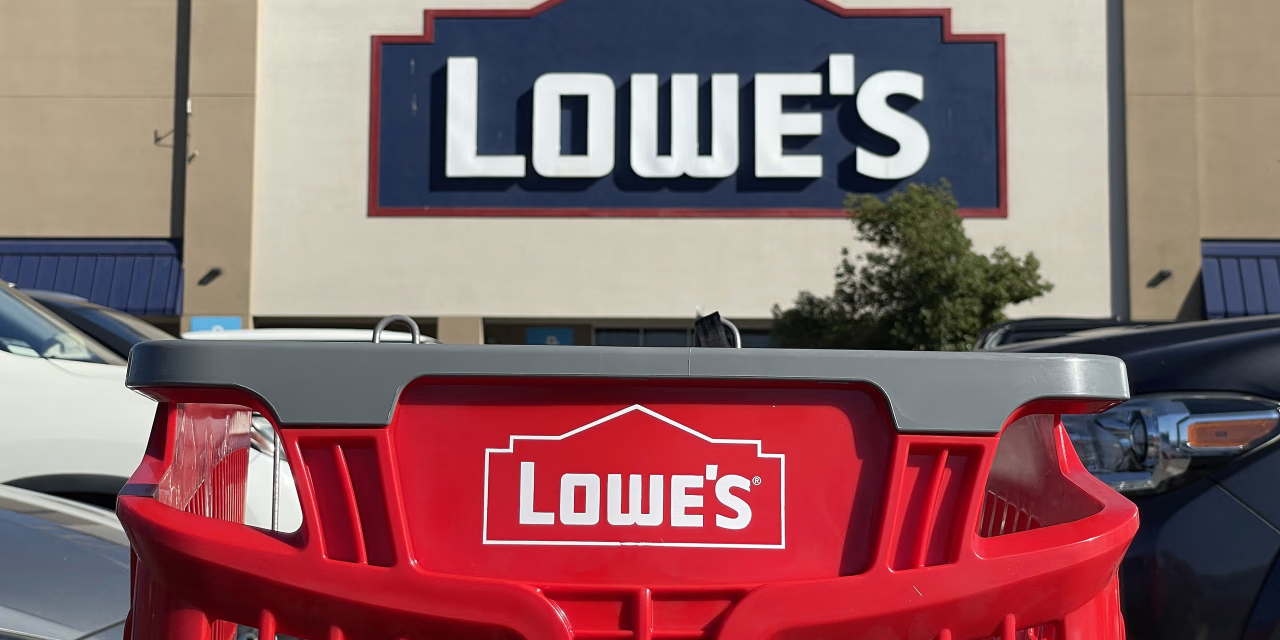
Lowe’s is expecting a flat home-improvement market in 2026 as stalled housing sales, high interest rates and economic uncertainty continue to lead homeowners to delay remodeling and repair projects.

“Our outlook for 2026 remains cautious given the persistent volatility in the housing macro,” said Chief Executive Marvin Ellison in the company’s earnings call. “This uncertainty continues to pressure big-ticket discretionary [do-it-yourself] projects, as many consumers are reluctant to make significant investments in their homes.”

Copyright ©2026 Dow Jones & Company, Inc. All Rights Reserved. 87990cbe856818d5eddac44c7b1cdeb8

Continue Reading

Business

Netflix ditches Warner Bros. Discovery deal after Paramount offer deemed superior

Published

on

Netflix ditches Warner Bros. Discovery deal after Paramount offer deemed superior

Netflix is walking away from a deal to buy Warner Bros. Discovery’s studio and streaming assets after the WBD board on Thursday deemed a revised bid by Paramount Skydance to be a superior offer.

Earlier this week, Paramount raised its bid to buy the entirety of WBD to $31 per share, up from $30 per share, all cash. It was the latest amendment to Paramount’s multiple offers in recent months — and since moving forward with a hostile bid to buy the company — and it’s now unseated a deal between WBD and Netflix to sell the legacy media company’s studio and streaming businesses for $27.75 per share.

Last week, Netflix granted WBD a seven-day waiver to reengage with Paramount, resulting in the higher bid. Paramount’s offer is for the entirety of WBD, including its pay TV networks, such as CNN, TBS and TNT.

Netflix had four business days to make changes to its own proposal in light of Paramount’s superior bid, the WBD board said in a statement Thursday.

Advertisement

Instead, the decision by the streaming giant to walk away puts a pin in a drawn-out saga that saw amended offers from both bidders.

Netflix stock spiked 10% in extended trading Thursday. Shares of Warner Bros. Discovery fell 2%.

“The transaction we negotiated would have created shareholder value with a clear path to regulatory approval,” Netflix co-CEOs Ted Sarandos and Greg Peters said in a statement. “However, we’ve always been disciplined, and at the price required to match Paramount Skydance’s latest offer, the deal is no longer financially attractive, so we are declining to match the Paramount Skydance bid.”

The latest Paramount bid included a $7 billion breakup fee in the event the proposed merger doesn’t win regulatory approval. The company also agreed to pay the $2.8 billion breakup fee that WBD would owe Netflix if that deal didn’t go through.

Advertisement

Sarandos told CNBC’s Julia Boorstin in an interview last week that the company granted WBD the waiver to reopen Paramount talks in order to give shareholders clarity.

“Paramount had been making a ton of noise, flooding the zone with confusion for shareholders … including floating all these hypothetical offers and talking directly to the shareholders and bypassing the Warner Bros. Discovery board,” Sarandos said at the time. “So we’ve given the opportunity to get those shareholders exactly what they deserve, which is complete clarity and certainty.”

However, Sarandos had fallen short of commenting on whether Netflix would up its own offer to match a revised Paramount bid.

“Warner Bros. is a world-class organization, and we want to thank David Zaslav, Gunnar Wiedenfels, Bruce Campbell, Brad Singer and the WBD Board for running a fair and rigorous process,” the Netflix co-CEOs said in their statement.

Advertisement

“We believe we would have been strong stewards of Warner Bros.’ iconic brands, and that our deal would have strengthened the entertainment industry and preserved and created more production jobs in the U.S.,” they said. “But this transaction was always a ‘nice to have’ at the right price, not a ‘must have’ at any price.”

This news is developing. Please check back for updates.

Continue Reading

Business

Space X supplier Filtronic launches expanded North East base

Published

on

Business Live

The new factory and headquarters space in County Durham brings larger capacity to the technology innovator

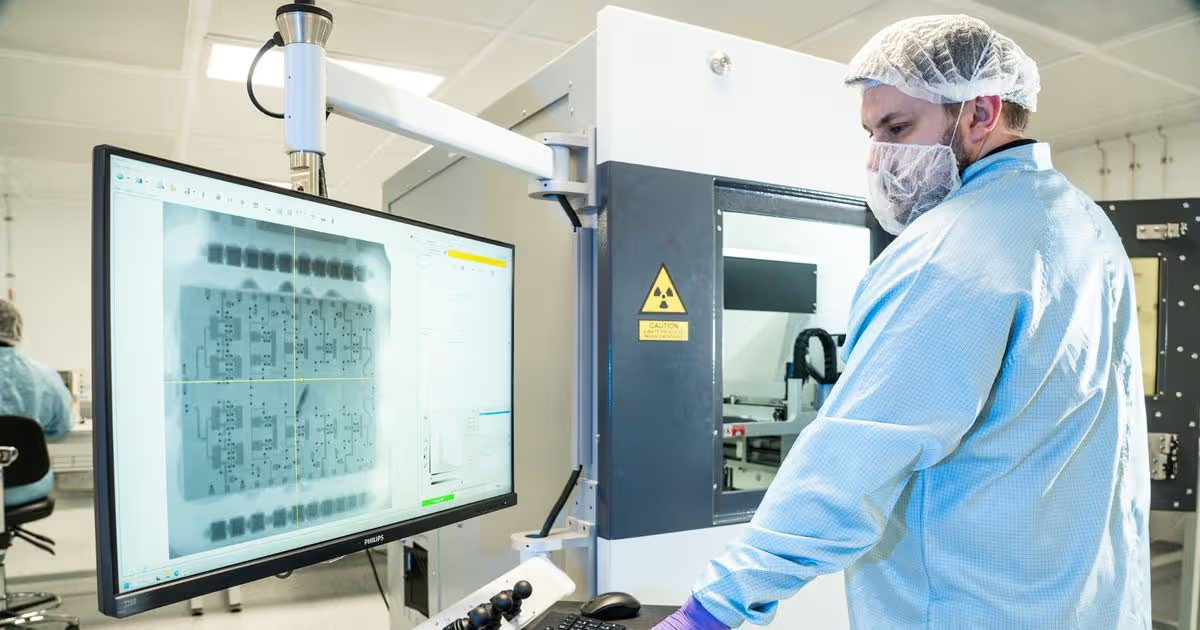
Filtronic has substantially increased capacity with its new NETPark base.

Filtronic’s new base gives it the capacity to drive more than £200m in annual revenue.(Image: Simon Dewhurst)

Satellite communications specialist Filtronic has launched a new, multimillion-pound factory in County Durham.

The world-leading firm, which has a key supplier to Elon Musk’s Starlink satellite programme, has opened the 44,000 sqft headquarters and manufacturing facility close to its original home at NETPark. The purpose-built site significantly expands production capacity with a doubling of its manufacturing footprint and a six-fold increase in cleanroom facilities.

Filtronic says the move means it now has the capacity to support £200m annual revenue, from its current position of about £55m. The firm says the new home will help it cement its position as the country’s top producer of “mission-critical” high frequency technologies used in satellite communications, space systems and defence programmes.

In it, Filtronic’s engineers will design, develop, qualify, manufacture and test high performance connectivity technology. The new facility – which has been entirely self funded by the London-listed business – is intended to make production more scalable via growing automation.

Advertisement

Nat Edington, CEO at Filtronic, said, “Our investment in this new facility brings the scale, capability and resilience needed for our next phase of growth. As our markets shift decisively towards higher frequencies, higher bandwidth and ultra-reliable solid-state architectures, it’s a signal that we’ll continue to pre-empt, support and surpass our customer’s long-term requirements.”

Filtronic's expansion comes on the back of lucrative deals with Space X.

Sedgefield’s Filtronic has opened new premises.(Image: North News & Pictures Ltd)

With hopes of growing a record order book that includes Space X projects worth tens of millions of dollars, Filtronic is also hoping to capitalise on increased spending by Governments on secure satellite communications and next-generation defence systems. In recent months it has attracted a more diverse range of customers including a €7m agreement with a European space customer and a £13.4m contract with a leading European defence client.

Space Minister Liz Lloyd said: “The opening of this state-of-the-art facility is a clear demonstration of the strength and confidence within the UK’s space sector, and a powerful example of British industrial ambition in action. Filtronic is helping to reinforce the UK’s status as a world leader in cutting-edge communications technology.”

Filtronic is hoping to reach £200m annual revenue in the years ahead.

Inside Filtronic’s new 44,000 sqft headquarters at NETPark.(Image: Simon Dewhurst)

Filtronic’s technology is used in surface‑to‑space, space‑to‑space, and space‑to‑surface communications. The company says it is now the only high‑volume supplier of very high‑frequency solid‑state power amplifiers in the space sector.

Advertisement

Paul Bate, CEO, UK Space Agency, said: “Filtronic’s new facility at NETPark is a statement of intent for UK space manufacturing. Doubling their production footprint and dramatically expanding cleanroom capacity demonstrates exactly the kind of long-term industrial commitment that strengthens Britain’s capability in critical space technologies. As demand grows for high-performance RF solutions across satellite constellations and defence programmes, having world-class manufacturers of this calibre operating at scale in the UK are a significant asset.”
Continue Reading

Business

Burger King rolls out AI headsets that track employee 'friendliness'

Published

on

Burger King rolls out AI headsets that track employee 'friendliness'

The fast-food chain is testing OpenAI-powered headsets that monitor staff interactions with customers.

Continue Reading

Business

Florida man charged in alleged $328 million crypto Ponzi scheme

Published

on

Florida man charged in alleged $328 million crypto Ponzi scheme

A Florida man was arrested on federal charges related to an alleged cryptocurrency “Ponzi scheme” that defrauded investors of at least $328 million.

The U.S. Attorney’s Office for the Middle District of Florida said in a release Tuesday that Christopher Alexander Delgado, a 34-year-old from Apopka, Florida, was arrested on wire fraud and money laundering charges. If convicted on all charges, Delgado would face a maximum of 30 years in federal prison.

Advertisement

According to the federal complaint, Delgado was the president and CEO of Goliath Ventures, formerly known as Gen-Z Venture Firm, and allegedly carried out the Ponzi scheme from January 2023 through January 2026. A Ponzi scheme involves paying purported returns to existing investors from funds obtained from new investors.

The U.S. Attorney’s Office said the scheme involved Delgado allegedly soliciting victims to invest substantial amounts of money under what prosecutors described as false and fraudulent promises of monthly returns generated by cryptocurrency “liquidity pools.”

CRYPTO EXPERT EXPLAINS WHY BITCOIN MAKES ‘PERFECT RECORD’ FOR TRACKING DOWN CRIMINALS

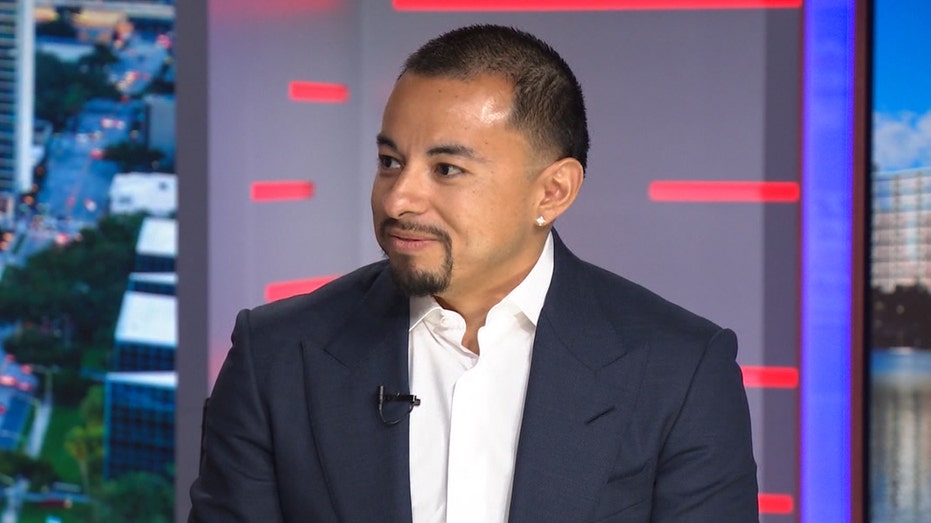
Christopher Alexander Delgado sits for a TV interview.

Christopher Alexander Delgado was arrested and charged with wire fraud and money laundering. (WNYW)

Victims of the scheme, according to the complaint, were also induced to give money to Delgado’s firm through personal referrals, professional marketing materials, luxury events, charitable sponsorships, along with some monthly payments of the purported returns to establish Goliath’s reputation with investors.

Advertisement

While Goliath said it would place investors’ funds in cryptocurrency liquidity pools, the federal prosecutors’ announcement indicated that the funds were mainly used to pay the purported returns to earlier investors, return the principal of investors who requested it, as well to pay for extravagant business gatherings, holiday parties and luxury travel accommodations.

The U.S. attorney’s office said that Delgado used funds from investors he allegedly victimized to buy four residential properties that were each worth between $1.15 million and $8.5 million.

bitcoin and other crypto coins displayed

The alleged Ponzi scheme attracted investors with promises of returns from crypto liquidity pools. (iStock)

PHILADELPHIA MEN REPEATEDLY TRAVELED TO MINNEAPOLIS TO CARRY OUT $3.5M HOUSING FRAUD SCHEME: DOJ

Victims who have been identified by law enforcement will receive a notice of their rights under the Crime Victims’ Rights Act

Advertisement

The announcement by the prosecutors’ office also indicated that victims who haven’t received such a notice may reach out to the IRS through a dedicated contact email for Goliath victims, while the Department of Justice also has a webpage with information about how victims may self-identify themselves to law enforcement working the case.

Justice Department seal

The Department of Justice announced Delgado’s arrest on charges of running an alleged crypto Ponzi scheme. (Samuel Corum/Bloomberg via Getty Images)

SEC CHAIRMAN WARNS OF CHINA-LINKED RAMP-AND-DUMP ACTIVITY

Criminal complaints and charges are merely allegations that a defendant has broken the law, and all defendants are presumed innocent unless, and until, proven guilty.

The case is being investigated by the Internal Revenue Service Criminal Investigation and Department of Homeland Security Investigations.

Advertisement

GET FOX BUSINESS ON THE GO BY CLICKING HERE

Continue Reading

Business

Microsoft Stock Rebounds Sharply on Eased AI Concerns, Partnership News as Shares Climb Toward $401

Published

on

AMD CEO Lisa Su unveiled the chip giant's latest line of products during a keynote speech at Computex 2024 in Taipei

Microsoft Corp. shares surged nearly 3% in heavy trading Wednesday, snapping a recent pullback as investors found reassurance from comments easing fears over AI disruption and new strategic collaborations bolstered confidence in the tech giant’s cloud and artificial intelligence momentum.

Microsoft has made huge investments in AI infrastructure
AFP

Microsoft (NASDAQ: MSFT) closed at $400.60 on Feb. 25, up $11.60 or 2.98%, on volume of more than 43 million shares — well above the average. The stock traded in a day’s range of $390.20 to $401.47 before settling near session highs. Pre-market activity Thursday showed minor dips around $399 to $400. The shares have ranged from a 52-week low of $344.79 to a high of $555.45, reflecting volatility amid broader tech sector rotation and debates over AI spending sustainability. Market capitalization stands near $2.97 trillion.

The rally followed a period of pressure, with the stock down about 20% year to date through mid-February and approaching its 200-week moving average in what some analysts called a rare technical crossroads not seen in over a decade. Recent gains appear tied to reduced anxiety over generative AI potentially eroding enterprise software incumbents, including Microsoft’s own offerings.

Anthropic’s remarks suggesting its Claude AI ecosystem could complement rather than supplant existing tools helped calm nerves, while a White House initiative on “rate payer protection” for AI data center energy costs signaled potential regulatory support rather than headwinds. Microsoft also announced an expanded partnership with SpaceX’s Starlink to extend Azure’s edge computing reach, enhancing connectivity in remote areas and supporting hybrid cloud deployments.

The positive sentiment builds on Microsoft’s fiscal second-quarter results reported Jan. 28 for the period ended Dec. 31, 2025. Revenue reached $81.3 billion, up 17% year over year (15% in constant currency), beating consensus estimates around $80.3 billion. Operating income rose 21% to $38.3 billion, while GAAP net income surged 60% to $38.5 billion, or $5.16 per diluted share. Non-GAAP EPS was $4.14, up 24% and above expectations of about $3.86.

Advertisement

Microsoft Cloud revenue crossed $50 billion for the first time, climbing 26% (24% constant currency), driven by strong demand across the portfolio. Intelligent Cloud segment revenue hit $32.9 billion, up 29% (28% constant currency), with Azure and other cloud services growing 39% (38% constant currency). AI contributions were significant, accounting for 22 to 26 percentage points of Azure’s growth, executives noted on the earnings call.

Productivity and Business Processes revenue increased, fueled by Microsoft 365 commercial cloud subscriptions. More Personal Computing saw a decline due to softer gaming, partially offset by search advertising and Windows OEM strength.

CFO Amy Hood highlighted robust commercial bookings and capital expenditures of $37.5 billion in the quarter — much of it on AI infrastructure like GPUs and CPUs — positioning the company for future monetization. Total first-half fiscal 2026 capex reached $72.4 billion, on track for around $100 billion annually, raising some investor concerns about near-term margin pressure but underscoring commitment to AI leadership.

Guidance for the fiscal third quarter called for revenue of $80.65 billion to $81.75 billion, aligning with expectations, with Azure growth projected at 37% to 38% constant currency. Gross margins narrowed slightly to just over 68%, the lowest in three years, amid heavy infrastructure investments.

Advertisement

CEO Satya Nadella emphasized that Microsoft is “only at the beginning phases of AI diffusion,” with the company’s AI business already rivaling some of its largest franchises in scale. Partnerships with OpenAI, Anthropic and others continue to drive ecosystem expansion.

Recent developments include progress on internal silicon like the Maia 200 AI chip, which Goldman Sachs analysts praised as advancing Microsoft’s strategy, reiterating a buy rating with a $600 price target. Broader Wall Street sentiment remains bullish, with consensus ratings of “Strong Buy” or “Moderate Buy” from dozens of analysts. Average price targets hover around $592 to $603, implying 47% to 50% upside from current levels, though some range as high as $730 and as low as $392 amid valuation debates.

Challenges include regulatory scrutiny, such as a raid on Microsoft Japan’s offices over potential Azure restrictions on rival cloud services, and ongoing antitrust dynamics. Gaming leadership changes, including new appointments with AI expertise, signal tighter integration with Azure and Copilot.

Despite a year-to-date decline earlier in 2026, Microsoft’s fundamentals — dominant cloud position, recurring revenue streams and AI tailwinds — support optimism for recovery. Investors watch upcoming product roadmaps, capex efficiency and enterprise AI adoption for further catalysts.

Advertisement

As AI transforms industries, Microsoft’s integrated platform across cloud, productivity and emerging agentic capabilities positions it as a frontrunner, with recent share gains reflecting renewed conviction in its long-term trajectory.

Continue Reading

Business

Thailand Welcomes Close to 6 Million International Visitors in Early 2026

Published

on

Thailand Welcomes Close to 6 Million International Visitors in Early 2026

In early 2026, Thailand welcomed nearly 6 million foreign tourists, generating approximately 293 billion baht. Strong arrivals from China and Malaysia boosted revenue, supported by favorable travel policies and trends.


Key Points

  • Tourism Performance: Thailand saw nearly 6 million foreign arrivals and 293 billion baht in revenue from January 1 to February 22, 2026. China was the leading source market, contributing nearly 1 million visitors.
  • Recent Trends: From February 16 to 22, arrivals totaled 879,587, a minor decline of 0.34%. Notable increases were seen in Malaysian arrivals (up 33%) and a 7.57% rise from Russia, while arrivals from China, India, and South Korea decreased slightly.
  • Future Outlook: The government anticipates stable arrival numbers for the final week of February, bolstered by policies like the suspension of the TM.6 form and a focus on ASEAN travel trends, maintaining Thailand’s tourism growth momentum.

The Thai government reports strong early 2026 tourism performance, with nearly 6 million foreign arrivals and approximately 293 billion baht in revenue during the first two months.

Deputy Government Spokesperson Airin Phanrit reported that from January 1 to February 22, 2026, Thailand welcomed 5,947,434 international tourists, generating an estimated 293,119 million baht in revenue. China was the top source market with nearly 1 million visitors, followed by Malaysia, Russia, India, and South Korea.

​From February 16 to 22, arrivals totaled 879,587, a slight 0.34% decrease from the previous week. Arrivals from Malaysia increased by over 33% due to school holidays, reaching 111,581, the highest in eight weeks. Russian arrivals rose by 7.57%. Arrivals from China, India, and South Korea declined as peak holiday periods ended, though Chinese arrivals remained strong at nearly 200,000 for the week.

For the final week of February, the government expects arrival numbers to remain stable. This outlook is supported by “Ease of Traveling” policies, including suspension of the TM.6 immigration form, increased flight frequencies, and the “Trusted Thailand” safety campaign. Additionally, a shift in Chinese travel trends toward ASEAN destinations continues to support Thailand’s tourism growth.

Advertisement

Source : Thailand Records Nearly 6 Million Foreign Arrivals in Early 2026

Continue Reading

Business

Matt Hardy Says WrestleMania 42 Ticket Price Is Too High

Published

on

After transforming college basketball, Caitlin Clark is predicted to have the same effect on the WNBA

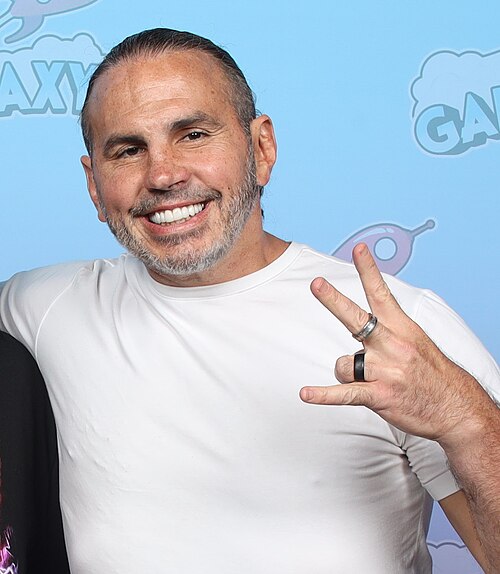
TNA World Tag Team Champion Matt Hardy has voiced concerns over the escalating ticket prices for WWE WrestleMania 42, calling it a “tough sell” for fans amid economic pressures and the event’s return to the same market for a second straight year.

In a recent episode of his podcast, “The Extreme Life of Matt Hardy,” the veteran wrestler addressed reports of sluggish ticket sales for the two-night spectacle set for April 18-19, 2026, at Allegiant Stadium in Las Vegas. Hardy, who has competed in multiple WrestleManias during his storied career in WWE and other promotions, empathized with fans facing the financial decision.

Matt Hardy
Matt Hardy

“It’s hard to justify spending that much money on tickets for entertainment,” Hardy said. “You know that isn’t something that you have to have in your every single day life to survive and live and be okay. So it’s a tough sell.”

Hardy’s comments come as WWE grapples with ticket demand trailing behind last year’s record-breaking WrestleMania 41, also held at Allegiant Stadium. Sources indicate that current get-in prices hover around $264 for Night 1 and $276 for Night 2 on resale platforms, with two-day passes starting near $652. Premium seats and packages have commanded significantly higher figures, with some reports citing top-tier options exceeding several thousand dollars per night before fees.

The company has responded to slower sales with promotions, including a reported 25% discount at Allegiant Stadium and meetings to reassess pricing strategies. Despite these efforts, attendance projections remain below the 2025 event’s pace, which drew massive crowds and generated substantial revenue following WWE’s merger into TKO Group Holdings.

Advertisement

Hardy pointed to several contributing factors. He highlighted the challenge of repeating the Las Vegas market so soon after its success in 2025, when the city hosted what many called one of the most profitable WrestleManias in history.

“Vegas was so good last year and they did these record numbers, and I guess they bid for them to come back,” Hardy explained. “But it’s tough to go into the market two years back-to-back, and you know that those tickets are pricey. Economically — especially since the pandemic — it’s kind of been a roller coaster ride for everyone.”

The post-pandemic economic landscape has left many households cautious with discretionary spending. Hardy noted that while WrestleMania remains a marquee event, the high costs — including not just tickets but travel, lodging, and related expenses in an expensive destination like Las Vegas — make it difficult for average fans to attend consecutively or even once.

“I mean, they go, ‘Well, I went last year, and it was pretty expensive. And kind of set me back a little bit, I don’t know if I can go this year,’” Hardy said, paraphrasing potential fan sentiment.

Advertisement

Hardy’s perspective echoes broader discussions within the wrestling community about pricing trends under WWE’s current leadership. Since the introduction of two-night WrestleManias in 2020, ticket costs have risen steadily to capitalize on premium demand, celebrity appearances, and high production values. Critics argue this shift prioritizes corporate revenue over accessibility for longtime supporters.

Some fans and commentators have suggested WWE could benefit from returning to a single-night format with longer cards to distribute costs more evenly, or from selecting fresh markets annually to avoid saturation. Hardy appeared to lean toward the latter idea, implying a new city might have generated more excitement and better sales momentum.

Despite the challenges, Hardy acknowledged WWE’s confidence in its product. The company continues to build toward WrestleMania 42 with major storylines across Raw, SmackDown, and international brands. Recent developments include high-profile matches rumored for the card, though official announcements remain forthcoming.

Hardy, 51, currently competes in Total Nonstop Action Wrestling (TNA), where he holds the World Tag Team Championship alongside his brother Jeff Hardy as part of The Hardys. His insights carry weight given his deep history in the industry, including iconic WrestleMania moments such as his ladder match appearances and championship reigns.

Advertisement

While not directly criticizing WWE’s business decisions, Hardy’s candid remarks add to a growing chorus questioning whether skyrocketing prices could alienate the core fanbase that has fueled WrestleMania’s growth into a global spectacle.

WWE has not publicly responded to Hardy’s specific comments but maintains that WrestleMania remains the pinnacle of sports entertainment, with tickets available through official channels like Ticketmaster. Single-day and multi-day options continue on sale, and the company has emphasized enhanced fan experiences, including premium hospitality packages.

As the Road to WrestleMania intensifies, all eyes will be on whether sales rebound in the coming months. Hardy concluded his thoughts optimistically yet realistically: “They’re confident, I guess they can do it for another year straight, and I guess when it’s all said and done, by the time we get to WrestleMania, we’ll see if they were right or not.”

For fans weighing the investment, the debate underscores a larger tension in modern sports entertainment: balancing blockbuster ambition with affordability in an uncertain economy.

Advertisement
Continue Reading

Business

FanDuel parent Flutter (FLUT) Q4 2025 earnings

Published

on

FanDuel parent Flutter (FLUT) Q4 2025 earnings
Flutter CEO Peter Jackson optimistic despite ‘bumpy year’

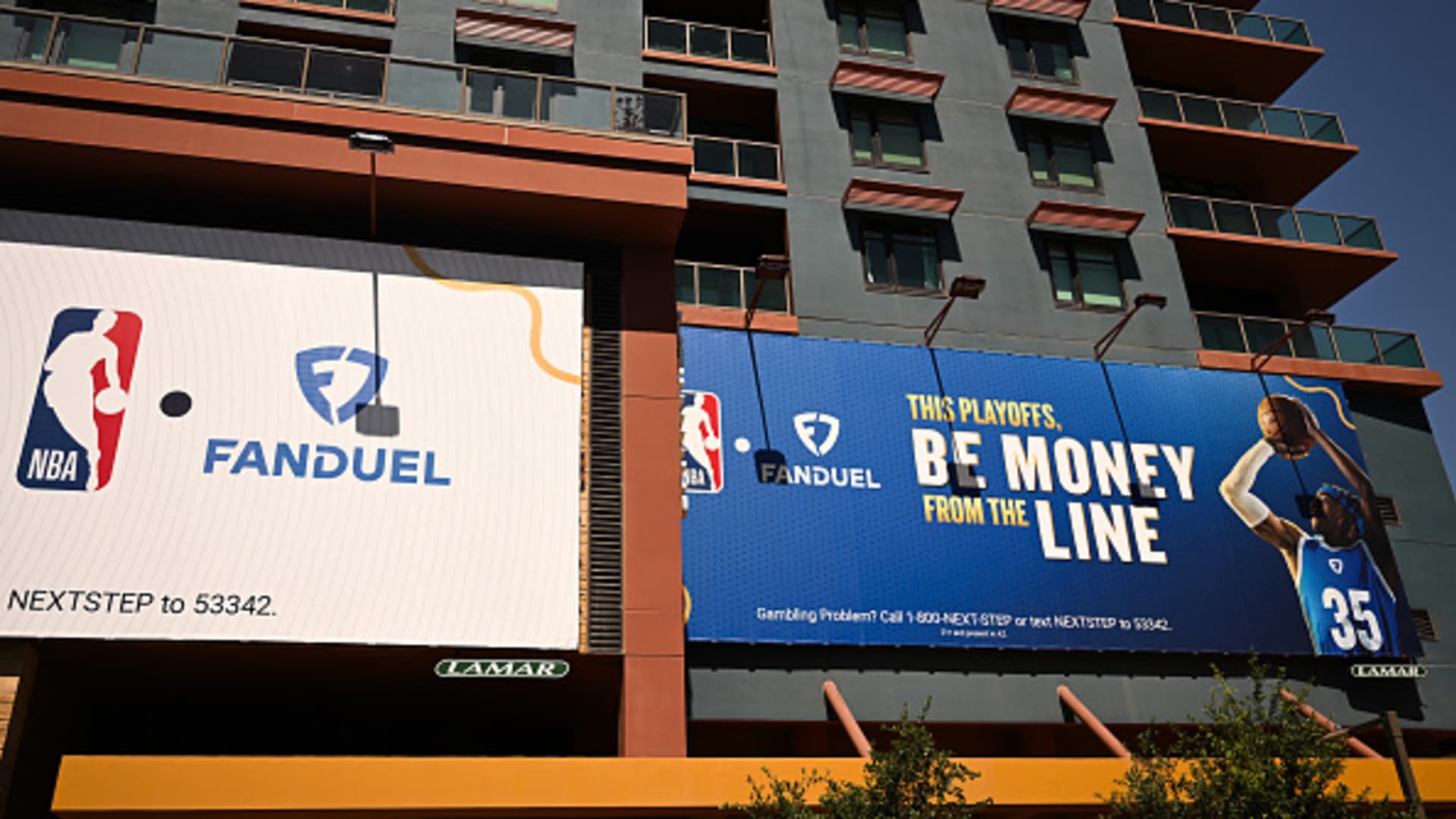
FanDuel parent Flutter Entertainment announced fourth-quarter earnings Thursday that missed Wall Street expectations on nearly every metric.

FanDuel’s performance in the final quarter of 2025 was affected by bettors losing more often than usual. When that happens, gamblers get discouraged, bet less and stop using the app as frequently, Flutter CEO Peter Jackson told CNBC in an interview.

“It’s fair to say, not everything went our way in the fourth quarter,” Jackson said.

Shares of Flutter fell almost 7% in extended trading Thursday.

Advertisement

Here’s what the company reported for the fourth quarter, compared with Wall Street consensus:

  • Revenue: $4.74 billion vs. $4.97 billion, according to LSEG
  • Adjusted EPS: $1.74 vs. $1.95, according to LSEG

For the fourth quarter, Flutter reported adjusted earnings before interest, taxes, depreciation and amortization of $832 million, below the $893 million that Wall Street was expecting, according to StreetAccount.

Its fourth-quarter revenue marked a year-over-year increase of 25%. And yet, Flutter’s 2026 revenue guidance of $17.75 billion to $19.05 billion was lower than analysts’ projection of $19.34 billion for the year.

On the company’s earnings call, Jackson told investors that prediction markets would likely spur more legalization of sports betting by the states. He also said the company has found no evidence that prediction markets are cannibalizing the sportsbook business.

Advertisement
Continue Reading

Business

Workday Earnings Beat Estimates. Why the Stock Is Tanking.

Published

on

Workday Earnings Beat Estimates. Why the Stock Is Tanking.

Workday Earnings Beat Estimates. Why the Stock Is Tanking.

Continue Reading

Trending

Copyright © 2025