
Business
How Aleksandr Loginov Is Redefining Design in the Age of AI

Recent releases made the shift in design impossible to ignore. Google DeepMind’s Nano Banana Pro showed how far image generation has moved toward precise, controllable editing, with tools that let creators adjust camera angle, focus, depth, and color treatment. For video, Seedance 2.0 combined audio-visual generation with much more direct control over performance, lighting, shadow, and camera movement.
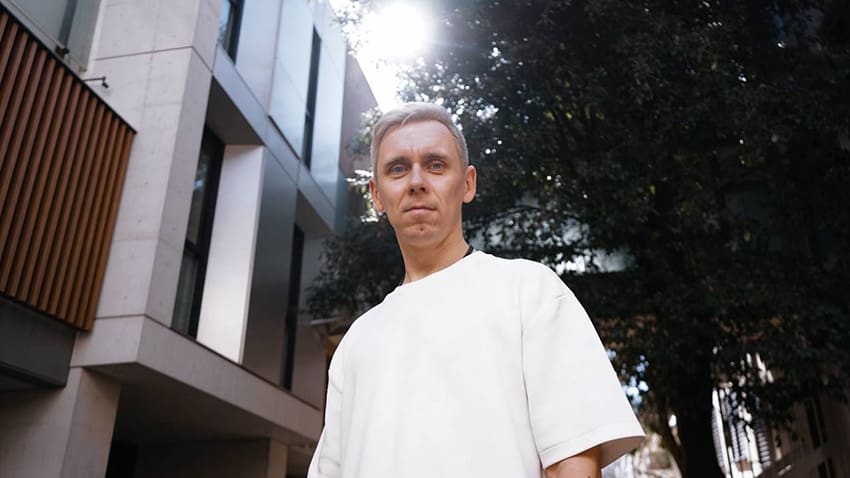
These tools are turning design into a controllable production system, so the designer’s role is moving towards that of a systems architect, says Aleksandr Loginov, a product designer and creative leader who combines broadcast visual craft, technical fluency, and product thinking. As Chief Design Officer at Prequel, a consumer app company in photo and video editing whose 4 apps repeatedly reached No. 1 in the App Store’s Photo & Video category in markets including the US, the UK, France, and Canada, he helped shape the strategy behind the company’s rapid expansion. Before moving into product and AI design, Aleksandr was a broadcast designer at STS, a popular Russian entertainment television channel, where he led his team to a silver PromaxBDA award in the UK in 2015 for high-level work in TV promotion and broadcast design. Now, as he has just joined Lazarev Agency as Art Director for agent-based AI product interfaces, he moves into an award-winning B2B design company with more than 600 shipped products, focused on complex, data-heavy platforms such as AI copilots, decision engines, and vertical SaaS.
Across all those roles, Aleksandr observed that as AI absorbs more of the manual craft, the real competitive edge is shifting elsewhere: toward judgment, system design, and making complex tools usable.
The New Creative Engine
To understand the shift in design, start with the stack itself. Creative teams are no longer using isolated tools. They are assembling a production engine. As Aleksandr notes, Nano Banana Pro is especially strong when the goal is a polished image with better lighting, composition, localized edits, and cinematic texture. But consistency of faces is not its main advantage. That is where Seedream is stronger. Right now, its clearest edge is identity transfer: keeping faces recognizable and consistent across outputs better than any other model in the stack. Kling and Seedance add the cinematography layer, making it possible to generate video with synchronized audio, controlled motion, and more coherent shot sequences. ElevenLabs adds the voice layer, giving visuals a believable multilingual narrative.
“I have already noticed that even a small amount of coding knowledge is now becoming essential for designers. Not to turn them into engineers, but to help them connect models in the right order, speed up iteration, and work with far less dependence on long engineering cycles,” Aleksandr says. Once the stack can provide photorealistic visuals, identity consistency, motion, and voice, the advantage is the ability to turn those capabilities into a dependable pipeline.
That shift becomes easier to recognize when you have had to lead products at scale. At Prequel, where Aleksandr served as Chief Design Officer, he was responsible not just for visual quality, but for the workflow behind image, video, and audio technologies across R&D, Data Science, Art, and key parts of Mobile and Backend. Part of the job was to improve quality, speed, cost, and time to market at the same time. One result, as he describes it, was a workflow that eventually cut the release cycle for AI features from roughly three months to 30 minutes, giving the company a much faster way to respond to signals from marketing. Once a creative stack can deliver photorealistic visuals, preserve identity, and handle motion and voice, the real advantage lies in turning that complexity into a pipeline people can actually use.
What Is Fading and What Is Rising
The manual labor of design is being automated into oblivion. If your value was based on how fast you could mask an image or navigate a complex software menu, the market is shrinking.
What is fading
- Technical Tool Proficiency: Knowing every shortcut in Photoshop is no longer a competitive advantage. The software is now a canvas for natural language and intent.
- Stock Curation: Spending hours browsing libraries for the “right” image is obsolete. If it doesn’t exist, you generate it in 15 seconds.
- Basic Asset Production: Routine tasks like resizing, color correction, and basic layout are now background processes.
What is rising
- Intent Engineering: This is more than prompting. It’s the ability to translate a business goal into a technical aesthetic description, i.e., understanding lighting, lenses, and psychology.
- Curatorial Judgment: When a machine gives you 50 perfect options, the designer is the one who knows which one actually resonates with the human heart.
- Ethical & Legal Oversight: Navigating the complexities of AI copyright and ensuring that generated content remains unbiased and original.
Aleksandr has witnessed this shift while building the kinds of systems that are redefining the designer’s role. In a multi-agent workflow for marketing, he did not focus on producing each asset by hand. He defined the creative logic, structured the sequence of models, and decided where human judgment needed to stay in the loop. Instead of scaling output by hiring dozens of designers, Aleksandr and his team built a system around Gemini and Nano Banana in which the designer began by describing the image and the criteria it had to meet. The model then generated 10 to 20 options. A separate vision-language model reviewed those outputs, identified the ones that matched the original brief most closely, and surfaced the strongest candidates for the designer to evaluate.
This way, Aleksandr shaped the next stage of the workflow. After the designer made a selection, the team animated the chosen images in Kling and assembled them into a single creative or a broader pack of creatives. They then tested that set either in Facebook ad accounts or through SplitMetrics to see which approaches attracted users most effectively. Aleksandr treated that stage not as a final checkpoint, but as part of the system itself: the team fed the performance data back into the workflow so the next round of creatives could build on what had already proven effective.
In practice, that workflow increased creative output many times over while sharply reducing the designer’s manual workload. Under Aleksandr’s leadership, the work that remained essential sat at a higher level: setting intent, defining quality, evaluating outputs, and steering the system as it iterated. For him, that is where the profession is moving. The designer’s value no longer lies mainly in making each asset by hand but in shaping the process that can produce strong creative results at scale.
He argues that this is also why consistency is becoming one of the hardest requirements in AI design:
“When a system produces many versions of the same person, the question is not whether it can generate an image, but whether it can preserve identity, recognizability, and stability across outputs. That is where the designer’s role changes most. The job is no longer just to make things look good, but to define the process, control the edge cases, and make sure the system produces results that are consistent enough to trust and ship,” he says.
From T-Shaped to Blob-Shaped Designers
For years, the ideal creative professional was T-shaped: broad across disciplines, with one deep specialty. In generative design, that model is starting to loosen. The role is becoming more fluid. A designer may move from visual direction to product logic, from interface structure to content behavior, depending on what the system needs at that moment. The craft does not disappear, but it stops living in one fixed place.
Aleksandr’s own career helps explain the shift. Early in his career, he worked in a television medium where images had to register at once (with precision, clarity, and emotional force), and that work led his team to a Silver PromaxBDA in the U.K. Later, at Prequel, he was no longer focused only on frames or campaigns. He concentrated on product systems that had to hold up across millions of user interactions while remaining intuitive enough to help the company’s apps repeatedly rise to the top of the App Store’s Photo & Video category in major markets. The role had expanded from making images to defining how creativity operates inside the product.
As Art Director for agent-based AI product interfaces at Lazarev Agency, he is not confined to one design lane. One week, the work is about understanding what AI capabilities can realistically support in a product. The next step is about shaping those capabilities into a usable flow with the right controls, review points, and product logic. Then the focus moves back to creative direction: defining what quality should look like when images, video, and audio are generated at scale. That is the new reality of generative design teams. Depth still matters, but it now means the ability to shape, connect, and govern systems across disciplines, not just master one static craft.
The Future Horizon of a Designer’s Career
The next shift in design is not just better media, but a different kind of interface, Aleksandr is sure.
One direction is generative UX. Instead of designing fixed pages, designers will increasingly define rules, states, and priorities. The system will assemble the right interface in real time based on the user’s intent and context. In that model, software becomes less like a set of screens and more like a temporary control surface that appears when needed.
Aleksandr has already seen the logic in product work built around ordinary users, not specialists. One of the central ideas he pushed at Prequel was that editing should help people express the feeling of a moment without forcing them to master the mechanics behind it. That same principle, he argues, can shape the next generation of interfaces: systems that infer intent, surface the right controls at the right moment, and ask for confirmation only when the stakes are high:
“When a complex capability is reduced to a simple action, adoption improves because users do not have to learn the system first. The same principle can shape the next generation of products: interfaces that infer intent, surface the right controls at the right moment, and ask for confirmation only when the stakes are high,” he says.
Further ahead, the profession may change again. Neural interfaces could make it possible to sketch ideas directly from thought into digital space. At the same time, fully human-made design may gain premium value as a mark of authorship and authenticity.
AI is not eliminating designers. It is stripping value from the most repeatable parts of the craft. What remains valuable is judgment: the ability to structure workflows, preserve coherence, define limits, and steer a product when the model becomes unstable. Aleksandr has moved in exactly that direction. He started by making visuals himself. He began with visuals. Now he works on systems that determine how creative work gets produced, scaled, and experienced. That is also the direction he is choosing deliberately: building tools that let people without design training create strong content, while giving experienced creators a way to move faster and produce far more. For him, the point is not automation for its own sake. It is to make creative expression more accessible on one side and more powerful on the other.


Earnings call transcript: RPM International Q3 2026 beats expectations, stock surges

Stocks surge, oil dives below $100 as Iran ceasefire sparks relief rally

Jefferies reiterates Woodward stock rating on aerospace upside

Form 8K CHS Inc Pref For: 8 April
Business
MAFS Australia 2026 Finale Delivers Drama as Only One Couple Stays Strong Heading Into Reunion

SYDNEY — The explosive 13th season of “Married at First Sight Australia” reached its emotional peak this week with Final Vows that left viewers stunned, as most matched couples walked away single while one standout pair emerged stronger than ever from the high-stakes social experiment.

Season 13, which premiered Feb. 2 on the Nine Network, wrapped its core episodes Tuesday with Final Vows airing April 7. The reunion special is scheduled for Monday, April 13, promising fireworks as the full cast reunites for the first time since filming concluded late last year.
Relationship experts John Aiken and Mel Schilling guided participants through weddings, honeymoons, commitment ceremonies and dramatic dinner parties filmed primarily in Sydney from July to November 2025. The season featured intense clashes, group chat scandals, intruder couples and heartfelt moments that kept audiences glued to Channel 9 and 9Now.
Among the most talked-about stories was the turbulent journey of Alissa Fay and David Momoh, the first couple married. Their Final Vows turned brutal when David refused to listen to Alissa’s vows, walking out in a moment many called one of the season’s harshest snubs. Alissa read her words alone as David departed, later telling producers he had no apologies for his actions. The pair are no longer together.
Bec Zacharia and Danny Hewitt delivered an emotional exchange filled with doubt. Bec described the breakup as “one of the hardest moments of her life,” recounting a brutal phone call days after the vows. They, too, parted ways.
In stark contrast, Stella Mickunaite and Filip Gregov stood out as the season’s success story. In an epic conclusion, Stella accepted Filip’s heartfelt proposal during Final Vows. The couple, praised as MAFS 2026’s most beautiful love story, plan an engagement party on a charter boat and have discussed future wedding and family plans. Multiple reports confirm they remain together and stronger than ever.
Other couples faced mixed fates. Rachel Gilmore and Steven Danyluk appeared solid at times but sources indicate they split shortly after filming, with Steven reportedly failing to make plans to visit Rachel and both moving on with new social circles. Brook Crompton left the experiment early, later announcing she rekindled her relationship with an ex-partner, got engaged on Christmas Day and is now pregnant with her first child — not with her MAFS match Chris.
Gia Fleur and Scott McCristal generated massive drama throughout the season, including accusations of rule-breaking and leaked footage of Gia flirting with another man. Gia has publicly confirmed the split and hard-launched a new romance with Alan Wallace, a former “Love Triangle” contestant, stating she is “in love” and could no longer pretend. Scott has spoken about the difficulty of watching his portrayal. The pair are not together.
Other notable participants included Mel and Luke, whose status remains under discussion in post-show coverage, and various intruder or late-entering couples like Joel and Juliette, whose awkward dynamic raised questions about longevity. Several brides and grooms have moved on, with some confirming new partners or focusing on personal growth.
The season was not without controversy. Brook reportedly considered legal action over certain scenes she viewed as toxic. Group chat leaks, feuds among brides and dramatic exits — including one bride fleeing to avoid exposure — fueled social media buzz. One groom stunned viewers with a confession after hearing his wife’s private messages.
Filming wrapped in November 2025, meaning much of the on-screen drama occurred months before it aired. The delayed broadcast allowed for post-experiment developments to leak, adding layers of intrigue as viewers watched events unfold while knowing some real-life outcomes.
Experts and producers designed the experiment to test whether strangers could build lasting love under intense scrutiny. While success rates on MAFS Australia have historically been low, the reunion often reveals deeper insights into personal growth, lingering resentments and surprise romances formed after the cameras stopped rolling.
The upcoming reunion on April 13 is expected to address unresolved tensions. All 24 participants have been invited back into the same room, setting the stage for score-settling, friendship tests and potential bombshells. Past reunions have featured explosive confrontations and tearful reflections; this year’s promises similar intensity given the season’s chaos.
Post-show updates reveal a mix of heartbreak and new beginnings. Some contestants have shared that the experience accelerated personal clarity, even if romantic matches failed. Others have leaned into newfound fame, with several appearing on related reality projects or building personal brands.
Stella and Filip’s positive arc provided a rare feel-good narrative amid the turmoil. Their willingness to commit publicly at Final Vows contrasted sharply with walkouts and bitter splits elsewhere. The couple’s plans for an engagement party inspired by a memorable date have fans rooting for a real-world wedding.
Viewers have taken to social media to debate everything from David’s cold exit to Gia’s rule-breaking moves. Hashtags related to specific couples trended heavily during Final Vows week, with some fans calling for accountability and others praising the raw honesty displayed.
The 2026 season followed the established MAFS format but amplified drama through new twists, including an alternative matches test that some grooms refused to engage with while brides reacted differently. Commitment ceremonies remained pivotal, forcing participants to decide “stay” or “leave” under pressure.
Nine Network has not released official viewership figures for the finale episodes, but the franchise consistently draws millions, making it one of Australia’s top reality programs. International audiences, including in the UK where it airs on E4, have followed closely despite spoiler risks.
As the reunion approaches, speculation swirls about what new revelations may emerge. Will fractured friendships mend or fracture further? Are there secret post-show hookups? How have participants processed the public scrutiny of their most vulnerable moments?
Relationship experts have weighed in on the season’s lessons, emphasizing communication, trust and the challenges of manufactured intimacy under constant filming. Schilling and Aiken’s guidance often highlighted red flags that played out dramatically on screen.
For many participants, the experiment served as a catalyst for self-reflection. Some have spoken about therapy, career shifts or renewed focus on non-romantic relationships following their time on the show.
The MAFS Australia format continues to evolve while retaining core elements that have made it a cultural phenomenon: strangers matched by experts, shared living arrangements, group challenges and the ultimate test of Final Vows.
With the reunion just days away, fans are bracing for closure — or fresh drama. The episode will air at 7:30 p.m. AEST on Channel 9 and stream on 9Now, with additional “After the Reunion” content available on Stan for subscribers.
In the broader reality television landscape, MAFS 2026 reinforced the genre’s appeal: the unpredictable mix of human connection, conflict and growth under artificial conditions. While only a handful of couples — led by Stella and Filip — appear to have found lasting romance, the season delivered memorable television that sparked nationwide conversations about modern dating.
As participants step back into everyday life, many carry lessons from the experiment. Some have formed genuine friendships that outlasted romantic pairings. Others have distanced themselves from the spotlight to focus on healing.
The coming reunion will likely provide the final chapter for this chaotic season, answering lingering questions and perhaps revealing new twists in the participants’ journeys. For now, Stella and Filip’s story offers a glimmer of hope that love — even when manufactured — can sometimes endure beyond the cameras.
Vishay launches power divider for aerospace applications

An assessment panel has greenlit a $35 million plan for apartments in a coastal suburb, after QS Developments scrapped the previously approved project on the site.
Datavault AI signs $750M in tokenization contracts in Q1
Gov. Ron DeSantis joins ‘Hang Out with Sean Hannity’ to discuss the massive migration to Florida and why blue states like New York and California are facing declining populations.
A new economic iron curtain is falling across America as the “Boom Belt” — an 11-state powerhouse in the U.S. Southeast — shatters records and challenges the traditional financial dominance of New York and Chicago.
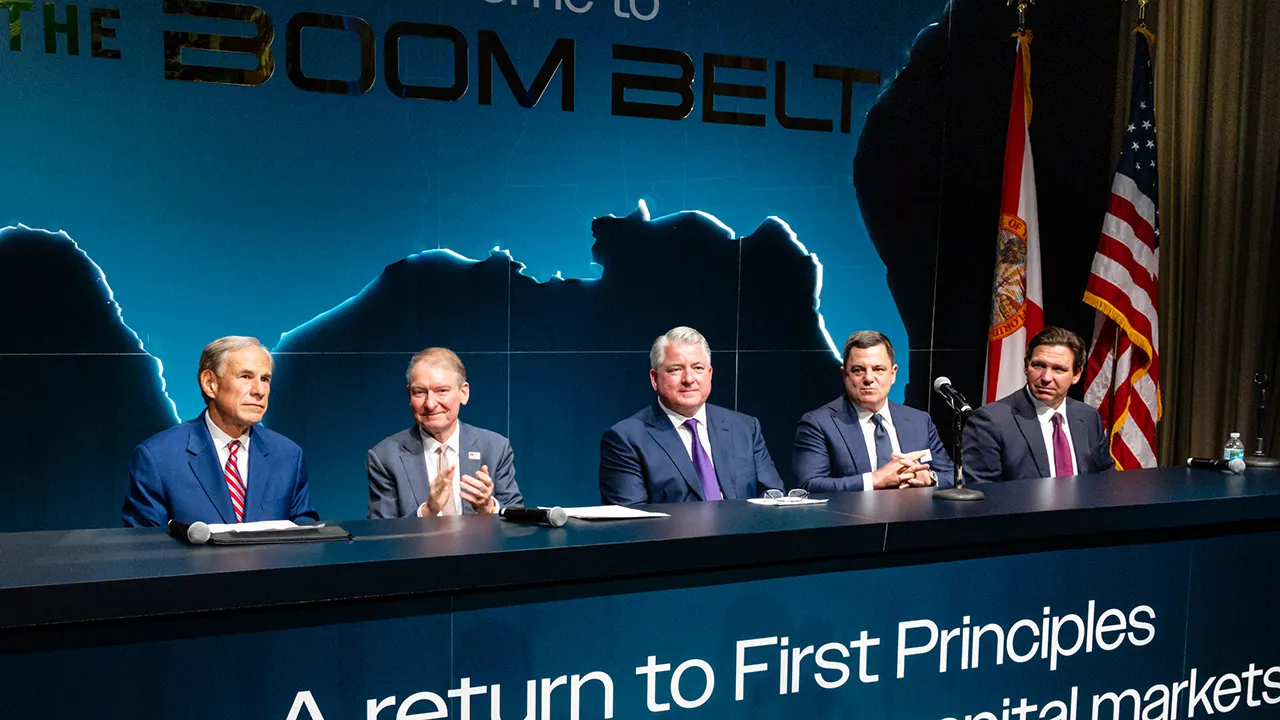
Florida Gov. Ron DeSantis and Texas Gov. Greg Abbott joined forces in Miami on Tuesday to celebrate a $9 trillion gross domestic product (GDP) region that is now outpacing every other quadrant of the country in population, jobs and capital investment.
“I often tell people, as Governor of Florida, my job is to closely follow California, Illinois, New York, so I can do precisely the opposite of what they do,” DeSantis said during the panel held at the Pérez Art Museum. “Florida’s had more adjusted gross income move into our state since I’ve been governor than has ever moved into any state in the history of the United States.”
“Visionary business leaders seek to where not the puck is right now, but to where it is going… while other regions where the puck has been in the past, they’re now burdened by high taxes, by restrictive regulations, by policies that are actually hostile to businesses,” Abbott added.
The governors spotlighted how Alabama, Arkansas, Florida, Georgia, Louisiana, Mississippi, North Carolina, Oklahoma, South Carolina, Tennessee and Texas now generate $9 trillion in annual GDP, trailing only the U.S. and China globally, while absorbing 70% of all U.S. population growth in the last five years.
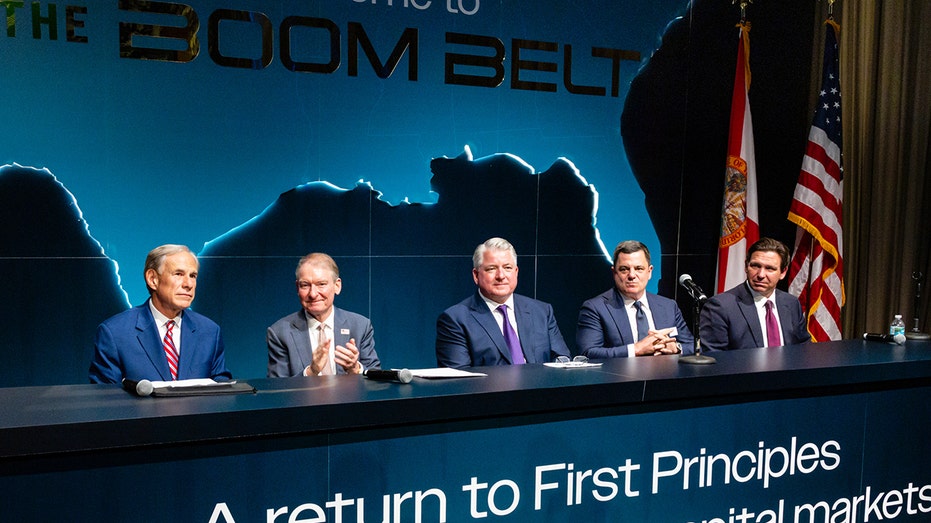
Greg Abbott, governor of Texas, from left, Paul Atkins, chairman of the U.S. Securities and Exchange Commission (SEC), Jim Lee, founder and chief executive officer of the Texas Stock Exchange, Jim Esposito, president of Citadel Securities, and Ron De (Getty Images)
The migration has been fueled by more than just sunshine; it is a tactical retreat from a wave of tax-the-rich proposals sweeping through blue-state legislatures including California, New York and now Washington.
“We’re in the 250th anniversary of the founding of the United States. The founding fathers, they wanted a system based on the consent of the government… They wanted to have a rule of law and they wanted some of this stuff, particularly private property, to not just be subjected to those types of whims,” DeSantis said.
“Hence, in Texas, even though we have never had a state income tax, we wanted to make sure that future generations would not be able to impose an income tax, so we made income taxes unconstitutional in the state of Texas,” Abbott said. “We made a wealth tax unconstitutional. We made a death tax unconstitutional, and as [Citadel’s] Jim Lee pointed out, we made a transactions tax unconstitutional.”
Texas REALTORS Chairman of the Board Jennifer Wauhob speaks to Fox News Digital about the Lone Star State’s recent wealth and population boom that’s ‘creating good things for Texas.’
“I know that there’s been a lot of very healthy competition between states like Florida, Tennessee, Texas, Georgia, some of these. And I think that’s really, really good,” DeSantis noted. “When Greg’s doing stuff, people say, ‘Look [at] what Texas just did.’”
SEC Chairman Paul Atkins and TXSE CEO Jim Lee warned that the U.S. has lost half of its public companies over the last 30 years because the federal government made it “complicated, expensive and legally treacherous” to go public.
“When capital, companies and people all move in the same direction, with that kind of consistency and at that kind scale, it behooves us to ask why. I believe that the answer, more often than not, is the region’s steady adherence to first principles, including those that rigorously protect investors without needlessly paralyzing companies,” Atkins said. “So for our part, the SEC is returning to those same principles by renewing the conditions that make our public markets the natural destination for companies to raise capital and for investors to share in their success.”
‘The Big Money Show’ examines blue state tax policies as the wealthy flock to low-tax states.
“As Chairman Atkins has remarked repeatedly, it used to be cool to be public, so what happened? The answer is we made it complicated, expensive and legally treacherous to be a public company. Remaining private became the only rational choice. This is not a coincidence. It is a consequence,” Lee emphasized.
GET FOX BUSINESS ON THE GO BY CLICKING HERE
As someone who helped lead the firm’s move from Chicago to Miami, Citadel Securities President Jim Esposito highlighted the practical, bottom-line reasons why the “Boom Belt” is winning the war for capital — framing the Southern governing style as an inspiration for the rest of America.
“Across Florida, Texas and other high-growth states, government officials have created environments where businesses can operate, invest. And importantly, grow with confidence,” he said. “This type of public and private partnership should be the model for the rest of our country.”

5 Markets Getting Pummelled Right Now

Preacher charged after man, 61, drowns during baptism | News UK
Earnings call transcript: RPM International Q3 2026 beats expectations, stock surges

Arkham Intel Removes TON Blockchain Support

Why Israel is blocking foreign journalists from entering

Bitcoin: We’re Entering The Most Dangerous Phase

Alan Cumming Brands Baftas Ceremony A ‘Triggering S**tshow’

15 Most Valuable Money Making Skills in 2026 (Ranked)

Joe Rogan on Ferrari Suing Philipp Plein! #money #finance #changeyourmindsetchangeyourlife

Monthly Subsidy of 70,000 Rupees Announced | Big Financial Relief| Hum News | Pakistan
-

 NewsBeat6 days ago
Steven Gerrard disagrees with Gary Neville over ‘shock’ Chelsea and Arsenal claim | Football
-

 Business6 days ago
No Jackpot Winner and $194 Million Prize Rolls Over
-

 Fashion5 days ago
Weekend Open Thread: Spanx – Corporette.com
-

 Crypto World7 days ago
Gold Price Prediction: Worst Month in 17 Years fo Save Haven Rock
-

 Business4 days ago
Expert Picks for Every Need
-

 Business3 days ago
Three Gulf funds agree to back Paramount’s $81 billion takeover of Warner, WSJ reports
-

 Sports4 days ago
India men’s 4x400m and mixed 4x100m relay teams register big progress | Other Sports News
-

 Business7 days ago
Login and Checkout Issues Spark Merchant Frustration
-

 Tech18 hours ago
How Long Can You Drive With Expired Registration? What Florida Law Says
-
Business3 days ago
No Jackpot Winner, Prize to Climb to $231 Million
-

 Tech6 days ago
Commonwealth Fusion Systems leans on magnets for near-term revenue
-

 Fashion2 days ago
Massimo Dutti Offers Inspiration for Your Summer Mood Board
-

 Crypto World7 days ago
Ripple rolls out enterprise crypto treasury platform for corporates
-
 Tech7 days ago
Drawing Tablet Controls Laser In Real-Time
-

 Fashion23 hours ago
Let’s Discuss: DEI in 2026
-
Politics5 days ago
Wings Over Scotland | The quality of mercy
-

 Crypto World7 days ago
Why It’s Partnering, Not Issuing
-
 Sports7 days ago
Steal Gary Woodland’s subtle power move for longer drives
-
Sports7 days ago
Tom Pelissero Drives the Final Nail in the Coffin
-

 Tech7 days ago
Battery Tester Outperforms Cheaper Options
You must be logged in to post a comment Login