
Business
How Capital Scaling Models Support Trader Development


Most traders don’t stall because they can’t find another indicator. They stall because their learning environment is poorly designed.
The feedback loop is either too punishing (one mistake wipes out weeks of progress) or too forgiving (tiny position sizes hide real execution problems). In both cases, growth slows, confidence becomes fragile, and decisions start to feel heavier than they should.
Capital scaling models—where the amount of capital you’re allowed to trade grows as you demonstrate competence—solve a surprisingly large part of that problem. Not because “more capital” magically makes you better, but because structured scaling creates a curriculum. It turns trading into a series of manageable stages, each with clearer expectations, risk constraints, and performance standards. If you’ve ever improved quickly in a sport, music, or a technical role, you already understand the principle: progression works when the next level is earned, not guessed.
Below is how capital scaling, done properly, supports trader development in a way that’s practical, measurable, and psychologically sustainable.
Capital scaling: more than “bigger size”
Capital scaling is often described as a simple idea: trade well, get more capital. But the real value is the framework around how “trade well” is defined and how capital is increased.
A good scaling model typically does three things:
- Sets guardrails (drawdown limits, daily loss limits, concentration rules).
- Defines performance quality (consistency, adherence to a plan, not just raw profit).
- Introduces size progressively so traders adapt to execution and emotional pressure in stages.
That last point matters more than most people expect. A trader who is calm risking $50 per trade might behave very differently at $500—even with the exact same strategy. Scaling lets you develop capacity (emotional and operational) alongside skill.
Why this structure accelerates learning
When scaling is staged, it improves the trading feedback loop:
- You get enough exposure to generate statistically meaningful results.
- You’re not forced to “swing for the fences” to make the effort worthwhile.
- Mistakes are survivable, which keeps you in the game long enough to correct them.
This is why many traders look for environments where scaling is formalized rather than improvised. For instance, a funded trader program with capital scaling can act as a structured progression path: start with defined limits, prove consistency, then earn higher allocations under similar rules. Whether you use a program like that or build your own scaling plan, the developmental mechanism is the same—graduated responsibility.
How scaling models build the skills traders actually need
Scaling models are often discussed in terms of opportunity, but their best contribution is education. They make the “hidden curriculum” of trading unavoidable.
Risk discipline becomes non-negotiable
Plenty of traders say they manage risk; fewer can do it on a random Tuesday after two losing trades. Scaling models make risk the entry ticket to growth. When the next level is tied to drawdown control, you stop treating risk rules as “nice ideas” and start treating them as professional standards.
This pushes development toward repeatable behaviors:
- Position sizing that’s consistent and pre-defined
- Stops that are placed for structural reasons, not emotional ones
- A clear understanding of worst-case scenarios before entering
You learn to think in process, not outcomes
One of the most damaging habits in early trading is over-valuing single-trade outcomes. Scaling models, when designed well, reward series performance—a month of solid execution rather than a lucky week.
Many firms and serious personal plans use criteria like:
- Maximum drawdown relative to gains
- Number of trading days (to discourage “one-hit wonder” runs)
- Consistency bands (avoiding one day generating most of the profits)
Here’s the key: these constraints nudge you toward building a process that can survive changing market conditions.
Execution quality improves under real constraints
Small accounts and tiny size can mask execution problems. Slippage feels irrelevant. Partial fills don’t matter. You can enter late and still “get away with it.”
As size scales, micro-inefficiencies become expensive. Traders are forced to clean up:
- entry timing and order types (market vs limit vs stop-limit)
- liquidity awareness (especially around news, open/close, rollovers)
- overtrading and churn costs (spreads/commissions add up fast)
Scaling is the point where trading starts to look less like theory and more like operating a real business.
What to measure: the metrics that drive sustainable scaling
Scaling works best when it’s tied to a small set of metrics that capture both profitability and robustness. Too many metrics create noise; too few invite loopholes. The most useful scorecards typically focus on a blend of outcome and behavior.
A practical set of scaling-aligned metrics might include:
- Max drawdown (absolute and relative to net profit)
- Profit factor (quality of returns, not just direction)
- Average loss vs average win (edge durability)
- Risk per trade consistency (tight dispersion beats “all over the map” sizing)
- Rule adherence rate (did you take only A+ setups, or did boredom win?)
Use these as a dashboard, not a judgment tool. The goal is to identify which lever improves your results without increasing fragility.
How traders can use scaling models to develop faster (even independently)
You don’t need a formal program to benefit from scaling principles. You can implement them in your own trading by treating capital increases like promotions: earned, documented, and reversible.
Build your “next tier” requirements
Decide in advance what qualifies you to increase size. Common examples: 20–40 trading days, a capped drawdown, and a minimum consistency threshold (e.g., no single day contributes more than X% of total gains).
The important part is that you write the rules before you’re tempted to break them.
Scale in risk units, not in dollars
Instead of doubling your position size because you had a good month, scale by modest increments in your fixed risk unit (for example, +10–20% risk per trade) while keeping the same setup quality threshold. This reduces the chance that your psychology outruns your method.
Rehearse the operational shift
When size increases, your trading “plumbing” matters more. Before scaling up, stress-test your execution:
- Do you know how your instrument behaves in fast markets?
- Have you tested your platform under volatility?
- Are you tracking costs and slippage, not just P&L?
Treat it like a pilot moving from a simulator to a real cockpit: the checklist becomes part of the craft.
Common scaling mistakes (and how to avoid them)
Scaling can backfire when traders treat a higher allocation like a trophy rather than a responsibility.
Mistake 1: Changing the strategy after scaling.
A new size tier is not the time to experiment. Keep the same setups that earned the scale-up; only refine after you stabilize.
Mistake 2: Letting confidence turn into looseness.
Traders often interpret a scale-up as proof they’re “past” discipline. In reality, this is where discipline finally starts paying rent.
Mistake 3: Ignoring market fit.
Some strategies don’t scale well in certain products or sessions due to liquidity. If slippage rises faster than expected, you may need to adjust instruments or execution tactics—not abandon the whole approach.
The real advantage: a professional growth path
Capital scaling models support trader development because they create a structured ladder: clear requirements, controlled risk, and progressive exposure to pressure. They reward the habits that keep traders in business—consistency, restraint, and thoughtful execution—while still allowing ambition to compound.
If your current trading feels like random progress followed by random setbacks, consider this: it might not be your ability that’s inconsistent. It might be your environment. A well-designed scaling plan—whether self-imposed or provided through a formal structure—turns improvement into something you can actually repeat.

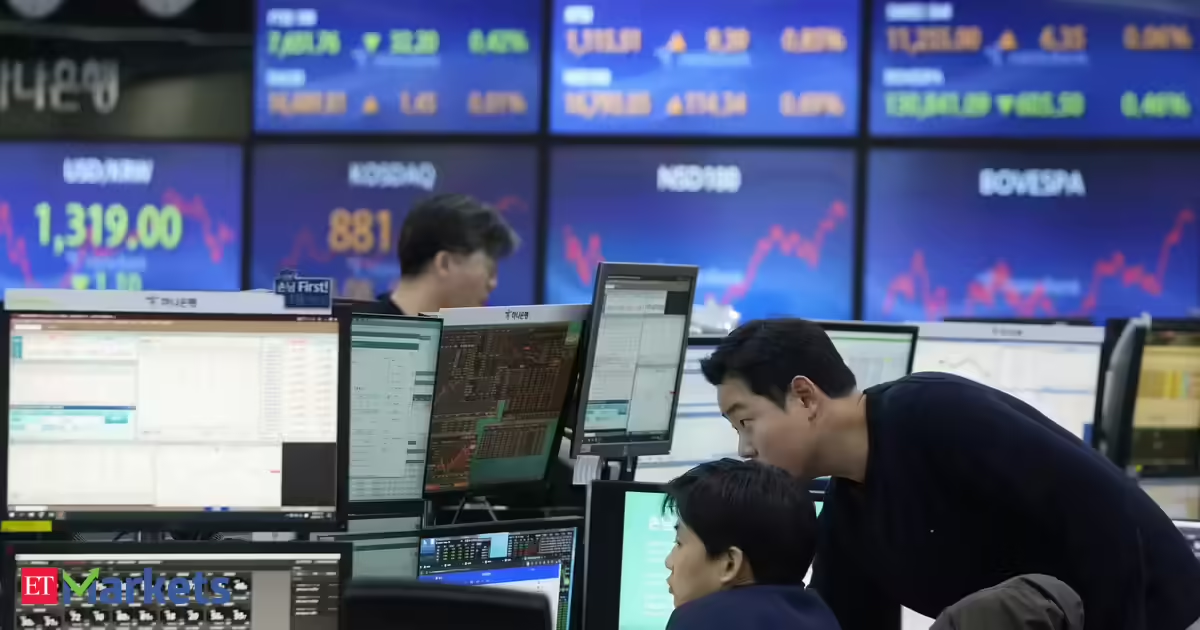
Markets were taken on a rollercoaster ride at the start of the week after Trump added five days to his Saturday ultimatum for Iran to reopen the Strait of Hormuz within 48 hours, citing productive talks with unidentified Iranian officials, which Tehran has denied.
“It’s a negotiating tactic… I don’t think that the U.S. administration wants to see oil at $150 because they themselves provoked it,” said Rajeev De Mello, chief investment officer at GAMA Asset Management.
Traders were quick to react to the reversal, sending crude futures tumbling and shares surging, while the dollar and government bond yields fell.
Most of the movement carried over to the Asian trading session on Tuesday, with MSCI’s broadest index of Asia-Pacific shares outside Japan rising 1.3%, while shares in Australia were up 0.7%.

Japan’s Nikkei advanced more than 2%, reversing most of Monday’s 3.5% decline.
U.S. futures were little changed after ending Monday’s cash session higher. Oil prices meanwhile edged higher on Tuesday after sliding 10% in the previous session. Brent crude futures were up 1% at $100.94 a barrel, while U.S. crude rose 1.9% to $89.84.
Still, movement was highly volatile as war in the Middle East dragged on and the prospect of higher-for-longer energy prices lingered.
“Markets are not out of the woods,” said Chris Weston, head of research at Pepperstone.
“Price action could remain choppy into Friday’s revised deadline… The key question is whether participants see this as a genuine extension that brings a deal closer, or simply a delay that prolongs uncertainty.”
PARING RATE HIKE EXPECTATIONS
Yields on U.S. Treasuries steadied on Tuesday after a sharp fall overnight, in line with a decline in global bond yields as investors trimmed bets of aggressive interest rate increases by major central banks this year.
The two-year yield was little changed at 3.8498%, having fallen more than 6 basis points in the previous session. The benchmark 10-year yield was last at 4.3400%.
While traders have priced out the small chance that the U.S. Federal Reserve could hike this year, they still expect rates to be left on hold.
The Bank of England is now seen raising rates just twice this year, compared to four previously, while market expectations for hikes from the European Central Bank have also been pared back.
“Unless the Strait (of Hormuz) is reopened very quickly, we are still more likely than not to see higher interest rates and a meaningful increase in oil importers’ costs in the coming weeks,” said Kit Juckes, head of FX strategy at Societe Generale.
In currencies, the U.S. dollar was on the back foot after falling on Monday, as a pick up in risk sentiment reduced demand for the safe haven currency.
The euro last traded at $1.1603, having risen 0.4% overnight, while sterling held near Monday’s two-week top and was last at $1.3420.
Against the yen, the dollar was up 0.04% at 158.54.
Data on Tuesday showed Japan’s core consumer inflation rate hit 1.6% in February to slide below the Bank of Japan’s 2% target for the first time in nearly four years, complicating the bank’s efforts to justify further interest rate hikes.
Spot gold was up 0.6% at $4,431.65 an ounce.

Thailand is enhancing its economy by promoting wellness tourism, collaborating public and private sectors to offer affluent foreigners medical, beauty, and travel services through Bangkok Dusit Medical Services’ 60 hospitals.
Key Points
- Thailand’s private and public sectors are collaborating to enhance wellness tourism, targeting affluent foreign visitors.
- The initiative focuses on integrating medical care, beauty services, and travel experiences.
- By promoting wellness tourism, Thailand aims to drive economic growth and attract high-value visitors, exemplified by businesses like Bangkok Dusit Medical Services.
Collaborative Efforts in Wellness Tourism
Thailand is making significant strides in promoting wellness tourism by fostering collaboration between its private and public sectors. This initiative aims to attract affluent foreign tourists who are looking for comprehensive services that blend medical care, beauty treatments, and travel experiences. The focus is on enhancing the core tourism sector, which is essential for the country’s economic growth. By leveraging the expertise of businesses, such as Bangkok Dusit Medical Services (BDMS) that manages 60 hospitals, the government seeks to create a robust infrastructure for wellness tourism.
Economic Growth through High-Value Services
The efforts to enhance wellness tourism in Thailand are not merely about increasing tourist numbers but also about providing higher-value services that contribute to a more sustainable economy. By targeting wealthy tourists seeking medical and aesthetic treatments, the initiative aims to transform Thailand into a global hub for wellness services. This strategy is expected to lead to a double impact, boosting both the health industry and travel sectors, thus creating wealth for local communities while improving the country’s international reputation.
Future Prospects and Challenges
While the ambition to establish Thailand as a premier destination for wellness tourism is commendable, it also presents certain challenges. The industry must focus on maintaining high quality standards in both medical and service aspects to compete with other global players. Furthermore, continuous investment in marketing, infrastructure, and staff training will be critical to ensuring that Thailand is seen as a trusted choice for wellness tourism. Despite these challenges, the potential for economic growth makes this initiative a strategic priority for both government and business entities in Thailand.
Other People are Reading

The firm behind plans for a renewable-powered data centre in Belmont have lodged a fresh application with the state for a facility in Hazelmere, this time without such a green tilt.

Business
Incorporated in 1984, Powerica is an integrated power solutions company with a dual business model spanning diesel generator sets and wind power generation. The generator set business remains the core revenue driver, contributing about 85% to total revenue in FY25. It also provides medium-speed large generators through collaboration with Hyundai. It operates three in-house manufacturing facilities located in Karnataka, Dadra & Nagar Haveli, and Maharashtra that serve industrial, commercial, data centre, and infrastructure customers.
The company diversified into clean energy in 2008 and has since built a wind power business covering independent power production (IPP), EPC (Engineering, Procurement, and Construction), and operations and maintenance (O&M) services. Its total installed operational wind capacity at the end of FY25 reached 279.6 megawatt (MW).
 Agencies
Wind in sales Genset maker, which is also into wind power, has been reporting growth in revenue and profits, but Ebitda lags that of peers
Financials
Revenue rose 5.3% annually to ₹2,653 crore in FY25 from ₹2,378 crore in FY23. Net profit increased by 25.8% to ₹175.8 crore from ₹106.5 crore during the period. However, the Ebitda margin declined to 13% in FY25 from 14% in FY23, underperforming peers such as Cummins India and Kirloskar Oil Engines, which reported margins of 19-23%.
Return on equity (ROE) declined to 17.5% in FY25 from 26.5% in FY24. The net debt-equity ratio fell to 0.2 in FY25 from 0.3 in FY23, but rose again to 0.4 in the first half of FY26 as the company ramped up ongoing wind projects.
Valuation
The issue is valued at the FY25 price-earnings (P/E) multiple of 28 based on post-IPO equity. Considering annualised profit for FY26, the P/E is 18.6 for the company. Cummins India, which manufactures engines and power generation systems, trades at a P/E of 52 while Kirloskar Oil Engines, engaged in diesel engines, agri-equipment and power solutions, trades at around 34.

MDA Space: The Easy Money Is Gone, Now Execution Matters (Rating Downgrade)

Start-ups are offering tech for novices to create apps with the help of AI.
Business
Stocks rally and oil sinks after Trump hints at a possible end to war, even as Iran denies talks

A cautious relief swept through financial markets Monday after President Donald Trump said the United States has talked with Iran about a possible end to their war.

Form 13D/A TripAdvisor For: 23 March

Duty on diesel will be reduced by 20 cent and petrol will be cut by 15 cent from midnight on Wednesday.
FTC Solar at the 38th Annual Roth Conference: Strategic Growth and Challenges
Global Market Today: Asian shares rally, oil retreats as Trump extends Iran ultimatum

Crypto ETP Inflows Slow to $230 Million After Fed Meeting

Jessie J Rushed To The Hospital After Car Incident In China

Smart energy pays enters the US market, targeting scalable financial infrastructure

Why Israel is blocking foreign journalists from entering

Bitcoin: We’re Entering The Most Dangerous Phase

Income Statement in Nepali || Multi Step || Class 12 Account Financial Statement || BBS 1st Year

Money Is Powerful. #viral #status #like #motivation #trending #funny #money #video #havegoals #bhai

XRP BREAKING 5 DAYS NEWS! It’s Happening NOW?!
-
 Crypto World3 days ago
NIO (NIO) Stock Plunges 6.5% as Shelf Registration Sparks Dilution Worries
-

 Fashion3 days ago
Weekend Open Thread: Adidas – Corporette.com
-

 Politics3 days ago
Jenni Murray, Long-Serving Woman’s Hour Presenter, Dies Aged 75
-
 Tech6 days ago
Are Split Spacebars the Next Big Gaming Keyboard Trend?
-

 Crypto World2 days ago
Best Crypto to Buy Now: Strategy Just Spent $1.57 Billion on Bitcoin During Fear While Early Investors Quietly Enter Pepeto for 150x Potential
-

 News Videos5 days ago
RBA board divided on rate cut, unusually buoyant share market | Finance Report | ABC NEWS
-

 Crypto World2 days ago
Bitcoin Price News: Bhutan Sells $72 Million in BTC Under Fiscal Pressure, but the Smart Money Entering Pepeto Sees What the Market Does Not
-

 Politics6 days ago
The House | The new register to protect children from their abusers shows Parliament at its best
-

 Tech4 days ago
inKONBINI Lets You Spend Summer Days Behind the Register
-
 Politics6 days ago
Real-time pollution monitoring calls after boy nearly dies
-

 Crypto World5 days ago
Canada’s FINTRAC revokes registrations of 23 crypto MSBs in AML crackdown
-

 Sports13 hours ago
Remo Stars and Kano Pillars Strengthen Survival Hopes in NPFL
-
 NewsBeat5 days ago
Residents in North Lanarkshire reminded to register to vote in Scottish Parliament Election
-

 News Videos5 days ago
PARLIAMENT OF MALAWI – PAC MEETING WITH REGISTRAR OF FINANCIAL ON AMARYLLIS HOTEL – INQUIRY LIVE
-

 Politics4 days ago
Gender equality discussions at UN face pushbacks and US resistance
-

 Business1 day ago
No Winner in March 21 Drawing as Prize Rolls to $133 Million for Next
-

 Business5 days ago
Who Was Alex Pretti? 5 Key Facts About the ICU Nurse Killed by Federal Agents in Minneapolis
-

 Sports12 hours ago
Gary Kirsten Accuses Pakistan Cricket Board Of ‘Interference’, Mohsin Naqvi Responds
-

 Tech1 day ago
Give Your Phone a Huge (and Free) Upgrade by Switching to Another Keyboard
-

 Sports3 days ago
2026 Kentucky Derby horses, odds, futures, preview, date: Expert who nailed 12 Derby-Oaks Doubles enters picks
You must be logged in to post a comment Login