Business
How to Score Yours Today
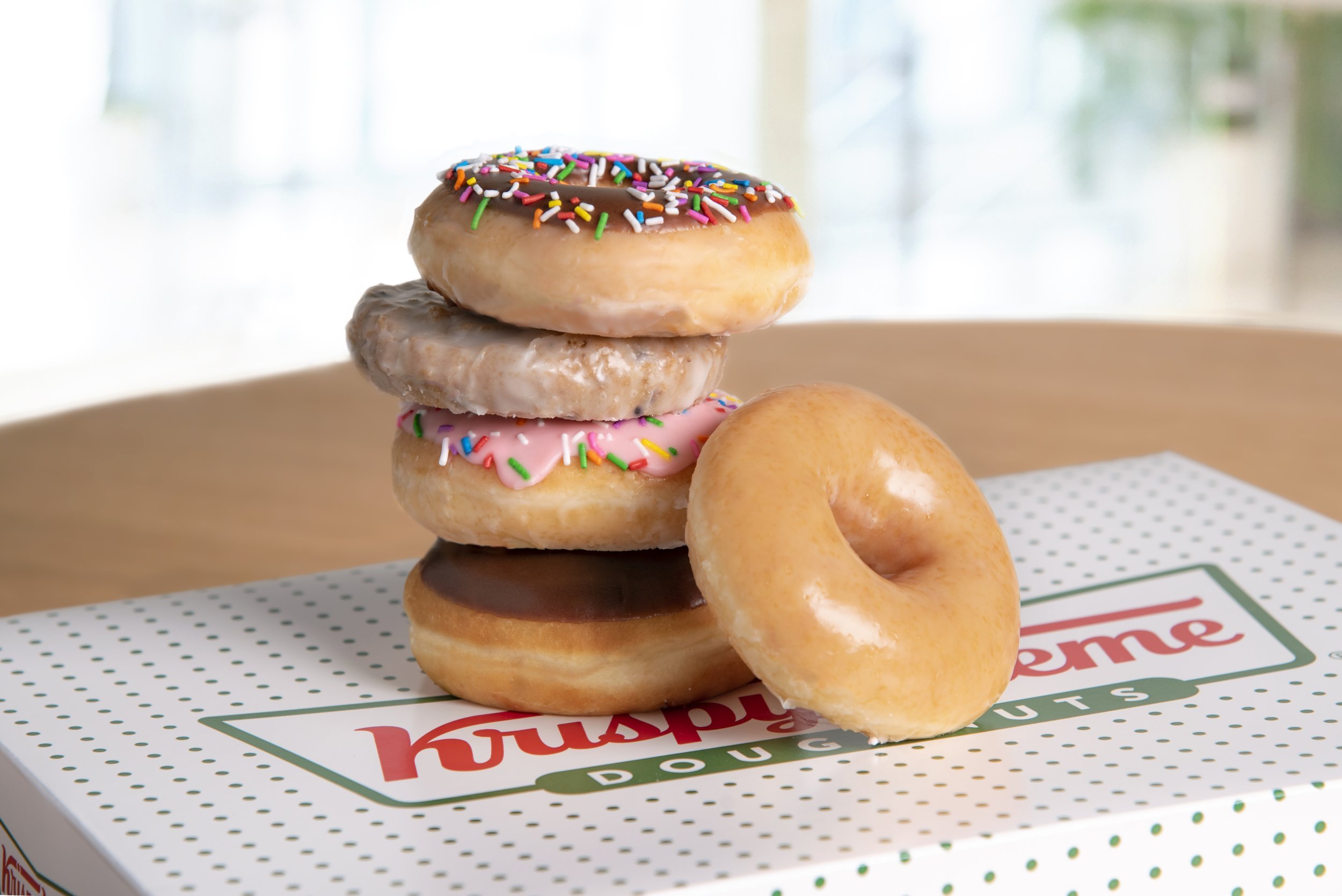
ATLANTA — Doughnut enthusiasts have a sweet opportunity Friday as Krispy Kreme marks National Doughnut Day with free doughnuts of choice at participating locations across the United States, no purchase necessary.
The promotion, available in-shop and at drive-thrus on June 5, aligns with the annual celebration honoring the Salvation Army’s Donut Lassies who served troops during World War I. Customers can select from a range of classics like Original Glazed, chocolate-iced varieties or filled options, subject to availability and exclusions for limited-edition or seasonal items.
“Stop in your local shop on Friday, 6/5 and get a FREE Doughnut of your choice, no purchase necessary,” Krispy Kreme announced on its website. The offer is limited to one per guest at participating U.S. shop locations.
A second deal sweetens the occasion: Buy any dozen doughnuts at regular price and receive a dozen Original Glazed for just $2. This BOGO-style offer is valid in-shop, drive-thru, online for pickup or delivery with promo code details on the Krispy Kreme site.
Details on Claiming Free Krispy Kreme Doughnuts
To maximize the free offer today, head to a participating Krispy Kreme shop or drive-thru. The deal runs all day while supplies last, though popular locations may see lines form early. No app or membership is required for the single free doughnut, making it accessible for walk-ins.
Krispy Kreme operates hundreds of dedicated retail shops nationwide, separate from grocery or convenience store counters where the promotion does not apply. Shoppers should verify local participation via the Krispy Kreme website or by calling ahead, as offers can vary slightly by market.
For those seeking more than one doughnut, the dozen deal provides significant value. Online orders require adding a full-priced dozen plus the promotional Original Glazed dozen and applying the appropriate code. Drive-thru and in-store redemptions offer flexibility for larger groups or families.
The History Behind National Doughnut Day
National Doughnut Day traces its roots to 1938 in Chicago, established by the Salvation Army as a fundraiser during the Great Depression. It commemorates the Donut Lassies — female volunteers who traveled to France in 1917 to support American soldiers in World War I. Using limited resources, including soldiers’ helmets as frying pans, they produced thousands of doughnuts to boost morale near the front lines.
The simple treat became a symbol of comfort and home, gaining popularity stateside upon the troops’ return. Today, the holiday on the first Friday in June serves both as a tribute to that service and a commercial celebration embraced by major chains. Krispy Kreme’s generous giveaway continues a tradition of sharing sweetness with the community.
Krispy Kreme’s Enduring Appeal
Founded in 1937 in Winston-Salem, North Carolina, Krispy Kreme has built a loyal following with its signature light, airy doughnuts and iconic “Hot Now” sign signaling fresh batches. The brand expanded globally but maintains its core focus on quality and freshness, often producing doughnuts throughout the day in full-view kitchens.
The free doughnut promotion highlights the chain’s customer-first approach, especially on a day dedicated to the treat. Past years have seen similar giveaways draw crowds, creating festive atmospheres at shops where staff hand out warm doughnuts amid smiles and photos.
Beyond the freebie, Krispy Kreme offers a wide menu including filled, iced and specialty varieties. Pairing a free doughnut with coffee or other items can enhance the experience, though the no-purchase rule means minimal commitment is needed.
Tips for a Successful Doughnut Run
Plan your visit strategically. Early morning or mid-afternoon may avoid peak lunch rushes. Bring friends or family to share the occasion, as the day encourages communal enjoyment. For larger quantities, combine the free single with the dozen deal to stock up economically.
Check traffic and store hours, as some locations open as early as 6 a.m. and close in the evening. Mobile ordering via the Krispy Kreme app or website can streamline the dozen deal, though the free single remains in-person only. Be mindful of weather, as drive-thru lines can lengthen during rain.
Health experts note that while treats like doughnuts fit occasional indulgence, moderation supports balanced diets. National Doughnut Day provides a fun, limited-time excuse to enjoy without guilt. Many participants offset the sweetness with a walk or sharing portions.
Broader National Doughnut Day Landscape
Krispy Kreme is not alone in celebrating. Dunkin’ offers a free classic doughnut with any beverage purchase, while other chains like Duck Donuts, 7-Eleven and Lidl provide their own incentives. These deals collectively amplify the holiday’s visibility and foot traffic across the food service industry.
Social media buzz typically explodes on the day, with users sharing photos of hauls using hashtags. Krispy Kreme encourages such engagement, turning individual visits into shared cultural moments.
The promotion underscores broader trends in experiential marketing, where brands leverage holidays to create memorable customer interactions. For Krispy Kreme, it reinforces brand loyalty among fans who appreciate the no-strings-attached generosity.
Looking Ahead
As National Doughnut Day unfolds, Krispy Kreme shops nationwide stand ready to deliver joy through fresh doughnuts. The free offer represents more than a discount — it embodies the spirit of celebration rooted in historical service and community connection.
Whether grabbing a quick treat on the way to work, surprising colleagues or enjoying a family outing, today offers an ideal chance to participate in this tasty tradition. With clear pathways to free and discounted doughnuts, Krispy Kreme makes it easy for everyone to join the fun.
Consumers are encouraged to act promptly, as supplies are finite and enthusiasm runs high. For the latest details or to locate the nearest shop, visit Krispy Kreme’s official site. In a world of daily stresses, a free warm doughnut provides a simple, delicious reminder of life’s sweeter side.

Business
EssilorLuxottica: Smart Glasses And Myopia Management Reinforce Long-Term Growth Story
Business
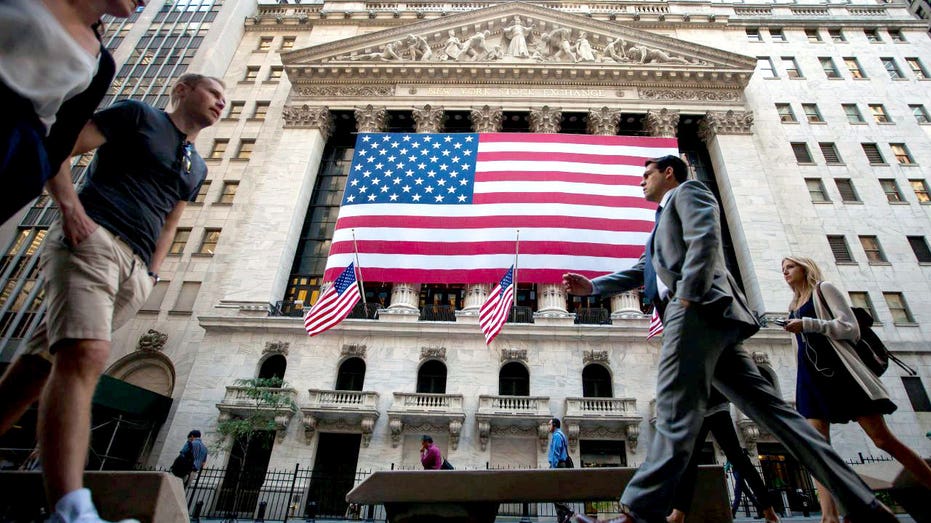
Is there an AI stock market bubble, and is it ready to burst?
Despite the Iran war, rising inflation and worries about rising government debt, US stock markets continue to hit all-time highs this year. That’s largely driven by the huge boom in investment in Artificial Intelligence.
The apparent mismatch between sky high stock market valuations and the real economy is beginning to set off some alarm bells ringing among investors. BBC’s Samira Hussain reports from Wall Street.
Business
Spurs Seek Game 2 Bounce-Back as Knicks Lead 2026 NBA Finals Series 1-0
SAN ANTONIO — The San Antonio Spurs will look to even the 2026 NBA Finals series when they host the New York Knicks in Game 2 on Friday night at Frost Bank Center, after dropping a hard-fought Game 1 at home that saw the visitors rally for a victory.
The Knicks took a 1-0 series lead with a 105-95 win in Game 1 on Thursday, overcoming an early deficit thanks to strong fourth-quarter execution and defensive intensity. Jalen Brunson led New York with 30 points, while Karl-Anthony Towns contributed a double-double. Victor Wembanyama paced the Spurs with 26 points and 12 rebounds in the loss.
Spurs head coach Mitch Johnson expressed confidence in his team’s ability to respond. The Spurs, who finished the regular season with one of the league’s best records, are expected to be sharper at both ends of the floor in front of a passionate home crowd.
Game 1 Recap and Key Takeaways
In Game 1, the Knicks overcame a double-digit deficit to pull away late, limiting the Spurs to just 19 points in the fourth quarter. New York’s playoff win streak reached new heights, showcasing the resilience that carried them through the Eastern Conference playoffs. Brunson’s leadership and the frontcourt presence of Towns proved decisive against San Antonio’s interior defense.
For the Spurs, fatigue may have played a role in the late collapse, as noted by analysts following the game. Wembanyama’s individual brilliance was evident, but supporting cast contributions will need to improve for San Antonio to avoid falling into an 0-2 hole heading to Madison Square Garden.
Matchup Analysis and Strategic Outlook
The Spurs enter Game 2 as home favorites, with betting lines around 5.5 points in their favor. The total is set near 214.5 points, reflecting expectations of a tighter, more competitive contest after Game 1’s lower-scoring affair.
San Antonio’s defensive schemes will likely focus on containing Brunson and disrupting the Knicks’ pick-and-roll actions. Wembanyama’s versatility on both ends remains the cornerstone, with potential for increased minutes and impact if the Spurs can push the pace selectively. Improved three-point shooting and rebounding margins will be critical.
The Knicks, riding high after stealing Game 1 on the road, will aim to maintain their defensive intensity and exploit any continued fatigue in the Spurs’ rotation. Brunson’s ability to create for teammates and Towns’ rebounding presence give New York multiple avenues for success. Coach Tom Thibodeau’s teams are known for physical, gritty play that wears down opponents over a series.
Analysts widely view this series as highly competitive, with home-court advantage potentially playing a significant role. The Spurs must protect their home floor to keep championship hopes alive, while the Knicks seek to build an insurmountable lead before the series shifts to New York.
Team Strengths and Roster Notes
The Spurs boast one of the league’s most dynamic young cores, headlined by Wembanyama’s generational talent. Their regular-season success stemmed from elite defense, efficient offense and depth. Adjustments in Game 2 could include more aggressive double-teaming and better ball movement to create open looks.
New York features a balanced attack with Brunson as the engine, supported by athletic wings and a physical frontcourt. Their playoff experience and recent hot streak make them dangerous on the road. Depth from the bench, including contributions from Mikal Bridges and others, has been a key factor in their postseason run.
Injuries have been minimal for both sides heading into Game 2, allowing coaches to deploy full rotations. Fatigue management will be paramount in what promises to be a physical, high-stakes matchup.
Broader Series Implications
A Spurs victory in Game 2 would tie the series at 1-1 and shift momentum back toward San Antonio, especially with the next two games scheduled for Madison Square Garden. An 0-2 deficit would place enormous pressure on the Spurs, as historical precedent shows teams rarely come back from such holes in the Finals.
Experts point to the Knicks’ road resilience and the Spurs’ home dominance as defining storylines. The series features contrasting styles: San Antonio’s modern, positionless basketball versus New York’s gritty, defense-first approach.
Historical Context and Fan Excitement
This Finals matchup pits two storied franchises against each other in a rare postseason clash. The Spurs’ championship pedigree under previous regimes contrasts with the Knicks’ resurgence in recent seasons. Fans in San Antonio are expected to create an electric atmosphere at Frost Bank Center, aiming to will their team to a response.
Broadcast coverage on ABC will bring the action to a national audience, with analysts anticipating adjustments from both coaching staffs. Pre-game narratives have focused on Wembanyama’s development under pressure and Brunson’s continued ascent among the league’s elite.
What to Watch in Game 2
Key storylines include Wembanyama’s rebounding battle against Towns, Brunson’s efficiency against San Antonio’s perimeter defense, and the effectiveness of bench units. Turnovers, three-point shooting variance and foul trouble could swing momentum quickly in a close contest.
Coaches will emphasize execution in half-court sets and transition opportunities. The Spurs need to start stronger to avoid playing catch-up, while the Knicks will look to sustain their defensive effort over 48 minutes.
As the series unfolds, both teams understand the high stakes. A win in Game 2 for the home side restores balance and sets up compelling storylines for the road games ahead. The Knicks, however, have shown they thrive in hostile environments and could seize control with another strong performance.
The basketball world will be watching to see if the Spurs can leverage home advantage or if the Knicks extend their remarkable run. Game 2 promises intensity, adjustments and potentially pivotal moments that could shape the championship outcome.
With tip-off approaching, anticipation builds in San Antonio and beyond. The Spurs’ response will test their championship mettle, while the Knicks aim to prove their Game 1 success was no fluke. This series is shaping up as a classic battle between emerging talent and veteran playoff savvy.
Business
There is a leadership vacuum in Infosys, time to get Nandan Nilekani back: Mohandas Pai
ET Now: There are two ways of looking at it the top level exits in Infosys. On the one hand, a lot of people say that there was a team that was probably not performing well and now they are exiting and that will probably be a positive for the stock over the long run. The sceptics, on the other hand, would argue that there are a lot of people who have been manning the company for the last many years and it is not a pint-sized company, but a Rs 1 lakh 70 thousand crore behemoth. Why have there been so many high profile exits in the company?
Mohandas Pai: There is a leadership vacuum in the company, because they made the wrong choice of CEO three years ago and that is playing out right now. The company has not performed and in June 2011, they had appointed three members on the board and all three of them have gone now and all three have been extraordinary individuals.
Ashok Vemuri is now the CEO of another company, V Balakrishnan had left and has started his own fund and BG Srinivas, I am told, would now be joining some other company as CEO.
So obviously, all three have been CEO materials. It is obvious that the chemistry did not work, or they were not fully empowered. There is a need for the board to sit down and work out a good succession plan and put a new team in place because the entire layer of people below the executive board are now gone and many of them were outstanding performers.
Yes, a few of them possibly were not pulling the weight, but it is not possible that all of them were not doing so. They were extraordinary people and they are performing at other places.
So there is a need for teamwork and need for people to come together. They need to forget the past and focus on the future, they need to realign the company based upon what the market needs.
The market has changed and so its model needs to change, its management structure needs to change and the set of people who have ruled the company for 30 years have to step down and hand over reins, because they have stayed on for too long. Therefore, I hope that in the next one or two months, the board will come together along with NRN and once and for all close this issue.
ET Now: Where can the breakthrough come from at this point, because you have already stated in the past that the board and Mr Murthy need to take responsibility for the exits. It just seems that the series of exits is not ending. Does this mean that the company may have to also consider forming a completely new team from outside and hiring some expensive resources from outside?
Mohandas Pai: My view is that the layer below BG Srinivas, V Balakrishnan and Ashok Vemuri is an extraordinary layer. You have many good people who have run units. But they have run units and they require one or two years to come up with enterprise.
Enterprise position is very different from a unit position. You could be an extraordinary unit person, but to run an entire enterprise in a very competitive environment, you require some mentoring and some experience.
Now the entire generation of leaders who could have handled enterprise has gone. The next layer of people have done very well and there is great management there, but they need to connect between themselves and NRN who is the executive chairman and will stay for the next three years. That connect has to be fixed and it is up to NRN to do it.
Now it can be done by somebody stepping up to the plate as CEO. He will be inexperienced, he would not have handled enterprise, but being very efficient, in three to six months, he can pick it up.
However, that requires a different style of functioning by NRN. It also means that some amount of bloodletting will happen. In fact, it has to happen when the next generation comes up, because obviously people who are much senior will not stay on and there has to be a cleanup. So in the next two or three months, we have to see a radical change.
It is very difficult to speculate whether we will have an external team of people coming in, because such a team does not exist in any other company, let us remember. It is a very large company, with 160000 people, and $25 billion or $30 billion of market value.
So it requires a certain level of expertise and the board and the chairman have to work with them very carefully. So they have their task cut out and it will help if Nandan Nilekani is asked to come back, because he could provide the link between the chairman and the next layer of people and help to mentor them for the next couple of years, because he had an extraordinarily connect with people, his style is very inclusive and he is a person who empowers his team and gives them full strength to go ahead and stands by them. So getting Nilekani back would be a great strategy.
Business
Our commitment for press freedom, and autonomy of public broadcast is absolute: Prakash Javadekar
He spoke to ET on the Bharatiya Janata Party government’s approach towards media, social media, media controls and much more. Edited excerpts…
In terms of communication and messaging, the BJP’s electoral campaign has been termed an object lesson in the field. How can you translate that into the governmental structure?
All communication needs of the government will be handled in our ministry through a social media hub. I am offering this service to all ministers. Their facebook, twitter and other social media outreach will be handled by the new media wing, and the social media and communication hub.
The advantage that the party saw in reaching out through all communication media has been tremendous, and it was felt that the government too use the available platforms. Therefore, this new hub will provide all the help needed by various ministers and ministries for setting up and operating their facebook pages, twitter handles and the outreach throughsocial media. Traditional media is important, of course, but social media vehicles have to be spruced up.
What are your priority areas as far as this (I&B) ministry is concerned?
We have to ensure transparency, make our vehicles more effective. We want to be accessible and accountable too. Now there is a stage three and stage four of digitisation, we will take a call on this only after taking all things into account. The issue is that digitisation increases the revenue of paid channels, but customers want fewer advertisements.
Now 11 crore new settop boxes are required, which provides a great case for indigenisation, rather than just import them. I will take it up with the finance and commerce ministers on how this could be done.
During the elections, an interview of Prime Minister Narendra Modi set off questions on the autonomy of the public broadcaster. As I&B minister, how will you deal with it?
Right off the bat, I would like to say that our commitment for press freedom, and the autonomy of public broadcast is absolute. But freedom or autonomy has its own responsibilities.
Media has the responsibility of being neutral and objective. There’s always a concern that when the government is spending so much, it must reach the public. The public broadcaster is a tool for public awareness. Having said all of this, let me categorically state that we have no plans to enforce controls on the media.
Modi has been described as a “post TV” Prime Minister, in that he reaches out to his audience or voter directly. How would you recast the role of the traditional media?
This is a lesson for everyone on how to put your point across, in the way the Prime Minister does. Minister for law and communications Ravi Shankar Prasad and I have been deputed as spokespersons for the government and we will shortly come up with a communications plan to suit everyone’s needs. This government is different from the way it approaches issues and problems.
For instance, Modiji’s design for the Cabinet. Yesterday, there were some issues related to environment and power. Piyush Goel holds the power, coal and renewable energy portfolio, I hold the environment portfolio, and between the two of us and 10 officials we sorted things which the previous government had tied up in knots in a Group of Ministers (GoM) set up. The emphasis is on synergy. For the media too, there will be things to learn from the new government and its functioning.
Business
When Is 1st Game For World Cup 2026? Mexico vs South Africa to Kick Off 2026 FIFA World Cup
MEXICO CITY — The 2026 FIFA World Cup will open on Thursday, June 11, with co-host Mexico facing South Africa in Group A at the historic Estadio Azteca in Mexico City, marking the start of the largest tournament in the competition’s history with 48 teams across three nations.
The match, scheduled for 19:00 local time (15:00 ET), will be the first of 104 games in the expanded tournament jointly hosted by Mexico, the United States and Canada. Estadio Azteca, already legendary for hosting two previous World Cup openers and iconic matches, becomes the first stadium to stage three tournament inaugurations.
Mexico, a soccer powerhouse in North and Central America, enters as one of the favorites in its group, which also includes South Korea and Czechia. South Africa, representing Africa, brings passion and ambition to its return to the global stage. The opener sets the tone for a month-long celebration of the sport that will culminate in the final on July 19 in New York New Jersey.
Significance of the Opening Match and Venue
Estadio Azteca, with its rich history, provides a fitting backdrop. The venue hosted the 1970 and 1986 World Cup finals and memorable moments like Diego Maradona’s “Goal of the Century.” Renovations have modernized the stadium while preserving its atmosphere, ensuring it can accommodate the heightened demands of the 2026 edition.
FIFA officials highlighted the choice as a tribute to Mexico’s soccer heritage and the passion of its fans. The opening match will draw massive global viewership, potentially reaching over a billion people, as audiences tune in for the ceremonial kickoff and national anthems under the iconic floodlights.
For Mexico, playing the first game carries both honor and pressure. The team aims to leverage home advantage in front of an expected capacity crowd exceeding 80,000. Recent friendlies, including strong performances, have boosted confidence as preparations intensify.
South Africa, meanwhile, views the matchup as a chance to make a statement. The Bafana Bafana have qualified for their first World Cup since 2010, when they hosted the tournament. Players and fans express optimism about competing against strong opposition and creating upsets in Group A.
Co-Host Openers and Tournament Format
The unique multi-nation hosting format spreads excitement across the continent. On Friday, June 12, Canada will open its campaign against Bosnia and Herzegovina in Toronto, while the United States faces Paraguay in Los Angeles. These matches complete the early Group A, B and D fixtures for the host nations.
The expanded 48-team format introduces more matches and opportunities for emerging nations. Group stages feature increased games, with knockout rounds promising high-stakes drama. Cities across the three countries will host, showcasing North America’s infrastructure and cultural diversity.
Mexico’s Soccer Legacy and Expectations
Mexico has a storied World Cup history, advancing to the quarterfinals on multiple occasions but seeking to break through further on home soil. The national team, known for its technical skill and passionate support, will look to dominate Group A and build momentum toward deeper tournament runs.
Coach and players have emphasized unity and preparation in the lead-up. Home crowds at Estadio Azteca are expected to create an intimidating environment for opponents, a factor Mexican squads have historically used to their advantage.
South Africa’s Ambition on the Global Stage
South African soccer has grown since the 2010 tournament. Qualification for 2026 reflects improved development programs and competitive performances in African competitions. The team combines experienced players with emerging talent, aiming to exceed expectations against technically strong sides like Mexico and South Korea.
Fans in South Africa and the diaspora anticipate a spirited showing, with hopes of progressing from the group stage and inspiring the next generation. The matchup against Mexico offers an immediate test of their mettle.
Broader Tournament Anticipation
The 2026 World Cup represents a landmark event, being the first co-hosted by three countries and the largest by team count. Billions in infrastructure investments have upgraded stadiums, transportation and fan experiences across venues. Economic projections suggest significant boosts for host cities through tourism and related spending.
Security, sustainability and inclusivity initiatives are central to FIFA’s planning. Broadcasters worldwide are preparing extensive coverage, with matches distributed across networks and streaming platforms for maximum accessibility.
Historical Context of World Cup Openers
Opening matches often set narratives for the entire tournament. From Brazil’s 2014 win to past memorable debuts, these games carry symbolic weight. For 2026, Mexico’s fixture at Azteca evokes nostalgia while ushering in a new era of expanded global participation.
As June 11 approaches, excitement builds among players, fans and officials. Ticket demand is high, with hospitality packages and travel arrangements selling briskly. Local economies in Mexico City are preparing for an influx of international visitors.
The tournament’s scale promises unforgettable moments, from underdog stories to displays of elite skill. Group A, featuring the opener, could prove competitive as teams vie for advancement.
Preparation and Legacy
Host nations have collaborated closely on logistics, ensuring seamless operations. Training facilities, fan zones and cultural programs will enhance the experience. For Mexico, success in the opener could galvanize national pride and set a positive trajectory.
South Africa arrives motivated to defy odds, embodying the World Cup’s spirit of unity and competition. Both teams recognize the match’s historic importance as the gateway to the event.
In the weeks leading to kickoff, attention will focus on team selections, injury updates and tactical previews. Analysts predict a vibrant atmosphere at Estadio Azteca, with fans creating a spectacle worthy of the occasion.
The 2026 World Cup opener symbolizes more than a single game — it launches a celebration of soccer’s global appeal, showcasing the sport’s power to unite across borders. As the world turns its eyes to Mexico City on June 11, the stage is set for what promises to be a memorable tournament.
Business
Russell 2000 Drops 1.66% as Small-Cap Stocks Face Pressure From Tech Selloff and Jobs Data
NEW YORK — The Russell 2000 Index declined sharply Friday, dropping about 49 points or 1.66% to trade near 2,886.50 in morning action, as small-cap stocks joined broader market weakness triggered by a technology selloff and stronger-than-expected May employment figures that reduced expectations for near-term Federal Reserve rate cuts.
The small-cap benchmark, which tracks approximately 2,000 smaller U.S. companies, has demonstrated resilience throughout 2026 but proved vulnerable to the prevailing risk-off sentiment. The decline highlights small-caps’ sensitivity to interest rate trajectories and profit-taking after periods of relative strength against larger indices.
Friday’s trading reflected ongoing rotation out of high-growth sectors following disappointing guidance from key semiconductor names like Broadcom. The robust jobs report, showing 172,000 new positions added — well above forecasts — reinforced a resilient labor market, pushing Treasury yields higher and dialing back hopes for imminent monetary easing.
Impact of Economic Data on Small-Caps
Smaller companies often rely more heavily on domestic borrowing and consumer spending, making them particularly responsive to rate expectations. Higher yields increase financing costs, potentially slowing expansion plans and pressuring valuations for firms with significant debt loads or growth-oriented business models.
The “good news is bad news” dynamic for equities was evident once again, as positive employment data raised concerns about the Fed maintaining higher rates longer to guard against inflation. This environment typically favors larger, more established companies in major indices like the Dow and S&P 500 over the Russell 2000.
Sector Performance and Market Rotation
Within the Russell 2000, financial and industrial stocks showed mixed results. Some banks benefited from steeper yield curves, while others faced headwinds from cautious lending outlooks. Technology and health care components, areas that had driven recent gains, contributed notably to the downside amid the broader tech pullback.
Energy names fluctuated with oil prices, influenced by geopolitical developments in the Middle East. Consumer discretionary and retail stocks faced pressure from uncertain spending patterns despite resilient employment. The index’s diversification across sectors provided some buffer, but overall correlation with Nasdaq weakness dominated the session.
Analysts described the move as part of a healthy market rotation rather than a fundamental shift. Money has been flowing from overheated growth areas into value and defensive plays, a pattern observed multiple times in 2026 as investors reassess valuations after the AI-fueled rally.
Russell Reconstitution and Technical Factors
The June 2026 Russell reconstitution, with annual updates to index membership, may have added to intraday volatility as passive funds and active managers adjusted portfolios. This semi-annual process influences trading volumes and can create temporary dislocations for newly added or removed companies.
Trading volume in Russell 2000-related products was elevated, reflecting heightened investor caution. Technical levels suggest the index is testing recent support zones, with potential for short-term bounces if bargain hunters emerge or if upcoming inflation data softens rate hike fears.
Year-to-Date Context and Small-Cap Resilience
Despite Friday’s decline, the Russell 2000 remains up significantly for the year, benefiting from broader economic recovery and increased participation beyond mega-cap technology names. The index’s performance reflects improving sentiment toward smaller firms as the economy demonstrates stability and corporate earnings hold up.
Many small-cap companies have reported solid first-quarter results, with particular strength in sectors tied to infrastructure, domestic manufacturing and niche technology applications. However, challenges persist, including supply chain issues, labor costs and competition from larger rivals.
Broader Market Implications
The Russell 2000’s movement provides insight into the health of the broader U.S. economy. Small businesses and companies often serve as early indicators of economic shifts, making the index a closely watched barometer alongside major averages. Friday’s session underscored a maturing bull market where leadership is broadening, even as periodic corrections occur.
Geopolitical uncertainties and energy market fluctuations added another layer of complexity. While some small-cap energy producers could benefit from higher oil prices, overall market risk aversion weighed on sentiment.
Investor Considerations and Outlook
For investors, the current environment emphasizes the importance of diversification and a long-term perspective. Small-cap exposure can offer growth potential and portfolio balance, particularly if the Fed eventually eases policy. However, near-term volatility tied to economic data releases warrants caution.
Looking ahead, focus shifts to upcoming inflation reports, consumer spending figures and corporate earnings from smaller firms. Analysts generally maintain a constructive outlook for small-caps over the medium term, citing reasonable valuations compared to large-caps and potential benefits from domestic-focused policies.
The Russell 2000’s 52-week range illustrates both its upside and capacity for pullbacks. With the index still well above prior-year levels, Friday’s decline may represent consolidation ahead of fresh catalysts rather than the start of a deeper correction.
Market participants will monitor whether the jobs data alters the Fed’s path or if subsequent indicators point to cooling. In a landscape defined by technological change and macroeconomic crosscurrents, small-cap stocks continue to play a vital role in capturing opportunities across the American economy.
As trading progresses, attention remains on sector leadership shifts and policy signals. The interplay between strong fundamentals and valuation discipline will likely shape the Russell 2000’s trajectory in the coming sessions.
Business
Every decision of government needn’t be a big reform: Anand Mahindra
On Modi government’s 10-point agenda.
I think it is almost brilliant to put at the head of the list the fact that bureaucrats should be encouraged to take decisions without fear. In a sense he’s gone to the heart of the problem of the paralysis. The Indian government is extraordinarily large and it is difficult to try and believe that one leader can make all the change. This is a federal system. In a large bureaucracy you cannot exercise the transformation of any situation without coopting bureaucracy.
So empowerment becomes important. It’s a good sign. If you remember, one of the major apprehensions about Modi was an autocratic style of functioning. By putting right at the top of the agenda the empowerment of the bureaucracy I think one has to appreciate and admit that it is definitely not the act of an autocrat.
On disbanding ministerial groups.
Without making much heavy weather of it, he’s been a case study for business schools on how to exercise leadership and have an impact from day one in the new job. He’s setting a clear agenda and is making a clear promise of making a measurement of progress made against that clear agenda. For example, making an agenda for 100 days will make it clear what the matrix would be for measuring success of that agenda. It is important that every day some incremental progress is made towards that agenda and that progress is communicated transparently. He has got his team ready, which is a focused team. To me, every decision needn’t be a big-bang reform but a signal of proactive decision-making and removal of red tape and bureaucracy. And a promise of even speedier decision-making in the future.
On the government’s immediate priorities.
Back in the 1980s, I had written a column headlined ‘Roads to Nowhere’. At that time we were not building enough roads. (Among) America’s competitive advantages happen to be its highways and its transportation network. Those are like blood vessels to the economy and they create job opportunities. Therefore, in a funny sense, the best thing anyone can do to create an inclusive economy is ironically through building roads, because access to markets or the lack of access to markets is one of the most discriminatory things one can do to the poor, especially to the rural poor. It’s not a point that we automatically think of but roads are a mechanism to create inclusiveness in the economy. So, I think, the faster he does that the better for the economy. There is huge economic data to show that roads (give) a bigger boost to rural income than even irrigation. It will help power dual income for families and will allow a kind of diversity from dependence on agriculture which creates productivity.
undefined
On India-US ties.
I’ve been here (in the US) for quite a while now. The Indian elections have generated enormous interest. Most of the diplomatic and political pundits are now urging the leadership in Washington not to miss out on what they feel is the diplomatic opportunity for the US in reaching out to and rebuilding a very strong relationship with India. They feel US has lost ground because of the visa controversy and that they should now rediscover the ground and build a strong relationship.
There is a feeling that both Japan and China have both stolen a march on building this kind of relationship with India. There is going to be, in my opinion, a strong effort from decision-makers here to reach out to the prime minister and his colleagues to rebuild the relationship.
On the perception that the new government will tilt more toward the east — Japan, China, South Korea.
There has been significant interest shown by Japan. It is a country with a liquidity overhang and an investment surplus. Modi is well aware of that. Why Japanese investors have been holding back is because they did not perceive any of the promises we’ve given to be gaining traction.
In the area of construction and large industrial projects, they can take pole position in large projects here. That being said, everybody speculated what the position of the PM and the Cabinet would be and the PM is his own man. My contention is that our PM is a practical man and he knows that any kind of vindictiveness has no role in foreign policy.
I think his whole objective is to enhance India’s economic health and through that gain what should be India’s rightful role in the world. The fact that we are the world’s largest democracy and we are all aware that power and a role in global affairs for a nation comes from economic strength. I think, in his own way and at the right time, he will respond positively when the correct signals are sent out from the US administration.
On FDI in defence
We have been consistent from the time we entered into JVs with foreign companies. We have not changed our stance. Right from the beginning we have been representing to the government that it is a positive step to allow at least 49% investment through the automatic route. Because it encourages the foreign partner to deploy the technology into the JV. Otherwise, there is wariness on their part to provide 100% support to the joint venture. So if you really want the best technology to be manufactured here, then (it should be) a minimum of 49% stake, which we have always advocated.
On Mahindra’s investments plans.
We have never shied away from making investments. Even during downcycles, we never stopped our investments. We invested in the Chakan automotive plant when the economy was down; we also invested in the tractor plant in Zaheerabad when the tractor market was witnessing a downcycle. When the market improved for tractors we were able to ramp up our output. We always have a long-term view of the economy. We have consistently been investing. In defence, for example, if the government starts buying again for the much-needed upgrade then we’ll certainly make the investments. Pawan (Goenka) has gone on record to say that we are considering a Rs 4,000-crore investment, which is independent of the new developments. It was something we were going to do.
Business
Broadcom: Strong ASIC Trend Fails To Save It From Overinflated Market Expectations (AVGO)
My professional journey in the investment field began in 2011. Today, I combine the roles of an Investment Consultant and an Active Intraday Trader. This synergistic approach allows me to maximize returns by leveraging deep knowledge in economics, fundamental investment analysis, and technical trading. What You Will Find in My Analysis: Clear, actionable investment ideas designed to build a balanced portfolio of U.S. securities. A combination of macro-economic analysis and direct, real-world trading experience. My two university degrees in Finance and Economics were merely the starting point—my true expertise was forged through active practice in management and trading. My Goal on Seeking Alpha: To identify the most profitable and undervalued investment opportunities (primarily in the U.S. market) that are capable of forming a high-yield, balanced portfolio. Follow me for a balanced view, backed by active trading practice.
Analyst’s Disclosure: I/we have a beneficial long position in the shares of MRVL, NVDA either through stock ownership, options, or other derivatives. I wrote this article myself, and it expresses my own opinions. I am not receiving compensation for it (other than from Seeking Alpha). I have no business relationship with any company whose stock is mentioned in this article.
Seeking Alpha’s Disclosure: Past performance is no guarantee of future results. No recommendation or advice is being given as to whether any investment is suitable for a particular investor. Any views or opinions expressed above may not reflect those of Seeking Alpha as a whole. Seeking Alpha is not a licensed securities dealer, broker or US investment adviser or investment bank. Our analysts are third party authors that include both professional investors and individual investors who may not be licensed or certified by any institute or regulatory body.
Business
S&P 500 Slips Over 1% as Tech Weakness and Strong Jobs Data Fuel Rate Concerns
NEW YORK — The S&P 500 declined Friday, falling about 81 points or 1.06% to trade near 7,503.78 in morning action, as technology and semiconductor stocks extended losses while a stronger-than-expected May jobs report raised fears of delayed Federal Reserve rate cuts.
The broad market benchmark came under pressure from ongoing rotation out of high-valuation growth names, particularly in artificial intelligence-related sectors. The pullback followed Thursday’s mixed session where the Dow Jones Industrial Average set a record close amid gains in financials and healthcare, highlighting a divergence in market leadership.
The May nonfarm payrolls report showed 172,000 jobs added, significantly beating consensus estimates around 85,000 to 110,000. Unemployment held steady at 4.3%, with upward revisions to prior months signaling a robust labor market. The data pushed Treasury yields higher, with the 10-year note climbing as investors reduced expectations for near-term monetary easing.
Tech Sector Drag Leads Decline
Broadcom’s post-earnings weakness continued to ripple through the market. The semiconductor giant’s shares plunged after its fiscal second-quarter results and forward guidance disappointed investors despite solid AI revenue growth. The selloff spread to peers including Micron, Advanced Micro Devices and Nvidia, weighing heavily on the S&P 500’s technology and communication services sectors.
Analysts viewed the move as profit-taking after months of concentrated gains in a handful of mega-cap names. While AI enthusiasm remains intact, lofty valuations have left the sector vulnerable to any perceived softening in growth narratives or earnings outlooks.
The S&P 500’s information technology sector, a major index driver throughout 2026, faced the brunt of selling pressure. This rotation toward more defensive and value-oriented areas has been a recurring theme as investors seek balance amid elevated multiples in growth stocks.
Economic Data and Policy Implications
Strong employment figures reinforced a resilient U.S. economy but complicated the Federal Reserve’s policy path. With inflation concerns lingering and energy prices influenced by geopolitical tensions, markets now price in fewer rate cuts for the remainder of 2026. Higher borrowing costs typically pressure growth stocks that dominate the S&P 500’s weighting.
The “good news is bad news” dynamic for equities was evident once again. While the jobs data underscores economic strength, it reduces the likelihood of imminent easing that many investors had anticipated to support further market advances.
Financial and healthcare stocks provided some offset, benefiting from the yield environment and defensive characteristics. These sectors helped limit losses in the broader index compared to the more tech-heavy Nasdaq Composite.
Year-to-Date Performance and Market Breadth
The S&P 500 remains solidly positive for 2026 despite Friday’s decline, reflecting broad underlying strength driven by corporate earnings resilience and technological innovation. However, market breadth has narrowed at times, with performance increasingly concentrated in leading names.
Recent earnings seasons have delivered mostly positive surprises, particularly in AI infrastructure and related services. Yet guidance from key players like Broadcom has introduced caution, prompting investors to reassess near-term expectations.
Smaller companies in the Russell 2000 also faced downward pressure, joining the broader risk-off sentiment. This correlation across market caps underscores the pervasive influence of macroeconomic and sector-specific factors on current trading.
Broader Context and Sector Dynamics
Geopolitical developments, including Middle East tensions, added another layer of uncertainty as oil prices fluctuated. Energy stocks showed mixed performance, with some producers benefiting while others faced broader market headwinds.
Consumer staples and utilities offered relative stability, acting as safe havens during the session’s volatility. The divergence highlights a market in transition, where investors balance enthusiasm for long-term growth themes with near-term caution around valuations and policy.
The S&P 500’s forward price-to-earnings ratio remains elevated by historical standards, reflecting optimism about earnings growth but also leaving room for corrections when sentiment shifts. Analysts continue to project solid corporate profit expansion, supported by productivity gains from technology adoption.
Investor Sentiment and Outlook
For market participants, Friday’s action serves as a reminder of the importance of diversification and risk management. While periodic pullbacks are normal in bull markets, they test conviction in underlying fundamentals.
Looking ahead, attention turns to upcoming inflation data, consumer spending reports and further corporate earnings. The market will gauge whether the strong jobs numbers alter the Fed’s trajectory or if subsequent softer indicators emerge.
Many strategists maintain a constructive long-term view on U.S. equities, citing resilient growth, technological advancements and potential policy support. However, they caution about near-term volatility as the year progresses and external risks persist.
The S&P 500’s 52-week range demonstrates both its upside potential and capacity for meaningful corrections. With the index trading well above year-ago levels, the current dip may represent healthy consolidation rather than the start of a deeper downturn, provided economic expansion continues without major disruptions.
Strategic Considerations
Investors with long horizons may view volatility as an opportunity to add to high-quality positions at more attractive valuations. Focus on companies with strong balance sheets, pricing power and exposure to secular trends like AI, infrastructure and domestic manufacturing can help navigate uncertain periods.
Portfolio rebalancing toward sectors showing relative strength, such as financials or healthcare, offers one approach to managing risk. At the same time, maintaining exposure to growth areas ensures participation in potential rebounds.
As trading continues, volume and sector leadership will provide clues about whether selling pressure intensifies or bargain hunters step in. Technical support levels in the S&P 500 will be closely watched alongside fundamental developments.
The interplay between strong economic data, corporate performance and monetary policy expectations will likely shape market direction in the coming weeks. In an environment of evolving AI capabilities and global crosscurrents, the S&P 500 remains a key barometer of investor confidence in American enterprise.
Friday’s modest decline, while notable, fits within the normal fluctuations of a dynamic bull market. Sustained progress will depend on continued earnings delivery and a balanced policy response that supports growth without reigniting inflation.
-
Business4 days agoJade Biosciences, Inc. (JBIO) Discusses Positive Interim Results From JADE101 Phase I Healthy Volunteer Study and Development Plans Transcript
-
Tech6 days agoSpaceX just won a second Golden Dome contract. This one is $4.16 billion.
-
News Videos7 days agoSHE IS KILLING XRP!!! WATCH URGENT AND ACT FAST
-
Sports3 days agoFrench Open 2026 results: Alexander Zverev beats Rafael Jodar and will play Jakub Mensik in semi-finals
-
NewsBeat7 days agoFIRST NIGHT REVIEW: Take That bring the Circus back to life in spectacular sun-soaked style
-
Business6 days agoIs the Spurs Phenom Already Better Than Prime Diesel?
-
Tech3 days agoCryZENx Releases Fresh Playable Content Deep Inside Jabu-Jabu for His Ocarina of Time Remake
-
NewsBeat7 days ago
Novak Djokovic v Joao Fonseca LIVE: French Open latest scores and results after Jannik Sinner’s shocking collapse
-
Crypto World7 days agoCFTC Has Approved the First Regulated Bitcoin Perpetual Contract in the U.S.
-
Politics6 days agoThe House | Inside Andy Burnham’s Makerfield Campaign: “Nobody Thinks This Is In The Bag”
-
Crypto World6 hours ago
LBank Surpasses 25 Million Users Worldwide as AFA Partnership Continues to Drive Global Growth
-
Entertainment7 days agoBruce Willis’ Generosity Resurfaces Amid His Dementia
-
Entertainment7 days agoWeak ‘Supergirl’ Box Office Tracking Amid Milly Alcock Backlash
-
Crypto World7 days ago
Snowflake (SNOW) Stock Rallies on Strong Q1 Results and AI Product Growth
-
Entertainment6 days agoOne of the Greatest Sitcoms of All Time Shoots Up Apple TV’s Charts 11 Years Later
-
Business6 days agoDemand Conditions Improve In Chemicals Sector In April 2026
-
Business3 days agoTrump Taps Housing Chief Bill Pulte as Acting Intelligence Director After Gabbard Exit
-
Crypto World7 days agoMicroStrategy Moves $30 Million in BTC to Coinbase Prime: Is the Bitcoin Sell-Off Already Here?
-
Crypto World3 days ago
Seagate (STX) Stock Surges to Record High on AI Boom and Legal Settlement
-
NewsBeat6 days agoEverything you need to know as Cambridge’s Strawberry Fair returns after cancelled year

You must be logged in to post a comment Login