

Business
India revisits Press Note 3: Key clarifications to FDI framework for investments from land-bordering countries


This change was introduced in the backdrop of the economic disruption caused by the COVID-19 pandemic, with the stated objective of curbing opportunistic takeovers and acquisitions of stressed Indian companies. At the same time, the measure was widely viewed as a response to growing geopolitical concerns, particularly in relation to investments originating from China, given the rising tensions along the Indo-China border.
Ambiguities and practical challenges under Press Note 3
Under Press Note 3, any direct or indirect investment into India from an entity incorporated in a country sharing a land border with India, or where the beneficial owner of such investment is situated in, or is a citizen of, such a country (including China, Hong Kong, Macau and other neighboring jurisdictions), requires prior approval of the Government of India. However, neither Press Note 3 nor the subsequent amendments to the Foreign Exchange Management (Non-Debt Instruments) Rules, 2019 (NDI Rules) clarified the threshold for determining “beneficial ownership”. This lack of clarity was particularly notable given that other Indian legislations, such as the Companies Act, 2013 and the Prevention of Money Laundering (Maintenance of Records) Rules, 2005, prescribe a 10% threshold for identifying beneficial ownership. In the absence of an express threshold under the FDI framework, considerable uncertainty emerged regarding both the ambit of the beneficial ownership test and the level within the ownership chain at which such ownership was required to be assessed.

In practice, investors often operate through multi-layered global structures spanning several jurisdictions. The absence of clear guidance on whether beneficial ownership needed to be traced up to the ultimate beneficial owner, coupled with the lack of a prescribed threshold, created significant interpretational challenges. As a result, even minority or non-controlling shareholdings held by investors from land-bordering countries, or minimal exposure to such investors within global funds, were frequently viewed as potentially triggering the requirement for prior government approval.
Consequently, a conservative interpretation of Press Note 3 emerged in practice, whereby any investment involving direct or indirect beneficial ownership from China, Hong Kong, Macau or other land-bordering jurisdictions, irrespective of the size of such ownership, could potentially require prior approval of the Government of India. This interpretation led to significant uncertainty and delays, particularly in the context of venture capital and private equity investments involving globally diversified investor bases.
In addition, the approval process itself often proved time-consuming. In several cases, obtaining approval under the Press Note 3 framework took anywhere between six and eight months, and sometimes longer. This significantly affected deal timelines and execution certainty, particularly for time-sensitive venture capital and private equity transactions.
Clarification to the Press Note 3 framework
Recognising the practical challenges associated with the implementation of Press Note 3, the Government of India has approved certain amendments aimed at providing greater clarity and improving the efficiency of the approval process. The amendments primarily address two aspects of the Press Note 3 framework, namely, the determination of beneficial ownership and the timeline for processing approvals in certain strategic sectors.
First, the amendment introduces clarity with respect to the concept of “beneficial ownership”. The revised framework aligns the determination of beneficial ownership with the standards prescribed under the Prevention of Money Laundering (Maintenance of Records) Rules, 2005. It provides that investments where beneficial ownership from entities of countries sharing land borders with India is limited to non-controlling holdings of up to 10% may be permitted under the automatic route, subject to applicable sectoral conditions and reporting requirements. This clarification is intended to address the long-standing uncertainty surrounding the interpretation of beneficial ownership under the Press Note 3 regime. The amendment further clarifies that the beneficial ownership test shall be applied at the level of the investor entity, thereby providing greater certainty on the level at which such ownership is required to be assessed.
Second, the amendments introduce a time-bound approval mechanism. Under the revised framework, proposals involving such investments in sectors including capital goods, electronic capital goods, electronic components, polysilicon and ingot-wafer manufacturing are required to be processed and decided within 60 days. At the same time, the framework provides that majority ownership and control of the Indian investee entity must remain with resident Indian citizens or Indian-owned entities for the 60 days’ timeline to be applicable to it.
Policy implications of the amendments
These amendments signal a calibrated shift in the Press Note 3 regime by seeking to balance national security considerations with the need to facilitate foreign investment, particularly in strategic manufacturing sectors that form part of India’s broader industrial and technology supply chains. While the core objective of screening investments from land-bordering countries continues to remain intact, the amendments indicate an effort by the Government to address the practical challenges that had emerged in the implementation of the framework. The changes are also broadly aligned with the Government’s continuing focus on improving the ease of doing business in India, particularly by providing greater regulatory clarity and reducing uncertainty for cross-border investors.
The clarification that the beneficial ownership test will be applied at the level of the investor entity, along with the introduction of a 10% threshold for non-controlling beneficial ownership, is likely to provide significant relief to global investment structures. Venture capital and private equity funds often have diversified general partner and limited partner bases across multiple jurisdictions, including passive investors from land-bordering countries. Under the earlier interpretation of Press Note 3, even minimal exposure to such investors could potentially trigger the requirement for prior government approval. The revised framework reduces this uncertainty by carving out non-controlling holdings below the prescribed threshold, thereby enabling global funds to deploy capital into India with greater regulatory clarity.
Further, the introduction of a time-bound approval mechanism for investments in certain manufacturing sectors reflects the Government’s broader policy objective of strengthening India’s domestic manufacturing ecosystem, particularly in segments such as electronics and semiconductor supply chains. By committing to process such proposals within 60 days, the Government appears to be signalling its willingness to facilitate investments that contribute to India’s strategic industrial capabilities, while continuing to retain safeguards around ownership and control.
The real test, however, will lie in how these changes are implemented in practice.
(Moin Ladha is Partner and Tanish Prabhakar is Senior Associate at Khaitan & Co. Views expressed are personal.)


Armstrong World Industries: Shares Are Right Where They Belong
Business
Neptune Insurance Holdings (NP) Stock Surges 20% to $21.87 Amid Strong Momentum in Insurtech Sector
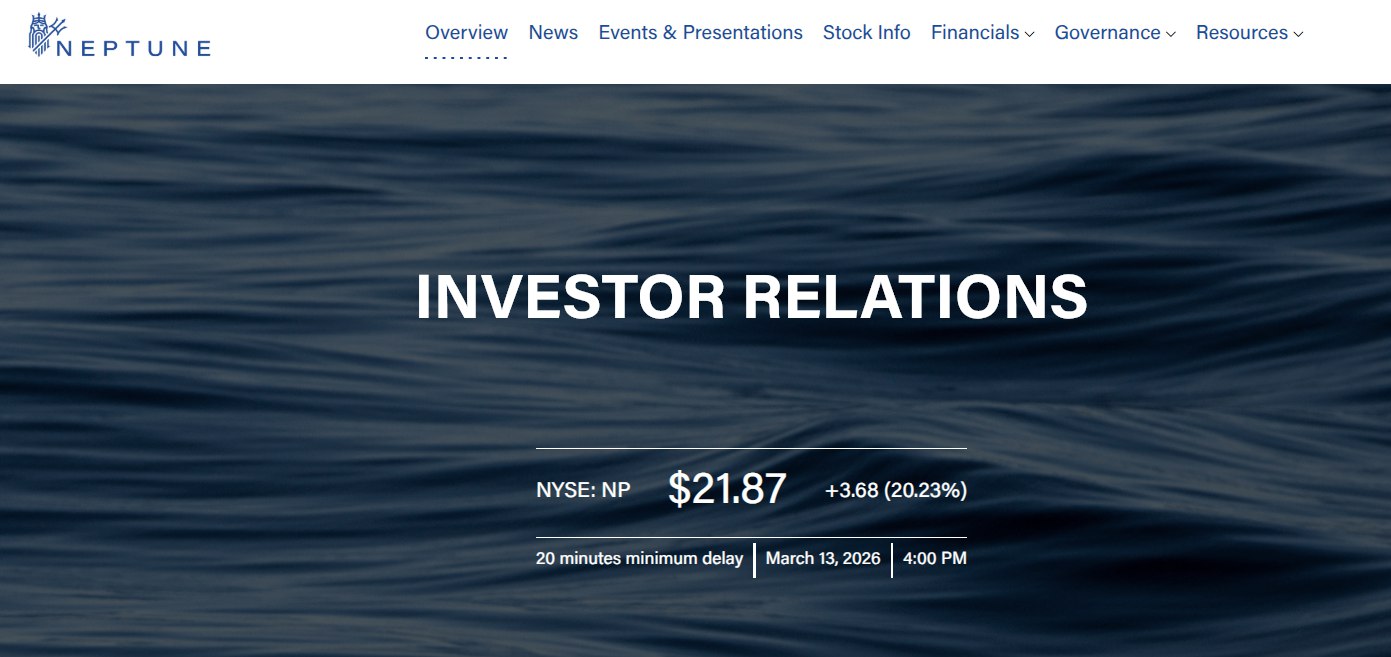
Neptune Insurance Holdings Inc. (NYSE: NP) shares closed sharply higher at $21.87 on March 13, 2026, up $3.68 or 20.23% from the previous day’s close of $18.19, as trading volume spiked to around 925,000 shares — more than double the average daily volume.
The Florida-based insurtech firm, which went public in October 2025, saw its stock rally on March 13 after a period of consolidation, with intraday trading ranging from a low of $18.52 to a high of $21.93. After-hours activity added another $0.25, pushing the price to $22.12, up 1.14% further.

The surge came amid broader interest in property and casualty insurers focused on flood and catastrophe coverage, as climate-related risks drive demand for specialized products. Neptune, through its subsidiary Neptune Flood Incorporated, operates as a managing general agent offering primary flood insurance, excess flood, parametric earthquake and indemnity earthquake policies distributed via agency networks.
The company reported strong growth in its latest earnings on February 18, 2026, for the fourth quarter and full year ended December 31, 2025. Revenue rose 39% to $43.8 million in Q4, though net income fell 63% to $4.3 million due to $4.6 million in IPO-related expenses. Full-year revenue grew 34% to $159.6 million, with net income up 8% to $37.4 million despite $13.1 million in one-time costs. Written premiums increased 34% to $367.3 million, adjusted EBITDA climbed 32% to $95.0 million, and new business sales hit records.
Analysts have responded positively. BMO Capital upgraded NP to Outperform from Market Perform in mid-February 2026, citing growth potential in the flood insurance market. Consensus ratings lean toward Buy, with an average 12-month price target around $26.79 to $27.04, implying 22-30% upside from recent levels. Some targets reach $36.75, while others sit at $22.72, reflecting varied views on execution and market conditions.
Neptune’s focus on data-driven underwriting and digital distribution positions it well in a sector facing rising catastrophe losses from hurricanes, floods and earthquakes. Recent initiatives include a March 12, 2026, launch of a ChatGPT-integrated app for preliminary flood quotes, expanding accessibility, and a March 4 analysis from its research group on FEMA’s proposed 2026 Harris County, Texas, flood map updates, highlighting potential impacts on policyholders.
The stock debuted in October 2025 with a strong first day, jumping 12.5% and valuing the company near $3.1 billion. It traded in a 52-week range of $14.78 (hit February 12, 2026) to $33.23 (October 3, 2025), reflecting post-IPO volatility typical for insurtech names.
Market capitalization stood around $3.02 billion at the March 13 close, with about 138 million shares outstanding. The forward P/E remains attractive relative to growth prospects, though trailing metrics show losses in some periods due to expansion costs.
No major news triggered the March 13 move directly, but traders pointed to technical breakout above recent resistance near $19-20, renewed analyst coverage and sector rotation into financials. Options activity showed elevated call volume, indicating speculative interest.
Neptune continues to build partnerships, including a January 2026 capacity deal with Somers Syndicate at Lloyd’s for additional reinsurance support. The company guides for 2026 revenue of $186-189 million and adjusted EBITDA margins of 60-61%, signaling confidence in scaling operations.
As climate change intensifies flood and seismic risks, Neptune’s specialized offerings could capture more market share from traditional carriers. Investors watch for the next earnings update, expected around May 2026, for updates on premium growth, loss ratios and tech investments.
The sharp gain on March 13 underscores momentum for NP as an emerging player in a high-demand niche, though volatility persists in the young listing.
Business
Planning to build Rs 10 crore by retirement? Starting early with mutual fund SIPs can make it easier – The power of time in wealth creation

The lesson for investors is simple: start investing as early as possible. Time allows investments to compound and grow exponentially. Small contributions made early can create significant wealth over decades, while delaying investments can make financial goals harder and more expensive to achieve.
In long-term investing, time is often more powerful than the amount invested. Starting early and staying invested consistently can make a meaningful difference in building financial security and long-term wealth
(Disclaimer: Recommendations, suggestions, views and opinions given by the experts are their own. These do not represent the views of The Economic Times)
Business
Stay patient, volatility temporary, says Sebi Chairman as Iran-Israel war ruffles global markets
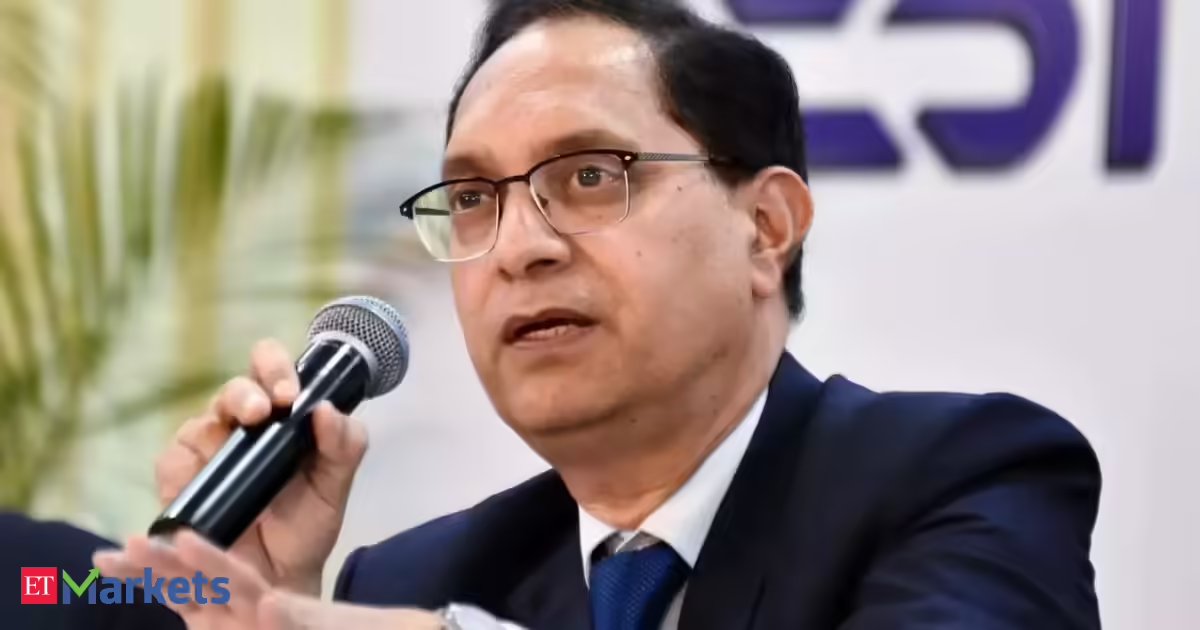
He noted that past disruptions like the COVID-19 pandemic and the Russia–Ukraine war showed that periods of extreme volatility are temporary and markets eventually stabilise. Pandey advised investors, especially retail participants, to remain patient during such phases. He added that the real test of financial markets is not the absence of volatility but their ability to function smoothly, fairly and efficiently despite uncertainty.
“… geopolitical tensions continue to influence economic relationships. Conflict in middle-east has disrupted energy supplies and created volatility in oil and gas markets across the world. Yet, when we look back at similar episodes in the past, one lesson becomes clear: periods of extreme volatility never last forever. In the recent past, we have witnessed the disruptions caused by the COVID-19 pandemic, followed by the Russia–Ukraine conflict, which has triggered market volatility across the world. Markets experienced turbulence — but they eventually stabilised,” Pandey said, while speaking at an event organised by Moneycontrol.
“The real test of a market is not whether volatility appears. The real test is whether the system continues to function smoothly, fairly and efficiently when it does. In uncertain times, the strength of a capital market does not lie in the absence of volatility. Volatility is a natural feature of markets. The real strength lies in the confidence that the system will function fairly, transparently and efficiently even during periods of stress,” Pandey added as he spoke on the subject titled ‘Making Capital Markets More Efficient in Uncertain Times’.
Fear Index India VIX has shot up 124% in the past three months and is now hovering around the 22.65 mark. On Friday, it shot up over 5% as the markets witnessed a bloodbath. The Indian benchmark indices fell sharply yesterday, recording their third successive decline as the Iran-Israel/US war continued to dent market sentiments. The biggest drags were metals, auto, and financial stocks.
Also read: FIIs sell Indian equities worth Rs 52,704 crore in March, so far; Friday records its highest single-day outflow in 2026
In a volatile session, the broader Nifty plunged 488.05 points, or 2.06%, to close at 23,151.10, while the 30-share BSE Sensex declined 1470.50 points, or 1.93%, to settle at 74,563.92.
Pandey highlighted the role of efficient capital markets, which he said play a stabilising role in an uncertain world as they enable transparent price discovery while absorbing shocks without destabilising the broader financial system.
“And perhaps most importantly, they sustain investor confidence. Efficiency is the foundation of trust in the financial system. Without that trust,
capital hesitates. Investment slows. And growth becomes more difficult to sustain,” the Sebi Chief said.
The Sebi Chairman also said the global economy is currently marked by uncertainty due to rapid technological changes such as AI.
(Disclaimer: The recommendations, suggestions, views, and opinions given by the experts are their own. These do not represent the views of The Economic Times.)

The Dominican Republic delivered a dominant performance in the quarterfinals of the 2026 World Baseball Classic, mercy-ruling South Korea 10-0 in just seven innings on March 13 at LoanDepot Park to secure a spot in the semifinals.
Cristopher Sánchez pitched five shutout innings, allowing only two hits while striking out six, setting the tone for a one-sided victory. The Dominican lineup exploded for three runs in the second inning and four more in the third, building an insurmountable lead early. Aggressive baserunning, timely hitting and power from stars like Vladimir Guerrero Jr., Junior Caminero and Fernando Tatis Jr. overwhelmed Korean starter Hyun-Jin Ryu, who lasted just 1.2 innings and surrendered three runs.

The game ended dramatically in the bottom of the seventh when pinch-hitter Austin Wells crushed a three-run walk-off home run off reliever So Hyeong-jun, triggering the WBC’s mercy rule with the score reaching 10 runs. Wells, who started on the bench, delivered the decisive blow to send the Dominicans to the semifinals with a perfect 5-0 tournament record so far.
The Dominican Republic advances to face the United States on Sunday, March 15, in the first semifinal at loanDepot Park. The U.S. earned its berth Friday night with a 5-3 win over Canada in Houston.
South Korea, which finished second in Pool C with a 2-2 record, managed only two hits against Sánchez and the Dominican bullpen. Ryu, the veteran left-hander making his WBC return, struggled with command and was pulled after allowing three runs on three hits and two walks. Korean relievers kept the game scoreless for a stretch, but the offense could not generate any threat against the powerful Dominican pitching.
The Dominicans showcased their depth and firepower throughout. In the second inning, Junior Caminero doubled home Vladimir Guerrero Jr. for the first run, followed by Julio Rodríguez’s RBI groundout and a Tatis Jr. single to make it 3-0. The third inning saw more damage: a bases-loaded walk, an RBI single by Manny Machado and additional runs on aggressive plays to push the lead to 7-0.
Sánchez, the Philadelphia Phillies lefty, was masterful in his start, mixing fastballs and off-speed pitches to keep Korean hitters off balance. The bullpen closed it out efficiently, allowing no runs over the final two frames.
Attendance reached 30,805 at loanDepot Park, with a lively crowd cheering the high-energy Dominican squad. The victory underscored the team’s status as a tournament favorite, having topped Pool D with strong performances and now carrying momentum into the knockout rounds.
For South Korea, the loss marked a disappointing end to a campaign that saw them reach the quarterfinals for the first time since 2017. The team relied on strong pitching in pool play but could not match the Dominican offensive barrage or contain their stars.
The mercy rule shortened the game, allowing the Dominicans to conserve arms ahead of the semifinal against the U.S., a rematch of the 2017 final won by the Americans. The Dominican Republic has not won the WBC since 2013 but has consistently been a powerhouse, boasting MLB talent across the roster.
Postgame, Dominican manager offered praise for Sánchez’s outing and the team’s execution. “We came ready to play every pitch,” he said. “This team has heart and talent — we’re not done yet.”
The win advances the Dominicans to Sunday’s semifinal at 8 p.m. ET on FS1, where they will face a U.S. team that survived a late rally from Canada. The winner will play in the March 17 championship at the same venue.
As the tournament progresses, the Dominican Republic’s blend of power hitting, solid pitching and clutch play positions them as strong contenders for the title. For South Korea, the focus shifts to future preparations, with the loss highlighting areas for improvement against elite international competition.
The 2026 WBC continues with Saturday’s quarterfinals: Puerto Rico vs. Italy at 3 p.m. ET on FS1 in Houston, and Venezuela vs. Japan at 9 p.m. ET on FOX in Miami.

Taylor Swift continues to dominate entertainment news in March 2026, with her net worth reaching an estimated $2 billion according to recent reports, fueling speculation about her personal and professional milestones as she prepares for a rumored summer wedding to Travis Kelce.
Forbes and other outlets confirmed March 12 that Swift’s fortune hit the $2 billion mark, making her the wealthiest female musician and one of the top celebrity billionaires. The surge builds on massive earnings from her “Eras Tour,” streaming royalties, merchandise and the 2025 repurchase of her early album masters for around $360 million. Her October 2025 album “The Life of a Showgirl” sold millions in its first week and sustained strong performance into 2026, contributing significantly to the wealth jump.

The milestone arrives amid fan theories about her next moves. Some speculate a 13th studio album could tie into personal events like her wedding, though no official announcement has come. Swift has kept a relatively low public profile in early 2026, focusing on private life after the “Eras Tour” wrapped and the “End of an Era” docuseries aired on Disney+.
Wedding rumors intensified in March, with multiple reports pointing to June 13, 2026, as a potential date. Fans dissected a Taylor Nation Instagram post featuring a chalkboard with partially erased text, interpreting remnants as “June 13” alongside possible “KC” and “NY” references — interpreted as nods to Kansas City and New York. A podcast tip from a listener claiming insider knowledge of a Rhode Island wedding on that date added fuel, though neither Swift nor Kelce has confirmed details.
Kelce addressed his NFL future in recent interviews, crediting Swift’s dedication to her craft for motivating his return to the Kansas City Chiefs for a 14th season. On the “New Heights” podcast with brother Jason, he discussed how her work ethic influenced his decision to delay retirement, highlighting their supportive dynamic. Jason playfully pressed Travis about wedding plans, keeping the topic light but prominent in media coverage.
Swift’s influence extends beyond music. She inspired Kelce’s career choices, donated generously to causes and maintained strong friendships, including with Selena Gomez, who recently shared details of a handmade gift from Swift. A separate controversy erupted when Jack White commented on songwriting, drawing backlash from fans who accused him of targeting her, though he later clarified his remarks.
On the music front, Swift’s single “Elizabeth Taylor” — released in late 2025 — continued charting, with a special limited-edition vinyl announced for Record Store Day 2026 on a “Cry My Eyes Violet Glitter” variant. The track peaked at No. 3 on the Billboard Hot 100 upon release and remains a fan favorite.
She skipped the 2026 Grammys, where she received no nominations due to eligibility timing for “The Life of a Showgirl.” Executive producer Ben Winston addressed rumors of her attending or performing, noting she was not involved this year. Swift led nominations for the 2026 iHeartRadio Music Awards earlier in the year with nine nods.
No new tour plans have surfaced for 2026, with Swift enjoying a break after the record-breaking “Eras Tour.” Rumors of a 2026 tour were debunked when a charity auction mistakenly listed tickets, later corrected by organizers.
Swift’s low-key approach in early 2026 contrasts with her high-visibility years, prioritizing personal milestones. Fans continue theorizing on social media about future releases, including possible “Taylor’s Version” of her debut album around its 20th anniversary in October 2026.
As spring unfolds, Swift’s blend of business success, romantic developments and cultural impact keeps her at the forefront. Whether through new music hints, wedding preparations or quiet philanthropy, the pop icon shows no signs of slowing her influence.

Rachel Reeves says the Treasury is also looking at “different options” to help households most vulnerable to soaring energy bills.
Business
US Airports Launch Donation Drives for Unpaid TSA Workers as Partial Government Shutdown Enters Fifth Week

A growing number of major U.S. airports are appealing to travelers for donations to support Transportation Security Administration employees working without pay during a partial government shutdown that began Feb. 14, 2026, leaving roughly 50,000 TSA officers to miss their first full paycheck on March 13 amid mounting financial hardship.
The funding lapse for the Department of Homeland Security — triggered when Congress failed to pass a spending bill over disputes on immigration enforcement and border security — has forced essential airport security personnel to continue screening millions of passengers daily without regular compensation. TSA officers received partial pay in late February but saw no funds deposited in many March 13 paychecks, according to union representatives and federal officials.

Airports nationwide have responded by reopening food pantries, setting up gift card collection points and urging passengers to contribute essentials. Denver International Airport (DEN) asked for $10 or $20 grocery and gas gift cards from stores like King Soopers, Safeway, Walmart, Costco and Target, emphasizing that Visa gift cards are not accepted due to federal rules limiting gifts to $20 or less per instance.
“Denver International Airport is seeking grocery store and gas gift card donations for federal employees working without pay,” DEN CEO Phil Washington said in a March 11 statement. “TSA employees just missed their first paycheck, and as we enter a busy spring break travel period, we want to do what we can to ease the stress of this moment.”
Seattle-Tacoma International Airport (Sea-Tac) opened a food pantry for TSA agents, requesting non-perishable food, hygiene items, diapers and baby supplies. Harry Reid International Airport in Las Vegas reactivated its Food & Essentials Pantry, accepting donations of toiletries, household items and pet supplies for affected federal workers.
Other airports participating include Orlando International, Cleveland Hopkins, Reno-Tahoe and more, with collection drives coordinated through airport management, employee unions and community partners. TSA guidance allows such donations from travelers via airport channels, provided they comply with ethics rules barring direct cash or excessive gifts.
The shutdown has strained TSA staffing. The agency reports about 300 officers have resigned since Feb. 14, with unscheduled absences rising to around 6% in some locations. Union leaders describe workers turning to side jobs like ride-sharing, plasma donation or food pantries to cover bills. Some report sleeping in cars or relying on family support after depleting savings from the previous 43-day shutdown in late 2025.
Travel disruptions have worsened, with reports of hours-long security lines at major hubs during peak spring break travel. Wait times of two to three hours have been documented at some checkpoints, though TSA insists expedited programs like PreCheck remain operational. Passenger security fees collected by airlines continue flowing to the government, creating a stark contrast: travelers pay for screening services while screeners go unpaid.
Senate negotiations remain stalled. A March 12 vote on a stopgap DHS funding bill failed, with Democrats blocking the measure over immigration provisions. Republicans have accused Democrats of obstructing progress, while Democrats point to GOP demands on border policy as the impasse. No breakthrough appeared imminent as of March 14.
The American Federation of Government Employees and travel industry groups, including Airlines for America, have launched campaigns urging on-time pay for TSA and FAA workers during lapses. Private operators highlight reliance on smooth airport operations for economic activity.
TSA officers, deemed essential, must report for duty or face termination. Many express frustration at repeated shutdowns, with some rebuilding finances from the prior fiscal year’s record closure.
As the shutdown nears one month, airports’ grassroots efforts underscore the human toll on frontline workers. Donations provide immediate relief, but union officials and advocates stress the need for permanent funding stability to prevent future crises.
Travelers encountering longer lines are encouraged to arrive early, use mobile apps for wait-time estimates and consider TSA PreCheck enrollment. For donation information, check individual airport websites or TSA union channels.

Global Net Lease: A High-Yield Turnaround Story Still In Progress

Goldman warns S&P 500 could decline to 6300 if growth weakens

Armstrong World Industries: Shares Are Right Where They Belong

AI developers may not be keen on crypto, but stablecoins are the secret to agentic finance, crypto insiders say

Israel murders medics in Lebanese hospital strike


-
 Tech3 days ago
A 1,300-Pound NASA Spacecraft To Re-Enter Earth’s Atmosphere
-

 News Videos5 days ago
10th Algebra | Financial Planning | Question Bank Solution | Board Exam 2026
-

 Crypto World5 days ago
Paradigm, a16z, Winklevoss Capital, Balaji Srinivasan among investors in ZODL
-

 Business4 days ago
ExxonMobil seeks to move corporate registration from New Jersey to Texas
-
 Crypto World10 hours ago
HYPE Token Enters Net Deflation as HyperCore Buybacks Outpace Staking Rewards
-

 Fashion20 hours ago
Weekend Open Thread: Addict Lip Glow
-

 Tech4 days ago
ChatGPT will now generate interactive visuals to help you with math and science concepts
-

 Sports7 days ago
Three share 2-shot lead entering final round in Hong Kong
-

 Sports6 days ago
Braveheart Lakshya downs Lai in epic battle to enter All England Open final | Other Sports News
-

 NewsBeat3 days ago
Residents reaction as Shildon murder probe enters second day
-

 Business6 days ago
Search for Nancy Guthrie Enters 37th Day as FBI Probes Wi-Fi Jammer Theory
-

 Business3 days ago
Search Enters Sixth Week With New Leads in Tucson Abduction Case
-
 NewsBeat5 days ago
Pagazzi Lighting enters administration as 70 jobs lost and 11 stores close across Scotland
-

 Tech5 days ago
Despite challenges, Ireland sixth in EU for board gender diversity
-

 Business5 days ago
Search Enters 39th Day with FBI Tip Line Developments and No Major Breakthroughs
-

 NewsBeat3 days ago
I Entered The Manosphere. Nothing Could Prepare Me For What I Found.
-

 Business49 minutes ago
US Airports Launch Donation Drives for Unpaid TSA Workers as Partial Government Shutdown Enters Fifth Week
-

 Sports5 days ago
Skateboarding World Championships: Britain’s Sky Brown wins park gold
-
 Crypto World4 days ago
Will Chainlink price reclaim $10 amid volatility squeeze?
-

 Business2 hours ago
Country star Brantley Gilbert enters growing non-alcoholic beer market