
Business
January new home sales plunge to the slowest pace since 2022


Blaine, Minnesota. New homes starting at a half million dollars in Lexington Waters are high efficiency homes and are HOA Maintained.
Michael Siluk | UCG | Universal Images Group | Getty Images
Sales of newly built homes in January dropped 17.6% month over month to a seasonally adjusted, annualized pace of 587,000 units, according to the U.S. Census Bureau. That is the slowest pace since 2022.
Housing analysts had been expecting a much smaller decline.
Sales were also 11.3% lower than in January 2025, according to the U.S. Census, which is still delayed in its reporting due to last year’s government shutdown. December sales were also revised lower.
This count is based on signed contracts, so people who were out shopping when mortgage rates were lower than they are today. The average rate on the 30-year fixed loan hovered between 6% and 6.2% during January, according to Mortgage News Daily. It is currently at 6.36%.
As a result, the inventory of homes for sale rose to a 9.7-month supply, up from eight months in December, according to the U.S. Census. That is 7.8% higher than January 2025.
More supply and less demand led builders to drop prices. The median price of a home sold in January was $400,500, the agency said, a decline of 6.8% year over year. Prices for existing homes are still flat nationally, but builders report increasing incentives to get buyers in the door.
Data from March does not appear to be any better. An estimated 37% of builders cut prices in March, an increase from February’s 36%, according to the National Association of Home Builders.
Sales were lower across the nation, but they dropped the most in the Northeast and Midwest, where rough winter weather could have had an impact. However, sales were down nearly 22% from December in the West, where weather would not have played a part.

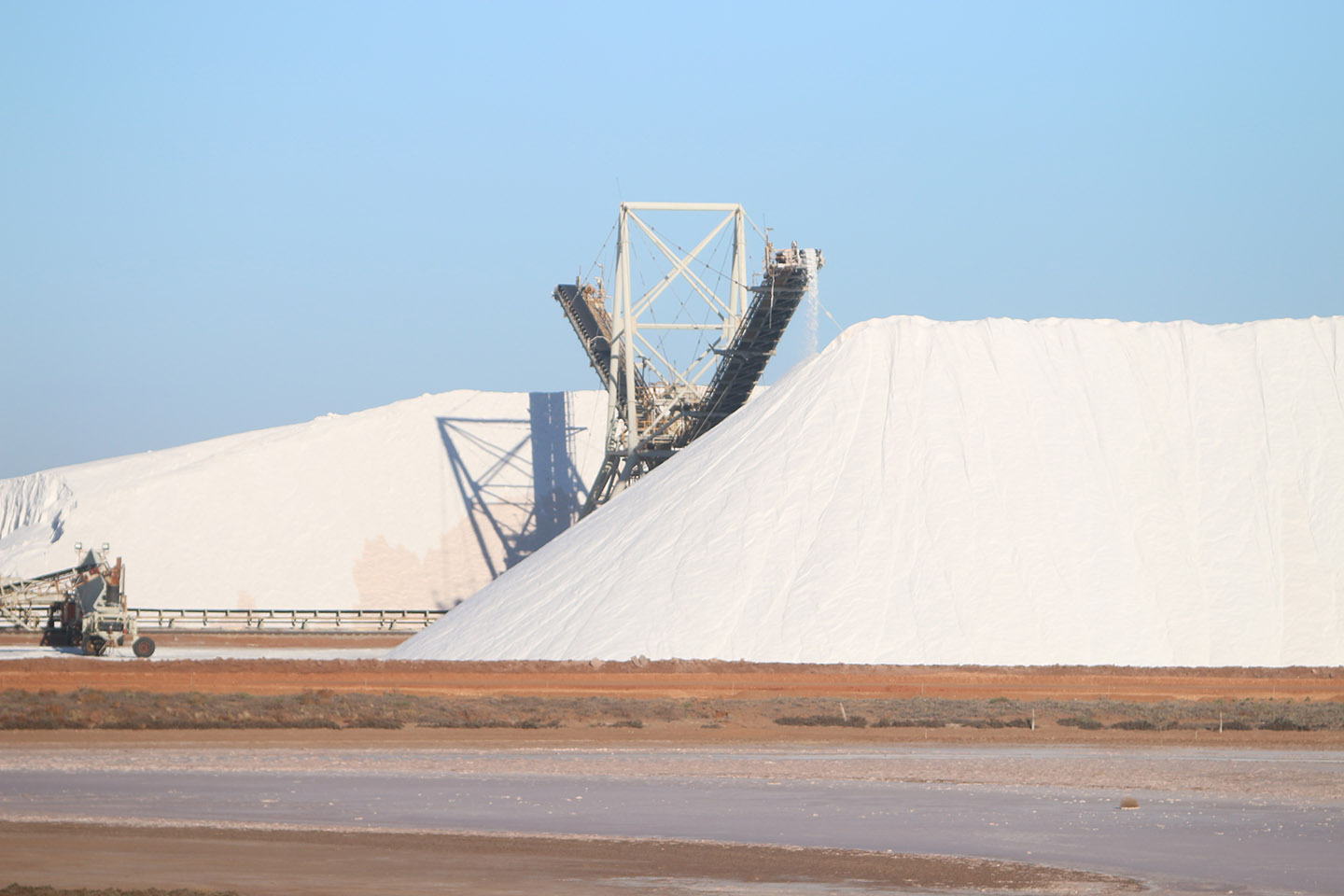
Salt harvester Leichardt has applied to double the size of the Lake MacLeod operation near Carnarvon which it bought from Rio Tinto.
As the conflict triggers economic disruption some risk being hit hard, while others stand to benefit.
They allegedly used fake papers and dummy gear as part of a plan to sell billions in tech to China.
The Premier announced the latest budget measure at an industry breakfast, committing $19.6 million to an additional 330 places in the scheme.

Rivian founder and CEO RJ Scaringe discusses the impact of import tariffs on The Claman Countdown.
Rivian and Uber on Thursday announced a partnership worth up to $1.25 billion to accelerate the two companies’ plans for autonomous vehicles and deploy up to 50,000 fully autonomous robotaxis in the years ahead.
Under the agreement, Uber will invest up to $1.25 billion in Rivian through 2031, subject to achieving autonomous performance milestones by specific dates.
The two companies have agreed to an initial $300 million investment following the signing of the deal, subject to regulatory approval.
Uber plans to purchase, either directly or through its fleet partners, 10,000 fully autonomous Rivian R2 robotaxis and the ride-hailing service firm will have the option to purchase up to 40,000 more in 2030. Rivian’s autonomous fleet of R2 robotaxis will be available exclusively through the Uber platform.

The partnership between Uber and Rivian will focus on deploying up to 50,000 autonomous Rivian R2 robotaxis. (Rivian)
The companies are planning to begin the initial deployment of the robotaxis in San Francisco and Miami in 2028, before expanding to more than two dozen cities by 2031.
If all autonomous performance milestones are met, Rivian and Uber will have deployed thousands of unsupervised robotaxis across 25 cities in the U.S., Canada and Europe by the end of 2031.
AUTOMAKER GEARS UP FOR SELF-DRIVING FUTURE WITH NEW CHIP

The Rivian R2 on display during the 2025 Los Angeles Auto Show. (Josh Lefkowitz/Getty Images)
“We couldn’t be more excited about this partnership with Uber – it will help accelerate our path to level 4 autonomy to create one of the safest and most convenient autonomous platforms in the world,” said Rivian founder and CEO RJ Scaringe.
Scaringe added that Rivian’s “growing data flywheel coupled with RAP1, our state of the art in-house inference platform, and our multi-modal perception platform make us incredibly excited for the rapid advancement of Rivian autonomy over the next couple of years.”
RIVIAN CEO DISCUSSES TARIFFS, SAYS EV MAKER HAS ‘VERY US-CENTRIC SUPPLY CHAIN’

The interior of the Rivian R2 is seen during the 2025 Los Angeles Auto Show. (Josh Lefkowitz/Getty Images)
Uber CEO Dara Khosrowshahi said that the company is “big believers in Rivian’s approach – designing the vehicle, compute platform, and software stacks together while maintaining end-to-end control of scaled manufacturing and supply in the U.S.”
“That vertical integration, combined with data from their growing consumer vehicle base and experience managing the complexities of commercial fleets, gives us conviction to set these ambitious but achievable targets,” Khosrowshahi added.
GET FOX BUSINESS ON THE GO BY CLICKING HERE
Rivian shares rose 3.8% on Thursday, while Uber stock declined by 1.72% during the day’s trading session.
Business
Geopolitical volatility makes strong case for bonds; stick to short-term funds: Devang Shah
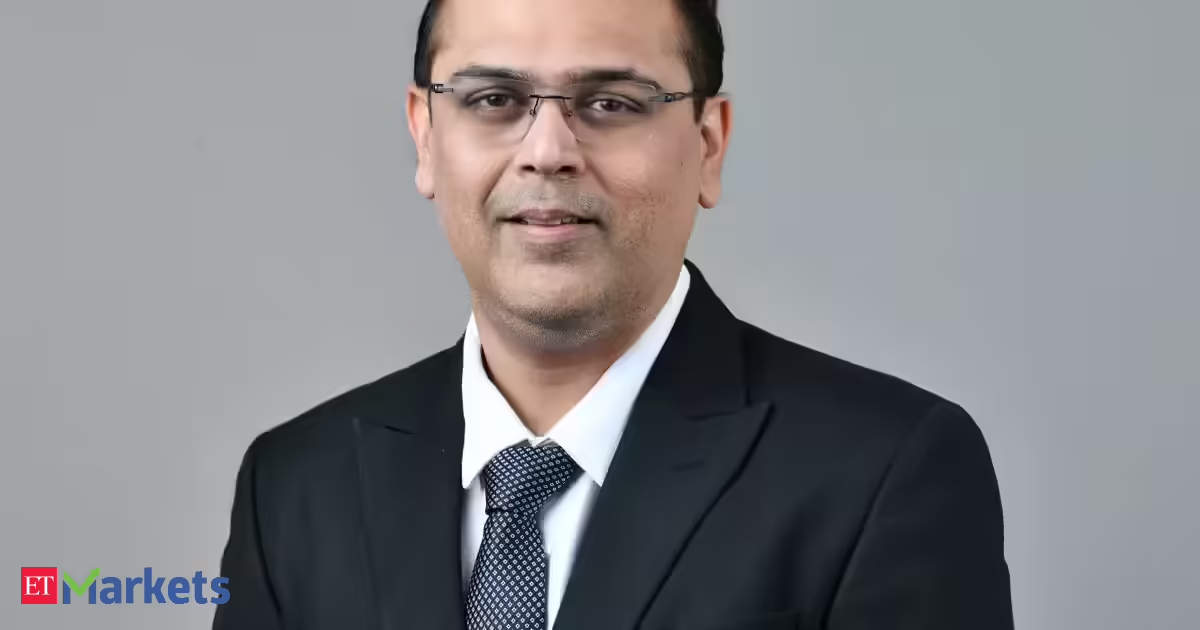
In an interaction with Kshitij Anand of ETMarkets, Devang Shah, Head – Fixed Income at Axis Mutual Fund, said that the current environment strengthens the case for fixed income as a core allocation.
With the rate cut cycle nearing its end and volatility expected to persist, he advises investors to stay cautious on duration and prefer high-quality, short-term debt strategies that can offer steady accrual and resilience amid evolving macro risks. Edited Excerpts –
Kshitij Anand: With global markets facing heightened geopolitical tensions—from ongoing conflicts to trade uncertainties—how are these risks reshaping investors’ interest in fixed income assets at this point in time?
Indian Bank is raising 50 billion rupees through seven-year infrastructure bonds next week. This move aims to fund stronger credit growth and capital requirements. The bank is seeking longer-term funding as deposit rates have increased. Discussions with investors like the Employee Provident Fund Organisation are underway. This issuance marks the bank’s return to the bond market after over 17 months.
Devang Shah: As you rightly highlighted, first of all, it is important from every investor’s perspective to always have asset allocation. What I mean by disciplined asset allocation is that you should not put all your money into one asset class.
We have done some studies—this is also part of our multi-asset allocation theme—where we analyse the top six or seven asset classes that investors typically consider, such as precious metals, bonds, equities, global assets, and offshore assets. Specifically, if you look at offshore assets like US and China markets, and analyse how these assets have performed over different periods, our 20-year study clearly shows that there is no single winner. No one asset class consistently outperforms others or delivers superior returns at all times.

So, asset allocation becomes an even more important theme going forward. Fixed income plays a crucial role in this because it provides stability. Historically, except for periods like 2008, 2013, and parts of 2018, fixed income has generally not delivered negative returns. So, it also offers a degree of capital protection.
In today’s environment, investors should definitely have some allocation towards fixed income. The exact allocation depends on several factors, such as the macroeconomic outlook, central bank actions, inflation, growth, the rate cycle, and liquidity. These are important levers to consider while deciding the allocation to fixed income.Given the current environment—with heightened volatility driven by geopolitical uncertainties and rising crude prices—there is certainly a strong case for bonds.
Kshitij Anand: For much of the last year, markets have been pricing in rate cuts from major central banks. But what if the rate cut cycle gets delayed or does not materialise as expected? How should investors rethink their fixed income allocation in such scenarios?
Devang Shah: You are right—the last two years have been very positive for bond markets. Across developed markets and in India, central banks have cut rates, leading to a strong rate-cut cycle globally.
However, since June, we at Axis have been communicating that we are nearing the end of this rate cycle. Going forward, other levers will drive returns in fixed income. We believe that we are close to the end of the rate cycle and do not expect significant rate cuts ahead.
Now, with the current geopolitical tensions and the sharp rise in crude prices, we need to look at two key aspects: how long this situation will last, and where crude prices will stabilise in the near and medium term.
Our assessment is that while no one can predict geopolitical developments with certainty, markets will eventually realign to a new crude price range across inflation, growth, corporate earnings, and fiscal deficits.
We believe that if crude prices remain in the $75–$85 range, the impact on the Indian economy will be present but muted. It will not significantly deteriorate macroeconomic conditions or force the RBI to hike rates immediately.
However, there could be some impact: inflation may rise by about 0.5%, moving from around 4.5% towards 5%. Growth could slow slightly from the expected 7%+, and the current account deficit may widen from around 1% to 1.5–1.75%.
This means that while macro fundamentals may weaken slightly, they will remain broadly stable. In such a scenario, the RBI is likely to stay supportive of growth by ensuring adequate liquidity. While inflation is a near-term concern, the bigger medium-term risk is slowing growth if crude prices remain elevated.
Therefore, we do not expect significant stress on bonds. Bond yields have already adjusted—especially at the short end of the curve, which has seen a sell-off of about 30–50 basis points. The OIS has also risen by around 30 basis points.
If crude prices stabilise within the $75–$85 range, we do not expect much further impact. However, if crude prices rise above $100—which we consider a lower probability but still a risk—it could trigger a faster rate hike cycle, pushing bond yields higher across the curve.
In such a scenario, it would make sense for investors to stay positioned at the short end of the yield curve.
Kshitij Anand: Now, in a world where equities can deliver strong wealth creation but also sharp volatility, how can bonds help investors balance growth, income stability, and capital preservation within a portfolio?
Devang Shah: As you rightly highlighted, today is a world of uncertainty, and this uncertainty will continue to prevail. That is why asset allocation becomes more and more important.
In today’s market environment, where a large part of the rate cycle is over and we are at a stage where the next move could be rate hikes—whether in six or twelve months—the key question is how to navigate this environment without experiencing significant volatility in your debt portfolio.
So, what should an investor do? That is the most important question. My understanding is that, as I mentioned earlier, the extreme short end of the curve—up to the one- to three-year segment—has seen a significant sell-off over the last six to nine months.
Let me share some numbers. One-year CDs were trading at 6.25–6.30% levels in June 2025. Today, despite rate cuts over the past nine months, they are trading in the 7–7.25% range. That implies a sell-off of about 50 to 75 basis points. This is largely due to strong credit growth and some degree of currency intervention, which led to temporary liquidity tightness.
Similarly, three-year corporate bonds, which were trading at around 6.5%, are now closer to 7.25–7.30%.
So, our perspective is that the segment which has already seen a significant sell-off—and is unlikely to react sharply even if the RBI starts raising rates—is where investors should focus for the near term, say over the next 12 to 18 months.
At yields of 7–7.25%, money market strategies and conservative short-term funds make a lot of sense for investors to navigate this uncertain environment, which is influenced by crude price volatility, policy uncertainty, and macroeconomic risks if crude sustains above $100.
Kshitij Anand: Also, as we are nearing the end of the financial year, can you sum up how FY26 was for bond markets in general?
Devang Shah: FY26 has been a volatile year. It started with significant policy easing, liquidity support, and rate cuts until June. As I mentioned earlier, there was a 50-basis-point rate cut in June.
So, the year began on a strong positive note for bonds, but some of those gains were later given up. If you look at 12–18 month returns, they are still quite healthy. At one point, bond markets were delivering close to double-digit returns—in June 2025, most debt funds, whether short-term, medium-term, long-duration, or gilt funds, were delivering double-digit returns.
However, a part of these gains has been eroded due to global uncertainties, rising crude prices, a large supply of state development loans, and strong credit growth, which signaled that we were nearing the end of the rate cycle.
Overall, FY26 has been a mixed bag for bond markets. The extreme short end has performed very well. Short- to medium-term funds have delivered reasonable returns, while long-duration bonds have remained volatile.
Kshitij Anand: As the financial year draws to a close, how should investors review their portfolios? Are there any specific adjustments they should consider in fixed income allocation before the new financial year begins?
Devang Shah: Our assessment is based on the assumption that over the next two to three months, conditions will stabilise, and crude prices are unlikely to remain above $100 for an extended period.
Under this base case, we have been advising investors to reduce duration in their fixed income portfolios and focus on the short end of the curve.
Specifically, money market funds, conservative short-term funds, and a relatively new category—income plus arbitrage fund of funds—are attractive options. These funds, with a two-year investment horizon, can deliver debt-like returns with equity-like taxation.
Even in a less likely scenario—say a 20% probability—where crude remains above $100 and causes significant stress on growth, investors should still remain invested in the short end of the curve in the near term. This is because the first reaction would likely be a shift in central bank policy towards rate hikes.
Once that scenario materialises, opportunities may emerge in the second half of the year to allocate to longer-duration funds.
For now, the key portfolio adjustment should be to reduce duration, focus on money market strategies, conservative short-term funds, and income plus arbitrage fund of funds. However, for income plus arbitrage funds, investors should maintain at least a two-year investment horizon to fully benefit from tax efficiency.
Going forward, depending on the macro environment, there could be tactical opportunities in long-duration bonds.
Kshitij Anand: So, what should investors keep in mind while building a fixed income strategy for the next financial year amid global uncertainty and evolving interest rate expectations?
Devang Shah: The general fear, whenever such uncertainties rise, is that investors tend to move towards highly liquid funds. They prefer instruments that offer high liquidity and are relatively immune to risks such as duration volatility and potential growth slowdowns.
Our perspective at this point is that if you want to navigate this environment effectively, you should stay invested in funds that predominantly hold AAA-rated credits, have a strong quality bias, and avoid taking excessive duration exposure, as duration can introduce volatility.
If growth weakens, then with a lag, the credit cycle may start deteriorating. While this is not our base case, investors who want to adopt a more conservative approach should continue allocating to money market funds, low-duration strategies, and ultra-conservative short-term bond funds, with a strong emphasis on high-quality AAA issuers.
That said, the credit cycle today remains strong. I do not see any immediate concerns. India’s macroeconomic story has not weakened significantly, and the credit environment continues to be healthy. If you look at bank and NBFC NPAs, leverage levels, and profitability, there has been no meaningful deterioration.
However, as a cautionary note, if crude prices continue to hover around $100 or higher, it could slow down India’s growth and create future concerns. To navigate such a scenario, it is better to stay invested in money market strategies with a higher quality bias.
Kshitij Anand: What factors are accelerating retail participation in India’s traditionally institutional bond markets, and what more needs to be done to deepen this ecosystem?
Devang Shah: To begin with, regulators have done a commendable job. Today, retail investors have access to government bonds through dedicated platforms, which was not the case earlier. Regulators have also simplified many aspects to help investors better understand the products they are investing in.
Mutual funds have also played a significant role. Today, there is a fund for every investor need. If you want to invest for one day, there are overnight funds. For three months, there are liquid funds. For longer horizons, there are target maturity funds, index funds, or long-duration funds.
SEBI and RBI have done a great job in promoting investor education. Tools such as riskometers and portfolio disclosure matrices help investors understand the risk profile and credit quality of their investments, including exposure to non-AAA assets.
A lot of improvements have been made since the 2018 credit crisis. Today, mutual fund products are much easier for retail investors to understand.
Innovations such as direct participation in government bonds and ensuring liquidity through mutual fund structures are important steps towards deepening the corporate bond market. These developments will support increased retail participation in fixed income over the medium term.
Kshitij Anand: Lastly, Indian government bonds have started getting included in major global indices. How could this influence foreign capital flows, yields, and investor interest in the Indian bond market?
Devang Shah: In my view, the increasing depth of the Indian bond market—reflected in volumes, bid-ask spreads, and overall size—has made it more attractive to global investors.
We have already seen initial steps with JPMorgan including Indian bonds in its indices, followed by partial inclusion in certain Bloomberg emerging market indices. There is also a strong possibility that Indian bonds could be included in the Bloomberg Global Aggregate Index, which tracks a $2.5–2.8 trillion market.
If that happens, India could see an allocation of close to 1%, potentially bringing in $20–25 billion of inflows. We believe this could happen within the next 12 months, possibly as early as the June review.
Such inclusion could create tactical opportunities in long-duration bonds, as inflows may lead to a rally in that segment depending on prevailing yield levels.
However, in the current environment, investors should maintain a higher allocation to the short end of the curve due to uncertainties around crude prices, geopolitical risks, and the fact that the rate cut cycle is largely behind us.
In a stable or rising rate environment, focusing on accrual or carry strategies through short-duration funds is a prudent approach.
That said, global index inclusion is a significant positive. As India’s bond market continues to grow in depth and scale, more such opportunities are likely to emerge, creating additional avenues for investors over time.
(Disclaimer: Recommendations, suggestions, views, and opinions given by experts are their own. These do not represent the views of the Economic Times)

Operator
Good day, and welcome to the Tantalus Systems’ Fourth Quarter and Year-End 2025 Financial Results Conference Call. [Operator Instructions] Please note that this event is being recorded. I would now like to turn the conference over to Deborah Honig, Investor Relations. Please go ahead.
Deborah Honig
Adelaide Capital
Thank you, operator. Thank you for joining us to discuss Tantalus Systems’ financial results and operating performance for the fourth quarter and year ended December 31, 2025. Tantalus issued these results, including their financial statements, management’s discussion and analysis and press release yesterday after market close, which are posted on the company’s website. Joining me today on the call from Tantalus Systems, herein referred to as Tantalus or the company are Peter Londa, President and Chief Executive Officer; and Azim Lalani, Chief Financial Officer. During the call, we will make forward-looking statements about Tantalus’ business. These statements are subject to certain risks and uncertainties, which could cause actual results to differ materially. Tantalus refers conference call participants either today or in the future to the company’s forward-looking statements contained in the investor presentation on our website at www.tantalus.com.
Statements made on this call reflect management’s analysis as of today, March 19, 2026. Management does not assume any responsibility or obligation to update forward-looking statements made during this conference call unless
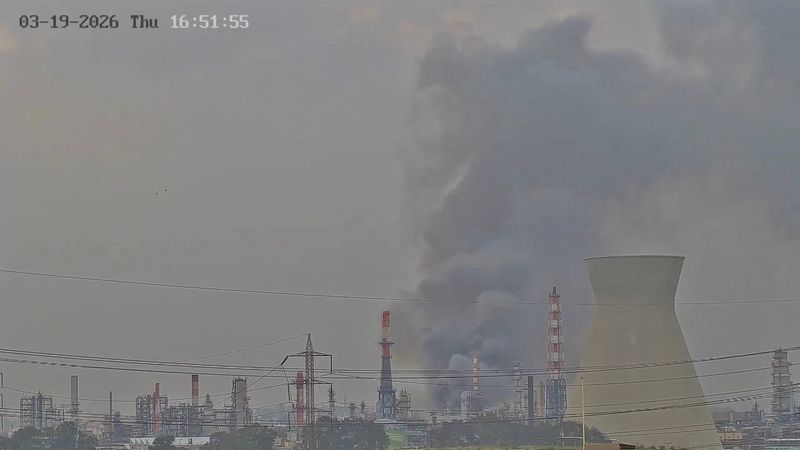

Israel launches new wave of attacks on Iran as crisis deepens

Check out what’s clicking on FoxBusiness.com.
Four Delta Air Lines flight attendants were injured on Friday after a flight bound for Australia experienced what the airline described as “brief turbulence.”
The flight, carrying 245 passengers and 15 crew members, was headed from Los Angeles, California, to Sydney, Australia, when the turbulence began.
The Airbus A350 was hit by the turbulence as it descended, but Delta said the aircraft landed “safely and normally” at the Sydney airport.
US FLIGHT CANCELLATIONS, GROUND DELAYS SURGE AS MASSIVE MARCH STORM DISRUPTS TRAVEL

The flight was carrying 245 passengers and 15 crew members from Los Angeles, California, to Sydney, Australia. (Getty Images / Getty Images)
Three of the injured flight attendants were sent to the hospital for medical treatment. No passengers reported any injuries.
“Delta flight 41 from Los Angeles encountered brief turbulence upon descent into Sydney, and four flight attendants reported injuries,” an airline spokesperson said in a statement to FOX Business.
“Nothing is more important than the safety of our people and our customers, and our priority is taking care of the impacted crew members,” the statement continued.

Three of the injured flight attendants were sent to the hospital for medical treatment. (Getty Images / Getty Images)
The flight landed in Sydney on Friday morning after departing Los Angeles on Wednesday night local time.
NSW Ambulance was alerted at about 6.45 a.m. local time, just minutes before the aircraft landed, according to flight data.
AIRLINES CANCEL FLIGHTS, ISSUE TRAVEL WAIVERS OVER MIDDLE EAST UNREST

No passengers reported any injuries. (Kevin Carter/Getty / Getty Images)
CLICK HERE TO GET FOX BUSINESS ON THE GO
Emergency responders said they treated five people who sustained minor injuries, according to The Sydney Morning Herald, although it is unclear why their injury total is different from Delta’s.
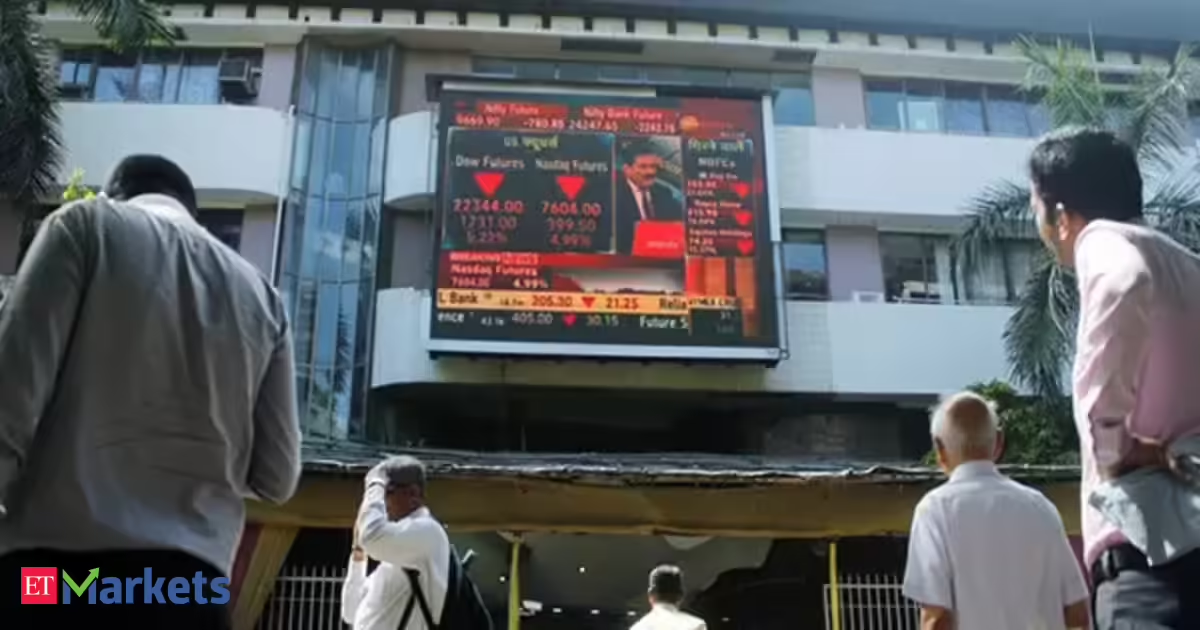
The NSE Nifty closed at 23,002.15 – the lowest since February 2025, down 775.65 points or 3.3%. The BSE Sensex ended 3.3% lower at 74,207.24 – the lowest since March 2025, shedding 2,496.89 points. Thursday’s slide wiped out gains from the previous three sessions and punched a ₹13 lakh crore-hole in the total market capitalisation of BSE-listed companies.
“The recent attacks on gas reserves are a serious concern that may have spooked investors and pushed oil prices higher,” said Hitesh Zaveri, head – Listed Equities Alternatives at Axis Mutual Fund. “Till this war is resolved, further declines cannot be ruled out.”
Iran’s strikes caused extensive damage to the world’s largest gas plant in Qatar, targeted a refinery in Saudi Arabia, forced a shutdown of UAE gas facilities, and triggered fires at two Kuwaiti refineries, Reuters reported. The retaliation followed Israel’s attack on Iran’s gas infrastructure.
Market participants do not rule out further downside amid the escalating West Asia tensions.
“There is scope for further downside since oil facilities were hammered, raising concerns that production and transport capabilities in Qatar, Saudi Arabia and Iran may be significantly impaired,” said UR Bhat, co-founder & director, Alphaniti. “This has added pressure on the markets while the closure of the Strait of Hormuz remains unaddressed. Consensus expectations for crude moving towards $150 a barrel may not be far-fetched if escalations persist.”
 Agencies
 Fear Gauge Rises 21.8%
Across Asia, Japan dropped 3.4%, South Korea fell 2.7%, Hong Kong slid 2%, while Taiwan and China declined 1.9% and 1.4%, respectively.
At home, all NSE sectoral indices ended lower. The Nifty Auto index tumbled 4.3%, while Nifty Realty fell 3.8%. Consumer durables, IT and metal gauges lost more than 3% each. The Bank Nifty fell 3.4%, dragged by HDFC Bank.
Analysts said the sell-off has prompted traders to initiate fresh bearish bets on the Nifty.
“Around 12-18 Nifty heavyweights saw not just unwinding of long positions but formation of short positions as well,” said Ruchit Jain, head of technical research at Motilal Oswal Financial Services.
Jain pegged 22,500 as the near-term support level but said a durable bottom depends on an easing of geopolitical stress.
Foreign portfolio investors sold a net ₹7,558.2 crore worth of shares on Thursday, while domestic institutions bought ₹3,864 crore. In March, global investors sold ₹79,805.7 crore of equities.
The India VIX jumped 21.8% to 22.8 – the sharpest rise since March 4 – signalling heightened near-term volatility. “With the VIX at extremely high levels, the swings are sharp and could continue,” Jain said.
The Nifty Midcap 150 fell 3.1%, and the Smallcap 250 dropped 2.6%. Of the 4,404 shares traded on the BSE, 3,359 declined and 913 advanced. Both indices were down about 3.3% over the past week till Thursday.

Will Victor Osimhen Need Surgery for Surgery after Arm Injury- Galatasaray Provide Update

inKONBINI Lets You Spend Summer Days Behind the Register

8 Horror Movies That Prove This Is Hollywood’s Best New Scream Queen


-
 Crypto World6 days ago
HYPE Token Enters Net Deflation as HyperCore Buybacks Outpace Staking Rewards
-

 Tech4 days ago
Your Legally Registered ‘Motorcycle’ Might Not Count Under Proposed US Law
-

 Fashion6 days ago
Weekend Open Thread: Addict Lip Glow
-
 Tech3 days ago
Are Split Spacebars the Next Big Gaming Keyboard Trend?
-
Sports6 days ago
Why Duke and Michigan Are Dead Even Entering Selection Sunday
-

 Business4 days ago
Search for Savannah Guthrie’s Mother Enters Seventh Week with No Arrests
-

 Business6 days ago
US Airports Launch Donation Drives for Unpaid TSA Workers as Partial Government Shutdown Enters Fifth Week
-
Crypto World5 days ago
Coinbase and Bybit in Investment Talks: Could Bybit Finally Enter the US Crypto Market?
-

 Business4 days ago
Australian shares drop as Iran war enters third week
-

 Business6 days ago
Country star Brantley Gilbert enters growing non-alcoholic beer market
-

 Crypto World4 days ago
Crypto Lender BlockFills Enters Chapter 11 with Up to $500M in Liabilities
-

 Sports6 days ago
College Basketball Best Bets: Conference Tournament Semifinal Picks
-

 Politics2 days ago
The House | The new register to protect children from their abusers shows Parliament at its best
-

 Fashion4 days ago
25 Celebrities with Curly Hair That Are Naturally Beautiful
-

 News Videos1 day ago
RBA board divided on rate cut, unusually buoyant share market | Finance Report | ABC NEWS
-

 Crypto World2 days ago
Canada’s FINTRAC revokes registrations of 23 crypto MSBs in AML crackdown
-

 Crypto World5 days ago
Crypto Losses Drop 87% in February, But Hackers Are Now Targeting People, Not Code
-
 Politics3 days ago
Real-time pollution monitoring calls after boy nearly dies
-
 NewsBeat1 day ago
Residents in North Lanarkshire reminded to register to vote in Scottish Parliament Election
-

 Business4 days ago
Meta planning major layoffs as AI spending and automation reshape workforce


You must be logged in to post a comment Login