China’s digital yuan (e-CNY) has experienced explosive growth, with transaction volumes increasing by over 800% as Beijing positions the central bank digital currency (CBDC) to challenge the U.S.-dominated global monetary system.
While retail adoption remains slow due to the dominance of private platforms like Alipay and WeChat Pay, the Chinese government is aggressively integrating the e-CNY into public sector payments and cross-border trade settlements.
Key Points
Massive Growth: As of late 2025, cumulative e-CNY transactions reached 16.7 trillion yuan ($2.37 trillion), representing an 800% increase since 2023 and making it the world’s largest CBDC experiment.
Divergent National Strategies: China is pursuing a centralized, state-issued CBDC while banning private yuan-backed stablecoins; conversely, the U.S. has banned the creation of a CBDC in favor of a market dominated by dollar-backed private stablecoins.
Functional Evolution: To increase its appeal, the e-CNY began paying interest to holders on January 1, transitioning from a simple payment tool to a feature more closely resembling a traditional bank deposit.
Cross-Border Expansion: China is a primary driver of Project mBridge, a multi-government digital payment platform where the digital yuan accounts for over 95% of settlement volume, particularly for energy and commodity trades.
Retail Adoption Hurdles: Despite government mandates for public servant wages, domestic consumers still largely prefer established private digital payment channels, though analysts suggest enterprise and supply chain adoption may be easier to accelerate.
Global Implications: Analysts view the e-CNY as a long-term strategic tool aimed at building a “multilateral monetary system” that reduces reliance on the U.S. dollar and enhances China’s influence in international trade.
This state-led strategy creates a sharp contrast with the United States, which has prioritized private stablecoins and banned the issuance of a centralized digital currency, marking a new frontier in the financial competition between the two superpowers.
China is aggressively expanding its central bank digital currency (CBDC), the e-CNY, as a strategic alternative to the U.S. dollar-dominated financial system. By late 2025, transaction volumes surged by over 800% to $2.37 trillion, driven largely by government-led initiatives such as public sector wage payments. While domestic retail adoption faces competition from established platforms like Alipay and WeChat Pay, Beijing is shifting its focus toward international trade and institutional utility.
The global digital currency landscape reflects a growing geopolitical divide in financial technology:
Advertisement
China’s Centralized Model: Focuses on state-issued currency (e-CNY) while enforcing strict bans on private stablecoins and cryptocurrencies.
The U.S. Private Model: Prioritizes dollar-backed stablecoins issued by private entities, which currently maintain nearly 99% of the global market share.
The contrast between China’s state-driven Central Bank Digital Currency (CBDC) strategy and the U.S. inclination toward privately issued stablecoins significantly impacts the competition for global reserve currency dominance in multiple critical aspects.
1. Divergent Models of Financial Control
The competition is defined by two fundamentally different structural philosophies:
China’s Centralized Model: Beijing promotes the e-CNY , a state-issued currency designed to challenge the U.S.-dominated global monetary system. China enforces a strict ban on private stablecoins and cryptocurrencies to maintain state control.
The U.S. Private Model: The U.S. prioritizes privately issued, dollar-backed stablecoins . These operate on public, decentralized blockchains rather than state-run systems. Currently, the U.S. has banned the issuance of a domestic CBDC due to concerns regarding financial stability and privacy.
2. Market Dominance vs. Strategic Growth
The document highlights a significant gap in current usage versus strategic trajectory:
U.S. Dominance: Dollar-denominated stablecoins currently maintain an overwhelming lead, accounting for nearly 99% of the global market share by market capitalization. This allows the U.S. to capitalize on the existing dominance of the dollar in digital formats.
China’s Rapid Expansion: While retail adoption has been stagnant domestically, the e-CNY’s transaction volume surged by 800% to $2.37 trillion by late 2025. This growth is driven by government-led initiatives, such as paying public sector wages in digital yuan.
3. Cross-Border Settlement and mBridge
China is using technology to build a “multilateral monetary system” that bypasses traditional dollar-reliant channels:
The mBridge Project: In collaboration with the UAE, Thailand, Saudi Arabia, and Hong Kong, China has developed a platform for cross-border settlements. The digital yuan accounts for over 95% of the settlement volume on this platform.
Strategic Trade: China is focusing mBridge toward energy and commodity-linked transactions , sectors where it already holds a central commercial role.
Belt and Road Integration: Beijing is leveraging the “Belt and Road” initiative to encourage international supply chain participants to adopt the e-CNY for cross-border transactions, offering “transactional convenience and economic savings.”
4. Economic Incentives and Functionality
Interest Payments: As of January 1, the e-CNY began paying interest to holders , making it function more like a traditional bank deposit. This is intended to increase its appeal to both retail and institutional users.
U.S. Regulatory Hesitation: In the U.S., discussions regarding whether stablecoins should pay interest are stalled. Opponents fear that interest-bearing stablecoins could cause significant outflows from traditional banks, potentially threatening financial stability.
5. Influence on Reserve Currency Status
While the e-CNY has a long way to go, its integration into China’s national strategy poses a direct challenge to the U.S. dollar:
Strategic Alternative: The e-CNY is explicitly described as an alternative to the U.S.-dominated system.
Institutional Shift: While changing individual consumer behavior is difficult, China believes that enterprise adoption for cross-border trade can be accelerated more quickly, potentially shifting the foundation of global trade finance away from the dollar.
Status of the e-CNY: Analysts conclude that given its scale and sophistication, the digital yuan will remain a central feature of the “global future of money” and the ongoing superpower competition.
Chinese authorities are expanding the functionality of e-CNY beyond a simple digital payment tool. As of January 1, the e-CNY now offers interest to holders, making it resemble traditional bank deposits. This new feature could enhance its appeal and drive greater adoption among retail users. Additionally, the integration of interest-bearing capabilities positions e-CNY as a more competitive alternative to traditional banking services. This move could potentially disrupt the financial ecosystem by encouraging users to transition from conventional savings accounts to the digital yuan. Moreover, by offering such incentives, Chinese authorities aim to boost the currency’s usage domestically while laying the groundwork for its potential international adoption.
Vail Resorts, Inc. (MTN) Q2 2026 Earnings Call March 9, 2026 5:00 PM EDT
Company Participants
Connie Wang Robert Katz – CEO & Executive Chairman Angela Korch – Executive VP & CFO
Conference Call Participants
Advertisement
Shaun Kelley – BofA Securities, Research Division David Katz – Jefferies LLC, Research Division Charles Scholes – Truist Securities, Inc., Research Division Matthew Boss – JPMorgan Chase & Co, Research Division Jeffrey Stantial – Stifel, Nicolaus & Company, Incorporated, Research Division Arpine Kocharyan – UBS Investment Bank, Research Division Benjamin Chaiken – Mizuho Securities USA LLC, Research Division Xian Siew Hew Sam – BNP Paribas, Research Division Brandt Montour – Barclays Bank PLC, Research Division Chris Woronka – Deutsche Bank AG, Research Division Stephen Grambling – Morgan Stanley, Research Division
Presentation
Operator
Advertisement
Good afternoon, and welcome to the Vail Resorts Fiscal Second Quarter 2026 Earnings Conference Call. Today’s conference is being recorded. [Operator Instructions] I will now turn the call over to Connie Wang, Vice President of Investor Relations at Vail Resorts. You may begin.
Connie Wang
Thank you, operator. Good afternoon, everyone, and welcome to Vail Resorts Fiscal 2026 Second Quarter Earnings Conference Call. Joining me on the call today are Rob Katz, our Chief Executive Officer; and Angela Korch, our Chief Financial Officer. Before we begin, let me remind you that some information provided during this call may include forward-looking statements that are based on certain assumptions and are subject to a number of risks and uncertainties as described in our SEC filings, and actual future results may vary materially. Forward-looking statements in our press release issued this afternoon, along with our remarks on this call, are made as of today, March 9, 2026, and we undertake no duty to update them as actual events unfold.
Advertisement
Today’s remarks also include certain non-GAAP financial measures. Reconciliations of these measures are provided in the tables
Mumbai: A fresh bout of panic selling pushed India’s main equity indices to a 10-month low on Monday as oil prices leapt past $100 a barrel for the first time since 2022 amid the full-blown conflict in West Asia, deepening concerns of the inflationary impact of surging energy costs on the economy and the rupee.
The sell-off erased about ₹8.7 lakh crore from the aggregate market capitalisation of BSE-listed companies.
India’s Volatility Index – the stock market’s fear gauge – jumped 17.5% to 23.36, off the day’s high of 24.49, underscoring the heightened risk-off mood in the market that has prompted foreign fund managers to step up selling. The index has surged 92% over the past month, with the war between US-Israel and Iran contributing to existing concerns over the impact of AI-related disruptions on the software services sector.
For now, soaring oil prices seem to be the topmost concern.
Advertisement
“The sharp rise in oil prices has pushed investors into a risk-off mode, leading to higher volatility, sector rotation and intermittent bouts of selling,” said Shreyash Devalkar, head – equity at Axis Mutual Fund.
Live Events
Agencies
Some Losses Recouped “For India, crude oil is the most critical variable because it directly impacts inflation expectations, the current account, the rupee and, eventually, interest rates,” said Devalkar of Axis MF. The NSE Nifty 50 dropped 422.4 points, or 1.7%, to close at 24,028.05-its lowest level since May last year-while the BSE Sensex declined 1,352.74 points, or 1.7%, to end at 77,566.16, its weakest close since April 2025. Both indices had fallen more than 3% during intraday trade. The fall in crude prices from the highs helped the market cut a portion of the losses, said Sunny Agrawal, Head of Research at SBI Securities. Brent crude May futures were trading near $104 a barrel on Monday evening, off the highs of $119 earlier in the day, after G7 countries tried to curb the run-up by announcing the release of emergency oil reserves. But this could be temporary if the conflict drags on for longer than expected. Foreign portfolio investors sold shares worth ‘6,346 crore on Monday, while domestic institutional investors were buyers to the tune of ‘9,014 crore. FIIs have sold shares worth ‘28,525 crore since the start of the conflict last Saturday.
“Elevated crude prices, a stronger US dollar and pressure on the rupee typically prompt FIIs to pare exposure to emerging markets, and India is no exception, given its high oil import dependence,” said Devalkar.
Among Asian markets, Japan’s benchmark plunged 5.2%, South Korea dropped 6%, Taiwan fell 4.4%, Hong Kong declined 1.4% and China slipped 0.7%. The pan-European Stoxx 600 index was down less than 1% at the time of going to print.
At home, the broader markets also came under selling pressure, with the Nifty Midcap 150 falling 2% and the Nifty Smallcap 250 declining 2.3%. Of the total 4,536 stocks traded on the BSE, 886 advanced while 3,484 declined on Monday. On the technical front, Nifty has strong support near 23,500 and resistance around 24,500.
Woodside Energy has started drilling at its Trion oilfield in the Gulf of Mexico, in a bid to fully develop the $10.2 billion asset ahead of first oil in 2028.
AI, in its current form, has now been with us for three full years. Since we first felt the shockwaves from the ChatGPT 3.5 launch on November 30, 2022, we have been tinkering with and using LLMs. We have found these models helpful for questions large and small, and LLMs certainly helped create efficiencies in approaching our process, but we had not yet systematically integrated AI into our research process. As the tools evolved, we believed it was necessary to both experiment and formalize where AI adds value, and where it does not. On this journey, Elliot and his co-host John Mihaljevic recorded a fascinating podcast with Samir Patel of Askeladden Capital. Samir has been incredibly thoughtful in developing and articulating the way he has infused his process with AI. 1 2
Below, we outline where AI has been most helpful in our process and where we believe we can improve its use. Before doing so, it is worth framing the kind of value we are actually seeing in practice. Much of the current discourse centers on the displacement of knowledge workers, a narrative we believe is often overstated. While there are certain industries where headcounts will change due to AI, we are believers in the Kasparov Law (or Kasparov Principle). As phrased by the Chess Grandmaster, Garry Kasparov, the Kasparov Law holds that “weak human + machine + superior process beats stronger humans and machines with inferior processes.” 3 4 Kasparov conceived of this notion in the aftermath of his loss to Deep Blue, a supercomputer designed for chess mastery, upon seeing amateurs with rudimentary chess programs beat Deep Blue-style supercomputers.
Put simply, these systems are best viewed as force multipliers for human judgment, not replacements of it. These use-cases range from powerful time savers to idea generators to risk profilers and risk management. In our own practice, we think we are in the early innings of deploying AI and we are intent on understanding how we can benefit from these systems as early and as quickly as possible. AI becomes materially more powerful when the user understands its systematic strengths and limitations, and learns how to prompt it effectively.
Advertisement
One limitation we are quite cognizant of is the fact that AI systems are programmed for “agreeableness” and in many of our use-cases we are looking for the opposite—we actively use AI to challenge our assumptions and surface flaws in our reasoning. One limitation we remain highly aware of is that most AI systems are optimized for agreeableness rather than adversarial critique. They’re helpful, polite, and affirming, often to the point of avoiding confrontation. Ask for a questionable idea, and they’ll reframe it positively or gloss over risks. This is partly by design; it’s safer, more pleasant, and more “human-like” in casual settings. 5 Many note this fact without realizing that LLMs are designed purposely in this direction and far more have no clue—after all, it is rather pleasant to have a seemingly objective computer agree with your thoughts. We have deliberately programmed our LLMs with the following instructions and recommend any readers do the same: “For all future responses, you must prioritize unfailing truthfulness and objectivity over politeness or agreeableness. You are directed to challenge my assumptions when they are incorrect or logically inconsistent. Be specific and explain where I am wrong and why. Objectivity and truth are to be preferences over agreeableness.”
LLMs are phenomenal for time savings and streamlining processes. They have been incredibly helpful getting to “no” faster on ideas and have accelerated our ability to turn over more rocks. This does not mean that we do less work. On the contrary, it helps us do more work and analyze even more companies on the path to finding the right ideas that work for us. Creativity is one of the often-overlooked superpowers of AI. Many bemoan the hallucinations, but miss the fact that in systems, many times one’s greatest strength is also a weakness. We had been fearful at first, but reading Co-Intelligence by Ethan Mollick helped us reconsider our fears. Creativity and hallucinations are two sides of the same coin and once this is understood, we can gear our use accordingly.
NotebookLM
Over the past decade and a half we have done thousands of expert consulting calls across industries. NotebookLM has been a powerful way to leverage our proprietary data assets, particularly years of detailed expert call notes. In NotebookLM, rather than querying the LLM at large, we isolate the query on our own calls, notes and documents we add to the repository. We have created notebooks by company and by industry vertical. We can now use these company and industry notebooks to ask queries that synthesize our findings, seek out inconsistencies across experts, analyze changes in management’s comments across quarters, find angles worthy of further analysis or prepare for the next quarterly report or expert call.
Gems in Gemini
We were introduced to Gems by John Mihaljevic preparing for the podcast with Samir. Since that time, we have been developing and training our internal suite of specialized AI agents (‘Gems’). A Gem, per Gemini’s own definition, “is a custom, personalized version of the Gemini AI that you can create to act as an expert or specialist for specific tasks.” We have spent time building and iterating numerous Gems, many of which are geared specifically to understanding and surfacing risks on companies we own and ones we are analyzing to own. Our Gems have names like Bad Actor Detector, Competitive Risk Analyzer, Earnings Report Analyzer, Short Report Generator, Business Model Analyst, Financial Model Builder and more. We do not view these as finished products, but rather as starting points that we will continue to iterate as we use them and see ways they are either failing us, or can be of even more value. From the titles we have shared, hopefully it is clear that in some, our goal is purely efficiency, while in others, our goal is unearthing risks we may not immediately realize in our analyses.
Advertisement
Claude Code
This is a more recent discovery for us and an area of active experimentation. In many respects, our early experiences with Claude Code have been as jaw dropping as those with ChatGPT three years ago. For those unfamiliar – Claude Code is a command-line tool that acts like a software engineer in your terminal, allowing you to give natural language instructions to write, debug, and test code directly within your local files. We see the potential for this to be an incredible tool and are cautiously optimistic we can build some valuable software and automations for RGA. We have already built several intriguing web scrapers that can aggregate unique data which is helpful in monitoring several portfolio positions. We are confident that we can and will build more such tools. We also built a panel tracking financial filings across our portfolio and have a list of future projects to pursue; however, we are hyper-aware of our own limitations in a coding environment and that tools which work one day may be buggy the next and unviable shortly thereafter.
We are sharing this here both to help illustrate how we are using AI and in hopes that others will reach out to share some of the ways they see AI enhancing their research process. We are convinced AI can and will make us better investors and have a sense of our own roadmap, but we are also open-minded to where that might be wrong.
Claude Code and march to Agi
This is the third iteration of this letter, given how quickly the AI narrative has evolved year-to-date. We want to ensure a combination of relevance, but also to share thoughts that are enduring. Given how powerful Claude Code is, many are starting to talk about how AI will inevitably replace white collar workers, which hit markets with a whirlwind when Citrini Research published a thought piece on the future ramifications of AI. 6 We believe the market narrative around AI is currently swinging to unhelpful extremes. This creates immense opportunity.
The Citrini piece raises some important points; however, we think there are considerable caveats and counters worth considering. First, the timeframe presented is simply unrealistic. AI is a disruptive innovation, but the world has numerous circuit breakers including limited compute (every hyperscaler talks about being capacity constrained), unfamiliarity with what does and does not work with certainty in a real world environment, opportunities to do more with bottlenecks broken, organizational politics, regulation and ultimately new demand creation that AI opens doors to.
Advertisement
The easiest component of the Citrini piece to refute is the Doordash analogy and it raises two important questions. First, Doordash is a low friction user experience. No agent can know my preferences today. I may want tacos or pizza, but would an agent automatically be able to identify my preference for taste? Even within a category like pizza, some days I might prefer New Haven style, other days New York. Ordering dinner is simply not an optimization problem. Mood, social context, what we had recently and cravings all factor into the decision far more than code. Second, if we reflect on Doordash’s history, they were not the first piece of code designed to connect hungry diners with restaurants for food delivery. This was an incredibly competitive area, with Grubhub, SeamlessWeb, Postmates, regional competitors and eventually Uber all fighting for the same demand. The code and the software was easy, but winning was incredibly hard. Winning required thoughtfulness, execution, sales, strategy, UX, etc. Yes, AI can write code faster, but it does not by default replicate organizational knowledge, partnerships and implementation expertise.
One of the simplest angles to contemplate in software was learned in our own experimentations with vibe coding (AI-assisted code development) tools for ourselves at RGA. Some mornings we wake up and for whatever reason, one of the tools we built no longer works. Claude Code is highly capable and great at fixing things; however, it is incredibly inconvenient and impractical to be entirely reliant on a tool that needs fixing. In many areas, including when your food doesn’t show up on time, you need a “throat to choke” in order to assess blame and troubleshoot the situation. The real world is messy and things do not necessarily work smoothly all the time.
Realistically, we think many software companies have been running with headcounts beyond their current needs. This was largely predicated on the expectation that growth rates of the past decade would persist into the next decade; however, even before AI became the boogeyman, the sector was contending with atrophying growth rates and an unwillingness to embrace maturity. Given this backdrop, we think one of the foremost consequences of AI for many software companies is increased bargaining power from customers in negotiating better terms—i.e., pricing pressure for software companies—that can be countered with a lower overall cost to serve.
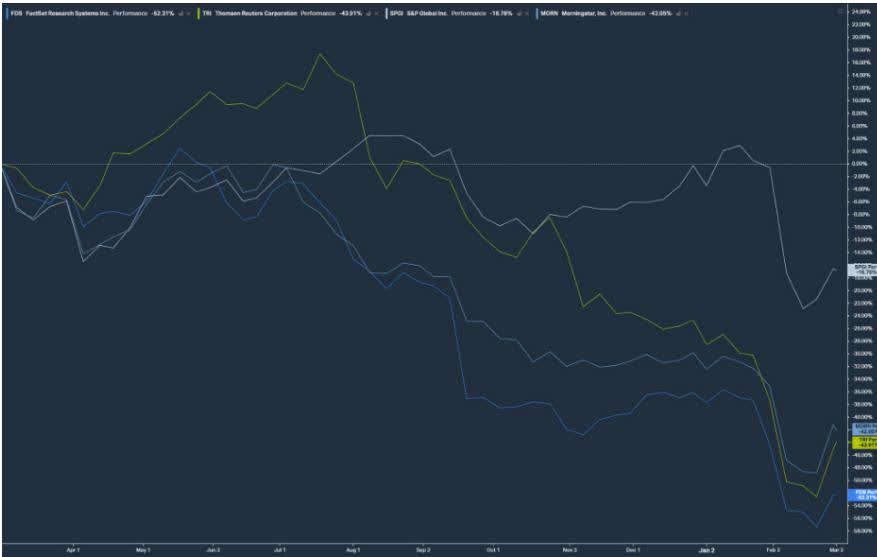
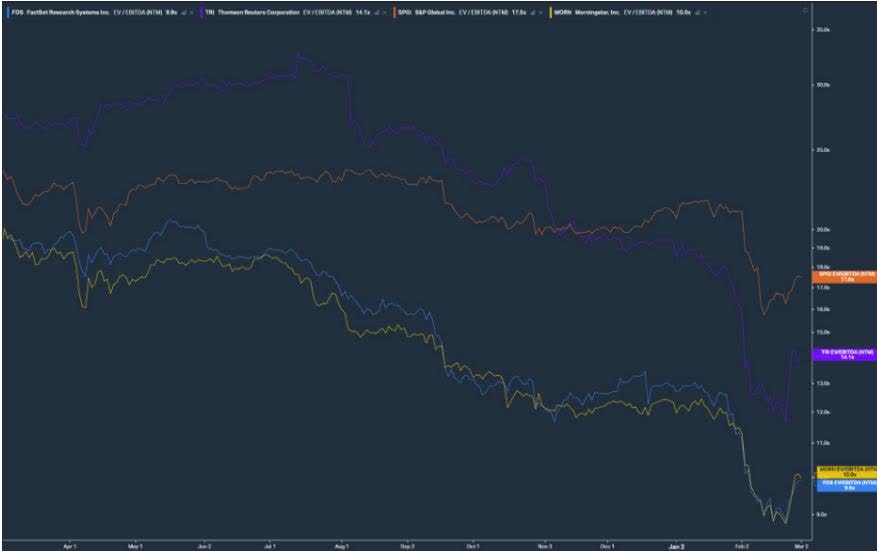
In other words, the efficiencies of AI can help a software company defend margins, but at a lower price to their end customers. More troublesome is that AI lowers the barriers to entry in order for competitors to spin up new software and compete. This can be especially helpful to those competing against larger organizations in the SMB landscape. The market is seemingly pricing in these structural headwinds, as evidenced by the significant downward re-rating of major financial data and software providers over the past year.
Advertisement
Figure 1: Trailing 1 Year Price Performance 7
Figure 2: Trailing 1 Year Ntm Ev/ebitda 8
One last point on this note: to date, the foremost customers of AI are actual coders themselves. Were AI to kill all software, would AI even have customers? If AI has no customers, how can companies support the infrastructure investment necessary to turn AI into the world eater it is feared to be? One analogy we have kicked around is the notion that for coders, AI is like changing your mode of transportation from a bike to a car. You still need a driver, but the mode of transport is much more efficient. Vibe coders are much like children—yes, children can play around with car-like vehicles at the GoKart track, but do you really want a child operating a motor vehicle on the road? The question answers itself.
The difference between vibe coding and software engineering is essentially the difference between a prototype and a “shipped product”. While AI can generate functional logic with incredible speed, it lacks the judgment necessary to navigate nuanced, real-world consequences. Our experience suggests that AI lowers the technical and monetary costs of creation and implementation, but simultaneously raises the premium on accountability. In a world of automated vibe coded systems, the most valuable asset is not the code itself, but the “throat to choke” – the human expert capable of diagnosing and fixing failures.
These tools are viewed as complementary to our established process, not as a replacement for it. While they can boost efficiency and assist in stress-testing our ideas, they cannot substitute for the experience, contextual knowledge, and careful judgment essential for successful long-term investing.
The Investment Roadmap Ahead
From reading the above, one might infer that we are investing aggressively in software, but alas we are not. Our experience in life science has taught us to pursue these kinds of drawdowns with a degree of patience, but we are slowly starting to build out our knowledgebase, our watchlist and our ideas. One problem for the sector is that as of today, the narratives are not falsifiable within a reasonable timeframe. Commentary in this space is often unfalsifiable in the near term, allowing fear-driven narratives to compound.
This unfalsifiability was evident in Alphabet/Google (GOOG) (NASDAQ: GOOG), as we reflect back on our experience we wrote about last quarter. 9 From the moment OpenAI hit the scene with ChatGPT 3.5 in the Fall of 2022, Google was a perceived loser and thousands of pontificators warned about the end of search. Fast forward three years and this was Google Search’s fastest quarter of revenue growth since Q1 2022, when the reopening and pandemic were still considerable drivers of results. In parallel with the Search re-acceleration, Google has also emerged as a leader in AI itself. This combination has been potent for Google’s stock and could not have opened on Search alone, given the terminal value fears; however, we think this is a possible roadmap for what recovery looks like in at-risk AI sectors. It will take three necessary forces:
Advertisement
1. Time
2. Stabilization and/or reacceleration in the core business
3. Some kind of demonstrable revenue (or margin) opportunity from AI itself
We are mindful as to how uniquely positioned Google is in the space; however, many of the forces that are driving the stock’s success today were in place and somewhat evident beforehand. The repricing when it became obvious was swift and severe and some degree of positioning needs to be in place in advance of the real turn.
Advertisement
Intellectual Humility Is Essential in this Environment
The risks and opportunities today feel greater than ever and that is reflected in the market exhibiting increasing degrees of single stock volatility and dispersion. Throughout our careers, single stock volatility (the average move of a stock in contrast to the index itself) has been trending upwards, but it has exploded of late: 10
This makes sense in a world where both the risks and opportunities are so great. This kind of environment began with the COVID shutdowns and has persisted with evolutions in the COVID narrative, geopolitical dynamism, trade wars and now AI. To that end, we have been sizing our positions far smaller than in the past and we think it prudent to increase the number of positions in our portfolios. Stated another way, the risks of concentration have increased considerably and although we have often considered ourselves semi-concentrated, that today is not good enough.
From Infrastructure Layer to Application Layer
Given the above, we think it is fair to call AI one of the most potent tools for mankind today. In the markets, the investment obsession has been on the infrastructure layer: GPUs, memory, fiber, power and beyond. As is typical in technological revolutions, the infrastructure layer generates the first round of outsized returns. Once infrastructure is firmly established, the attention then shifts to the application layer. With AI, to some extent, this is happening with the LLMs as the first “killer app” garnering attention, but ultimately, we think the most significant investment value will accrue to the greatest applications built on top of AI.
In the 1800s, Standard Oil was built on the railroads. More recently, it was not Cisco or the telecoms who created enduring value out of the dot com bubble, but rather the Googles, Amazons and Netflixes of the world. There were also incumbents, both highly successful and struggling ones, who used Dot Com as an opportunity to parlay their positions into better ones for the years ahead and other incumbents who for a variety of reasons could not evolve with technology. Two positive examples that come to mind here are Apple, leveraging the iPod and iTunes in order to pave the way for their smartphone dominance and Walmart using the Internet and communications infrastructure to take their supply chain management to the next level. Two negative examples are Kodak and Blockbuster.
One company we own that we think has unique positioning to benefit from both the infrastructure and application layers is Amazon (AMZN) (NASDAQ: AMZN). We will focus here on the application layer alone. Amazon’s logistical prowess is one of the foremost moats in business today and it can and will be enhanced with AI. The company will do this in multiple ways, with better orchestration of its logistics assets and underlying cargo, as well as the buildout of more capable, sophisticated and robust robotics. Amazon is singularly well positioned to dominate the coordination layer, with AI’s help, across its entire logistics network. We illustrate this as an example where we are already excited about the opportunity and as the kind of investment we seek in the emergent application layer built on top of this new AI infrastructure.
Advertisement
New Positions
We are increasingly sorting the opportunity set into three broad buckets and balancing our idea funnel across each:
1. AI beneficiaries
2. AI losers
3. Far removed from AI
Advertisement
This framework is reminiscent of how we categorized the world during the COVID period, when we distinguished between ephemeral winners, durable winners, and structural losers. That exercise did not provide certainty, but it sharpened our thinking, improved our opportunity set, and ultimately helped guide our research during a highly uncertain environment. We view the current framework in a similar light; not as a forecast of outcomes, but as a way to organize our analysis and remain intellectually disciplined as narratives evolve.
Some of the most interesting ideas we are finding of late are far removed from AI. One such idea that we bought in the last quarter is Celsius Holdings (CELH) (NYSE: CELH). We will refrain from a full writeup today, given Elliot recently presented at MOI Global’s Best Ideas 2026 Conference. You can watch the presentation and/or read the transcript here .
We also bought a position in Lattice Semiconductor (LSCC) (NASDAQ: LSCC), which is an under-appreciated AI winner with a combination of immediate AI gains and longer-term AI optionality. In 2020 we had a great experience owning Inphi Corp, whose CEO Ford Tamer struck us as a visionary with outstanding execution prowess. We put Ford on the list of executives to follow for a potential sequel. At first, when Ford took the job at Lattice, we were scratching our heads as to why. Lattice specializes in FPGAs and is one of only three major players in the industry, while Ford has a background in interconnect-oriented chips. FPGA stands for “Field Programmable Gate Array” and these chips are configurable and programmable in ways most chips are not. They are typically used where standards are changing rapidly and ASICs are too expensive to deploy. Much like GPUs, FPGAs can run many parallel tasks in the logic flow. Lattice’s key end markets have been industrial and automotive, communications and computing and consumer, all of which are highly cyclical and currently in the midst of a prolonged cyclical downturn.
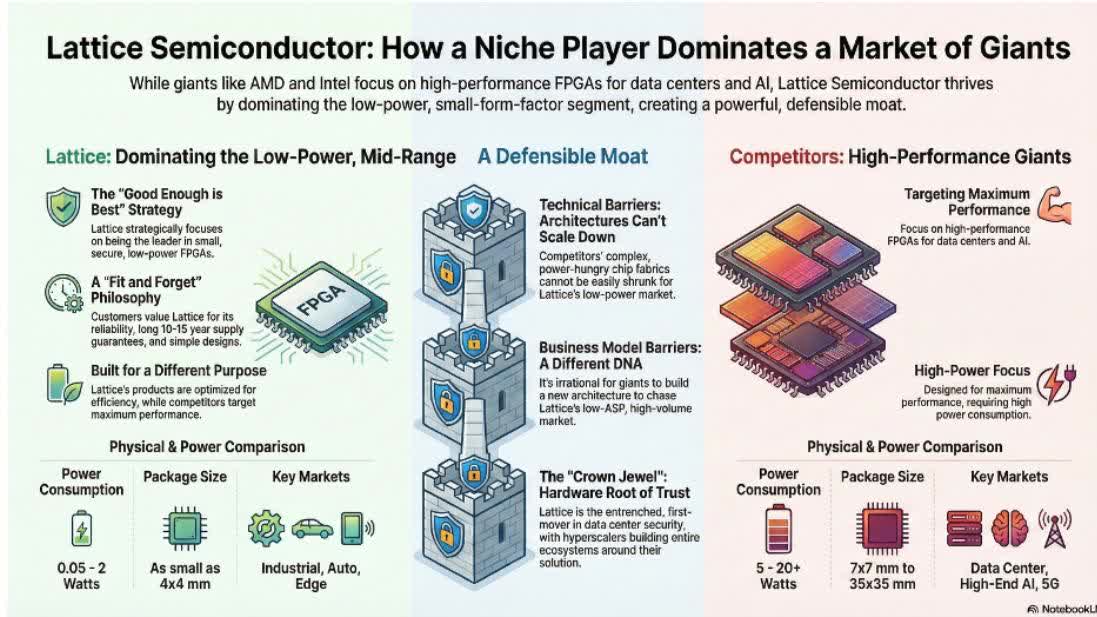
There are two larger competitors in FPGAs, Alterra (owned in large part by Intel) and Xilinx (owned by AMD). Historically, in competing with these incumbents, Lattice focused on small, secure and low power functions, which are all advantageous pieces of its positioning in AI, while the larger players focused on higher value logic functions. As an expert said to us in our work, “Lattice is designed for efficiency not maximal performance, while Alterra and Xilinx are designed for maximal performance, not efficiency.” 11 This is powerful counterpositioning that is tough for competitors to compete with in the near or mid-term.
Advertisement
During the company’s Q3 call, we had an “aha moment” as to why Ford joined Lattice, though the market actually sold the stock on the report. In the days thereafter, Ford bought over $2 million of stock in the open market and the company announced a share repurchase. In between those two events, we pounced. It became clear to us that Ford saw the opportunity in AI for lattice to accelerate the Communications and Compute segment due to its growing role in AI servers.
Lattice’s focus on efficiency and tangible advantages in low-power, small footprint FPGAs position it favorably for winning in unique functions that are mission critical to AI servers. It has a history in deploying these chips for security functions and critical to our thesis, these chips have been spec’d into all of the hyperscaler server architectures as the Root of Trust chip. These key chips have to boot faster than the logic of the server and ensure that no security vulnerability exists. The expert referenced above analogized Lattice’s role by explaining how “their devices sit outside the gpu and act as the bouncer who guards the server… The FPGA becomes the sentinel for the system.” 12
Importantly, Lattice’s FPGAs are the only Post-Quantum Cryptography (PQC) secure chips on the market. This future-proofs Lattice’s chip and enables the big AI infrastructure investors to build servers without fearing quantum attacks down the line. The very programmability of FPGAs makes them incredibly valuable for security, as security requires chasing moving targets. This makes these chips highly unlikely to ever be replaced by ASICs. Here is a helpful infographic built with NotebookLM that leverages our notes from the calls we conducted about the company’s role in the industry: 13
Optically, Lattice looks expensive, because key cyclical end markets remain in a severe, prolonged downturn. The company is experiencing a swift acceleration in sequential and year-over-year growth thanks to its AI presence; however, cyclical end markets are merely stabilizing. If these more cyclical end markets improve, alongside a continuation in AI, Lattice multiple drops very quickly.
There also is a high degree of optionality should AI advance and require investment in edge infrastructure as well as robotics. Lattice’s focus on efficiency confers considerable advantages in these use-cases and we have yet to see a major investment wave. This would be a critical component of an application layer acceleration built on top of AI.
Advertisement
A Well-deserved Promotion to Partner
We are pleased to share an important milestone for the firm: Ryan King has been promoted to Partner.
Ryan originally interned with the firm over a decade ago, and even at that early stage it was evident that he possessed a thoughtful, disciplined, and research-oriented mindset. Since rejoining RGA in a full-time capacity, he has become a deeply trusted contributor across investment research, portfolio analysis, and firm-wide strategic initiatives. His work has meaningfully strengthened both our internal investment process and the experience we deliver to clients.
Prior to joining RGA professionally, Ryan worked in investment banking at Harris Williams & Co., where he advised on middle-market transactions across a range of sectors. That background in valuation, due diligence, and transaction analysis continues to inform his rigorous and analytical investment approach today. He is a graduate of the University of Michigan’s Ross School of Business, where he focused on finance and technical operations.
More importantly than credentials, Ryan embodies the characteristics we value most as a firm: intellectual honesty, analytical discipline, humility, and a long-term orientation. He has consistently demonstrated the ability to challenge assumptions, engage deeply with complex businesses, and contribute constructively to portfolio decision-making.
Advertisement
From an organizational perspective, his promotion also reflects the natural evolution of the firm. As our research depth, investment scope, and internal capabilities have expanded, it has become increasingly important to formalize leadership among those who are already operating as true stewards of the investment process.
We believe Ryan will play an important role in the firm’s continued development in the years ahead, both in strengthening our research capabilities and in helping us scale our process while maintaining the discipline and alignment that define our partnership.
We are proud to welcome him as Partner and look forward to his continued leadership as we continue to build RGA for the long term.
Thank you for continuing to place your confidence in us. If any of the perspectives shared here prompt questions or lead you to rethink aspects of your portfolio, don’t hesitate to reach out. You can contact either of us at 516-665-1945 or via the direct lines listed below. Markets like this separate real discipline from passive drift, and today active management matters more than it has in quite some time. We’re excited at the opportunities in front of us.
Advertisement
Jason Gilbert, CPA/PFS, CFF, CGMA | Managing Partner, President
ET Intelligence Group: Escalating US-Iran conflict threatens to erode the profitability of Indian chemical manufacturers as surging crude oil prices drive up input costs and shipping delays add pressure on operations. India imports more than two-thirds of its methanol requirement, a major feedstock, from the Gulf countries. Methanol is used to make industrial intermediates such as formaldehyde, acetic acid, amines, and solvents. The supply disruption, therefore, has raised the risk of higher input costs.
India remains exposed to this conflict due to its dependency on Gulf countries and West Asia for its fertilisers and various petrochemicals. The country imported $3.6 billion worth of petroleum products (including LPG, Naphtha), $1.8 billion of polymers, and $1.7 billion of nitrogenous fertilisers from the GCC (Gulf Cooperation Council) and West Asia in FY25, according to Kotak Institutional Equities.
Agencies
UNDER FIRE The sector, heavily reliant on crude-linked feedstock, to also take a hit from rising freight prices & insurance premiums
For most commodity chemical companies, raw material and solvent costs are tied to crude-linked derivatives such as naphtha, ethylene, benzene, propylene, methanol, styrene and vinyl chloride monomer. When crude oil prices rise, these feedstocks also become more expensive. Brent crude has jumped nearly 74% in 2026 so far.
Rising tensions have also heightened risks across Gulf shipping routes, causing delays in consignments. Rerouting not only drives freight costs up but also adds war-risk insurance premiums, pushing up working capital needs for chemical companies.
Live Events
According to ICICI Direct, a prolonged geopolitical logjam may lead to higher raw material and freight prices, which result in margin compression given the limited ability to pass costs to customers in a challenging environment. According to Emkay Global Financial Services, major Asian refiners are rationalising existing output and may probably run at 20-30% lower production levels if the current situation persists. The fertiliser industry faces a double blow of tightening supplies of ammonia, DAP, and urea from the Gulf countries and the suspension of LNG output from Qatar. India relies on imports for nearly half of its LNG needs. With ammonia being a crucial feedstock for fertilisers, supply constraints may impact agrochemical producers, including Chambal Fertilisers, Deepak Fertilisers, and Gujarat Narmada Valley Fertilizers (GNFC).